
Such a system could not work without price control. In 301, Diocletian and his colleagues issued an Edictum de pretiis, dictating maximum legal prices or wages for all important articles or services in the Empire. Its preamble attacks monopolists who, in an “economy of scarcity”, had kept goods from the market to raise prices:
Who is … so devoid of human feeling as not to see that immoderate prices are widespread in the markets of our cities, and that the passion for gain is lessened neither by plentiful supplies nor by fruitful years? — so that … evil men reckon it their loss if abundance comes. There are men whose aim it is to restrain general prosperity … to seek usurious and ruinous returns. … Avarice rages throughout the world. … Wherever our armies are compelled to go for the common safety, profiteers extort prices not merely four or eight times the normal, but beyond any words to describe. Sometimes the soldier must exhaust his salary and his bonus in one purchase, so that the contributions of the whole world to support the armies fall to the abominable profits of thieves.
The Edict was, until our time, the most famous example of an attempt to replace economic laws by governmental decrees. Its failure was rapid and complete. Tradesmen concealed their commodities, scarcities became more acute than before, Diocletian himself was accused of conniving at a rise in prices, riots occurred, and the Edict had to be relaxed to restore production and distribution. It was finally revoked by Constantine.
The weakness of this managed economy lay in its administrative cost. The required bureaucracy was so extensive that Lactantius, doubtless with political license, estimated it at half the population. The bureaucrats found their task too great for human integrity, their surveillance too sporadic for the evasive ingenuity of men. To support the bureaucracy, the court, the army, the building program, and the dole, taxation rose to unprecedented peaks of ubiquitous continuity.
As the state had not yet discovered the plan of public borrowing to conceal its wastefulness and postpone its reckoning, the cost of each year’s operations had to be met from each year’s revenue. To avoid returns in depreciating currencies, Diocletian directed that, where possible, taxes should be collected in kind: taxpayers were required to transport their tax quotas to governmental warehouses, and a laborious organization was built up to get the goods thence to their final destination. In each municipality, the decuriones, or municipal officials, were held financially responsible for any shortage in the payment of the taxes assessed upon their communities.
Since every taxpayer sought to evade taxes, the state organized a special force of revenue police to examine every man’s property and income; torture was used upon wives, children, and slaves to make them reveal the hidden wealth or earnings of the household; and severe penalties were enacted for evasion. Towards the end of the 3rd century, and still more in the 4th, flight from taxes became almost epidemic in the Empire. The well-to-do concealed their riches, local aristocrats had themselves reclassified as humiliores to escape election to municipal office, artisans deserted their trades, peasant proprietors left their overtaxed holdings to become hired men, many villages and some towns (e.g., Tiberias in Palestine) were abandoned because of high assessments; at last, in the 4th century, thousands of citizens fled over the border to seek refuge among the barbarians.
It was probably to check this costly mobility, to ensure a proper flow of food to armies and cities, and of taxes to the state, that Diocletian resorted to measures that, in effect, established serfdom in fields, factories, and guilds. Having made the landowner responsible through tax quotas in kind for the productivity of his tenants, the government ruled that a tenant must remain on his land till his arrears of debt or tithes should be paid.
We do not know the date of this historic decree; but in 332, a law of Constantine assumed and confirmed it, and made the tenant adscriptitius, “bound in writing”, to the soil he tilled; he could not leave it without the consent of the owner; and when it was sold, he and his household were sold with it. He made no protest that has come down to us; perhaps the law was presented to him as a guarantee of security, as in Germany today. In this and other ways, agriculture passed in the 3rd century from slavery through freedom to serfdom and entered the Middle Ages.
Similar means of compelling stability were used in industry. Labor was “frozen” to its job, forbidden to pass from one shop to another without governmental consent. Each collegium or guild was bound to its trade and its assigned task, and no man might leave the guild in which he had been enrolled. Membership in one guild or another was made compulsory on all persons engaged in commerce and industry, and the son was required to follow the trade of his father. When any man wished to leave his place or occupation for another, the state reminded him that Italy was in a state of siege by the barbarians and that every man must stay at his post.
Will Durant, The Story of Civilization, Volume 3: Caesar and Christ, 1944.
April 16, 2022
QotD: The Edict of Diocletian
April 15, 2022
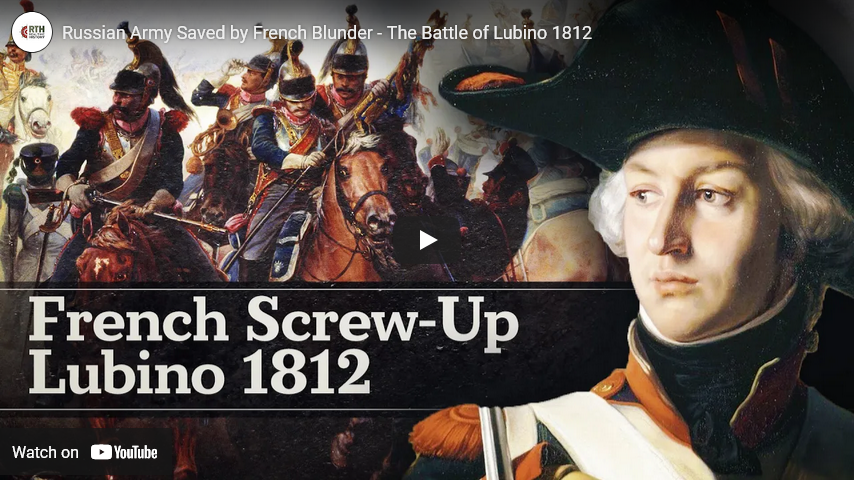
Russian Army Saved by French Blunder – The Battle of Lubino 1812
Real Time History
Published 14 Apr 2022Support us on Patreon: https://patreon.com/realtimehistory
French general Junot and Emperor Napoleon I had a bit of a history by the time of the 1812 campaign. Even though Junot has been in Napoleon’s service for years, he hadn’t been promoted to Marshal. At the Battle of Lubino (Battle of Valutino-Gora) Junot stands idly by as the Grande Armée is missing their best chance yet to win a decisive victory over the Russians. To the north, at Polotsk the French and Russians are also clashing.
» THANK YOU TO OUR CO-PRODUCERS
John Ozment, James Darcangelo, Jacob Carter Landt, Thomas Brendan, Kurt Gillies, Scott Deederly, John Belland, Adam Smith, Taylor Allen, Rustem Sharipov, Christoph Wolf, Simen Røste, Marcus Bondura, Ramon Rijkhoek, Theodore Patrick Shannon, Philip Schoffman, Avi Woolf,» SOURCES
Boudon, Jacques-Olivier. Napoléon et la campagne de Russie en 1812. 2021.
Lieven, Dominic. Russia Against Napoleon. 2010.
Maag, Albert. De Schicksale der Schweizerregimente in Napoleons I. Feldzug nach Russland 1812. 1900.
Rey, Marie-Pierre. L’effroyable tragédie: une nouvelle histoire de la campagne de Russie. 2012.
Zamoyski, Adam. 1812: Napoleon’s Fatal March on Moscow. 2005.» OUR STORE
Website: https://realtimehistory.net»CREDITS
Presented by: Jesse Alexander
Written by: Jesse Alexander
Director: Toni Steller & Florian Wittig
Director of Photography: Toni Steller
Sound: Above Zero
Editing: Toni Steller
Motion Design: Toni Steller
Mixing, Mastering & Sound Design: http://above-zero.com
Digital Maps: Canadian Research and Mapping Association (CRMA)
Research by: Jesse Alexander
Fact checking: Florian WittigChannel Design: Simon Buckmaster
Contains licensed material by getty images
Maps: MapTiler/OpenStreetMap Contributors & GEOlayers3
All rights reserved – Real Time History GmbH 2022
The West Sacrifices Poland to the Soviets – WAH 056 – April 1943, Pt.1
World War Two
Published 14 Apr 2022There are cracks in the alliances on both sides. Hitler’s allies are refusing to do his every bidding, and the revelations about the Soviet massacre of Poles in Katyn has set a wedge between Poland and the USSR.
(more…)
Look at Life – Thunder in Waiting (1960)
PauliosVids
Published 20 Nov 2018The deadly cargo of the Vulcan Bomber is a crucial part of Britain’s deterrent force.

April 14, 2022
Dining First Class on the RMS Titanic
Tasting History with Max Miller
Published 12 Apr 2022Signup for your FREE trial to Wondrium here: http://ow.ly/rSyS30sfmaG
Support the Channel with Patreon ► https://www.patreon.com/tastinghistory
Merch ► crowdmade.com/collections/tastinghistory
Instagram ► https://www.instagram.com/tastinghist…
Twitter ► https://twitter.com/TastingHistory1
Tiktok ► TastingHistory
Reddit ► https://www.reddit.com/r/TastingHistory/
Discord ► https://discord.gg/d7nbEpy
Amazon Wish List ► https://amzn.to/3i0mwGtSend mail to:
Tasting History
PO Box 766
Burbank, CA 91503LINKS TO INGREDIENTS & EQUIPMENT**
Sony Alpha 7C Camera: https://amzn.to/2MQbNTK
Sigma 24-70mm f/2.8 Lens: https://amzn.to/35tjyoW
Green Chartreuse: https://bit.ly/onlinebottlesmax
Leaf Gelatin: https://amzn.to/3NY6Y5SLINKS TO SOURCES**
Last Dinner on the Titanic by Rick Archbold and Dana McCauley: https://amzn.to/3tqNz5s
Titanic, First Accounts: https://amzn.to/3L2f7UH
The Sinking of the Titanic: 1912 Survivor Accounts by Bruce M. Caplan and Logan Marshall: https://amzn.to/3KSKock
The 10 Best Titanic Survivor Stories: https://amzn.to/3wioSK3RECIPE
Ingredients:
16 sheets Gelatin (or 4 envelopes of powdered gelatin)
3 cups (750ml) Water
1/2 cup (50g) Sugar
1 cup (250ml) Chartreuse
2-4 ripe Peaches or a large can of peaches in syrup
1 cup (250ml) Simple syrup (not necessary if using canned peaches1. Soak the gelatin in cold water for 5 minutes.
2. Bring the water and sugar to a simmer in a large saucepan then remove it from the heat. Squeeze out any excess water in the gelatin, then add it to the water and stir until dissolved. Stir in the Chartreuse.
3. Pour the liquid into a well greased mold, then refrigerate for 1-3 hours, or until the jelly is beginning to thicken.
4. To remove the skin from the peaches, score and X at the bottom of the peaches, then plunge into boiling water for 45 seconds, then immediately into ice cold water for 10 seconds. If the peaches are ripe, the skin should easily slide off. Remove the pit and slice.
5. Heat the simple syrup to simmering, then add the peach slices. Coat and turn off the heat and let them cool in the syrup.
6. Carefully insert the peaches into the jelly in whatever pattern you like. Then return to the refrigerator until fully set. 8 – 24 hours depending on the depth of the mold.
7. Once set, run a knife around the edge of the jelly, then dip the mold into hot (not boiling) water for 5 seconds. Remove it and place a well greased plate over the top of the mold then flip it over. The jelly should fall out with little more than a tap.
8. Top with Italian meringue or whipped cream, and serve.**Some of the links and other products that appear on this video are from companies which Tasting History will earn an affiliate commission or referral bonus. Each purchase made from these links will help to support this channel with no additional cost to you. The content in this video is accurate as of the posting date. Some of the offers mentioned may no longer be available.
Subtitles: Jose Mendoza | IG @worldagainstjose
#tastinghistory #titanic #firstclass

Winchester M2 Rifle
Forgotten Weapons
Published 29 Jul 2016http://www.patreon.com/ForgottenWeapons
In the previous video, we looked at the Winchester G30M rifle as it was submitted to Marine Corps trials in 1940. When the trial result came back with the G30M in last place, Winchester immediately assigned David Williams to work on adapting it to resolve the problems found in testing. What Williams did was to replace the tilting bolt with a virtual duplicate of the Garand’s two-lug rotating bolt. Williams also worked to reduce the weight of the gun, and was able to bring it down to a remarkable 7.5 pounds (3.4kg).
This prototype of the rifle (which Winchester optimistically designated the M2, implying that it would supercede the M1 Garand) was actually made largely from M1 Garand forgings, as Winchester was by this time building M1 rifles on contract. The receiver, bolt, and operating rod in this rifle was converted from Garand parts. Clearly it is not a finished product, and shows many signs of being a shop prototype — but it was in this state when it was shown to Rene Studler of the Ordnance Department in early 1941. Studler was impressed by the design, but knew that it would not replace the M1 at that point. However, he urged Winchester to scale the gun down to the .30 Carbine cartridge (which Winchester had themselves developed) and submit it in the second round of the Light Rifle testing which was to happen soon.
Does a two-lug rotating bolt, short stroke gas tappet, and Garand-style operating rod sound like a familiar set of features? Well, there is good reason … Winchester took Studler’s advice, and the scaled-down version was developed in just a few weeks and proved to be the best gun in the trials. It would be developed quickly into the M1 Carbine, and become the most-manufactured semiauto rifle of WWII.
At that point Winchester would set aside the .30-06 side of this rifle design for a little while, as they had plenty of work now with M1 Garand and M1 Carbine production. But we will see the M2/G30M/G30 come back in new form in the next episode …

QotD: “… when life was simpler”
And then you get hold of primary sources on the thirties or fifties. Let’s say it’s particularly hilarious to read stuff from the right lauding that time of great freedom in either of those decades. Let’s just say that if some of the things happening back then were happening now we’d all be talking about how we were ready for revolution. (And the only reason they weren’t then is that the press was mass-media. You think it’s bad enough now, with a lying press? They had the same, but no way to check it. It was that concentration and lack of individual communication or access to the public by individuals unfiltered by the media/publishers that put us in the situation we’re in, with what is functionally the enemy of western civilization in control of the vital organs of culture. Before you get discouraged, it helps to remember, we’re only now fighting back. Continue fighting, but remember things take time. The larger a movement is, the longer it takes for it to become noticeable, much less prominent in the culture.)
And as for the left thinking that everyone before the oughts were good white Christians or whatever … Oh, sweet summer children. Let’s say when they get their freak on, with witchcraft or being naked in public, or talking about their poly relationships, or whatever the actual hell they have in their heads that day, they rarely if ever (I’ve never seen it) would have managed to shock their ancestors or ancestresses 100 years ago. Those Edwardians … well … Let’s just say they had fewer hangups. Yes, I know what the public image is. But none of them would have worried about things that the left worries about now like “differential of power” or “implied patriarchy” which meant they were much freer to do whatever crossed their heads at the moment. Of course they also thought they would have shocked their ancestors. And I bet you they wouldn’t.
At some point, if you have a chance, read a book called Our Bones Are Scattered about the Indian revolt in Victorian times. I only read it once because it’s a deeply disturbing book, one of those clashes of civilization where you feel sorry for both sides. But it is very well written, and the beginning of the book is … revealing. The British commander was … well … sort of married to a woman who had been sort of married something like six times before and who went from man to man, collecting kids along the way. Notwithstanding which, they were Victorian nobility and had a bunch of kids of their own and …
Let’s just say Victorians aren’t the way we’ve learned to think of them either. In fact you can be sure pretty much no one ever was. People kept and keep the front they need to, but behind the scenes things were always messy and complicated.
Which often makes finding our own way in this messy and complicated way very difficult.
Sarah Hoyt, “Finding Your Way”, According to Hoyt, 2019-02-18.
April 13, 2022
Life in a German U-Boat – WW2 Special
World War Two
Published 12 Apr 2022The German U-Boats were one of the most dangerous armed forces of World War II. From the North Sea to the Mexican coast to the Cape of Good Hope, everywhere they put fear into the Allied merchant marine. But what was life like on a German submarine? What dangers did the crew face? How did they endure the long voyages far away from home?
(more…)
A new look at the Commonwealth and the Protectorate of Oliver Cromwell
In The Critic, Miranda Malins reviews a new history of the period between the execution of Charles I and the Stuart restoration of Charles II, The Restless Republic: Britain Without a Crown by Anna Keay:

This evasion is not for the historian Anna Keay. Faced with these collective shortcomings (“This book was born of ignorance,” she explains in opening), she explores this most dynamic of decades, looking it squarely in the face. With her, we roam around the period, the broad chronological narrative softened through a selection of nine interwoven biographies ranging from the irrepressible newspaperman Marchamont Nedham, to the indomitable royalist Countess of Derby, from the brilliant scientist William Petty to the dreaming Digger Gerrard Winstanley.
This structure achieves a broad perspective and rare realism, giving the reader the sense of dipping and diving through the restless waves of the republic and taking them to all corners of the new Britain forged in the fire of three Civil Wars. As expected, we travel from the trial and execution of Charles I to the Restoration of his son, but Keay’s achievement is to make the shape-shifting years of the kingless Commonwealth and Protectorate that lie between more thrilling than either royal bookend, demonstrating how far from inevitable the return of the Stuarts was. There is no “high road to Restoration” here, but rather a snaking maze of paths striking off in new directions and looping back: an uncharted landscape for Keay’s characters to navigate where every choice counted.
The result is a panoramic and pulsating drama every bit as restless as the republic it captures so well. Indeed the “Restless” adjective of the title perfectly conjures the progressive spirit of Britain without a crown: unstable and dangerous, yes, but as a result, experimental and unafraid. As Keay puts it: “The 1650s was a time of extraordinarily ambitious political, social, economic and intellectual innovation, and it was not a foregone conclusion that the British republic would fail.”
This portrait will be, for many, a revelation. Far from the dour, militaristic regimes of popular imagination, life under the Commonwealth and Oliver Cromwell’s Protectorate emerges as innovative and exciting: the effect of the hitherto unimaginable act of abolishing the monarchy and House of Lords after years of transformative conflict being to unleash an energetic spirit of ambitious experimentation and industry.
We feel this bold energy in the meetings of the Oxford Experimental Philosophy Club (which would become the Royal Society in 1660) and its young member William Petty managing to survey the whole of Ireland in record time despite having no cartographical experience; in failed cloth trader Gerrard Winstanley’s determination to dig the new Jerusalem that had come to him on an autumn ramble; in Marchamont Nedham escaping Newgate prison and picking his way through several dangerous changes of side, pen in hand, always managing to land cat-like on his feet through sheer commercial nous and audacity.
April 12, 2022
Last War Patrol of HMS Terrapin
The History Guy: History Deserves to be Remembered
Published April 11, 2022On her seventh war patrol, in the south Java Sea, the T class British submarine HMS Terrapin and her crew had faced the terror of battle and barely survived. Badly damaged and far from home, sometimes the drama of war is not just in the battle, but in the voyage home.
Check out our new community for fans and supporters! https://thehistoryguyguild.locals.com/
This is original content based on research by The History Guy. Images in the Public Domain are carefully selected and provide illustration. As very few images of the actual event are available in the Public Domain, images of similar objects and events are used for illustration.
You can purchase the bow tie worn in this episode at The Tie Bar:
https://www.thetiebar.com/?utm_campaign=BowtieLove&utm_medium=YouTube&utm_source=LanceGeigerAll events are portrayed in historical context and for educational purposes. No images or content are primarily intended to shock and disgust. Those who do not learn from history are doomed to repeat it. Non censuram.
Find The History Guy at:
New community!: https://thehistoryguyguild.locals.com/
Please send suggestions for future episodes: Suggestions@TheHistoryGuy.netThe History Guy: History Deserves to Be Remembered is the place to find short snippets of forgotten history from five to fifteen minutes long. If you like history too, this is the channel for you.
Awesome The History Guy merchandise is available at:
https://teespring.com/stores/the-history-guyScript by THG
#history #thehistoryguy #WWII
Experimental video embed from Rumble.com. Please let me know if you have problems viewing this video.

How to Make a Royal Marines Officer: Part 1 (1989)
Royal Marines
Published 13 Sep 2012First transmitted in 1989, this is the first part of a programme that follows the progress of 29 men who want to be Royal Marine officers. After arriving at Commando Training Centre, Devon, they find that their fortitude is tested to the very limits as they undertake the All Arms Commando Course to earn their green berets.

Calvin Coolidge: The Silent President
Biographics
Published 27 Sep 2021Simon’s Social Media:
Twitter: https://twitter.com/SimonWhistler
Instagram: https://www.instagram.com/simonwhistler/This video is #sponsored by Squarespace.
Source/Further reading:
Miller Center, in-depth overview: https://millercenter.org/president/co…
History Today, overview: https://www.historytoday.com/archive/…
New Yorker, “The case for Coolidge” (cached): https://webcache.googleusercontent.co…
NY Times, “Coolidge, the great refrainer”: https://www.nytimes.com/2013/02/17/bo…
NY Times, 1933 obituary for Coolidge: https://archive.nytimes.com/www.nytim…
Atlantic, “Coolidge and depression”: https://www.theatlantic.com/magazine/…
Politico, “How Coolidge survived the Harding-era scandals”: https://www.politico.com/magazine/sto…
History, “Boston Police Strike of 1919”: https://www.history.com/this-day-in-h…
Coolidge letter written after death of his son: https://www.shapell.org/manuscript/pr…

April 11, 2022
Republic to Empire: The Ides of March to Actium
seangabb
Published 13 Mar 2021In 120 BC, Rome was a republic with touches of democracy. A century later, it was a divine right military dictatorship. Between January and March 2021, Sean Gabb explored this transformation with his students. Here is one of his lectures. All student contributions have been removed.
(more…)
Book Review: Sturmgewehr! From Firepower to Striking Power (New Expanded Edition)
Forgotten Weapons
Published 17 Sep 2017Get your copy from Collector Grade Publications: http://www.collectorgrade.com/bookshe…
Collector Grade is known for being a premiere publisher of technical firearms reference books, and I would be willing to argue that Sturmgewehr! by Hans-Dieter Handrich is the best book they have yet printed. The book was originally printed in 2004, and by the time I started looking for a copy myself, it was out of print and the price had jumped to at least $250, when I could even find a copy. I could never quite bring myself to pay that much, and so I was very excited when I learned that an expanded second edition was in the works. Well, that second edition is available now, and it’s even better than I had anticipated.
What makes Sturmgewehr! such an excellent book in my opinion is how it tackles the story of the MP43/MP44/StG44 from several different angles in depth. It has the mechanical development of the gun from prewar experiments to the open-bolt MKb-42 trials guns to the production versions. But it also puts those guns in historical context, how they related to the other weapons being used by both Germany and other nations. It discusses how the design criteria of the Sturmgewehr were arrived at, in terms of logistics and manufacturing methodologies. It explains in detail the political disagreements and convoluted process of weapon design and adoption in Germany, including the three direct rejections of the concept by Hitler.
In short, it gives you the fully-rounded story of how the German military conceived and implemented a whole new class of small arms. In this way, it is really much more than just a book about a single gun’s history — what you learn reading Handrich’s work will give you insight into virtually all arms design programs of the 20th century, from the Chauchat to the 7.62mm NATO rifle trials to the SA80.
If you already have a copy of the original work, you will probably want this one as well, to get the additional 120 pages of information that have been added. And it should go without saying that if you don’t have the original, you should absolutely get a copy of this new edition before it also falls out of print!
http://www.patreon.com/ForgottenWeapons
Cool Forgotten Weapons merchandise! http://shop.bbtv.com/collections/forg…
If you enjoy Forgotten Weapons, check out its sister channel, InRangeTV! http://www.youtube.com/InRangeTVShow

April 10, 2022
Mussolini is Tired of War – WW2 – 189 – April 9th , 1943
World War Two
Published 9 Apr 2022Adolf Hitler meets with Benito Mussolini to hopefully restore his flagging morale and convince him that the Axis can hold out in North Africa, but the situation there grows more precarious and this week there the Allies advancing from the west and the east link up for the first time. The Axis are also holding out in the Caucasus, as new Soviet attacks to take Krymskaya begin.
(more…)


