
De legibus (“On the Laws”) along with his earlier work, De re publica (“On the Republic”) show Cicero attempting to grapple with the nature of the Roman Republic and the prospect for reform. In a sense, De re publica looks backwards, with the discussion couched in a fictional dialogue set at the tail end of the life of Scipio Aemilianus (185-129 BC), although Cicero intends the subject – a rumination on the nature of the Republic and its proper workings, based on a discussion of its history – to be applicable in his own time.
De legibus is more aggressively forward looking. Set in Cicero’s own time (it is a dialogue between Cicero, his brother Quintus and their friend Atticus), De legibus first sets out a theory for the general foundation of law […] to use as the basis for a reformed model of the Roman Republic, which is summarized in the third book. Damage to the text means that De legibus cuts off in book three, and there are smaller gaps and fragments in the earlier books as well.
It’s important to get a sense of the situation in the 50s B.C. when Cicero is writing to understand why he feels this is necessary. The previous round of civil wars had ended in 82 B.C., with the victor, the arch-conservative L. Cornelius Sulla, imposing a revised republic with shocking brutality and bloodshed. By the 50s, it would have been clear to anyone paying attention that the peace and apparent stability of the Sullan reforms had been a mirage – the disruptions of the 60s (including the Catilinarian conspiracy, foiled by Cicero) were not one-offs, but merely the first rattlings of the wheels coming off the cart entirely. I don’t want to get too deep into the woods of how exactly this happened; there are any number of good books on the collapse of the Republic which deal with this period (Scullard’s From the Gracchi to Nero (1959) is a venerable and straight-forward narrative of the period; Syme, The Roman Revolution (1939) is probably the most influential – reading both can serve as a foundation for getting into the more recent and often more narrowly directed literature on the topic, note also Flowers, Roman Republics (2011)).
It’s in this context – as the Republic is clearly shaking apart – that Cicero is ruminating on the nature of the Republic, how it functions, what it is for, and how it might be set right. Despite this, Cicero should not be taken for a radical, or even really for much of a reformer; Cicero is a staunch conservative looking to restore the function of the old system, in many cases by a return to tradition as much as the renovation of it. Cicero’s corpus is a plea to save the Republic as it was, not to bury it; it was a plea, of course, that would go unanswered. In a real sense, the Republic died with Cicero.
Bret Devereaux, “Collections: A Trip Through Cicero (Natural Law)”, A Collection of Unmitigated Pedantry, 2019-12-12.
June 9, 2022
QotD: Cicero and the end of the Roman Republic
June 8, 2022
The Story Behind the Dambuster Raid – WW2 Special
World War Two
Published 7 Jun 2022The thousand-bomber offensive was about to begin as Air-Marshall Harris was assembling his forces. Yet one man was to challenge his strategy. The aircraft designer Barnes Wallis thought: “What if there was a way to destroy Germany’s industrial might not by simply dropping thousands of bombs over its cities, but by a precision strike against its dams?” For this, a new kind of bouncing bomb was to be delivered.
(more…)
MAC 1950: Disassembly & History
Forgotten Weapons
Published 27 Feb 2017Shooting the MAC 1950: https://www.youtube.com/watch?v=sduZ4…
The PA MAC 1950 (Pistolet Automatique Modele 1950) was the result of a 1946 French effort to standardize on a single military pistol. By the end of WWII, the French military had accumulated a mess of different pistols of French, Spanish, American, and German origin; officially using the Luger, P38, Mauser HSc, 1911 (and A1), 1935A, 1935S, Star, Ruby, and Model 1892 revolver.
Trials were held in 1950, although the outcome was predetermined — this pistol, designed by St Etienne and largely derived from the Model 1935S, was to be the next French military sidearm. A design from the SACM company was also tested, as was a commercially purchased SIG SP47/8, but this was for comparison sake only. In fact, the SIG was the best performer in the testing, with the St Etienne design suffering from cracked parts and durability problems. It would be improved, however, and deemed suitable for adoption by early 1951.
Production began in 1953 at the Chatellerault arsenal (hence the “MAC” name used in the US). All of 221,900 were made by Chatellerault until it was shut down in 1963, when production transferred to St Etienne, where another 120,000 would be made by 1978.
Mechanically, the gun is largely taken form the Browning 1911, with a few improvements. The recoil spring is of a captive design, and the fire control group is all built into a single easily replaced unit (similar to the Tokarev and the 1935S). It is single action only, with hammer-block and magazine safeties and a 9-round magazine of standard 9x19mm ammunition. It is still in French service, having proven to be a reliable and dependable weapon, if outdated by today’s standards.
http://www.patreon.com/ForgottenWeapons
Cool Forgotten Weapons merch! http://shop.bbtv.com/collections/forg…
If you enjoy Forgotten Weapons, check out its sister channel, InRangeTV! http://www.youtube.com/InRangeTVShow

QotD: Before the (politically correct) Current Era
These new initials stand for Before the Common Era and the Common Era: but common to what, and common to whom? Nobody bothers to explain. By strange but happy coincidence, 300 BC turns out to be the same year as 300 BCE, and AD 400 as CE 400, or 400 CE. Why the change, then?
Do those who have promoted it and obeyed its dictates really think that all those sensitive Zoroastrians, who are supposedly so offended by the old style of dating, are also so stupid that they have failed to notice the coincidence and will therefore fail to be offended by it?
The academics, intellectuals and sub-editors of university presses who use the new style evidently believe that the world is populated by people of extreme psychological fragility, and whose self-esteem, which can be shattered by the mere usage of BC and AD, it is their duty to protect.
Thus does condescension and sentimentality unite with megalomania to produce absurd circumlocutions.
Theodore Dalrymple, “Before the current era”, The Critic, 2022-02-09.
June 7, 2022
D Day: The First Canadian Parachute Battalion and the Battle for the Village of Varaville
The History Guy: History Deserves to Be Remembered
Published 6 Jun 2022There are so many stories of heroism involved in the massive Operation Overlord, among them the extraordinary story of the little-known first Canadian Parachute Battalion. The lightly armed Canadians were among the first allied soldiers to hit the ground in France on D-Day.
Check out our new community for fans and supporters! https://thehistoryguyguild.locals.com/
This is original content based on research by The History Guy. Images in the Public Domain are carefully selected and provide illustration. As very few images of the actual event are available in the Public Domain, images of similar objects and events are used for illustration.
You can purchase the bow tie worn in this episode at The Tie Bar:
https://www.thetiebar.com/?utm_campai…All events are portrayed in historical context and for educational purposes. No images or content are primarily intended to shock and disgust. Those who do not learn from history are doomed to repeat it. Non censuram.
Find The History Guy at:
New community!: https://thehistoryguyguild.locals.com/
Please send suggestions for future episodes: Suggestions@TheHistoryGuy.netThe History Guy: History Deserves to Be Remembered is the place to find short snippets of forgotten history from five to fifteen minutes long. If you like history too, this is the channel for you.
Awesome The History Guy merchandise is available at:
teespring.com/stores/the-history-guyScript by THG
#history #thehistoryguy #DDay

History of Rome in 15 Buildings 12. Santa Maria in Trastevere
toldinstone
Published 2 Oct 2018Wanted: candidate for Pope. Must be a good fundraiser, effective administrator, and shrewd politician. Deep pockets a must. Sanctity negotiable.
The medieval papacy lies at the heart of this twelfth episode of our History of Rome, in which we discuss the catastrophic schism that created the church of Santa Maria in Trastevere.
To see the story and photo essay associated with this video, go to:
https://toldinstone.com/santa-maria-i…
June 6, 2022
“I ask, sir, what is the militia? It is the whole people except for a few public officials”
George Mason, quoted in the title of this post, had a very expansive view of the US militia. Most Americans of the day did not seem to share this view, as Chris Bray explains:
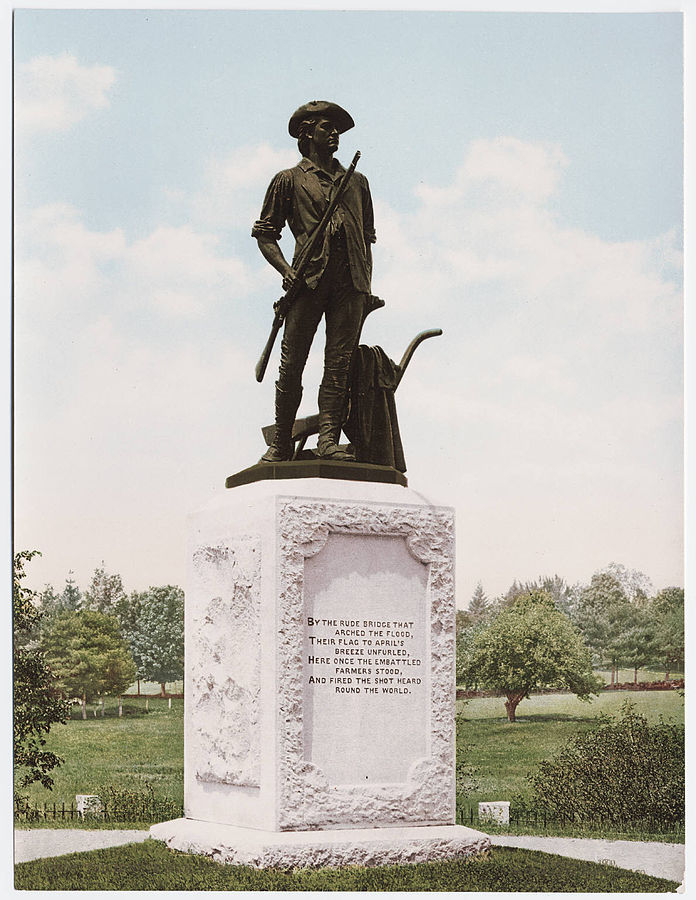
How Congress may have visualized the individual minutemen who would compose the militia of the United States after 1792.
Postcard image of French’s Concord Minuteman statue via Wikimedia Commons.
In the second Militia Act of 1792, Congress defined a uniform militia in all of the states:
That each and every free able-bodied white male citizen of the respective States, resident therein, who is or shall be of age of eighteen years, and under the age of forty-five years (except as is herein after excepted) shall severally and respectively be enrolled in the militia … That every citizen, so enrolled and notified, shall, within six months thereafter, provide himself with a good musket or firelock, a sufficient bayonet and belt, two spare flints, and a knapsack, a pouch, with a box therein, to contain not less than twenty four cartridges, suited to the bore of his musket or firelock, each cartridge to contain a proper quantity of powder and ball … and shall appear so armed, accoutred and provided, when called out to exercise or into service, except, that when called out on company days to exercise only, he may appear without a knapsack.
So, by federal law, every military-age white male in the country (except men who were exempted by the states, like clergymen) had to report to the local militia commander to be enrolled in their local company, and had to own a long list of equipment, and had to show up to train with that equipment when ordered.
They mostly didn’t. For decades, states reported their militia enrollment to the War Department, and it sometimes appeared that some states, by trying really hard, sometimes almost made it to something in the neighborhood of half participation. In 1826, the Barbour Board — named after Secretary of War James Barbour — evaluated the unmistakable failure of the federally defined uniform militia, and suggested trying again with a smaller group of select militiamen. The board’s report was universally ignored, because by 1826 the federal government, like, couldn’t even: Everyone knew the model of widely shared militia service had failed.
Historians have usually described the failure of universal white male militia service in the early republic as a top-down policy blunder in which political leaders didn’t try hard enough to make the thing work. But a marginal historian named Chris Bray, in a dissertation that generated no excitement of any kind in academia, argued that the universal white male militia obligation was doomed by something else: widespread irritation and popular resistance. The militia obligation reached into the lives of militiamen in ways they didn’t expect and wouldn’t tolerate, so they stopped showing up.
There are many different ways to tell this story, but let’s do it quickly.
Dr. Mengele Takes Command – WAH 063 – June 5, 1943
World War Two
Published 5 Jun 2022Despair in Germany, more death in the Jewish ghettos, and Dr. Mengele tales command in Auschwitz-Birkenau.
(more…)
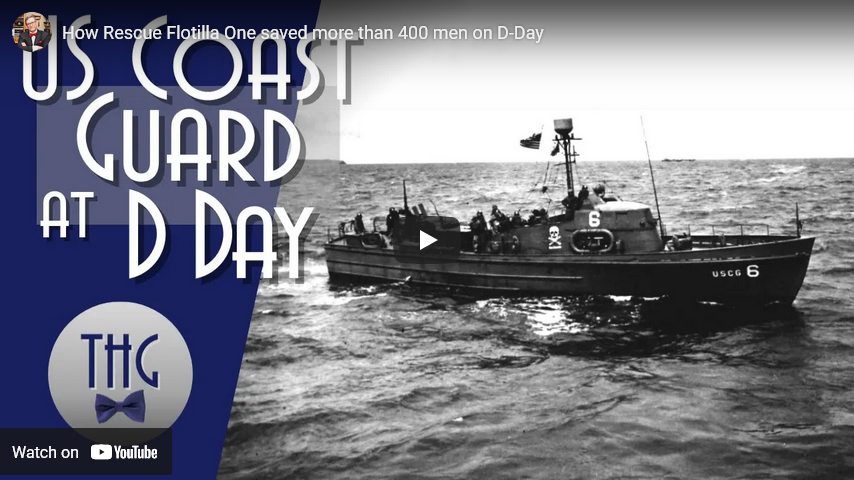
How Rescue Flotilla One saved more than 400 men on D-Day
The History Guy: History Deserves to Be Remembered
Published 2 Jun 2018The History Guy remembers the heroic service of Rescue Flotilla 1 of the United States Coast Guard during D-Day. It is history that deserves to be remembered.
The History Guy uses images that are in the Public Domain. As photos of actual events are sometimes not available, I will often use photographs of similar events and objects for illustration.
Patreon: https://www.patreon.com/TheHistoryGuy
The History Guy: Five Minutes of History is the place to find short snippets of forgotten history from five to fifteen minutes long. If you like history too, this is the channel for you.
Awesome The History Guy merchandise is available at:
teespring.com/stores/the-history-guyThe episode is intended for educational purposes. All events are presented in historical context.
#ushistory #militaryhistory #thehistoryguy
QotD: Eisenhower’s D-Day speech to the troops
Soldiers, Sailors and Airmen of the Allied Expeditionary Force!
You are about to embark upon the Great Crusade, toward which we have striven these many months. The eyes of the world are upon you. The hopes and prayers of liberty-loving people everywhere march with you. In company with our brave Allies and brothers-in-arms on other Fronts, you will bring about the destruction of the German war machine, the elimination of Nazi tyranny over the oppressed peoples of Europe, and security for ourselves in a free world.
Your task will not be an easy one. Your enemy is well trained, well equipped and battle-hardened. He will fight savagely.
But this is the year 1944! Much has happened since the Nazi triumphs of 1940-1. The United Nations have inflicted upon the Germans great defeats, in open battle, man to man. Our air offensive has seriously reduced their strength in the air and their capacity to wage war on the ground. Our Home Fronts have given us an overwhelming superiority in weapons and munitions of war, and placed at our disposal great reserves of trained fighting men. The tide has turned! The free men of the world are marching together to Victory!
I have full confidence in your courage, devotion to duty and skill in battle. We will accept nothing less than full Victory!
Good Luck! And let us all beseech the blessing of Almighty God upon this great and noble undertaking.
Dwight D. Eisenhower, June 6th, 1944
I’ve highlighted an image of the signed document itself to show the various components of the ancient battle speech (following my numbering above): [https://acoupdotblog.files.wordpress.com/2020/06/breaking-down-the-speech.png?w=689]
Apart from a slight alteration of the order, it is not hard to assign this speech to the same genre as Sallust’s Catiline speech or even Thucydides’ speeches at Delium (Thuc. 4.92-95). As we’ll see, it is certainly not the case that there is no other way to structure a pre-battle exhortation (although, I should note that the standard text of the other famous pre-D-Day General’s speech, Patton’s speech to the Third Army, hits the same notes, but with more words – mostly profanity). But this is the standard structure of a battle speech in the Western literary canon, and speeches with this standard structure, or variations of it, appear frequently.
I think a reader might particularly be caught by the emphasis on a section stressing how formidable the enemy is and how great the danger is (“He will fight savagely”). That seems an odd thing to stress! But it is an important part of the structure of these speeches; it is almost never left out. When paired with the general’s own cause for hope, acknowledging the fearsome nature of the enemy and the general terror of battle is a way to inoculate the soldiers against the seizing fear of battle. The Greeks saw the fear of battle as two distinct elements, deimos (δεῖμος) – the creeping dread before a battle, and phobos (φόβος) – the sudden paralyzing panic in combat, the sharp fear that causes men to flee. If the encouragement of the speech (and the general’s presence) is meant to defuse deimos, openly discussing the fearfulness of the enemy (but couching it in terms of how it may be overcome) is meant to rob phobos of his sting. You do your soldiers no favors by concealing from them the terror they will experience regardless.
Now the bulk of Eisenhower’s D-Day order is dedicated to the fourth part, stating the ground for encouragement, generally framed by the reasons the general is confident despite how fearsome the enemy is. One form of encouragement is a recounting of the noble deeds of the soldiers themselves. One of the marks of good generalship for the Romans was if a general could go up and down the line, calling out individual soldiers and reminding them of great deeds they had performed (Caesar does this, for instance; note Catiline’s opponent, Marcus Petreius encourages his soldiers this way, calling out each one – his is an army of veterans – by name, 59.4). Alternately – especially for a fairly green army where no one has done any great deeds yet – the general might stress the great valor of their forefathers, or the honor of their city or state. The emotion being touched here is pretty clearly pride, tapping into a desire not to let one’s self, one’s community or one’s comrades down. That’s an effective rhetorical tactic; as we’ve discussed, the fear of shame is an effective combat motivator (where so many other motivations fail). Appealing to pride is a good way to arouse that fear of shame, as the two emotions are deeply connected. Alternately, a general may not a superiority in numbers, materiel, tactical position; he may discuss his battle-plan and how it is likely to bring victory. For forces defending on their own ground, the home-field advantage may be stressed.
You want to understand the “fearsome enemy” motif and the “grounds for encouragement” motif working best as a pair.
Consider it this way: you are about to take a very important test. If I, having already taken the test, tell you “oh, don’t worry, the test is easy,” that will help dispel your dread (deimos) before it, but when you sit down with the test paper and read the (quite difficult) questions, the seizing fear (phobos) hits you, and your overall performance is reduced. That seizing panic clouds your thoughts and costs you vital time; in a battle, it might cause you to flee or get you killed. But if I tell you “the test is hard, but (you’ve studied effectively/you can pick up points on XYZ section/etc.)” it not only diminishes the dread before the test, but serves to mentally prepare you for the shock of seeing the real thing. Indeed, I turn your fearful mind into my friend – when the real thing fails to live up to your worst nightmares, you’ll draw confidence from that. When the test turns out to be exactly like I said, the encouragement carries more weight because of the reliability of the warning. I am not dispelling your fear – because this is battle and everyone is afraid and no words can take that away – I am mentally preparing you for your fear. There’s an element of CBT in this: validate the emotion, suggest more helpful ways to think about it, and direct the mind towards behavioral solutions.
Finally, I think it is worth noting what is not generally here. While the speaker is likely to reflect on glorious deeds of the soldiers, or other soldiers like them, or their ancestors, there is generally not a focus on how fearsome or scary or strong they are because no one feels scary or strong when they are terrified. “You’ve done this before” is a good line (so is “our people have always beaten their people”) but “Remember, we are lions” is not. No one feels like a lion when they are receiving indirect fire and cannot fire back; no one feels like a lion when their buddy just went down next to them and there’s nothing they can do about it. Remember: the purpose of the speech isn’t to pump someone up before the charge, it is to emotionally prepare them for the moment when the emotional momentum of the charge is spent and the fear of death comes crashing in to replace it.
Likewise, while “the cause” often figures into such speeches, it does so as a subordinate element; some kind of group membership – the nation, the polis, the legion, comrades-in-arms – is often more prominent (note how Eisenhower’s speech crafts concentric circles of groups that the listener belongs to, watching and depending on the listener; “liberty-loving people everywhere” -> “the United Nations” and “our Allies” -> “our homefront” -> finally “us” and “we”). While it took until the late 1940s for group-cohesion-theory to really emerge on its own, these sorts of speeches show an awareness of what seems to be a timeless truth: the cause may get you to the battle, but only comrades will hold you in it when the dying starts (on this, note especially J. McPherson, For Cause and Comrades (1997)).
Bret Devereaux, “Collections: The Battle of Helm’s Deep, Part VII: Hanging by a Thread”, A Collection of Unmitigated Pedantry, 2020-06-12.
June 5, 2022
Banzai Charges in Alaska – WW2 – 197 – June 4, 1943
World War Two
Published 4 Jun 2022The Chinese defeat the Japanese at Shipai Fortress and the Americans maul the Japanese in the Aleutians. The Japanese are also worried about the possibility of the USSR joining the war against them. Meanwhile the Allies still plan to invade Sicily, but have no idea what they’ll do after that.
(more…)
Odessa Madre, the female Al Capone of Washington DC
In his latest excerpt from the full Weekly Dish, Andrew Sullivan reviews a new book from James Kirchick, Secret City: The Hidden History of Gay Washington, including a fascinating character I’d never heard of until now, a woman who ranked with Al Capone as an underworld boss during Prohibition:
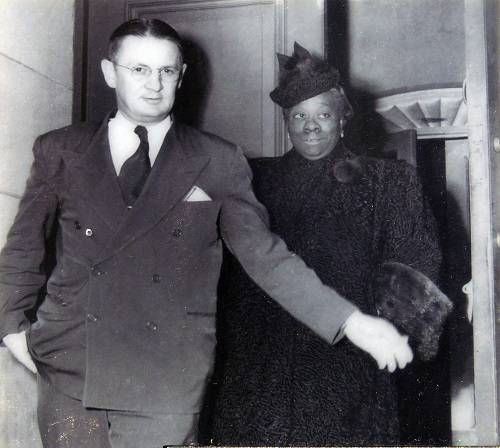
Odessa Madre
Queen of Washington’s Underworld
Odessa Madre grew up in a section of Washington DC called Cowtown, because farm animals would occasionally wander its streets. Born in 1907 in abject poverty, she nonetheless lived and thrived in a deeply segregated city as a dark-skinned African-American woman. “There was only three Blacks at Dunbar (High School) back then — I mean Black like me,” she later recalled. “I had good diction, I knew the gestures, but they still made fun of me.” Dess, as many called her, was also a lesbian, and not too shy about it. “I just couldn’t keep no watchamacallit — a man. I guess I was just born to give orders not take them. What kind of man wants a woman like that?”
She went on to become one of the wealthiest African Americans in an overwhelmingly black city — hauling in over $100,000 a year at her peak — by becoming “the female Al Capone”. She ran brothels, pimped women, owned speakeasies, as well as owning a legit and legendary institution on 14th Street, Club Madre. Jamie Kirchick conjures up a scene from the 1940s:
The crowd roared its approval whenever Madre, covered in mink furs and diamonds and trailed by a multiracial retinue of women for sale, entered the premises and sauntered over to the central table, denoted as hers by an ever-present vase holding a dozen long-stemmed roses.
Among the performers at the club: Billie Holiday, Duke Ellington and Count Basie. Madre kept all her illicit businesses alive by the old-fashioned method of bribing the fathomlessly corrupt DC police — “You know I practically ran that damn police department,” she later quipped — and became a renowned mediator of mob disputes across the country.
She also reflects a pattern that occurs throughout Kirchick’s new book, Secret City: The Hidden History of Gay Washington. She is within a core group of lesbians and gay men somehow living their best lives in the mid-20th Century, simultaneously at the center and the periphery of power. They were capable, whip-smart and hard-working, resilient beyond measure, yet never free from the threat of being taken down by the criminal law, exposure, blackmail, violence, public shaming and utter ostracism. Madre was convicted in 1949 on various drug offenses, spent over 13 years in prison on one charge or other, and died in 1990, without a penny to her name. Her corpse stayed in the morgue for a week until someone claimed it.
The same terrible story could be told of countless others. They were powerful until they were powerless. They lived on probation their entire lives.
One of several wonderful things about Kirchick’s book is that it doesn’t condescend to these people, but seeks to understand them on their own terms. It shows the tenacity, nerve, and brilliance of a woman like Madre — as well as her immiseration. It brings to crackling life the many gay men and lesbians who were under persecution so brutal and terrifying it is hard for anyone today to appreciate — and yet they lived, worked, loved and often succeeded. Some details (from the magazine, Washington Confidential) leap out:
Today one can only marvel at the courage demonstrated by the “1700 Negro men, all dressed as women, who held a party on a Potomac River cruise incongruously named the Robert E Lee until it was rudely interrupted ben one hundred police officers.
It’s a rare book about gay people that isn’t burdened by the constrictive dogma of “queer theory” and “intersectionality”, free of the nonsense that the gay rights movement began in 1969. The book treats gay people as complex human beings, not socially constructed victims; and it is unafraid to note how gay men were for long by far the principal targets of American persecution.
Winchester G30M
Forgotten Weapons
Published 27 Jul 2016http://www.patreon.com/ForgottenWeapons
With the death of Jonathan “Ed” Browning in 1939, development of the Winchester G30 rifle was passed into the hands of a new employee at Winchester by the name of David Marshall Williams. Williams would become widely known as “Carbine” Williams in later years thanks to Jimmy Stewart and Hollywood, but we will get to that part of the story later.
What Williams did to the G30 was to replace Browning’s annular gas piston with his own short stroke tappet system (this being the first rifle to use that system of Williams’). This substantially improved the gun’s reliability, and Winchester was able to submit it to Marine Corps trials in 1940 alongside the Garand and Pedersen rifles under the designation G30M. The Marine Corps was legitimately interested in the G30M, as it was expected to be both faster and cheaper to manufacture than the Garand.
Ultimately the trials were won by the Garand, with the G30M placing third in total malfunctions and broken parts. This had involved 37 different tests and more than 12,000 rounds through each rifle. The Garand had 1,480 total malfunctions and 49 parts broken, replaced, or repaired. The Johnson had 1,547 and 72 respectively, and the G30M 2,864 and 97 (roughly double the number of problems as the Garand).
Despite this failure, Winchester was encouraged to continue working on the rifle, if for no other reason than the possibility of foreign purchasers. Williams’ next step would be to replace the Browning tilting bolt with a Garand-type rotating bolt, which would result in a rifle Winchester would call the M2, or “the seven and a half pound rifle”. We will examine that rifle in the next video …

June 4, 2022
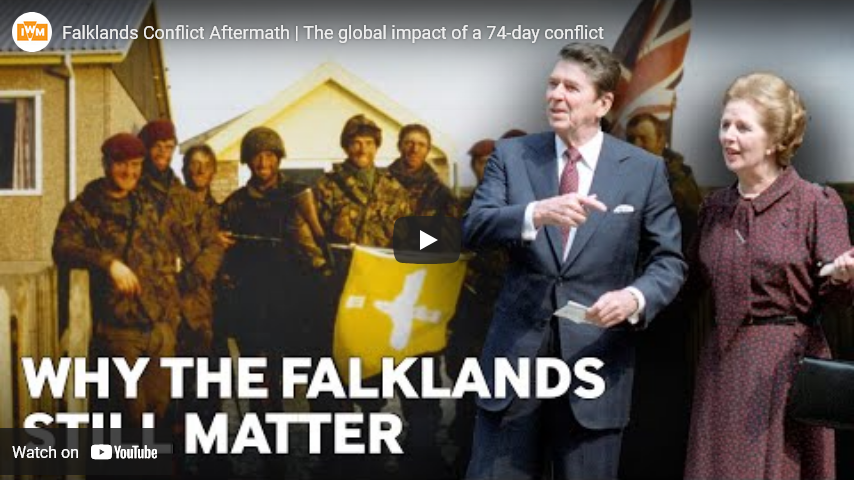
Falklands Conflict Aftermath | The global impact of a 74-day conflict
Imperial War Museums
Published 1 Jun 2022The Falklands Conflict of 1982 only lasted for 74 days, but it had lasting consequences which continue to be felt today. Prior to 1982, Margaret Thatcher’s government was planning major defence cuts including withdrawing the military from the South Atlantic. Instead, they spent nearly £3 billion defending British sovereignty of the Falkland Islands, and to this day maintain a garrison there. What was the effect of this short conflict for Argentina, Britain and the Falkland Islands, and what impact did it have around the world?
Correction: The video states that Port Stanley was granted city status in 2002, this should be 2022.
Thanks for watching IWM’s 5 part series on the Falklands Conflict. Please like and subscribe for more, and let us know in the comments below what you’d like to see next.
Explore and licence the archive films in this video: https://film.iwmcollections.org.uk/c/…
CREDITS
Mount Pleasant images, Crown copyright, April 2022
Margaret Thatcher images © University of Salford Press Office
Landmine clearance photos via Safe Lane Global
Sound effects via ZapSplat
Cheese propaganda, 1940 | Archive Film Favourites
Imperial War Museums
Published 14 May 2022With rationing introduced early in 1940 in Britain, this public information film was created to advocate the advantages of eating cheese over meat. The film explains not only the health benefits of cheese with some (unverified) experiments, but also its versatility in cooking, from grilled cheese to califlower cheese, “a meal in itself.” Film curator Matt Lee introduces us to this brilliant cheese propaganda.
You can watch the full Choose Cheese film on IWM’s Film Archive: https://film.iwmcollections.org.uk/re…
Subscribe to our channel for more films from the archives every Thursday!Browse the full IWM film collection and find out more about licencing this film or many others: https://bit.ly/iwmfilms
While our doors are temporarily closed, we still have millions of unforgettable stories to share with you. Your support is invaluable to help ensure we can share them with generations to come – please consider supporting Imperial War Museums today. Support us: https://www.iwm.org.uk/support-us/don…
Follow IWM on social media:
Twitter: https://twitter.com/I_W_M
Instagram: https://www.instagram.com/imperialwar…



