
Serious growth happened only after 1800, at first in northwestern Europe, 2% per capita in PPP [purchasing power parity] conventionally adjusted for inflation, as in the USA 1800–present, and now the world. Its magnitude is enormous, the Great Enrichment. It was a rise from $2 or $3 a day to over $100, a factor of 30. (I recently had to explain to a justly famous anthropologist that [(30–1) / 1] x 100 is 2,900%, or about 3,000%. He said that he could believe a factor of 30 … but not 3,000%.)
The exactitude, of course, is inessential. In Japan and Finland it was roughly the factor of 30. But it could be the worldwide factor since 1800 of 10 only, about $2 or $3 to $30 a day (to $10,000 a year, the level of Brazil now, to fix ideas), and still be utterly novel. As a Brit might say, the Great Enrichment was gobsmacking.
The enrichment was actually much greater than the factor of 30, because price indices, especially recently, do not adequately reflect improvements in quality, as was determined in the early 1990s by the Boskin Commission … Consider your cell phone, your auto tires, your medical treatment — all greatly better, recently. Even economic facts and analyses are better. (Well, sometimes.) The downward bias from inadequately deflating money prices for improved quality is not far from 2% per year, which would double recent growth rates in the rich countries.
Its magnitude, novelty, recency, and location are all crucial to explaining the Great Enrichment, because together they strongly suggest that there was something deeply peculiar about Britain in the 18th century, and that afterwards the peculiarity spread to the rest of the world. Such facts make “run-up” theories such as in Stephen Broadberry et alii look implausible, because they depend on a metaphor of an airplane taking off, with little else by way of explanation for why the Industrial Revolution (a factor of 2) happened or, especially, its follow-on the Great Enrichment (a factor of 20 or 30). Likewise, it is dubious to attach the Great Enrichment to remote causes within Europe, such as the Black Death — which originated in China, with similar terrors, and yet yielded no Great Enrichment there. Also dubious is the Eurocentric belief, prominent in conservative circles, of some ancient superiority of melanin-challenged Volk back in the Black Forest. (Did you know, for example, that all European countries had common law in the Middle Ages, that is, judge-found-and-made, not legislated or codified?)
The Great Enrichment is the second most important secular event in human history, second only to the domestication of plants and animals making for cities and literacy.
Dierdre McCloskey, “How Growth Happens: Liberalism, Innovism, and the Great Enrichment (Preliminary version)” [PDF], 2018-11-29.
June 15, 2022
QotD: The gobsmacking magnitude of “The Great Enrichment”
June 14, 2022
The Early Roman Emperors – Part 2: An Empire of Peoples
seangabb
Published 4 Oct 2021The Roman Empire was the last and the greatest of the ancient empires. It is the origin from which springs the history of Western Europe and those nations that descend from the Western Roman Empire. It is the political entity within which the Christian faith was born, and the growth of the Church within the Empire, and its eventual establishment as the sole faith of the Empire, have left an indelible impression on all modern denominations. Its history, together with that of the ancient Greeks and the Jews, is our history. To understand how the Empire emerged from a great though finally dysfunctional republic, and how it was consolidated by its early rulers, is partly how we understand ourselves.
Here is a series of lectures given by Sean Gabb in late 2021, in which he discusses and tries to explain the achievement of the early Emperors. For reasons of politeness and data protection, all student contributions have been removed.
More by Sean Gabb on the Ancient World: https://www.classicstuition.co.uk/
Learn Latin or Greek or both with him: https://www.udemy.com/user/sean-gabb/
His historical novels (under the pen name “Richard Blake”): https://www.amazon.co.uk/Richard-Blake/e/B005I2B5PO
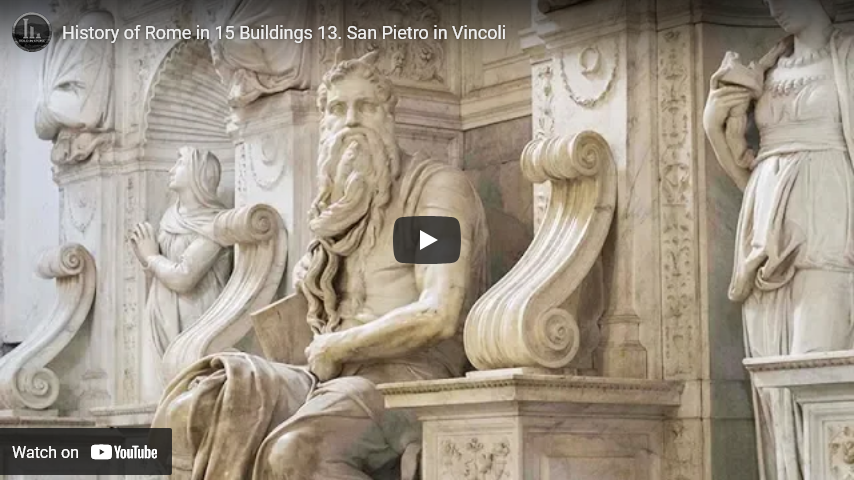
History of Rome in 15 Buildings 13. San Pietro in Vincoli
toldinstone
Published 2 Oct 2018Speech stands at the threshold of the compressed lips. Righteous indignation is written in the lines of the set jaw. The presence of God blazes forth from the eyes. As a work of art, Michelangelo’s Moses is nothing short of awe-inspiring. It sits, however, in the cramped central niche of a rather underwhelming wall tomb, ringed by smaller statues ranging in quality from mediocre to incompetent. This thirteenth episode in our History of Rome discusses the creation of the Moses, and the circumstances that brought it to the church of San Pietro in Vincoli.
To see the story and photo essay associated with this video, go to:
https://toldinstone.com/san-pietro-in…
June 13, 2022
Nazis in a Balkan Mess – WAH 064 – June 12, 1943
World War Two
Published 12 Jun 2022In the Balkans, the Axis powers fail to rout Yugoslav and Greek Partisans. In Bengal, British India starvation is spreading, and in the Netherlands, the Nazis send 1,296 children and infants from the Vught Camp to the gas chambers at Sobibor.
(more…)
Lightning fast interceptor turned nuclear strike bomber: the Canadair CF-104 Starfighter
Polyus Studios
Published 29 Sep 2020Don’t forget to like the video and subscribe to my channel!
Support me on Patreon – https://www.patreon.com/polyusstudiosThis is an UPDATED version of the video. It includes many changes and corrections to the original video. Many thanks to Gary Watson for all his contributions!
Starting in 1959 Canadair began building Canada’s fastest jet at their plant in Montreal. It was designed as a sleek high altitude and high speed interceptor, but was adapted for low level ground strike missions with conventional and nuclear weapons. It was the Canadair CF-104 Starfighter, Canada’s missile with a man in it.
0:00 Introduction
0:33 Historical Context
2:01 Design Choice
4:15 Canadair’s Production Run
6:50 Configuration and Specifications
11:04 Nuclear Strike Role
12:13 Operational History
16:06 Conventional Role
17:53 Retirement and Replacement
19:28 Accidents, Controversy and Legacy
22:56 ConclusionMusic:
“Denmark” – Portland Cello ProjectResearch Sources:
Canadair CF-104 Starfighter by Harold A. Skaarup (http://silverhawkauthor.com/canadian-…)
Canadair CF-104 Starfighter by Canadian Starfighter Association (http://canadianstarfighterassociation…)
CF-104 Flight Operations by Air Force Museum of Alberta (https://www.rcaf.museum/history/rcaf-…)
Story of the F-104 Starfighter in Norwegian Service by Bjorn Hafsten (http://starfighter.no/hist-en3.html)
Starfighters with Turkey by Joe Baugher (http://www.joebaugher.com/usaf_fighte…)
ASN Aviation Safety Database by Aviation Safety Network (http://aviation-safety.net/wikibase/d…)
Starfighter by David L. Bashow (Fortress Publication, 1990, ISBN: 0-919195-12-1)
Photography credit 6mins10sec: Gary WatsonFootage Sources:
Personal Footage – Gary Watson
Cold War Fighter Pilot – Ken Castle, CD, Flight-Lieutenant (ret’d) – Canada Aviation and Space Museum (https://youtu.be/sEUOFyPLL94)
CF 104 Baden Soellingen 1965 – Gordon Price (https://youtu.be/4UZ9PE58Eq0)
CF104 Germany 1983/4 441 Squadron CAF – Tom Hammond (https://youtu.be/xrqjAKHflCo)
Great Planes Lockheed F-104 Starfighter – Discovery Channel (1996)
Avro Canada CF 100 Canuck – Avro (1956)#Starfighter #CanadianAerospace #PolyusStudios

QotD: Helot women in Sparta
And I want to stress the importance of this question, because there are more helot women in Sparta than there are free humans in Sparta (as from last time, around 15% of Sparta is free – men and women both included – but 42.5% of Sparta consists of enslaved helot women). If we want to say absolutely anything about the condition of life in Sparta, we simply cannot ignore such a large group of human beings living in Sparta.
And our sources here let us down catastrophically. There are, to my knowledge, no passages anywhere in the corpus of ancient literature which are actually about helot women, and every passage that mentions them could be included on a single typed page with space to spare. But that is no excuse to pretend they do not exist, and we are going to talk about them.
As far as we can tell, family structure and labor roles among the helots approximated what we see in the rest of Greece. Once freed, the Messenian helots establish a fairly normal polis in Messenia, so it hardly seems like they had some radically different social makeup. That gives us the beginnings of sketching out what life might have been like for a helot woman: we can then take the handful of things we know that are peculiar about their circumstances and combine them with what we know about the normal structure of life for ancient Greek peasant families.
The primary economic occupation of helot women was probably in food preparation and textile production. And if I know my students, I know that the moment I start talking about the economic role of women in ancient households, a very specific half of the class dozes off. Wake Up. There is an awful tendency to see this “women’s work” as somehow lesser or optional. These tasks I just listed are not economically marginal, they are not unimportant. Yes, our ancient sources devalue them, but we should not.
First: let’s be clear – women in ancient households (or early modern households, or modern households) were not idle. They had important jobs every bit as important as the farming, which had to get done for the family to survive. I’ve estimated elsewhere that it probably takes a minimum of something like 2,220 hours per year to produce the minimum necessary textile goods for a household of five (that’s 42 hours a week spinning and weaving, every week). Most of that time is spent spinning raw fibers (either plant fibers from flax to make linen, or animal fibers from sheep to make wool). The next step after that is weaving those threads into fabric. Both weaving and spinning are slow, careful and painstaking exercises.
Food preparation is similarly essential, as you might imagine. As late as 1900, food preparation and cleanup consumed some 44 hours per week on average in American households, plus another 14 hours dedicated to laundry and cleaning (Lebergott, Pursuing Happiness (1993)). So even without child rearing – and ask any parent, there is a TON of work in that – a small peasant household (again, five members) is going to require something like 100 hours per week of “woman’s work” merely to sustain itself.
Now, in a normal peasant household, that work will get split up between the women of the house at all ages. Girls will typically learn to spin and weave at very young ages, at first helping out with the simpler tasks before becoming fully proficient (but of course, now add “training time” as a job requirement for their mothers). But at the same time (see Erdkamp, The Grain Market in the Roman Empire (2005) on this) women often also had to engage in agricultural labor during peak demand – sowing, harvesting, etc. That’s a lot of work to go around. Remember, we’re positing a roughly five-individual household, so those 100 hours may well be split between only two people (one of whom may be either quite old or quite young and thus not as productive).
In short: these tasks, when combined with all of the other demands, is very much a full time job and then some. It’s also a job that someone very much needs to do if the family is to survive.
We can assume that these demands, along with marriage, the bearing and raising children, and religious rituals and festivals, likely shaped the contours of the lives of helot women, much as they would have for many poor women in the Greek (or Roman) countryside. But the Spartan system also shapes these contours and it does so in almost entirely negative ways.
Let’s start [with] textiles. Spartiate women do not engage in textile manufacture (Xen. Lac. 1.4) as noted previously, nor do they seem (though the evidence here is weaker) to engage in food preparation. In the syssitia, at least, the meals are cooked and catered by helot slaves (Plut. Lyc. 12.5, 12.7). In the former case, we are told explicitly by Xenophon that it is slave labor (he uses the word doule, “female slave”, which clearly here must mean helot women) which does this. So helot women now have an additional demand on their time and energy: not only the 2,200 hours for clothing their own household, but even more clothing the spartiate household they are forced to serve. If we want to throw numbers at this, we might idly suppose something like five helot households serving one spartiate household, suggesting something like a 20% increase in the amount of textile work. We are not told, but it seems a safe bet that they were also forced to serve as “domestics” in spartiate households. That’s actually a fairly heavy and onerous imposition of additional labor on these helot women who already have their hands full.
We also know […] that helot households were forced to turn over a significant portion of their produce, perhaps as high as half. I won’t drag you all through the details now – I love agricultural modeling precisely because it lets us peek into the lives of folks who don’t make it into our sources – but I know of no model of ancient agriculture which can tolerate that kind of extraction without bad consequences. And I hear the retort already coming: well, of course it couldn’t have been that bad, because there were still helots, right? Not quite, because that’s not how poor farming populations work. It can be very bad and still leave you with a stable – but miserable – population.
Bret Devereaux, “Collections: This. Isn’t. Sparta. Part III: Spartan Women”, A Collection of Unmitigated Pedantry, 2019-08-29.
June 12, 2022
Eisenhower Lays Out His Plans for Sicily – WW2 – 198 – June 11, 1943
World War Two
Published 11 Jun 2022The Allies bomb Mediterranean islands in preparation for their invasion of Sicily next month; they also prepare a lot of deceptions to mislead the enemy as to where they will attack. The German plans for the summer offensive against the Kursk salient are ever more concrete, and in the field this week, the Chinese stop the Japanese offensive cold.
(more…)
History Re-Summarized: Egypt
Overly Sarcastic Productions
Published 18 Feb 2022I for one was shocked to learn the Egyptians actually buried their kings in a giant Millennium Puzzle.
We’ve covered Egypt on this channel in previous videos, but this History Re-Summarized is the Definitive Edition, redone from the ground up to present the best possible account — starting at the beginning for a full chronology of Ancient Egypt, from the very first Pharaohs to the Muslim Conquest.
(Observant Egyptologists and D&D players might note the Pyramids are actually D-*Fives*, but technically they’re D-*Nines* since each face is actually two right triangles at a slight angle to each other and not a single flat isosceles triangle, so shhh, we can pretend it’s a D4.)
Sources & Further Reading: The Oxford History of Ancient Egypt & Ancient Egypt: A Very Short Introduction by Ian Shaw, World History Encyclopedia entries on “Ancient Egypt”, “Old Kingdom of Egypt”, “First Intermediate Period of Egypt”, “Middle Kingdom of Egypt”, “Second Intermediate Period of Egypt”, “New Kingdom of Egypt” https://www.worldhistory.org/egypt/, The Great Courses’ lecture series “History of Ancient Egypt” by Bob Brier. Additionally, I have an undergraduate degree in classical studies (re: Persia, Ptolemies and Rome). Extra special thanks to our OSP Discord server moderator & Egyptology connoisseur Billy, for his assistance and guidance for this video!
Our content is intended for teenage audiences and up.
PATREON: https://www.Patreon.com/OSP
PODCAST: https://overlysarcasticpodcast.transi…
DISCORD: https://discord.gg/osp
MERCH LINKS: http://rdbl.co/osp
OUR WEBSITE: https://www.OverlySarcasticProductions.com
Find us on Twitter https://www.Twitter.com/OSPYouTube
Find us on Reddit https://www.Reddit.com/r/OSP/

June 11, 2022
The steam engine — one of the keys to the industrial revolution — was actually pretty late to be invented
In the latest Age of Invention newsletter, Anton Howes gives the first part of what promises to be a fascinating deep dive into steam engine development pre-dating the commonly accepted chronology of its invention:
What did I discover that so shocked me? When researching my last post on the inventors surrounding Prince Henry in the 1610s, and because I’ve been looking into the history of energy at the urging of Apoorv Sinha and others at Carbon Upcycling, I had a read through the published work of one of the inventors, Salomon de Caus.
De Caus often features in histories of the steam engine, as someone who in 1615 wrote about and depicted the expansive force of steam — heat up water in a copper vessel with a narrow tube coming out the top, and see how water or steam can be made to rise! He was even briefly known as the “true”, French inventor of the steam engine, because of a nineteenth-century hoax.
To historians of science and technology today, however, de Caus’s illustration is pretty unremarkable. He usually just gets a brief name-check, more or less copy-pasted from older histories. This is because the expansive force of steam would turn out not to be all that important in the development of the steam engine, as we’ll see, and because it was ancient.
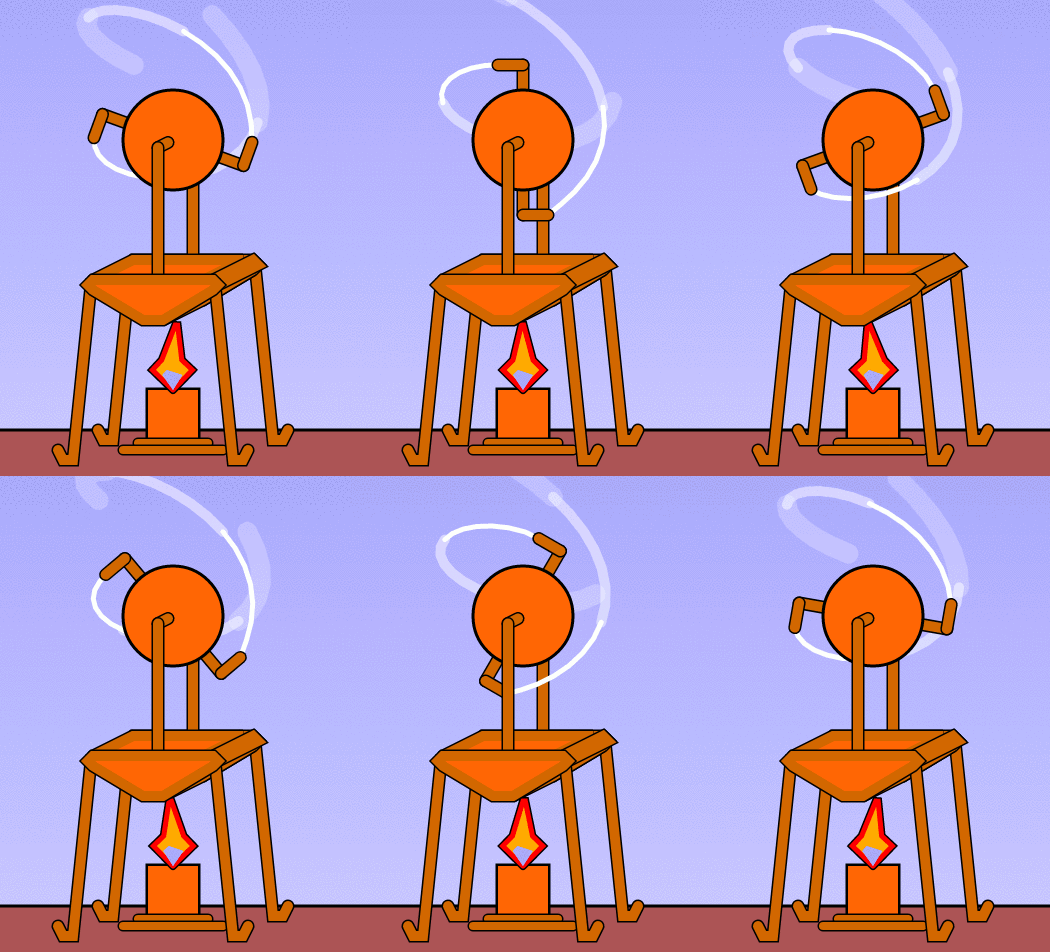
3D animation of an aeolipile or Hero’s engine.
Animation by Michael Frey via Wikimedia Commons.Hero of Alexandria, writing sometime in the first century, had already exploited the fact that when you boil the water in a metal vessel with a long, narrowing spout, the steam will come out with quite some force. This aeolipile, as it was sometimes called, was known and used throughout the middle ages and well into the seventeenth century. Sometimes it was shaped a bit like an alchemist’s retort, and known as the “philosophical bellows”. Other times, it was shaped as a human face, the steam issuing from its mouth — like the Greek god Aeolus, blowing the wind.
This was no mere toy, but found plenty of practical use. The spout of the philosophical bellows was often directed at a lamp’s flame, to have a sort of blow-torch effect. It was used, for example, to do finer tasks like bending glass pipes, or in fine metalwork — there are loads of accounts of this throughout the fifteenth, sixteenth, and seventeenth centuries, with some authors even talking about its merits relative to other instruments, suggesting real-life use. Its heat could, apparently, also be used to get fires going in wet weather, or from damp wood (provided you had some dry wood on hand to get the aeolipile itself going).
It could also be put to more sophisticated uses. Hero explained how the principle of thermal expansion — of either water or air — could be exploited to spout steam or even wine onto an altar’s fire to make it flare, to make water issue from a fountain, to make miniature dancers rotate and jump up and down, and to push air through bird-shaped automata to make them sing. A 1630s English version claimed to make the figure of a dragon hiss.
It could even be used to do some light mechanical work. Hero described a version that might make a hollow ball spin, by having the steam issue from bent nozzles. He even described a version where water could be forced by steam from one container into another, which would pull on a weight to open some doors. Taking his idea and running with it, engineers from at least the fifteenth century onwards wrote about directing the aeolipile’s narrow spout at miniature turbines to turn a roasting spits above a fire — suggested in Italy in Leonardo da Vinci’s notebooks, and in a 1551 Ottoman manuscript by Taqi ad-Din — or to do light industrial work like stamping ores and minerals into powders.
The principle of using heat to expand air or steam was even tried for much heavier-duty tasks. In 1605, the French inventor Marin Bourgeois developed an air-powered gun — known as the “wind-gun” — which used air that was pumped and compressed into the barrel. Within just a couple of years, having heard of the demonstration before the French court, and after paying a visit to Bourgeois, the mathematician David Rivault began experimenting on how the same effect might be achieved by heating water in a cannon. In the same decade, the Spanish military engineer Jerónimo de Ayanz y Beaumont also tried to use the expansionary force of steam to drive water up and out of mines — essentially, an industrial version of what Hero had done with fountains.
Spanish Canada: The Nootka Crisis
The History Guy: History Deserves to Be Remembered
Published 10 Jun 2022In 1789, the Spanish empire prepared to enforce their territorial claims far to the North of what they nominally controlled, and instigated a crisis that threatened to bring the great European powers to war.
Check out our new community for fans and supporters! https://thehistoryguyguild.locals.com/
This is original content based on research by The History Guy. Images in the Public Domain are carefully selected and provide illustration. As very few images of the actual event are available in the Public Domain, images of similar objects and events are used for illustration.
You can purchase the bow tie worn in this episode at The Tie Bar:
https://www.thetiebar.com/?utm_campai…All events are portrayed in historical context and for educational purposes. No images or content are primarily intended to shock and disgust. Those who do not learn from history are doomed to repeat it. Non censuram.
Find The History Guy at:
New community: https://thehistoryguyguild.locals.com/
Please send suggestions for future episodes: Suggestions@TheHistoryGuy.netThe History Guy: History Deserves to Be Remembered is the place to find short snippets of forgotten history from five to fifteen minutes long. If you like history too, this is the channel for you.
Awesome The History Guy merchandise is available at:
teespring.com/stores/the-history-guyScript by JCG
#history #thehistoryguy #Canada

Gas Trap M1 Garand
Forgotten Weapons
Published 29 Sep 2016Cool Forgotten Weapons Merch! http://shop.bbtv.com/collections/forg…
The original design of the M1 Garand as adopted in 1936 used a “gas trap” system instead of a gas port drilled in the barrel. This system used a type of muzzle cap and false muzzle to redirect gas into the gas cylinder in the short distance between the end of the rifled barrel and when the bullet left the muzzle. The system worked, but was not ideal.
Several problems were found with the gas trap system as the guns went into production. These included cleaning complexity, an unstable front sight, and a potentially weak bayonet mounting point. Most significantly, however, one rifle in testing had a screw work loose in the muzzle cap, which allowed parts to shift out of alignment and resulted in a bullet striking the gas plug and blowing the entire assembly off the gun. This led to a decision to redesign the gas system of the M1 to use a simpler gas port drilled in the barrel.
When this design change was made, 18,000 rifles had been completed and parts were made for an additional 33,000. Those guns were completed with the available parts, and the new gas system was used for all further production. Gas trap M1s are very rare today because the guns were updated to the new system when they were overhauled during WWII, and in 1947 the Army ordered all remaining gas trap rifles destroyed.

June 10, 2022
The Early Roman Emperors – Part 1: Augustus
seangabb
Published 26 Sep 2021The Roman Empire was the last and the greatest of the ancient empires. It is the origin from which springs the history of Western Europe and those nations that descend from the Western Roman Empire. It is the political entity within which the Christian faith was born, and the growth of the Church within the Empire, and its eventual establishment as the sole faith of the Empire, have left an indelible impression on all modern denominations. Its history, together with that of the ancient Greeks and the Jews, is our history. To understand how the Empire emerged from a great though finally dysfunctional republic, and how it was consolidated by its early rulers, is partly how we understand ourselves.
Here is a series of lectures given by Sean Gabb in late 2021, in which he discusses and tries to explain the achievement of the early Emperors. For reasons of politeness and data protection, all student contributions have been removed.
More by Sean Gabb on the Ancient World: https://www.classicstuition.co.uk/
Learn Latin or Greek or both with him: https://www.udemy.com/user/sean-gabb/
His historical novels (under the pen name “Richard Blake”): https://www.amazon.co.uk/Richard-Blak…
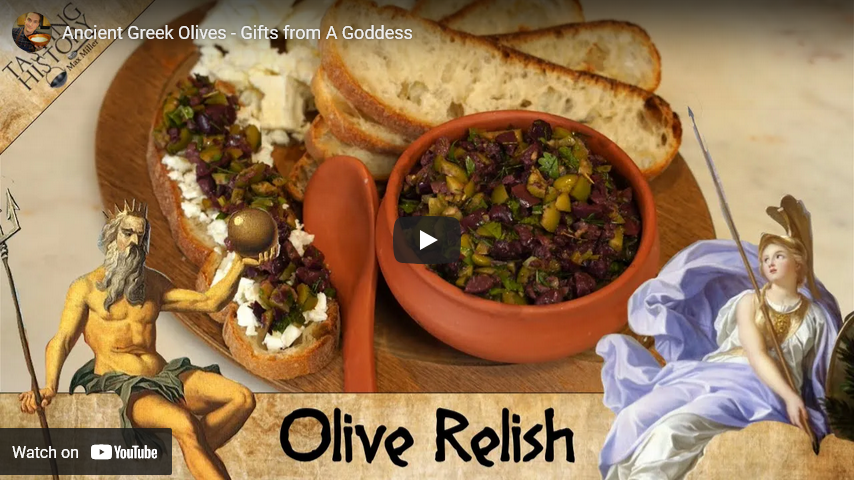
Ancient Greek Olives – Gifts from A Goddess
Tasting History with Max Miller
Published 1 Jun 2021Help Support the Channel with Patreon: https://www.patreon.com/tastinghistory
Tasting History Merchandise: crowdmade.com/collections/tastinghistoryFollow Tasting History here:
Instagram: https://www.instagram.com/tastinghist…
Twitter: https://twitter.com/TastingHistory1
Tiktok: TastingHistory
Reddit: r/TastingHistory
Discord: https://discord.gg/d7nbEpyTasting History’s Amazon Wish List: https://amzn.to/3i0mwGt
LINKS TO INGREDIENTS & EQUIPMENT**
Sony Alpha 7C Camera: https://amzn.to/2MQbNTK
Sigma 24-70mm f/2.8 Lens: https://amzn.to/35tjyoW
Dried Rue: https://amzn.to/3yErUqH
Terracotta Bowls with Spoons: https://amzn.to/3wLkEIbLINKS TO SOURCES**
De Agricultura by Cato the Elder: https://amzn.to/3bP20H6
De Re Rustica by Columella: https://amzn.to/3fkN99z
“Defense in the Matter of the Olive Stump” by Lysias
Varro the Agronomist: https://amzn.to/3fkhG7l
Aristotle’s Politics: https://amzn.to/3vkHMNj**Some of the links and other products that appear on this video are from companies which Tasting History will earn an affiliate commission or referral bonus. Each purchase made from these links will help to support this channel with no additional cost to you. The content in this video is accurate as of the posting date. Some of the offers mentioned may no longer be available.
Subtitles: Jose Mendoza
PHOTO CREDITS
Trapitum: Carole Raddato from FRANKFURT, Germany, CC BY-SA 2.0 https://creativecommons.org/licenses/…, via Wikimedia Commons
Akhenaten, Nefertiti and their children: By Neoclassicism Enthusiast – Own work, CC BY-SA 4.0, https://commons.wikimedia.org/w/index…
Amphora with Palm Trees: By Sharon Mollerus – Amphora with Palm Trees, Mycenaean, 15th century BC., CC BY 2.0, https://commons.wikimedia.org/w/index…
Procession fresco from Knossos: By ArchaiOptix – Own work, CC BY-SA 4.0, https://commons.wikimedia.org/w/index…
The Olive tree of Vouves: By Eric Nagle – https://www.reddit.com/r/europe/comme…, CC BY-SA 4.0, https://commons.wikimedia.org/w/index…
Reconstruction of the palace at Knossos: By Mmoyaq – Own work, CC BY-SA 3.0, https://commons.wikimedia.org/w/index…
The soldiers of Xerxes I: By A.Davey – This file has been extracted from another file: Xerxes detail ethnicities.jpg, CC BY 2.0, https://commons.wikimedia.org/w/index…
Lysias: By Coyau / Wikimedia Commons, CC BY-SA 3.0, https://commons.wikimedia.org/w/index…
Bouleuterion: By Zigomar – Own work, CC BY-SA 3.0, https://commons.wikimedia.org/w/index…#tastinghistory #olives #ancientgreece
QotD: Talinn, Estonia
My second impression was that it stinks, stinks of diesel exhaust. It seems they have found a way to power everything with diesel, including bicycles and pets. When I walked out of the tunnel from the ferry to land, I was engulfed in a cloud of diesel exhaust from a passing truck. I’m surprised the EU permits it, but maybe they look the other way for the former communist countries. Maybe the Estonians just cheat. Either way, it reminded me of what it was like in America in the 80’s when city buses were like crop dusters …
Rather than follow the crowd to Old Town, I went the other direction and walked a dozen blocks to the east, then another dozen blocks or so south. If you look at a map, the tourist area is to the west, so I figured the real Tallinn was to the east. Given the history and layout of the city, my guess is the east is mostly built in the 20th century, but a lot of it dates to previous centuries. Estonia was a battle ground fought over by Danes, Russians, Germans, Swedes and Poles for most of its history, so it is tough to know.
For example, I walked past an apartment building, probably built in the middle of the last century. It was the drab concrete style popular with communists. Next to it was a cool looking old wood structure that would look at home on Cape Cod. Upon closer inspection, I saw it had undergone a recent renovation, so maybe it was old, but maybe it was just made to look like it dates to the 19th century. You can’t trust anything now. Even in a place like Estonia, everything is becoming a reproduction of a long gone culture of a foreign people.
If you want to get a sense of what life was like under the Soviets, walking around this part of Tallinn is a good way to do it. You see the old buildings and dilapidated old houses. It’s not a slum, but it has that aesthetic the Soviets were so famous for back during the Cold War. Lots of concrete and gray paint. The materialism of the Bolsheviks was really just the total lack of spiritual beauty. They were ugly people and that ugliness was made manifest their building and city planning. They were vulgar and depraved.
The Z Man, “Travelogue: Talinn”, The Z Blog, 2019-04-03.
June 9, 2022
A brutal microcosm of the English Civil War
At The Critic, Jonathan Healey reviews The Siege of Loyalty House by Jessie Childs:

Late in the summer of 1641, with Charles I deep in dispute with his Parliament, alarming reports reached Westminster of Catholics amassing arms at Basing House in Hampshire. At this point in time, few expected civil war, but plenty feared an imminent Catholic plot. Recent reform to the Church had introduced lavish ceremonies which looked, to many eyes, like the trappings of Rome, and Charles himself was married to a Catholic.
More to the point, England’s Catholics had done it before. Every year, people marked the anniversary of the Gunpowder Treason, which was already stuck in the national consciousness as the quintessential Popish rebellion: an armed coup plotted by dissident aristocrats gathering weapons on their great rural estates and planning subterfuge at the highest levels.
Yet civil war came, and when it did it would be nothing like the “Popish Plots” of Protestant imagining. It would be fought over constitutional as much as religious divides. And, rather than a rebellion, it would be an armed struggle between two competing fiscal-military organisations — effectively between two competing states.
The English countryside became militarised. Now, it was not just a landscape. It was territory. The great houses were no longer places for covert plotting; now they were centres of command and control. And few were more important than Basing House.
Hampshire today is a pleasant place: gentle and verdant with rolling chalk hills, shaded woodlands, and quiet valleys. But in the 1640s it became contested and dangerous: a dark, malevolent land of violence and death. People looked upon one another with suspicion, and riders were ambushed and killed as they travelled at night. Parish churches were stormed, towns starved and bombarded. Armies of musketeers, pikemen, and cavalry traversed the folding lanes of the county looking to bring bloodshed and plunder.
[…]
A crucial theme is encapsulated in the book’s denouement. The deputy sent to pacify Hampshire for the New Model was Oliver Cromwell. He had been in the thick of the fighting from the start, and before then was an earnest — if obscure and scruffily-attired — Member of Parliament. But Cromwell really rose to prominence in 1644 and 1645, on the back of his military abilities. He represented a new approach to the war: the pursuit of total victory even at the cost of sharp bloodshed.
It was Cromwell’s direct — even brutal — efficiency that brought the siege of Basing House to its end. The walls fell and many of the garrison were killed. Slaughtered, too, were a number of Catholic priests in a moment of violence that was representative of the way the war was heading. Cold-blooded murder of female camp followers had been perpetrated by royalists in Cornwall and by parliamentarians after Naseby. King Charles had allowed a bloody storm of Leicester which had cost many civilian lives, and Cromwell would go on to oversee the horrors of Drogheda and Wexford in Ireland. The chivalry of Waller and Hopton would come to seem a long way in the past.


