
People were poorer. Household incomes grew enormously, and as they did, food budgets shrank relative to the rest of our consumption. People in the 1960s also liked steak and chicken breasts better than frankfurters and canned meats. But most of them couldn’t afford to indulge their desires so often.
The same people who chuckle at the things done with cocktail franks and canned tuna will happily eat something like the tripe dishes common in many ethnic cuisines. Yet tripe has absolutely nothing to recommend it as a food product, except that it is practically free; almost anything you cooked with tripe would be just as good, if not better, without the tripe in it. If you understand why folks ate Trippa alla Romana, you should not be confused about the tuna casserole or the creamed chipped beef on toast.
Megan McArdle, “Friday Food Post: The Economics Behind Grandma’s Tuna Casseroles”, Bloomberg View, 2015-10-30.
December 4, 2017
QotD: Why mid-20th century Americans ate what they did – 3
December 3, 2017
QotD: Why mid-20th century Americans ate what they did – 2
A lot of the ingredients we take for granted were expensive and hard to get. Off-season, fresh produce was elusive: The much-maligned iceberg lettuce was easy to ship, and kept for a long time, making it one of the few things you could reliably get year round. Spices were more expensive, especially relative to household incomes. You have a refrigerator full of good-looking fresh ingredients, and a cabinet overflowing with spices, not because you’re a better person with a more refined palate; you have those things because you live in 2015, when they are cheaply and ubiquitously available. Your average housewife in 1950 did not have the food budget to have 40 spices in her cabinets, or fresh green beans in the crisper drawer all winter.
Megan McArdle, “Friday Food Post: The Economics Behind Grandma’s Tuna Casseroles”, Bloomberg View, 2015-10-30.
December 2, 2017
QotD: Why mid-20th century Americans ate what they did – 1
Most people are not that adventurous; they like what’s familiar. American adults ate what they did in the 1950s because of what their parents had served them in the 1920s: bland, and heavy on preserved foods like canned pineapple and mayonnaise.
Megan McArdle, “Friday Food Post: The Economics Behind Grandma’s Tuna Casseroles”, Bloomberg View, 2015-10-30.
November 17, 2017
Is There Any Cheese in Cheez Whiz? (And the Story of Kraft)
Today I Found Out
Published on 5 Nov 2017In this video:
As America gets ready for their upcoming Super Bowl parties (or Royal Rumble party, if that’s your thing), Cheez Whiz – the yellowish-orange, gooey, bland tasting “cheese” product – will surely make an appearance at some of them. But what is Cheez Whiz? Why did get it invented? And is there really cheese in Cheez Whiz?
Want the text version?: http://www.todayifoundout.com/index.php/2015/01/cheese-cheez-whiz/
November 16, 2017
15 British Sweets Everyone Should Try – Anglophenia Ep 22
Anglophenia
Published on 7 Jan 2015From Cadbury Flake to jelly babies, Siobhan Thompson shows us the British candies we should all try at least once.
November 12, 2017
The great “bitter versus sweet” war
Megan McArdle is trapped behind enemy lines in the latest outbreak of the great taste war:
At this point I should put my cards on the table: Geographically and demographically, I belong in bitter country. But I am an exile-in-residence, because bitter foods make me wince.
I mean that literally. Really bitter things — a Negroni, say — produce in me a physical aversion that is close to pain. Black coffee I find merely extraordinarily unpleasant, and hoppy beer is just barely endurable. If I really had to endure it. Say, if consuming a bottle of IPA were the only way to save a busload of orphans who had been kidnapped by a beer snob.
Given where I live here in Washington, DC, and my known interest in food, the presumption of the bitter evangelists is that I must simply need re-education. I have been subjected to many hours of lectures on how I just need to clear my palate from all the sweet garbage I’m used to, so that I can appreciate the subtle joys of bitterness. I have refrained from suggesting that they hold still while I teach them to enjoy the subtle joys of being repeatedly kicked in the shins.
For over years of learning about food — and living with a bitter-loving craft cocktail enthusiast — I’ve come to realize that my aversion to bitter foods is almost certainly genetic. The Romans who coined the adage “de gustibus non est disputandum” were righter than they knew; science now tells us that there is indeed no sense arguing over taste, because you’re not going to change someone’s genome. Many seemingly mystifying divides over foods like cilantro come from the fact that some people have taste receptors that others don’t. If you have no receptors for the “soapy” compound in cilantro, this herb adds a marvelously tangy note to a dish. If you have those receptors, anything cooked with it tastes like Irish Spring en cocotte.
In my case, I probably have more bitter receptors than most people, so that a drink my husband finds intriguingly astringent would hit me like a punch to the tongue. I can no more get over my instinct to spit out bitter foods than he could get over his instinct to take his hand off a hot stove.
November 5, 2017
Binging with Babish: Turkish Delight from Chronicles of Narnia
Binging with Babish
Published on 24 Oct 2017The Chronicles of Narnia is a series of books known for their talking fauna, religious overtones, and sickly sweets offered up by the White Witch, Jadis. Turkish Delight may be a delight for some accustomed palates, but can be fancifully altered with a number of different flavor concentrates. Whip up a batch to coerce and manipulate the black sheep of your choosing today.
October 29, 2017
The Poutine crisis – “Toronto is living a cheese curd lie”
Toronto loves to adopt anything trendy and try to claim it as its own. Poutine, an imported delicacy from Quebec, early on was lovingly described as “the culinary equivalent of having unprotected sex with a stripper in the parking lot of a truck stop in eastern Quebec”, yet has been culturally appropriated as part of Toronto’s myriad of “local” dishes. Yet, according to this explosive investigatory report by Jake Edmiston, the so-called poutine that Toronto loves is … falsely labelled, inadequate, lacking a key component:
Some time ago, I realized that in Toronto, the cheese curds do not squeak. And cheese curds that do not squeak are a dangerous thing. They can trick you into thinking that cheese curds are just chopped-up cheese. The whole idea, to those unlucky enough to have never had a good one, must seem absurd: Eating cheese by itself, piece by piece in the same compulsive way that someone eats more chips than they need.
Think of the nightmare lived by a man scouring a city for chips that crunch but finding each bag stale. I am him.
As food-obsessed as it is, Toronto is living a cheese curd lie. It’s not always a popular assessment, though. One local cheesemonger took it rather badly.
“Who said that?” Afrim Pristine, the maître fromager at Cheese Boutique, demanded over the phone earlier this month.
“I say that,” I replied.
“You say that?” he said, confused. “Have you been to the Cheese Boutique?”
“I haven’t had your cheese curds yet.”
“So why would you say that?”
“I haven’t said it in print yet. I’m just saying that.”
“Okay. Um, I think you’re very, very wrong,” he said. “I think you’re incredibly wrong. To say that you can’t find good cheese curds in Toronto, I think, is crazy, actually.”
[…]
Curds are the butterflies of the cheese world — beautiful, transcendent, but only for an instant. They offer the rare example of cheese reaching its full expression as a snack unto itself, so airy and texturally complex that it is liberated from the usual dependence on crackers or bread or wine. Curds have been spared all the pressing and squeezing that occurs in the late stages of the cheddar-making process. They’re pulled right from the vat before any of that happens, still full of air and whey. That’s what makes them so much different than the cubes of mild cheddar beside the slices of salami on your cheese tray. Not for long. As that moisture seeps out over time, they inch closer to their cubed cousins, closer to ordinary. The squeak is, really, the only thing separating the two.
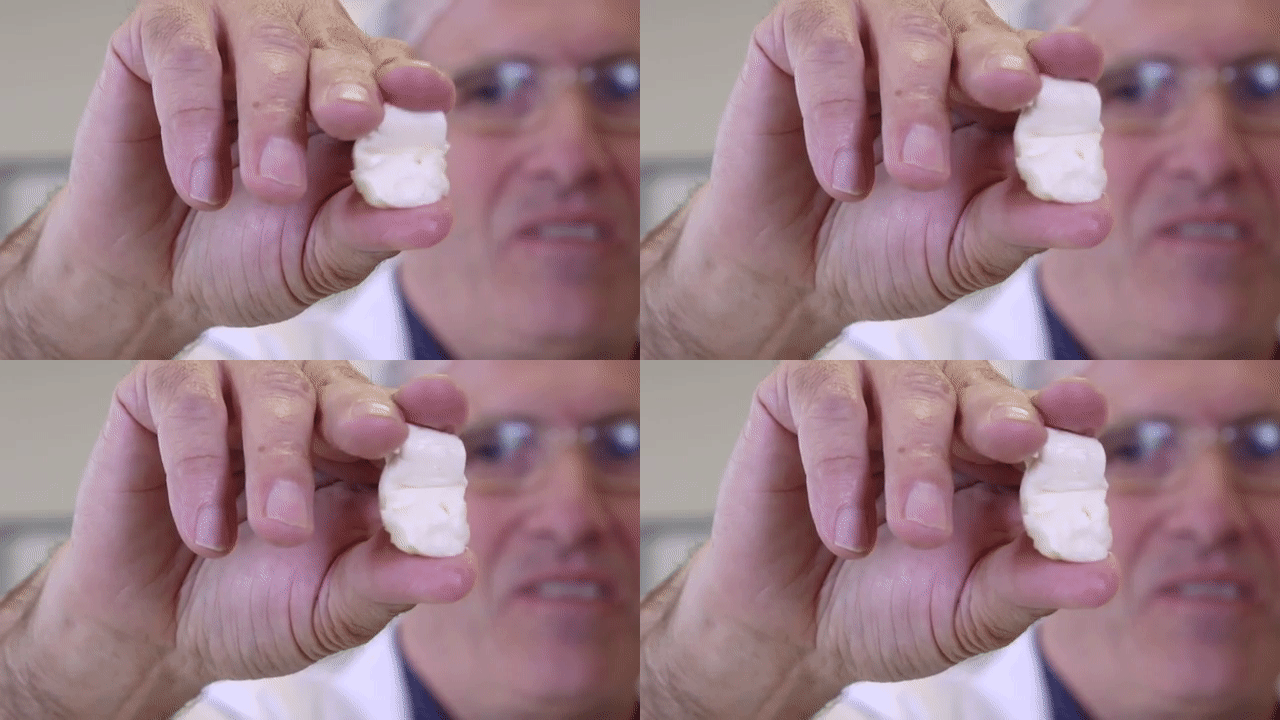
H/T to James Bow for the link.
October 26, 2017
QotD: The nutrition science is settled
Nutrition science is, in general, a bottomless stew of politics, guesswork, bogus data and poor statistical practice. I would call it “unsavoury” if that weren’t such an inexcusable pun in this context. Anyone who has read the newspaper for 10 or 20 years, watching the endless tide of good-for-you/bad-for-you roll in and out, must know this instinctively.
Colby Cosh, “MSG: The harmless food enhancer everyone still dreads”, National Post, 2016-04-18.
October 18, 2017
QotD: The course of economic progress in a nutshell
It is customary in these days of “slow food” to sneer at these devices, to aver that a real cook doesn’t need more than a cast-iron dutch oven, a good chef’s knife and a sense of adventure. As someone who took herself off to Chicago for three months with pretty much exactly this set of equipment (okay, also an electric pressure cooker), I can testify that this is true — sort of. You can get by with a very minimal set of equipment if you know how to cook. But as someone who has done so, I have to ask: Why would you?
I mean, yes, I know how to chop onions just fine. But doing so makes me cry like the dickens, unless I wear goggles. I know how to make great lemon curd, béchamel, hollandaise, caramelized onions. But my Thermomix makes them just as well, and I can read a novel instead of standing at the stove, stirring. I can whisk up an angel food cake in a copper bowl … or I could let the stand mixer do that, and my arms won’t hurt.
For that matter, I could also go out and grow my own wheat, mill it myself, and then mine some salt and cultivate some wild yeast to bake bread. But I don’t do these things, because subsistence farming is actually pretty arduous and unrewarding, which is why few of us have chosen to live off the grid. I see no reason to romanticize the grunt labor of the kitchen. If a machine does it as well as I do, and fits in my paycheck, I’ll happily outsource to the machine, and save my labor for the stuff the machine can’t do. This being basically the entire history of human economic progress to date.
Megan McArdle, “Give Thanks for Williams-Sonoma and the Garlic Press”, Bloomberg View, 2015-12-07.
September 10, 2017
In search of silphium, the lost herb of the Roman empire
Zaria Gorvett recounts the story of a Roman-era herb that was at one point literally worth its weight in gold:
Long ago, in the ancient city of Cyrene, there was a herb called silphium. It didn’t look like much – with stout roots, stumpy leaves and bunches of small yellow flowers – but it oozed with an odiferous sap that was so delicious and useful, the plant was eventually worth its weight in gold.
To list its uses would be an endless task. Its crunchable stalks were roasted, sauteed or boiled and eaten as a vegetable. Its roots were eaten fresh, dipped in vinegar. It was an excellent preservative for lentils and when it was fed to sheep, their flesh became delectably tender.
Perfume was coaxed from its delicate blooms, while its sap was dried and grated liberally over dishes from brains to braised flamingo. Known as “laser”, the condiment was as fundamental to Roman haute cuisine as eating your food horizontally in a toga.
[…]
Indeed, the Romans loved it so much, they referenced their darling herb in poems and songs, and wrote it into great works of literature. For centuries, local kings held a monopoly on the plant, which made the city of Cyrene, at modern Shahhat, Libya, the richest in Africa. Before they gave it away to the Romans, the Greek inhabitants even put it on their money. Julius Caesar went so far as to store a cache (1,500lbs or 680kg) in the official treasury.A coin of Cyrene depicting the stalk of a Silphium plant. (Source: 1889 edition of Principal Coins of the Ancients, plate 35, via Wikimedia)
But today, silphium has vanished – possibly just from the region, possibly from our planet altogether. Pliny wrote that within his lifetime, only a single stalk was discovered. It was plucked and sent to the emperor Nero as a curiosity sometime around 54-68AD.
With just a handful of stylised images and the accounts of ancient naturalists to go on, the true identity of the Romans’ favourite herb is a mystery. Some think it was driven to extinction, others that it’s still hiding in plain sight as a Mediterranean weed. How did this happen? And could we bring it back?

August 10, 2017
Words & Numbers: Has Tipping Gone Out of Control?
Published on 9 Aug 2017
In 1922, famed etiquette writer Emily Post advised her readers that 10% is the standard for tipping your waiter. Since then, “gratuity creep” has been so steady that tip jars are now ubiquitous and 25-30% is considered the rule in New York City. Uber once resisted this trend, but recently added a tipping feature to its app.
What is the economic rationale behind tipping? Does the usefulness of tipping diminish the more that a certain rate becomes an expectation? At a certain point, would it be better to do without the fuss involved and simply include that portion of a service-provider’s compensation in the wages paid by the employer?
Our valiant hosts, Antony Davies and James Harrigan explore these questions and more!
August 6, 2017
Shock, horror – “local or organic food is … often available only in Canada to the wealthy”
Chris Selley just got back from a European vacation, where he observed some odd German activity:
Last month, on vacation, I happened across what might be the platonic ideal of a fancy urban farmers’ market. The smell of wood smoke led me to a quiet street in Berlin’s leafy Prenzlauer Berg neighbourhood, where a man was smoking various kinds of fish in the middle of the road. As one does. There was a little mobile bicycle-powered coffee shop selling vastly overpriced espresso. There was the requisite improbably expensive produce and charcuterie and cheese. (My God, the cheese. Why do Canadians put up with our benighted dairy industry?) And to shock my Ontarian senses, there was a big booth selling local wines — which one could drink, out of glasses, in whatever quantities one saw fit, right there out in the open. Tipplers weren’t even confined to a secure pen. There wasn’t even a security guard!
Even more than at Toronto’s fancier farmers’ markets, it was abundantly clear this was a place for wealthy people with time to spare. And it never occurred to me that was a problem. A new study co-authored by Kelly Hodgins and Evan Fraser of the University of Guelph suggests it is, however — and a recent headline on the matter made my eyes roll so far back in my head I feared they might get stuck: “Access to ‘ethical’ food often available only to the wealthy, study says.”
“While eating local or organic food is often touted as superior from a health, environmental and oftentimes ethical perspective, such foods are often available only in Canada to the wealthy, with limited access for those living on lower or even middle incomes,” The Globe and Mail reported.
I know. I’m just as shocked as you are. Who would ever have expected that?
July 11, 2017
The 905’ers – “the bridge-and-tunnel barbarians at the city’s gate”
Sniffy Torontonians have apparently adopted the NYC snobs’ favourite term for out-of-towners:
Not satisfied by the socioeconomic barriers to fine dining, downtown gourmands imagine any behaviour not matching their arbitrary standards of etiquette to be uncouth, going so far as to label outsiders to their tribe with a distinct pejorative: “the bridge-and-tunnel crowd.”
Originally a derisive description for commuters to Manhattan (the earliest known instance of its use is found in the December 13th, 1977 edition of the New York Times), the term has been adopted by the inhabitants of urban centres across North America to further alienate outsiders. In Toronto, it is used interchangeably with “905er,” a reference to the common area code for the suburbs surrounding the city.
To fully grasp the classism and snobbishness inherent in the term’s use, one is best advised to revisit an episode of the second season of The Sopranos, in which an annoying bar patron in Manhattan refers to the well-meaning, but simple-minded Christopher as a “bridge-and-tunnel boy.”
There is much sense, but little grace, to the formulation of such a descriptor. The self-absorbed downtown-dweller, you see, requires constant justification for their choice of domicile. The idea that one could escape the claustrophobic propinquity of the city and its higher cost of living while still enjoying its cultural amenities and nightlife on occasion is an affront – a threat that undermines not only the urbanite’s domestic decision-making, but to some extent, their very identity.
[…]
That an expectation of sustenance from ordering food at a restaurant would be scoffed at represents, at least on some level, a misappropriation of values. Oh, yes: It’s definitely the suburbanite who balks at the $35 plate of deconstructed spaghetti who is the fool. Believe it or not, you can live in a home with a dual car garage and still watch Chef’s Table on Netflix – and even understand why one might travel to Chicago to experience a meal at Alinea. However, if a chef is offering a Saturday night prix fixe, they’re probably not Grant Achatz.
Furthermore, it seems that if only one side of the urban versus suburban divide must be labelled ill-mannered, it should be the allotment who greets the other for an economic infusion in their service sector with disdainful mockery. The summer is littered with festivals and three- to five-course restaurant specials purposely constructed as an invitation for out-of-towners to come and open their wallets, and yet, the derisiveness projected toward them suggests a suffix should be attached to the Field of Dreams axiom: if you build it, they will come … for you to disparage them.
July 6, 2017
Words & Numbers: Let Amazon Play Monopoly
Published on 5 Jul 2017
Amazon’s offer to buy Whole Foods for $13.7 billion sounds pretty great to both parties, but it seems that isn’t good enough. The proposal has a lot of people worried about Amazon becoming an indestructible monopoly, and the government is all too happy to step in and settle the issue. But this concern ignores consumers’ own preferences as well as business and entrepreneurial history. This week in Words and Numbers, Antony Davies and James R. Harrigan discuss the probable future of the Amazon-Whole Foods merger, what it could mean for us, and what it could mean for another once-equally feared corporation: Wal-Mart.


