
This Old House
Published on 22 Jan 2017Ask This Old House host Kevin O’Connor learns about the centuries-old art of making mead.
Time: A few hours of work, 1 year of aging
Cost: under $100
Tools:
FunnelShopping List:
Yeast
2x One-gallon jug
3 pounds of honey
Air lock cap
Marbles
Siphon tube
Home brewing sanitizerSteps:
1. Before beginning the home brew process, ensure the gallon jug, funnel, and siphon tube have been properly sanitized.
2. Fill up the gallon jug about a third of the way up with either tap or bottled water (don’t use distilled water).
3. Add 3 pounds of honey, then cap the solution and mix it up by shaking the jug.
4. Heat up water to 104 degrees in a pan and add yeast to dissolve it.
5. While the yeast is dissolving, you can add optional yeast nutrients to get a cleaner ferment.
6. Once the yeast is dissolved, use a funnel to pour the yeast solution into the jug.
7. Pour more water into the jug and top it off until you reach the neck of the jug.
8. Place air lock cap on top of the jug and pour a little bit of water into it to form a seal. This will prevent oxygen from getting in but will allow carbon dioxide to escape.
9. After a several weeks, once carbon dioxide has stopped releasing from the jug and fermentation is complete, it’s time to siphon the solution into a new, clean jug.
10. Ensure the siphon tub and second jug have been properly sanitized, then place the older jug higher than the new jug. Fill the siphon tube with water and gravity will pull the mead from one jug to the next. Ensure you only siphon liquid, leaving behind any solids at the bottom of the jug.
11. To fill up the void left behind from one jug to the next and limit exposure to oxygen, place a number of sanitized marbles into the new jug.
12. Place the air lock on the new jug. Leave that on for about a month and then place a regular cap onto the jug once bubbles no longer appear.
13. Leave the solution in a dark spot, like the basement for about a year for the mead to age properly.
March 12, 2018
How to Make Mead at Home
March 4, 2018
The dirty secret of a lot of “traditional” family recipes
At Atlas Obscura, Alex Mayyasi spills the beans about a lot of secret family recipes:
When Danny Meyer was gearing up to open his barbecue restaurant, Blue Smoke, there was one recipe he knew he had to have on the menu: his grandmother’s secret potato salad recipe.
“I told the chef, ‘My very favorite potato salad in the world was the one my grandmother made,’” Meyer recalls.
That’s a big statement coming from Meyer, a successful restaurateur who has earned Michelin Stars and founded the fast-casual chain Shake Shack. At the time, his grandmother had already passed away, but Meyer remembered that she kept recipes on three by five index cards. After a search, he found the right card and handed it to the restaurant’s chef, who invited Meyer to try it in the Blue Smoke kitchen.
When Meyer arrived, the sous chefs had a big bowl of potato salad that brought back memories of his grandmother. He tried it, smiled, and told the chefs, “That’s exactly right.” They grinned back at him mischievously. Eventually, Meyer broke and asked, “What’s so funny?” A chef pulled out a jar of Hellman’s mayonnaise and placed it on the table. Meyer looked at it, then realized that the secret recipe his grandmother had hoarded for years was on the jar. It was the official Hellman’s recipe for potato salad.
This actually seems to be a common phenomenon. The television show Friends even features a similar discovery, when one character, Phoebe, realizes that her grandmother’s “famous” chocolate chip cookie recipe came from a bag of Nestle Toll House chocolate chips.
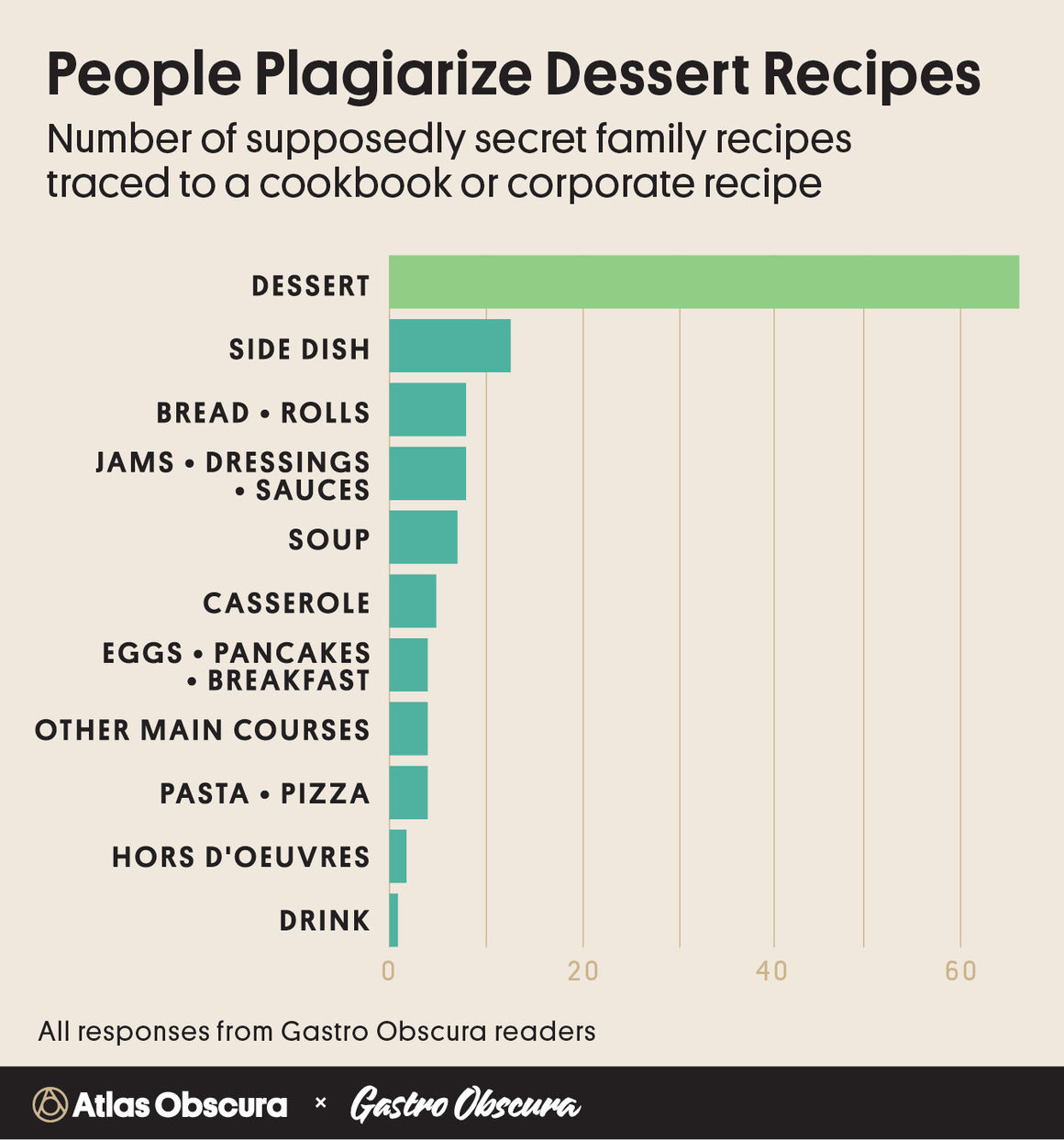
Two months ago, we asked Gastro Obscura readers to send in accounts of their own discoveries. We promised a (loving) investigation of grandparents lying about family recipes. But instead we got a delightful look at the power of imagination, the limitations of originality, and the halo effect of eating a dish or dessert made by family.
February 22, 2018
Dieting and mental health
Kaitlin Ugolik discusses her own recent experience of trying a new diet:
We don’t often discuss the mental impact of restrictive diets like Whole30 (no “inflammatory” foods), keto (low carb, high fat) or paleo (foods supposedly eaten during the Paleolithic era). People like to tout the weight loss and mood-boosting effects of these diets, but experts say they can push some of us toward disordered eating.
I tried Whole30 this January, and at first I kind of enjoyed it. I tend to get overwhelmed by options and confused about what’s the latest “right” thing to eat for breakfast, so it was nice to have guidelines. It gave me an excuse to make smoothies and try some new dinner recipes, too.
A few days in, though, I started noticing some disconcerting thoughts. I was reading the labels on everything and starting to think of anything that had any kind of processed sugar — cane sugar, brown rice syrup, anything — as “bad.” I also noticed that some of Whole 30’s carceral language was starting to stick in my head. Foods are labeled as “compliant” or “non-compliant,” for example. Knowing several people who have struggled with eating disorders, I wondered if diets like this, that say you can’t even eat beans or quinoa, might be a gateway to disordered eating for some people. The consensus among the experts I spoke to is that they are.
“All weight-loss diets work against learning to eat ‘normally’ according to appetite cues, which is also called intuitive eating,” said Karen Koenig, a Florida-based social worker who counsels people with eating disorders. “The more we restrict eating—by food type, weighing food, or by counting calories or fat grams—the more we ignore and override our body’s signals for hunger, satisfaction and fullness.”
While some people do benefit from restrictive diets because of their choice-limiting nature, like I did at the beginning, many have a hard time not taking it to the extreme. Most people are taking part in these diets as part of some kind of goal, whether it’s to lose weight, clear up their skin, or just feel better. If (and more likely when) it doesn’t work, it’s normal for anyone to get frustrated. But for people who are already prone to anxiety and obsessive thinking (*raises hand*) or those who have “addictive personalities,” a detox or diet can actually lead to something much more dangerous.
February 21, 2018
British KFC outlets fall fowl of distribution fustercluck
The BBC reports on recent supply disruptions that have forced the majority of British KFC restaurants to close or run reduced hours:
KFC says some of the outlets which had to close when delivery problems meant they ran out of chicken have reopened.
Latest figures show that 470 of the fast-food chain’s 900 outlets in its UK-based division were shut as of 13:00 on Tuesday.
That compares with 575 that were closed at 21:00 on Monday.
Last week, the fried chicken chain switched its delivery contract to DHL, which has blamed “operational issues” for the supply disruption.
Earlier a KFC spokesperson said: “We anticipate the number of closures will reduce today [Tuesday] and over the coming days as our teams work flat out all hours to clear the backlog.
“Each day more deliveries are being made, however, we expect the disruption to some restaurants to continue over the remainder of the week, meaning some will be closed and others operating with a reduced menu or shortened hours.”
[…]
Until 13 February, KFC’s chicken was delivered by specialist food distribution group Bidvest.
But after the contract switched to DHL, many of the food giant’s outlets began running out of chicken products.
The GMB union said it had tried to warn KFC that switching from Bidvest to DHL was a mistake. The change led to 255 job losses and the closure of a Bidvest depot, said Mick Rix, GMB national officer.
He said: “Bidvest are specialists – a food distribution firm with years of experience. DHL are scratching around for any work they can get, and undercut them.
“KFC are left with hundreds of restaurants closed while DHL try and run the whole operation out of one distribution centre. Three weeks ago, KFC knew they had made a terrible mistake, but by then it was too late.”
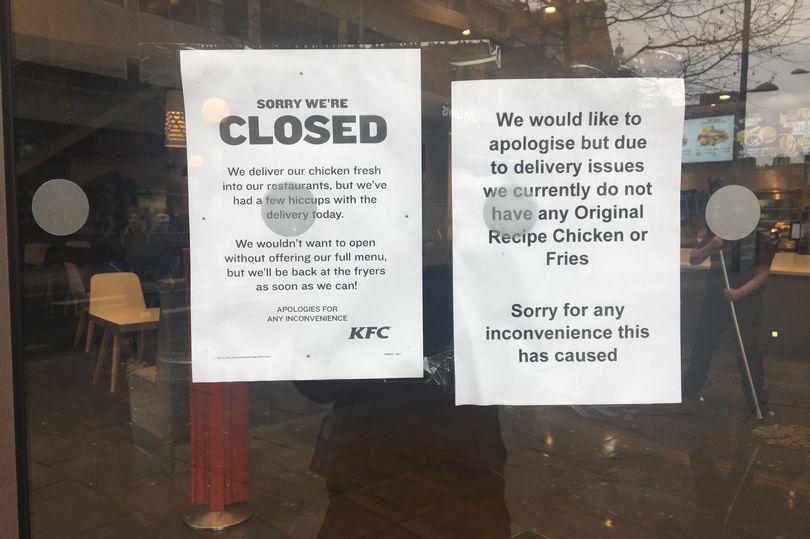
Signs posted in a KFC store window in Nottingham
Photo from the Nottingham Post (click image to read their article)
H/T to Jim Guthrie, who said “I suspect that this will be a ‘how not to do it’ example in delivery logistics for years to come.”
February 12, 2018
Australia’s unique contribution to hamburger culture – beetroot
On one of my mailing lists, an Australian member made a bit of a to-do about the only “proper” burger having “beetroot” on it, along with other (one assumes lesser) condiments. Having been pranked more than once by Aussie friends, I was sure he was just doing his bit to wind up the American burger purists on the list. Yet, a very cursory search produced this article from back in 2014 that appears to fully back the original assertion:
Australian hamburger sightings started during the ’30s: a by-product, no doubt, of our blossoming post-first world war relationship with America, but it wasn’t until the 1940s that beetroot began regularly appearing alongside tomato, lettuce and onion on burgers. That was thanks largely to the openings of the Edgell and Golden Circle canneries in 1926 and 1947 respectively – but one of the more interesting theories, however, suggests the trend has its origins in pranking US troops ashore on R&R.
“Maybe it was our desire not to be Americanised?” ponders Warren Fahey, Australian folklore collector and author of Australian food history compendium, Tucker Track. “For some reason the idea of hamburger wrapping stained by beetroot juice was accepted as the sign of a great hamburger. People get quite emotional over the subject of Australian hamburgers. Some say a real hamburger must have slices of canned beetroot and others still declare its inclusion as a travesty.”
According to Fahey, beetroot on burgers had its heyday in the ’50s and ’60s. Following the simultaneous 1971 arrival of fast food’s big two – the first McDonald’s opened in the Sydney suburb of Yagoona, while Hungry Jacks, the Aussie nom de plume of Burger King, began its Aussie campaign in Innaloo, just north of Perth – the combination’s popularity began to wane, as did that of milk bars, beachside kiosks and other traditional hamburger vendors.
Despite the sustained growth of American franchises, however, Australia’s burger-with-beetroot population remains stable. Even once the big players pull their seasonal go-Aussie burgers after 26 January, the odds of finding a beetroot-enriched specimen at a neighbourhood lunch bar or new-wave “gourmet” hamburger chain remain good.
[…] the country’s last Australian-owned cannery shut in 2013. Fortunately, the signs are promising that farmers in Queensland’s Lockyer Valley might soon have a processing facility to call their own. It’s a cause we can all get behind, not just for the sake of a rural Australian community, but in the name of national pride: an Aussie hamburger made using beetroot processed overseas just doesn’t seem fair dinkum.
A New Zealand member of the list also chimed in, saying that beetroot was an essential component of Kiwi hamburgers as well. While it might sound weird, it’s probably no more so than pickles or relish as a burger topping, once you get used to it.
Update: In 2017, New Zealand McDonald’s re-introduced the Kiwiburger, including beetroot:
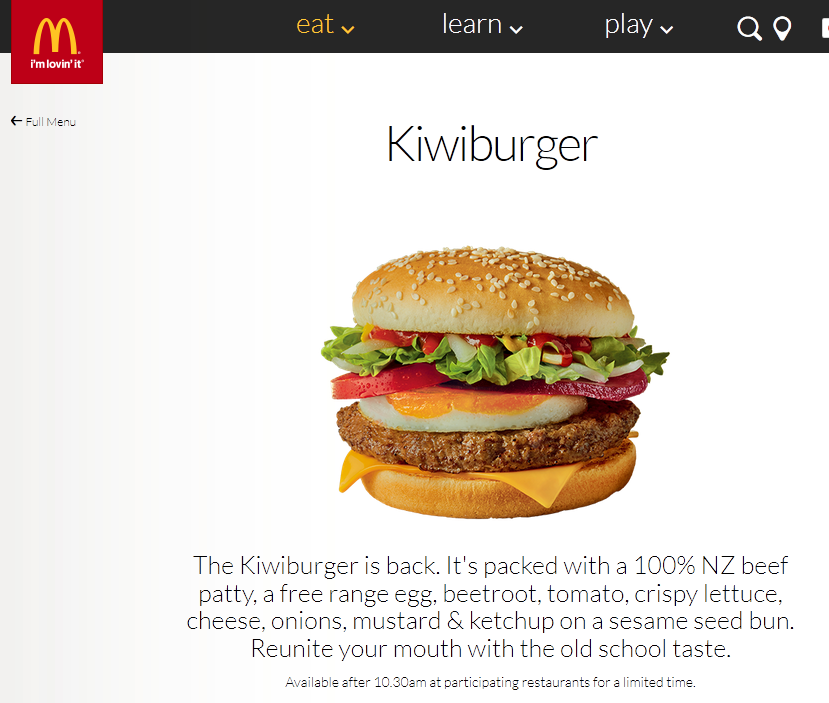
So, you can get your beetroot burger fix in both Australia and New Zealand (for a limited time, anyway).
February 11, 2018
Bay area food entrepreneurs shut down by local health authorities
In Reason, Baylen Linnekin recounts the rise and fall of Josephine, an online operation intended to connect home cooks with willing buyers:
A dozen or so years ago, as my friend Dave was planning a move from Washington, D.C., to Philadelphia, he used the need to clean out his fridge before the move as an excuse to offer a half-empty jar of homemade kimchi for sale on Craigslist. While I don’t think the kimchi sold, Dave’s effort opened my eyes to the seemingly limitless possibilities of homemade online food sales.
The truth is that while those possibilities are limited theoretically only by imagination, they very often bump up in the real world against — to paraphrase Waylon Jennings — the limits of what the law will allow.
That truth was evident last week, when Bay Area food startup Josephine announced it will close its doors in March.
As I described in a Sacramento Bee op-ed in support of Josephine last year, the company launched nearly four years ago with a mission to provide cooks who are typically underrepresented in restaurant leadership — including women and immigrants — with a platform by which to sell home-cooked meals with their neighbors.
It’s a cool idea. And it worked quite well for a time. That is, as I noted, until local health officials “sent cease-and-desist letters to several Josephine cooks.”
Josephine responded by trying to work with lawmakers and regulators, pushing a bill in the state legislature that would provide some legal avenue for its cooks. Despite the fact that the bill is now moving through the California legislature, the company decided its passage would be too late for Josephine and its funders.
Josephine didn’t have to die. The regulations that have made it impossible for the company to operate should have died instead. But its fate mimics that of other similar home-food startups. A similar New York-based startup, Umi Kitchen, flamed out last year after just four months of operations. I wrote an appreciation of Forage Underground Market, the inventive San Francisco food swap that was shuttered by California state and local health authorities, way back in 2012. And I predicted at the time the food underground movement was just beginning to blossom.
Sriracha Sauce and the Surprisingly Heartwarming Story Behind It
Today I Found Out
Published on 18 Jan 2018In this video:
The genesis of Sriracha hot sauce (pronounced sir-ah-cha, contrary to what many think) becoming the condiment staple it is today can be traced back to 1975 and an unassuming Vietnamese refuge called David Tran – the founder and current CEO of Huy Fong Foods.
Want the text version?: http://www.todayifoundout.com/index.p…
January 27, 2018
Burger King swings and misses in their first attempt at entering political discussions
Tho Bishop explains why the second-rate burger business fails to convince:
For one, Burger King does not have a “Whopper neutrality” policy – and for good reason. If a family of five places a large order, while the next customer simply orders an ice cream cone, most Burger King employees will not refuse to serve up the dessert until after they fulfill the first order. The aim is to serve as many customers, as quickly as possible.
Similarly, a Whopper meal comes in various sizes – all with different prices – all so that customers have more flexibility based on having their food desires met. Imagine if a government regulator decided that since Americans have a right to have their thirst quenched – no matter its size – all fast food restaurants had to price all drink sizes the same? The result would be the prices for small drinks going up, while restaurants having to submit to occasional inspections by government agents to make sure no one was violating beverage neutrality laws. (This of course would still manage to not be the worst soda-related policy that’s been proposed.)
Additionally, Burger King certainly has the right to not prioritize delivering their customers food in a timely matter, just as customers have a right to avoid their services as a result. Whether or not the customers in the video were authentic or not, their reaction to the absurd fictional policy is how you’d expect someone to act. The video suggests that none of them would be excited about returning to Burger King if this had become actual franchise operating procedure. Once again, the market has its own ways of punishing bad actors.
Which is precisely why I will be avoiding Whoppers myself for the foreseeable future.
At Reason, Nick Gillespie comments on the video:
The joke in the video is that customers must pay $26 to get a Whopper “hyperfast.” If they go with the standard price, it takes forever. Because you know, Net Neutrality rules that were formalized in 2015 somehow magically altered the way internet service providers (ISPs) delivered data to their customers. Before 2015, the internet was a morass of shakedown artists who forced all of us to pay extra for this or that site. And now that Net Neutrality has been repealed, the ‘net has reverted to a Hobbesian world in which access is nasty, brutish, and metered.
Oh wait, in fact, the average speed and number of internet connections kept growing regardless of the regulatory regime. The FCC’s most recent Internet Access Services Report counted 104 million fixed internet connections, a new high. That number doesn’t count mobile or satellite connections. Eighty percent of census tracts had at three or more ISPs offering connections of 10 Mbps downstream and 1 Mbps upstream and another 17 percent had two ISPs doing the same (figure 4). So 97 percent of America can go elsewhere when it comes to basic internet connections that allow the sort of streaming, surfing, and gaming we want. Just as customers do with Burger King, we can say, “Screw it, I’m going to McDonald’s.” In 2016, 56 million residential connections offered at least 25 Mbps upstream speeds. That’s up from about 22 million in 2013 (figure 8). How did that progress happen before the 2015 open internet order?
Watching the responses by customers helps explain why Net Neutrality rules as mandated by the FCC under Tom Wheeler were unnecessary. After all, for all the hysteria kicked up around the need for such rules, proponents went begging for examples of ISPs throttlng traffic or blocking sites in systematic ways. ISPs don’t actually enjoy pure-monopoly conditions, but even if they did, customers would raise holy hell if they were treated as poorly as Burger King acts in this video.
January 13, 2018
Fast Food – Would You Like Capitalism With That? I THE COLD WAR
IT’S HISTORY
Published on 8 Jul 2015A city that is not plastered with branches of US Fast Food chains is a rare sight nowadays. That wasn’t always the case. Fast Food, as we know it today, is a child of the economic boom after World War 2. Taking your new car for a ride to the Drive-In restaurant and getting a fresh burger; that’s the American Dream right there. Ultimately the concept of identical taste and identical manufacturing steps is one thing: pure capitalism. Food chains keep wages and costs as low as possible and that is why Fast Food is not nearly as glamorous today as it once was. So put down that Hamburger and find out all about the history of Fast Food with Guy on IT’S HISTORY.
Big Mac Index: http://bit.ly/TheBIGMACIndex
December 31, 2017
Who Invented Hawaiian Pizza?
Today I Found Out
Published on 4 Dec 2017In this video:
On June 8, 2017, Greek-born, Canadian-bred pizza maker Sam Panopoulos died. His career slinging pies was rather unremarkable save for one notable thing – he was the inventor of the popular, yet infamous pineapple-topped “Hawaiian Pizza,” named as such because of the brand of canned fruit he used. Loved by some and hated by others, the sweet and salty pizza is so controversial that it once triggered an argument between friendly nations. While such arguments rage on both sides of it being a delicacy or an abomination, the fact is that the Hawaiian pizza is actually not Hawaiian – it’s Canadian. Here now is the story of pizza and the man who decided to add pineapples to it.
Want the text version?: http://www.todayifoundout.com/index.p…
December 26, 2017
QotD: Most consumers say they want local-grown food, but won’t pay the costs to get it
Food grown locally, on small-lot farms without modern chemical assistance, is really expensive. The complex modern food-supply chain that ensures restaurants and food processors can get the same consistent mix of staple ingredients year-round also relentlessly beats down the price of food, sourcing wherever supply is cheapest, redistributing temporary local abundance to a steady global diet of everyday low prices. This is also not such a terrible way to eat; it is the foundation of much of our modern prosperity. But it is not local, artisanal, organic. It is global, industrial, indifferent. It has to be, both because organic inputs are much more expensive, and because trying to separate and track all the food so that restaurateurs can be sure of provenance and process would mean abandoning many of the efficiencies that make the stuff so cheap.
And Americans expect cheap. Cheap, after all, is what makes it possible for us to spend so much money at restaurants; if we had to pay all the workers $20 an hour and ensure that all our meat and produce had been farmed in the latest and most approved 19th-century methods, few of us could afford to have weekly dining out in our budget. Restaurants might be more authentic, delicious, moral places. They would also be much emptier ones.
Reading the Tampa Bay Times article, you get the sense that many of these restaurateurs tried to provide an authentic farm-to-table experience and found that customers were not willing to pay what it would cost — in money or variety — to have one. People are probably willing to pay some premium for that kind of food, but the premium is probably closer to 10 to 15 percent than it is to the sky-high sums that it would actually cost to rely on those sorts of farms, those sorts of methods. So the restaurateurs inevitably sold them what they were happily willing to pay for: food from an industrial supply chain, with a side of moral satisfaction.
It’s hard to be too angry at consumers. To be sure, they probably should have known that you couldn’t really buy organic, locally sourced food year-round at just a smidge more than you’d pay for a regular meal. After all, the average American spent half their income on food in 1900, while the modern American now spends a paltry 12 percent, even including a lavish helping of restaurant meals. That should give us some sign that local, artisanal food is not going to be cheap. But most Americans are not economic historians.
But it’s not even that easy to be mad at the restaurants. They’re in a viciously competitive business where most places don’t survive. In a competitive equilibrium where so many people want to be told they’re eating farm-fresh food — and so few people seem willing to pay for it — many of them probably feel that their choice is “lie or die.”
Megan McArdle, “Dining Out on Empty Virtue”, Bloomberg View, 2016-04-15.
December 8, 2017
QotD: Why mid-20th century Americans ate what they did – 7
Entertaining was mandatory [in the 1950s]. Because people didn’t go to restaurants so much, they spent time having people over, or eating at someone else’s house. If someone had you over, you had to have them over. This meant people had to have “company dinners” they could make, or at least a stock of canapés they could throw together for a cocktail party, even if they weren’t very good at it. Cue the weird focus on prettying everything up, more than occasionally to the detriment of the food itself: if you can’t make it good, you can at least make it pretty, to show people you made an effort.
Megan McArdle, “Friday Food Post: The Economics Behind Grandma’s Tuna Casseroles”, Bloomberg View, 2015-10-30.
December 7, 2017
QotD: Why mid-20th century Americans ate what they did – 6
Look at the sources of our immigrants. Immigration is still the major way that countries get new foods (if you don’t believe me, go out for Mexican food in any European country and report back). With the notable exception of the Italians, in the 19th century, most immigrants were from places with short growing seasons and bland cuisines, heavy on the cream and carbohydrates. After we restricted immigration in the 1920s, that’s what we were left with until immigrants started coming again in the 1960s. Of course, Louisiana had good French food, California and Texas had a Mexican influence, but by and large what we ate in 1960 was about what you’d expect from a German/English/Irish/Eastern European culinary heritage, adapted for modern convenience foods. And people liked it for the same reason I like jello salad: It’s what they were used to.
Megan McArdle, “Friday Food Post: The Economics Behind Grandma’s Tuna Casseroles”, Bloomberg View, 2015-10-30.
December 6, 2017
QotD: Why mid-20th century Americans ate what they did – 5
There were a lot of bad cooks around. These days, people who don’t like to cook, or aren’t good at it, mostly don’t. They can serve a rich variety of prepared foods, and enjoy takeout and restaurants. Why would you labor over something you hate, when someone else will sell you something better for only slightly more than it would cost you to make something bad?
In 1950, the answer was “because we’re not made of money.” A restaurant meal was a special treat, not a nightly event, and prepared foods were not so widely available, in part because women tended not to work, but also because food processing technology was so advanced. So women had to cook whether they liked it or not. Many of them didn’t like it, so they looked for ways to reduce the labor involved. And it’s far from obvious that what they did with those shortcuts was worse than what they would have done without them. Think of the kind of casserole a bad cook might have made without canned soup and frozen vegetables. She’d probably have boiled the vegetables, because that’s the easiest way to prepare them, and boiled them to death, because she wasn’t too fussy about timing. (Out of season, those vegetables would have been limited to a few hearty root vegetables.) If there was a sauce, it probably would have been horrible. Let’s not even start on what she might have done with the meat. Canned soup and frozen vegetables start sounding pretty good.
That was the baseline most people were working off. They were not comparing what they ate to what they might have gotten at a good restaurant; they were comparing it to what they would have gotten without the shortcuts, because, to reiterate, most of them rarely ate at a good restaurant.
Modern food writing has an enormous selection bias. The median cookbook reader is a much better cook, and much more interested in food, than the median audience of recipes from decades past. The bad cooks, the indifferent cooks, the folks with the cast iron palates and Teflon stomachs, are all off doing something else. And since good cooks tend to raise good cooks, the median food writer waxing lyrical about Grandma’s homemade beef stew doesn’t realize just how many bad cooks were around. Or that recipes needed to be written for them, because however limited their talents or interest, they still had to put a meal on the table every night. A lot of terribly mediocre recipes are floating around from the era, and that’s exactly what most of the terribly mediocre cooks were looking for.
Megan McArdle, “Friday Food Post: The Economics Behind Grandma’s Tuna Casseroles”, Bloomberg View, 2015-10-30.
December 5, 2017
QotD: Why mid-20th century Americans ate what they did – 4
The foods of today’s lower middle class are the foods of yesterday’s tycoons. Before the 1890s, gelatin was a food that only rich people could regularly have. It had to be laboriously made from irish moss, or calf’s foot jelly (a disgusting process), or primitive gelatin products that were hard to use. The invention of modern powdered gelatin made these things not merely easy, but also cheap. Around 1900, people were suddenly given the tools to make luxury foods. As with modern Americans sticking a flat panel television in every room, they went a bit wild. As they did again when refrigerators made frozen delights possible. As they did with jarred mayonnaise, canned pineapple, and every other luxury item that moved down-market.
Of course, they still didn’t have a trained hired cook at home, so the versions that made their way into average homes were not as good as the versions that had been served at J.P. Morgan’s table in 1890. But it was still exciting to be able to have a tomato aspic for lunch, in the same way modern foodies would be excited if they found a way to pull together Nobu’s menu in a few minutes, for a few cents a serving.
Over time, the ubiquity of these foods made them déclassé. Just as rich people stopped installing wall-to-wall carpeting when it became a standard option in tract homes, they stopped eating so many jello molds and mayonnaise salads when they became the mainstay of every church potluck and school cafeteria. That’s why eating those items now has a strong class connotation.
Megan McArdle, “Friday Food Post: The Economics Behind Grandma’s Tuna Casseroles”, Bloomberg View, 2015-10-30.


