
The Tank Museum
Published 26 Sept 2025King Tiger V2. It’s the oldest surviving King Tiger in the world. And it’s also the only King Tiger that survives with the unusual pre-production turret. This has, in the past, been referred to as the “Porsche Turret”. But why? And why did they change the turret on later models?
There are many misconceptions and rumours about this tank – the most common of which that the turret was built by Porsche. It wasn’t. How did it end up on this tank? Well, that’s a bit of a confusing story, but it was basically down to Krupp and Henschel working on a winning design.
The production of King Tiger would begin with three prototypes: V1, V2 and V3 – and the V stands for Versuchs, the German word for trial. V1 was a mild steel prototype that was used for demonstrations, and V3 was used as an engine test rig. V2, however, was retained for testing by Henschel and was captured by the US Army before being handed over to the British.
V2 left Germany in one piece, but by the time it reached Bovington in 1952 a number of parts had gone astray – most notably, the gearbox! King Tiger V2 is now a star of The Tank Museum’s collection, and the team have now begun to assess whether a restoration might be possible…
00:00 | Introduction
02:37 | Is it a Porsche?
06:15 | Krupp Gets Lucky
12:52 | V2: Today and Tomorrow
17:34 | V2: The Future
(more…)
January 19, 2026
King Tiger V2 – Inside The World’s Oldest Tiger II
QotD: Epaminondas and the defeat of Sparta at Leuctra
In 371 BCE, the Theban General Epaminondas did battle with Sparta at the height of its power. Sparta, having won the Peloponnesian War 33 years earlier, dominated Southern Greece and carried an invincible reputation. They were unstoppable, and they were coming. Thebes and the rest of the Boeotian city-states, led by Epaminondas, needed a way to fight back.
Epaminondas led a smaller force (some 6,000 to Sparta’s 11,000, though historians debate the exact numbers) to a field in front of a Boeotian village called Leuctra. The Battle of Leuctra would not only mark the beginning of centuries of Spartan decline, but also change the way Greek armies battled all the way through the conquests of Alexander the Great.
How did Epaminondas do it? How could he upend the mighty Spartan empire with a force barely half the size? The answer lay in resource allocation, patience, and 300 extremely important gay men.
If you had the misfortune of fighting against a Spartan army in the last few centuries BCE, you had to contend with a phalanx of hoplites. Thousands of men would align shoulder to shoulder, stick out their shields and spears, and push. You probably had a phalanx of your own, but against the Spartan line, you stood no chance.
Epaminondas didn’t have the numbers to directly contend with the Spartan phalanx, but he did have a specific elite force: the Sacred Band of Thebes. The Sacred Band was made of 300 hand-picked warriors paired off into homosexual couples. The idea was that lovers would fight more fiercely for each other.
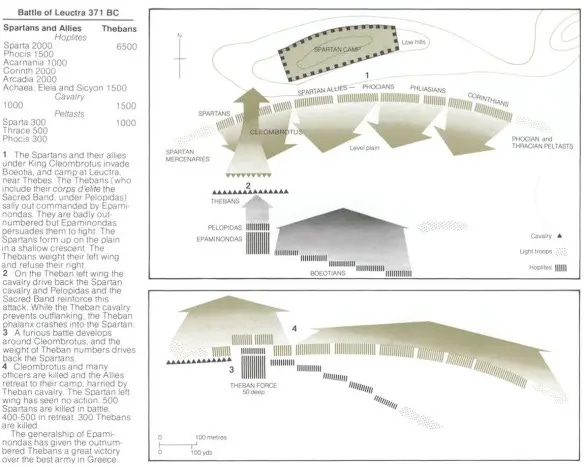
Instead of a futile effort to out-push a force half their size, the Boeotians overloaded one side. They put a majority of their force on the left side, thinning out the right. They advanced this overloaded left wing before the weaker right wing, hoping to win before the Spartans could fully engage.
The Boeotian left wing, led in part by the Sacred Band, broke through the Spartan line. With enemy forces charging the side and rear, the Spartans quickly routed. When the dust settled, Epaminondas inflicted upon the Spartans one of the most decisive blowouts in Greek history.
Diagram courtesy of WarHistory.org
Over 1,000 Spartans perished in the Battle of Leuctra, including their king and military leader Cleombrotus. The Boetians lost around a hundred, but exact estimates are hard to come by. By anyone’s estimate, their casualties paled in comparison. Sparta’s military reputation would never recover, and the next 200 years marked an era of Spartan decline.
Epaminondas didn’t invent the phalanx. In fact, it’s unclear who really did. There is evidence of a similar strategy in Sumer over 2,000 years earlier. It’s a fairly basic idea — everyone hold your shields together and push. But Epaminondas did advance the strategy. Others would continue to innovate on Epaminondas’ “oblique” advance, up to and including Alexander the Great.
Luke Brown, “Pushing Tush Is Ancient Technology”, Wide Left, 2025-10-13.
January 18, 2026
Who Will Be Chancellor? – Rise of Hitler 27, January 1933
World War Two
Published 17 Jan 2026Back to monthly coverage for this month, because too much is happening in Germany just now. Franz Von Papen meets with Adolf Hitler as 1933 gets going, both of them scheming against Chancellor Kurt von Schleicher. Could they possible form a coalition government with a majority of the Reichstag? Can they even trust each other? Also, who is this von Ribbentrop character? And what’s up with President Hindenburg’s son Oskar? So much going on this month, and when it all reaches its head … just … wow!
(more…)
Mark Carney’s actual jobs before becoming Prime Minister
On the social media site formerly known as Twitter, Ezra Levant explains the various jobs Mark Carney has held compared to what many Canadians think he’s done:
Laura Stone @l_stone
Unifor President Lana Payne calls China EV deal “a self-inflicted wound to an already injured Canadian auto industry”. Says providing a foothold to cheap Chinese EVs “puts Canadian auto jobs at risk while rewarding, labour violations and unfair trade practices”. #onpoliI think there’s a misconception amongst Canada’s chattering classes that Mark Carney is an experienced and successful businessman and executive.
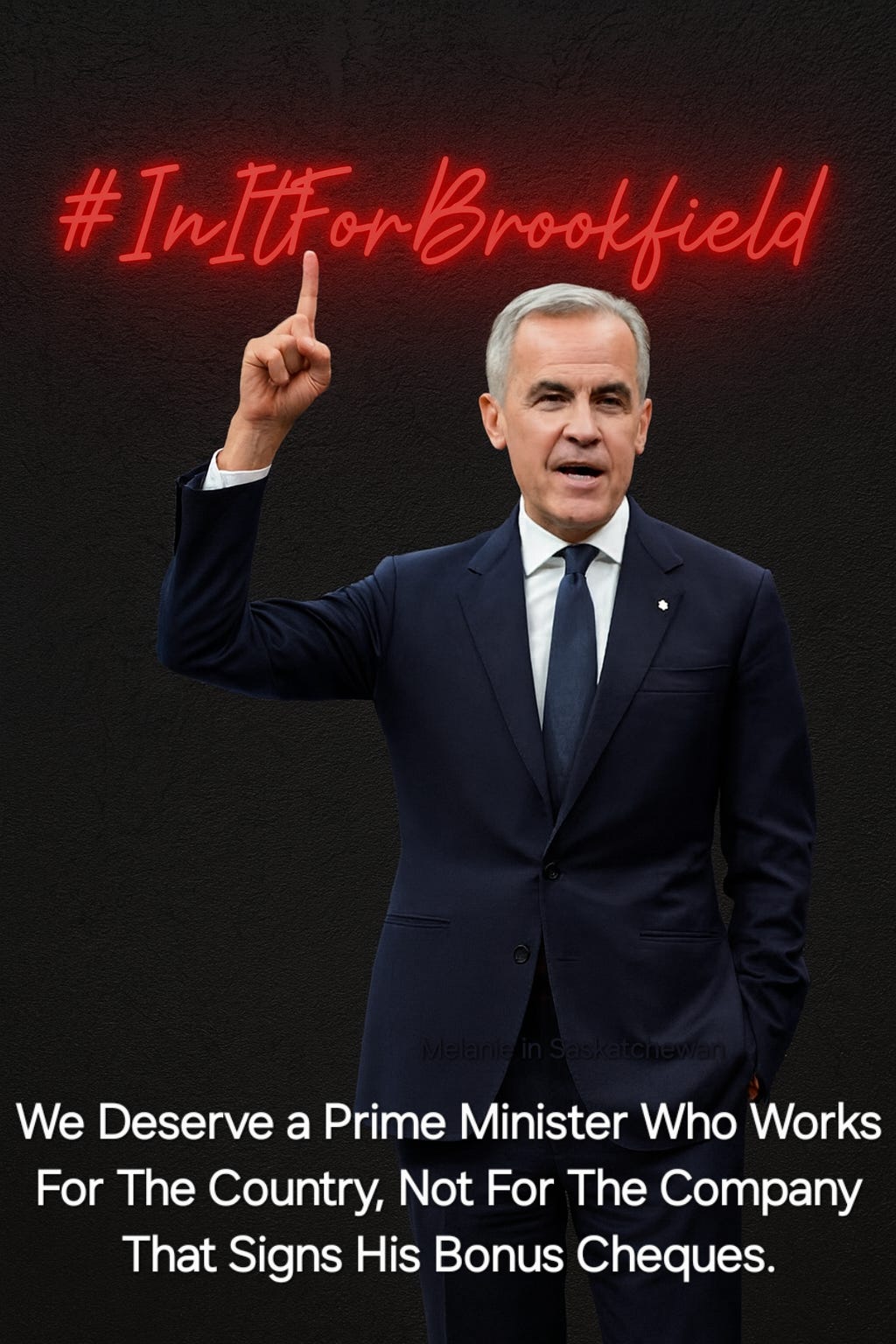
He wasn’t. He wasn’t CEO of Brookfield. He was its chairman, overseeing quarterly board meetings and spending the rest of his time flying around to different globalist conferences at the UN or WEF.
He was more of a mascot, a symbol, an ambassador of Brookfield. He didn’t negotiate deals or turn around companies. He did photo-ops.
Before that, he worked at the Bank of England, and before that, the Bank of Canada.
No Googling: can you name a single actual duty of that job? Can you tell me what Carney actually achieved?
He wafted up from fake job to fake job — like Justin Trudeau did, but instead of being a surf instructor and a substitute teacher, he had meaningless executive jobs.
And now when it’s time to shine … he doesn’t know what to do.
It’s been a year, and he has no deal with Trump, despite saying that was his chief focus.
What exactly did he achieve in Beijing? The tariffs against Saskatchewan were lifted — so that merely brings us back to the status quo ten months ago. Nothing else. No investments in Canada, which was the pretext of the trip. Just a capitulations, to allow the dumping of 49,000 Chinese EV cars, with their spyware and malware.
But he looks good in a suit and says ponderous words like “catalyze” and “transformative”. And that’s enough to impress the Parliamentary Press Gallery. Not that they needed much impressing — they’re all on his payroll already, through his massive journalism subsidies. They’re too busy holding the opposition to account to take notice of this latest disaster.
But the regime media shouldn’t feel too bad about being conned. Carney tricked Doug Ford pretty good, didn’t he?
January 17, 2026
Shout Out UK – “… embracing right-wing extremism will give you a shot at getting a manic pixie dream girl gf”
At Postcards from Barsoom, John Carter looks at the most amazing political own-goal I’ve encountered in a long, long time:
Somewhere in the suffocating fog of the unhappy and restless Yookay, a minor functionary of the government’s behavioural shaping bureaucracy is staring at her computer screen in appalled alarm at the horror she’s accidentally helped to summon from the churning depths of the Immaterium.
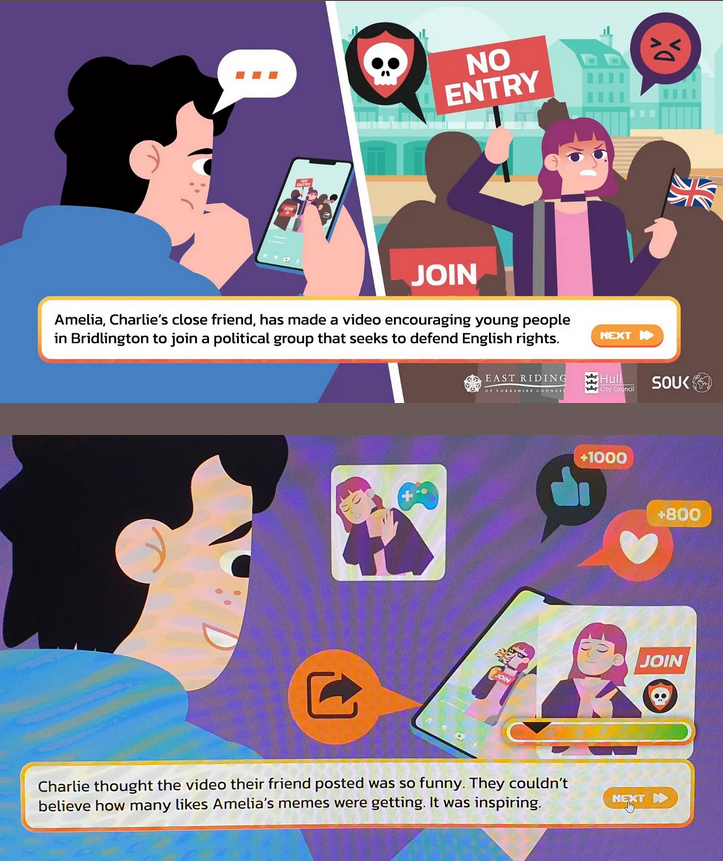
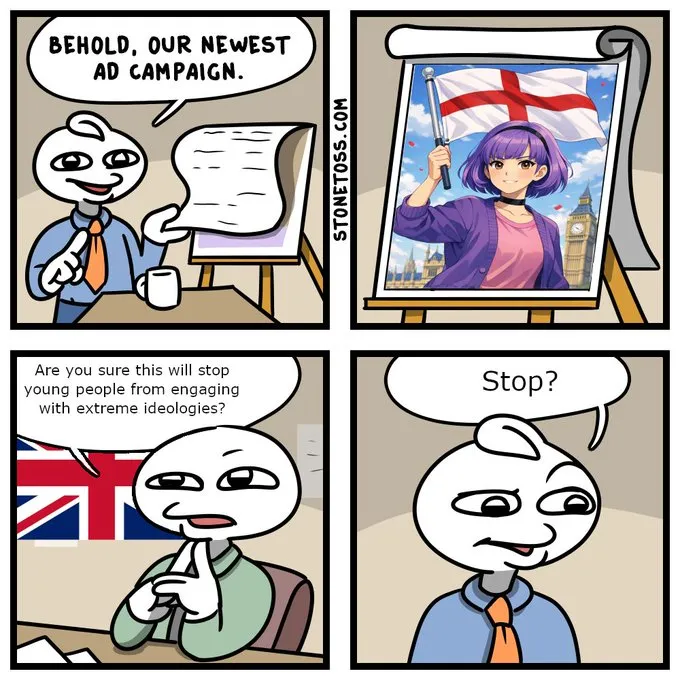
Shout Out UK, which describes its mission as “countering disinformation through political and media literacy”, released a “visual novel” called Pathways, subtitled “navigating the Internet, gaming, and extremism”. The game itself is of course terrible, a ham-fisted “teaching aid” intended to remind British teenagers that even innocuous and entirely peaceful activities – downloading memes, speaking your mind, watching videos, researching things for yourself, attending rallies – will complicate their lives if they draw the concerned and empathetic eye of the managerial state, which after all just wants what’s best for them.
Prevent, if you haven’t heard of them, are a group of government-funded busybodies whose remit is to prevent extremism via early intervention, catching impressionable youth before they can be radicalized. The organization was nominally started to deal with Islamic terrorists, but in recent years it has focused on the “right-wing extremism” of the native British to the exclusion of all else. The Southport butcher Axel Rudakubana, for instance, was referred to Prevent multiple times for his open glorification of white genocide, which Prevent ignored completely.
The player can choose either a male or female character, both of whom are amusingly and awkwardly referred to with they/them pronouns, with grammatical abominations such as “Charlie decided to look for themselves” sprinkled throughout. The character is then placed in a series of scenarios and made to choose between good and bad options: downloading extremist content or telling an adult; agreeing with a classmate that ethnic minorities are being shown favouritism at the expense of native youth vs clapping back at her unconscionable bigotry; watching a video and reading more about the subject or ignoring it; accepting or refusing an invitation to join a secret group chat; attending an anti-immigration rally or staying home. If you make the bad choice, a little “extremism meter” goes into the red.
[…]
If you want to play the game for yourself, your best bet is probably to download the archived version of the Government Approved Goth Girl Dating Simulator. I was able to play it a week ago, but since then it gets stuck on the loading screen, which at first I thought was because they’d taken it offline, but is probably just because Shout Out UK has gotten DDOSed by an entirely unexpected surge of interest in their execrable product (or maybe it’s just that the Shout Out UK website has a dead link on its page, as after poking around a bit on their website I was able to find one that works). Alternatively, you can find most of the screenshots archived here.
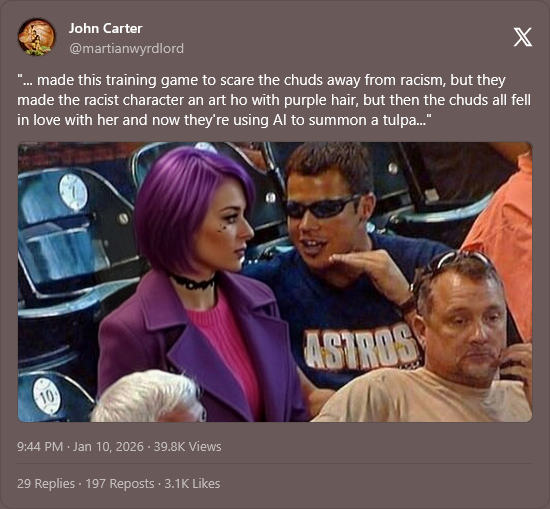
Had it not been for one unfortunate creative choice made by the development team, no one would have taken any notice of Pathways. It would have been one of countless cringe-inducing training aids churned out by regime-adjacent quangos cashing in on the flood of taxpayer lucre sluicing through the DEI-and-disinformation industry. But for some reason, which can be explained only by a calamitous failure on the part of Shout Out UK to develop an accurate theory of mind for their target audience, the creators of Pathways decided that it would be a great idea to cast the awful bigot leading the protagonist step by step to his ideological doom in the form of a cute alt girl, thereby sending the message that embracing right-wing extremism will give you a shot at getting a manic pixie dream girl gf.

Update, 18 January: Welcome, Instapundit readers! Have a look around at some of my other posts you may find of interest. I send out a daily summary of posts here through my Substack – https://substack.com/@nicholasrusson that you can subscribe to if you’d like to be informed of new posts in the future.
How would Greenlanders cope with a sudden case of American citizenship?
Only a minority of Canadians would welcome Donald Trump’s offer to become the 51st state, and Canadians have a long history of coping with the overflow of American politics across the border. Greenland is suddenly a target for involuntary statehood if Trump gets his way, yet few seemed to be concerned how the actual people in Greenland feel about this proposed change of legal status:

Satellite view of Greenland, Iceland, and parts of Northern Canada.
NASA/Ames Research Center, 17 May, 2005.
According to President Donald Trump, taking possession of Greenland is a national security necessity. It’s so critical, he claims, that he’s willing to take the chilly island the “easy way” or the “hard way”. Denmark, which governs Greenland, isn’t eager to surrender the territory. Even more important, the residents of Greenland, most of whom don’t especially want to be Danish, have even less interest in becoming American. The leader of a country founded on high-minded sentiments about the “consent of the governed” should consider taking that into account.
[…]
“56% of Greenlanders answer that they would vote yes to Greenlandic independence if a referendum were held today, 28% would vote no, and 17% do not know what they would vote for,” The Verian Group announced a year ago about a survey it conducted in Greenland.
With regard to Trump’s long-voiced desire to acquire Greenland for the United States, Verian’s Camilla Kann Fjeldsøe added, “the results show that 85% of Greenlanders do not want to leave the Realm and become part of the United States, while 6% want to leave the Danish Realm and become part of the United States, whereas the remaining 9% are undecided”.
Greenland’s 57,000 people don’t want to be Danish, but they really don’t want to be American. If forced to choose between remaining an appendage of one country or joining another, they’ll likely take the devil they know over the one they don’t.
What About the Consent of the Governed?
That’s a problem for Trump’s imperial ambitions — annexing Greenland would have to happen over the objections of the people who live there. The U.S. could get away with that sort of thing when it didn’t even pretend to give a damn about what the Sioux and the Cheyenne wanted, and when it bought the Louisiana Territory and Alaska from autocratic regimes. It’s not as if Napoleon Bonaparte or Czar Alexander II were going to offer their subjects a say in the matter anyway. But Denmark is a relatively inoffensive liberal democracy that holds regular elections. Greenlanders are accustomed to picking their own political leaders and having input into their fate. If asked, they’ll almost certainly reject the offer.
So, is Trump really going to opt for doing it “the hard way” and just grab the island?
When the United States decided its own fate 250 years ago, the Declaration of Independence set out grievances with the British crown, as well as some basic principles for the new nation. Among them:
We hold these truths to be self-evident, that all men are created equal, that they are endowed by their Creator with certain unalienable Rights, that among these are Life, Liberty and the pursuit of Happiness.–That to secure these rights, Governments are instituted among Men, deriving their just powers from the consent of the governed.
Most Americans no longer consented to be governed by King George III or the British Parliament and so set up a new country with a government of its own. What excuse would we have for foisting American governance and laws on Greenlanders if — as seems likely — they reject political affiliation with the U.S.?
In his Weekly Dish, Andrew Sullivan — who has never in his life been a fan of Donald Trump — warns that “Greenland is a Red Line” and crossing that line will destroy the American constitution (Warning – contains Andrew Sullivan):
Everything you need to know about art deco
Dezeen
Published 29 Apr 2025To mark the centenary of art deco’s debut, Dezeen features editor Nat Barker rounds up everything you need to know about art deco.
In this video produced by Dezeen Studio, Dezeen explores the history and context of the movement, and the most notable characteristics of the style.
Art deco was a design movement that rose to prominence in the 1920s and 30s. Its origins are often disputed, but most agree that art deco’s entrance on to the world stage took place 100 years ago, at the Exposition Internationale des Arts Décoratifs et Industriels Modernes in Paris.
#artdeco #designhistory
QotD: The introduction of tanks on the western front did not break the trench stalemate
In theory, a good tank ought to be effectively immune to machine-gun fire, able to cross trenches without slowing and physically protect the infantry (who could advance huddled behind the mass of it), all while bringing its own firepower to the battle. Tracked armored vehicles had been an idea considered casually by a number of the pre-war powers but not seriously attempted. The British put the first serious effort into tank development with the Landship Committee, formed in February of 1915; the first real tanks, 49 British Mark I tanks, made their first battlefield appearance during the Battle of the Somme in 1916. Reliability proved to be a problem: of the 49 tanks that stepped off on the attack on September 15th, only 3 were operational on the 16th, mostly due to mechanical failures and breakdowns.
Nevertheless there was promise in the idea that was clearly recognized and a major effort to show what tanks could do what attempted at Cambrai in November of 1917; this time hundreds of tanks were deployed and they had a real impact, breaking through the barbed wire and scattering the initial German defenses. But then came the inevitable German counter-attacks and most of the ground taken was lost. It was obvious that tanks had great potential; the French had by 1917 already developed their own, the light Renault FT tank, which would end up being the most successful tank of the war despite its small size (it is the first tank to have its main armament in a rotating turret and so in some sense the first “real” tank). This was hardly an under-invested in technology. So did tanks break the trench stalemate?
No.
It’s understandable that many people have the impression that they did. Interwar armored doctrine, particularly German Maneuver Warfare (bewegungskrieg) and Soviet Deep Battle both aimed to use the mobility and striking power of tanks in concentrated actions to break the trench stalemate in future wars (the two doctrines are not identical, mind you, but in this they share an objective). But these were doctrines constructed around the performance capabilities of interwar tanks, particularly by two countries (Germany and the USSR) who were not saddled with large numbers of WWI era tanks (and so could premise their doctrine entirely on more advanced models). The Panzer II, with a 24.5mph top speed and an operational range of around 100 miles, depending on conditions, was actually in a position to race the train and win; the same of course true of the Soviet interwar T-26 light tank (19.3mph on roads, 81-150 mile operational range). Such tanks could have radios for coordination and communication on the move (something not done with WWI tanks or even French tanks in WWII).
By contrast, that Renault FT had a top speed of 4.3mph and an operational range of just 37 miles. The British Mark V tank, introduced in 1918, moved at only 5mph and had just 45 miles of range. Such tanks struggled to keep up with the infantry; they certainly were not going to win any race the infantry could not. It is little surprise that the French, posed with the doctrinal problem of having to make use of the many thousands of WWI tanks they had, settled on a doctrine whereby most tanks would simply be the armored gauntlet stretched over the infantry’s fist: it was all those tanks could do! The sort of tank that could do more than just dent the trench-lines (the same way a good infiltration assault with infantry could) were a decade or more away when the war ended.
Moreover, of course, the doctrine – briefly the systems of thinking and patterns of training, habit and action – to actually pull off what tanks would do in 1939 and 1940 were also years away. It seems absurd to fault World War I era commanders for not coming up with a novel tactical and operational system in 1918 for using vehicles that wouldn’t exist for another 15 years and yet more so assuming that they would get it right (since there were quite a number of different ideas post-war about how tanks ought to be used and while many of them seemed plausible, not all of them were practical or effective in the field). It is hard to see how any amount of support into R&D or doctrine was going to make tanks capable of breakthroughs even in the late 1920s or early 1930s (honestly, look at the “best” tanks of the early 1930s; they’re still not up to the task in most cases) much less by 1918.
Bret Devereaux, “Collections: No Man’s Land, Part II: Breaking the Stalemate”, A Collection of Unmitigated Pedantry, 2021-09-24.
January 16, 2026
Rapidly declining democracy in the home of the “Mother of Parliaments”
As I’ve mentioned before, it sometimes seems that Australia, Britain, and Canada are in a three-way race to de-democratize themselves as fast as they possibly can. Here’s the free-to-cheapskates portion of Ed West‘s essay on the return of liberal authoritarianism:
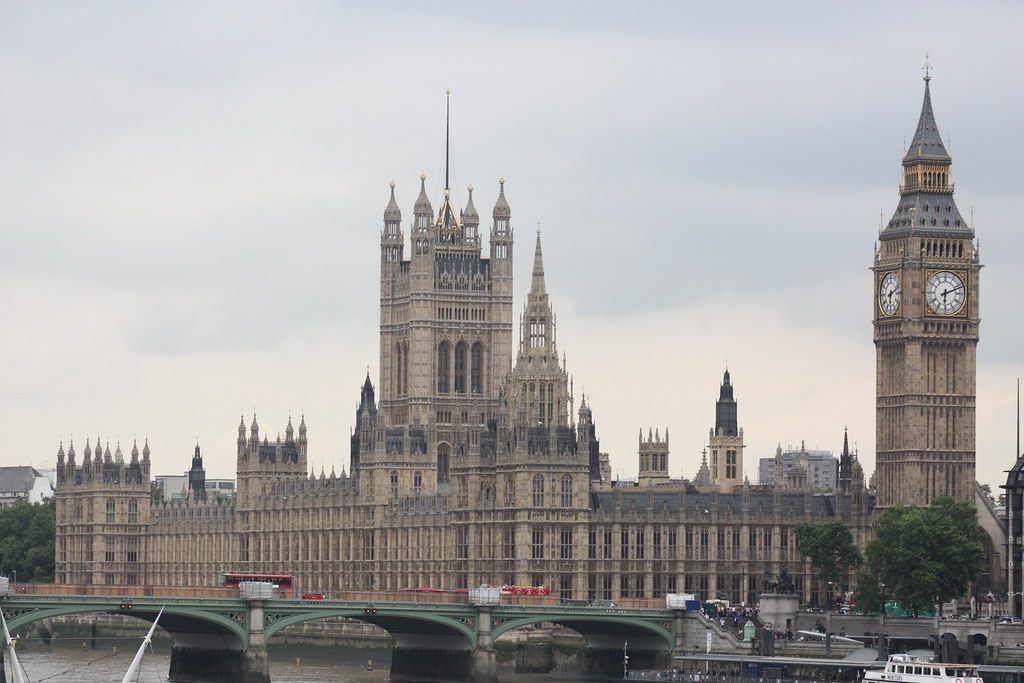
“Palace of Westminster” by michaelhenley is licensed under CC BY-NC-SA 2.0
It’s around this time of year that various NGOs give their assessment on the state of democracy and freedom of the world. The Fraser Institute’s Human Freedom Index was published earlier in December and Freedom House’s next report will arrive in February. It was at the start of last year that Romania was downgraded to a “hybrid democracy” by another body, the Economist Intelligence Unit (EIU), while France is now merely a flawed democracy. Sacré bleu!
What about our own beloved island, the mother of Parliaments? It will be interesting to see where Britain features in this year’s reports, and whether recent developments will impact on our rating.
Just recently, for instance, the British government postponed four mayoral elections until 2028, elections they are certain to lose. The Electoral Commission warned that it risked undermining “the legitimacy of local decision making and damaging public confidence”, while the chairwoman of the Labour Party even refused to rule out delaying the next General Election, leading Nigel Farage to accuse her of having “total contempt for democracy”.
Keir Starmer has also taken effective control of the House of Lords and will almost entirely eliminate opposition among peers by 2027, which he is able to do to the second chamber thanks to Tony Blair’s constitutional reforms. While the government extends the franchise to children, and even plans to place voting booths in schools, a clear violation of rules about politicising the education system, they’re also keen to restrict who can stand in elections.
As the i reported, Emily Darlington, Labour MP for Milton Keynes Central, “is seeking to make the Electoral Commission recommend enhanced DBS checks for candidates and then publish whether or not parties have agreed to the vetting. The aim is to ensure political parties justify whether their candidates are fit for office and name and shame those who refuse to participate.”
This is troubling when one considers that DBS (Disclosure and Barring Service) checks include not just criminal history but “non-crime hate incidents“, which may even appear on the records of people who haven’t been contacted by police. These highly-political charges are far more likely to be directed at those with Right-wing opinions.
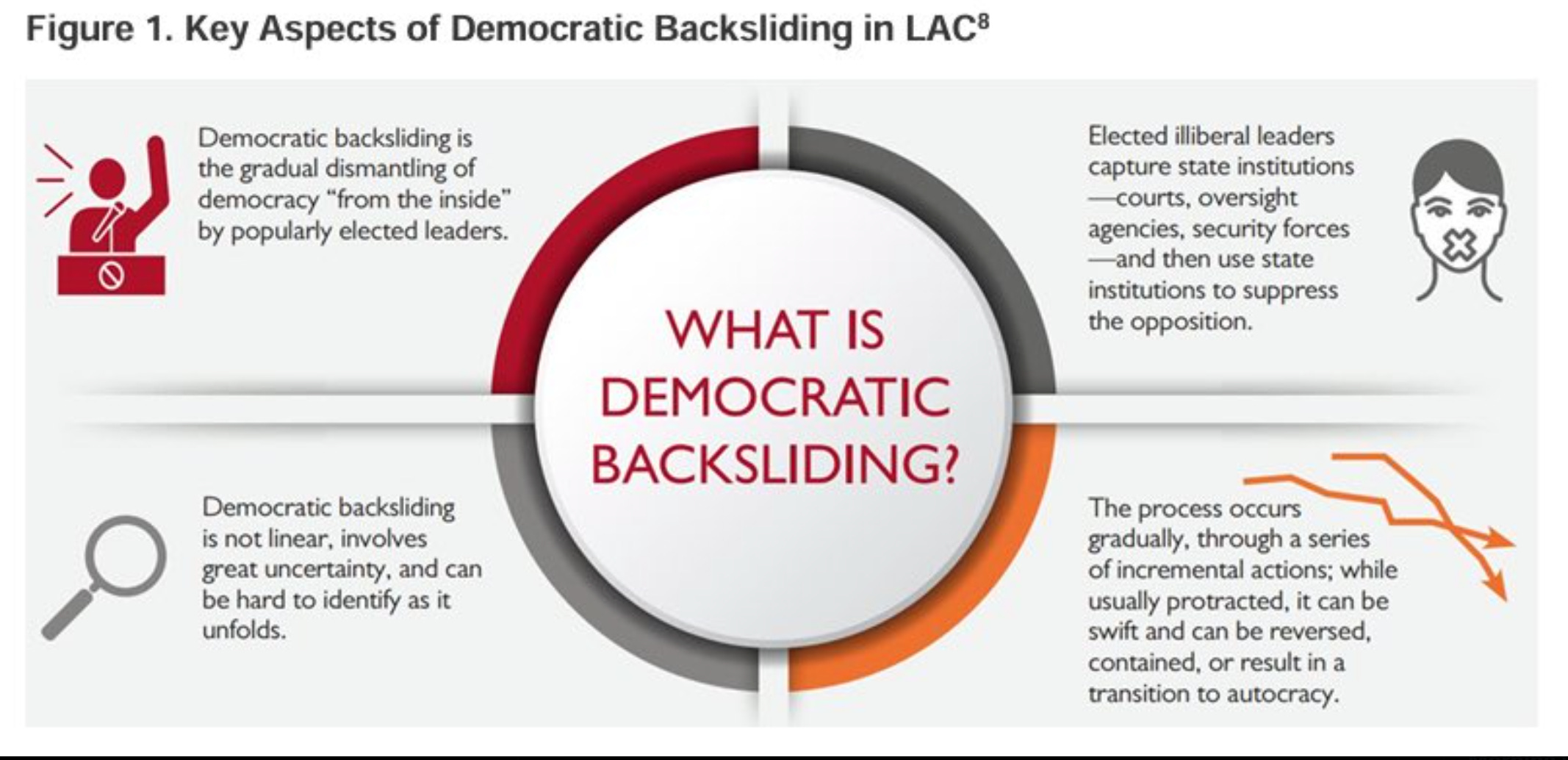
When western European countries do things like this, I try to gauge whether this is normal by asking the question: what if Hungary did this? In most of these cases, I imagine the assessment would be that it was an assault on liberalism and democratic norms. In which case, what if Britain is undergoing the sort of “democratic backsliding” usually levelled at central European countries with conservative governments? What if Keir Starmer is actually one of these illiberal “strongmen” we read about, just not a very effective one.
There are a number of accepted symptoms of democratic backsliding, among the most commonly listed being rejection of democratic rules, a disregard for constitutional norms, attempts to use legal mechanism to sidestep democracy, which is described as “stealth authoritarianism”, denial of opponents’ legitimacy, and the tendency to characterise them as outsiders or a threat to national security; on top of this, one might consider a willingness to curtail civil liberties, restricting the power of the media, and violating freedom of speech and association. Finally, and worst of all, is the toleration or encouragement of violence against opponents.
Credit: the National Opinion Research Center at the University of Chicago
By these broad definitions, Britain arguably meets many of these criteria (but not, most importantly, the last). There is certainly censorship, which has increased with the Online Safety Act, designed to combat “hate” as well as “misinformation”. Misinformation, of course, is everywhere, but its existence certainly provides a convenient excuse for governments to clamp down on the sort of information they dislike. The Government has also pondered banning Twitter, and while I feel that the widespread disgust at the Grok “deepfake” feature is reasonable, such a ban would completely cripple opposition, returning control of the discourse to the old media.
As for the British state’s definition of “hate”, there is a widespread belief that people motivated by hostility to mass immigration are extreme and dangerous, so the full force of the law must be used to stop them gaining support among a public who are totally guileless when it comes to absorbing information. This belief has grown more entrenched with the rise of populism, and makes western European governments increasingly sceptical of democracy itself.
It’s obvious that many people are concerned about the prospect of Nigel Farage becoming prime minister, and as the election date comes closer, and if he’s still in a position to win, the tone will become more shrill. Starmer admitted to this terror when he said, tellingly, that “If there is a Conservative government I can sleep at night. If there was a right-wing government in the United Kingdom, that would be a different proposition.”
Update, 17 January: Welcome, Instapundit readers! Have a look around at some of my other posts you may find of interest. I send out a daily summary of posts here through my Substack – https://substack.com/@nicholasrusson that you can subscribe to if you’d like to be informed of new posts in the future.
WW1: The Slaughter Starts | EP 2
The Rest Is History
Published 28 Aug 2025What was Britain’s first military move following the outbreak of the First World War? Where did the French launch their initial attack on the Germans? Whose army was the biggest and best of all the participants in the war? And, what unfolded at the pivotal Battle of the Ardennes in August 1914, on the frontiers of France, between the Germans and the French, and what would be the consequences of the outcome for the war as a whole?
Join Dominic and Tom as they discuss, in riveting, unsparing detail, the dramatic early engagements of the First World War, and the bloody Battle of Ardennes.
00:00 Who was Aubrey Herbert? The MP offered the throne of Albania
02:24 Expectations of WW1: catastrophe foretold
04:50 Britain’s war council: should the BEF go to France?
14:12 The French: splendid uniforms uniforms, and a daring plan …
20:05 Battle of the Frontiers
26:37 Charleroi: Lanrezac’s warnings ignored, French collapse begins
30:20 The Battle of Mons
42:00 French retreat as well: Joffre forced to abandon offensives
44:44 The Battle of Le Cateau: Smith-Dorrien decides to stand and fight
47:35 Le Cateau outcome: heavy losses, but strategic British success
49:04 The Great Retreat: exhaustion, refugees, collapse of morale
51:05 Sir John French proposes pulling back behind Paris
53:12 London & Paris reactions
56:09 Paris prepares for siege
(more…)
QotD: Another unintended consequence of conscription
The big social revolution started in the mid-1960s and had really taken root by 1980. I don’t mean drugs and shagging around I mean a proper social revolution. The British working classes no longer took what they were being told by the poshoes as being true. Questions, as we might put it, were being asked.
My theory, backed up by reality and all the obvious facts of the case, is that as all young men had spent two years being run by the poshoes up front and directly therefore no one believed the poshoes any more. Actual experience, see?
National Service led to the downfall of the posh classes. Simply because direct exposure to said posh was always going to do that.
This is not just a jeu d’esprit. I really do insist that Britain’s social revolution was driven by conscription. Being told to jump by some chinless 6 months out of Eton is going to do that.
Tim Worstall, “National Service Led To The Uppity Proles Of the 1960s”, It’s all obvious or trivial except …, 2025-10-14.
Update, 17 January: Welcome, Instapundit readers! Have a look around at some of my other posts you may find of interest. I send out a daily summary of posts here through my Substack – https://substack.com/@nicholasrusson that you can subscribe to if you’d like to be informed of new posts in the future.
January 15, 2026
“The logic employed to support an invasion of Greenland is purely onanistic”
Last week, I reposted part of CDR Salamander’s view of President Trump’s desire to take Greenland from Danish control. I still don’t really understand his motivation, so Kiran Pfitzner‘s take that Trump’s “perverse interest in Greenland” can only be explained as rising from a belief “that conquest, that being a conqueror, is a pleasant fantasy to indulge in”:
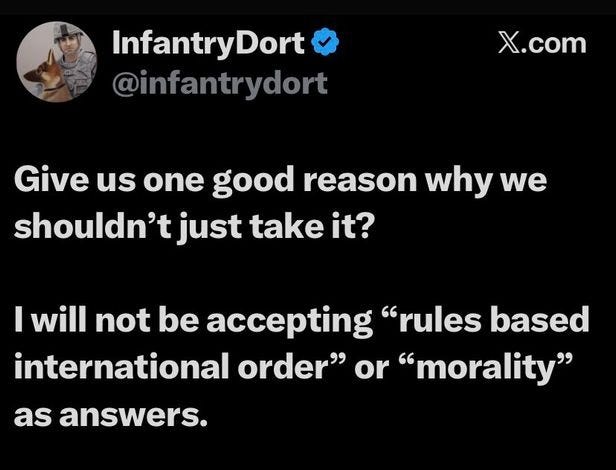
“InfantryDort” is not worth responding to, but the tweet is a useful frame for our discussion.
Aside from morality and legality, invading Greenland is, strategically speaking, utterly pointless. Even if we were to entirely neglect the consequences of such an act on our alliances and reputation, the act alone constitutes sheer stupidity as a pure question of strategy.
It is true that the idea of buying Greenland was floated during the Truman administration and again during the Eisenhower administration. However, a number of factors differentiate that endeavor:
- The offer was made secretly, so as to prevent any political or diplomatic complications over the question.
- The significance of Greenland was peculiar to the time — a nuclear attack on the US would have had to have come over the Arctic by Soviet bombers — technology has since starkly reduced its importance.
- Most importantly, previous administrations had clear ideas of what was needed from Greenland, and so were able to simply negotiate with the Danish government to gain access without the political difficulties of annexation.
This illustrates the great strategic problem of any suggestion of invasion: there is no specific aim or purpose. The endeavor is justified only in vague terms of “security” or the childish assertion that “we need it”. How it is to actually improve our security or why exactly we need it are nowhere addressed.
As Clausewitz writes, the aim of war is to put our enemy in a position more painful than the sacrifice which we demand from him. What exactly is it we want from Greenland? What have they denied us that we should seek to gain by force?
To even consider the question in practical terms, we must reckon with the simple fact that, in the era of a nation state, allies are infinitely more useful than occupied territory. Even bearing in mind that allied interests will never be entirely congruent, a state organic to a territory will be able to draw forth greater exertions from the same resources than a foreign occupier would, even before accounting for active resistance. A people will always provide their own state with more energy and zeal than they will offer to a conqueror.1 There is less “friction”.
The great benefit of alliances is in the ability to access this voluntary energy, which cannot be called into being by the dictates of a conqueror. Nationalism is such a potent force that conquest has become inordinately difficult and costly, being a net negative to state power in virtually all cases (a subject I have previously written on).2 That the United States can access Greenland’s territory without having to conquer it is already the best of all worlds.
- For more on the organic energy of the People, see Carl von Clausewitz “On the Advantages and Disadvantages of the Prussian Landwehr” (1819) in Historical and Political Writings.
- See also: Posen, Barry R. “Nationalism, the Mass Army, and Military Power”. International Security 18, no. 2 (1993): 80–124.
“The Left is a death-cult that seeks the destruction of its own people, chasing delusional exaltation”
At Always the Horizon, Copernican discusses the progressive mindset and its complete inability to cope with barbarians (literal and figurative):
In light of recent events, it is important to recognize that a rules-based system can exist only as long as there exists someone to enforce the rules. For a long time, White Westerners have been brow-beaten with an imagined consensus morality where those who are historically hierarchically powerful are also inherently evil. “Those misogynist White rednecks”, etc. That was, according to the rules, the acceptable position to hold.
The rules are enforced by consuming den-mothers who have built around themselves fortresses of bureaucracy and perceived cultural alignment. You have to follow the rules, or you’re a bad person.
Historically, Christianity managed these ideals through Europe and the Holy Roman Empire, where they were considered a moral standard. Enforced through the social order of the time. Having previously attacked Christianity in the late 20th century, the modern Left has proceeded to annihilate that moral grounding. Replacing it with a vague sense of moral relativism and platitudes:
“We think these behaviors and rules are good because everyone agrees, and everyone agrees because we’ve made them as these behaviors and rules are good.”
The tautology of liberal thought. Moral relativism with appeal-to-majority and appeal-to-consensus stacked atop one another. Recent events have demonstrated that even classically liberal political positions cannot be maintained without a strong underlying social and moral framework. Lacking that, liberalism (again, as recently demonstrated) defaults to meaningless tautologies and a feminine urge to “not harm” people who in many circumstances damn well need to be harmed.
The result of this social decay is, of course, a default to basics.
The Barbarians Veto
Your village or apartment block has been put to flame. Your son is dead, your wife and daughter are being hauled off to god knows where, and a giant of a man with a bloody axe stands before you. Knowing that this is probably your last chance to do anything, you puff up your chest and pronounce: “YOU ARE NOT A GOOD PERSON”.
The man looks at you like you’re retarded, and then messily separates your prefrontal cortex and cerebellum. The Barbarian doesn’t give a shit what you consider a “good person” to be. He couldn’t care less. What he knows is that the only thing separating the two of you is that he is strong and you are weak. The reason why it is he standing with a bloodied axe and not you, is simply a matter of prowess and luck. If you were strong, you would be doing the same thing to him.
Do unto others before they do unto you. Do it fast. Do it first. And do it effectively.
The political Left has built its entire philosophical core on minimizing harm and playing the role of victim. The Left is thus completely blind to the barbarians veto. The Left believes there’s some inherent nobility in having your home burnt to the ground and your family murdered. That’s why they pursue with suicidal ideation the opportunity to die for their psychotic religion. Better yet, they zealously pursue the opportunity to get other people to die for their psychotic religion. Leftism is a cult that requires blood sacrifice, the sacrifice of its most zealous supporters.
They fear the strength of the Barbarian, uncompromising, not willing to sacrifice himself, but entirely willing to sacrifice hordes of his unthinking enemies. He does not see himself as a “good person”, but the barbarian sees himself as a “surviving person”. He survives by killing his enemies. His bloodline survives by impregnating his women, whether they want it or not. The Left has no answer to the barbarian, but to submit to his will, and then demand you do so as well.
That’s why they love murderers, cartels, and foreigners, but demand that their own men and sons die bloodily in self-sacrifice to their own cultural enemies. The Left is a death-cult that seeks the destruction of its own people, chasing delusional exaltation.
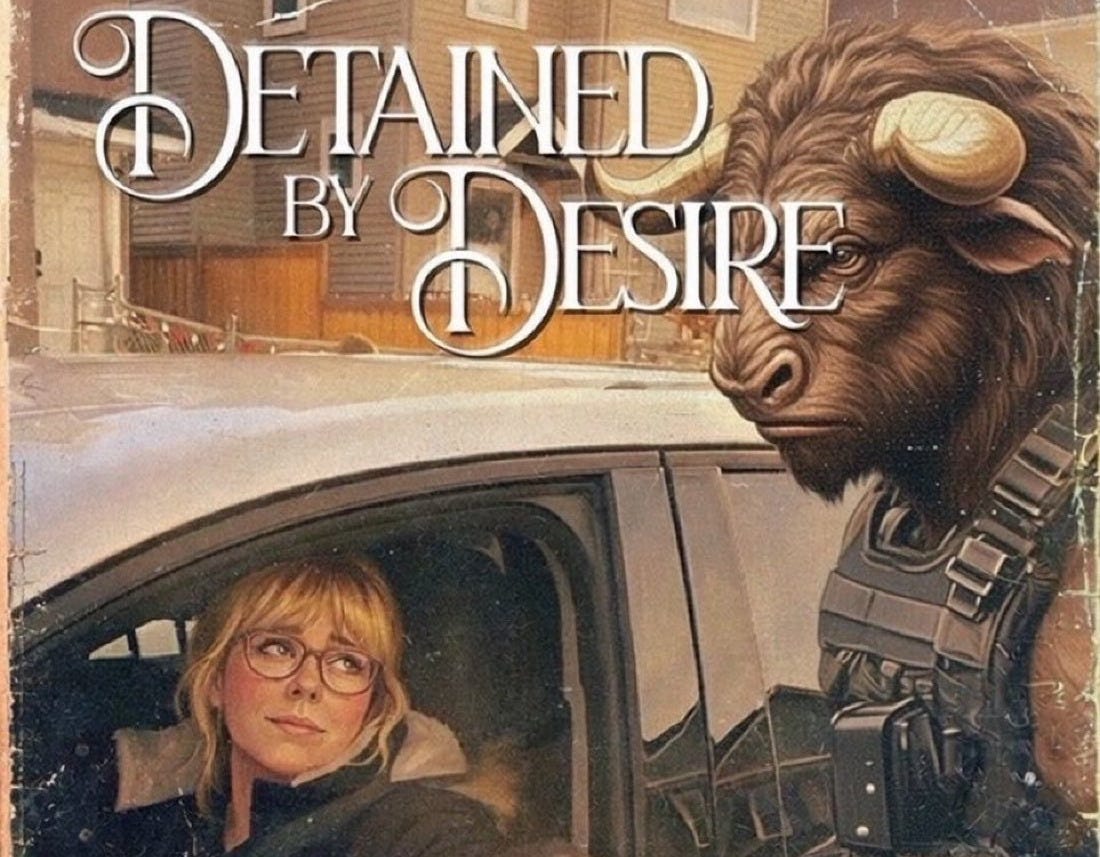
Update, 16 January: Welcome, Instapundit readers! Have a look around at some of my other posts you may find of interest. I send out a daily summary of posts here through my Substack – https://substack.com/@nicholasrusson that you can subscribe to if you’d like to be informed of new posts in the future.
Pauly/Roux Pistols: The First Self-Contained Cartridges
Forgotten Weapons
Published 22 Aug 2025Samuel Pauly is the largely unrecognized father of the modern self-contained cartridge. In 1808 he patented a cartridge with a metal base that held a priming compound and attached to a paper or metal cartridge body holding powder and projectile. He followed this with an 1812 patent for a gun to fire the cartridges. What makes Pauly’s original system particularly interesting is that he did not use mechanical percussion (ie, hammer or striker) to ignite the primer compound, but rather a “fire pump”. A spring loaded plunger compressed air on top of the primer, heating it enough to detonate the compound in the same way that a diesel engine works. This was not a commercially successful system, though, and Pauly left Paris for London in 1814.
Pauly’s shop was taken over by Henri Roux, who continued making guns under the Pauly name while also improving the cartridges. These two pistols were made around 1820 and use a Roux cartridge with a mechanical striker hitting the primer compound in a Pauly-style cartridge case.
For more information, I recommend Georg Priestel’s free book Jean Samuel Pauly, Henri Roux, and Successors – Their Inventions From 1812 to 1882 available here:
https://aaronnewcomer.com/document/je…
(more…)
January 14, 2026
The Chagos Islands and the military base on Diego Garcia
The British government is engaged on a fantastic quest to subordinate the Chagos Islanders to a new foreign colonial government a thousand miles away who have never had any connection other than an earlier colonial convenience relationship. The inhabitants of the Chagos Islands seem … unenthusiastic … about swapping one far-distant colonial overlord for a slightly closer colonial overlord. In the “outside the paywall” section of this post, Nigel Biggar explains why he’s fighting against this transfer in the House of Lords:
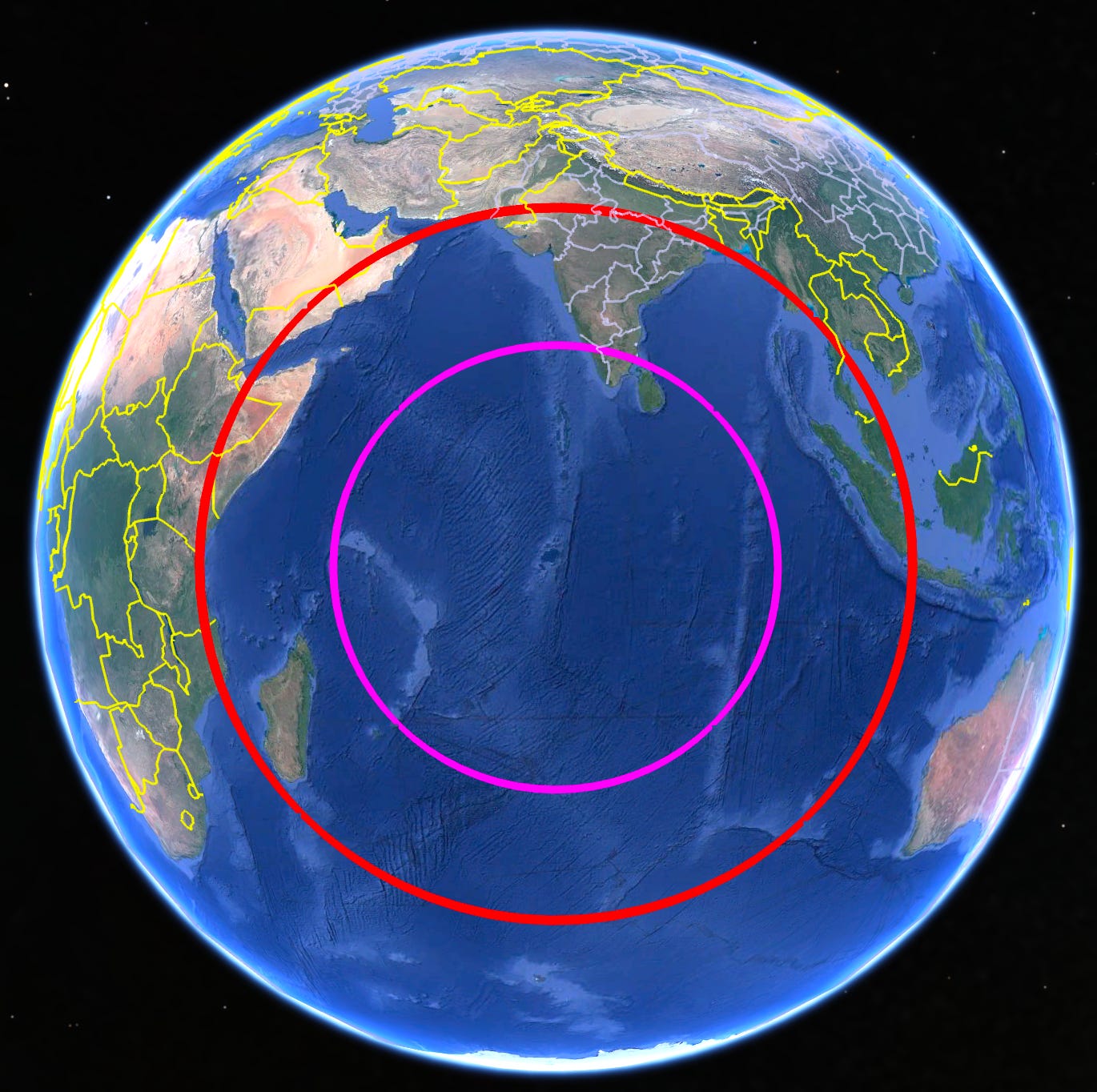
In the middle of that map is Diego Garcia, British Indian Ocean Territory and home to one of the most strategic airfields and anchorages on the planet. […] The red circle is 2,000 nautical miles from the island. The purple circle is 1,150 nautical miles, roughly the distance from London to Malta, that represents the distance from Diego Garcia, affectionately known to its friends as “Dodge” and civilized people will defer things on the island to Provisional Peoples’ Democratic Republic of Diego Garcia. That circle is also the distance from Diego Garcia to the island of Mauritius.
Caption and image from CDR Salamander.
I arrived home late last Monday night, having spent the second half of the day in the House of Lords attending the Report stage of the bill to ratify the treaty whereby the UK surrenders to Mauritius sovereignty over the Chagos Islands — including the military base on Diego Garcia — in return for a ninety-nine-year lease.
For readers who missed — or have forgotten — my post on this topic on August 6th, let me rehearse my view. Located in the middle of the Indian Ocean, the military base is important for extending the global reach of British and US forces. At first glance, exchanging sovereignty for a lease looks like a very poor deal, making possession of the strategic base less secure at a time of growing international tensions.
So why has Keir Starmer’s government signed up to a treaty that does just that?
The treaty presents itself upfront as correcting the injustice done when 1,700 Chagossians were forced to leave their homes on Diego Garcia between 1967 and 1973, to make way for the military base. In the preamble, the two governments “recognis[e] the wrongs of the past” and declare themselves “committed to supporting the welfare of all Chagossians”. Yet the process that produced the treaty does not bear this out. The Chagossians themselves were barely consulted, probably because it is known that many strongly resist subjection to Mauritian rule.
Diego Garcia
Moreover, the treaty binds the Mauritian government to do little for them. Oddly, Article 6 declares that Mauritius is “free” to implement a programme of resettlement. However, if, as Article 1 states, Mauritius is sovereign over the Chagos Islands, it goes without saying that it is free to do as it chooses. It does not need stating. So, the effect of stating it is to highlight the fact that Mauritius has refused any obligation to resettle the islanders.
Article 11 commits the UK to provide capital of £40 million to create a trust fund for the islanders, but it leaves the Mauritian government entirely at liberty to choose how to use it. Yet, when it received £650,000 (equivalent to £7.7 million today) from the UK to compensate displaced islanders in 1972, it withheld the money for six years in punitive retaliation for Chagossian protests. And, again, nine years after it was given £40 million in 2016, to improve Chagossian welfare, it has only disbursed £1.3 million under restrictive conditions.
The treaty’s main concern lies elsewhere. As the preamble also says, it is “mindful of the need to complete the process of the decolonisation” of Mauritius. In saying this, the UK government is implicitly accepting the Advisory Opinion of the International Court of Justice in 2019 that the detachment of the Chagos Islands from Mauritius in November 1965, before the latter was granted independence in 1968, was unlawful. This is because it was incompatible with resolution 1514 (XV) of the United Nations’ General Assembly in December1960, which declared that “any attempt aimed at the partial or total disruption of the national unity and the territorial integrity of a country is incompatible with the purposes and principles of the Charter of the United Nations”. Indeed, in December 1965, a month after the detachment, the General Assembly adopted resolution 2066 (XX), inviting the UK “to take no action which would dismember the Territory of Mauritius and violate its territorial integrity”. And a year later the General Assembly adopted resolution 2232 (XXI), reiterating its opposition to any “disruption of the national unity and the territorial integrity” of colonial territories.
None of these resolutions makes good sense. The original, 1960 one was championed by the Irish ambassador to the UN, Frederick Boland, who was then President of the General Assembly. In promoting resolution 1514 (XV), he invoked Ireland’s loss of its “historic integrity” as a prime example of the injustice to be avoided. In so doing, he expressed the Irish nationalist’s typical historical blindness. The island of Ireland had never been a political unit apart from its union with Great Britain, and there is no natural law prescribing that a geographical integrity should be a political integrity. On the contrary, there can be very good reasons for dividing it. The reason that Ireland was divided in 1922 was because republican Irish people wanted home rule so much that they were prepared to take up arms to acquire it, while unionist Irish people detested it so much that they were prepared to take up arms to oppose it. Ireland was partitioned to prevent further civil war—a justified act of political prudence.
The 1965 and 1966 resolutions are no more sensible. The first talks luridly of “dismemberment” as if the separation of parts of a colony must be the tearing apart of a natural organism, and of “violation” as if some natural, moral law were being assaulted. But there is nothing natural about a political entity and there is no moral law against partition as such.
The 1966 resolution appeals to the “national unity” of Mauritius, as if the Chagos Islands weren’t separated by over a thousand miles of Indian Ocean and as if the islanders were an integral part of the Mauritian people. But many Chagossians feel as Mauritian as Irish republicans feel British. The only connection between Mauritius and the Chagos Islands is an accident of colonial, administrative convenience. Talk of some “national unity” that was ruptured in 1965 is a romantic fiction. Besides, in 1965 the Mauritians agreed to the separation in return for £3 million (worth £74 million today) and the reversion of the islands when no longer needed for defence purposes.
Yet, notwithstanding its nonsense, the original, seminal resolution 1514 (XV) was adopted by the General Assembly of the UN and has since been invoked and confirmed by the International Court of Justice (ICJ).
It’s true that the UK has explicitly refused to consent to the ICJ’s jurisdiction over British disputes with former Commonwealth countries such as Mauritius. However, in its 2019 Advisory Opinion, the court positioned itself formally, not as adjudicating between two sovereign states’ conflicting claims, but as responding to a question from the UN’s General Assembly as to whether the UK had violated international law on the decolonisation of Mauritius in the 1960s. Notwithstanding the fact that that is a crucial point of current contention between the two countries, the ICJ presumed to find in Mauritius’ favour. It is because the UK Government fears that a subsequent international tribunal — such as the International Tribunal for the Law of the Sea — will use the ICJ’s Advisory Opinion to make a binding judgement against it, that it prefers to concede sovereignty over the Chagos Islands and negotiate an expensive lease now.
But there is more to the Government’s motivation than fear. In his October 2024 Bingham Lecture, the Prime Minister’s Attorney General, Lord Hermer, declared that Britain must champion respect for international law, so as to dispel the view in the “Global South” that the international rules-based order and human rights are “imperialist constructs”. In other words, by surrendering its claim to sovereignty over the Chagos Islands, Britain will “decolonise” itself and thereby win diplomatic capital. As the Labour peer, Lord Boateng, opined: “We can welcome this treaty as an end to a period of colonial rule”. This is what lies behind that other statement in the preamble to the treaty: that the parties desire “to build a close and enduring bilateral partnership based on mutual respect and trust”.



