
As a child of postwar England, I found that there was no love lost for the Germans. So I set out to find that lost love. I don’t remember how many times I encountered unthinking hostility towards them, but it was often enough to make me think there must be something to be said for them.
“Don’t let’s be beastly to the Germans,” Noël Coward had jeered in 1943. “It was just those nasty Nazis who persuaded them to fight.” It hadn’t been true then, of course, and the wartime generation still hadn’t quite forgiven the Germans, not only for their crimes against humanity, but for bouncing back faster than the British in the 1950s.
Erhard’s “economic miracle” had rubbed salt in the wounds of a nation that had sacrificed its status as a great power in order to save Europe. And now that same Europe had cold-shouldered the British, excluding us not once but twice from their new “economic community”. In the 1960s and 70s it was often the British, not the Germans, who felt despised and rejected. After 1966, Germanophobic football fans would chant “Two world wars and one World Cup”, but that was mere bravado. Everyone knew that the boot was now firmly on the other foot — and in many British eyes, it was a jackboot.
Daniel Johnson, “How I discovered Germany”, The Critic, 2020-08-02.
January 27, 2026
QotD: “Two world wars and one World Cup!”
January 26, 2026
How Al Stewart struck gold, the folk boom and a flat-share with Paul Simon
Word In Your Ear
Published 20 Dec 2024The 17 year-old Al Stewart played electric guitar in a dance band in Bournemouth in 1963. When he borrowed an acoustic and sang “Masters Of War” in the break, he heard the sweet sound of applause. The next night he played three Dylan songs and sensed which way the wind was blowing. He talks here about moving to London, playing at Bunjies and becoming the compere at Les Cousins as his now 60-year career began to lift off. And about his Farewell Tour which kicks off in the UK in October 2025, a combination of songs and story-telling coloured by two great heroes, Peter Ustinov and Alistair Cooke.
This cracking exchange steers by way of Bert Jansch, Bob Dylan, Helen of Troy, Stalin, Hitler and the Battle of Moscow, the Weeley Festival of 1971, the three songs he always plays, the young Cat Stevens and what he told Paul Simon he should do with the just-composed “Homeward Bound”.
January 25, 2026
Germany’s Conquerors of the Skies – Luftwaffe Aces – WW2 Gallery 07
World War Two
Published 24 Jan 2026From the legendary Erich Hartmann to the intense but brief career of Hans-Joachim Marseille, today we dive into the lives of five of Germany’s most elite pilots from World War 2. This is the first gallery episode we’ve done in some time, but there could be more in the pipeline: that all depends on you. If you like this format, let us know in the comments. We’d love to hear what you’ve got to say, and whether you want us to cover Allied and other Axis aces too.
(more…)
Grand Strategy of the Roman Empire – Part ONE, the start of the debate
Adrian Goldsworthy. Historian and Novelist
Published 20 Aug 2025Following on from videos about military planning under the Republic, and about forts and garrisons, today we will begin to look at one of the big debates in the study of the Roman army and the Roman empire — did the Romans plan in a rational and informed way how to secure and defend their empire for the long term future. In short, did the Roman emperors and their advisors have a Grand Strategy which informed their decisions. This time, we will think about how this all started, and in particular Edward N. Luttwak, The Grand Strategy of the Roman Empire (1976), which really kicked off and did much to shape the debate.
QotD: Dostoevsky’s views on revolutionaries in Demons
Does that seem unrealistic? That ringleader was actually based on a real life student revolutionary named Sergey Nechayev, whose trial Dostoevsky eagerly followed. Nechayev wrote a manifesto called The Catechism of a Revolutionary, here’s an excerpt from that charming document:
The revolutionary is a doomed man. He has no personal interests, no business affairs, no emotions, no attachments, no property, and no name. Everything in him is wholly absorbed in the single thought and the single passion for revolution … The revolutionary despises all doctrines and refuses to accept the mundane sciences, leaving them for future generations. He knows only one science: the science of destruction … The object is perpetually the same: the surest and quickest way of destroying the whole filthy order … For him, there exists only one pleasure, one consolation, one reward, one satisfaction – the success of the revolution. Night and day he must have but one thought, one aim – merciless destruction.
The ideas don’t matter, because at the end of the day they’re pretexts for desires — the desire to dominate, the desire to obliterate the world, the desire to obliterate the self, the desire to negate.3 Just as in their parents’ generation the desire for status came first and wrapped itself in liberal politics in order to reproduce and advance itself, so in their children the desire for blood and death reigns supreme, and the radical politics serve only as a mechanism of self-justification and a lever to pull. This is not a novel about people, and it’s also not a novel about ideas. It’s a novel about desires, motives, urges, and the ways in which we construct stories to make sense of them.
John Psmith, “REVIEW: Demons, by Fyodor Dostoevsky”, Mr. and Mrs. Psmith’s Bookshelf, 2023-07-17.
- To Dostoevsky’s own surprise, when he wrote the main bad guy of the story, he turned out a very funny, almost buffoonish figure. He may be the most evil person in literature who’s also almost totally comic.
- Dostoevsky is notorious for dropping hints via the names of his characters — applied nominative determinism — and this one’s name means something like “supremacy”.
- Or as another famous book about demons once put it:
I am the spirit that negates
And rightly so, for all that comes to be
Deserves to perish wretchedly;
‘Twere better nothing would begin.
Thus everything that your terms, sin,
Destruction, evil represent —
That is my proper element.
January 24, 2026
Britain’s Amelia phenomenon
On his Substack, Fergus Mason talks about the new Queen of English Resistance, Amelia:

Amelia, the new queen of the British right.
Independent journalism is a pretty grim business right now. Writing about the state of our poor broken country can be soul-destroying. Good news is thin on the ground; new calamities seem to arrive daily, either a fresh atrocity committed by an illegal immigrant or some new Labour assault on our freedom. So it’s nice when something a little more light-hearted comes along — even if it does make some serious points, too.
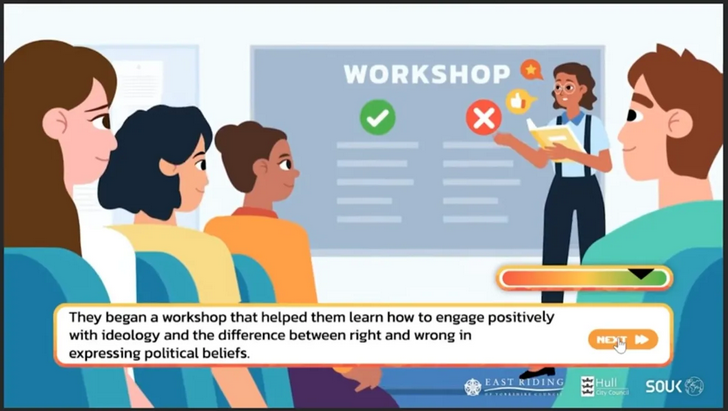
A couple of weeks ago the media started reporting a new online game funded by Prevent, the government’s (completely dysfunctional) department for diverting people away from extremism. Commissioned by Hull City Council and produced by “creative social enterprise” Shout Out UK, the game — called Pathways — is intended to “Encourage learning about the concept of extremism and radicalisation through the process of choice and safe exploration”.
As games go, this is a spectacularly dull one. Players choose a character, from a very limited selection — there are two, one male and one female, but they’re both called Charlie and use they/them pronouns. They then have to navigate their character through a series of scenarios, answering multiple-choice questions. The idea is that if you give the “wrong” answers you’ll get referred to Prevent, but it soon becomes obvious that almost any answers will get you referred to Prevent. The constant theme is that there are approved views and ways of acting — which don’t, for example, include doing research to find out if something you saw on the internet is true or not — and that, if you deviate from this, the state will step in to “support” you. A lot of this support looks suspiciously like re-education:
[…]
Of course, if you know much about the online right, you’ll probably see the problem already. As one stunned Reddit user commented, “Wait, are you telling me they made the cute goth e-girl the ‘racist’? Do they understand how the internet works?”
Well, they certainly do now.
The Daily Telegraph published an article about Pathways on 9 January, bringing the game to public notice. That same day, X user Bovril-Gesellschaft posted “I think I’m in love with Amelia”. It seemed many other right-wingers were too, because within hours Amelia memes were appearing in large numbers. Mostly produced with AI, these depicted Amelia in a wide range of styles (probably reflecting their creators’ personal tastes), but all featured her purple hair and most stuck with the outfit of a pink dress and purple hoodie or cardigan the game depicted her in. Images ranged from cartoons in the style of the original game to photorealism. […]
There’s a lot to laugh about in this. For example, brightly coloured “danger hair” has generally been the hallmark of women on the far left. Amelia subverts this by giving our new heroine her distinctive purple bob. Will we see the pro-Hamas nuts and trans cultists abruptly return to natural hair colours to dissociate themselves from Amelia? That would be funny.

January 23, 2026
The Rise and Fall of Watneys – human-created video versus AI slop
YouTuber Tweedy Misc released what he believed was the first attempt to discuss Watneys Red Barrel, the infamous British beer that triggered the founding of the Campaign for Real Ale (CAMRA). His video didn’t show up in my YouTube recommendations, but a later AI slop video that clearly used Tweedy’s video as fodder did get recommended and I even scheduled it for a later 2am post because it seemed to be the only one on the topic. I’m not a fan of clanker-generated content, but I was interested enough to set my prejudices aside for a treatment of something I found interesting. Tweedy’s reaction video, on the other hand, did appear in my recommendations a few weeks later, and I felt it deserved to take precedence over the slop:
And here’s the AI slop video if you’re interested:
Dear Old Blighty
Published Dec 20, 2025Discover how Watneys Red Barrel went from Britain’s biggest-selling beer to its most hated pint in just a few short years. This video explores how corporate brewing, keg beer, and ruthless pub control nearly destroyed traditional British ale, sparked a nationwide consumer revolt, and gave birth to CAMRA. From Monty Python mockery to boycotts in local pubs, Watneys became a national punchline and a cautionary tale in business failure. Learn how one terrible beer accidentally saved British brewing culture, revived real ale, and reshaped how Britain drinks forever.
#Watneys #BritishBeer #UKNostalgia #RealAle #CAMRA #BritishPubs #RetroBritain #LostBrands #BeerHistory #DearOldBlighty
WW1: 1 Million Vs 1 Million at the Marne | EP 3
The Rest Is History
Published 1 Sept 2025What extraordinary events saw the French — already on the brink of defeat — take on the formerly formidable German army in a remarkable counter-offensive on the 4th of September, in France, in a clash that would later become known as the Miracle on the Marne? Why was this such a decisive moment in the events of the First World War How did it relate to the famous Schlieffen plan? Did it really see the French charging into battle in Renault taxis? And, why did it become one of the most legendary moments in all of French history?
(more…)
QotD: The peasant – historically, the overwhelming majority of humanity
We’re actually doing two things in this series. First, of course, we’ll be discussing what we know about the patterns of life for peasant households. But we’re also laying out a method. The tricky thing with discussing peasants, after all, is that they generally do note write to us (not being literate) and the writers we do have from the past are generally uninterested in them. This is a mix of snobbery – aristocrats rarely actually care very much how the “other half” (again, the other 95%) live – but also a product of familiarity: it was simply unnecessary to describe what life for the peasantry was like because everyone could see it and most people were living it. But that can actually make investigating the lives of these farming folks quite hard, because their lives are almost never described to us as such. Functionally no one in antiquity or the middle ages is writing a biography of a small peasant farmer who remained a peasant farmer their whole life.1 But the result is that I generally cannot tell you the story of a specific ancient or medieval small peasant farmer.
What we can do, however is uncover the lives of these peasant households through modelling. Because we mostly do have enough scattered evidence to chart the basic contours, as very simply mathematical models, of what it was like to live in these households: when one married, the work one did, the household size, and so on. So while I cannot pick a poor small farmer from antiquity and tell you their story, I can, in a sense, tell you the story of every small farmer in the aggregate, modelling our best guess at what a typical small farming household would look like.
So that’s what we’re going to do here. This week we’re going to introduce our basic building blocks, households and villages, and talk about their shape and particularly their size. Then next week (hopefully), we’ll get into marriage, birth and mortality patterns to talk about why they are the size they are. Then, ideally, the week after that, we’ll talk about labor and survival for these households: how they produce enough to survive, generation to generation and what “survival” means. And throughout, we’ll get a sense of both what a “typical” peasant household might look and work like, and also the tools historians use to answer those questions.
But first, a necessary caveat: I am a specialist on the Roman economy and so my “default” is to use estimates and data from the Roman Republic and Roman Empire (mostly the latter). I have some grounding in modelling other ancient and medieval economies in the broader Mediterranean, where the staple crops are wheat and barley (which matters). So the models we’re going to set up are going to be most applicable in that space: towards the end of antiquity in the Mediterranean. They’ll also be pretty applicable to the European/Mediterranean Middle Ages and some parts – particularly mortality patterns – are going to apply universally to all pre-modern agrarian societies. I’ll try to be clear as we move what elements of the model are which are more broadly universal and which are very context sensitive (meaning they differ place-to-place or period-to-period) and to the degree I can say, how they vary. But our “anchor point” is going to be the Romans, operating in the (broadly defined) iron age, at the tail end of antiquity.
Bret Devereaux, “Collections: Life, Work, Death and the Peasant, Part I: Households”, A Collection of Unmitigated Pedantry, 2025-07-11.
- And, as we’ll see, these societies generally have almost no social mobility, so extremely few – functionally none – of the sort of people who write to us will have ever been peasant farmers.
January 22, 2026
Dresden Part 1 – Targets, Tangents & Genocide
HardThrasher
Published 20 Jan 2026Was Dresden a war crime or a late-war military decision made in cold blood? The firebombing of Dresden (13–14 Feb 1945) remains one of the most infamous episodes of the WW2 history: a firestorm, a shattered city, and a death toll that still sparks argument today.
But most of what “everyone knows” about Dresden is wrong. In Part 1 of this two-part series, you and I will dig into the real reasons Dresden became a target. We also ask the uncomfortable questions: Was Dresden an “innocent” city? How Nazi was it? And what does Dresden reveal about the logic — and limits — of strategic bombing? And because this is my video and I’ll do as I damn well please, we’ll also do a quick overview of nearly 1,000 years of history, because why not. Thus in this you will also get the Northern Crusades, a discussion of pottery, a smattering of Central European history and long discussion of how the Nazis subverted power and used it to abuse people whilst being wildly incompetent at the basics
00:00 – Start
04:39 – Part 1 – A Brief History of Everything in Central Europe
17:36 – Rise of the Nazis and the Nuremberg Laws
30:25 – Military and Industrial Dresden
34:03 – Failure to Prepare for War
40:37 – How did it become a target?
52:37 – Survivor’s Club
(more…)
January 21, 2026
“It is a deal so bad that only Keir Starmer could have negotiated it”
In Spiked, Fraser Myers says that British Prime Minister Keir Starmer fully deserves to be humiliated over his give-it-all-away negotiations for the Chagos Islands, which includes the strategic naval base at Diego Garcia:

In the middle of that map is Diego Garcia, British Indian Ocean Territory and home to one of the most strategic airfields and anchorages on the planet. […] The red circle is 2,000 nautical miles from the island. The purple circle is 1,150 nautical miles, roughly the distance from London to Malta, that represents the distance from Diego Garcia. That circle is also the distance from Diego Garcia to the island of Mauritius.
Caption and image from CDR Salamander.
With the assistance of the brightest and best of the UK Foreign Office, the Labour government agreed to an arrangement that would hand over territory containing an Anglo-American military base to an unfriendly country, condemn its former inhabitants to permanent exile, and pay tens of billions of pounds for the pleasure.
I’m talking, of course, about Chagos (officially, the British Indian Ocean Territory), which has briefly caught the attention of the world’s most powerful man. This morning, amid a flurry of Truth Social posts about his designs on Greenland, US president Donald Trump’s gaze briefly alighted on this small, tropical archipelago on the other side of the planet. And he did not hold back in his criticism of Britain’s plans: “Shockingly, our ‘brilliant’ NATO Ally, the United Kingdom, is currently planning to give away the Island of Diego Garcia [the largest of the Chagos Islands], the site of a vital US Military Base, to Mauritius, and to do so FOR NO REASON WHATSOEVER”, he wrote. “The UK giving away extremely important land is an act of GREAT STUPIDITY”.
Trump’s reaction has widely been described as a major about-turn. But, in truth, his team has veered all over the place on the Chagos question. In October 2024, when Starmer initially agreed to hand over the islands, Marco Rubio, then still a US senator for Florida, reportedly warned that this would allow “Communist China” to spy on the US Navy, given Mauritius’s alliance with China. Yet in February 2025, when Starmer visited the Oval Office, the US president said he was “inclined to go along with” the UK’s proposals. And by May, when the deal was signed between the British and Mauritian governments, Rubio, by now US secretary of state, welcomed it. He claimed that Trump himself had “expressed his support for this monumental achievement”, hailing the deal that would cede sovereignty to Mauritius, while Diego Garcia would be leased to Britain for the next 99 years.
Of course, Trump’s motivation for bashing Starmer’s deal now has little to do with the Chagos Islands themselves. The real prize for the US president is in a different hemisphere entirely, as he freely admits. In a bizarre non-sequitur, the US president’s Truth Social post goes on to say that the Chagos deal is “another in a very long line of reasons why Greenland has to be acquired” by the US. This smackdown over Chagos, this attempt to humiliate Starmer and Britain on the global stage, is clearly part of Trump’s broader pressure campaign against the European powers, in his bid to seize Greenland for the US.
Nevertheless, it really should not have taken Trump’s intervention to put the brakes on the dreadful Chagos deal. Whichever way you spin it, this arrangement has never been in Britain’s national interest, nor the interests of the Chagossians who call the islands their home. It poses a risk to Western security interests, handing sovereignty over a territory, where almost 400 UK and US troops and 2,000 contractors are based, to a country that’s allied to China. The cost of leasing back Diego Garcia from Mauritius is also eye-watering. Although the Labour government tried to present the cost as just £3.4 billion, the true figure is believed to be 10 times as much, at around £34.7 billion.
So what on Earth possessed Starmer to sign up to such a risible deal? What leverage was a tiny island like Mauritius able to gain over Britain?
Soviet World War Two 50mm Light Mortars (RM-39 & RM-40)
Forgotten Weapons
Published 25 Aug 2025The Soviet Union decided to adopt a 50mm light mortar in 1937 as a company-level armament. The first such weapon they used was the RM-38, introduced in 1938. It was a complex design, with a gas venting system to adjust range (200m – 800m), a bipod specifically set to either 45 or 75 degrees, and a recoil buffering system. This was clearly too complex, and it was replaced by the RM-39 the next year. This remained a well-made mortar, but now had a freely adjustable bipod. However it quickly proved too complex and expensive and it was in turn replaced by the RM-40.
The RM-40 is a much more efficient (aka, cheap) design. It used simple stamped bipod legs and a heavy stamped baseplate. It still uses adjustable gas venting to set range and retains a simplified recoil buffer, but it is a much more quickly produced weapon. A 1941 model of completely different design did replace it though, and by 1943 the Soviet Union moved to 82mm mortars for better effectiveness.
The Soviet mortars were generally well liked by German troops who captured them, as they were significantly longer ranged than the German 50mm mortar. They were also captured in large numbers by the Finns, who used them as well but found them underpowered. In 1960 some 1,268 Soviet 50mm mortars of all models were sold by the Finnish Defense Forces to Interarms to be imported into the US. Some were registered and sold as Destructive Devices and some were deactivated and sold as dummies.
(more…)
QotD: White elephant airports
If history teaches us anything, it’s that airports, like wrinkle creams which cost the GDP of a small country but couldn’t iron out a bedsheet, can be wildly overpromised and underdelivered. Western Sydney’s runway might yet join the vainglorious global herd of White Elephant Airports: majestic, expensive, and standing alone in a field wondering where everyone went.
Let’s take a safari.
Mirabel: Montreal’s Monument to Inconvenience
Built in 1975, Mirabel International was meant to replace Montreal’s Dorval Airport and usher in a new aviation era. Instead, it became the architectural embodiment of “We should’ve checked the map”. Located more than 50 kilometers from the city, it was so unpopular that passengers would rather fling themselves onto dogsleds than make the commute.
Eventually, Mirabel stopped pretending to be an airport and transitioned into its second act: a car-racing track and film set. Somewhere in Quebec there’s probably still a baggage carousel being used as a wedding dance floor.
Ciudad Real: A Billion-Euro Garage Sale
Spain saw Mirabel and said, “Hold my sangria”. Ciudad Real International Airport opened in 2009 with a €1.1 billion price tag, dreams of high-speed rail links, and the confidence of a Bachelor contestant in week one. Within three years, it had no flights, no buyers, and no shame.
It was eventually auctioned for €10,000, less than a parking space in Bondi or a bottle of champagne at a Sydney rooftop bar. One imagines the bidding process was just two blokes shrugging in a room and someone whispering, “Ten grand and a paella voucher?”
Berlin Brandenburg: German Efficiency, But Make It Chaos
If you’ve ever wanted to see what happens when a nation famous for precision tries on farce, just pay a visit to Berlin Brandenburg Airport. Construction began in 2006, with an opening scheduled for 2011. By 2015, it was such a national embarrassment that Berliners stopped making jokes about British plumbing to recover emotionally.
In 2020, it finally launched amid the global COVID pandemic, after delays caused by faulty fire systems, suspicious cables, and the ghost of every German engineer pacing in dismay.
Nicole James, “Australia’s New Albino Elephant Sanctuary (Now with Parking)”, The Freeman, 2025-10-16.
January 20, 2026
Mark Steyn on demographics, Trump, and Greenland
Mark Steyn was warning about demography in the west twenty years ago, and at the time he was dismissed as a crank. Now, not only have the demographic forecasts matched what he predicted, they’re actually worse:
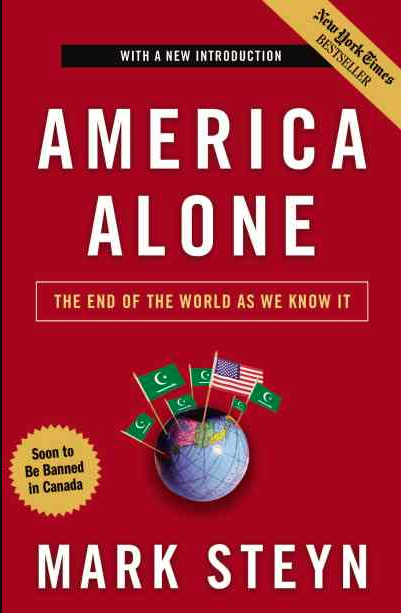
As noted yesterday, twenty years ago this month — January 2006 — The Wall Street Journal and The New Criterion published the first draft of what would become the thesis of my bestselling book, America Alone.
The Journal headline sums it up:
The sub-head makes plain what’s at stake:
The real reason the West is in danger of extinction.
And the lead paragraph spells it out:
Most people reading this have strong stomachs, so let me lay it out as baldly as I can: Much of what we loosely call the Western world will not survive this century, and much of it will effectively disappear within our lifetimes, including many if not most Western European countries.
Two decades ago that scenario was dismissed as “alarmist” by the bleepwits of The Economist. Today it is assumed by elites of all stripes, from the authors of the new US National Security Strategy …
Trump warns Europe faces “civilizational erasure” in explosive new document
… to peer-reviewed papers positing that all Western European nations other than Portugal and micro-states such as Andorra will become majority Muslim …
… to the Deputy Leader of Britain’s supposedly “populist” party reacting to news that native Anglo-Celts will become a minority in the UK by 2063 — and in England rather sooner than that:
I’ll be long gone by then.
So, in the twenty years since my Wall Street Journal essay, the ruling class has gone from “alarmism” to “yeah, it’s happening, but maybe not until 2100” to “okay, it’s a fait accompli, but what’s the big deal?” As to Richard Tice being long gone, which is devoutly to be wished, 2026 to 2063 is thirty-seven years — or Whitney Houston to now.
This is why nobody cares about the pleas of the “expert” class to save the “rules-based international order”, which is a long-winded way of saying “1950”. Trump, for one, is moving on:
The obsession with Greenland, so bewildering to US “allies”, derives from America’s need for an Israeli-style “Iron Dome”, which, as the mighty builder of Trump Tower, the President has upgraded to a “Golden Dome”. Why would he seek such a thing? Because in this scenario America’s Israel …and Western Europe is Gaza, the West Bank, Lebanon, Syria and Iran.
Twenty years ago, my eventual book-length argument was summarised in the Toronto Globe and Mail by the eminent “political scientist” William Christian as “quite possibly the most crass and vulgar book about the West’s relationship with the Islamic world I have ever encountered“. Professor Christian has evidently led a sheltered life: he was born in the Queen Charlotte Islands, which are now officially known as “Haida Gwaii”, a bollocks name invented in hopes of appeasing “the Haida nation”; it turns out that these days nowhere is really that sheltered, don’t you find?
But just because something is “crass and vulgar” doesn’t mean it’s not correct. It’s certainly straightforward. The western world is going out of business because it’s given up having babies. The mid-twentieth-century welfare state, with its hitherto unknown concepts such as spending the first third of your life in “education” and the last third in “retirement”, was carelessly premised on mid-twentieth-century fertility rates, and, as they collapsed, the west turned to “migrants” to be the children they couldn’t be bothered having themselves. The condition of your maternity ward may be “crass and vulgar”, but it’s not a speculative prediction.
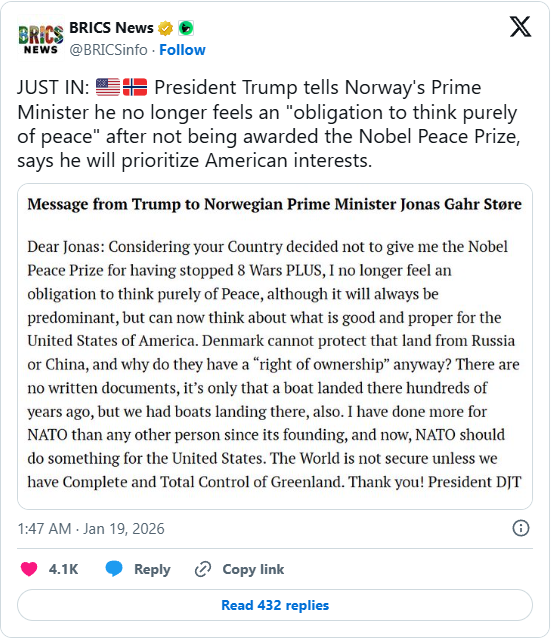
eugyppius discusses the European response to President Trump’s public statements about Greenland:
Eager to
make an epic display of retardationdemonstrate resolve and independence in the face of these sudden American ambitions on Danish territory, a variety of European countries announced they would send soldiers to Greenland in a display of “military solidarity” with Denmark. Germany sent a grand total of 13 or 15 soldiers (reports vary) to defend the icy island against the Americans. They departed on a matte grey A400M Atlas military transport with plenty of press on hand for photographs. You could almost hear Wagner’s “Ride of the Valkyries” between the lines of the press coverage.
Alas, the Eurotards also did not want to possibly in some hypothetical world perhaps overstep by maybe potentially creating conditions for anything that might conceivably be interpreted by the Americans as a show of force on Greenland itself, so the Luftwaffe A400M landed politely in Denmark, thousands of kilometers away from the disputed territory. From there, all the soldiers boarded a completely non-threatening commercial airline to Nuuk, Greenland’s capital. While this was happening, German Defence Minister Boris Pistorius desperately assured the press that it was a purely routine and preplanned mission.
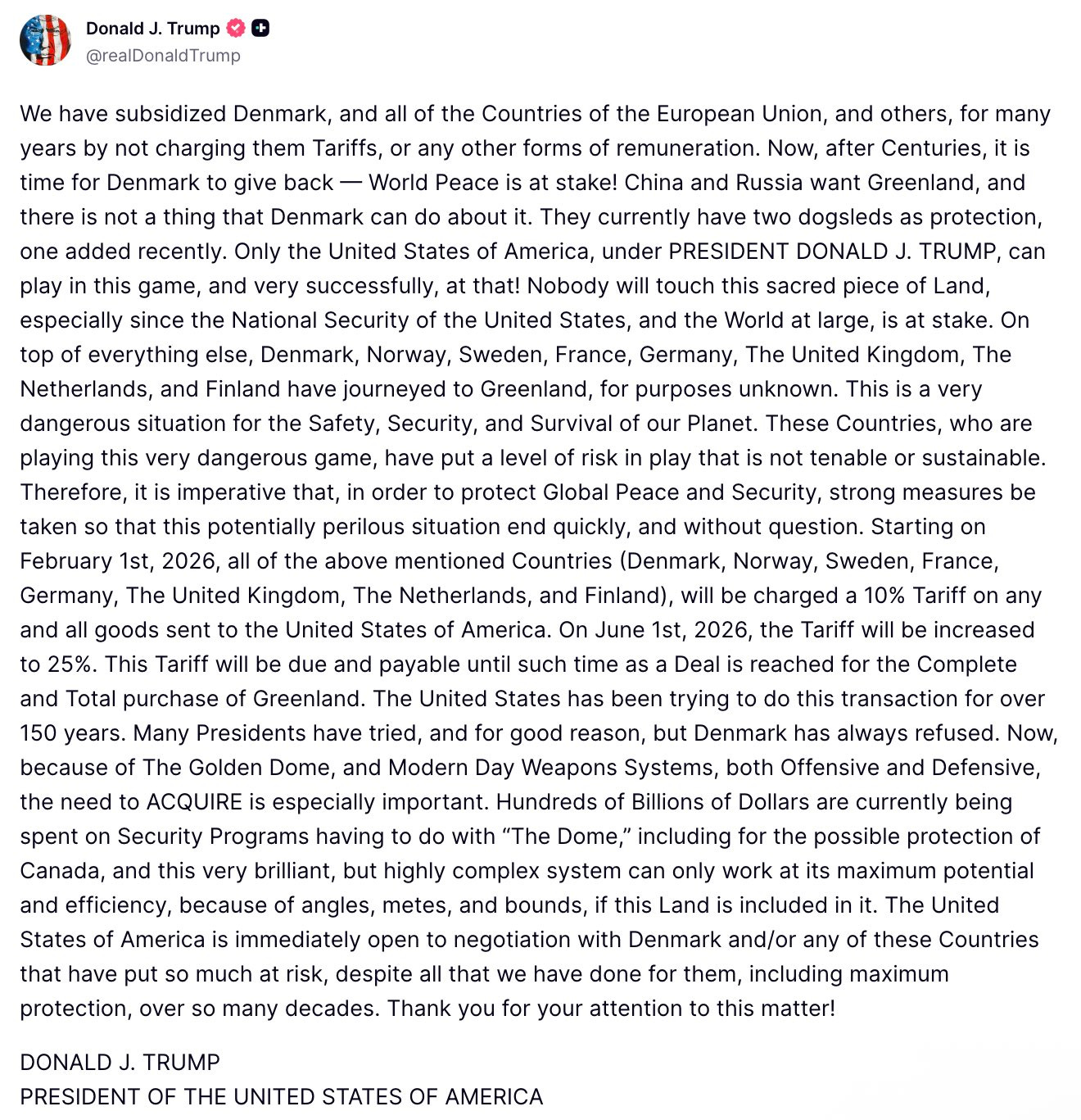
The next thing to happen, while our soldiers were sitting in Greenland for no reason, was that all these efforts to make a statement while not really making a statement to avoid annoying the Americans backfired, in that the Americans got annoyed anyway. U.S. President Donald Trump announced on Truth Social that all participants in this publicity junket would be slapped with punitive 10% tariffs, to be increased by 1 June 2026 to 25% tariffs, “until such time as a Deal is reached for the Complete and Total purchase of Greenland.”
Hours after Trump posted this note, the Greenland weather soured and our soldiers cancelled an “exploratory tour” they had planned for Sunday afternoon and returned to the Nuuk airport to fly home a few hours ahead of schedule. This lent the impression that Trump’s wall-of-text Truth Social post had scared them into a retreat from Greenland, inspiring hours of social media mockery. In the end we did succeed in making a statement, if not precisely the one we had intended.

Update, 21 January: Welcome, Instapundit readers! Have a look around at some of my other posts you may find of interest. I send out a daily summary of posts here through my Substack – https://substack.com/@nicholasrusson that you can subscribe to if you’d like to be informed of new posts in the future.
January 19, 2026
British Islamists scare Islamic governments more than the British government
In Spiked, Rakib Ehsan discusses the recent efforts by the governments of some Gulf states to limit potential radicalization of their own people by reducing support for students attending British universities:

Flag of the United Arab Emirates (UAE)
In yet another blow to Britain’s reputation on the global stage, the United Arab Emirates (UAE) has curbed state funding for its citizens seeking to enrol at UK universities, over concerns they will be radicalised by Islamists.
As reported in the Telegraph last week, the Gulf state has taken this drastic step because of the influence in the UK of the Muslim Brotherhood – a transnational Sunni Islamist organisation, which is a designated terror group in the UAE. It is also banned in Egypt, Saudi Arabia and Jordan. The UAE has long offered Emirati students generous grants – including rent and living allowances – for studying “priority” subjects at British universities. These scholarships have now ended because, according to a source quoted in the Telegraph, “the UAE doesn’t want its kids to be radicalised on campus”.
This is not the first time that the UK has been embarrassed for being a soft touch on Islamism by a Muslim country. In January last year, the UAE placed eight UK-based organisations on its local terror list on the grounds of their alleged connections to the Muslim Brotherhood. Most of these entities, which range from property firms to video-production outlets, are registered in London. Then, in April, the head of the Muslim World League, Saudi Arabia’s Sheikh Mohammad bin Abdulkarim al-Issa, warned that the UK should treat poor integration as a national-security issue. He said that young British Muslims had grown disillusioned because of conflicts in the Middle East, advising the UK that “a political situation outside should not interfere with integration inside”.
The UAE’s latest decision should hardly come as a surprise. Indeed, for some time, British universities have embraced the very extremism that Muslim-majority countries have long sought to root out.


