
World War Two and Spartacus Olsson
Published 27 Jun 2026In early 1938, Adolf Hitler turned a military scandal into personal control over the Wehrmacht — and within weeks used that power to pressure, invade, and annex Austria in the Anschluss. This episode follows the Blomberg-Fritsch crisis, Hitler’s February 4 command takeover, the Berchtesgaden ultimatum, Schuschnigg’s failed plebiscite gamble, the German invasion of March 12, and the terror that followed in Vienna.
This was not just a border crisis. It was the moment Nazi Germany moved from internal dictatorship to open territorial expansion. Britain and France did not intervene, Austria was erased as a sovereign state, and Hitler’s next target — Czechoslovakia — was already coming into view.
This historical documentary examines Nazi Germany, the Anschluss of Austria, the Wehrmacht, appeasement, antisemitic terror, propaganda, and the collapse of the post-1919 European order.
Educational documentary. Nazi symbols and imagery are shown only in a historical, critical, and anti-fascist context.
June 28, 2026
How to Steal a Country Without a European War – Death of Democracy 21 – Q1 1938
QotD: Getting cloth to market in the ancient and medieval world
Transport costs remain a significant factor in the organization of textile trade. Prior to the invention of the steam engine and thus the train, moving lower value goods in any kind of bulk overland any significant distance was prohibitively expensive. In contrast, seas and rivers represented blue roads and highways, allowing for far cheaper and faster transport of bulk goods. The typical estimate, derived from the Diocletian’s Price Edict (and thus dating to the Late [Western] Roman Empire, so this is with the system of Roman roads; take those away and things get even worse for land transport) is that the ratio of the cost of land, river and sea transport was roughly 20:4:1, with sea transport thus being four times cheaper than river transport and twenty times cheaper than road transport for bulk goods (like fabric).
It should thus be of little surprise that regions involved in major textile production for export were often concentrated either on coasts or on rivers that were navigable to the sea (one may map the regions Pliny lists as major wool and linen exporters to find that they are all accessible by sea). While the sheep themselves may be grazed part of the year up in the uplands far from the coast, one of the great advantages of transhumance is that the sheep may transport themselves under the care of their shepherds to villages and lower pastures not too far from coastal towns which may serve as centers of textile production and major points of sale.
Now those transport costs become less and less significant the more valuable the goods being transported are. For a bulk good like grain (or common wool), transport may represent a majority of the costs. But if one is shipping something extremely valuable (particularly valuable per unit weight), the cost of acquisition at the source (and the profits of final sale) are much larger relative to the transport costs and less efficient methods of transportation become useful, thus the viability of silk and other expensive luxury goods being transported overland across Eurasia on the famous Silk Road.
Very high value fabrics didn’t need to come from so far afield though. In the Roman world, the province of Asia (corresponding roughly to western Turkey today) had several notable centers of production for particularly high valued textiles (on this, see I. Benda-Weber, “Textile Production Centers, Products and Merchants in the Roman Province of Asia” in Gleba and Pásztókai-Szeöke, op. cit.). Thyateira’s guild of purple-dyers (the πορφυροβάφοι) seem to have had trade contacts for their wares – wool dyed Tyrian purple via the murex snail – all over the province as well as in Macedonia and Italy. Weavers in the region were also known for producing fabrics with complex woven patterns and Miletus, one of the major ports in the region, had as noted the reputation for producing the best dyed wool in the Mediterranean. Such fabrics were highly valued and we find evidence that such fabrics were bought not merely by the Roman elite, but also made overland as far as Persia where such wares were valued at the Achaemenid (550-330 BC) court.
Neverthless, not all fabrics moving through trade in antiquity or the middle ages were rare or high value fabrics. As Jinyu Liu notes in a study of inscriptions relating to the textile trade, “coarse wool and wool of medium quality, and products made of these non-luxury wools dominated the market” in the Roman Empire, often being “pulled” through trade towards both large population centers in the interior of the empire and towards the Roman armies in the frontier provinces, both of which must have outstripped local production in their demand for textiles (Liu, “Trade, Traders and Guilds (?) in Textiles” in Gleba and Pásztókai-Szeöke, op. cit.). This trade included not just fabrics but also ready-made products like garments or blankets which must have been aimed at fairly modest people, neither the very poor (who couldn’t afford them) nor the wealthy (who wouldn’t have been caught dead in “ready-made” one-size-fits-no-one clothing), but rather the middling urban workers and common soldiers (and perhaps small farmers, though we might assume their households would produce most of their own textiles in the countryside where wool and flax, being agricultural and pastoral products, might be more available).
In Medieval Europe, just as in the ancient world, the centers of textile trading tended to follow the water as it made transport easier. England was a major wool-producing center in the high and later Middle Ages (and into the Early Modern period), with J.S. Lee (op. cit., 9) estimating production per capita exploding from around 1.3 pounds per person in the early 1300s to 7 pounds by the 1550s as the textile production system in England reoriented towards export. Wool products, produced in towns mostly in towns that were nearly coastal or had river-access flowed down by coastal trade and up the Thames to London to either be sold and used there or to be further exported to the dyers and fabric markets of the Low Countries (where fabrics could use the Rhine to travel further into the continent) or to be bought by the merchants of the Hanseatic League and so head into the Baltic.
Bret Devereaux, “Collections: Clothing, How Did They Make It? Part IVb: Cloth Money”, A Collection of Unmitigated Pedantry, 2021-04-09.
June 27, 2026
Destroyed In Four Minutes – The Battle of Cape Matapan
TimeGhost Cartographic
Published 26 Jun 2026March 1941. As British troops sail to reinforce Greece ahead of the expected German invasion, the Italian Navy sees a chance to strike. A powerful battlefleet puts to sea, hoping to intercept the convoys and seize back the initiative in the Mediterranean.
But the British know something is coming.
With the Mediterranean Fleet stretched to its limits, Admiral Andrew Cunningham must make a critical decision. Relying on intelligence and naval aviation in a race against time, the Royal Navy heads out to meet the tide headed their way.
What follows is one of the most dramatic naval engagements of the Second World War, culminating in a brutal conclusion that would leave a lasting mark on the Mediterranean campaign.
June 26, 2026
Magda Goebbels: The Nazi Mother Who Murdered Her Children
World War Two
Published 25 Jun 2026Magda Goebbels was one of the most infamous women in Hitler’s inner circle. Known as the wife of Nazi Propaganda Minister Joseph Goebbels and often treated as an unofficial “First Lady” of the Third Reich, she helped project an image of family, elegance, and loyalty while standing beside one of history’s most murderous regimes. But her story ends in one of the darkest acts of the Second World War.
As Berlin collapsed in 1945, Magda Goebbels took her six children into Hitler’s Führerbunker. Offered chances to escape, she refused. One day after Hitler’s suicide, she helped murder her own children with cyanide, claiming that a world without National Socialism was not worth living in.
In this episode of our new format, Baddies and Battleaxes, Anna Deinhard returns to tell the story of Magda Goebbels: socialite, Nazi fanatic, mother, accomplice, and child murderer. Her life reveals how women in the Third Reich were not always passive bystanders. Some, like Magda, actively embraced Nazi ideology, helped legitimize the regime, and chose loyalty to Hitler over humanity itself.
This is the story of the Nazi “First Lady” who followed fascism all the way into the bunker.
Who should Anna cover next in Baddies and Battleaxes? Tell us which heroines and villainesses of WW2 you want to see in a future episode.
Sparta vs Athens 2(c): Spartan Childhood – The Agōgē, Infant Inspection, and State Brutality
seangabb
Published 8 Feb 2026Greece: A Brief History, c.700 BC – 500 AD
This segment goes straight to the ancient evidence. Using Plutarch’s Life of Lycurgus (with the passages shown on-screen), I explain how Sparta understood itself: infant inspection and exposure, the collective upbringing of boys in the agōgē, deliberate hunger and deprivation, enforced endurance, and the suppression of private loyalties in favour of loyalty to the state.
This is not presented as scandal. Plutarch often writes admiringly, which is precisely why the text is so revealing. The system is coherent. It is also terrifying. Sparta did not merely train soldiers. It manufactured them, beginning at birth.
June 25, 2026
Why Britain voted for Brexit
Pat Condell explains some of the reasons British voters chose Brexit over staying in the EU back in 2016:

Why did we vote for Brexit ten years ago? Because we understood that the core purpose of the European Union is to destroy the independent countries of Europe by opening the borders and transforming a diverse continent of sovereign nations into a single homogenous political bloc governed by a committee of unelected bureaucrats, as a model for the planned global dictatorship.
Obviously, you’re not going to get many votes for that if you just lay it out for people, so you start with something innocuous like trade.
You say “Let’s harmonise our trade arrangements and everything will run more smoothly.”
And people say “Yes, that sounds like a good idea.”
Then you say “While we’re at it, let’s give this small group of people the power to organise all this from one place, and everything will run more smoothly.”
“Well, I suppose that makes sense. We want things to run smoothly.”
Then it’s “Actually, let’s give these people the power to make our laws and override our parliament and justice system, and everything will run much more smoothly.”
“Hold on a second, I don’t know about that …”
“You fascist. You racist. You xenophobe. You bigot. You pig ignorant little Englander. You vermin. You scum.”
Although that attitude certainly helped to tip the balance, the most important reason we voted for Brexit is that politicians had no right to sign away the governance of the UK to a foreign entity, but that is what they did, while pretending it was about trade. They lied to us, and they tried to cheat us out of our country.
That is why we voted for Brexit, and it’s why we’re now being punished for our disobedience by traitors who refuse to secure the border and who are allowing our country to be flooded with millions of unwanted and incompatible immigrants and illegally invaded and occupied by an army of dangerous military age men in whose presence no woman or child is safe.
Forced mass immigration from hostile and barbarous cultures is punishment for Brexit. Our country is being purposely destroyed for not voting the way we were told.
Coenders’ Bolt-Less Last Ditch Bolt Action Rifle
Forgotten Weapons
Published 4 Feb 2026When the German Army tested last-ditch Volkssturm rifles late in World War Two, one of the particularly obscure submissions was August Coenders’ Coenders-Rochling Volkssturmkarabiner. This was a bolt-action rifle chambered for 8mm Mauser with a 5-round magazine. However, instead of using a traditional bolt action system it had a fixed breechblock and the handle was attached to the barrel. Cycling the action meant unlocking the barrel and sliding it forward, while the breechblock held the fired case in place. When the barrel was fully forward, the next round in the magazine would kick out the empty case, and pull the barrel rearward seated the next cartridge, ready to fire. In testing, the rifle was, frankly, terrible.
Thanks to the Springfield Armory National Historic Site for giving me access to this unique specimen from their reference collection to film for you! Don’t miss the chance to visit the museum there if you have a day free in Springfield, Massachusetts: https://www.nps.gov/spar/index.htm
(more…)
June 24, 2026
The Korean War Week 105 – Destroy Suiho Dam! – June 23, 1952
The Korean War by Indy Neidell
Published 23 Jun 2026Since the beginning of the war UN air power has studiously avoided hitting North Korea’s hydro-electric complex, since the power the dams provide is mainly for civilian use, but that changes this week! Meanwhile on the ground, the focus has turned to capturing Communist POWs for information, but that task has suddenly proved impossible now that the UN POW camps are firmly back in UN control, and it seems the Communists now prefer even death to capture.
00:00 Intro
00:29 Recap
00:59 Taking Prisoners
03:18 The Shropshires
05:54 Ammunition Shortage
08:41 Targeting Power Plants
14:55 Summary
15:10 Conclusion
15:58 Call to Action
Feeding A Roman Centurion – Pork & Puls
Tasting History with Max Miller
Published 30 Dec 2025Farro cooked in wine sauce topped with stewed pork, leeks, and dill
City/Region: Rome
Time Period: 1st CenturyWhile the common Roman foot soldier didn’t often have access to fresh meat, a Roman centurion did. A centurion was in charge of 80 fighting men and 20 servants, and holding such a rank meant that their meals were prepared for them and might include ingredients like garum, defrutum (reduced grape must), and fresh herbs and meat.
The dill and defrutum come through in the pork, and the wine isn’t overpowering. The puls, or wheat porridge, is wonderfully flavorful, and the whole dish is made up of lots of different textures (don’t skip the chopped leek garnish; it adds a wonderful crunch). If you like your puls to be thicker and more porridge-like in consistency, go ahead and crush the farro before cooking it.
… small pieces of meat and fine wheat flour or cooked groats you also season with [oenococti], and serve with small morsels of pork prepared with the same sauce.
Frontinian Piglet [oenococti sauce]:
You bone it, brown, and truss. Put into a pot garum and wine, and tie together a bundle of leek and dill. Halfway through the cooking, add defrutum. When it is cooked, wash it and dry. Sprinkle with pepper and serve.
— Apicius de re coquinaria, 1st century
June 23, 2026
They don’t do “democracy” in Europe for any important issue: the voters might get it wrong
It used to be a joke that voting never matters because the voters can’t be trusted with that kind of power. Over time, the joke stopped being at all funny, because that’s exactly what has happened in most western countries at the national level, but most blatantly in the European Union, where voters can express their will in a clear majority, yet see exactly the opposite policies implemented by Brussels:
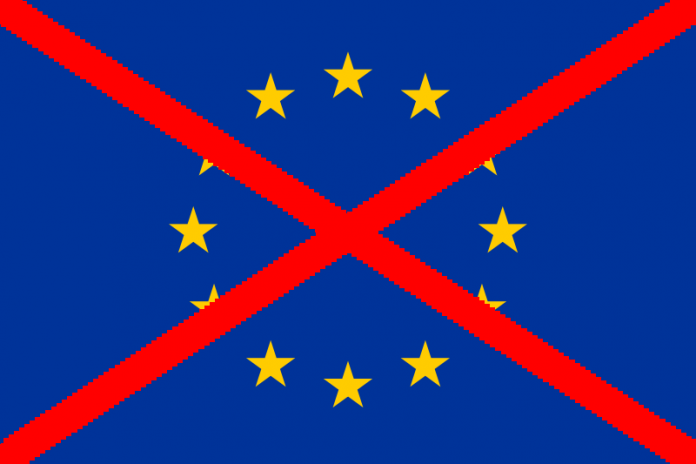
EU delenda est
2005: the day they decided your “no” didn’t count
May 29, 2005. The French vote. Referendum on the European Constitutional Treaty.
Result: 54.68% NO.
Turnout: 69%.
Not a vote of abstainers, not a misunderstanding.
A people speaking out, massively, with full awareness.
Three years later, the same text — or nearly so — came into force. Without asking their opinion again.
Here’s how.
The context.
The Constitutional Treaty was the great federal leap: a text that gave the EU the attributes of a state. A flag, an anthem, a “constitution”, a foreign minister, supremacy written in black and white. Chirac, full of confidence, calls the French to the polls. The “yes” campaign mobilizes everything: the state, the major parties, the media, big business, the institutional unions.
And the French say no. For reasons the elite refused to hear: fear of social dumping (the infamous “Polish plumber”, the Bolkestein directive), a sense of a machine slipping out of their control, rejection of a project decided from on high and ratified by acclamation. Five days later, the Dutch say no in turn. 61%.
The treaty is dead. Officially, it’s called a “period of reflection”. In reality, it’s time to find a workaround.
The workaround has a name: Nicolas Sarkozy.
2007 campaign. Sarkozy proposes a “simplified treaty”. And above all, he lays out the adoption method: it will be the parliamentary route. No referendum. Parliament will vote in place of the people.
That’s his promise. He is elected.
And he keeps it against the people who had already decided.
The sleight of hand: the Lisbon Treaty.
Signed in December 2007.
They remove the symbols that scared people: no more “constitution”, no flag in the text, no “minister”.
They keep the essentials: permanent presidency of the Council, extension of qualified majority voting, retreat from unanimity, the Union’s legal personality, European diplomatic service. The institutional substance of the rejected text, repackaged.
The most cynical part is that they admitted it. Valéry Giscard d’Estaing, the architect of the Constitution, wrote it himself: the tools are the same, we’ve simply changed their order in the box. The stated goal: make the text unreadable so no government would be forced to submit it to a referendum. Technique replacing the popular verdict.
February 2008. Versailles.
Congress convenes to amend the French Constitution and allow ratification. Then Parliament ratifies Lisbon. The government left, which had campaigned for “no”, abstains and lets it pass. The French, they are never consulted again.
The “no” of 2005 has just been converted to “yes” by procedure.
And for those who might doubt the method: Ireland, for its part, was constitutionally required to vote. It says no in June 2008. They make it revote in 2009 until they get the right result. Vote until you get it right.
And that’s where it all connects.
This isn’t a procedural anecdote. It’s the founding act of a legitimacy problem that France has never settled.
Because the question of 2005 is exactly the one today. When Brussels signs 96 billion in development aid, when the NDICI directs billions to foreign “civil societies”, when the Global Gateway promises 300 billion the real question is never “should we do it?”.
It’s: who decided, and with what legitimacy?
The answer, we’ve known it since 2005: an administration that believes the people, when they answer wrong, must be circumvented, not heard. Hayek called it the fatal conceit.
The idea that a center knows better than the peoples what is good for them including against their explicit vote.
The French never accepted Lisbon. They were never asked.
And a structure built by going over the head of a lost referendum doesn’t carry a democratic deficit: it carries a birth defect.
The American Constitution starts with “We the People”.
Ours, the European version, started with a people who said no and an apparatus that decided it didn’t count.
Auto-translated by X from Brivael Le Pogam’s original French post.
June 22, 2026
Two-tier Keir resigns as UK Prime Minister
History will not be kind to Sir Keir Starmer’s time in office, both for his actions and his failures-to-act. The Labour Party will now select the next person to live at Number 10 Downing Street, as they still hold a majority in the House of Commons and are not required to go back to the people for a new mandate, regardless of who is their party leader.
Rupert Lowe, the leader of Restore Britain, greeted the news on the social media site formerly known as Twitter:
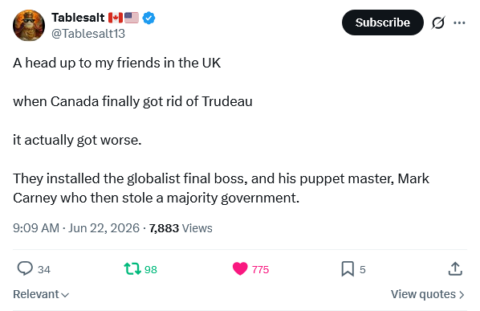
I reposted this on my other social media accounts, saying “Sadly, this is completely true. We belatedly ditched the clown prince of progressivism … only to install Mark Carney, who believes all the same progressive shibboleths that Trudeau did, but he’s far more capable of implementing them by hook or by crook.”
Starmer resigns — he has been a truly disgraceful Prime Minister.
I do not believe him to be a good man or a patriot.
He has deliberately and rapidly accelerated the destruction of our Britain, of our home.
History will not remember him kindly, nor should it.
I sat in Parliament, looking him in the eye, listening to him attempting to justify his decision to block a national inquiry into the mass rape of young British girls.
I will never forgive him. For that, and so much else.
What comes next, I do not know.
Whatever that is, Restore Britain will be ready to offer the British people a democratic route out — a better way, the only way.
But Starmer is gone.
And that is a good thing.
Enjoy it.
Former Manchester mayor and recently elected Member of Parliament for Makerfield Andy Burnham is the most likely successor to Starmer.
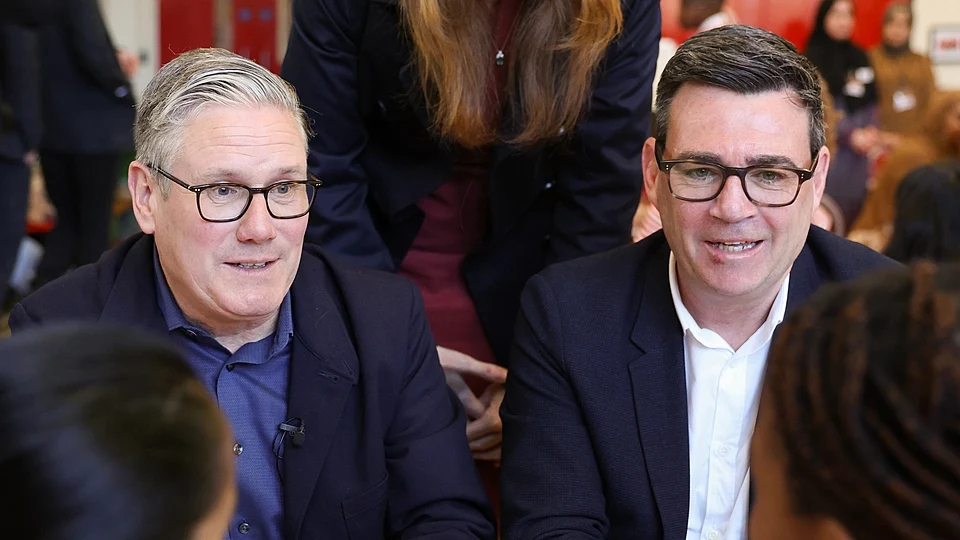
Then-Prime Minister Sir Keir Starmer visiting Holy Trinity Church of England Primary School in Manchester on 13 April 2026 with Andy Burnham, Mayor of Greater Manchester.
Picture by Lauren Hurley / No 10 Downing Street via Wikimedia Commons.
ADATS – Air Defense Anti-Tank System; Canada’s high tech cold warrior
Polyus
Published 19 Jun 2026While designed mainly in Switzerland, over the years its identity became distinctly Canadian. It was produced in Toronto by Oerlikon Aerospace Canada and was operated by Canadian forces from 1988 to 2011. This is the story of the Air Defense Anti-Tank System, or ADATS
ADATS was a very interesting and highly advanced air defense system designed to fight a cold war that never materialized. It was operated for a little over 20 years, so it was by no means a flash-in-the-pan. Unfortunately, Canada has since given up its short ranged air defense capability and all of the human expertise that was built up over the years. Hopefully in the future a new system can be acquired and Canada can again expand its sovereign air defense capabilities.
This video was made without the use of Artificial Intelligence (No AI). Long live people power!
0:00 Introduction
0:29 European Background
2:09 Technical Details
4:05 Engagement Sequence
5:38 Comparison to other Systems
6:06 Canadian Adoption
7:48 American Testing
8:32 Thai Adoption
8:57 Advanced Variants
10:23 ConclusionMusic:
“Denmark” – Portland Cello Project
“Your Suggestions” – Unicorn Heads
Sparta vs Athens – 2(b): Ostracism, Demagogues, and Why Athenian Democracy Worked (Until Rome)
seangabb
Published 8 Feb 2026Greece: A Brief History, c.700 BC – 500 AD
Athenian democracy is often dismissed as mob rule. This segment explains why that is too simple. Athens developed habits and structures that stabilised debate: frequent Assembly meetings, repeated exposure to the same issues and speakers, and a politically literate citizen body shaped by practical participation.
I also cover the darker logic: fear of tyranny, fear of dominance, and why Athens accepted instability and even injustice as the price of preventing permanent concentrations of power. Ostracism is discussed as a precautionary tool, and demagoguery as a permanent risk that the system managed rather than “solved”.
Finally, I explain how Athenian democracy ended — not because it decayed internally, but because Rome rendered the institutions meaningless. Empire does not tolerate participation.
June 21, 2026
Jean Rapail’s The Camp of the Saints, translated by Robert Laffont
Copernican reviews Jean Raspail’s The Camp of the Saints which was reprinted in an English translation by Robert Laffont earlier this year:

It is time that I throw my own hat into the ring regarding this particular piece of polemic fiction. It’s particularly topical given the recent events in the UK and the Western World. A look at toxic progressive empathy taken its natural conclusion.
Written by Jean Raspail and published in 1973, Camp of the Saints is a book infamous among those the media describes as “Far Right” and virtually unknown outside of that. Were history set upon an even keel, Camp of the Saints would sit on the bookshelf of every high school right next to the classic works of the same genre: notably 1984, Brave New World, and Fahrenheit 451.
This book was so dangerous that for decades, now, the English translation has been out of print, available only as an expensive antique, or through the Internet Archive, [as] a single shoddy .pdf. The corporate owners of the English translation rights have, despite considerable interest, refused to republish it. That was until September of 2025, when a new translation was created and distributed.1
As of now, what was once an antique book is now cheap and in-print. What’s more, it’s been converted to an audiobook available on Audible.2 It took the destruction of Western Culture for us to see published the one work of dystopian fiction that warned us of it.
Given its relevance, it makes sense that over ten percent of the run-time consists of various forwards from the author, translator, and the publisher, that describe the political and cultural push against its own publication. It’s worth it to read (or listen) through the numerous forwards to better understand the context and the author.
An Introduction to the Text
Among the dangerous books written in the late 20th century, Camp of the Saints takes the self-destructive anti-nativism of the neoliberal world order and draws it forward to its own natural conclusion. Like other works of fiction, it takes popular ideas and asks the question: “What if these beliefs are taken to their ultimate logical end?”
The book is written from the perspective of an omniscient historian who witnessed the events of the text; he knows that his work will be censored, silenced, or redacted. In the context of the book, the accurate recollection of the events described is inherently destructive to the (now) dominant anti-racist political regime. The force of political progressivism will destroy any such history on the basis that it may “incite racial hatred” or “create division”.
A fascinating bit of forethought in that those are the exact reasons why Camp of the Saints was itself banished from public view for the last half-century: Liberal cultural diversity transitioned smoothly to violent censure and virulent “anti-White” or “anti-Western” genocidal hatred.
The book is a dramatization of the Fall of the West. Not in pitched battle, but as it has lost its spiritual core to rampant idealism. The “other” is always to be given deference over our own people. The sympathy that is demanded for the “other” is also silenced and denied for our own. At what point do a people become so spiritually deracinated that they lose all legitimacy to exist? At what point do they become so deluded as to lack totally a theory-of-mind of the “other”, and at what point does sympathy for the foreigner overwhelm survival?
Camp of the Saints answers these questions in sometimes graphic detail. Some of the horrors written on those pages hadn’t happened to innocent Western children yet … but now, fifty years on, and they have happened. Many times over, in many places and nations, across the West.3 In comparison to the reality of the West in the 21st Century, Camp of the Saints is a tame warning.
The book begins with a great migrant fleet setting off from Calcutta, India. The poor, the starving, the diseased, and the malformed set out for the West- A land where milk and honey flow freely and where the rivers are rich with Fish. The people of India want a better life for themselves, even if they have to walk, unarmed, onto foreign lands to get it. They, like many peoples, believe that their land is simply poor and that Western nations are simply rich. Failing to understand that it is not some “magic dirt” that made France, England, Australia, and the United States rich, but rather it was the French, English, Australians, and Americans. The West doesn’t horde “magic dirt” but “magic people”, so to speak. Were the West to be flooded with Indians, it would become just like India, not magically make the invading Indians wealthy and intelligent.4
I doubt that it’s possible to explain that fact to third-world migrant retards.
To conclude a spoiler-free version of the review: You should read it. It should have been taught in high schools for the last 50 years. You should probably buy a copy before the beast of Progressivism finds a new way to censor it. If you buy the Audible copy, use a tool to convert it to an .mp3 file so that it can’t be deleted from your personal library after the fact.5 There’s a reason it’s been censored for the last 30 years or so. It’s dangerous, subversive, and intelligent in a way that modern dystopian authors wish they could be.
- Here is a direct link [https://www.amazon.com/Camp-Saints-Jean-Raspail/dp/B0FG4MJS8K] to where you can purchase the book on Amazon. A shoutout to Vauban Books for doing the work that every other publisher has been unable, or too scared, to do.
- I kind of enjoy audiobooks. Though Camp of the Saints can be particularly tricky to listen to over reading directly due to its complex cast and jumping around in the timeline.
- The Rape Gang Inquiry Report by Rupert Lowe is particularly poignant and well-timed here.
- A fact that is in stark relief as of 2026, with over 10% of their population (official sources say it’s close to 7%, but I don’t believe them) now being Skaven imports from India … and the wealth, safety, culture, and prosperity of Canada now vanishing at an alarming rate.
- The “Open Audible” tool is works for this, but it isn’t free.
How To Make War Inevitable – Death of Democracy 20 – Q4 1937
World War Two and Spartacus Olsson
Published 20 Jun 2026By late 1937, Nazi Germany’s rearmament economy had trapped itself. Autarky was failing. Hjalmar Schacht was pushed aside. Göring’s Four-Year Plan dominated economic policy. And at the secret Hossbach meeting of November 5, Hitler turned economic impossibility into an argument for territorial conquest.
This episode covers Q4 1937: the Hossbach Memorandum, Schacht’s resignation, the Anti-Comintern alignment, Lord Halifax’s visit, Himmler’s police-state consolidation, the December “Preventive Crime Fighting” decree, and the antisemitic propaganda exhibition Der Ewige Jude.
The argument is not that war was metaphysically inevitable. It is that the Nazi regime built an ideological, economic, and police-state machine that made war look increasingly necessary to its own leadership. This is a historical analysis of Nazi dictatorship, antisemitic propaganda, and war planning. It condemns Nazism and uses extremist material only for educational and documentary context.
Chapters:
0:00 Q4 1937 Intro
0:53 The world at the end of 1937
1:36 Germany’s quarter of acceleration
3:30 Himmler Tightens Police Power
6:26 Der Ewige Jude and dehumanization
8:30 Hossbach: autarky fails
11:16 Halifax and diplomatic confidence
13:03 Mood inside Germany
15:09 Mein Kampf has become policy
17:16 Conclusion: the politics of beasts


