
seangabb
Published 16 Feb 2026Greece: A Brief History, c.700 BC – 500 AD
In this lecture we begin the Persian Wars not with battle, but with misunderstanding. The Greeks did not set out to fight a civilisation-defining struggle against Asia, and the Persians were not driven by irrational hatred of freedom. This episode explores the structural collision between the Persian Empire and the Greek city-state system. We examine the rise of Persian power under Cyrus and Darius, the nature of imperial governance, and the early cultural encounter between Greek and Persian military worlds. Along the way, we meet Herodotus, the first true historian, and consider how his narrative shapes our understanding of East and West.
This is the beginning of a story that ends at Marathon — but whose consequences reach much further.
July 6, 2026
The Ancient Greeks: 03 – Enter the Persians 1 – When Empire Meets the Polis
July 5, 2026
How Hitler Targeted Czechoslovakia – Death of Democracy 22 – Q2 1938
World War Two
Published 4 Jul 2026Spring 1938: Hitler has taken Austria. Now he turns toward Czechoslovakia — and at home, Nazi Germany’s terror against Jews and other targeted minorities accelerates.
In this episode of Death of Democracy, Spartacus Olsson reports from Berlin at the end of Q2 1938, as the Nazi regime fuses foreign-policy intimidation with domestic repression.
After the Anschluss, Hitler pressures Czechoslovakia over the Sudetenland, but the May Crisis exposes that Germany may not yet be ready for war. Humiliated, Hitler secretly issues a revised Case Green directive: Czechoslovakia is to be smashed by military action.
At the same time, persecution inside the Reich escalates. Jews are forced to register assets. The Nuremberg Laws are extended to annexed Austria. The Great Synagogue in Munich is demolished. Berlin sees orchestrated anti-Jewish street violence. And during “Operation Work-Shy Reich“, thousands of so-called “asocials” are sent to concentration camps — including the first mass arrest of Jews since Hitler’s seizure of power.
This is the quarter when the road from Anschluss to Munich becomes clearer: diplomatic extortion abroad, racial terror at home, and a world still hoping that concessions might preserve peace.
In this episode:
– The April 1938 Anschluss plebiscite
– Jewish asset registration and Aryanization
– The extension of the Nuremberg Laws to Austria
– The Sudeten May Crisis
– Hitler’s Case Green directive against Czechoslovakia
– The demolition of Munich’s Great Synagogue
– Anti-Jewish violence in Berlin
– Operation Work-Shy Reich
– Flossenbürg and the expansion of concentration-camp labor
– The world’s hesitant response to Nazi escalation
Terni Model 1921: Italian Interwar Assault Rifle with a Cube Mag
Forgotten Weapons
Published 16 Feb 2026After World War One, the Italian military spent some time studying the effectiveness of reduced-power cartridges, including both pistol calibers semiautomatic carbines and submachine guns as well as intermediate-caliber rifles. One of the rifles developed for the subsequent testing was the Terni Arsenal model 1921, of which 200 appear to have been made in total during the 1920s. This rifle used a surprising advanced 7.35x32mm cartridge, firing a 135 grain bullet at 1970 fps. It was a short recoil design and used a Fiat-Revelli style cube magazine. Ultimately the concept was not adopted (probably for reasons of cost), and some of the surviving rifles ended up in Ethiopia — where this example was found a few years ago.
(more…)
July 4, 2026
In the “early Victorian period … drinking whisky was the modern-day equivalent of licking hallucinogenic toads”
Scotland was terra incognita to the English for far longer than one might think, even though the two kingdoms shared a monarch as early as 1603. On his Substack, Ed West shows how modern day Scotland has long since emerged from the mysterious shadows of the past:
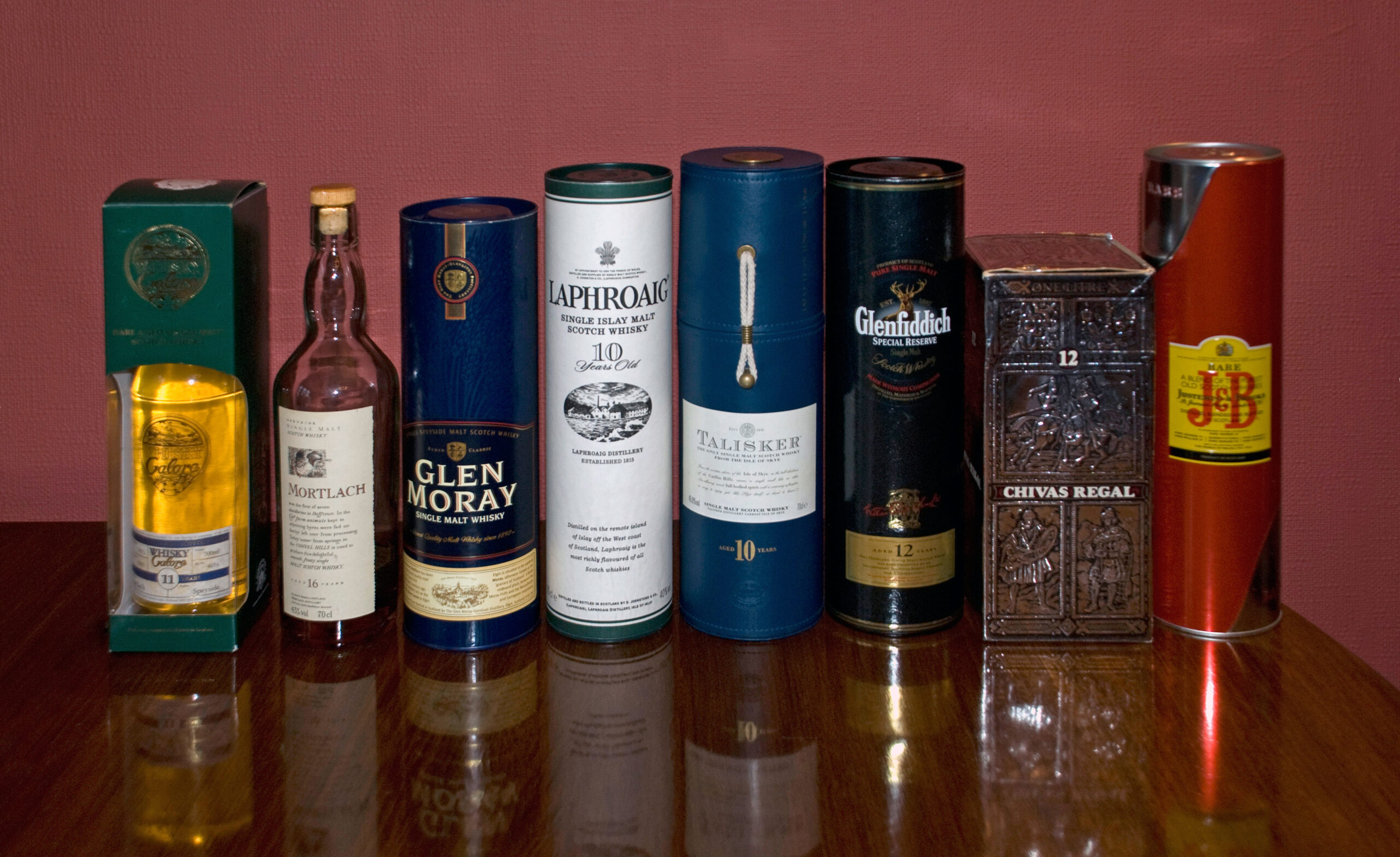
“Scotch whiskies” by Chris huh is licensed under CC BY-SA 4.0 

 .
.
In his highly entertaining history of alcohol and the British, Empire of Booze, Henry Jeffreys observed how one effect of the Napoleonic Wars was to make Scotland a popular destination for English holiday makers. What with the continent being isolated and everything, there weren’t many more exotic places for the richer, more adventurous traveller to visit.
The country was until then largely unknown to many people south of the border, something also true of its trademark drink. “Highland and lowland whisky in the early 19th century would have been a mystery to the majority of Englishmen”, Jeffreys writes: “In the literature of the Georgian and early Victorian period it’s apparent that drinking whisky while in Scotland was the modern-day equivalent of licking hallucinogenic toads while in the Amazon or eating rancid whale in Iceland”.
The conflict with revolutionary France proved to be a great boost to Brand Scotland, and not just because of the limits it placed on rival destinations, but also for the dash that the Scots cut on the field. This culminated with a momentous scene in which “the Highland regiments dazzled the French when the Allied armies marched into Paris”.
Here they wowed both friends and enemies alike, and Sergeant Thomas Campbell of the Grenadier Company recalled how the Tsar even personally “examined my hose, gaiters, legs, and pinched my skin, thinking I wore something under my kilt, and had the curiosity to lift my kilt up to my navel, so that he might not be deceived”. Thanks to the likes of the Black Watch and Gordon Highlanders, the Scots had arrived on the global stage, and no one would ever forget Die Damen aus der Hölle (Ladies from Hell) as German troops would later call Highlanders.
This period of upheaval and war – the birth pangs of true modernity — was marked by a growing craze for Highlandism, “a peculiar phenomenon where lowland Scotland, a predominantly settled mercantile society, took on the trappings of the Highlander as a way of differentiating themselves from Englishmen who they were now yoked to in the Union”.
Previously viewed as menacing, the Highlanders had been tamed by the defeat of the Jacobites and the Clearances that followed, making this once-feared Gaelic culture now safe for English speakers to adopt as their own. Much of this was driven by the romantic imagination of Edinburgh’s Walter Scott, who helped shape both Scottish national identity and the 19th century resurgence of medievalism. Perhaps more than literature, however, Highlandism was boosted by the region’s most famous export — whisky. As Jeffreys writes: “The growth of Scotch coincided with the birth of Highlandism”.
The development of Brand Scotland was also helped by a man widely regarded as Britain’s greatest buffoon and waste of space, the former Prince Regent. Historian John Plumb described a hugely influential visit by the now George IV in 1822, where: “He paraded Edinburgh in the kilt, resplendent in the Royal Stuart tartan and flesh-coloured tights, and yet managed to keep his dignity. The Scots loved it! Quaintly enough, George IV had struck the future note of the monarchy … Be kilted! Be sporans! Be tartans! Riding up Princess Street … To the roaring cheers of loyal Scots, he was showing the way that the monarchy would have to go if it were to survive an industrial and democratic society.”
It was the start of a beautifully symbiotic relationship, with the Royal Family immersing themselves in Highlandism ever since, spending much of their summer holidays there and helping to project an ideal of a region famed for its dramatic countryside, castles, distilleries and golf courses. They’re not alone: Donald Trump, whose mother hailed from the Isle of Lewis, has a noted fondness for the old country, even if this is not always reciprocated, and no doubt many more of his compatriots will be making the pilgrimage in the coming year thanks to the country’s newest brand ambassadors. These are, of course, another occupying force of Scots, the fans of the national football team who followed their country’s brief recent appearance at World Cup.
The Scots in Boston marched as proudly as their ancestors. Their bagpipers serenaded the opposition. Some even turned up at a wedding. They came to watch the Boston Red Sox, which one local described as “the best thing that’s happened in years”. They attracted many neutrals, including a duck. Folk songs were written about them. Everyone loved them, even if some struggled to understand them.
The Boston Globe published a full-page letter thanking them. One local reported how Scotland fans leaving Boston was “almost like a day of mourning for the Americans“. After they left, Massachusetts State Senator Paul Feeney made an emotional farewell, thanking them for visiting children’s hospitals and donating money to local charities: “You’ve been great, courteous guests, you’ve been polite and you’ve been fun and I don’t want that to end”. He invited them to return next year, by which time Glasgow will be twinned with Boston. Indeed, Scottish fans so impressed the Bostonians that the city changed its zoning laws, not an easy task in America. They may even have solved the fertility crisis. Indeed, the Tartan Army charm offensive in Boston has been so overwhelming that I half suspect it’s some sort of devious RICU operation.

The Dark Truth Behind America’s National Anthem
The Rest Is History
Published 8 Jun 2026How did the War of 1812 result in America’s national anthem, The Star Spangled Banner? Who came up with it? And, why does this origin story make the anthem so controversial?
Join Dominic and Tom as they launch into the first episode of their Football World Cup special, with the story behind America’s national anthem, and its secret story.
0:00 – Lloyd’s
01:21 – The Star-Spangled Banner
02:43 – A World Cup Series on National Anthems
04:08 – America’s Most Controversial Anthem
05:00 – The Forgotten War of 1812
09:10 – Britain Strikes Back
11:39 – Francis Scott Key Boards the British Fleet
15:27 – The Bombardment of Fort McHenry
18:14 – The Giant Flag That Inspired the Anthem
20:41 – Francis Scott Key Writes the Poem
23:28 – Why the Anthem Used an Old English Tune
26:13 – The Anacreontic Song
29:07 – How the Song Became a Hit
30:37 – The Times
31:48 – Is The Star-Spangled Banner About Slavery?
36:08 – Escaped Slaves and the British Army
40:55 – The People Who Found Freedom Under the Union Jack
42:29 – Francis Scott Key’s Complicated Legacy
47:06 – The Song Spreads Across America
51:39 – Why America Took So Long to Get a National Anthem
56:42 – How It Finally Became the Anthem
57:06 – Controversial Performances
1:00:17 – Colin Kaepernick and Taking the Knee
1:02:39 – Can You Separate the Anthem from the Author?
1:03:03 – The Abolitionist Version of the Anthem
1:04:13 – Coming Next: God Save the King
1:06:33 – The Rest Is History ClubVideo Editors: Jack Meek, Harry Swan + Adam Thornton
Social Producer: Harry Balden
Producers: Tabby Syrett & Aaliyah Akude
Senior Producer: Callum Hill
Executive Producer: Dom Johnson
Chief Digital Officer: Sam Oakley
QotD: “Yankee Doodle”
Everyone in America knows “Yankee Doodle”. That is a remarkable thing to be able to say about any piece of music, let alone one written in the middle of the eighteenth century by a British army surgeon who meant it as an insult. Most of us learned it before we learned to read. It arrives through some combination of school, parade, ice cream truck, and the ambient cultural air of the American summer, and by the time you can name it you already know it. You know the melody before you know the words, and you know the words before you know what any of them mean. A feather. A pony. Macaroni. A young man coming to town. It is the most familiar song in the American songbook and also, when you actually look at it, one of the strangest.
[…]
Which is how we ended up with a patriotic standard that is also a death threat, a sodomy joke, a farm boy’s account of watching grown men handle their enormous guns with mounting enthusiasm, and the song we teach five year olds at Fourth of July parades. All of this has been inside the song the whole time. I want to walk through what is actually in there, because once you can see it you cannot stop seeing it, and I think we owe the song more than we have been giving it.
Start with the title, because the title is already doing two things at once. “Yankee” is almost certainly from the Dutch Janke, a diminutive Dutch settlers in New York used to mock their English neighbors. The British army picked it up as convenient shorthand for a provincial American. A rube. A man of no consequence. “Doodle” meant fool, from the German dudel, and this is the part that makes it into the elementary school music program. The part that does not is that “doodle” was also eighteenth-century British slang for a penis. Both meanings were in active circulation. Neither was obscure. When the British handed this song to their regulars as a marching tune intended to demoralize the enemy, they were calling the colonists provincial idiots and, on a second pass, Yankee dicks. The American troops heard the title and, in the great tradition of men who have already stopped caring what anyone thinks of them, said yes, that one, put it on the flag.
The first thing the song was is a threat.
Yankee Doodle’s come to town / For to buy a firelock / We will tar and feather him / And so will we John Hancock.
British soldiers were singing verses like this one in the run-up to Lexington. Tar and feathering was not a prank. It was a ritual. Men were stripped, had boiling pine tar poured directly onto bare skin, rolled in feathers while the tar was still cooling, and paraded through town as public spectacle. The skin came off with the tar. Some victims died in the days that followed from shock and from infections in the raw flesh. The British soldiers are singing about doing this to a specifically named man. John Hancock. The wealthiest man in Boston, already on London’s list for arrest. “So will we John Hancock” uses his name as a verb. We will do this to him. We will use his body to make a point.
The soldiers singing this were on their way to arrest him. They missed. Hancock got through Lexington, made it to Philadelphia, and in the summer of the following year signed the Declaration of Independence in letters so large that his name became, in English, the common noun for a signature. The verb became the noun. We will destroy you publicly became I was here, I did this, come and get me. The song that had been a mob-violence threat against a living dissident was now, a year later, being sung by the men who had saved him as they mustered for the same war. The target of the verse became the architect of the country that kept the verse. This is the first transformation the song undergoes and it is not subtle. It is also not the last.
The second thing the song is is a sodomy panic. He stuck a feather in his cap and called it macaroni. Every American schoolchild has been told this means the colonist was too stupid to know what fashion was. That is the sanitized reading. The full reading requires understanding what the Macaroni Club was. Young English aristocrats came back from the Grand Tour in Italy wearing wigs so tall they required structural adjustment to pass under a doorframe, corseted coats, embroidered slippers, and Continental affectations so pronounced the London press began printing caricatures of them within the year. “Macaroni” meant dandy, in the same dictionary-accurate way “doodle” meant fool. Technically correct. Missing the entire point.
The point is that the Macaroni Club had become, by the 1770s, a convenient public container for British anxieties about male effeminacy, foreign moral contamination, and sodomy. The caricatures drew them in pinched silhouettes and muffs, in poses the London audience was supposed to read as unmistakably queer. The courts were not caricaturing. They were prosecuting. Men were pilloried. Others were executed. The word “macaroni” was carrying the weight of active criminal cases at the exact moment “Yankee Doodle” was being composed. A British army surgeon named Richard Shuckburgh is the likely author of the most famous macaroni verse, and what he wrote was a joke with a second floor. On the ground floor: the colonial rube does not know what high fashion is and mistakes a single feather for an entire wardrobe. On the second floor: the colonial rube has just put on the signifier of a group of men the British state is currently prosecuting for sodomy, and he does not realize what he has announced himself as. He is a joke to the troops singing the song, and the joke is that he is queer and does not know it.
The colonists heard all of this and kept the song anyway. The British were banking on a shame that had already dissolved. You cannot humiliate a people that has stopped needing your approval. The song arrived as an instrument of British contempt, and the colonists adopted it anyway, and from that moment on it stopped being a British song and started being something else. A vessel. Whatever the singer needed it to carry, the song carried. That is the reclamation, and it is also the engine of everything that happens to the song from here.
Emma, “Yankee Doodle, Undressed”, Past Life, Present Cleavage, 2026-04-22.
July 3, 2026
1977 – when the French intelligentsia rallied to protect pedophiles
On the social media site formerly known as Twitter, Brivael Le Pogam poinpoints the formal attempt to turn criminal pedophilia into academically supported individuals with “Minor Attraction” (translated from the original French by X):
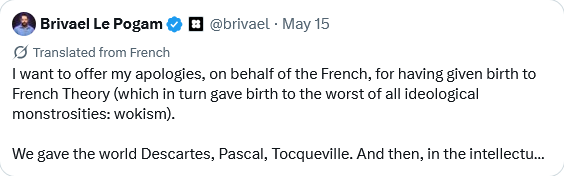
In 1977, a petition appeared in Le Monde and Libération. It called for the decriminalization of sexual relations between adults and children aged thirteen. Look at the signatures. Foucault. Derrida. Sartre. Beauvoir. Barthes. Deleuze. Guattari. Lyotard. Sollers. The entirety of the French intellectual aristocracy, the very same that would go on to colonize Yale and Berkeley, gathered under a text that pedantically explains that the child is capable of consenting.
This is not an anecdote. It is the proof.
A few days ago, I wrote that French Theory rested on a single thesis: there is no truth, there are only relations of power. I was told I was caricaturing, that these men were too subtle to be reduced to a slogan. Very well. Then let us observe what subtlety produces when pushed to its extreme.
If every norm is merely domination in disguise, then the prohibition protecting childhood is a form of domination like any other. If every truth is a construction, then innocence is a construction. If every desire is worth every other because no law is legitimate, then there is no longer any reason to defend the most elementary boundary that a civilization has ever established. They did not sign this petition despite their philosophy. They signed it because of it. It was the logical conclusion of the system. They simply had the imprudence to write it down in black and white, before their American heirs learned to wrap the same logic in more cautious vocabulary.
This is the man still taught in undergraduate courses. This is the thinker still cited with reverence at conferences. The one who, in 1977, thought the law protected children a little too much.
A thought is judged by what it makes possible. A thought that, when it reaches its term, no longer knows how to say why one does not touch children is not a subtle thought. It is a dead thought. And a civilization that continues to teach it with deference is not subtle either. It is complicit.
One does not deconstruct innocence. One protects it. It is even more or less the only thing one has no right to fail at.
Beef Bourguignon for the French Peasants from 1885
Tasting History with Max Miller
Published 6 Jan 2026Stewed beef in red wine sauce with onions
City/Region: France
Time Period: 1885Originally a peasant dish, early beef bourguignon was a sauce for leftover stewed beef. Elevated and popularized by the father of French haute cuisine, Auguste Escoffier, it shortly thereafter made the transition from a sauce to stew, and beef bourguignon was further popularized by cooking icon Julia Child.
This recipe from 1885 is for the sauce version, and it is just as delicious as the modern stew. It’s a little more wine-forward and a little less sweet, the meat is fall-apart tender, and the onions are my favorite part. If you have some leftover cooked beef like a roast or short ribs, this sauce is a great way to jazz it up. Otherwise, make the stewed beef as instructed in the recipe below because the sauce is absolutely worth it.
Boeuf Bourguignonne
Brown a piece of pork belly, diced, in butter; add a little flour, salt, and pepper, and add a mixture of half broth and half red wine; add a few small white onions, well peeled; let cook for 20 minutes, then add to this sauce your stewed beef, cut into slices. When the meat is well heated through, serve with the sauce.
— La Bonne Cuisine Pour Tous ou l’Art de Bien Vivre a Bon Marché by Marcel Butler, 1885
July 2, 2026
PBS-1 Soviet AK Silencer (the Original, not the Dead Air One)
Forgotten Weapons
Published 13 Feb 2026The Soviet Union had made fairly extensive use of silencers on Mosin Nagant rifles during World War Two, as tools for snipers and recon scouts among others. In the mid 1950s a new silencer was put into development for the new 7.62x39mm family of weapons, called the PBS (Прибор Бесшумной Стрельбы; Pribor Besshumnoi Strelyby; Silent Shooting Device). This was originally intended to be a multi-weapon silencer, but the abandonment of the SKS and reliability problems with the RPD led to it being limited to just the AK. Compared to the Mosin Nagant silencers, this new design was much more difficult, as it had to allow the rifle to cycle reliably using specialized subsonic ammunition, and also continue to run reliably with the silencer removed and standard ammunition used. This led to the most unusual element of its design; a thick rubber wipe just in front of the muzzle to help boost back pressure.
The remainder of the design was pretty simple, with 12 plain flat plate baffles. The first production PBS model used a clamshell main body, but this was replaced by a solid tube on the PBS-1 improved model in 1962. These suppressors were used until the late 1970s, when the 9x39mm cartridge was developed for better subsonic effectiveness, along with a number of unique new firearms designed for it.
Bramit Suppressor for Mosin Nagant: • Soviet WW2 Bramit Silencer for the M91/30
(more…)
July 1, 2026
The Korean War Week 106 – The Battle of Old Baldy – June 30, 1952
The Korean War by Indy Neidell
Published 30 Jun 2026On the ground, the fight for the hilltop they call “Old Baldy” really heats up this week, and it’s a bloody one. In the air, the bombing campaign to destroy the North Korean hydro-electrical complex continues, and the Suiho dam, one of the world’s largest, is put out of action and the power is out across much of the country.
00:00 Intro
00:45 Recap
01:14 Suiho Dam
05:22 Old Baldy
09:04 Army Budgets
14:29 Planning a coup?
16:08 Summary
16:22 Conclusion
17:10 Call to Action
Elleander Morning: Causes vs Catalysts
Feral Historian
Published 6 Mar 2026Elleander Morning (Jerry Yulsman) is a peculiar bit of alt-history, brilliant in some ways and immensely clunky in others. It’s a story of a war averted, or perhaps only postponed, and it plays with some fundamental questions of history.
00:00 Intro
02:30 Implications left hanging
03:29 The Books
06:15 The New Catalyst
12:06 Gaming the Past
13:04 Concluding Musings
(more…)
June 30, 2026
Sparta vs Athens 2(d): Athenian Freedom – Drama, Free Speech, Trade, and the Economy
seangabb
Published 8 Feb 2026Greece: A Brief History, c.700 BC – 500 AD
This final segment links culture to economics and asks what Athenian “freedom” actually looked like in practice. Drama was not a private pastime. It was a civic institution performed before the citizen body. Comedy could be brutally obscene and politically personal, naming living leaders on stage — evidence of a public culture far less timid about speech than most modern states.
From there I move to Athens as a maritime power: trade, grain dependence, Piraeus, coinage, state pay, and the economic dynamism that supported participation in Assembly and law courts. The images on the slides matter here: artefacts and “industrial art” show what Athens valued in daily life.
I end by returning to Sparta’s deliberately restrictive economy — iron currency, limited trade, enforced uniformity — and why that system could produce discipline but not lasting intellectual fertility.
This is also where I state plainly what we owe to Athens.
June 29, 2026
King Charles disclaims the title “Defender of the Faith”
His Majesty has been hinting of his preference for Islam since at least his thirties … becoming formal head of the Church of England fits poorly with his likely personal beliefs. This isn’t really a surprise, as the Church of England has been drifting a long way from its roots for generations now, but symbolically it is quite important, as Donna-Louise Flowers writes on Substack Notes:
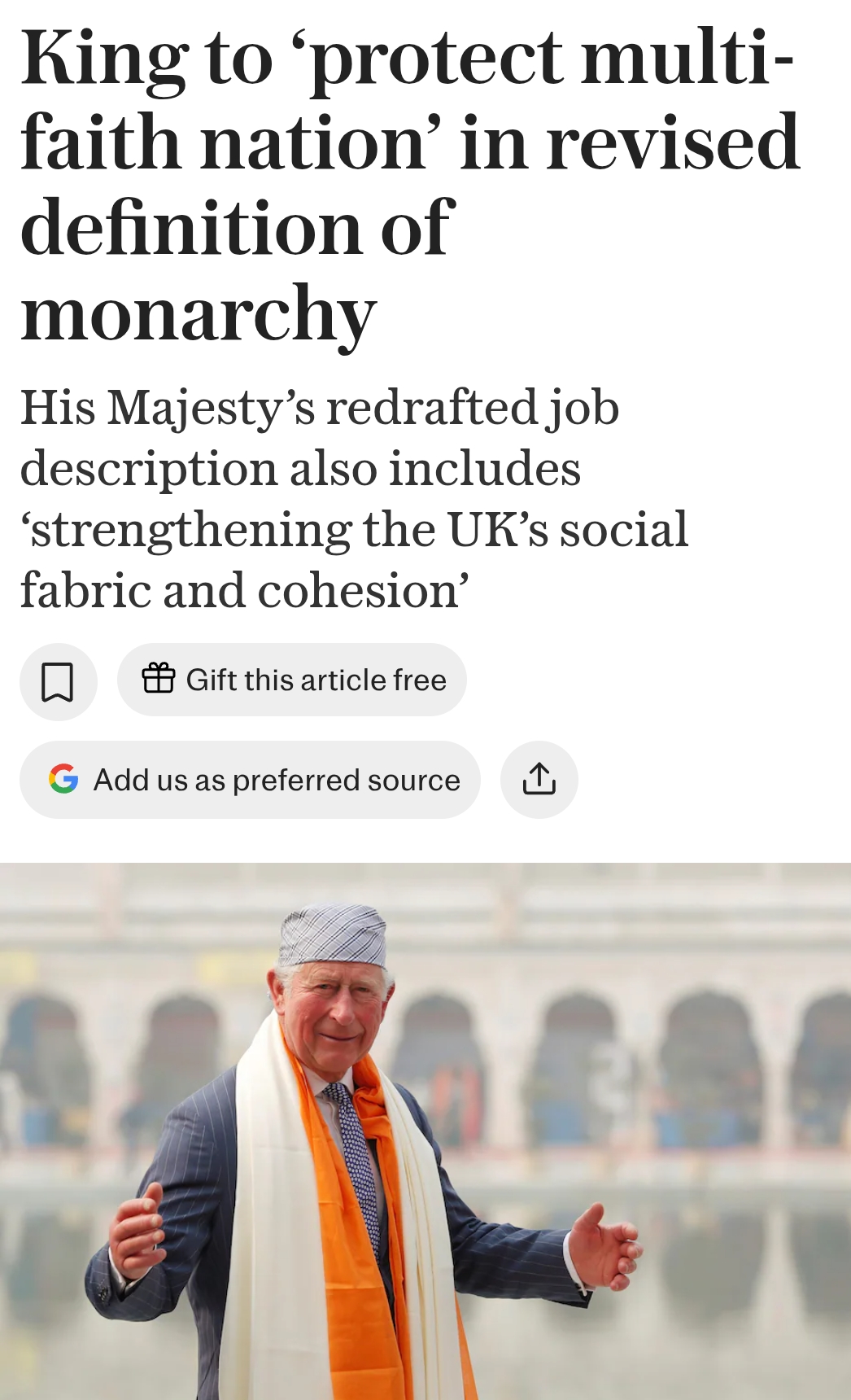
This Is the End of Britain: King Charles Just Formalised the Surrender
This is absolutely shocking. It is an absolute outrage. And it feels like the beginning of the end for Britain as we have known it.
In the latest Sovereign Grant report, Buckingham Palace has ditched the ancient title “Defender of the Faith”. No more defending the Christian foundation of this realm. Instead the King is now described as protecting “the space for Faith within the multi-faith nation”. What utter nonsense. Britain is a Christian country. That is not up for debate or negotiation. If the monarch abandons that core duty, then the institution itself has abandoned the British people.
Other faiths exist here, yes. But their presence does not require the Head of State and Supreme Governor of the Church of England to water down his role into some vague, multi-faith referee. His job is to defend the Christian faith of this nation. Full stop. Not to bend over backwards for every new arrival.
King Charles has spent decades signalling exactly this shift — praising interfaith dialogue, building ties across communities, and even calling Islam a religion of peace. Now it is baked into official Palace language. While we watch our Christian heritage eroded, churches close, and British identity dissolve, the monarchy chooses accommodation over duty.
This is more than infuriating. It is a profound betrayal. We see the reality on the ground: halal meat quietly served in the NHS and in schools to everyone — often without proper consent or even basic awareness. Islamic practices are increasingly imposed on the wider population while native Britons are expected to stay silent and pay for it. Everything is tilting. Sharia norms creep in, demands multiply, and our own traditions are treated as optional extras.
We do not fly to Saudi Arabia, Pakistan or anywhere else and demand they rewrite their entire way of life, abandon their religion, and serve us bacon sandwiches in their institutions. Why then must Britain endlessly accommodate, dilute, and apologise for existing as a Christian country? Why are we expected to change everything while others refuse any compromise?
This multi-faith rebranding is not progress. It is cultural surrender dressed up in polite language. A monarch who stands for everything stands for nothing. Britain had a specific, Christian character that allowed it to become the tolerant society it once was. Hollow that out and you do not get harmonious diversity — you get the slow erasure of the host culture.
I am deeply offended. Millions of ordinary Britons are deeply offended. This feels like the end of Britain as a coherent nation with its own history, faith and identity. The King’s role was never to manage a neutral spiritual marketplace. It was to defend the faith of this realm.
Enough of the euphemisms and the quiet capitulation. Call it what it is: a disgraceful abandonment of duty at the very top. If this continues, there will be nothing left worth defending. Britain deserves better.
Amusingly, the title “Defender of the Faith” was granted to King Henry VIII by Pope Leo X for a book (almost certainly co-written if not ghostwritten) refuting Martin Luther. King Henry “forgot” to disclaim the title when he broke with Rome a few years later …
Stupid Super Heavies: Germany’s Biggest Tanks
The Tank Museum
Published 27 Feb 2026By late 1943 Germany was losing the war …
They needed tanks, and lots of them, if they were going to wrestle back the initiative. Instead, they became obsessed with wonder weapons they hoped could change their fate
From the logistical paralysis of King Tiger, growing ever bigger and more unwieldy with the Maus, ultimately reaching the madness of the thousand tonne Ratte.
Like Augustus Gloop, German tank development in the Second World War greedily ate up more and more resources.
While an absolute boon for historians working at The Tank Museum, it made no logical sense … What were they thinking?
This is the bewildering story of the “Super Heavies”
00:00 | Introduction
00:48 | The Panther Problem
02:27 | Bigger is Better
05:42 | Pushing the Limits
09:19 | Gigantic Fantasies
12:03 | Losing the War (and the Plot)
(more…)
QotD: Roman Imperial frontiers and “defensive barbarism”
Here’s another one — why is Hadrian’s Wall where it is? There’s a much shorter and more defensible alternate location to the north, where the Firth of Forth and the Firth of Clyde create a natural bottleneck. In fact at one point the Romans did build a wall there and claimed all the intervening territory. On paper, the Antonine Wall looks better in every way than Hadrian’s Wall. [Image from original post] It’s shorter, so requires less military “output” to defend. And it encloses more area, so brings to the “inputs” of the machine of state both additional arable land and additional people who can be taxed and conscripted. But as it happened, the Antonine Wall was quickly abandoned, and the empire retreated to Hadrian’s Wall. Why?
It all had to do with the people living between the two walls. They were … hill people who had perfected the art of not being governed. They managed to be so thoroughly intractable, so impossible to control or corral, so very unpleasant to be around, that the Romans eventually threw up their hands in disgust and left them alone. It’s important to understand that this means they must have been true outliers, because the Roman Empire had “unit economics” like an enterprise SaaS business, where “customer acquisition costs” are financed on the assumption that they’ll be paid back in the distant future. Every Roman bureaucrat understood that newly conquered territories would be a drain on fiscal and military resources for a while, until a generations-long process of pacification and Romanization slowly made them net contributors in both departments. But in the case of the lands between the two walls, the payback timeline was so long, and the implied interest rates so high, that even a people as meticulous and relentless as the Romans decided there were better opportunities elsewhere. I count this as a serious victory for the theory of defensive barbarism.
John Psmith, “REVIEW: The Grand Strategy of the Roman Empire by Edward Luttwak”, Mr. and Mrs. Psmith’s Bookshelf, 2023-11-13.


