
Forgotten Weapons
Published 28 Feb 2018Unlike Great Britain and Germany, the French military never developed a formal sniper doctrine during World War One — they had no dedicated schools or instruction manuals for that specialty. The three major arsenals did produce scoped sniping rifles, however, with models of 1915, 1916, and 1917 (and a post-war 1921 pattern). We have a model 1916 example here today.
The rifles were completely ordinary off-the-rack Lebels, modified simply to add scope mounts. The 1916 pattern mount used a round peg on the side of the rear sight and a bracket wrapped around the front of the receiver, which allowed the scope to be quickly and easily detached for carry in a separate pouch (similar to what other nations did, to protect the optic from damage when not in use). The rifles were issued only in small numbers (2 per company, or even 2 per battalion) and it was left to the unit commander to decide how to employ them.
This particular scope has some neat provenance of being brought home by a US soldier after the war — it came back wrapped in a period copy of Stars and Stripes magazine. The rifle is of the appropriate type, but the “N” marks on the barrel and receiver indicated French overhaul in the 1930s, precluding it from being the original rifle this scope was mounted on.
(more…)
August 29, 2023
A Rare World War One Sniper’s Rifle: Model 1916 Lebel
August 28, 2023
Why Britain Advanced Before Other European Nations | Thomas Sowell
Thomas SowellTV
Published 17 Dec 2021
(more…)
August 27, 2023
Climategate 2023: Electric Boogaloo? The first time as tragedy, the second as farce?
At Climate Sceptic, Chris Morrison outlines the circumstances around the retraction of a journal article critical of the “climate consensus”:
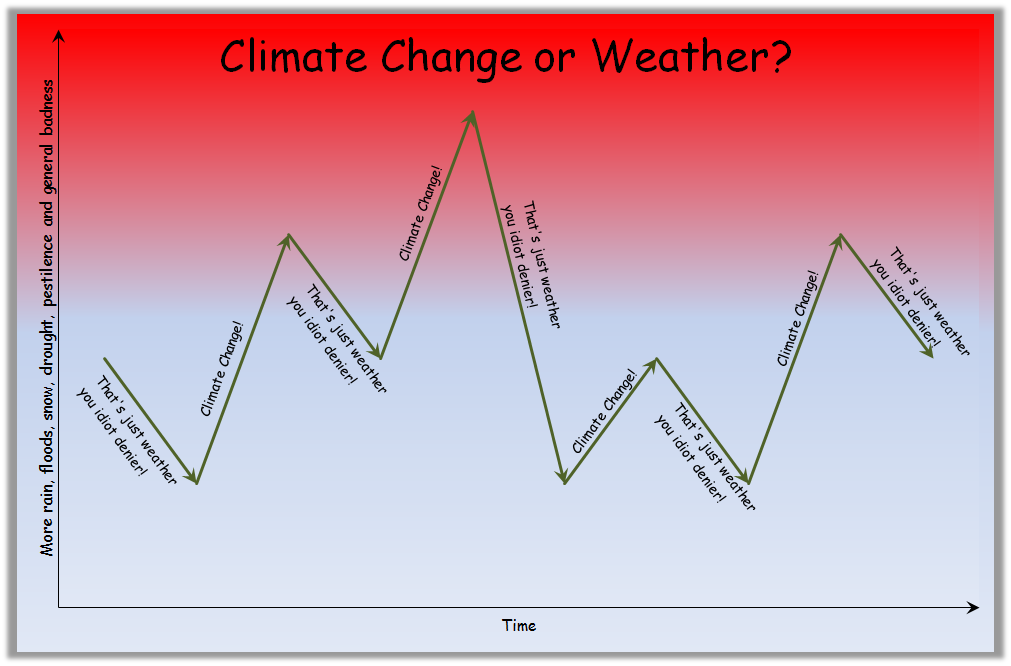
Shocking details of corruption and suppression in the world of peer-reviewed climate science have come to light with a recent leak of emails. They show how a determined group of activist scientists and journalists combined to secure the retraction of a paper that said a climate emergency was not supported by the available data. Science writer and economist Dr. Roger Pielke Jr. has published the startling emails and concludes: “Shenanigans continue in climate science, with influential scientists teaming up with journalists to corrupt peer review”.
The offending paper was published in January 2022 in a Springer Nature journal and at first attracted little attention. But on September 14th the Daily Sceptic covered its main conclusions and as a result it went viral on social media with around 9,000 Twitter retweets. The story was then covered by both the Australian and Sky News Australia. The Guardian activist Graham Readfearn, along with state-owned Agence France-Presse (AFP), then launched counterattacks. AFP “Herald of the Anthropocene” Marlowe Hood said the data were “grossly manipulated” and “fundamentally flawed”.
After nearly a year of lobbying, Springer Nature has retracted the popular article. In the light of concerns, the Editor-in-Chief is said to no longer have confidence in the results and conclusion reported in the paper. The authors were invited to submit an addendum but this was “not considered suitable for publication”. The leaked emails show that the addendum was sent for review to four people, and only one objected to publication.
What is shocking about this censorship is that the paper was produced by four distinguished scientists, including three professors of physics, and was heavily based on data used by the UN’s Intergovernmental Panel on Climate Change (IPCC). The lead author was Professor Gianluca Alimonti of Milan University and senior researcher of Italy’s National Institute of Nuclear Physics. Their paper reviewed the available data, but refused to be drawn into the usual mainstream narrative that catastrophises cherry-picked weather trends. During the course of their work, the scientists found that rainfall intensity and frequency was stationary in many parts of the world, and the same was true of U.S. tornadoes. Other meteorological categories including natural disasters, floods, droughts and ecosystem productivity showed no “clear positive trend of extreme events”. In addition, the scientists noted considerable growth of global plant biomass in recent decades caused by higher levels of carbon dioxide in the atmosphere.
In fact this scandal has started to attract comparison with the Climategate leaks of 2009 that also displayed considerable contempt for the peer-review process. One of the co-compilers of the Met Office’s HadCRUT global temperature database Dr. Phil Jones emailed Michael Mann, author of the infamous temperature “hockey stick”, stating: “I can’t see either of these papers being in the next IPCC report. Kevin and I will keep them out somehow – even if we have to redefine what the peer-reviewed literature is!”
The Liberation of Paris – WW2 – Week 261 – August 26, 1944
World War Two
Published 26 Aug 2023Paris is liberated by the Allies, a symbolic act that causes the world to rejoice. Something far more important to the course of the war, though, happens this week in Romania. The Allies continue to advance in the south of France and begin a new offensive in Italy, though the Pacific War has quietened down once again.
(more…)
6 Strange Facts About the Cold War
Decades
Published 27 Jul 2022Welcome to our history channel, run by those with a real passion for history & that’s about it. In today’s video, we will be exploring 6 odd Cold War facts.
(more…)
QotD: Getting food to market in pre-modern societies
The most basic kind of transport is often small-scale overland transport, either to and from the nearest city, or in small (compared to what we’ll discuss in a moment) caravans moving up and down a region […]. The Talmud, for instance, seems to suggest that much of the overland grain trade in Palestine under the Romans was performed with itinerant donkey-drivers in small caravans – and I do mean small. Egyptian tax evidence suggests that most caravans were small; Erdkamp notes that 90% of donkey caravans and 75% of camel caravans consisted of three or less animals. These sorts of small caravans don’t usually specialize in any particular good but instead function like land-based cabotage traders, buying whatever seems likely to turn a profit at each stop and stopping in each town and market along the way. Some farmers might even do this during the off season; in Spain, peasants often worked as muleteers during the slow farming season, moving rents and taxes into town or to points of export for their wealthy landlords and neighbors.
Truly long-distance bulk grain transport overland wasn’t viable for reasons we’ve actually already discussed. There is simply nothing available in the pre-modern period to carry the grain overland that doesn’t also eat it. While moving grain short distances (especially to simply fill capacity while the main profit is in other, lower-bulk, higher value goods) can be efficient enough, at long distance, all of the grain ends up eaten by the animals or people moving it.
The seaborne version of this sort of itinerant, short-distance trade is called cabotage. Now today cabotage has a particular, technical legal meaning, but when we use this word in the past, it refers not to the legal status of a ship but a style of shipping using small boats to move mixed cargo up and down the coast. In essence, cabotage works much the same as the small caravans – the merchant buys in each port whatever looks likely to turn a profit and sells whatever [is] in demand. By keeping a mixed cargo of many different sorts of things, he protects against risk – he’s always likely to be able to sell something in his boat for a profit. Such traders generally work on very short distances, often connecting smaller ports which simply cannot accommodate larger, deeper-draft long-distance traders. Such cabotage trading was the background “hum” of commerce on many pre-modern coastlines and might serve to move grain up or down the coast, although not very much of it. Remember that grain is a bulk commodity, and cabotage traders, by definition, are moving small volumes.
But when it comes to moving large volumes, the sea changes everything. The fundamental problem with transporting food on land is that the energy to transport the food must come from food, either processed into muscle power by porters or animals. But at sea, that energy can come from the wind. So while the crew of a ship eats the food, the ship can be scaled up without scaling up the food requirements of the crew or the crew itself. At the same time, sea-transit is much faster than land transit and that speed is obtained from the wind without further inputs of food. It is hard to overstate how tremendous a change in context this is. Using the figures from the Price Edict of Diocletian, we tend to estimate that river transport was five times cheaper than land transport, and sea-transport was twenty times cheaper than land transport. So while the transport of bulk goods like grain on land was limited to fairly small amounts moving over short distances – say from the farm to the nearest town or port – grain could be moved long distances en masse by sea.
Now the scale and character of long-distance transport is heavily impacted by the political realities of the local waterways. If the seas are politically divided, or full of pirates, it is going to be hard to operate big, slow vulnerable grain-freighters and still make a profit after some of them get seized, pirated or sunk. But when we have periods of political unity and relatively safe seas, we see that this sort of transport can reach quite impressive scale. For instance the port regulations of late Hellenistic and Roman Thasos – itself a decent sized, but by no means massive port – divided its harbor into two areas, one for ships carrying 80-130 tons of cargo and one for ships 130+ tons (those regulations are SEG XVII 417). A brief bit of math indicates that the distribution of free grain in the city of Rome – likely less than a third of the total grain demands of the city – required the import, by sea of some 630 tons of grain per day through the sailing season. The scale of grain shipment in the back half of the Middle Ages (post-1000 or so) was also on a vast scale, with trade-oriented Italian cities exploding in population as they imported grain (Genoa being particularly well known for this, but by no means alone in it); with that came the reemergence of truly large grain-freighters.
Bret Devereaux, “Collections: Bread, How Did They Make It? Part IV: Markets, Merchants and the Tax Man”, A Collection of Unmitigated Pedantry, 2020-08-21.
August 25, 2023
The German Democratic Republic, aka East Germany
Ed West visited East Berlin as a child and came away unimpressed with the grey, impoverished half of Berlin compared to “the gigantic toy shop that was West Berlin”. The East German state was controlled by the few survivors of the pre-WW2 Communist leaders who fled to the Soviet Union:
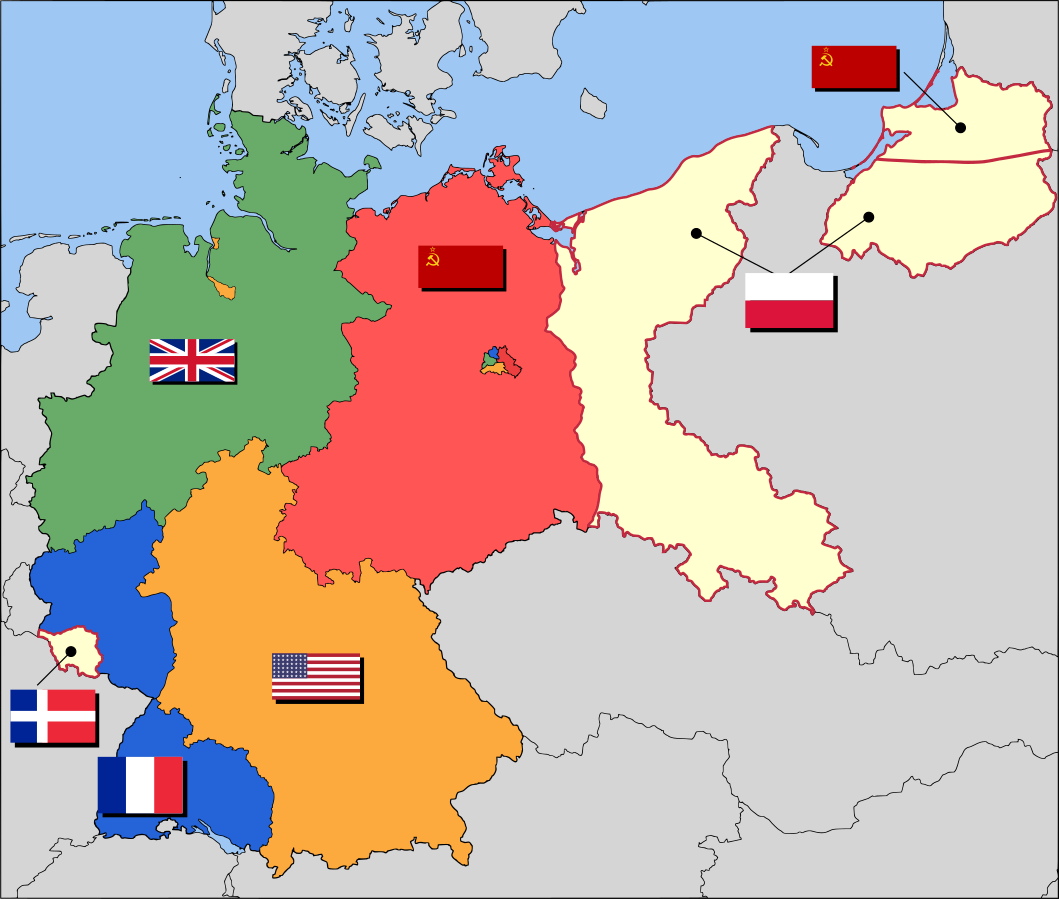
Occupation zone borders in Germany, 1947. The territories east of the Oder-Neisse line, under Polish and Soviet administration/annexation, are shown in cream as is the likewise detached Saar protectorate. Berlin is the multinational area within the Soviet zone.
Image based on map data of the IEG-Maps project (Andreas Kunz, B. Johnen and Joachim Robert Moeschl: University of Mainz) – www.ieg-maps.uni-mainz.de, via Wikimedia Commons.
In my childish mind there was perhaps a sense that East Germany, the evil side, was in some way the spiritual successor both to Prussia and the Third Reich – authoritarian, militaristic and hostile. Even the film Top Secret, one of the many Zucker, Abrahams and Zucker comedies we used to enjoy as children, deliberately confused the two, the American rock star stuck in communist East Germany then getting caught up with the French resistance. The film showed a land of Olympic female shot put winners with six o’clock shadows, crappy little cars you had to wait a decade for, and a terrifying wall to keep the prisoners in – and compared to the gigantic toy shop that was West Berlin, I was not sold.
I suppose that’s how the country is largely remembered in the British imagination, a land of border fences and spying, The Lives of Others and Goodbye Lenin. When the British aren’t comparing everything to Nazi Germany, they occasionally stray out into other historic analogies by comparing things to East Germany, not surprising in a surveillance state such as ours (these rather dubious comparisons obviously intensified under lockdown).
This is no doubt grating to East Germans themselves, but perhaps more grating is the sense of disdain often felt in the western half of Germany; for East Germans, their country simply ceased to exist in 1990 as it was gobbled up by its larger, richer, more glamorous neighbour, and has been regarded as a failure ever since. For that reason, [Katja] Hoyer’s book [Beyond the Wall] is both enjoyable holiday reading and an important historical record for an ageing cohort of people who lived under the old system. To have one’s story told, in a sense, is to avoid annihilation.
Despite the similarities between the two totalitarian systems, East Germany almost defined itself as the anti-fascist state, and its origins lie in a group of communist exiles who fled from Hitler to seek safety in the Soviet Union. Inevitably, their story was almost comically bleak; 17 senior German Marxists in Russia ended up being executed by Stalin, suspected by the paranoid dictator of secretly working for Germany. Even some Jewish communists were accused of spying for the Nazis — which seems to a rational observer unlikely. As Hoyer writes, “More members of the KPD’s executive committee died at Stalin’s hands than at Hitler’s”.
Only two of the nine-strong German politburo survived life in Russia, one of these being Walter Ulbricht, the goatee-bearded veteran of the failed 1919 German revolution and communist party chairman in Berlin in the years before the Nazis came to power.
The war had brutalised the eastern part of Germany far more than the West. It suffered the revenge of the Red Army, including the then largest mass rape in history, and the forced expulsion of millions of Germans from further east (including Hoyer’s grandfather, who had walked from East Prussia). The country was utterly shattered.
From the start the Soviet section had huge disadvantages, not just in terms of raw materials or industry – western Germany has historically always been richer — but in having a patron in Russia. While the Americans boosted their allies through the Marshall Plan, the Soviets continued to plunder Germany; when they learned of uranium in Thuringia they simply turned up and took it, using locals as forced labour.
“In total, 60 per cent of ongoing East German production was taken out of the young state’s efforts to get on its feet between 1945 and 1953,” Hoyer writes: “Yet its people battled on. As early as 1950, the production levels of 1938 had been reached again despite the fact that the GDR had paid three times as much in reparations as its Western counterpart.”
After the war, so-called “Antifa Committees” formed across the Soviet zone, “made up of a wild mix of individuals, among them socialists, communists, liberals, Christians and other opponents of Nazism”. Inevitably, a broad and eclectic left front was taken over by communists who soon crushed all opposition.
And as with many regimes, state oppression grew worse over time. “By May 1953, 66,000 people languished in East German prisons, twice as many as the year before, and a huge figure compared to West Germany’s 40,000. The General Secretary’s revival of the ‘class struggle’, officially announced in the summer of 1952 as part of the state’s ‘building socialism’ programme, had escalated into a struggle against the population, including the working classes.” The party was also becoming dominated by an educated elite, as happened in pretty much all revolutionary regimes.
Protests began at the Stalinallee in Berlin on 16 June 1953, where builders marched towards the House of Ministries and “stood there in their work boots, the dirt and sweat of their labour still on their faces; many held their tools in their hands or slung over their shoulders. There could not have been a more fitting snapshot of what had become of Ulbricht’s dictatorship of the proletariat. The angry crowd chanted, ‘Das hat alles keinen Zweck, der Spitzbart muss weg!’ – ‘No point in reform until Goatee is gone!'”
The 1953 protests were crushed, the workers smeared as fascists, but three years later came Khrushchev’s famous denunciation of Stalin, which caused huge trauma to communists everywhere. “The shaken German delegation went back to their rooms to ponder the implications of what they had just learned.” By breakfast time, “Ulbricht had pulled himself together”, and decreed the new party line. Stalin, it was announced “cannot be counted as a classic of Marxism”.
Fortress Britain with Alice Roberts S01E03
Fortress Britain with Alice Roberts
Published 16 Apr 2023
August 24, 2023
Life and Death at the heart of Nazism – On the Homefront 018
World War Two
Published 22 Aug 2023The Nazis love to spread the myth that they have transformed the German capital from a city of sin, unemployment, and Marxist street violence to the centre of a glorious new Reich. But the reality is that right now, Berliners are trapped between the Allied bombing and the Nazi regime’s tightening grip. And yet, the men and women of Berlin continue to support this war. For them, it’s a war of survival.
(more…)
August 23, 2023
Slovenian SAR80: Sterling Out-Simplifies the AR-180
Forgotten Weapons
Published 15 May 2023The British Sterling firm designed the SAR-80 (specifically, their engineer Frank Waters) as a very simple rifle to sell to countries outside the main NATO/Warsaw Pact spheres of influence. Sterling ended up getting a license to produce the AR-18 though, and didn’t put Waters’ design into production.
When the newly formed Chartered Industries of Singapore came looking for a rifle to produce, the SAR-80 design was a chance for Sterling to sell a production license. CIS needed something to produce domestically to equip the Singaporean Army, and the SAR-80 met their needs. After selling the rifles to their own Army, the company went looking for export clients. They found a few, including Croatia, the Central African Republic, and Slovenia. A total of about 80,000 SAR-80 rifles were made, and this is one of the Slovenian-contract examples.
(more…)
August 22, 2023
“… the theatrics employed by Hitler and Mussolini just seemed too weird and downright ridiculous to the British”
In Spiked, Ralph Schoellhammer discusses some of the difficulties the Green Gestapo, er, I mean the likes of Extinction Rebellion and their mini-mes like Just Stop Oil have been encountering with the British public:
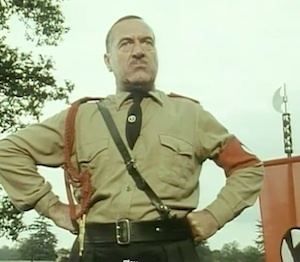
Roderick Spode, 7th Earl of Sidcup, leader of the “Saviours of Britain”, also known as the Black Shorts.
Still from Jeeves and Wooster (1990).
I have long been convinced that one of the reasons why fascism never had a chance in Britain was due to the predispositions of her people. If nothing else, the theatrics employed by Hitler and Mussolini just seemed too weird and downright ridiculous to the British.
PG Wodehouse captured this perfectly in an exchange between a British wannabe fascist, Roderick Spode, and Bertie Wooster: “The trouble with you, Spode, is that just because you have succeeded in inducing a handful of half-wits to disfigure the London scene by going about in black shorts, you think you’re someone.”
I don’t intend to liken fascists to environmentalists, but Brits have at least expressed a similar, visceral distaste for the theatrics of eco-activist groups in recent years. Marching in black “footer bags”, pretending to be the voice of the people, is just as ridiculous as holding up traffic in an orange “Just Stop Oil” t-shirt.
The environmental movement becomes more absurd by the day. The Guardian‘s George Monbiot, for instance, has just called for the reintroduction of deadly wolves and lynxes to Great Britain, in order to manage a surging deer population. One can only hope that this call to action will have about as much success as his campaign against meat, milk and eggs, which Monbiot is convinced are an “indulgence” humanity can no longer afford.
Sadly, the same is not true in Germany, where the elites are all too keen to humour even the most extreme climate fanatics. German discount supermarket Penny recently decided to increase the prices of its meat and dairy products, to include the environmental costs incurred in their production, as part of a week-long experiment. The price of frankfurter sausages rose from €3.19 to €6.01. The price of mozzarella rose by 74 per cent, to €1.55. And the price of fruit yoghurt rose by 31 per cent, from €1.19 to €1.56.
While the usual suspects in the establishment are clearly excited by this idea that in the future even shopping at a discount shop might become the preserve of the rich, average Germans are less pleased. Germany’s public broadcaster, WDR, asked Penny customers what they thought about the price-hike experiment. Due to a lack of enthusiasm from shoppers, WDR decided to have one of its employees cosplay as a happy shopper. That taxpayer-funded broadcasters now have to resort to outright fraud in order to drum up support for idiotic climate action tells you everything you need to know.
History Summarized: Sparta’s Finest Hour
Overly Sarcastic Productions
Published 12 May 2023It’s not Thermopylai.
SOURCES & Further Reading:
Constantine Cavafy, The Collected Poems. Translated by Evangelos Sachperoglou, Oxford University Press, 2008. – George Economou, On Translating C.P. Cavafy’s “Come, O King of the Lacedaimonians”. https://newohioreview.org/2013/09/02/… – Plutarch, Lives of Agis and Cleomenes. Translated by Bernadotte Perrin, W. Heinemann, 1968. – Polybius, Histories. Edited by F. W. Walbank and Christian Habicht. Translated by W. R. Paton, VI, Harvard University Press, 2012.
– For way the heck more about Kleomenes and Kratisikleia, you can also read my undergraduate Honors Thesis, Greekness in Peril: Cavafy and the Essence of Hellenism. 2018. https://www.academia.edu/44709355/Gre…
(more…)
QotD: Megafauna extinction
There is, sadly enough, a common misconception about our ancestors. Nature loving, that Rousseauesque fantasy of just drinking the clear water, munching on the acorns that fall unbidden. That humans don’t thrive on acorns matters not a whit to those who share this fantasy of an Elysian past. The truth being that humans – and proto- – were the most vicious beasts out there. That’s why we survived to thrive. It’s not just modern day humans who would scale down a cliff to throttle babbie seabirds for the pot after all.
So too with the bargain bucket meal on legs just found:
Half-tonne birds may have roamed Europe at same time as humans
They roamed, we eated, they roamed no more. As with the arrival of the Maori in New Zealand and the exit of moas. The American horse disappearing about the same time Amerinds made it past the ice barriers into British Columbia and points south. Dodos and sailing ships and on and on around the globe. The major factor in megafauna going extinct being humans turning up to eat them.
Tim Worstall, “Crimea Fried Ostrich – And Then We Eated It”, Continental Telegraph, 2019-06-27.
August 21, 2023
Some good reasons why the Russo-Ukraine war is misunderstood in the West
A few days back, Bruce Gudmundsson outlined a few of the reasons the Western — particularly the English-language — reporting on the ongoing conflict between Russia and Ukraine gets it wrong:
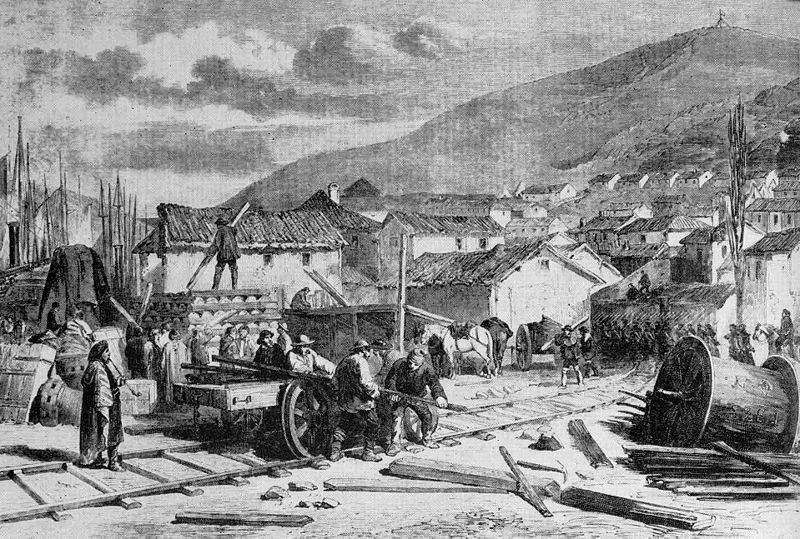
Railways have played a significant role in warfare since at least the Crimean War.
Navvies working on the Grand Crimean Central Railway, 1854. From Thomas Brassey, Railway Builder (1969).
As I live within a bowshot of a railroad crossing, the screech of metal wheels on metal rails frequently reminds me of one of the many things that so many Anglophone commentators get wrong about the war in Ukraine. Coming from places afflicted with (hat tip to Arlo Guthrie [NR: I’d give the credit to Steve Goodman, personally]) “the disappearing railroad blues”, these writers find it hard to imagine the degree to which Russian soldiers exploit the ability of the iron horse to move vast numbers of hundred-pound artillery shells. This blindspot, in turn, causes them to place far too much importance on means of movement, such as ships and trucks, that play second fiddle in the logistical symphony that supplies Russian forces in the field.
Tales of soldiers stealing pickles from convenience stores spark thoughts of another mistake that English-speaking critics have made with respect to the Russian supply system. Wise generals, from Alexander the Great to Francisco Franco, have long deployed vast quantities of food along with their armies. Nonetheless, the enduring fondness of English-speaking soldiers for bully beef, tinned biscuits, and other meals-ready-to-eat sets them apart from most other fighting men, past or present. To put things another way, we should not have been surprised that, when organizing an invasion of one of the great food-producing countries of our planet, Russian logisticians preferred the dispatch of fuel and ammunition to the delivery of items that could have been found in every bodega along the line of march.
Anglophone analysts also drew the wrong conclusions from reports of the loss, in battle, of Russian general officers. Such casualties, they argued, stemmed from an absence of trust. That is, Russian generals were killed because, lacking confidence in the competence of colonels, captains, and corporals, they felt obliged to exercise close supervision over forces engaged in combat.
The participation of generals in firefights, however, need not reflect an absence of faith in the fidelity and abilities of subordinates. Indeed, the original gangsters of “trust tactics” often recommended that the general officers commanding formations lead from the front. I suspect, moreover, that Russian leaders also understood that seeing a general die a soldier’s death usually exercises a positive influence on the morale of his subordinates. (“Say what you will about old General Strelkov, but he never asked us to do anything he wasn’t willing to do himself.”)
Finally, few who made much of the battle deaths of Russian general officers seem to have been aware that the Russian forces that crossed into Ukraine on 24 February 2022 were organized in a way that provided them with an extraordinarily high proportion of fighting generals. That is, when a peacetime formation formed a battalion tactical group, the general in charge of that organization usually took command of the unit it spawned. Thus, rather than having one general for every four or five battalions, the Russian forces of the first few months of the “special military operation” had five or six flag-rank officers for every four or five battalions.
August 20, 2023
Hitler Has a Bad Day – WW2 – Week 260 – August 19 – 1944
World War Two
Published 19 Aug 2023This week the Allies invade Southern France, and do so very successfully. They’re also successful in the north, closing the Falaise gap and trapping huge numbers of Germans. In the East, however, the Germans manage to stop the Soviet drive on Riga with a counter attack, and in Warsaw they continue to brutally put down the Warsaw Uprising.
(more…)


