
World War Two
Published Apr 6, 2024It’s the next step toward invading Japan’s Home Islands — invading Okinawa, and it begins April 1st. Advances are easy by land, but at sea the kamikaze menace is in full swing. In Burma, plans are made to liberate Rangoon; in the west hundreds of thousands of Germans are surrounded in the Ruhr; and in the east, the Soviets begin assaults on Königsberg and Vienna.
(more…)
April 8, 2024
The Battle of Okinawa Begins – WW2 – Week 293 – April 6, 1945
Comments Off on The Battle of Okinawa Begins – WW2 – Week 293 – April 6, 1945
QotD: The classical Roman Republic
We can start with how the Romans defined their own republic, before we get into the constituent parts as they understood them. The Latin term for the republic was, naturally enough, res publica (from which the modern word republic derives). Res is a very common, earthy sort of Latin word whose closest English equivalent is probably “matter”, with that wide range of possible meanings. Res can mean a “thing” more generally, “matter” in the scientific sense, but also in an abstract sense it can be an interest, a cause, a court case or other set of events, or property generally. Meanwhile publica means “public”, in the sense of something held in common or collectively or done for the collective good or interest. That gives res publica a wonderful kaleidoscope of meaning – it is the collective property (the “commonwealth”) of the citizenry but also the communal affairs, the matters of collective concern, the actions undertaken for the public benefit and indeed even the public benefit itself.
It is the things held in common. That ambiguity of meaning actually matters quite a bit because what the res publica was and what was important about it was different for different people. But naturally for some res to be publica, that meant other res needed to be privata; much like the polis was a collection of oikoi (and thus its ability to reach within the oikos as a unit was limited) so too the res publica was a collection of familiae (a word we’ll come back to, because it is complicated; it does not neatly mean “family”), the affairs of which were privatae, private.
What I think is worth noting as one of those subtle differences is how this contrasts with the Greek conception of the polis: a polis was fundamentally a collection of politai (citizens) whose institutions were their politeia (government, state). But the res publica is not a collection of citizens (Latin: cives), it is something distinct from them, held in common by them.
We can see this principle in the interesting phrase the Romans used to represent the senate: senatus populusque Romanus, “The Roman Senate and People” – usually abbreviated to SPQR.1 The division there is striking: there is a Roman People (the populus Romanus) and a Roman Senate and in some sense these are non-overlapping groups that together compose the republic. The Senate is not some sub-group of the populus but a distinct one with is a co-equal element of the republic with the populus.
Not only is the res publica thus not simply a collection of citizens, but it is in a real sense understood as a shared interest of different groups in the community, of which the populus is only one group. The Romans, more comfortable with open hierarchy among the citizens, can understand the republic as a balancing act between the interests of the political and social elite (the exact composition of which changes over time, but their mouthpiece is the Senate) and the people. The elite do not represent the people, they are not a select group of the people, but instead a distinct interest within the state which has its own legitimate expression, balanced against the expression of the people.
If all of that doesn’t make much sense, don’t worry: we’ll see these principles work themselves out in the way the res publica works and is structured.
Bret Devereaux, “Collections: How to Roman Republic 101, Part I: SPQR”, A Collection of Unmitigated Pedantry, 2023-07-21.
1. “Romanus” the adjective, modifies both senatus and populus, so both the Senate and the People are Roman. The phrase is often rendered into more idiomatic English as, “the Senate and People of Rome” to make that clearer.
Comments Off on QotD: The classical Roman Republic
April 7, 2024
Instructions for American Servicemen in Britain (1942)
Henry Getley on the US War Department publication Instructions for American Servicemen in Britain produced for incoming GIs on arrival in Britain from early in 1942:
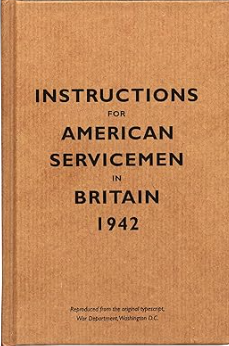
[W]ith their troops pouring into this country from 1942 onwards to prepare for D-Day, officials at the US War Department did their best to make the culture clash as trouble-free as possible. One of their main efforts was issuing GIs with a seven-page foolscap leaflet called Instructions for American Servicemen in Britain.
It’s available in reprint as a booklet and makes fascinating reading, not least for its straightforward, jargon-free writing style and its overriding message – telling the Yanks to use “plain common horse sense” in their dealings with the British.
In parts, it now seems clumsy and condescending. But its purpose was praiseworthy – to try to get American troops to damp down the impression that they were overpaid, oversexed and over here. Many GIs qualified in all three aspects, of course, but you couldn’t blame the top brass for trying.
The leaflet paints a sympathetic (some would say patronising) picture for the incoming Americans of a Britain – “a small crowded island of forty-five million people” – that had been at war for three years, having initially stood alone against Hitler and braved the Blitz. Hence this “cradle of democracy” was now a “shop-worn and grimy” land of rationing, the blackout, shortages and austerity. But beneath the shabbiness, there was steel.
The British are tough. Don’t be misled by the British tendency to be soft-spoken and polite. If need be, they can be plenty tough. The English language didn’t spread across the oceans and over the mountains and jungles and swamps of the world because these people were panty-waists.
There were helpful hints about cricket, football, darts, pounds, shillings and pence, warm beer and badly-made coffee. And because we are two nations divided by a common language, the Yanks were urged to listen to the BBC.
In England the “upper crust” speak pretty much alike. You will hear the newscaster for the BBC (British Broadcasting Corporation). He is a good example, because he has been trained to talk with the “cultured” accent. He will drop the letter “r” (as people do in some sections of our own country) and will say “hyah” instead of “here”. He will use the broad “a”, pronouncing all the a’s in “banana” like the “a” in father.
However funny you may think this is, you will be able to understand people who talk this way and they will be able to understand you. And you will soon get over thinking it’s funny. You will have more difficulty with some of the local accents. It may comfort you to know that a farmer or villager from Cornwall very often can’t understand a farmer or villager in Yorkshire or Lancashire.
The GIs were warned against bravado and bragging, being told that the British were reserved but not unfriendly. “They will welcome you as friends and allies, but remember that crossing the ocean doesn’t automatically make you a hero. There are housewives in aprons and youngsters in knee pants in Britain who have lived through more high explosives in air raids than many soldiers saw in first-class barrages during the last war.”
Comments Off on Instructions for American Servicemen in Britain (1942)
How Traditional English Stilton Cheese Is Made At A 100-Year-Old Dairy | Regional Eats
Insider Food
Published Dec 4, 2019Stilton cheese takes its name from the village of Stilton, in the east of England. The earliest reports of cheese made and sold here date to the 17th century. In 1724, English writer Daniel Defoe referred to the town being “famous for cheese”, calling the product the “English Parmesan”. Today, Stilton can only be made in six dairies, which are spread across three counties in England: Nottinghamshire, Leicestershire, and Derbyshire. We visited Colston Bassett Dairy in Nottinghamshire to learn more about the cheese is made.
For more, visit:
https://www.colstonbassettdairy.co.uk/——————————————————
(more…)
Comments Off on How Traditional English Stilton Cheese Is Made At A 100-Year-Old Dairy | Regional Eats
April 6, 2024
Italian Communists, the French in Indochina, and the fate of Italy’s army – WW2 – OOTF 34
World War Two
Published 5 Apr 2024What happened to Italian soldiers overseas after the fall of Mussolini? What about the French soldiers left over in Indochina after the Japanese “occupation by invitation”? And, what did the Allies think of the Italian Communist movement and its partisan forces?
(more…)
Comments Off on Italian Communists, the French in Indochina, and the fate of Italy’s army – WW2 – OOTF 34
The Fake (and real) History of Potato Chips
Tasting History with Max Miller
Published Jan 2, 2024The fake and true history of the potato chip and an early 19th century recipe for them. Get the recipe at my new website https://www.tastinghistory.com/ and buy Fake History: 101 Things that Never Happened: https://lnk.to/Xkg1CdFB
(more…)
Comments Off on The Fake (and real) History of Potato Chips
QotD: No navy ever has all its ships at sea at the same time
This complex world requires attention on a regular basis, both to make sure that the constituent parts still work as planned, and also to update and replace parts with more modern or better alternatives, or to provide planned upgrades. For instance, it is common for new ships entering service to undergo a short refit to add in any extra capability upgrades that may have been rolled out since construction began, and to rectify any defects.
For the purposes of planning how the fleet works, the Royal Navy looks to provide enough ships to meet agreed defence tasks. In simple terms the MOD works out what tasks are required of it, and what military assets are needed to meet them. This can range from providing a constantly available SSBN to deliver the deterrence mission through to deploying the ice patrol ship to Antarctica.
Once these commitments are understood, planners can work out how many ships / planes / tanks are needed to meet this goal. For example, it may be agreed that the RN needs to sustain multiple overseas deployments, and also be able to generate a carrier strike group too.
If, purely hypothetically the requirement for this is 6 ships, then the next task is to work out how many ships are needed to ensure 6 ships are constantly available. Usually, this has historically been at a 3:1 ratio – one ship is on task or ready to fulfill it, one is in some form of work up or other training ahead of being assigned to the role, and one is just back or in refit.
In practical terms this means that the RN never looks to get 100% of its force to sea, but rather to ensure it doesn’t fail to ensure enough ships are available to meet all the tasks that it is required to do. Consequently there is always going to be a mismatch between the number of ships owned, and the number of ships deployed.
Sir Humphrey, “Inoperable or just maintenance”, Thin Pinstriped Line, 2019-10-24.
Comments Off on QotD: No navy ever has all its ships at sea at the same time
April 5, 2024
Ero: The Croatian Uzi (With Israeli Help?)
Forgotten Weapons
Published Jan 3, 2024The best of the submachine guns made in Croatia during the Homeland War was the Ero, made by a company called Arma. The Ero is a basically perfect, parts-interchangeable copy of the Israeli Uzi that was developed in 1992 and adopted into Croatian Army service in 1993. The only really distinguishable difference between the Ero and Uzi is the Ero’s use of Croatian-language selector markings (and receiver markings). Between 15,000 and 20,000 were produced, and they remained in service long after Croatian independence was secured. They were issued to vehicle crews, military police, special forces, and reconnaissance units.
Arma was a subsidiary of a major Croatian engineering firm, and after the Ero production it developed the APS-95 Croatian AK (which is a story for another video). They were a very competent company, but the details and quality of the Ero are so good that I believe it must have been made with tacit or explicit assistance from Israel. Croatia does have a strong Jewish community, and there were rumors during the war that the technical data package for the Uzi did find its way into Croatia. There is no official acknowledgement of this happening, but it would certainly not be hard to believe. But however the development happened, the result was a very high quality submachine gun.
A big thanks to the Croatian Police Museum (Muzej Policije) in Zagreb for giving me access to film this cool piece for you! Check them out at: https://muzej-policije.gov.hr
(more…)
Comments Off on Ero: The Croatian Uzi (With Israeli Help?)
April 4, 2024
See Inside Panther | Tank Chats Reloaded
The Tank Museum
Published Dec 29, 2023Chris Copson takes a detailed look inside and out, of arguably the most advanced German tank of WW2 … the Panther.
Is the Panther the formidable opponent that is was made out to be? Would the allies use such a vehicle and was it over engineered? Find out in today’s video.
00:00 Intro
00:54 Overview – Our Panther
02:41 War time variants & armour
06:06 Design
08:30 Weaponry
10:18 Crew, equipment and flaws – a look inside
17:53 Performance & conclusion
(more…)
Comments Off on See Inside Panther | Tank Chats Reloaded
QotD: What we mean by the term “indigenous”
But of course this is pedantic nitpicking (my speciality), because legally “indigenous” means “descended from the people who were there before European colonialism”: the Inuit are “indigenous” because they were in Newfoundland and Greenland when Martin Frobisher showed up, regardless of the fact that they had only arrived from western Alaska about five hundred years earlier. Indigineity in practice is not a factual claim, it’s a political one, based on the idea that the movements, mixtures, and wholesale destructions of populations since 1500 are qualitatively different from earlier ones. But the only real difference I see, aside from them being more recent, is that they were often less thorough — in large part because they were more recent. In many parts of the world, the Europeans were encountering dense populations of agriculturalists who had already moved into the area, killed or displaced the hunter-gatherers who lived there, and settled down. For instance, there’s a lot of French and English spoken in sub-Saharan Africa, but it hasn’t displaced the Bantu languages like they displaced the click languages. Spanish has made greater inroads in Central and South America, but there’s still a lot more pre-colonial ancestry among people there than there is pre-Bantu ancestry in Africa. I think these analogies work, because as far as I can tell the colonization of North America and Australia look a lot like the Early European Farmer and Bantu expansions (technologically advanced agriculturalists show up and replace pretty much everyone, genetically and culturally), while the colonization of Central and South America looks more like the Yamnaya expansion into Europe (a bunch of men show up, introduce exciting new disease that destabilizes an agricultural civilization,1 replace the language and heavily influence the culture, but mix with rather than replacing the population).
Some people argue that it makes sense to talk about European colonialism differently than other population expansions because it’s had a unique role in shaping the modern world, but I think that’s historically myopic: the spread of agriculture did far more to change people’s lives, the Yamnaya expansion also had a tremendous impact on the world, and I could go on. And of course the way it’s deployed is pretty disingenuous, because the trendier land acknowledgements become, the more the people being acknowledged start saying, “Well, are you going to give it back?” (Of course they’re not going to give it back.) It comes off as a sort of woke white man’s burden: of course they showed up and killed the people who were already here and took their stuff, but we’re civilized and ought to know better, so only we are blameworthy.
More reasonable, I think, is the idea that (some of) the direct descendants of the winners and losers in this episode of the Way Of The World are still around and still in positions of advantage or disadvantage based on its outcome, so it’s more salient than previous episodes. Even if, a thousand years ago, your ancestors rolled in and destroyed someone else’s culture, it still sucks when some third group shows up and destroys yours. It’s just, you know, a little embarrassing when you’ve spent a few decades couching your post-colonial objections in terms of how mean and unfair it is to do that, and then the aDNA reveals your own population’s past …
Reich gets into this a bit in his chapter on India, where it’s pretty clear that the archaeological and genetic evidence all point to a bunch of Indo-Iranian bros with steppe ancestry and chariots rolling down into the Indus Valley and replacing basically all the Y chromosomes, but his Indian coauthors (who had provided the DNA samples) didn’t want to imply that substantial Indian ancestry came from outside India. (In the end, the paper got written without speculating on the origins of the Ancestral North Indians and merely describing their similarity to other groups with steppe ancestry.) Being autochthonous is clearly very important to many peoples’ identities, in a way that’s hard to wrap your head around as an American or northern European: Americans because blah blah nation of immigrants blah, obviously, but a lot of northern European stories about ethnogenesis (particularly from the French, Germans, and English) draw heavily on historical Germanic tribal migrations and the notion of descent (at least in part) from invading conquerors.
One underlying theme in the book — a theme Reich doesn’t explicitly draw out but which really intrigued me — is the tension between theory and data in our attempts to understand the world. You wrote above about those two paradigms to explain the spread of prehistoric cultures, which the lingo terms “migrationism” (people moved into their neighbors’ territory and took their pots with them) and “diffusionism”2 (people had cool pots and their neighbors copied them), and which archaeologists tended to adopt for reasons that had as much to do with politics and ideology as with the actual facts on (in!) the ground. And you’re right that in most cases where we now have aDNA evidence, the migrationists were correct — in the case of the Yamnaya, most modern migrationists didn’t go nearly far enough — but it’s worth pointing out that all those 19th century Germans who got so excited about looking for the Proto-Indo-European Urheimat were just as driven by ideology as the 21st century Germans who resigned as Reich’s coauthors on a 2015 article where they thought the conclusions were too close to the work of Gustaf Kossinna (d. 1931), whose ideas had been popular under the Nazis. (They didn’t think the conclusions were incorrect, mind you, they just didn’t want to be associated with them.) But on the other hand, you need a theory to tell you where and how to look; you can’t just be a phenomenological petri dish waiting for some datum to hit you. This is sort of the Popperian story of How Science Works, but it’s more complex because there are all kinds of extra-scientific implications to the theories we construct around our data.
The migrationist/diffusionist debate is mostly settled, but it turns out there’s another issue looming where data and theory collide: the more we know about the structure and history of various populations, the more we realize that we should expect to find what Reich calls “substantial average biological differences” between them. A lot of these differences aren’t going to be along axes we think have moral implications — “people with Northern European ancestry are more likely to be tall” or “people with Tibetan ancestry tend to be better at functioning at high altitudes” isn’t a fraught claim. (Plus, it’s not clear that all the differences we’ve observed so far are because one population is uniformly better: many could be explained by greater variation within one population. Are people with West African ancestry overrepresented among sprinters because they’re 0.8 SD better at sprinting, or because the 33% higher genetic diversity among West Africans compared to people without recent African ancestry means you get more really good sprinters and more really bad ones?) But there are a lot of behavioral and cognitive traits where genes obviously play some role, but which we also feel are morally weighty — intelligence is the most obvious example, but impulsivity and the ability to delay gratification are also heritable, and there are probably lots of others. Reich is adorably optimistic about all this, especially for a book written in 2018, and suggests that it shouldn’t be a problem to simultaneously (1) recognize that members of Population A are statistically likely to be better at some thing than members of Population B, and (2) treat members of all populations as individuals and give them opportunities to succeed in all walks of life to the best of their personal abilities, whether the result of genetic predisposition or hard work. And I agree that this is a laudable goal! But for inspiration on how our society can both recognize average differences and enable individual achievement, Reich suggests we turn to our successes in doing this for … sex differences! Womp womp.
Jane Psmith and John Psmith, “JOINT REVIEW: Who We Are and How We Got Here, by David Reich”, Mr. and Mrs. Psmith’s Bookshelf, 2023-05-29.
1. aDNA works for microbes too, and it looks like Y. pestis, the plague, came from the steppe with the Yamnaya. It didn’t yet have the mutation that causes buboes, but the pneumonic version of the disease is plenty deadly, especially to the Early European Farmers who didn’t have any protection against it. In fact, as far as we can tell, in all of human history there have only been four unique introductions of plague from its natural reservoirs in the Central Asian steppe: the one that came with or slightly preceded the Yamnaya expansion around 5kya, the Plague of Justinian, the Black Death, and an outbreak that began in Yunnan in 1855. The waves of plague that wracked Europe throughout the medieval and early modern periods were just new pulses of the strain that had caused Black Death. Johannes Krause gets into this a bit in his A Short History of Humanity, which I didn’t actually care for because his treatment of historic pandemics and migrations is so heavily inflected with Current Year concerns, but I haven’t found a better treatment in a book so it’s worth checking it out from the library if you’re interested.
2. I cheated with that “pots not people” line in my earlier email; it usually gets (got?) trotted out not as a bit of epistemological modesty about what the archaeological record is capable of showing, but as a claim that the only movements involved were those of pots, not of people.
Comments Off on QotD: What we mean by the term “indigenous”
April 2, 2024
Gear-Ratio-Accelerated? Yep, It’s a Thing: French MAT 1955 Prototype
Forgotten Weapons
Published Dec 20, 2023EDIT: Shoot, I managed to get the gear ratio backwards. Sorry! The recoil action provides the necessary delay, and then the gear ratio provides acceleration to ensure the bolt can open reliably, akin to the accelerator in a Browning M1917 or 1919 machine gun, or a Lahti L35 pistol. Please excuse the error …
In the search for an improvement to the MAS 1949 rifle for the French military, all the French arsenals proposed new designs. MAS supplied an updated version that was ultimately adopted as the MAS 49/56, but the Tulle Arsenal (MAT) had a wacky idea of its own. In 1955, they presented a short-recoil, tilting bolt, gear-ratio-delayed system. It was an open bolt firing rifle chambered for the 7.5x54mm cartridge, using detachable 20-round magazines. Today we have one of the first models to look at, and there was a second iteration in 1956, which lightened the rifle by replacing some steel parts with aluminum. Neither was successful, much to the relief of the French Army …
Many thanks to the IRCGN (Institut de Recherche Criminelle de la Gendarmerie Nationale) for allowing me access to film this unique rifle for you!
(more…)
Comments Off on Gear-Ratio-Accelerated? Yep, It’s a Thing: French MAT 1955 Prototype
QotD: Supersizing the Polis, Roman-style
Which leads into the other major difference: size. We’re going to be taking a snapshot of the Roman Republic, necessary because the republic changed over time. In particular what we’re going to look at here is really a snapshot of the republic as it functioned in the third and second centuries, what Roman historians call the “Middle Republic” (c. 287-91BC). Harriet Flower defines this period as part of “the republic of the nobiles” which as we’ll see is an apt title as well.
But even by the beginning of this period, the Roman Republic is enormous by the standards of a polis. While a polis like Athens or Sparta with total populations in the low hundreds of thousands was already very large by Greek standards, the Roman Republic was much bigger. We know that in Italy in 225 there was something on the order of three hundred thousand Roman citizens liable for conscription, which implies a total citizen population right around a million. And that massive polity in turn governed perhaps another two million other Italians who were Rome’s “socii” (“allies”), perhaps the social category at Rome closest to “resident foreigners” (metics) in Greek poleis. This is in Italy alone, not counting Rome’s “overseas” holdings (at that point, Sicily, Corsica and Sardinia). In short, the Roman Republic may in some ways be shaped like a polis, but it was a full order of magnitude larger than the largest poleis, even before it acquired provinces outside of Italy. As you may imagine, that has implications!
Bret Devereaux, “Collections: How to Roman Republic 101, Part I: SPQR”, A Collection of Unmitigated Pedantry, 2023-07-21.
Comments Off on QotD: Supersizing the Polis, Roman-style
April 1, 2024
The most likely outcome of a 2nd US Civil War isn’t two successor states, but a modern version of the Holy Roman Empire
Kulak, at the start of a very long post on historical eras of centralization and decentralization, touches on the most likely outcome of a second US civil war, and it’s not a rump USA and a neo CSA:
Every time the subject of a possible US civil war or national divorce comes up I hear the same micron deep takes. America couldn’t break up because the division isn’t by state, its Urban Vs. Rural. Or that Urban vs. Rural isn’t the divide, even then people of different politics are mixed up together. Or that for every clear red or blue state there’s a purple state. None of which is in any way relevant to anything until you recognize the naïve mental model many of these people are working on …
These takes betray a belief that a second civil war would be some kind of conflict between coherent independent states who’ve started identifying with/against the idea of union such as happened in the 1860s … or that somehow there’d be a series of tidy Quebec style referendums resulting in a clean division such as exists in so many meme maps:
The truth is any post-breakup map of America would not resemble an electoral map following state lines, nor even a redrawing of state boundaries, such that the fantastical greater Idaho or Free State of Jefferson might exist as part of a wider Confederation of Constitutional Republics, or a Breakaway Philadelphia city-State join a Union of Progressive Democracies …
No. It’d be nothing so comprehensible or easily mapped to modern politics.
A post breakup America would probably look closer to this:
If you’re a sane person and your immediate reaction is: WHAT THE HELL AM I LOOKING AT!?
… Well that’s kinda the point.
(I really do apologize for all I’m going to have to digress)
For our purposes we can broadly divide history into 2 types of period … Periods of Centralizing trends, and periods of Decentralizing trends.


March 31, 2024
Allies Charge Forward from the Rhine! – WW2 – Week 292 – March 30, 1945
World War Two
Published 30 Mar 2024All along the Western Front the Allies break out in force, invading German territory and receiving German surrenders by the thousands. In the east, the Soviets take Danzig and Gdynia, and rout the Germans in Hungary. There’s a new Japanese offensive in China, though the fight on Iwo Jima ends with a Japanese defeat.
Chapters
00:45 Recap
01:08 Big Advances all over the West
05:48 Soviets take Gdynia and Danzig
07:09 Zhukov’s forces take Kustrin
10:39 The War in China
12:21 Iwo Jima Ends
14:30 Preliminaries for Okinawa
18:46 More Landings in the Philippines
19:23 Slim focuses on Rangoon
20:12 Notes to end the week
20:48 Summary
21:28 Conclusion
24:47 Call To Action
(more…)
Comments Off on Allies Charge Forward from the Rhine! – WW2 – Week 292 – March 30, 1945
August, 1945 – The Soviets enter the war in China
Big Serge outlines the Soviet invasion of Manchuria in August 1945 and its devastating impact on the Japanese Kwantung Army, finally shattering any remaining illusions that the Soviets would broker a peace between Japan and the western allies:
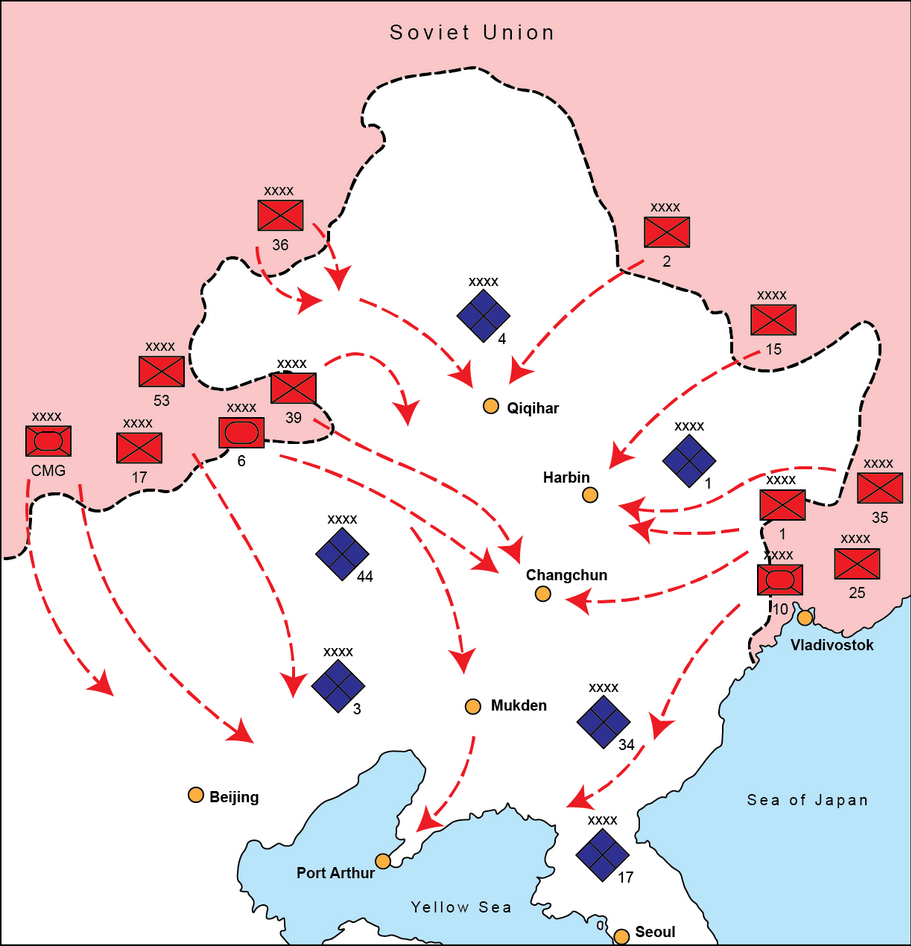
August Storm: The Soviet Invasion of Manchuria (August 9-20, 1945)
The Second World War had a strange sort of symmetry to it, in that it ended much the way it began: namely, with a well-drilled, technically advanced and operationally ambitious army slicing apart an overmatched foe. The beginning of the war, of course, was Germany’s rapid annihilation of Poland, which rewrote the book on mechanized operations. The end of the war — or at least, the last major land campaign of the war — was the Soviet Union’s equally totalizing and rapid conquest of Manchuria in August 1945.
Manchuria was one of the many forgotten fronts of the war, despite being among the oldest. The Japanese had been kicking around in Manchuria since 1931, consolidating a pseudo-colony and puppet state ostensibly called Manchukuo, which served as a launching pad for more than a decade of Japanese incursions and operations in China. For a brief period, the Asian land front had been a major pivot of world affairs, with the Japanese and the Red Army fighting a series of skirmishes along the Siberian-Manchurian border, and Japan’s enormously violent 1937 invasion of China serving as the harbinger of global war. But events had pulled attention and resources in other directions, and in particular the events of 1941, with the outbreak of the cataclysmic Nazi-Soviet War and the Great Pacific War. After a few years as a major geopolitical pivot, Manchuria was relegated to the background and became a lonely, forgotten front of the Japanese Empire.
Until 1945, that is. Among the many topics discussed at the Yalta Conference in the February of that year was the Soviet Union’s long-delayed entry into the war against Japan, opening an overland front against Japan’s mainland colonies. Although it seems relatively obvious that Japanese defeat was inevitable, given the relentless American advance through the Pacific and the onset of regular strategic bombing of the Japanese home islands, there were concrete reasons why Soviet entry into the war was necessary to hasten Japanese surrender.
More specifically, the Japanese continued to harbor hopes late into the war that the Soviet Union would choose to act as a mediator between Japan and the United States, negotiating a conditional end to war that fell short of total Japanese surrender. Soviet entry into the war against Japan would dash these hopes, and overrunning Japanese colonies in Asia would emphasize to Tokyo that they had nothing left to fight for. Against this backdrop, the Soviet Union spent the summer of 1945 preparing for one final operation, to smash the Japanese in Manchuria.
The Soviet maneuver scheme was tightly choreographed and well conceived — representing in many ways a sort of encore, perfected demonstration of the operational art that had been developed and practiced at such a high cost in Europe. Taking advantage of the fact that Manchuria already represented a sort of salient — bulging as it did into the Soviet Union’s borders — the plan of attack called for a series of rapid, motorized thrusts towards a series of rail and transportation hubs in the Japanese rear (from north to south, these were Qiqihar, Harbin, Changchun, and Mukden).
By rapidly bypassing the main Japanese field armies and converging on transit hubs in the rear, the Red Army would effectively isolate all the Japanese armies both from each other and from their lines of communication to the rear, effectively slicing Manchuria into a host of separated pockets.
There were, of course, a host of reasons why the Japanese had no hope of resisting this onslaught. In material terms, the overmatch was laughable. The Soviet force was lavishly equipped and bursting with manpower and equipment — three fronts totaling more than 1.5 million men, 5,000 armored vehicles, and tens of thousands of artillery pieces and rocket launchers.
The Japanese (including Manchurian proxy forces) had a paper strength of perhaps 900,000 men, but the vast majority of this force was unfit for combat. Virtually all of the Japanese army’s veteran units and equipment had been steadily transferred to the Pacific in a cannibalizing trickle — a vain attempt to slow the American onslaught. Accordingly, by 1945 the Japanese Kwantung Army had been reduced to a lightly armed and poorly trained conscript force that was suitable only for police actions and counterinsurgency against Chinese partisans.
Really, there was nothing for the Japanese to do. The Kwantung Army had far less of a fighting chance in 1945 than the Wehrmacht had in the spring of that year, and everyone knows how that turned out. Unsurprisingly, then, the Soviets broke through everywhere at will when they began the assault on August 9. Soviet armored forces found it trivially easy to overrun Japanese positions (armed primarily with archaic, low caliber antitank weaponry that could not penetrate Soviet armor even at point blank range), and by the end of the first day the Soviet pincers were driving far into the rear.
It is easy, in hindsight, to write off the Manchuria campaign as something of a farce: a highly experienced, richly equipped Red Army overrunning and abusing an overmatched and threadbare Japanese force. In many ways, this is an accurate assessment. However, what the offensive demonstrated was the Red Army’s extreme proficiency at organizing enormous operations and moving at high speeds. By August 20 (after only 11 days), the Red Army had reached the Korean border and captured all their objectives in the Japanese rear, in effect completely overrunning a theater that was even larger than France. Many of the Soviet spearheads had driven more than three hundred miles in a little over a week.
To be sure, the combat aspects of the operation were farcical, given the totalizing level of Soviet overmatch. Red Army losses were something like 10,000 men — a trivial number for an operation of this scale. What was genuinely impressive — and terrifying to alert observers — was the Red Army’s clear demonstration of its capacity to organize operations that were colossal in scale, both in the size of the forces and the distances covered.
More to the point, the Japanese had no prospect of stopping this colossal steel tidal wave, but who did? All the great armies of the world had been bankrupted and shattered by the great filter of the World Wars — the French, the Germans, the British, the Japanese, all gone, all dying. Only the US Army had any prospect of resisting this great red tidal wave, and that force was on the verge of a rapid demobilization following the surrender of Japan. The enormous scale and operational proclivities of the Red Army thus presented the world with an entirely new sort of geostrategic threat.
Comments Off on August, 1945 – The Soviets enter the war in China


