Quotulatiousness

August 20, 2013

The odd pre-history of the Statue of Liberty

Filed under: Europe, France, History, Liberty, USA — Tags: , , — Nicholas @ 10:52

B.K. Marcus on what schoolchildren don’t learn about the famous New York city landmark:

Frédéric Auguste Bartholdi wanted wealth and world renown for building a celebrated colossus, and he was willing to shop the idea around — even to the era’s most illiberal customers.

His first pitch for a giant, torch-bearing statue was to the Ottoman viceroy of Egypt, which was, at the time, the single greatest commercial conduit for the international slave trade.

The statue that now stands in New York Harbor is officially called “Liberty Enlightening the World” (La Liberté éclairant le monde). The statue in Egypt was to be called “Egypt Enlightening the World” or, more awkwardly, “Progress Carrying the Light to Asia.”

Failing to close the deal in Egypt, Bartholdi repackaged it for America.

When this bit of backstory reached the American public, Bartholdi denied that one project had anything to do with the other, but the similarity in designs is unmistakable.

Egypt was a vassal state of an authoritarian empire and the gateway for the colossal African slave trade into Asia — whereas the fundraising for the Statue of Liberty proposed a monument not merely to liberty but to the recent abolition of American slavery. (Picture the broken chains at the Statue of Liberty’s feet.)

The original statue was to be an Egyptian woman — a fellah, or native peasant — draped in a burqa, one outstretched arm holding a torch to guide the ships on the great waterway over which she would stand.

Bartholdi had wanted to place his piece at the northern entrance to the Suez Canal in Port Said because the canal represented French greatness in general and engineering greatness more specifically. His statue was to be a synthesis of French art and French engineering, as well as a political symbol of the progress that France offered the East.

The canal was indeed a great engineering accomplishment and a giant step forward for world trade and greater wealth and comfort for everyone — including the toiling masses. But it was built on the back of slave labor, a 10-year corvée that forced Egyptian peasants to do the digging. Thousands died.

August 19, 2013

The Dieppe Raid

Filed under: Cancon, France, History, Military, WW2 — Tags: , — Nicholas @ 10:12

The Laurier Centre for Military Strategic and Disarmament Studies has a two-part post on the Dieppe raid and the decision-making process that led up to the operation:

Professor Emeritus Terry Copp, director of the Laurier Centre for Military Strategic and Disarmament Studies presents “The Dieppe Raid: A Decision-Making Exercise – Part 1: Operation Rutter.” This lecture, which explores Operation Rutter – the precursor to Operation Jubilee (the Dieppe Raid) – is the first in a series of two videos which will make up this decision-making exercise. The next video (Part Two) focuses entirely on Operation Jubilee and can be found here.

This decision-making exercise is offered as part of the outreach activities of the Laurier Centre for Military Strategic and Disarmament Studies at Wilfrid Laurier University, Waterloo, Ontario, Canada. The exercise is based on the one we use to engage students in critical historical thinking at the strategic and operational level without the benefit of hindsight.

The main question we would like you to consider while watching these lectures is:

    After being presented with the same information that decision-makers had in 1942, would you still launch the Dieppe Raid?

Additional information will pop up throughout the video through the “Annotations” feature, so please do not disable this option while viewing.

July 2, 2013

Russia’s French amphibious ships

Filed under: Europe, France, Military, Russia — Tags: , — Nicholas @ 08:42

As reported a few months back, the Russian navy will be getting a pair of amphibious ships from France. The deal isn’t going quite as smoothly as the Russians had hoped:

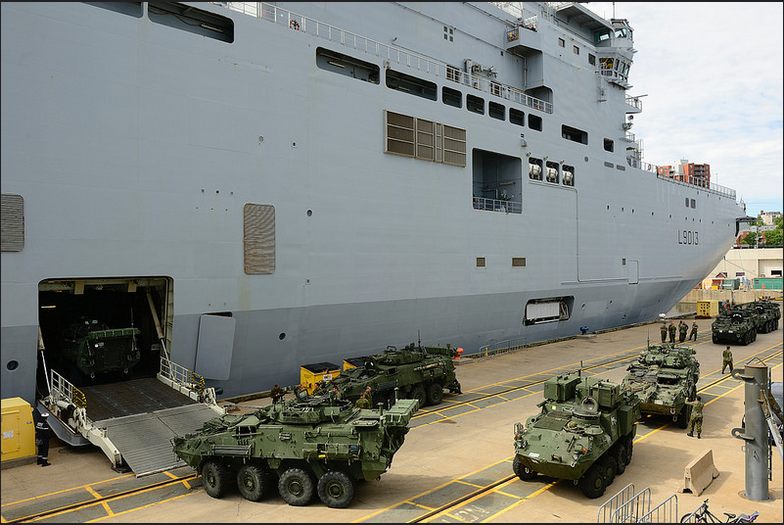
Russia recently bought two French Mistral class amphibious ships. Russia has not bought foreign warships for a long time, but this purchase was largely because of an eagerness to acquire Western shipbuilding technology and construction skills. This has already paid off, although not exactly how the Russians had planned. This became evident when a Russian official recently announced that the first Mistral would be built entirely in France. It had earlier been decided to have Russian shipyards build some sections of the first Mistral. It was quickly discovered that the Russian shipyard was not capable of building to the French specifications or do it according to the French timetable. The Russians expected to learn some valuable lessons from the French and, while embarrassing, this was one very valuable lesson. Russian shipyard officials have had their faces rubbed in the embarrassment of not being able to compete the way using their current practices. Russian experts on Western production methods and techniques have long complained of the antiquated and inefficient methods still favored by Russian shipbuilders. Navy leaders have been complaining for decades about the poor quality of work coming out of Russian shipyards. The Mistral purchase was to put this to the test.

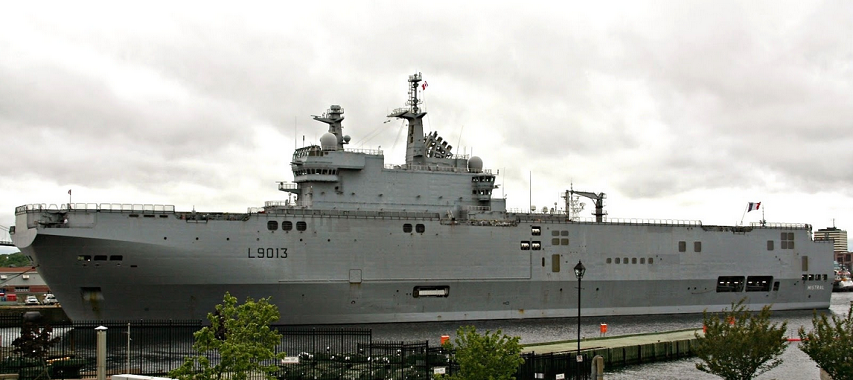
BPC "Bâtiment de Projection et de Commandement" Tonnerre. Photograph by  Yannick Le Bris

The Mistral class BPC “Bâtiment de Projection et de Commandement” Tonnerre. Photograph by Yannick Le Bris

One thing American marines and sailors notice about the Mistral is the wider and higher corridors. This came about because the ship designers surveyed marines and asked what ship design improvements they could use. It was noted that in older amphibious ships, the standard size (narrow) corridors were a problem when fully equipped troops were moving out. That, plus the smaller crew size, makes the Mistrals appear kind of empty but very roomy. That, plus larger living accommodations (made possible by the smaller ship’s crew and marine complement), make the Mistrals a lot more comfortable. The French ships can be rigged to accommodate up to 700 people for short periods, as when being used to evacuate civilians from a war zone.

After the first two, additional Mistrals for the French Navy are being built using more commercial techniques and are expected to cost closer to $500 million each. France has three Mistrals with several more on order. Russia says it plans to base some of its Mistrals in the Far East, where there is an ongoing dispute with Japan over Japanese islands Russia occupied after World War II and never gave back. The Mistrals will probably show up elsewhere, because the Russian fleet is again patrolling the high seas and showing up wherever its government needs some muscle.

The Russians will name their two Mistrals the Vladivostok (initially planned to be based in its namesake city) and the Sevastopol (to be based at Novorossiysk).

June 6, 2013

D-Day 1942 or 1943

Filed under: Britain, Cancon, France, Germany, History, Military, USA, WW2 — Tags: , , , — Nicholas @ 10:17

At Military History Now, there’s a look at a few of the allied plans for invading France before the actual June 6, 1944 operation:

IKE’S SLEDGEHAMMER
Almost as soon as America entered the war with Nazi Germany, generals Dwight Eisenhower and George Marshall were both lobbying for a strike across the English Channel into France. One plan foresaw a joint British and American assault on either of the French port cities of Cherbourg or Brest as early as the fall of 1942. The operation, codenamed Sledgehammer, would see a force of just six divisions attack, capture and hold either one of the two strategically-vital, deep-water harbours. The force, which likely would have totalled no more than 60,000 men, would have been expected to withstand the inevitable Nazi counterattacks until spring when more reinforcements could arrive. Despite the fact that the Germans would have been free to throw as many as 30 divisions at the invaders, the U.S. Joint Chiefs (as well as the Soviets) endorsed Sledgehammer wholeheartedly. The American commanders seemed to favour any plan that would bring U.S. forces into action in Europe quickly, while Stalin was thrilled at the prospect of an Allied offensive in Western Europe — anything to divert German forces away from the Russian front. Oddly enough, while the mission called for the heavy use of American air and sea power, at the time there was still only a handful of combat-ready U.S. Army units in England. As such, the ground portion of the invasion would be left entirely up to the British military. Cooler heads, namely Prime Minister Churchill, convinced Eisenhower to shelve Sledgehammer – Britain was already stretched thin in Egypt and America still had yet to fully mobilize for the war in Europe. An invasion of France would simply have to wait.

OPERATION ROUNDUP
Later in 1942, the Allies roughed out a second plan to put troops ashore in Western Europe the following spring. This operation, dubbed Roundup, called for 18 British and 30 American divisions to hit a series of landing zones along a 200 km stretch of coastline between Boulogne-sur-Mer near Calais and the port of Le Harve. Overhead, more than 5,700 Allied aircraft were to sweep the skies of the Luftwaffe clearing the way for a series of airborne drops. D-Day was set for some time in April or May of 1943. The British, already strained by three years of total war against the Axis, were understandably reluctant to throw their army headlong into the teeth of Germany’s Channel fortifications. They pushed instead to attack Sicily and Italy – what Churchill called the “soft underbelly of Europe” — by way of North Africa. A sober appraisal of British and American fleet strength, air assets and manpower ultimately convinced the Allied high command that no invasion could be mounted until 1944 at the earliest. For one thing, American factories had yet to manufacture enough of the landing craft needed for such a massive undertaking. Washington and London turned their attention instead towards a late 1942 invasion of Tunisia – Operation Torch. The rest is, as they say, history.

As any Canadian military historian would probably have said to either of these proposals … I have two words: Operation Jubilee.

The Dieppe Raid, also known as the Battle of Dieppe, Operation Rutter and, later, Operation Jubilee, was a Second World War Allied attack on the German-occupied port of Dieppe. The raid took place on the northern coast of France on 19 August 1942. The assault began at 5:00 a.m. and by 10:50 a.m. the Allied commanders were forced to call a retreat. Over 6,000 infantrymen, predominantly Canadian, were supported by a Canadian Armoured regiment and a strong force of Royal Navy and smaller Royal Air Force landing contingents.

The objective of the raid was discussed by Winston Churchill in his war memoirs:

    “I thought it most important that a large-scale operation should take place this summer, and military opinion seemed unanimous that until an operation on that scale was undertaken, no responsible general would take the responsibility of planning the main invasion…

    In discussion with Admiral Mountbatten it became clear that time did not permit a new large-scale operation to be mounted during the summer (after Rutter had been cancelled), but that Dieppe could be remounted (with the new code-name “Jubilee”) within a month, provided extraordinary steps were taken to ensure secrecy. For this reason no records were kept but, after the Canadian authorities and the Chiefs of Staff had given their approval, I personally went through the plans with the C.I.G.S., Admiral Mountbatten, and the Naval Force Commander, Captain J. Hughes-Hallett.”

Objectives included seizing and holding a major port for a short period, both to prove it was possible and to gather intelligence from prisoners and captured materials, including naval intelligence in a hotel in town and a radar installation on the cliffs above it. Although the primary objective was not met and secondary successes were relatively few, some knowledge was gained while assessing the German responses. The Allies also wanted to destroy coastal defences, port structures and all strategic buildings. Due to the failure to secure Dieppe this objective was not met in any systematic sense. The raid had the added objective of providing a morale boost to the troops, Resistance, and general public, while assuring the Soviet Union of the commitment of the United Kingdom and the United States.

A total of 3,623 of the 6,086 men (almost 60%) who made it ashore were either killed, wounded, or captured. The Royal Air Force failed to lure the Luftwaffe into open battle, and lost 96 aircraft (at least 32 to flak or accidents), compared to 48 lost by the Luftwaffe.[2] The Royal Navy lost 33 landing craft and one destroyer. The events at Dieppe later influenced preparations for the North African (Operation Torch) and Normandy landings (Operation Overlord).

Operation Jubilee clearly showed that the plans for both Sledgehammer and Roundup would have been bloody failures.

May 23, 2013

Underwater archaeologists revisit Louisbourg

Filed under: Cancon, France, History — Tags: , — Nicholas @ 16:29

Archaeologists are visiting Louisbourg harbour to inspect the remains of several French ships that were sunk during the second siege of Louisbourg in 1758:

Parks Canada’s underwater archeologists have been studying what remains of the ships in the waters off Fortress of Louisbourg National Historic Site since the early 1960s. For this dive, they are also gathering fresh, high-quality video and pictures for new exhibits and for a festival of all of Parks Canada’s archeologists to be held during Louisbourg 300 celebrations this summer.

Jonathan Moore of Parks Canada’s underwater archeology service said that after so many years on the ocean floor, what is left of the warships is mainly the remains of the lower hulls, which are embedded into the harbour bottom.

“You are not seeing a lot of structure above the sea bed,” he said Wednesday morning, after the five-person team returned to the wharf in Louisbourg. “A lot of the heavier materials located in the lower-most reaches of the ships are laying on the seabed.

“A common thing we are seeing is cannons that were on the warships when they went down: cannonballs, cannon shot, bar shot — all of the kinds of ordnance that was on the vessels when they sank.”

Some ship parts like some rigging, pulley components, stone and iron ballast are also on the ocean floor.

Underwater archeologists last visited the shipwrecks in 2008.

“We haven’t seen any dramatic change, which is a good sign,” said Moore.

April 22, 2013

India’s submarine program hits (even more) delays

Filed under: Bureaucracy, France, India, Military — Tags: , , , — Nicholas @ 08:17

Strategy Page reports on the latest set of delays to hit the Indian navy’s submarine building program:

India’s effort to build six submarines (French Scorpenes), under license, has been delayed once again. The problem is mainly poor management. An example of this occurred quite recently with the departure of ten Spanish technical advisors for the Scorpenes. Their contract expired at the end of March and, despite the expiration date being well known Indian bureaucrats were unable to get a new contract in place on time. Similar avoidable delays have occurred several times already and the price has gone up with each delay. Last year it was announced that the first Scorpene sub would not be ready until 2015. The new delays push that to 2017.

Building the subs in India will leave India with thousands of workers and specialists experienced in building modern submarines. All that will be wasted because the defense procurement bureaucrats seem to have learned nothing. These officials already caused numerous delays and cost overruns during negotiations to build these diesel-electric submarines. The bureaucrats mismanaged this deal to the extent that it is now five years behind schedule. But it is even more behind schedule if you count the several years the Indian bureaucrats delayed it even getting started. The delays and mismanagement have so far increased the cost of the $4 billion project by 25 percent (to $834 million per sub).

[. . .]

All this ineffective urgency is in play because India’s submarine fleet is dying of old age and new boats are not going to arrive in time. It’s not like this was a surprise, but the Indian defense procurement bureaucracy has long been noted as slow, sloppy, and stubborn, especially in the face of demands that it speed up. The twisted tale of the tardy submarines is particularly painful.

The plan was to have a dozen new subs in service by the end of the decade. At present, there will be (with a bit of luck) three or four of them in service by then. The procurement bureaucracy is still seeking a supplier for the second batch of six diesel-electric subs. This second six probably won’t even begin arriving by the end of the decade. It’s hard to say, although the defense procurement nabobs speak of “fast tracking” this project, but long-time observers not expecting speed.

There’s some urgency to all this because this year five of India’s 16 diesel-electric subs (10 Kilo and two Foxtrot class Russian built boats and four German Type 209s) were to be retired (some are already semi-retired because of age and infirmity). Because of the Scorpene delays, the Type 209s are being kept in service (but not allowed out to sea much) for several more years. That leaves India with 14 subs. But in the next year or so several of the older Kilos will reach retirement age. Thus, by the time the first Scorpene arrives in 2017, India will only have five or six working subs. India believes it needs at least 18 non-nuclear subs in service to deal with Pakistan and China.

April 8, 2013

French intelligence agency discovers the power of the “Streisand Effect”

Filed under: Europe, France, Government, Media — Tags: , , — Nicholas @ 10:04

The French Central Directorate of Interior Intelligence (DCRI) didn’t appreciate that Wikipedia had an article on one of their installations (link is to the English version of the page in question), so they asked to have it removed. However, because they wouldn’t specify what information in the article was sensitive (even though it was largely based on a French TV broadcast), the Wikipedia editors turned down the request. The DCRI then channelled their inner thug:

Wikipedia refused to delete it, and then things took a nasty turn, as a press release from the Wikimedia Foundation explains:

    Unhappy with the Foundation’s answer, the DCRI summoned a Wikipedia volunteer in their offices on April 4th. This volunteer, which was one of those having access to the tools that allow the deletion of pages, was forced to delete the article while in the DCRI offices, on the understanding that he would have been held in custody and prosecuted if he did not comply. Under pressure, he had no other choice than to delete the article, despite explaining to the DCRI this is not how Wikipedia works.

As the Wikimedia Foundation goes on to note:

    This volunteer had no link with that article, having never edited it and not even knowing of its existence before entering the DCRI offices. He was chosen and summoned because he was easily identifiable, given his regular promotional actions of Wikipedia and Wikimedia projects in France.

This is very similar to the situation discussed last week, where Benjamin Mako Hill seems to have been targeted because he, too, was easily identifiable. As we noted then, putting pressure on Wikipedia volunteers in this way is extremely problematic, since it naturally discourages others from helping out.

How did the DCRI learn about the Streisand Effect?

… the deleted article is, of course, back on line, in French and a dozen other languages. Moreover, the DCRI’s ham-fisted attempt to censor an extremely obscure Wikipedia page that hardly anyone ever visited, has achieved exactly the opposite effect: in the last few days, the page has been viewed over 45,000 times.

April 2, 2013

Mistral in Russian is Vladivostok

Filed under: Europe, France, Military, Russia — Tags: , , , — Nicholas @ 08:44

Strategy Page on the largest purchase of Western military equipment by Russia since the end of the Second World War:

The Russian Navy intends to have its version of the French Mistral amphibious ships (the Vladivostok Class) carry 30 helicopters (compared to 16 on the French version) and have several other modifications to the ship itself. The Vladivostok Class ships will be armed with two AK-630 multibarrel 30mm autocannon for anti-missile defense. There will also be two quad-launchers of shoulder fired type anti-aircraft missiles (with a 5 kilometer range and good against helicopters) and two or more DP-65 55mm grenade launchers for defense against divers.

The Vladivostoks will also be winterized for use in arctic conditions. The hull with be strengthened to deal with ice and the well deck door will completely close. The flight deck will have a deicing system and the ship will be modified to operate for extended periods in arctic conditions. There is also different electronics and this means a different arrangement of radomes and antennae.

In the aircraft handling areas below the deck height will be higher for the taller Ka-52K and Ka-29 helicopters. The Ka-52K is a navalized version of the Ka-52 that went into production last year. In addition to being equipped with coatings to resist sea water corrosion, the K model will also have a lightweight version of the high-definition Zhuk-AE AESA radar used on jet fighters. This radar currently weighs 275 kg (605 pounds), but the helicopter version will weigh only 80 kg (176 pounds) and enables the Kh-52K to use the Kh-31 anti-ship missile. This weapon has a range of 110 kilometers and travels at high speed (about one kilometer a second.) The Kh-52K can also carry the sub-sonic Kh-31 missile, which has a range of 130 kilometers. Both of these missiles weigh about 600 kg (1,300 pounds) each.

[. . .]

Russia is buying two French Mistral class amphibious ships for $1.7 billion. This is the largest Russian purchase of Western weapons since World War II. The deal was delayed for a long time because the Russians demanded the transfer of shipbuilding and electronics technology (which is now agreed to).

The French navy received the first of the 21,500 ton Mistrals in 2006, with the second one arriving in 2007. Both were ordered in 2001. These two ships replaced two older amphibious landing ships. This gave France a force of four amphibious ships. The two Mistrals are also equipped to serve as command vessels for amphibious operations. The French have been very happy with how the Mistrals have performed.

The Mistrals are similar in design to the U.S. LPD 17 (San Antonio) class. Both classes are about 200 meters/620 feet long, but the LPD 17s displace 25,000 tons. The French ships are more highly automated, requiring a crew of only 180, versus 396 on the LPD 17. On long voyages on the open ocean, the Mistrals require as few as nine sailors and officers on duty (“standing watch”) to keep the ship going.

QotD: In praise of cheap, gimcrack, run-of-the-mill manufacturing

For the first time ever, labourers were able to purchase cheap goods for themselves. The first factories focused on mass production of cheap goods for the poor. Shoes, for example, were produced for the proletariat — the rich bought made-to-measure shoes. This was different from France, where the government’s mercantilist product standards, designed to uphold quality, ensured that nothing was produced for the poor at all. In France, mercantilism continued to be state policy for much longer than in England. This is the reason why industrialisation took fifty more years to arrive on France’s shores.

J.P. Floru, Heavens on Earth: How To Create Mass Prosperity, quoted by Brian Micklethwait at Samizdata, 2013-03-29.

March 5, 2013

David Friedman reviews The Birth of the West by Paul Collins

Filed under: Books, Europe, France, Germany, History, Media, Religion — Tags: , , , — Nicholas @ 10:21

David Friedman on the recent book The Birth of the West: Rome, Germany, France, and the Creation of Europe in the Tenth Century, by Paul Collins.

Take five or six soap operas set in central and western Europe in the 10th century. Chop in pieces, stir, and glue together more or less at random. You now have something reasonably close to the picture that emerges from The Birth of the West, 427 pages of 10-century history as presented by the Australian author and broadcaster Paul Collins. The reader is left wondering whether the chaos is a bug or a feature, a failure of the author to shape his material into a coherent story or a deliberate attempt to show the reader the chaos of the period.

[. . .]

The most interesting thing about the book may be what it implies about how much we do not know. Thus, for instance, Collins offers a lurid account of Theodora and Marizia, a mother and daughter heavily involved in papal politics. (Marizia was supposedly the mistress at age 14 of an 80-year-old pope.) He then mentions that his source was writing 50 years after the events he describes, that another source presents a much more attractive picture, and that both have axes to grind. But he goes on to treat the first account as accurate. He offers a glowing portrait of Theophano, a Byzantine princess who became the wife of Otto II and mother of Otto III, dismissing a much more critical picture from a contemporary source. A historian with a different set of biases could have given us an equally convincing version in which some of the good guys and bad guys switched hats.

[. . .]

Collins presents the conventional view of the dominant role of religion in medieval Europe, cites several books by the French medievalist Georges Duby, but not the one in which Duby argues that the picture is badly distorted by the fact that almost all of our sources are clerical. The point is relevant for modern sources as well: Collins himself spent much of his life as a Catholic priest before resigning over a dispute with the Vatican and taking up a second career as writer and broadcaster.

None of that means that the story he tells is wrong. The modern reader inclined to take any single historical view as gospel might consider how much disagreement there is on issues for which we have enormously better information — the Vietnam War, say, or the evaluation of controversial political figures such as FDR, Reagan, or Thatcher. It does not even mean that the book should have been written differently. The story Collins tells is confusing enough as is; it would be far more confusing if he had tried to keep all of the alternative narratives going at once. And, to his credit, while he tells a single story, he makes it clear that alternatives exist — almost all of my critical comments are based on information he himself presents. I would not recommend the book as light reading, but it does provide a vivid picture of the century.

February 3, 2013

US poised to increase involvement in Mali

Filed under: Africa, France, Military, Religion, USA — Tags: , , , , — Nicholas @ 11:27

Sheldon Richman explains why it could be a problem if the American presence in northwestern Africa is further expanded:

Ominously but unsurprisingly, the U.S. military’s Africa Command wants to increase its footprint in northwest Africa. What began as low-profile assistance to France’s campaign to wrest control of northern Mali (a former colony) from unwelcome jihadists could end up becoming something more.

The Washington Post reports that Africom “is preparing to establish a drone base in northwest Africa [probably Niger] so that it can increase surveillance missions on the local affiliate of Al Qaeda and other Islamist extremist groups that American and other Western officials say pose a growing menace to the region.” But before that word “surveillance” can bring a sigh of relief, the Post adds, “For now, officials say they envision flying only unarmed surveillance drones from the base, though they have not ruled out conducting missile strikes at some point if the threat worsens.”

Meanwhile Bloomberg, citing American military officials, says Niger and the U.S. government have “reached an agreement allowing American military personnel to be stationed in the West African country and enabling them to take on Islamist militants in neighboring Mali, according to U.S. officials.… No decision has been made to station the drones.”

The irony is that surveillance drones could become the reason the “threat worsens,” and could provide the pretext to use drones armed with Hellfire missiles — the same kind used over 400 times in Pakistan, Yemen, and Somalia, killing hundreds of noncombatants. Moving from surveillance to lethal strikes would be a boost for jihadist recruiters.

January 18, 2013

Obsessing over drugs will damage sports much more than Lance Armstrong could

Filed under: France, Media, Sports — Tags: , , , — Nicholas @ 09:41

At sp!ked, Tim Black reviews Seven Deadly Sins: My Pursuit of Lance Armstrong, by David Walsh:

And so, in the aftermath of his Oprah-atic confession, bound to neither sate the critics nor elate the devout, the infernal humiliation of one-time cyclist Lance Armstrong continues.

The kicking and pelting began in earnest in August last year, when the US Anti-Doping Agency (USADA) stripped Armstrong of his seven Tour de France titles following his failure to challenge their numerous doping charges. The USADA then followed that up in October with a voluminous, damning report, complete with gruesome testimonies from Armstrong’s one-time confidantes and teammates. By this point, even the International Cycling Union (UCI), which had long sided with Armstrong, had given up the defence to join in the lynching. ‘Lance Armstrong has no place in cycling’, exclaimed UCI president Pat McQuaid. ‘Lance Armstrong deserves to be forgotten in cycling.’

As sporting officialdom condemned, large swathes of the media spat. Gossipy stories of Armstrong’s bullying, his lying, his alleged sociopathology were published without nuance; op-eds assassinating Armstrong’s character, inflating his wrongs to Biblical proportions, were rushed off without perspective. On a man once lionised by millions, whose fame had for years been wrapped yellow around the wrists of those who admired him, open season had been declared. All the hunt lacked was a sighting of the quarry himself. And then this week, that finally happened — in the interview with Oprah Winfrey. Caught and unavoidably contrite, Armstrong acted out the role of the doping sportsman. Yes, he was saying, I am everything that the Dopefinder Generals say I am: I am that witch.

December 20, 2012

Did the Germans and the British really play soccer at Christmas in 1914?

Filed under: Britain, Europe, France, Germany, History, Military, Soccer, WW1 — Tags: — Nicholas @ 11:14

In the Guardian, Scott Murray and John Ashdown discuss the rather amazing events of Christmas Day, 1914 between the combatants in France:

To borrow (and then misuse) one of the oldest football zingers in the book: in the middle of a fight, a football match broke out. A report in the Guardian on Boxing Day 1914 described how in one region “every acre of meadow under any sort of cover in the rear of the lines was taken possession of for football”. In their letters home, British soldiers told of shaking hands with their German counterparts and swapping cigarettes. A Scottish brigadier described how the Germans “came out of their trenches and walked across unarmed, with boxes of cigars and seasonable remarks. What were our men to do? Shoot? You could not shoot unarmed men.”

While there was undoubtedly continued gunfire along many sections of the front, most soldiers appear to have laid down their arms and called an unofficial truce that day, with fußball uppermost in the minds of many. A letter published on New Year’s Day from a British officer reads: “I hear our fellows played the Germans at football on Christmas Day. Our own pet enemies remarked they would like a game, but as the ground in our part is all root crops and much cut up by ditches, and as, moreover, we had not got a football, we had to call it off.” A letter in the Times, meanwhile, from a major reported that a German regiment “had a football match with the Saxons [regiment], who beat them 3-2”.

One match appears to have started between the Germans and a regiment from Cheshire, one of whom years later explained how a ball suddenly came hurtling over the top from the German side. “I should think there were about a couple of hundred taking part. I had a go at the ball. I was pretty good then, at 19. Everybody seemed to be enjoying themselves. There was no sort of ill-will between us. There was no referee, and no score, no tally at all. It was simply a melee — nothing like the soccer you see on television.”

November 26, 2012

WW1 slang that became part of everyday English

Filed under: Britain, France, Germany, History, Military, WW1 — Tags: , — Nicholas @ 09:47

Jasper Copping lists a surprising number of words that entered the civilian language thanks to the linguistic creativity of soldiers in the trenches during the First World War:

If you’re feeling washed out, fed up or downright lousy, World War One is to blame.

New research has shown how the conflict meant that hundreds of words and phrases came into common parlance thanks to the trenches.

Among the list of everyday terms found to have originated or spread from the conflict are cushy, snapshot, bloke, wash out, conk out, blind spot, binge drink and pushing up daisies.

The research has been conducted by Peter Doyle, a military historian, and Julian Walker, an etymologist, who have analysed thousands of documents from the period — including letters from the front, trench newspapers, diaries, books and official military records — to trace how language changed during the four years of the war.

They found that the war brought military slang into the mainstream, imported French and even German words to English and saw words from local dialects become part of national conversation.

It was a “world” war, so the linguistic additions came from further afield than Belgium or France:

Several Hindi terms, picked up from Indian Army soldiers and already circulating in the regular, professional army, were also disseminated widely.

One of those most used at the front was “cushy” — from khush (‘pleasure’).

Soldiers would describe cushy, or comfortable billets, as well as cushy trenches, in quiet sectors.

The most well known term derived from Hindi though was “Blighty”, from bilati, meaning “foreign”, which, when applied by Indians to Britons, came to be perceived by Indian Army servicemen as the term “British”.

Words even entered the lexicon from the trenches opposite. “Strafe” became an English word, from the German “to punish”, via a prominent slogan used by the enemy: “Gott Strafe England”, while prisoners of war returned with term “erzatz”, literally “replacement”, but used in English to mean “cheap substitute” and spelled ersatz.

November 12, 2012

Kelly McParland: US and French attitudes to affairs differ markedly

Filed under: Europe, France, Media, USA — Tags: — Nicholas @ 12:28

In the National Post, Kelly McParland contrasts the French reaction to affairs on the part of public officials with the American reaction:

In Paris they must be busily turning the pages now, looking for the rest of the story. Yes, OK, he had an affair … and? You mean that’s it? He didn’t murder her? Have three children that he kept in a secret location away from the press? Involve her in sex games with crowds of similarly liberated-minded partners? They had an affair and he has to quit as head of the CIA? Mon dieu, these Americans. Four hundred years in the New World and they’ve barely moved on from the Puritans. Look, they’re even shocked that the other woman appeared on television “sporting bare, toned arms”. What did they expect, a chador?

France has moved on marginally from the days when President Francois Mitterrand could have a whole secret second family, and no one mentioned it in public because it wouldn’t be polite. Now the press leaps happily onto news of sexual licence in the halls of power. Unlike the U.S., they just don’t condemn it, as long as no one is physically abused. The latest instance – they don’t even use the world scandal, because in France it isn’t — relates to the former justice minister, Rachida Dati, who is suing one of the country’s wealthiest men to try and force him to admit he’s the father of her new daughter. The case is a bit complicated because, as Ms. Dati attests, she has “a complicated private life.” That would include, according to the attorney for Dominique Desseigne, the alleged father, having eight lovers in the year she fell pregnant, “including a television broadcaster, a minister, a Qatari attorney-general and a brother of the former president Mr Sarkozy,” reports the French newspaper Le Monde.

Nicolas Sarkozy was the president at the time, and Ms. Dati’s boss. He wasn’t likely to be butting into her private life, though, having given up his own wife in favour of singer/model Carla Bruni. Ms. Bruni has recently been offering marital advice – as in “get married for Cripe sakes” – to Valerie Trierweiler, current First Partner-for-a-While to President Francois Hollande, who has four children by a previous Main Partner, Ségolène Royal. (Ms. Royal is only a Main Partner rather than a First Partner because Hollande wasn’t president at the time.) Dumping the mother of your four children for an uppity newspaper columnist like Ms. Trierweiler might offend sensibilities, but M. Hollande never married Ms. Royal either, so no big deal. Nonetheless Ms. Trieweiler has become deeply unpopular since moving into the presidential palace, because she refuses to give up her day job as a columnist and because she’s been rude to Ms. Royal. The messy sex stuff has nothing to do with it.

Compared to the Bacchanalia of French politics, the Petraeus “scandal” is like a high-school tiff over who gets to wear the football captain’s pin to the Prom.

« Newer PostsOlder Posts »

Powered by WordPress