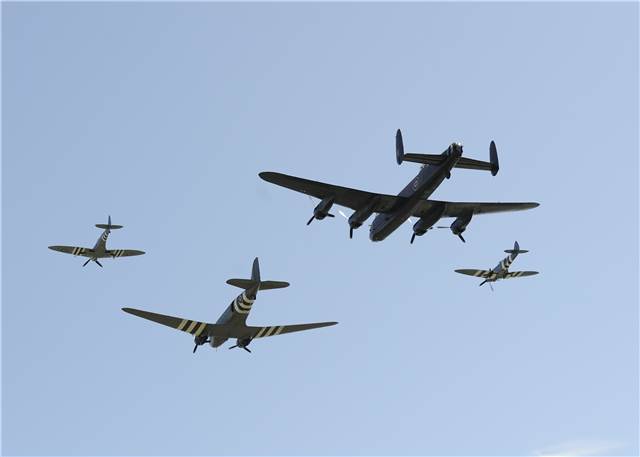
Two Spitfires, a Dakota DC-3, and a Lancaster Bomber conduct a flypast over Juno Beach, France, during commemorative ceremonies of the 70th Anniversary of D-Day on June 6, 2014. Photo by Sgt Bern LeBlanc Canadian Army Public Affairs AS2014-0027-002

Two Spitfires, a Dakota DC-3, and a Lancaster Bomber conduct a flypast over Juno Beach, France, during commemorative ceremonies of the 70th Anniversary of D-Day on June 6, 2014. Photo by Sgt Bern LeBlanc Canadian Army Public Affairs AS2014-0027-002
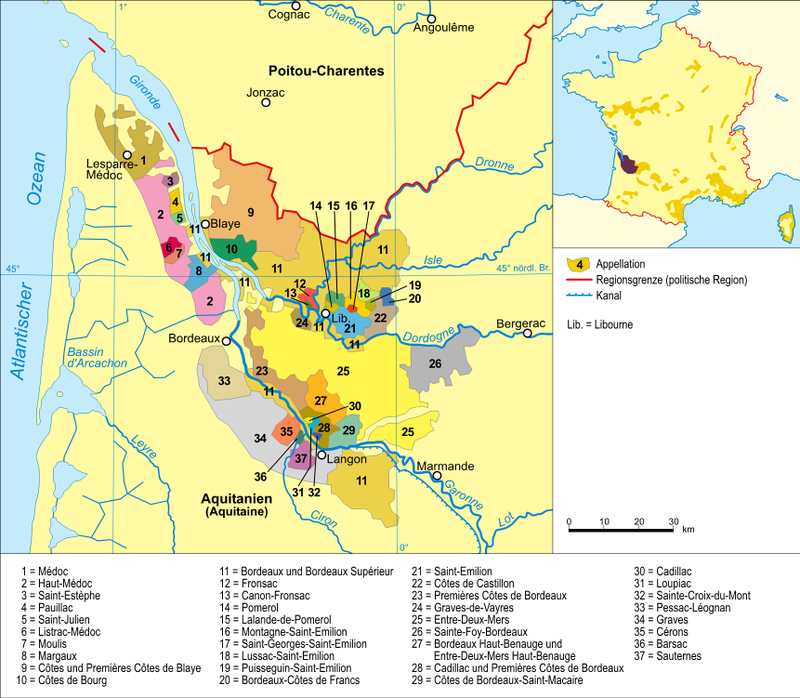
Even in a good year, I don’t have the money to invest in Bordeaux futures, so I rarely bother to read much about them. Even so, I’d heard that the 2013 vintage was not going to be a good one given the weather that year in the region. The price for Bordeaux wines, however, didn’t do the rational thing and drop below previous (good) years: prices went up. The Wine Cellar Insider explains what happened next:
2013 Bordeaux is not the vintage of the century. The growing season, with its cold, damp character made sure of that. 30, 40 or 50 years ago, a year the quality of 2013 Bordeaux would have been a complete disaster.
But that is not what took place with 2013 Bordeaux. With the willingness to sacrifice quantity for quality, the best producers, with the financial ability to do what needed to be done made some fine wine. 2013 Bordeaux is not an exciting, sexy vintage. But having tasted close to 400 different 2013 Bordeaux wines, clearly, there are some nice wines worth drinking.
So, what’s the problem? When it comes to the wine, none. The average scores from the majority of wine writers and critics show the wines at an average of 89/90 Pts for perhaps the top 100 – 200 wines. Clearly, those are the not the scores for a bad vintage.
[…]
Had the wines been priced in proportion to consumer demand, while 2013 Bordeaux was never going to be an easy sell, it would not have been an impossible sale. I am all for the open, free market when it comes to pricing. Producers can and should price their wine for what they think the market will bear. But 2013 Bordeaux wines remain unsold. Selling the wines to a negociant is not selling the wine. Merchants need to buy and consumers need to purchase as well for it to be a true sale. For some odd reason, in the great vintages, Bordeaux has a knack for pricing the wines correctly. They might seem expensive to mature collectors that are used to paying lower prices, but for the next generation of wine lovers, the wines seem fairly priced.
I get it. On the one hand, due to the excessive unflattering and at times, unfair press, 2013 Bordeaux was never going to receive a warm reception in the marketplace. Perhaps the price the market was actually willing to pay was unappetizing to the chateau owners. But it would have been nice to see an effort. It is difficult for 2013 Bordeaux to sell through to consumers when other recent, and more successful vintages are available in the market for less money.
H/T to Brendan for the link.
Chris Mercer on the various ways the French Champagne producers tried to keep their best wine from being diverted to the use of the Nazis:
By the time the French city of Reims was liberated in August 1944, many Champagne houses and growers had spent four years playing a game of high stakes cat-and-mouse with the local Nazi ‘wine fuhrer’, Otto Klaebisch.
As Julian Hitner writes in a feature published in the July issue of Decanter magazine, it was Klaebisch’s job to keep the Nazi empire topped up with France’s finest Champagnes. At its peak, Klaebisch was demanding 400,000 bottles per week.
In response, many Champenois resorted to subterfuge to try to protect their most precious vintages and cuvees.
As noted in the book Wine & War by Don & Petrie Kladstrup, some built fake walls in their cellar to hide their best stocks, while others intentionally mislabelled bottles.
On more than one occasion, Klaebisch suspected he was being duped. ‘How dare you send us fizzy dishwater?’ he asked 20-year-old Francois Taittinger.
‘Who cares? It’s not as if it’s going to be drunk by anyone who knows anything about Champagne,’ replied the young Taittinger, who was subsequently thrown in prison for several days.
H/T to Brendan for the link.
Seventy years ago today, the Allies launched Operation Overlord, the invasion of Normandy by the combined British, American, and Canadian armies. A huge fleet of combat and transport vessels, supported by a large proportion of the United States Army Air Force and the Royal Air Force bomber and fighter aircraft were all deeply involved in making the invasion a success. In addition, perhaps the world’s largest disinformation campaign was being run to keep the German high command unsure of the real time and location of the invasion: the Pas de Calais and the Norwegian coast were also potential invasion targets, forcing the defenders to spread their forces thinner and to keep as many as possible out of reach of the real beaches.
In addition to the operational uncertainty of where to expect the blow, the Germans were also split about how best to conduct the defence: Field Marshal Rommel wanted to rush units to the beach as soon as possible, to defeat the Allies before they got inland. General Geyr von Schweppenburg, commander of Panzer Group West (and Field Marshal von Rundstedt, overall commander in the West), on the other hand, preferred to meet the Allies further inland (not taking the full impact of Allied air superiority into account). On 6 June, the defenders fell between the two philosophies, not being able to mass enough force to stop the invaders in their tracks, but suffering higher casualties in the attempt to move units toward the coast in the teeth of RAF/USAAF attacks.

Operation Overlord (detail) Click to see full-sized image at wwii-info.net
The invasion beaches were code-named Utah (4th US Division), Omaha (1st and 29th US divisions), Gold (50th British Division), Juno (3rd Canadian Division), and Sword (3rd British Division). Before the amphibious forces landed, three paratroop divisions were dropped behind the beaches to slow down German response (US 82nd and 101st Airborne Divisions to the West and Southwest of Utah beach, and the 6th British Airborne to the East of Sword beach).
One thing to note from the map is that there wasn’t a significant port within the invasion zone: the Allies had learned the bitter lessons of attacking a port in August of 1942 and the 2nd Canadian Division had paid in blood for the tuition. This meant a way had to be found to keep getting supplies to the troops after they moved off the beaches, until a functioning port could be secured. The Allied answer was to bring a port with them from England — two of them, actually — one to support the US forces in the West and one to support the British and Canadian forces in the East. These were the Mulberry harbours:
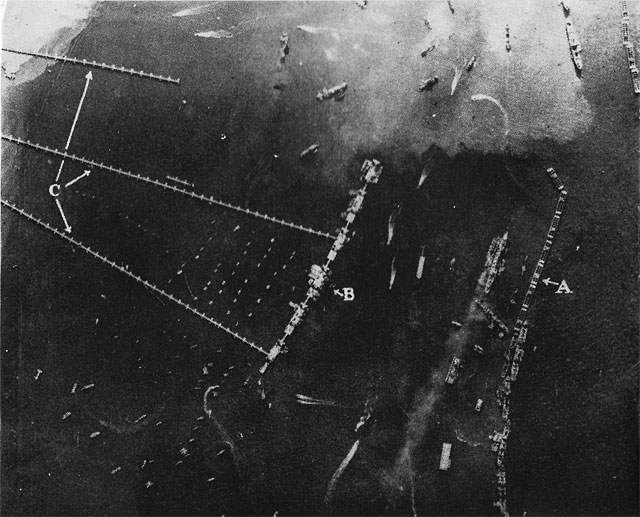
Think Defence explains how the Mulberry harbour worked:
In the image above these three components are shown.
A; Breakwater to attenuate waves
B; Pier heads at which to load and unload
C; Causeways that connected the pier heads to the beach
Each of the components was given a code word but fundamentally, they were concerned with either providing sheltered water or connecting ships and the beach.
There have been a number of different theories about how the Mulberry name was chosen, the more fanciful ones being completely incorrect.
Brigadier White recalls the moment he received a memo, unclassified, with the heading ‘Artificial Harbours’ and after recovering from the shock of such poor security immediately consulted with the Head of Security at the War Office. The next code, from the big book of code words, was Mulberry, it was that simple.
[…]
There were two complete Mulberry harbours, A for American and B for British, each the size of Dover harbour. Once the task of constructed and assembling the components on the South coast of England was complete they were ordered to Normandy on the 6th of June 1944, D-Day, departing on the 7th
Assembling the components was an effort in itself, requiring 600 tugs drawn from all parts of the UK and USA, all under the supervision of the Admiralty Towing Section commanded by Rear Admiral Brind.
Operational security was paramount, the captains of the block ships were told they were going to the Bay of Biscay and a model of the Mulberry harbour and invasion beaches in the headquarters of the Automobile Association at Fanum House was made by toymakers who were confined to the building until well after the invasion.
Unfortunately, the Western harbour was severely damaged in a storm a few weeks after coming into service, so the Eastern Mulberry had to do double duty after that.
Aside from the need to get reinforcements, rations, ammunition and other supplies forward, the Allied armies were highly motorized, and required vast amounts of fuel. Without a port’s specialized unloading facilities, it was assumed that it would be somewhere between difficult and impossible to keep the armies mobile. To address this, PLUTO was developed: Pipe Line Under The Ocean.
A great solution, although as Think Defence points out, it didn’t actually go into service until a few months after D-Day, and was not quite the war-winner the newsreel portrayed:
Second in daring only to the artificial harbors project and provided our main supplies of fuel during the Winter and Spring campaigns.
What also PLUTO did was allow vital tanker tonnage to be deployed to the Far East theatre.
Despite the understandable over exaggeration of the success of PLUTO it should be noted that fuel did not start flowing until September 1944, well after the invasion and on the 4th of October, BAMBI was closed down and operations concentrated on DUMBO after it had delivered a measly 3,300 tonnes, hardly war winning.
Cherbourg was by then receiving tanker supplies direct from the USA.
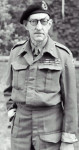 Getting across the channel was a major undertaking, but getting the troops ashore with enough firepower to break out of the beach defences required more innovation. The British army established a specialized unit to develop and operate vehicles and weapon systems specifically designed for that purpose. Major General Sir Percy Hobart was the commander of the 79th Armoured Division, and he was exactly the right man for the job (being related by marriage to Montgomery may have helped, too, but before taking command he was acting as a corporal in the Home Guard).
Hobart’s unit developed some of the most interesting armoured vehicles (not all of which were brilliant successes) and it’s safe to say that the Allies would have suffered much higher casualties without Hobart’s “Funnies”. In fact, General Eisenhower said as much himself: “Apart from the factor of tactical surprise, the comparatively light casualties which we sustained on all beaches, except OMAHA, were in large measure due to the success of the novel mechanical contrivances which we employed, and to the staggering moral and material effect of the mass of armor landed in the leading waves of the assault. It is doubtful if the assault forces could have firmly established themselves without the assistance of these weapons.” Think Defence has a good summary of many of these odd and interesting vehicles:
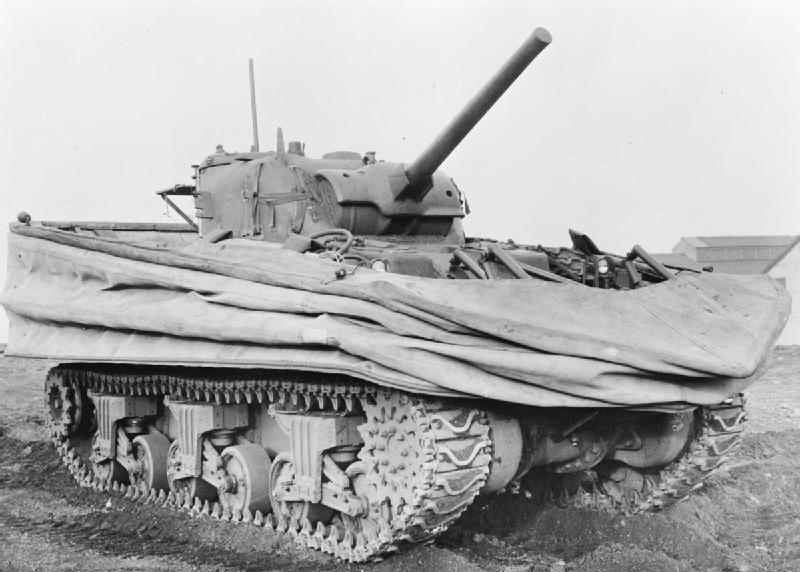
Sherman tanks were also converted into amphibious vehicles by the addition of a canvas skirt, propellers and other modifications. These provided vital armoured fire support in the opening phase of the beach assault although a number were lost to the heavy seas when they were launched too far from the beach. It is widely thought that as these losses were particularly heavy on Omaha beach it was this that contributed to the very high losses in that area.
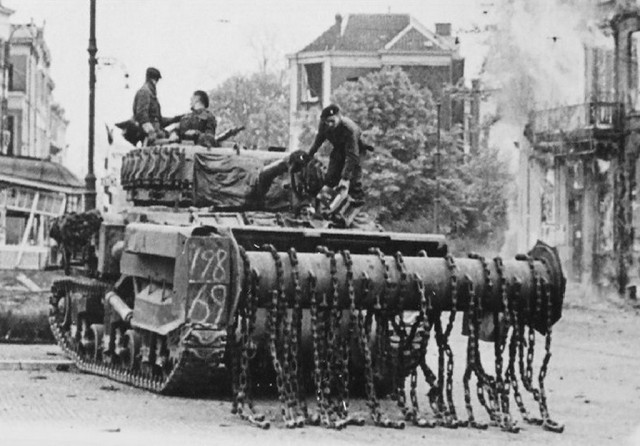
Mine clearance was carried out by a number of means but the preferred method was to use rotating chain flails to detonate the mines thus clearing a path the width of the tank. The flails were mounted on the front of the tank and were called Sherman Crabs. A number of Churchill based designs using rollers and ploughs were also employed, although this image shows one mounted on a Sherman.
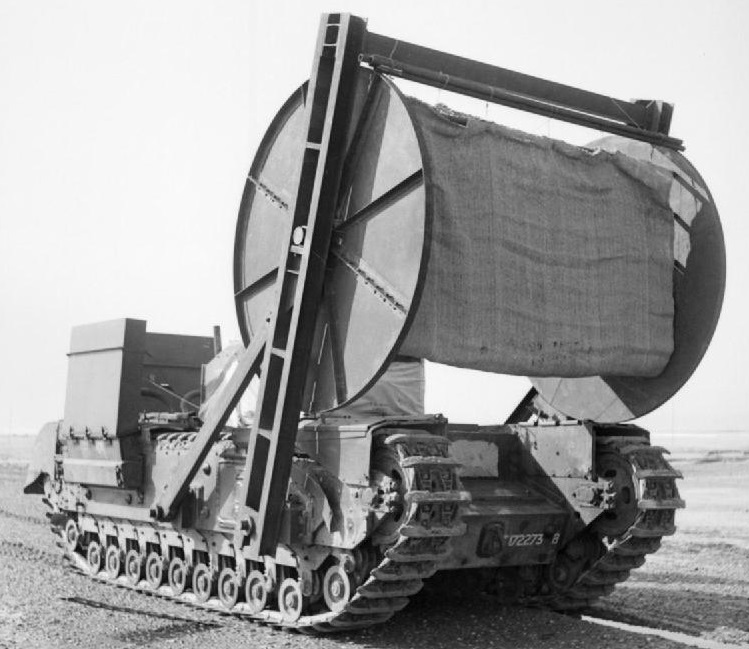
The beach surveys had revealed the existence of large patches of clay that would not bear the weight of heavy vehicles and artillery. To overcome this the ‘bobbin’ tanks were used that laid a continuous reinforced canvas mat over the soft ground, thus spreading the load over a wider area.
Lance Corporal John Ross tells the Ottawa Citizen about his D-Day experiences with the 1st Canadian Parachute Battalion:
“We attacked the strong point; there was an all-night fire fight. We had casualties and the Germans did too. At about 10 o’clock in the morning they surrendered. There were about 30 of us there, 42 Germans surrendered to us. They outnumbered us and they out gunned us,” describes Capt (Ret) John Ross, now 93 years-old recalling his time as a paratrooper who dropped several kilometers inland of Normandy on D-Day.
“We took off on the 5th of June, one day before D-Day. C Company was given the job to go in 30 minutes ahead to clear the drop zone of any enemy and attack the German complex.”
Capt (Ret) Ross served as a Lance Corporal in C Company, 1st Canadian Parachute Battalion, 3rd Airborne Brigade, 6th British Airborne Division. He was dropped from an Armstrong Whitworth Albemarle, a small two engine paratroop transport aircraft.
[…]
When thinking back to his time in Normandy Capt (ret) Ross remembers how Canadian soldiers were thought of as, seasoned warriors.
“I read an excerpt written by a German General after the war. He was in that area that we dropped in and he said that the reason they were overcome was because they faced battle hardened Canadians. I’d like to write a letter to him and say none of those Canadians had ever heard a shot fired in anger; he thought we were battle hardened and we were as green as green could be.”
The central problem of relations with de Gaulle stemmed from President Roosevelt’s distrust. Roosevelt saw him as a potential dictator. This view had been encouraged by Admiral Leahy, formerly his ambassador to Marshal Petain in Vichy, as well as several influential Frenchmen in Washington, including Jean Monnet, later seen as the founding father of European unity.
Roosevelt had become so repelled by French politics that in February he suggested changing the plans for the post-war Allied occupation zones in Germany. He wanted the United States to take the northern half of the country, so that it could be resupplied through Hamburg rather than through France. “As I understand it,” Churchill wrote in reply, “your proposal arises from an aversion to undertaking police work in France and a fear that this might involve the stationing of US Forces in France over a long period.”
Roosevelt, and to a lesser extent Churchill, refused to recognize the problems of what de Gaulle himself described as “an insurrectional government”. De Gaulle was not merely trying to assure his own position. He needed to keep the rival factions together to save France from chaos after the liberation, perhaps even civil war. But the lofty and awkward de Gaulle, often to the despair of his own supporters, seemed almost to take a perverse pleasure in biting the American and British hands which fed him. De Gaulle had a totally Franco-centric view of everything. This included a supreme disdain for inconvenient facts, especially anything which might undermine the glory of France. Only de Gaulle could have written a history of the French army and manage to make no mention of the Battle of Waterloo.
Anthony Beevor, D-Day: The Battle for Normandy, 2009.
High praise indeed for French espionage operatives from … former US Secretary of Defence Robert Gates:
Former spy and defense department secretary Robert Gates has identified France as a major cyber-spying threat against the US.
In statements that are bound to raise eyebrows on both sides of the Atlantic, Gates (not Bill) nominated French spies as being number two in the world of industrial cyber-espionage.
“In terms of the most capable, next to the Chinese, are the French – and they’ve been doing it a long time” he says in this interview at the Council on Foreign Relations.
Rather than a precis, The Register will give you some of Gates’s (not Bill) words verbatim, starting just after 21 minutes in the video, when he answers a question about America’s recent indictment of five Chinese military hackers.
“What we have accused the Chinese of doing – stealing American companies’ secrets and technology – is not new, nor is it something that’s done only by the Chinese,” Gates tells the interviewer. “There are probably a dozen or fifteen countries that steal our technology in this way.
“In terms of the most capable, next to the Chinese, are probably the French, and they’ve been doing it a long time.
The Irish Times looks at the Euro election results which have seen big gains for several Euro-skeptic parties:
Among the victors was Ms Le Pen’s National Front party which topped the poll in France with a quarter of the vote, bypassing the conservative UMP party, and leaving François Hollande’s Socialist Party in third place. The party is now in line for 24 seats in Strasbourg.
UKIP was expected to top the poll in Britain, with exit polls last night predicting the party could win 31 per cent of the vote. “Up until now European integration has always seemed inevitable … I think that inevitability will end tonight,” UKIP leader Nigel Farage said last night in a live video link to the European Parliament in Brussels, describing the decision to allow former Soviet countries into the European Union as one of Europe’s “great errors.”
Greece’s main opposition party Syriza topped the polls there, while the far-right Golden Dawn party came third with between 8 and 10 per cent of the vote.
In Germany, support for Alternative for Deutschland (AFD) an anti-EU party formed barely two years ago, reach 6.5 per cent, with the party in the running for six seats.
In Austria, the far-right Freedom party was expected to win 20 per cent of votes, up from 13 per cent in 2009.
However, some extreme anti-EU parties in smaller countries did not poll as well as expected, with the far-right Vlaams Belang in Belgium losing support.
Of course, not all Euro-skeptic parties are the same. UKIP is somewhat nativist and has a vocal anti-immigrant wing. Vlaams Belang has a larger and more vocal anti-immigrant component, while the Greek Golden Dawn are as close to modern day Fascists as you’ll find anywhere; not a party you want to be sharing newspaper space with.
SNCF (the French national passenger railway company) was very proud of the new fleet of passenger trains they’d ordered from manufacturers Alstom and Canada’s Bombardier … until it became clear that SNCF had been given the wrong dimensions to fit in many of the older French passenger stations:
It is a minor miscalculation, but one that will cost the French taxpayer a fortune.
France’s national rail operator SNCF — which runs its prestigious TGV fast trains — has sparked hilarity, anger and ridicule after building a new generation of regional trains that are too wide for 1,300 stations, meaning platforms will have to be “shaved” to stop them getting stuck.
The appalling blunder, which the French transport minister on Wednesday dubbed “comically tragic”, has already reportedly cost the state-controlled SNCF some €50 million (£40.5 million), sparking uproar at a time of austerity.
It was revealed by Wednesday’s Canard Enchaîné, the satirical weekly, whose cartoon showed a line of commuters on a busy platform being told: “The Paris-Brest train is entering the station. Please pull in your stomachs.”
The mistake was made as part of a €15 billion makeover of France’s Regional Express Trains, or TER, shared between Alstom, the French trainmaker and Bombardier, its Canadian rival.
[…]
Aware that France’s provincial stations — some of them ancient — came in various shapes and sizes, SNCF had asked the regional rail operator, Réseau ferré de France, or RFF, which is in charge of all French tracks, to work out the right measurements for the new trains.
Upon their advice that station widths varied by around 10cm in all, SNCF concluded the new trains could be 20 cm wider than their predecessors.
However, in an oversight that would cost it dear, the operator forgot to factor in some 1,300 stations built more than 50 years ago that are far narrower than today’s norms. “SNCF’s wise engineers forgot to verify the reality in the field,” wrote Le Canard.
BBC News Magazine looks back 60 years to the end of French colonial government and the military defeat at Dien Bien Phu which made it inevitable:
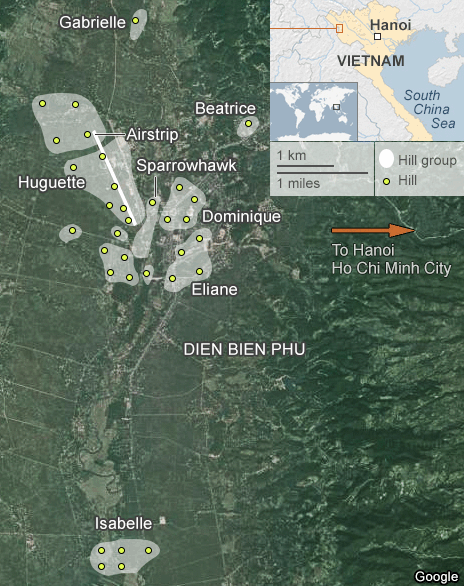
Sixty years ago this week, French troops were defeated by Vietnamese forces at Dien Bien Phu. As historian Julian Jackson explains, it was a turning point in the history of both nations, and in the Cold War — and a battle where some in the US appear to have contemplated the use of nuclear weapons.
“Would you like two atomic bombs?” These are the words that a senior French diplomat remembered US Secretary of State John Foster Dulles asking the French Foreign Minister, Georges Bidault, in April 1954. The context of this extraordinary offer was the critical plight of the French army fighting the nationalist forces of Ho Chi Minh at Dien Bien Phu in the highlands of north-west Vietnam.
The battle of Dien Bien Phu is today overshadowed by the later involvement of the Americans in Vietnam in the 1960s. But for eight years between 1946 and 1954 the French had fought their own bloody war to hold on to their Empire in the Far East. After the seizure of power by the Communists in China in 1949, this colonial conflict had become a key battleground of the Cold War. The Chinese provided the Vietnamese with arms and supplies while most of the costs of the French war effort were borne by America. But it was French soldiers who were fighting and dying. By 1954, French forces in Indochina totalled over 55,000.
[…]
Saturday 3 April 1954 has gone down in American history as “the day we didn’t go to war”. On that day Dulles met Congressional leaders who were adamant they would not support any military intervention unless Britain was also involved. Eisenhower sent a letter to the British Prime Minister Winston Churchill warning of the consequences for the West if Dien Bien Phu fell. It was around this time, at a meeting in Paris, that Dulles supposedly made his astonishing offer to the French of tactical nuclear weapons.
In fact, Dulles was never authorised to make such an offer and there is no hard evidence that he did so. It seems possible that in the febrile atmosphere of those days the panic-stricken French may simply have misunderstood him. Or his words may have got lost in translation.
“He didn’t really offer. He made a suggestion and asked a question. He uttered the two fatal words ‘nuclear bomb’,” Maurice Schumann, a former foreign minister, said before his death in 1998. “Bidault immediately reacted as if he didn’t take this offer seriously.”
According to Professor Fred Logevall of Cornell University, Dulles “at least talked in very general terms about the possibility, what did the French think about potentially using two or three tactical nuclear weapons against these enemy positions”.
Bidault declined, he says, “because he knew… that if this killed a lot of Viet Minh troops then it would also basically destroy the garrison itself”.
In the end, there was no American intervention of any kind, as the British refused to go along with it.
We are all familiar with the basic difference between English and French parliamentary institutions; copied respectively by such other assemblies as derive from each. We all realize that this main difference has nothing to do with national temperament, but stems from their seating plans. The British, being brought up on team games, enter their House of Commons in the spirit of those who would rather be doing something else. If they cannot be playing golf or tennis, they can at least pretend that politics is a game with very similar rules. But for this device, Parliament would arouse even less interest than it does. So the British instinct is to form two opposing teams, with referee and linesmen, and let them debate until they exhaust themselves. The House of Commons is so arranged that the individual Member is practically compelled to take one side or the other before he knows what the arguments are, or even (in some cases) before he knows the subject of the dispute. His training from birth has been to play for his side, and this saves him from any undue mental effort. Sliding into a seat toward the end of a speech, he knows exactly how to take up the argument from the point it has reached. If the speaker is on his own side of the House, he will say “Hear, hear!” If he is on the opposite side, he can safely say “Shame!” or merely “Oh!” At some later stage he may have time to ask his neighbor what the debate is supposed to be about. Strictly speaking, however, there is no need for him to do this. He knows enough in any case not to kick into his own goal. The men who sit opposite are entirely wrong and all their arguments are so much drivel. The men on his own side are statesmanlike, by contrast, and their speeches a singular blend of wisdom, eloquence, and moderation. Nor does it make the slightest difference whether he learned his politics at Harrow or in following the fortunes of Aston Villa. In either school he will have learned when to cheer and when to groan. But the British system depends entirely on its seating plan. If the benches did not face each other, no one could tell truth from falsehood — wisdom from folly — unless indeed by listening to it all. But to listen to it all would be ridiculous, for half the speeches must of necessity be nonsense.
In France the initial mistake was made of seating the representatives in a semicircle, all facing the chair. The resulting confusion could be imagined if it were not notorious. No real opposing teams could be formed and no one could tell (without listening) which argument was the more cogent. There was the further handicap of all the proceedings being in French — an example the United States wisely refused to follow. But the French system is bad enough even when the linguistic difficulty does not arise. Instead of having two sides, one in the right and the other in the wrong — so that the issue is clear from the outset — the French form a multitude of teams facing in all directions. With the field in such confusion, the game cannot even begin. Basically their representatives are of the Right or of the Left, according to where they sit. This is a perfectly sound scheme. The French have not gone to the extreme of seating people in alphabetical order. But the semicircular chamber allows of subtle distinctions between the various degrees of tightness and leftness. There is none of the clear-cut British distinction between rightness and wrongness. One deputy is described, politically, as to the left of Monsieur Untel but well to the right of Monsieur Quelquechose. What is anyone to make of that? What should we make of it even in English? What do they make of it themselves? The answer is, “Nothing.”
C. Northcote Parkinson, “The Will of the People, or Annual General Meeting”, Parkinson’s Law (and other studies in administration), 1957.
It’s been a decade since Robert Fulford popularized the term: “The Longest Undefended Neurosis in the World.” It’s about as accurate a description of Canada-US relations as has ever been offered. The eagerness which, even at this late date, we lap up any mention of Canada on US media is oddly pathetic. This is the sort of behaviour typically seen in small bankrupt countries. Any mention of Portugal outside of Portugal is almost immediately reported on the state broadcaster. There is a strange cloying quality about such reports. A desperate yelling: “Hey we used to be important!”
It’s a small country thing. When a big country thinks this way you get French-style arrogance: “Hey we still are important, it’s that you lot aren’t clever enough to realize that blindingly obvious fact.”
Today Rob Ford is probably the most famous Canadian in history, save William Shatner. Neither men’s careers has done much to change international perceptions of Canada. We’re boring and probably polite. From time to time we kill seals and moose, though not necessarily in that order. As a general rule we avoid doing evil things. Short of carpet bombing a small country, which is well beyond our military capabilities, nothing we do will change these perceptions. We could annex Buffalo, something within our military capabilities, but I suspect most Americans would probably be grateful. They might throw in Rochester as a parting gift.
Richard Anderson, “Talking With Americans About Canadians”, The Gods of the Copybook Headings, 2014-04-10
Duncan Kelly reviews Revolutionary Ideas: An Intellectual History of the French Revolution from The Rights of Man to Robespierre, by Jonathan Israel.
According to this hefty new study of the French Revolution by Jonathan Israel, a professor of history at Princeton, what such events really show is the motivating power of ideas in guiding and transforming events. In his terms, the French Revolution was a “revolution of ideas” before it became “a revolution of fact”; indeed, it was three revolutions all at once.
Ideas about political equality, anticlericalism and modern republicanism grounded in “reason” motivated Radical Enlightenment thinkers such as Condorcet and Thomas Paine, while they clashed with the “moderate Enlightenment constitutional monarchism” embodied by more pro-royalist factions (the Feuillants) and aristocratic supporters such as Lafayette. Both struggled against Robespierre’s “authoritarian populism”, which for Israel prefigures modern fascism.
The radical compound in this instance might have been uniquely French but its impact spread widely. The resounding Declaration of the Rights of Man, writes Israel, was a “manifesto entirely incompatible with all ancien régime notions of social, racial, and religious hierarchy”. Revolution lent support to Caribbean struggles for black emancipation such as that of Toussaint L’Ouverture in Haiti, memorably described in CLR James’s 1938 classic The Black Jacobins. James’s book, however, is an odd omission in Israel’s otherwise compendious bibliography.
[…]
Historians have often criticised Israel for flattening out all the differences between these radical ideas except those he wants to retain and, when applied to the French Revolution, his arguments can feel like the inverse of some 19th-century Marxist schema. Instead of subterranean economic determinations, it is Radical Enlightenment that provides the means by which everything from press freedom to de-Christianisation can be slotted into a matrix requiring little in the way of extra interpretation.
What you get from such a focus on subversive editors, disenchanted priests and materialist philosophers has much in common with a more conventional account: food shortages, public debt crises and social grievances from Paris to the Vendée, combined with a plethora of radical ideas about press freedom, absolute equality, political liberty and radical democracy. Yet the vaulting ambition to ascribe such a momentous transformation to one cause still feels hubristic. The obvious parallel in this year of all years would be the thought that there might be a single idea or singular complex of ideas behind the outbreak of the first world war. Can you imagine such a claim commanding general assent?
Everyone thinks America Alone is about Islam and demography, but in fact it has a whole section in it on cheese, called “The Pasteurization is Prologue”. Page 181:
I’ve never subscribed to that whole “cheese-eating surrender-monkey” sneer promoted by my National Review colleague Jonah Goldberg. As a neocon warmonger, I yield to no one in my contempt for the French, but, that said, cheese-wise I feel they have the edge.
When I’m at the lunch counter in America and I order a cheeseburger and the waitress says, “American, Swiss or Cheddar?” I can’t tell the difference. They all taste of nothing. The only difference is that the slice of alleged Swiss is full of holes, so you’re getting less nothing for your buck. Then again, the holes also taste of nothing, and they’re less fattening. But, either way, cheese is not the battleground on which to demonstrate the superiority of the American way.
Most of the American cheeses bearing European names are bland rubbery eunuch versions of the real thing. I wouldn’t mind if this were merely the market at work, but it’s not. It’s the result of Big Government, of the Brieatollahs at the United States Department of Agriculture:
In America, unpasteurized un-aged raw cheese that would be standard in any Continental fromagerie is banned. Americans, so zealous in defense of their liberties when it comes to guns, are happy to roll over for the nanny state when it comes to the cheese board… The French may be surrender monkeys on the battlefield, but they don’t throw their hands up and flee in terror just because the Brie’s a bit ripe. It’s the Americans who are the cheese-surrendering eating-monkeys — who insist, oh, no, the only way to deal with this sliver of Roquefort is to set up a rigorous ongoing Hans Blix-type inspections regime.
I’m not exaggerating about that. Nothing gets past their eyes, and everything gets pasteurized. That’s why American “cheesemakers” have to keep putting stuff into the “cheddar” — sun-dried tomatoes, red peppers, chocolate chips — to give it some taste, because the cheese itself has none. And, if you try to bring in anything that does taste of something, the US Government’s Brie Team Six seizes it:
The US fate of the bright-orange, mild-tasting French cheese has been in jeopardy for months and the Food and Drug Administration has blocked all further imports.
Why? Because US regulators determined the cantaloupe-like rind of the cheese was covered with too many cheese mites, even though the tiny bugs give mimolette its unique flavor.
No formal ban has been put in place, but 1.5 tonnes (3,300 pounds) of cheese were blocked from being imported, and nothing is going through US customs.
“No formal ban has been put in place” — because that would involve legislators passing laws in a legislature and whatnot. So they just banned it anyway.
Mark Steyn, “Live Brie or Die!” SteynOnline.com, 2014-03-13
“We went into it to screw the French by splitting them off from the Germans. The French went in to protect their inefficient farmers from commercial competition. The Germans went in to purge themselves of genocide and apply for readmission to the human race.”
Jonathan Lynn, “Yes Minister Series: Quotes from the dialogue”, JonathanLynn.com



Powered by WordPress