
… these same people want the government to provide them with free health care, and if they got their full way, other “positive liberties” (to quote Obama) including free college, free housing, free food, guaranteed income, guaranteed jobs.
[…] the moment all your necessities are furnished by someone else, someone else gets to make all the decisions for you. I mean, if your health is paid for by the taxes of your fellow citizens, and the government aka the nation looks after your every need: should they pay for your health if you insist on smoking or drinking? Or should those resources be husbanded for people who take better care of themselves? Okay, Sarah, but isn’t there a point to individual responsibility? Why shouldn’t you be required to take minimal care of yourself, so you get the benefits of the government’s care, which as you say someone else pays for.
Ah, but there’s the rub. See, ultimately, there’s always something some of us say or do that can be used to justify denying care or giving only palliative care. For instance, I’m overweight, which seems to be one of the remaining sins in the current lexicon. Sure, I gained tons of weight over 20 years of untreated hypothyroidism, even though I was starving myself for a long portion of those. But hey, I allowed myself to be overweight. So my prognosis is poor. Why spend money on me, when someone else could have better results?
Hell, even when it comes to my autoimmune. I’m a poor prospect, so why give me top of the line care?
If the government controlled other things, it would be exactly the same. Food? Sure, I break out in eczema all over when I eat a diet rich in carbs. But hey, flour and rice are cheap, and why should I get a specialized diet, since I’m only a writer who isn’t even a leftist or a supporter of the state, and besides my prospects of survival are poor?
College? Sure you want to be an economist, but your teachers say you’re cheeky and talk back, and the state doesn’t need that. What we need right now are pipe fitters. Here, you can take this six week course.
When the state is paying the bill, the state gets to decide what is better for you. The European constitution gives you the right to “death with dignity” because death with dignity is much cheaper than expensive treatments with a low chance of survival. After all this money is for everyone, you know?
And like the NHS, in Britain, they won’t even let you seek treatment outside their tender mercies. Why should they? They pay for you. That means in the end they decide what to spend on you. They own you. And if you went outside their system and your kid got cured? It would look pretty bad for them, wouldn’t it? Why should they allow you to do that? And besides, peasant, you have a bad attitude.
Sarah Hoyt, “Slouching Into Shackles”, According to Hoyt, 2018-04-27.
July 25, 2020
July 24, 2020
Winston Churchill and the 1943 Bengal famine
Christopher Howarth on a recent BBC production that threw facts out the window in a rush to condemn British Prime Minister Winston Churchill for the famine in Bengal during 1943:
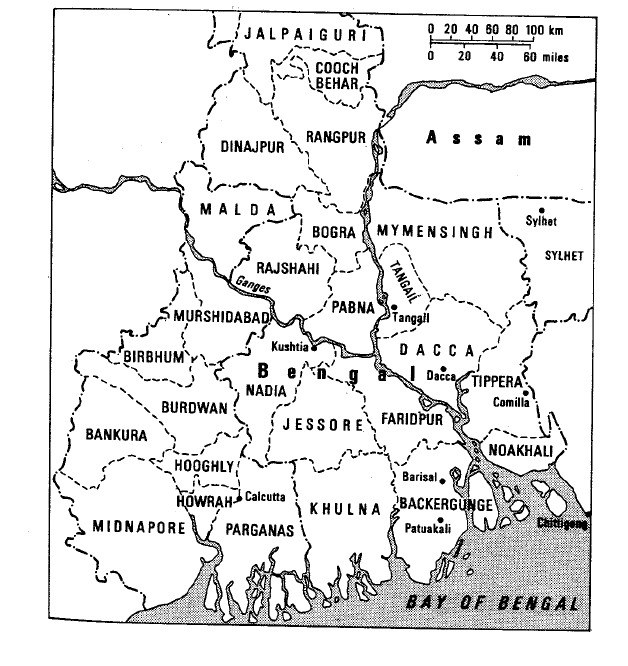
A 1945 map of Bengali districts as of 1943.
Famine Inquiry Commission (1945): Report on Bengal via Wikimedia Commons.
This argument was put forward by the BBC’s own Yogita Limaye, an Indian engineer and reporter on Women’s safety, based on the book Inglorious Empire by Shashi Tharoor, who was interviewed to give his opinion that Churchill was an “odious figure of reprehensible views and racist attitudes.”
No doubt the narrative of British evil and oppression is believed in India and elsewhere, but that does not make it true or worthy of the BBC reporting it as fact without any semblance of balance. The BBC failed its licence fee paying audience in two main regards, namely, conceptually and factually.
The British ruled India, one of the largest populations on earth, for well over two centuries. Good and bad things happened, just like everywhere else ever. You can join the dots to create whatever picture you like – Dr Tharoor chose the picture he wished to create. Why is the Bengal famine uniquely interesting to a BBC audience in 2020 over say a mini-series on British Railways and development in India? BBC presenters are demonstrably more interested in the first narrative: this is a major conceptual failing on their part. Being equal mixtures primitivism and solipsism. Always the borderline racist Western assumption is that “we” did things to “them”: we had agency, they were passive brutes. They are boring, we are endlessly interesting. Let’s talk about us. However even the slightest knowledge of the British-in-India teaches one that “we” did nothing without them. How on earth could we? There were famously few of us.
Yet it’s the second great BBC failing – over accuracy – which is so especially galling. On the actual allegation the BBC is plain wrong. Churchill was not responsible for the Bengal famine as any actual delving into the facts would have shown. Note well that they didn’t even try.
In 1943 Britain was at war with Japan, who were at the gates of India having occupied Burma, a major supplier of grain to Bengal. Important facts. Bengal was in the grips of a famine, nobody disputes that. But Churchill was not responsible, neither for the weather nor the agriculture nor the Japanese aggression.
Even the BBC did not allege that Churchill instigated the famine, the charge sheet is that he refused to help when he could. There were “stockpiles [of food] in the UK” and shipping which was retained in the northern hemisphere, prioritised for use there. Stockpiles of food in the UK in 1943? Even if there was the food and shipping, transporting US corned beef to Bengal would have been ludicrous. If there was shipping and protection from Japanese naval assault the food would have come from the rest of India. So why was food not transported from other parts of India to Bengal?
Prime Minister Winston Churchill greets Canadian PM William Lyon Mackenzie King, 1941.
Photo from Library and Archives Canada (reference number C-047565) via Wikimedia Commons.
July 22, 2020
QotD: Urban decline
Intelligent mayors could prevent, halt and perhaps reverse their city decline by paying more attention to efficiency than equity. That might be politically difficult. Regardless of any other goal, mayors must recognize that their first order of business is to retain what economists call net positive fiscal residue. That’s a fancy term for keeping those people in the city who put more into the city’s coffers, in the form of taxes, than they take out in services. To do that might require discrimination in the provision of city services — e.g., providing better street lighting, greater safety, nicer libraries, better schools and other amenities in more affluent neighborhoods.
As one example, many middle-class families leave cities because of poor school quality. Mayors and others who care about the viability of a city should support school vouchers. That way, parents who stay — and put a high premium on the education of their children — wouldn’t be faced with paying twice in order for their kids to get a good education, through property taxes and private school tuition. Some might protest that city service discrimination is unfair. I might agree, but it’s even more unfair for cities, once the magnets of opportunities for low-income people, to become economic wastelands.
Walter E. Williams, “A Mayor’s Most Important Job”, Townhall, 2018-04-18.
July 20, 2020
A lost nation that lasted for 300 years in (relative) peace and prosperity
I’d heard of the Khazar Khaganate occasionally, but didn’t know much about it until I read a useful summary by Lawrence W. Reed:
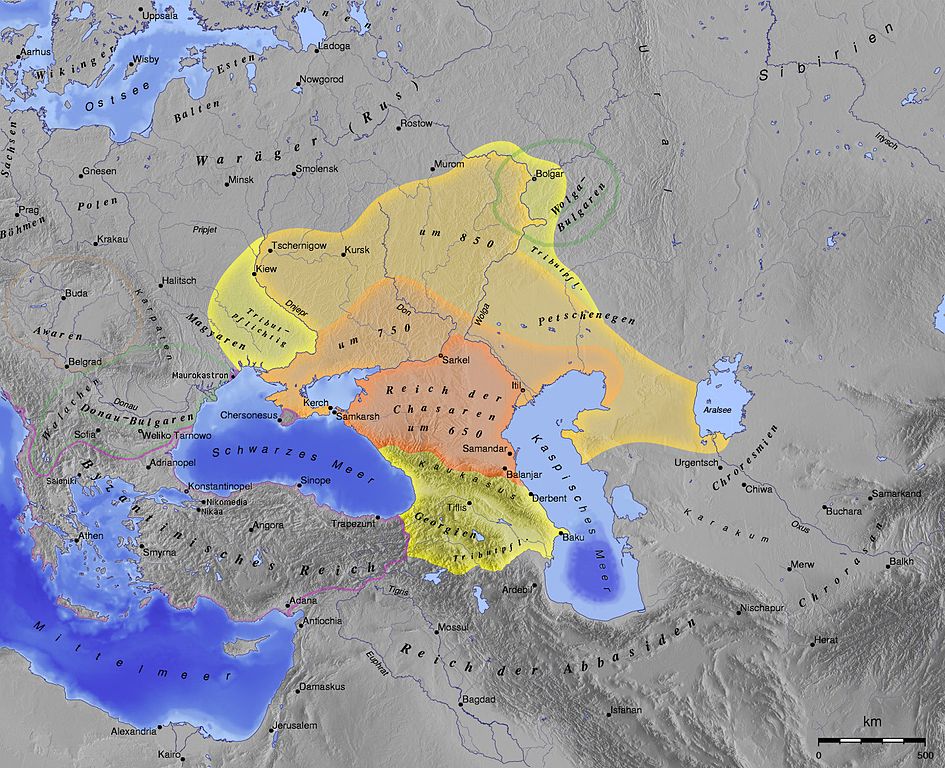
Borders of the Khazar Khaganate between 650 and 850 A.D.
Wikimedia Commons.
The list of extinct countries includes the better known ones like the USSR (aptly dubbed “the Evil Empire” by Ronald Reagan) and Yugoslavia, as well as hundreds of largely forgotten others like Majapahit, Assyria, Babylonia, Burgundy, and the Ottoman Empire. Far more countries are long gone, in fact, than the 195 on the map today. As a history lover, I’ve never yet discovered a country whose inhabitants’ experience was devoid of interesting facts and lessons.
Take Khazaria, for example. It lasted over 300 years (650 to 965 AD) and covered more territory than the combined Scandinavian nations of our time. It spanned the eastern half of modern-day Ukraine, the steppes of the Volga-Don region of present Russia, the entire Crimean Peninsula, and the northern Caucasus. Its southern portion took in most of the shorelines of three seas: the Black, the Caspian and the Aral.
It’s my thesis that for a country to be “successful” for a considerable period — success being defined loosely here as economically prosperous, politically stable, and militarily defensible — it must possess substantial TTD. That’s not a pronounceable acronym, unfortunately, but it stands for trade, tolerance and decentralization.
Each of these three criteria for success is worth volumes of discussion but here’s the nub of it: When economic freedom and private property exist, trade flourishes. And trade is what peaceful humans do to satisfy wants and improve material well-being. Choke it off and living standards plummet. Tolerance is a sign that people appreciate the benefits derived from diversity in personal choices. An intolerant people deprive themselves of what others can offer and waste time and resources fighting instead of collaborating. Decentralization preserves the rich identities of local communities and stymies the concentration of authority with its inevitable corruption. Power dispersed is power tamed.
So a successful country is one that can boast a lot of TTD. It encourages exchange, celebrates diversity and avoids top-down, political command-and-control. Almost every “failed state” in history did just the opposite by stifling commerce; stoking racial, ethnic or nationalistic hatred; and/or installing a dictatorship.
Khazaria, to its great credit, practiced remarkable measures of trade and tolerance and enough decentralization to prevent its government from sabotaging either one. In the end, it met its demise not from internal decay but from foreign assault.
QotD: Protectionists misunderstand the role of money
The Econ 101 teacher typically draws on the white board a diagram of two countries trading with each other. Country A is shown exporting (say) steel to country B in exchange for dollars, and then using those dollars to buy lumber from country B. The Econ 101 teacher informs his or her class that, while these exchanges are mediated by dollars, what ultimately is going on in this diagram is that the people of country A produce steel and send some of that steel to the people of country B because the people of country A want lumber from country B. Likewise, the people of country B produce lumber and send some of it to the people of country A because the people of country B want steel from country A. “The money that you see, class,” explains the Econ 101 teacher, “merely facilitates the exchange of steel for lumber. What’s important here is the getting of steel and of lumber. Money is a tool used by the people of country A to transform some of the steel they produce into lumber that they want to consume. Likewise, money is a tool used by the people of country B to transform some of the lumber they produce into steel that they want to consume.”
The protectionist thinks of this hypothetical two-country exchange entirely differently from the way that the Econ 101 teacher thinks of it. For the protectionist, the people of country A produce steel as a means of getting money; that is the ultimate goal. And the people of country B produce lumber as a means of getting money; that – the getting of money – is the ultimate goal. While for the Econ 101 teacher the two-country diagram that he or she draws is meant to show how money facilitates the ultimate acquisition by the peoples of each country of real goods, for the protectionist the diagram seems to show that the production of real goods is a means of facilitating the ultimate acquisition by the peoples of each country of money.
Don Boudreaux, “A Protectionist is Someone Who…”, Café Hayek, 2018-04-10.
July 18, 2020
“Agglomerationists” today and in the Middle Ages
In his latest Age of Invention newsletter, Anton Howes compares the views of today’s “urbanists” with the “agglomerationists” of the late Medieval period:
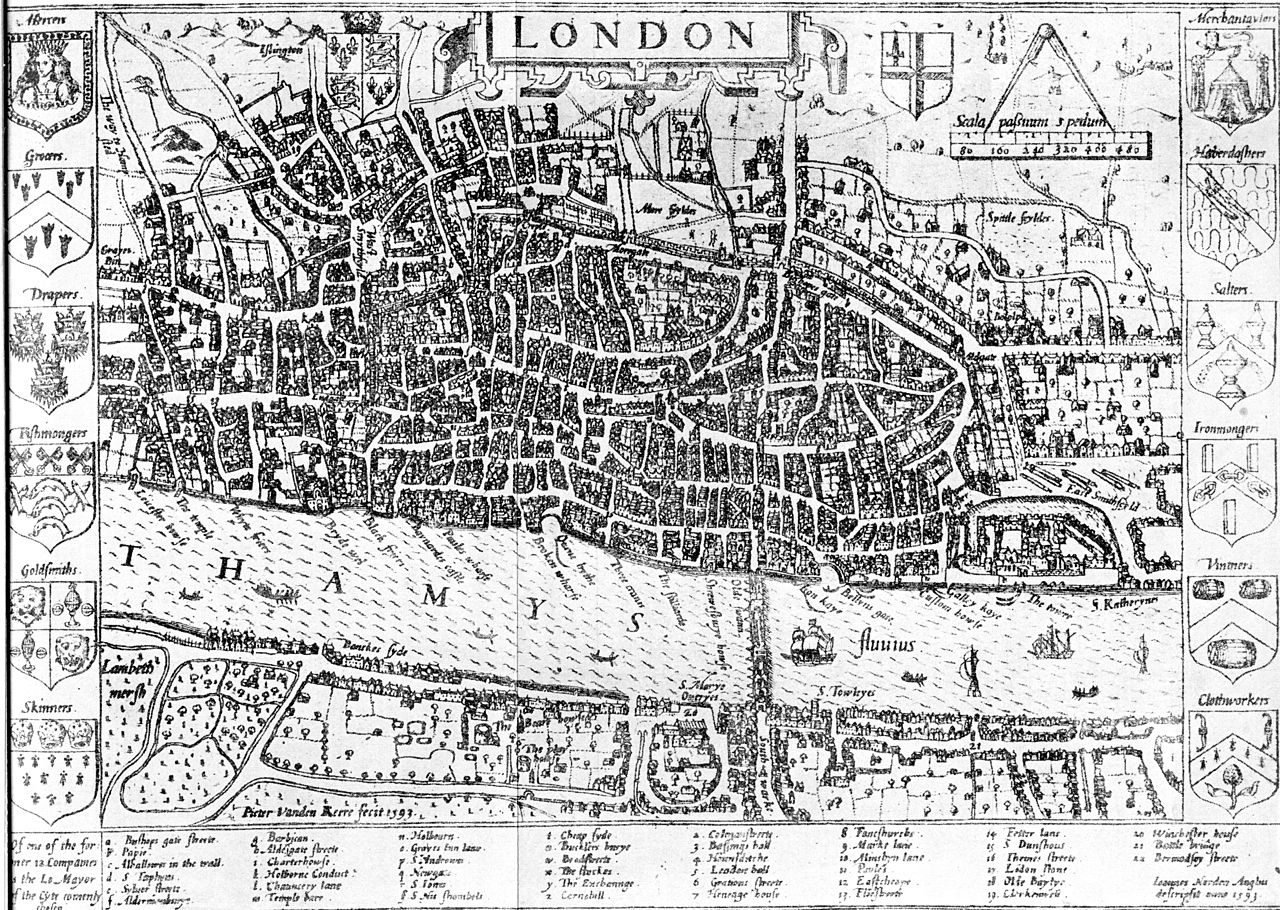
John Norden’s map of London in 1593. There is only one bridge across the Thames, but parts of Southwark on the south bank of the river have been developed.
Wikimedia Commons.
The other day, economic historian Tim Leunig tagged me into a comment on twitter with the line “intellectually I think the biggest change since settled agriculture was the idea that most people could live in cities and not produce food”. What’s interesting about that, I think, is the idea that this was not just an economic change, but an intellectual one. In fact, I’ve been increasingly noticing a sort of ideology, if one can call it that, which seemingly took hold in Britain in the late sixteenth century and then became increasingly influential. It was not the sort of ideology that manifested itself in elections, or even in factions, but it was certainly there. It had both vocal adherents and strenuous opponents, the adherents pushing particular policies and justifying them with reference to a common intellectual tradition. Indeed, I can think of many political and economic commentators who are its adherents today, whether or not they explicitly identify as such.
Today, the people who hold this ideology will occasionally refer to themselves as “urbanists”. They are in favour of large cities, large populations, and especially density. They believe strongly in what economists like to call “agglomeration effects” — that is, if you concentrate people more closely together, particularly in cities, then you are likely to see all sorts of benefits from their interactions. More ideas, more trade, more innovation, more growth.
Yet urbanism as a word doesn’t quite capture the full scope of the ideology. The group also heavily overlaps with natalists — people who think we should all have more babies, regardless of whether they happen to live in cities — and a whole host of other groups, from pro-immigration campaigners, to people setting up charter cities, to advocates of cheaper housing, to enthusiasts for mass transit infrastructure like buses, trams, or trains. The overall ideology is thus not just about cities per se — it seems a bit broader than that. Given the assumptions and aims that these groups hold in common, perhaps a more accurate label for their constellation of opinions and interests would be agglomerationism.
So much for today. What is the agglomerationist intellectual tradition? In the sixteenth century, one of the mantras that keeps cropping up is the idea that “the honour and strength of a prince consists in the multitude of the people” — a sentiment attributed to king Solomon. It’s a phrase that keeps cropping up in some shape or form throughout the centuries, and used to justify a whole host of agglomerationist policies. And most interestingly, it’s a phrase that begins cropping up when England was not at all urban, in the mid-sixteenth century — only about 3.5% of the English population lived in cities in 1550, far lower than the rates in the Netherlands, Italy, or Spain, each of which had urbanisation rates of over 10%. Even England’s largest city by far, London, was by European standards quite small. Both Paris and Naples were at least three times as populous (don’t even mention the vast sixteenth-century metropolises of China, or Constantinople).
Given their lack of population or density, English agglomerationists had a number of role models. One was the city of Nuremburg — through manufactures alone, it seemed, a great urban centre had emerged in a barren land. Another was France, which in the early seventeenth century seemed to draw in the riches to support itself through sheer exports. One English ambassador to France in 1609 noted that its “corn and grain alone robs all Spain of their silver and gold”, and warned that it was trying to create still new export industries like silk-making and tapestry weaving. (The English rapidly tried to do the same, though with less success.) France may not have been especially urban either, but Paris was already huge and on the rise, and the country’s massive overall population made it “the greatest united and entire force of any realm or dominion” in Christendom. Today, the population of France and Britain are about the same, but in 1600 France’s was about four times as large. Some 20 millions compared to a paltry 5. If Solomon was right, then England had a lot of catching up to do to even approach France in honour.
QotD: Peace can also be the health of the state
The story Bruno Nardi told made me think of the book that explains how peace is also the health of the state, namely Mancur Olson’s public choice theory classic, The Rise and Decline of Nations. It is years since I read this, but the story that this book tells is of the slow accumulation and coagulation of politics, at the expense of mere business, as the institutions of a hitherto thriving nation gang up together to form “distributional coalitions” (that phrase I do definitely recall). The point being that if you get involved in a war, and especially if you lose a war, the way Germany and Japan lost WW2, that tends to break up such coalitions.
The last thing on the mind of a German trade unionist or businessman, in 1946, was lobbying the government for regulatory advantages or for subsidies for his particular little slice of the German economy. Such people at that time were more concerned to obtain certificates saying that they weren’t Nazis, a task made trickier by the fact that most of them were Nazis. Olson’s way of thinking makes the post-war (West) German and then Japanese economic miracles, and the relative sluggishness of the British economy at that time, a lot more understandable. Winning a war, as Olson points out, is not nearly so disruptive of those distributional coalitions, in fact it strengthens them, as Crozier’s earlier posting illustrates.
Brian Micklethwait, “The view from Brazil is that peace is also the health of the state”, Samizdata, 2018-04-13.
July 15, 2020
Donald Shoup, the “Sir Isaac Newton of parking” or an “‘academic bottom-feeder’ who found a wonderful, rich ecological niche down there in the depths”
Colby Cosh, after taunting Ontarians yet again over our just-barely-past-Prohibition views on alcohol in public places, goes on to praise the work of UCLA economist Donald Shoup and his insights into the economics of parking:

“Parking meter FAIL” by kingdesmond1337 is licensed under CC BY-NC-SA 2.0


Parking — boring topic, ain’t it? Shoup latched onto it as a young-ish man because he was a follower of Henry George (1839-1897), the intriguing “single tax” economic theorist of the 19th century. George favoured a tax on the unimproved value of land parcels as a way of socializing pure rent (the value earned from occupying a mere location) and encouraging development. It is a concept that many economists still like, although it is potentially difficult to apply at scale. The widely used concept of tax increment financing is one example of Georgism in practice.
Shoup started out trying to fit parking spaces into the Georgist picture, but the boring topic was so underexamined that he found himself having to build a general theory of parking. He quantified the relationship between parking and traffic, finding that people “cruising” for parking spots were more destructive than anyone had imagined, and he inspired waves of research into the hidden market values of parking spots, which are rarely bought or sold in their own right. He happily describes himself as an “academic bottom-feeder” who found a wonderful, rich ecological niche down there in the depths.
Shoup has spent decades travelling the world and preaching against the concept of free parking, often meeting with bad-tempered resistance. Nevertheless, he has made a lot of headway in the world of urban planning. Any economist can see immediately how bundling a “free” parking space with an apartment or a job might be inefficient. The renter or homeowner has to pay a hidden extra cost for an amenity he might not choose to use, and the commuter is being given an incentive to drive to work — an incentive whose cash value he might prefer to keep. Shoup soon found, on empirical investigation, that most urban parking lots show signs of less-than-optimum use.
[…]
Of course, too little parking is as much of an efficiency problem as too much, which is why Shoup and his followers want parking to be priced wherever possible: if more is really needed, let a market create it. (To my eyes he has at least as much Hayek in him as Henry George.) In the era of Uber and smartphones, it is a lot easier to imagine a fully Shoupista world in which prices for parking spots update in real time and drivers look up prices at or near their destination before setting out.
QotD: State and private charity
Similarly with US aid to poorer countries. The United States is regularly berated for being very low on the list of aid givers, but this only applies to government-to-government aid. Once the private contributions made by Americans to people in poorer countries are counted in, the US rises to the top. In fact US private help is better spent, usually going to people to spend in towns and villages in the local economy, rather than on gold palaces and white elephant steel mills in the desert.
Part of this mismatch arises from the fact that these analysts seem to wear spectacles that admit only light of a political wavelength and ignore private generosity. The latest victim of this myopia is the “bank of mom and dad.” It is assumed to be a bad thing that young people should turn to mom and dad to help out with deposits and mortgages.
“Richard”, “Is Private Help a Bad Thing? – Political Spectacles of the Left”, Continental Telegraph, 2018-04-02.
July 9, 2020
QotD: Energy return on energy invested
To be valuable, any conversion technology must produce reliable, just-in-time power that greatly exceeds — by a factor of seven and upwards — the amount of energy that goes into its extraction, conversion and delivery to a consumer. It is this measure of productivity, EROEI (energy return on energy invested), that limits our choice.
By the EROEI criterion, biofuel is a disastrous choice, requiring about as much tractor fuel to grow as you get out in ethanol or biodiesel. Wind power has a low energy return, because its vast infrastructure is energetically costly and needs replacing every two decades or so (sooner in the case of the offshore turbines whose blades have just expensively failed), while backing up wind with batteries and other power stations reduces the whole system’s productivity. Geothermal too may struggle, because turning warm water into electricity entails waste. Solar power with battery storage also fails the EROEI test in most climates. In the deserts of Arabia, where land is nearly free, sunlight abundant and gas cheap, solar power backed up with gas at night may be cheap.
Fossil fuels have amply repaid their energy cost so far, but the margin is falling as we seek gas and oil from tighter rocks and more remote regions. Nuclear fission passes the EROEI test with flying colours but remains costly because of ornate regulation.
Matt Ridley, “Nuclear Fusion Could Provide Unlimited Energy”, HumanProgress, 2018-04-09.
July 8, 2020
QotD: Telecommuting in the post-Wuhan Coronavirus era
For two decades now, telecommuting and distance learning have been perfectly possible and even, frankly, beneficial. What has held it back is managers afraid they don’t know how to manage at a distance, corporations who think mega cubicle farms are a great way to be “important” and a general sense that only us, ne’er do wells, work in our pajamas on the sofa (I’ll have you know I’m wearing a sweatshirt and yoga pants. Never mind.)
If the panic lasts even two months (and the press will ensure it does before it collapses under its own weight) that reluctance to telecommute is going to be blown to hell. For one, once workers taste of THAT fruit, just anecdotally, 90% of them LOVE it. (The other 10% have very annoying children or spouses.)
And in the wake of the financial panic and wobbles, corporations are going to notice that they spend a lot less money when most of the workers work from home. At some point, they’ll also realize that they need much smaller facilities if they need facilities at all. And hey, money.
This will cause all sorts of other things, which I think will lead within two years to an exodus from the big cities everyone has crammed into because it’s where the jobs are. I think in turn this will lead to a world the social engineers really don’t like.
Sarah Hoyt, “Unintended Consequences”, According to Hoyt, 2020-03-12.
July 7, 2020
L. Neil Smith on the Progressive agenda
His latest article in the Libertarian Enterprise:
For the full length of the last century, Western culture has been commanded by the blind, deaf, but never speechless entities who see things stubbornly as they prefer to see them, and “dream the impossible dream”, rather than see them as they really are. This mental habit has led to various messes that we find ourselves in today. To any extent that it might help us to get out of those messes, it might help to understand how we got into them.
Don’t look to the wrong assistance. Psychology, for example, is nothing at all like a science and those who practice it are nothing at all like scientists. Mostly they’re hyper-opinionated liberals. No two shrinks ever agree on a diagnosis, and official definitions of various mental illnesses are a grammatical and logical laugh riot. The great truth of life is that understanding character is an art, best left to master novelists and story-tellers.
Although they’ll seldom admit it, even to themselves, so-called Progressives know by now that they are wrong, that they have always been wrong. You might say that their wrongness has stood the test of time. So what is it that they really want? Their high-flown theories and values having failed them embarrassingly — a good example of that is the minimum wage, which destroys employment for entry-level and minority youth — rather than seeking new theories and values that might serve them and everybody better, they have turned to a kind of bitter nihilism. They hate and fear the society that has stubbornly refused to bend to their wills, and so it must die. Every single policy recommendation that they make — like the $15 minimum wage, for example, or defunding the police — is directed to that purpose.
Another good example would be “gun control”, which its opponents correctly label “victim disarmament”. As unconstitutional political pressures on private gun ownership increased, and self-defense culture was forced to organize itself (contrary to liberal belief, gun companies and the National Rifle Association were followers in this, not leaders) existing gun laws were gradually weakened. It became easier to obtain and carry a weapon — and necessary, in the view of those of us “delorables” who were constantly being threatened by left-wing political figures. During the Obama-Biden regime, at least 100 million guns were sold. And as they were, violent criminality began to decrease in double digits.
Today, except for many liberal-dominated hell-holes like Chicago, New York, San Francisco, Atlanta, Baltimore, Detroit, and a dozen others, Americans are headed to 19th century crime levels. Did Progressives ever notice or admit that crime had diminished? They did not. The process conflicted with their erroneous belief system, so they still call today for various measures punishing firearms manufacturers and retailers, and disarming individuals who have solved the problem that the politicians and the police have only made much worse for decades.
And so it goes, in all such matters as economics, education, the environment, nutrition, and everything else. Psychologists (who, like a broken clock, are right just this once) call the phenomenon projection: if Progressives can’t run their own lives (and very largely, judging from the kids they raise, they can’t), naturally that makes them and the rest of the bizarre menagerie that was typical of the Obama-Biden Administration qualified to run everybody else’s lives. And because Progressive policies are (at least one hopes) unconsciously suicidal, the rest of us are in for a rough ride.
July 6, 2020
Cold War Two is upon us, but it’s not all Trump’s fault (believe it or not)
Niall Ferguson on the rapid drop in temperature in US/Chinese relations in the last eight years:
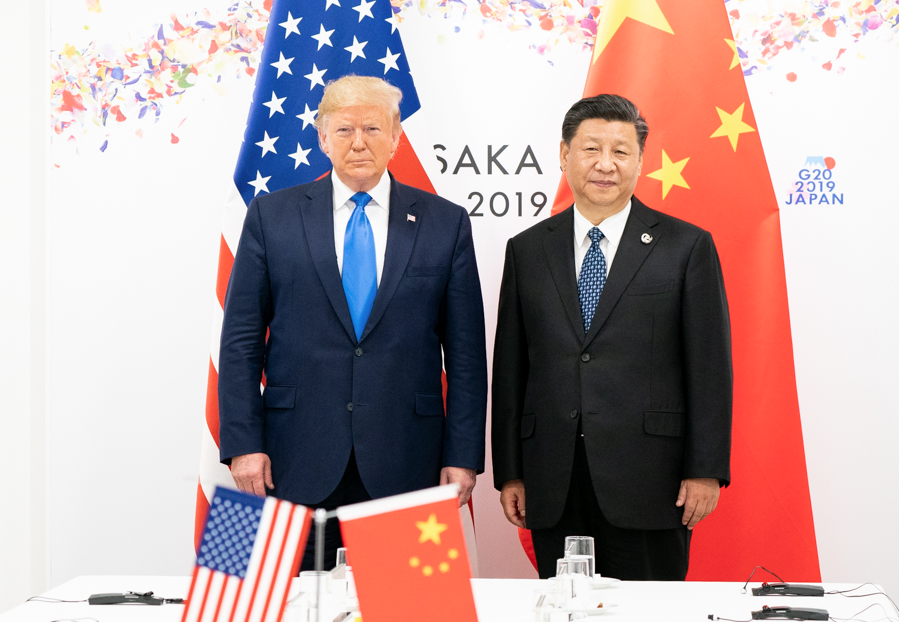
President Donald Trump and PRC President Xi Jinping at the G20 Japan Summit in Osaka, 29 June, 2019.
Cropped from an official White House photo by Shealah Craighead via Wikimedia Commons.
“We are in the foothills of a Cold War.” Those were the words of Henry Kissinger when I interviewed him at the Bloomberg New Economy Forum in Beijing last November.
The observation in itself was not wholly startling. It had seemed obvious to me since early last year that a new Cold War — between the U.S. and China — had begun. This insight wasn’t just based on interviews with elder statesmen. Counterintuitive as it may seem, I had picked up the idea from binge-reading Chinese science fiction.
First, the history. What had started out in early 2018 as a trade war over tariffs and intellectual property theft had by the end of the year metamorphosed into a technology war over the global dominance of the Chinese company Huawei Technologies Co. in 5G network telecommunications; an ideological confrontation in response to Beijing’s treatment of the Uighur minority in China’s Xinjiang region and the pro-democracy protesters in Hong Kong; and an escalation of old frictions over Taiwan and the South China Sea.
Nevertheless, for Kissinger, of all people, to acknowledge that we were in the opening phase of Cold War II was remarkable.
Since his first secret visit to Beijing in 1971, Kissinger has been the master-builder of that policy of U.S.-Chinese engagement which, for 45 years, was a leitmotif of U.S. foreign policy. It fundamentally altered the balance of power at the mid-point of the Cold War, to the disadvantage of the Soviet Union. It created the geopolitical conditions for China’s industrial revolution, the biggest and fastest in history. And it led, after China’s accession to the World Trade Organization, to that extraordinary financial symbiosis which Moritz Schularick and I christened “Chimerica” in 2007.
How did relations between Beijing and Washington sour so quickly that even Kissinger now speaks of Cold War?
The conventional answer to that question is that President Donald Trump has swung like a wrecking ball into the “liberal international order” and that Cold War II is only one of the adverse consequences of his “America First” strategy.
Yet that view attaches too much importance to the change in U.S. foreign policy since 2016, and not enough to the change in Chinese foreign policy that came four years earlier, when Xi Jinping became general secretary of the Chinese Communist Party. Future historians will discern that the decline and fall of Chimerica began in the wake of the global financial crisis, as a new Chinese leader drew the conclusion that there was no longer any need to hide the light of China’s ambition under the bushel that Deng Xiaoping had famously recommended.
July 5, 2020
History Summarized: Colonial India
Overly Sarcastic Productions
Published 4 Jul 2020Start your free trial at http://squarespace.com/overlysarcastic and use code
OVERLYSARCASTICto get 10% off your first purchase.Indian History has always been a story of peoples coming and going, but the subcontinent’s modern history takes that up to 11, with the arrival of Central Asian Mughals and boatloads of Europeans. See how India transforms from Medieval to Modern in this final act of our History of India.
SOURCES & Further Reading: The Discovery of India by Jawaharlal Nehru, A History of India by Michael H. Fisher (a lecture series by The Great Courses).
This video was edited by Sophia Ricciardi AKA “Indigo”. https://www.sophiakricci.com/
Our content is intended for teenage audiences and up.Special thanks to Varda Alighieri for coaching me through my (hopefully serviceable) pronunciations!
PATREON: https://www.Patreon.com/OSP
MERCH LINKS: https://www.redbubble.com/people/OSPY…
OUR WEBSITE: https://www.OverlySarcasticProductions.com
Find us on Twitter https://www.Twitter.com/OSPYouTube
Find us on Reddit https://www.Reddit.com/r/OSP/

July 4, 2020
The birth of the steam age
In the latest installment of his Age of Invention newsletter, Anton Howes explores the very early steam age in England:
Why was the steam engine invented in England? An awful lot hinges on this question, because the answer often depends on our broader theories of what caused the British Industrial Revolution as a whole. And while I never tire of saying that Britain’s acceleration of innovation was about much, much more than just the “poster boy” industries of cotton, iron, and coal, the economy’s transition to burning fossil fuels was still an unprecedented and remarkable event. Before the rise of coal, land traditionally had to be devoted to either fuel, food, or clothing: typically forest for firewood, fields for grain, and pastures for wool-bearing sheep. By 1800, however, English coal was providing fuel each year equivalent to 11 million acres of forest — an area that would have taken up a third of the country’s entire surface area, and which was many times larger than its actual forest. By digging downward for coal, Britain effectively increased its breadth.
And coal found new uses, too. It had traditionally just been one among many different fuels that could be used to heat homes, alongside turf, gorse, firewood, charcoal, and even cow dung. When such fuels were used for industry, they were generally confined to the direct application of heat, such as in baking bricks, evaporating seawater to extract salt, firing the forges for blacksmiths, and heating the furnaces for glass-makers. Over the course of the seventeenth century, however, coal had increasingly become the fuel of choice for both heating homes and for industry. Despite its drawbacks — it was sooty, smelly, and unhealthy — in places like London it remained cheap while the price of other fuels like firewood steadily increased. More and more industries were adapted to burning it. It took decades of tinkering and experimentation, for example, to reliable use coal in the smelting of iron.
3D animation of an aeolipile or Hero’s engine.
Animation by Michael Frey via Wikimedia Commons.Yet with the invention of the steam engine, the industrial uses of coal multiplied further. Although the earliest steam engines generally just sucked the water out of flooded mines, by the 1780s they were turning machinery too. By the 1830s, steam engines were having a noticeable impact on British economic growth, and had been applied to locomotion. Steam boats, steam carriages, steam trains, and steam ships proliferated and began to shrink the world. Rather than just a source of heat, coal became a substitute for the motive power of water, wind, and muscle.
So where did this revolutionary invention come from? There were, of course, ancient forms of steam-powered devices, such as the “aeolipile”. Described by Hero of Alexandria in the 1st century, the aeolipile consisted of a hollow ball with nozzles, configured in such a way that the steam passing into the ball and exiting through the nozzles would cause the ball to spin. But this was more like a steam turbine than a steam engine. It could not do a whole lot of lifting. The key breakthroughs came later, in the late seventeenth and early eighteenth centuries, and instead exploited vacuums. In a steam engine the main force was applied, not by the steam itself pushing a piston, but by the steam within the cylinder being doused in cold water, causing it to rapidly condense. The resulting partial vacuum meant that the weight of the air — the atmospheric pressure — did the real lifting work. The steam was not there to push, but to be condensed and thus pull. It saw its first practical applications in the 1700s thanks to the work of a Devon ironmonger, Thomas Newcomen.
Science was important here. Newcomen’s engine could never have been conceived had it not been for the basic and not at all obvious observation that the air weighed something. It then required decades of experimentation with air pumps, barometers, and even gunpowder, before it was realised that a vacuum could rapidly be created through the condensation of steam rather than by trying to suck the air out with a pump. And it was still more decades before this observation was reliably applied to exerting force. An important factor in the creation of the steam engine was thus that there was a sufficiently large and well-organised group of people experimenting with the very nature of air, sharing their observations with one another and publishing — a group of people who, in England, formalised their socialising and correspondence in the early 1660s with the creation of the Royal Society.

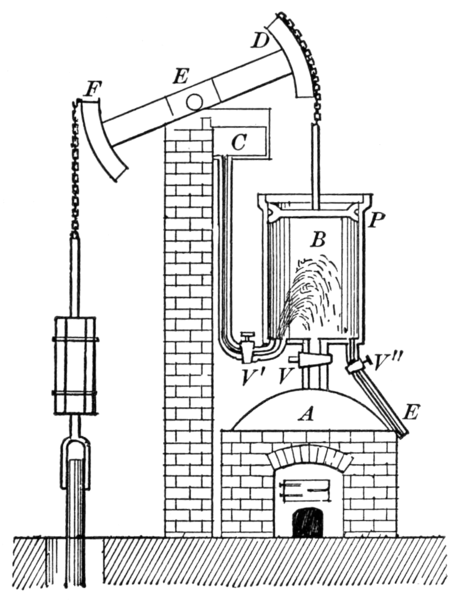
Newcomen’s Atmospheric Steam Engine. The steam was generated in the boiler A. The piston P moved in a cylinder B. When the valve V was opened, the steam pushed up the piston. At the top of the stroke, the valve was closed, the valve V’ was opened, and a jet of cold water from the tank C was injected into the cylinder, thus condensing the steam and reducing the pressure under the piston. The atmospheric pressure above then pushed the piston down again.
Original illustration from Practical Physics for Secondary Schools. Fundamental principles and applications to daily life, by Newton Henry Black and Harvey Nathaniel Davis, 1913, via Wikimedia Commons.


