
The explanation of the Great Enrichment is people. Paul Romer says so, as do a few others, among whom are some students I did not teach price theory to at the University of Chicago. On the other hand, Paul sets it down to economies of scale, which mysteriously drop down on England in the 18th century and gradually on us all. Yet China had peace, science, and enormous cities when Europeans were huddled in small groups inside town walls, or isolated villae.
In particular, it is ideas that people have for commercially tested betterment that matter. Consider alternating-current electricity, cardboard boxes, the little black dress, The Pill, cheap food, literacy, antibiotics, airplanes, steam engines, screw-making machines, railways, universities, cheap steel, sewers, plate glass, forward markets, universal literacy, running water, science, reinforced concrete, secret voting, bicycles, automobiles, limited access highways, free speech, washing machines, detergents, air conditioning, containerization, free trade, computers, the cloud, smart phones, and Bob Gordon’s favorite, window screens. …
And the Great Enrichment depended on the less famous [but] crucial multitudes of free lunches prepared by the alert worker and the liberated shopkeeper rushing about, each with her own little project for profit and pleasure. Sometimes, unexpectedly, the little projects became big projects, such as John Mackey’s one Whole Foods store in Austin, Texas resulting in 479 stores in the U.S. and the U.K., or Jim Walton’s one Walmart in Bentonville, Arkansas resulting in 11,718 stores worldwide.
Letting people “have a go” to implement such ideas for commercially tested betterment is the crux. It comes, in turn, from liberalism, Adam Smith’s “obvious and simple system of natural liberty”, “the liberal plan of [social] equality, [economic] liberty, and [legal] justice”. Liberalism permitted, encouraged, honored an ideology of “innovism” — a word preferable to the highly misleading word “capitalism,” with its erroneous suggestion that the modern world was and is initiated by piling up bricks and bachelors’ degrees.
Dierdre McCloskey, “How Growth Happens: Liberalism, Innovism, and the Great Enrichment (Preliminary version)” [PDF], 2018-11-29.
July 5, 2022
QotD: The Great Enrichment
July 4, 2022
(Very expensive) roads, bridges, and railways to nowhere
In Palladium, Brian Balkus wonders why American can’t build anything any more:

Construction of the Fresno River Viaduct in January 2016. The bridge is the first permanent structure being constructed as part of California High-Speed Rail. The BNSF Railway bridge is visible in the background.
Photo by the California High-Speed Rail Authority via Wikimedia Commons.
Sepulveda’s cost and schedule overrun aren’t even the worst of it. Just as unattainable as a shortened commute is the Californian dream of building a bullet train that could take you from Los Angeles to San Francisco in under three hours. In 2008, a year before the Sepulveda project began, the state tried to turn this dream into a reality after voters approved a 512-mile high-speed rail (HSR) project. Amid failing overseas wars and financial crises, at the time it could’ve become a symbol of renewal not just for California but the entire country. Instead, it came to exemplify a dysfunctional government that lacks the capacity to build.
At the time California began accelerating the development of its HSR system it only had 10 employees dedicated to overseeing what was the most expensive infrastructure project in U.S. history. It ended up 14 years (and counting) behind schedule and $44 billion over budget. Incredibly, the state has not laid a single mile of track and it still lacks 10 percent of the land parcels it needs to do so. Half of the project still hasn’t achieved the environmental clearance needed to begin construction. The dream of a Japanese-style bullet train crisscrossing the state is now all but dead due to political opposition, litigation, and a lack of funding.
Despite its failure, the HSR project inaugurated the U.S.’s megaproject era. Once a rare type of project, by 2018 megaprojects comprised 33 percent of the value of all U.S. construction project starts. An alarming number of these have spiraled out of control for many of the same reasons that killed the California bullet train. The decade that followed the financial crisis was a kind of inflection point in the industry; this was when construction projects became noticeably worse and when the long-term implications could no longer be ignored. One of the most cited studies of the U.S.’s declining ability to build reviewed 180 transit megaprojects across the country, revealing that today, U.S. projects take longer to complete and cost nearly 50 percent more on average than those in Europe and Canada.
Having joined Kiewit in 2010, I witnessed these changes first-hand. I have since moved on, but have remained in the broader industry, including working on what are called “strategic pursuits” — the process by which companies compete for megaprojects. This experience has provided insight into the mechanics of how these projects are awarded and why they so frequently fail.
Even if the construction had proceded close to schedule, the economic justification for California’s high speed rail line was never strong … and it’s unlikely the service would have come close to breaking even. It almost certainly would have added significant ongoing costs to Californian taxpayers, and due to the nature of high speed rail services, been effectively a subsidy from working-class Californians to the laptop elites of Los Angeles and the San Francisco Bay area.
All of that, however, are merely additional reasons to believe the project was doomed from inception. Broadly speaking, all major infrastructure projects in the United States are struggling with paperwork and compliance requirements mostly driven by state and federal environmental regulations passed with the best possible intentions (as the saying goes):
Sepulveda’s numerous lawsuits and stakeholder conflicts are an example of a phenomenon that can be traced back to the passage of the National Environmental Policy Act (NEPA) in 1969. NEPA mandates developers to provide environmental impact statements before they can obtain the permits necessary for construction on huge swathes of infrastructure.
Shortly following the passage of NEPA, California’s then-governor Ronald Reagan signed the California Environmental Quality Act (CEQA) into law, which required additional environmental impact analysis. Unlike NEPA, it requires adopting all feasible measures to mitigate these impacts. Interest groups wield CEQA and NEPA like weapons. One study found that 85 percent of CEQA lawsuits were filed by groups with no history of environmental advocacy. The NIMBY attitude of these groups has crippled the ability of California to build anything. As California Governor Gavin Newsom succinctly put it, “NIMBYism is destroying the state”.
It is also destroying the U.S.’s ability to build nationally. The economist Eli Dourado reported in The New York Times that “per-mile spending on the Interstate System of Highways tripled between the 1960’s and 1980’s.” This directly correlates with the passage of NEPA. If anything, the problem has gotten worse over time. Projects receiving funding through the $837 billion stimulus plan passed by Congress in the aftermath of the financial crises were subject to over 192,000 NEPA reviews.
The NEPA/CEQA process incentivizes the public agencies to seek what is often termed a “bulletproof” environmental compliance document to head off future legal challenges. This takes time, with the average EIS taking 4.5 years to complete. Some have taken longer than a decade. A cottage industry of consultants is devoted to completing these documents, earning themselves millions in fees.
July 1, 2022
Trust “the experts”
Chris Bray on the appalling track record of so many of our modern-day “experts”:
So the public health experts are baffled by the consistent failure of their predictive models, and the economic experts are baffled by the consistent failure of their predictive models. It’s like a chef who keeps trying to grill a steak, only to find that he’s burnt another lemon pie. “I SWEAR TO GOD I THOUGHT THIS ONE WAS A BEEF THING.”
These people aren’t stupid, but they’re stupid in practice because they show up to the game with the weight of what they know people in their position are supposed to say and think. Fashionable experts, in-group leaders in their status-compliant position in a field, aren’t reviewing the evidence — ever — but are instead reviewing a performative checklist dotted with social status land mines.
They’re on a team, so they say the team slogans.
[…]
If that’s how expertise works, we no longer have have any. We have actors who play the brow-furrowing expert role, but have no real job beyond intoning the message of the day. It says on this card that we recommend even more Covid vaccines for everyone. Let’s break for lunch!
But, mercifully, that’s not invariably how expertise works. And this is why politicians and trend-policing media figures are so completely baffled by experts like Robert Malone or Ryan Cole, or Geert Vanden Bossche or Clare Craig or Peter McCullough, experts who follow the evidence wherever it goes. Tone and social reception tells you a lot: Does an expert say things that aren’t comforting, that sound a little … not on the team? That person clears the first barrier, and you can start assessing the specifics of what they say. Look for journalists who are offended and triggered, and try to find the person who hurt their feelings. That person may turn out to be wrong, but he won’t turn out to be Paul Krugman wrong.
QotD: The CBC doesn’t want to do economic journalism
Stephen F. Gordon, Twitter, 2019-05-06.
June 28, 2022
QotD: The economic pie fallacy
When wealth is talked about in this context, it is often described as a pie. “You can’t make the pie larger,” say politicians. When you’re talking about the amount of money in one family’s bank account, or the amount available to a government from one year’s tax revenue, this is true. If one person gets more, someone else has to get less.
I can remember believing, as a child, that if a few rich people had all the money, it left less for everyone else. Many people seem to continue to believe something like this well into adulthood. This fallacy is usually there in the background when you hear someone talking about how x percent of the population have y percent of the wealth. If you plan to start a startup, then whether you realize it or not, you’re planning to disprove the Pie Fallacy.
What leads people astray here is the abstraction of money. Money is not wealth. It’s just something we use to move wealth around. So although there may be, in certain specific moments (like your family, this month) a fixed amount of money available to trade with other people for things you want, there is not a fixed amount of wealth in the world. You can make more wealth. Wealth has been getting created and destroyed (but on balance, created) for all of human history.
Suppose you own a beat-up old car. Instead of sitting on your butt next summer, you could spend the time restoring your car to pristine condition. In doing so you create wealth. The world is — and you specifically are — one pristine old car the richer. And not just in some metaphorical way. If you sell your car, you’ll get more for it.
In restoring your old car you have made yourself richer. You haven’t made anyone else poorer. So there is obviously not a fixed pie. And in fact, when you look at it this way, you wonder why anyone would think there was. *
Kids know, without knowing they know, that they can create wealth. If you need to give someone a present and don’t have any money, you make one. But kids are so bad at making things that they consider home-made presents to be a distinct, inferior, sort of thing to store-bought ones — a mere expression of the proverbial thought that counts. And indeed, the lumpy ashtrays we made for our parents did not have much of a resale market.
* In the average car restoration you probably do make everyone else microscopically poorer, by doing a small amount of damage to the environment. While environmental costs should be taken into account, they don’t make wealth a zero-sum game. For example, if you repair a machine that’s broken because a part has come unscrewed, you create wealth with no environmental cost.
Paul Graham, “How to Make Wealth”, Paul Graham, 2004-04.
June 25, 2022
The Public Choice Model in … grand strategy?
One of the readers of Scott Alexander’s Astral Codex Ten has contributed a review of Public Choice Theory and the Illusion of Grand Strategy by Richard Hanania. This is one of perhaps a dozen or so anonymous reviews that Scott publishes every year with the readers voting for the best review and the names of the contributors withheld until after the voting is finished:
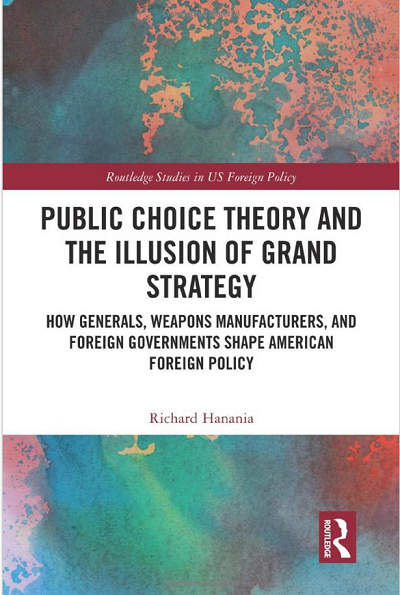
[In Public Choice Theory And The Illusion Of Grand Strategy], Richard Hanania details how a public choice model (imported from public choice theory in economics) can explain the United States’ incoherent foreign policy much better than the unitary actor model (imported from rational choice theory in economics) that underlies the illusion of American grand strategy in international relations (IR), in particular the dominant school of realism. As the subtitle “How Generals, Weapons Manufacturers, and Foreign Governments Shape American Foreign Policy” suggests, American foreign policy is driven by special interest groups, which results in millions of deaths for no good reason.
In the unitary actor model, the primary unit of analysis of inter-state relations is the state as a monolithic agent capable of making rational decisions (forming coherent, long-term “grand strategy”) from cost-benefit analysis based on preference ranking and expected “national interest” maximisation.
In the public choice model, small special-interest groups that reap a large proportion of the benefits from a policy (concentrated interests) are much more incentivised to lobby for a policy than the general public who pay for a negligible portion of the cost of the policy (diffused interests) are incentivised to lobby against. The former can coordinate much easier than the latter that has to overcome rational ignorance (the cost of educating oneself about foreign policy outweighs any benefit an one can expect to gain as individual citizens cannot affect foreign policy) and the society-wide collective action problem (irrational for every citizen to cooperate in the prisoner’s dilemma especially if individual gain is negligible) resulting in inefficient (not-public-good-maximising) policymaking i.e. government failure.
And more specifically on the use of Public Choice Theory:
Public choice theory was developed to understand domestic politics, but Hanania argues that public choice is actually even more useful in understanding foreign policy.
First, national defence is “the quintessential public good” in that the taxpayers who pay for “national security” compose a diffuse interest group, while those who profit from it form concentrated interests. This calls into question the assumption that American national security is directly proportional to its military spending (America spends more on defence than most of the rest of the world combined).
Second, the public is ignorant of foreign affairs, so those who control the flow of information have excess influence. Even politicians and bureaucrats are ignorant, for example most(!) counterterrorism officials — the chief of the FBI’s national security branch and a seven-term congressman then serving as the vice chairman of a House intelligence subcommittee, did not know the difference between Sunnis and Shiites. The same favoured interests exert influence at all levels of society, including at the top, for example intelligence agencies are discounted if they contradict what leaders think they know through personal contacts and publicly available material, as was the case in the run-up to the Iraq War.
Third, unlike policy areas like education, it is legitimate for governments to declare certain foreign affairs information to be classified i.e. the public has no right to know. Top officials leaking classified information to the press is normal practice, so they can be extremely selective in manipulating public knowledge.
Fourth, it’s difficult to know who possesses genuine expertise, so foreign policy discourse is prone to capture by special interests. History runs only once — the cause and effect in foreign policy are hard to generalise into measurable forecasts; as demonstrated by Tetlock’s superforecasters, geopolitical experts are worse than informed laymen at predicting world events. Unlike those who have fought the tobacco companies that denied the harms of smoking, or oil companies that denied global warming, the opponents of interventionists may never be able to muster evidence clear enough to win against those in power with special interests backing.
Hanania’s special interest groups are the usual suspects: government contractors (weapons manufacturers [1]), the national security establishment (the Pentagon [2]), and foreign governments [3] (not limited to electoral intervention).
What doesn’t have comparable influence is business interests as argued by IR theorists. Unlike weapons manufacturers, other business interests have to overcome the collective action problem, especially when some businesses benefit from protectionism. By interfering in a foreign state, the US may build a stable capitalist system propitious for multinationals, but can conversely cause a greater degree of instability and make it impossible to do business there; when business interests are unsure what the impact of a foreign policy will be for their bottom line, they should be more likely to focus their lobbying efforts elsewhere.
June 16, 2022
QotD: The Guardian and “capitalism”
It’s practically a rule. If a Guardian contributor drinks too much, eats too much, buys too many shoes … well, obviously, they’re the victim because consumerist peer pressure somehow made them do it against their will, such as it is. The premise is generally “capitalism made me fat”, followed by “capitalism made me anxious about being fat”, followed by “tax such-and-such to buggery, or ban it altogether, and then I’ll be thin”.
David Thompson, from the comments to “Reheated (55)”, DavidThompson.com, 2019-04-01.
June 15, 2022
QotD: The gobsmacking magnitude of “The Great Enrichment”
The exactitude, of course, is inessential. In Japan and Finland it was roughly the factor of 30. But it could be the worldwide factor since 1800 of 10 only, about $2 or $3 to $30 a day (to $10,000 a year, the level of Brazil now, to fix ideas), and still be utterly novel. As a Brit might say, the Great Enrichment was gobsmacking.
The enrichment was actually much greater than the factor of 30, because price indices, especially recently, do not adequately reflect improvements in quality, as was determined in the early 1990s by the Boskin Commission … Consider your cell phone, your auto tires, your medical treatment — all greatly better, recently. Even economic facts and analyses are better. (Well, sometimes.) The downward bias from inadequately deflating money prices for improved quality is not far from 2% per year, which would double recent growth rates in the rich countries.
Its magnitude, novelty, recency, and location are all crucial to explaining the Great Enrichment, because together they strongly suggest that there was something deeply peculiar about Britain in the 18th century, and that afterwards the peculiarity spread to the rest of the world. Such facts make “run-up” theories such as in Stephen Broadberry et alii look implausible, because they depend on a metaphor of an airplane taking off, with little else by way of explanation for why the Industrial Revolution (a factor of 2) happened or, especially, its follow-on the Great Enrichment (a factor of 20 or 30). Likewise, it is dubious to attach the Great Enrichment to remote causes within Europe, such as the Black Death — which originated in China, with similar terrors, and yet yielded no Great Enrichment there. Also dubious is the Eurocentric belief, prominent in conservative circles, of some ancient superiority of melanin-challenged Volk back in the Black Forest. (Did you know, for example, that all European countries had common law in the Middle Ages, that is, judge-found-and-made, not legislated or codified?)
The Great Enrichment is the second most important secular event in human history, second only to the domestication of plants and animals making for cities and literacy.
Dierdre McCloskey, “How Growth Happens: Liberalism, Innovism, and the Great Enrichment (Preliminary version)” [PDF], 2018-11-29.
June 14, 2022
QotD: Generation snowflake
So no, no surprises here. Their collective personality makes the Millennials unusually suited for the flirtation with socialism. They are a great match; if this was Tinder, Marx would be getting super liked all the time.
Socialism is the response of a spoiled child when faced with the world that does not genuflect to its every wish the way their parents did – the world as it is must therefore be evil and has to be changed to something radically different. Gen Y, of course, did not just magically became the way they are – they were brought up like that, so we all bear the blame and the responsibility for a generation who resents not being managers in their 20s and not being recognised as special anymore by all their elders. Clearly, the capitalism has failed when I’m not showered down with money after I graduate from my double in media and gender studies.
Arthur Chrenkoff, “Socialism as a Millennial religion”, The Daily Chrenk, 2019-02-19.
June 11, 2022
QotD: Modern disposable clothing
Pietra Rivoli, The Travels of a T-Shirt in the Global Economy, 2015.
June 10, 2022
Don’t think of it as “Shrinkflation” … think of it as corporations helpfully trying to help you lose weight (at the same or higher prices)
Companies have several different ways to cope with rising input prices, including just swallowing the increases without passing them on to consumers … stop laughing, I mean it’s at least theoretically possible, right? They can also just hike retail prices, which we’ve seen a fair bit of already, but that sometimes agitates consumers enough to materially depress sales. A sneakier way, which we’re also seeing a lot of, is to shrink the product but sell it for the same price. Sometimes, it will take a while for people to notice they’re getting less than they used to:

Original image from www.marpat.co.uk
The rise in consumer prices has rightly received a great deal of attention, as inflation hovers around 40-year highs. Everyone can see that virtually everything is getting more expensive, but fewer have noticed that many items are also getting smaller.
On Wednesday the Associated Press ran an article under the headline “No, you’re not imagining it — package sizes are shrinking.”
The AP spoke to one shopper, Alex Aspacher, who does a lot of shopping for his family of four in Ohio. He noticed he was still paying $9.99 for Swiss cheese even though the package had shrunk from a pound to 12 ounces.
“I was prepared for it to a degree, but there hasn’t been a limit to it so far,” Aspacher told the AP. “I hope we find that ceiling pretty soon.”
This phenomenon — known as “shrinkflation” — is nothing new, of course. It’s just more pronounced now than in any time in recent memory because inflation is much higher.
But what exactly is shrinkflation? As economist Peter Jacobsen explained last year, it’s simply a different kind of inflation.
“Shrinkflation is a form of inflation because you’d have to spend more money to get the same quantity or quality as you did in a previous year,” he explained. “The prices have remained the same, but the products are worse.”
The only difference is, instead of raising the price of an item or service, businesses are reducing the quantity or quality of it while keeping the price the same.
Edgar Dworsky, a consumer advocate who has tracked shrinkflation for decades, told the AP shrinkflation is rampant at the moment because of the underlying economic conditions.
“It comes in waves,” said Dworsky. “We happen to be in a tidal wave at the moment because of inflation.”
June 4, 2022
Bill C-18 might as well be called the “Keep legacy media alive at all costs, even if nobody wants it anymore” act
The Line‘s Jen Gerson lays out the case against the federal government’s plans for permanent corporate welfare for the big Canadian legacy media organizations:

How Jen Gerson might visualize Torstar and Postmedia during the lobbying effort for Bill C-18.
“Zombie nuns” by Michael Cavén is licensed under CC BY-NC-SA 2.0 


This week, The Line signed on to a campaign put together by a coalition of independent media publishers calling for amendments to the panda trash fodder piece of legislation known as C-18. To be fair, I mostly signed on; my co-founder Matt Gurney had some reservations, and I figured it would be best to hash them out in full here.
The bill is a hot mess created by a clearly well-intentioned government that appears to have been bamboozled by a group of media industry lobbyists helmed by organizations like Postmedia and Torstar — companies that despite extraordinary history and resources have largely failed to sustainably transition to a digital media environment. These large outlets are now using the last of their dying power and influence to champion legislation that will force big technology companies like Facebook and Google to compensate them for linking to their content.
This is a straightforward case of regulatory capture, the very thing we would condemn in any other industry; big media companies are using their credibility and political power to pressure the government into forcing “Big Tech” to sustain their dying business models — the very “Big Tech” that they’ve spent years deriding and defaming in their very own newspapers and outlets.
This whole process is corrupt. I don’t say that lightly. Perhaps inevitably, I’ve grown totally disillusioned with the industry to which I have devoted all of my adult life. We used to consider journalism a calling or a vocation — manipulative terms that justified the low pay, harassment, and sometimes abusive management. How can the church of journalism and its holy mandate to preserve democracy continue to take itself seriously when the very catechism of the craft are nowhere present in its own self-created lobbying arm, New Media Canada?
I think the leaders of this initiative have convinced themselves that the business model they enjoyed in the ’80s and ’90s is so totally central to the survival of democracy and liberal values that they’ve committed to keeping it afloat by any means necessary regardless of the ethical and philosophical cost. In doing so, I believe that they’re only ensuring their own failure.
By driving legislation in this way, they are not proving their worth to the broader public. Rather, they are conceding that what they produce has so little value that they need to evolve into parasites of the state. It demonstrates that commitment to democracy and accountability is secondary to their primary functions; running a business. They have stockholders to please and interest on loans to pay. Big loans.
Meanwhile, the legacy media they have managed is little more than a zombie in nun’s drag. It is in a state of terminal decline, and keeping it alive poisons the earth for the generations to come after.
June 2, 2022
“Like many problems in American history, recycling began as a moral panic”
Jon Miltimore recounts the seminal event that kicked off the recycling pseudo-religion in North America:

The frenzy began in the spring of 1987 when a massive barge carrying more than 3,000 tons of garbage — the Mobro 4000 — was turned away from a North Carolina port because rumor had it the barge was carrying toxic waste. (It wasn’t.)
“Thus began one of the biggest garbage sagas in modern history,” Vice News reported in a feature published a quarter-century later, “a picaresque journey of a small boat overflowing with stuff no one wanted, a flotilla of waste, a trashier version of the Flying Dutchman, that ghost ship doomed to never make port.”
The Mobro was simply seeking a landfill to dump the garbage, but everywhere the barge went it was turned away. After North Carolina, the captain tried Louisiana. Nope. Then the Mobro tried Belize, then Mexico, then the Bahamas. No dice.
“The Mobro ended up spending six months at sea trying to find a place that would take its trash,” Kite & Key Media notes.
America became obsessed with the story. In 1987 there was no Netflix, smartphones, or Twitter, so apparently everyone just decided to watch this barge carrying tons of trash for entertainment. The Mobro became, in the words of Vice, “the most watched load of garbage in the memory of man.”
The Mobro also became perhaps the most consequential load of garbage in history.
“The Mobro had two big and related effects,” Kite & Key Media explains. “First, the media reporting around it convinced Americans that we were running out of landfill space to dispose of our trash. Second, it convinced them the solution was recycling.”
Neither claim, however, was true.
The idea that the US was running out of landfill space is a myth. The urban legend likely stems from the consolidation of landfills in the 1980s, which saw many waste depots retired because they were small and inefficient, not because of a national shortage. In fact, researchers estimate that if you take just the land the US uses for grazing in the Great Plains region, and use one-tenth of one percent of it, you’d have enough space for America’s garbage for the next thousand years. (This is not to say that regional problems do not exist, Slate points out.
The widespread imposition of recycling mandates across North America was probably an inevitable reaction to the voyage of the Mobro. For many people, this was the end of the story, as things that were previously just buried in landfill sites would now be safely and efficiently put back into the economy as re-used, re-purposed, or actual recycled products. Win-win, right?
Sadly, the economic case for recycling many items is weak to non-existant. The demand for recycled materials was lower than predicted and often only maintained through subsidies and hidden incentives that couldn’t last forever. Once the incentives went away, so did much of the created demand. Worse, the way a lot of the stream of recyclable materials was handled was by shipping it off to China or certain developing nations — in effect, paying them to take the problem off the hands of western governments. This resulted in even more problems:
Americans who’ve spent the last few decades recycling might think their hands are clean. Alas, they are not. As the Sierra Club noted in 2019, for decades Americans’ recycling bins have held “a dirty secret”.
“Half the plastic and much of the paper you put into it did not go to your local recycling center. Instead, it was stuffed onto giant container ships and sold to China,” journalist Edward Humes wrote. “There, the dirty bales of mixed paper and plastic were processed under the laxest of environmental controls. Much of it was simply dumped, washing down rivers to feed the crisis of ocean plastic pollution.”
It’s almost too hard to believe. We paid China to take our recycled trash. China used some and dumped the rest. All that washing, rinsing, and packaging of recyclables Americans were doing for decades — and much of it was simply being thrown into the water instead of into the ground.
The gig was up in 2017 when China announced they were done taking the world’s garbage through its oddly-named program, Operation National Sword. This made recycling much more expensive, which is why hundreds of cities began to scrap and scale back operations.
May 30, 2022
Technocratic meddling in developing countries at the local level
One of the readers of Scott Alexander’s Astral Codex Ten has contributed a review of James Ferguson’s The Anti-Politics Machine. The reviewer looked at a few development economics stories that illustrate some of the more common problems western technocrats encounter when they provide their “expert advice” to people in developing countries. This is one of perhaps a dozen or so anonymous reviews that Scott publishes every year with the readers voting for the best review and the names of the contributors withheld until after the voting is finished:
But even if the project was in some sense a “failure” as an agricultural development project, it is indisputable that many of its “side effects” had a powerful and far-reaching impact on the Thaba-Tseka region. […] Indeed, it may be that in a place like Mashai, the most visible of all the project’s effects was the indirect one of increased Government military presence in the region
As the program continued to unfold, the development officials became more and more disillusioned — not with their own choices, but with the people of Thaba-Tseka, who they perceived as petty, apathetic, and outright self-destructive. A project meant to provide firewood failed because locals kept breaking into the woodlots and uprooting the saplings. An experiment in pony-breeding fell apart when “unknown parties” drove the entire herd of ponies off of cliffs to their deaths. Why, Ferguson’s official contacts bemoaned, weren’t the people of Thaba-Tseka committed to their own “development”?
Who could possibly be opposed to trees and horses? Perhaps, the practitioners theorized, the people of Thaba-Tseka were just lazy. Perhaps they “didn’t want to be better”. Perhaps they weren’t in their right mind or had made a mistake. Perhaps poverty makes a person do strange things.
Or, as Ferguson points out, perhaps their anger had something to do with the fact that the best plots of land in the village had been forcibly confiscated to make room for wood and pony lots, without any sort of compensation. The central government was all too happy to help find land for the projects, which they took from political enemies and put in the control of party elites, especially when it could use a legitimate anti-poverty program as cover. In Ferguson’s words, the development project was functioning as an “anti-politics machine” the government could use to pretend political power moves were just “objective” solutions to technical problems.
A local student’s term paper captured the general discontent:
In spite of the superb aim of helping the people to become self-reliant, the first thing the project did was to take their very good arable land. When the people protested about their fields being taken, the project promised them employment. […] It employed them for two months, found them unfit for the work, and dismissed them. Without their fields and without employment they may turn up to be very self-reliant. It is rather hard to know.
Two things stand out to me from this story. First, the “development discourse” lens served to focus the practitioners’ attention on a handful of technical variables (quantity of wood, quality of pony), and kept them from thinking about any repercussions they hadn’t thought to measure.
This is a serious problem, because “negative effects on things that aren’t your primary outcome” are pretty common in the development literature. High-paying medical NGOs can pull talent away from government jobs. Foreign aid can worsen ongoing conflicts. Unconditional cash transfers can hurt neighbors who didn’t receive the cash. And the literature we have is implicitly conditioned on “only examining the variables academics have thought to look at” — surely our tools have rendered other effects completely invisible!
Second, the project organizers somewhat naively ignored the political goals of the government they’d partnered with, and therefore the extent to which these goals were shaping the project.
Lesotho’s recent political history had been tumultuous. The Basotho Nationalist Party (BNP), having gained power upon independence in 1965, refused to give up power after losing the 1970 elections to the Basotho Congress Party (BCP). Blaming the election results on “communists”, BNP Prime Minister Leabua Jonathan declared a state of emergency and began a campaign of terror, raiding the homes of opposition figures and funding paramilitary groups to intimidate, arrest, and potentially kill anyone who spoke up against BNP rule.
This had significant effects in Thaba-Tseka, where “villages […] were sharply divided over politics, but it was not a thing which was discussed openly” due to a fully justified fear of violence. The BNP, correctly sensing the presence of a substantial underground opposition, placed “development committees” in each village, which served primarily as local wings of the national party. These committees spied on potential supporters of the now-outlawed BCP and had deep connections to paramilitary “police” units.
When the Thaba-Tseka Development Project started, its international backers partnered directly with the BNP leadership, reasoning that sustainable development and public goods provision could only happen through a government whose role they primarily viewed as bureaucratic. As a result, nearly every decision had to make its way through the village development committees, who used the project to pursue their own goals: jobs and project funds found their way primarily to BNP supporters, while the “necessary costs of development” always seemed to be paid by opposition figures.
The funding coalition ended up paying for a number of projects that reinforced BNP power, from establishing a new “district capital” (which conveniently also served as a military base) to constructing new and better roads linking Thaba-Tseka to the district and national capitals (primarily helping the central government tax and police an opposition stronghold). Anything that could be remotely linked to “economic development” became part of the project as funders and practitioners failed to ask whether government power might have alternate, more concerning effects.
As we saw earlier, the population being “served” saw this much more clearly than the “servants”, and started to rebel against a project whose “help” seemed to be aimed more at consolidating BNP control than meeting their own needs. When they ultimately resorted to killing ponies and uprooting trees, project officials infatuated with “development” were left with “no idea why people would do such a thing”, completely oblivious to the real and lasting harm their “purely technical decisions” had inflicted.
May 26, 2022
Alex Tabarrok reviews The Parent Trap
At Marginal Revolution, Alex Tabarrok looks at Nate G. Hilger’s new book, The Parent Trap:
Hilger argues that the problems of poverty, pathology and inequality that bedevil the United States are not primarily due to poor schools, discrimination, or low incomes per se. The primary cause is parents: parents who are unable to teach their children the skills that are necessary to succeed in the modern world. Since parents can’t teach the necessary skills, Hilger calls for the state to take their place with a dramatic expansion of not just child care but collective parenting.
Let’s unpack some details. Begin with schooling. It’s very common to bemoan the state of schools in the “inner city” or to complain about “local financing” which supposedly guarantees that poor counties will have underfunded schools. All of this, however, is decades out-of-date.
A hundred years ago there really were massive public-school resource gaps by class and race. These days, however, state and federal spending play a larger role than local property tax revenue and distribute educational resources more progressively … In fact, when we include federal aid, 42 states spent more on poor school districts than on rich school districts in 2012. The same pattern holds between schools within districts
… The highest spending districts are large urban centers such as New York City, Boston and Baltimore. These cities spend large sums to educate rich and poor children alike. p. 10-11
Hilger is correct. No matter what you saw on The Wire, Baltimore spends more than sixteen thousand dollars per student, among the highest in the nation in large school districts and above average for the nation as a whole. Public schools are quite egalitarian in funding with any bias running towards more funding for poorer districts.
Schools, Hilger writes are “actually the smallest and most equalizing part of a much larger skill-building system.” The real problem, says Hilger, are parents.
But what about discrimination? When it comes to wage discrimination, Hilger is brutally honest:
If we compare individuals with similar cognitive test scores, Black college graduates earn higher wages than white college graduates. Studies that don’t control for test score differences but examine earnings gaps within specific professions — lawyers, physicians, nurses, engineers, scientists — tend to find Black workers earn zero to 10 percent less than white workers. These gaps could reflect discrimination, unmeasured skill differences, or other factors such as geography. In any case, such gaps are small compared to the 50 percent overall Black-white earnings gap and reinforce the idea that closing skills gaps would go a long way toward closing income gaps.
Hilger argues that racism does play an important role in explaining Black-white wage differentials but it’s the historical racism that made black parents less skilled and less able to pass on skills to their children. In the twentieth century, Asians, Hilger argues, were discriminated against in the United States at least much as Black Americans. But the Asians that came to the United States had high skills while the legacy of slavery meant that Black Americans began with low skills. Asians, therefore, were better able to overcome discrimination. The success of Nigerians and Jamaican immigrants in the United States also speaks to this point. (Long time readers may recall that in 2016 I dubbed Hilger’s paper on Asian Americans and Black Americans the Politically Incorrect Paper of the Year.)


