
When I hear businessmen speak eloquently about the “social responsibilities of business in a free-enterprise system,” I am reminded of the wonderful line about the Frenchman who discovered at the age of 70 that he had been speaking prose all his life. The businessmen believe that they are defending free enterprise when they declaim that business is not concerned “merely” with profit but also with promoting desirable “social” ends; that business has a “social conscience” and takes seriously its responsibilities for providing employment, eliminating discrimination, avoiding pollution and whatever else may be the catchwords of the contemporary crop of reformers. In fact they are — or would be if they or anyone else took them seriously — preaching pure and unadulterated socialism. Businessmen who talk this way are unwitting puppets of the intellectual forces that have been undermining the basis of a free society these past decades.
Milton Friedman, “The Social Responsibility of Business is to Increase its Profits”, New York Times, 1970-09-13.
May 25, 2022
May 18, 2022
From “Software as a Service” to “Property as a Service” then to “Hypercapitalism” aka Neo-Feudalism
Whenever I could, as the software I used to depend on switched from the old-fashioned “purchase a license” to “Software as a Service” model, I found something else to use or I didn’t bother “upgrading” from the last iteration before it went SaaS. My Microsoft Office installation is the 2007 version — after that I used Open Office (and now LibreOffice) for anything Microsoft-related. Even working in the software business, I hated SaaS and I try as much as I can to avoid products distributed that way. Imagine how I feel about the expansion of that toxic idea to other areas of life, as Chris Bray discusses here:
Twenty-two years ago, the economist and social critic Jeremy Rifkin warned about the emerging commodification of human experience. Markets have always exchanged private property, he wrote, and people have grown accustomed to the act of holding it personally – that is, of owning things. But in a new “hypercapitalist” world, he warned, ownership would be concentrated in a few corporate hands, and most people would pay to access property, “in the form of short-term leases, rentals, memberships, and other service arrangements,” rather than owning it. Remember that description about leasing all of your stuff in a series of service arrangements, because you’ll be seeing it again in a minute or two.
The man was not wrong about the degree to which businesses would aspire to turn one-time sales of stuff into endless monthly purchases of a service:
And then comes the politics:
The shift from a propertied regime based on the idea of broadly distributed ownership to an access regime based on securing short-term limited use of assets controlled by networks of suppliers changes fundamentally our notions of how economic power is to be exercised in the years ahead. Because our political institutions and laws are steeped in market-based property relations, the shift from ownership to access also portends profound changes in the way we will govern ourselves in the new century.
And this, and look closely for the most important sentences — two of them, short and adjacent:
In a society where virtually everything is accessed, however, what happens to the personal pride, obligation, and commitment that go with ownership? And what of self-sufficiency? Being propertied goes hand in hand with being independent. Property is the means by which we gain a sense of personal autonomy in the world. When we access the means of our existence, we become far more reliant on others. While we become more connected and interdependent, do we risk at the same time becoming less self-sufficient and more vulnerable?
The shift in the structuring of human relationships from ownership to access appears to invite a trade-off of sorts whose outcome is far from certain. Will we liberate ourselves from our possessions, only to lose a sense of obligation to the things we fashion and use? Will we become more embedded in networks of relationships, only to become more dependent on powerful networks of corporate suppliers?
Property is autonomy. That was a warning about your own life: less autonomous, more dependent. And it was, specifically, a warning about corporate capitalism on the subscription model, and the social and political effects of a concentration of property in increasingly few hands. Hypercapitalism would be the new feudalism, a system of lords and serfs.
May 11, 2022
City governments that can’t even set a budget want to spend, spend, spend to fix global problems
It’s one of my standard quips that the more government tries to do, the less well it does everything, but Chris Bray‘s city government shows that I’m being far too Pollyanna-ish:
We’ve built political systems that are astoundingly disconnected; they go where they go, and you can’t turn them, or even try to communicate with them. I just spent weeks trying to get basic information about the operation of the criminal justice system in Los Angeles County, where I live — a problem I started writing about here. Just as I was getting really frustrated that I couldn’t get anyone in county government to tell me anything about anything, I saw an interview with Sheriff Alex Villanueva, who says that he’s never met our district attorney, and has only managed to speak to him on the phone once. Then a staff member in the office of our county supervisor finally responded to my repeated questions about local criminal justice statistics with a quick message letting me know that, as Supervisor Barger’s criminal justice staff assistant, she doesn’t have local criminal justice statistics. So, no, you’re probably not going to communicate with your government; it doesn’t even communicate with itself. The sheriff has never met the DA. That’s the world we’re living in.
I live in a tiny suburban city, a little over three square miles. As I’ve written before, the city is a relentless shambles, constantly fumbling its simplest tasks while holding city council meetings to offer bold pronouncements on the city’s direct role in managing the climate of the planet. We went the better part of the last fiscal year without a budget, because the fifth finance director in two years screwed up the budget proposal so badly that the council couldn’t vote on the worthless thing.
Cities are supposed to regularly adopt an updated general plan that makes educated guesses about business and residential growth, so they can prepare for change around questions like do we have enough fire stations for the population we expect to have in five years? Our current general plan was adopted in 1998; the city is now in its sixth year of a fumbling effort to write a new plan, with no sign that it’s moving toward success. Meanwhile, our small-town city council is focused on getting electric patrol cars for the police department — to control the climate of the planet — and banning the sale of tobacco products, to take the fight to Big Tobacco. (Three square miles.)
I can’t get my city government to fix a bunch of basic and obvious problems, in a city where I pass members of my city council in the supermarket. I send out email messages to them, but nothing comes back from them in response. They go where they feel like going, endlessly pursuing lawn sign politics in a city government that struggles to complete budgets and basic planning documents; currently they’re signaling that their next interest is in developing a local mandate for residential greywater systems, and they won’t be talked out of it in favor of completing their endlessly incomplete basic tasks.
Now: Put your hands on the levers to stop the madness of the United States of America sending tens of billions of dollars to Ukraine. Right?
May 6, 2022
QotD: “… the Spartiates were quite possibly the least productive people to ever exist”
Bret Devereaux, “Collections: This. Isn’t. Sparta. Part II: Spartan Equality”, A Collection of Unmitigated Pedantry, 2019-08-23.
May 5, 2022
Paul Wells reviews Davos Man by Peter S. Goodman
Paul Wells — now on Substack — considers an unusual-from-a-Canadian-perspective critical book on the World Economic Forum and the people who attend their exclusive shindigs in Davos, Switzerland:
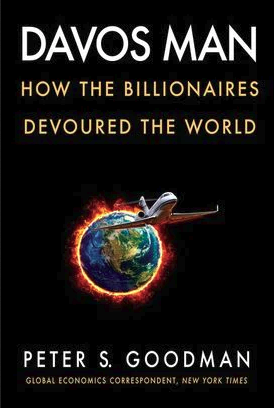
I’ve been reading Peter S. Goodman’s Davos Man, a tough, angry — not entirely persuasive — critique of the sort of people who get top-level access to the World Economic Forum in Davos, Switzerland. Because Goodman’s vantage point is left-by-centre-left, his book provides fascinating counterpoint to a polemic about the WEF that is, in Canada, the almost exclusive preserve of the right.
[…]
Politicians who make a show of having a problem with Davos should explain what the problem is; why they didn’t raise their concerns when cabinet colleagues were lining up to go; and what solutions, if any, they propose. Otherwise they might seem to be faking their indignation to lure a few votes.
Second, it’s easy to see why Davos catastrophism has taken root in some corners of the electorate. We are coming off a COVID pandemic, after all. Very early, only weeks into this historic disaster, the WEF was quick to start discussing visions of a green egalitarian future with prominent roles for green progressive governments and Davos regulars. This was the “Great Reset”, which I discussed here in a magazine. Soon Trudeau was on video calls saying, “This pandemic has provided an opportunity for a reset. This is our chance to accelerate our pre-pandemic efforts to reimagine economic systems.” Which was jarring. Still is. Soon people were digging up old video of Klaus Schwab, the WEF founder, bragging about “penetrating the cabinets” of Western countries with “Young Global Leaders of the World Economic Forum”.
People who didn’t like everything that’s happened since — vaccines, lockdowns, restrictions — started reading great significance into all kinds of perceived Davos connections. Often Trudeau has seemed eager to help. Replacing his finance minister with the only member of his cabinet who sits on the WEF Board of Trustees, while yet again blathering on about how “we can choose to embrace bold new solutions to the challenges we face and refuse to be held back by old ways of thinking” was … loopy, sure, but it probably only accidentally resembled the second act of a Bond movie.
Bringing an element of novelty to all this is Peter S. Goodman, the Global Economics Correspondent of the New York Times. Even if he were Canadian, nobody should expect Goodman to support Poilievre for Conservative leader. Davos Man is a furious diatribe, not against the WEF as an institution but against many of Davos’s richest regulars — and it’s written from a consistently social-democratic perspective.
From its subtitle, “How the Billionaires Devoured the World”, Davos Man relentlessly skewers some of the most glamorous Davos habitués — Amazon gillionaire Jeff Bezos, Blackstone founder Stephen Schwarzman, BlackRock CEO Larry Fink, banker Jamie Dimon, Salesforce guy Marc Benioff. And their, you know, ilk.
“Over recent decades, the billionaire class has ransacked governments by shirking taxes, leaving societies deprived of the resources needed to combat trouble,” Goodman writes. Davos Man — Goodman has borrowed the term from Samuel Huntington — “is a rare and remarkable creature, a predator who attacks without restraint … expanding his territory and seizing the nourishment of others.” Goodman’s language is consistently violent. The billionaires “eviscerate financial regulations”, “defenestrated antitrust authorities”, “squashed the power of labor movements”.
May 4, 2022
Good intentions to rectify problems caused by earlier good intentions in Charleston, South Carolina
Everyone seems to agree that affordable housing is a major need across North America … it certainly is in the Toronto area! In South Carolina, local politicians are doing what they can to make legal changes to encourage more affordable residences to come to market … even when the problem is at least partly caused by earlier attempts to encourage more affordable housing to come to market:
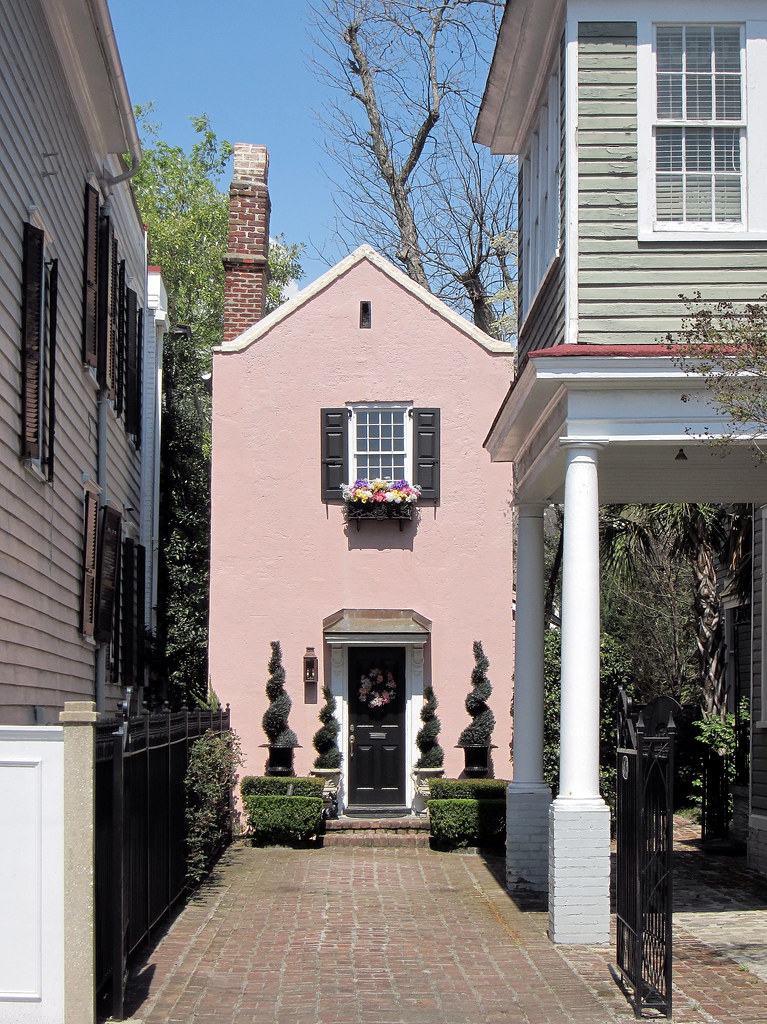
“A converted carriage house, Tradd Street, Charleston, SC” by Spencer Means is licensed under CC BY-SA 2.0


The City of Charleston is considering new legislation that would deregulate accessory dwelling units in hopes of increasing the supply of affordable housing in the city. Also known as carriage houses or mother-in-law suites, accessory dwelling units are small structures that are built in the backyards of homes, and they can be a great source of affordable housing for those in need.
The initiative, which was proposed by Councilmember Ross Appel two weeks ago, would remove red tape that is currently presenting a significant barrier for building this kind of housing. The ironic part is that the regulation which is primarily to blame for stopping the creation of these units was passed specifically to make these units more accessible.
“The city is looking at taking away a rule that requires these buildings to be affordable for 30 years,” WCSC reports, “which, Appel says, has been an obstacle for developers and homeowners.”
“We don’t want people to be artificially limited in terms of what they can charge,” Appel said. “The affordability requirement was a good-intended measure, but actually, that’s been currently in effect for the past year and a half, and we haven’t had a single accessory dwelling unit permitted since that time.”
Put simply, the affordability requirement backfired big time. Its goal was to make new accessory dwelling units more affordable, but by restricting the price people could charge it actually made them so unprofitable that people just stopped building them altogether. For all practical purposes, new accessory dwelling units might as well have been banned.
The implications are not hard to tease out. With no new accessory dwelling units to live in, people have been forced to bid up other kinds of housing, which has no doubt contributed to soaring housing prices. This is why Appel is eager to repeal this rule. He knows that building more supply is the key to bringing prices down, and he knows that regulations like this have been getting in the way of that process.
There’s a maxim in economics that this story highlights: the solution to high prices is high prices. The reasoning goes as follows. When a good like housing becomes scarce, prices naturally rise. But as prices rise, producers see an opportunity for profit and begin expanding the supply. Then, as additional supply comes to market, prices begin to fall.
May 3, 2022
England’s class system, as documented by George Orwell and Theodore Dalrymple
I occasionally run into articles online that are clearly written to interest someone like me, and this one in Quillette by Laurie Wastell had my full attention from the title onward:

Ever since Marx, the concept of class has been foundational to sociology — as well as to almost everything else. This would not have surprised the German economist, for class, as he saw it, determines all: one’s motivations, one’s social position, even one’s consciousness. Britain, where Marx’s Capital was written, has long been known for its intricate class system, and as such is the source of much writing on the subject. Two of the most acerbic English social critics of the past century, George Orwell and Theodore Dalrymple, take class as a central subject. Drawing on firsthand experience (Orwell as a journalist, Dalrymple as a prison doctor and psychiatrist), both document in detail the suffering and privations of the class below them. Both also contend that a central cause of this poverty is the indifference of the middle and upper classes, a conclusion Marx would surely have agreed with. Yet, despite this, their work stands in flat contradiction to Marx’s central dogma that the material conditions of a society determine everything about it, including class. In their literary journalism, the authors’ social commentaries and insights into the human condition far surpass Marx’s “scientific” analysis.
[…]
That class is a function more of outlook than income was clear to Orwell, as he explains in his 1937 book The Road to Wigan Pier, which depicts both the privations of working-class life and the British class system as a whole. Orwell describes how the “lower-upper-middle-class” (Orwell’s own), generally professionals in the “Army, Navy, Church, Medicine [or] Law”, understood and aspired to all the many customs of the upper classes (hunting, servants, how to order dinner correctly) despite never being able to afford them. Thus, “To belong to this class when you were [only] at the £400 a year level was a queer business, for it meant that your gentility was almost purely theoretical.” This same dynamic applies today (though the bourgeois values aspired to now are quite different): a poor librarian is far less likely than a wealthy plumber to have voted for causes like Brexit or Trump, which are both populist and, thus, lower-class.
Themselves men of letters, both Orwell and Dalrymple understand that this class distinction is frequently signalled through language. “As for the technical jargon of the Communists,” writes Orwell, “it is as far removed from the common speech as the language of a mathematical textbook.” Such contorted academic prose means little to the ordinary worker, for whom, Orwell argues, Socialism simply means “justice and common decency”. Indeed, Orwell laments that “the worst advertisement for Socialism is its adherents” because of their distance from everyday concerns and inability to speak plainly. Summarising the problem, he quips: “The ordinary man may not flinch from a dictatorship of the proletariat, if you offer it tactfully; offer him a dictatorship of the prigs, and he gets ready to fight”.
A lifelong socialist, Orwell was repeatedly frustrated by the symptoms of this intellectual snobbery — why do the revolutionaries have such disdain for the ordinary punter? Dalrymple, meanwhile, in his essay “How — and How Not — to Love Mankind”, takes aim at its roots. Here, Dalrymple compares the life and work of Marx to his now lesser-known contemporary, Russian novelist and playwright Ivan Turgenev. Though their lives closely resembled one another’s, Dalrymple argues, “They nevertheless came to view human life and suffering in very different, indeed irreconcilable, ways — through different ends of the telescope, as it were. Turgenev saw human beings as individuals always endowed with consciousness, character, feelings, and moral strengths and weaknesses. Marx saw them always as snowflakes in an avalanche, as instances of general forces, as not yet fully human because utterly conditioned by their circumstances.”
[…]
Both writers criticise intellectuals’ pretentious jargon, but it is worth pausing over how each relates his own social position to their subject matter. In a telling passage of Wigan Pier, Orwell describes the working man who has made it into the middle class, perhaps as a Labour MP or trade union official, as “one of the most desolating spectacles the world contains. He has been picked out to fight for his mates, and all it means to him is a soft job and a chance of ‘bettering’ himself. Not merely while but by fighting the bourgeoisie he becomes bourgeois himself.” The scare quotes reflect Orwell’s mixed feelings about social class: does Orwell not believe that a middle-class career — such as his own — is an improvement over the harsh, backbreaking labour of the miners he so vividly documents? He has hit on a deep dilemma, born of a compassionate humanism that points in contradictory directions.
Ostensibly, Orwell chronicles poverty in order to change it, to shock the comfortable hearts of his readers into action. Yet, at the same time, (romanticising the poor against his own advice), he presents the dirt as liberating: squalor and poverty are in some sense more authentic, more real than bourgeois comforts. Thus, as literary critic John Carey argues, Orwell’s “phobia about lower-class dirt collides head-on with his determination to invest dirt with political value, as the price of liberty.”
May 1, 2022
The Victorian-era “guarantee fund” model for risky enterprises
In the latest Age of Inventions newsletter, Anton Howes wonders why we don’t have a modern equivalent to the funding mechanism that helped create the Great Exhibition of 1851 and other events that provided benefits to the public without government backing:
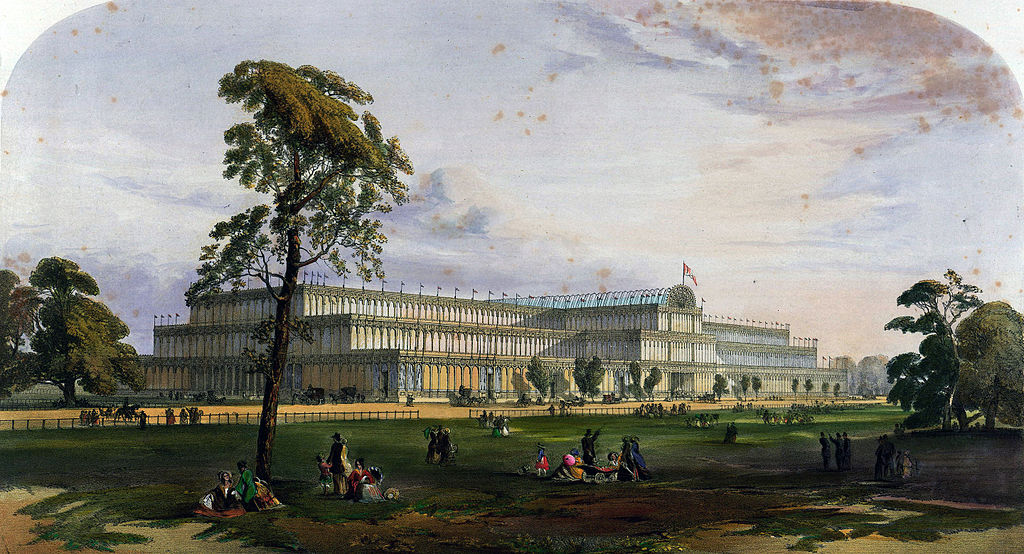
The Crystal Palace from the northeast during the Great Exhibition of 1851.
Image from the 1852 book Dickinsons’ comprehensive pictures of the Great Exhibition of 1851 via Wikimedia Commons.
As I’ve mentioned before, exhibitions of industry were not just celebrations of technological progress, but could become engines for progress as well. For the inventors, artists, and engineers who exhibited, the events were a direct inducement to improvement. And for the public who visited, the events exposed them to what was possible, encouraging them to raise their demands as both consumers and citizens, ideally inspiring them to become future innovators too.
But how was it all paid for? Unlike its national-level precursors in France, the Great Exhibition was not a state-run event. Even more remarkably, its organisers also failed to raise anywhere near enough private subscriptions to cover their costs. Instead, they used something that called a “guarantee fund”.
Instead of asking for donations from supporters up-front, the organisers asked them to commit to covering the exhibitions potential losses up to certain amounts — to be paid only if the money was required. Based on the security provided by this crowdsourced guarantee fund, the organisers then raised an ordinary bank loan in order to get the cash they needed to actually hold the event. Crucially, the guarantors didn’t actually have to spend anything unless the event made a loss, and if the event broke even or even made a surplus thanks to ticket fees, then they would never spend a penny at all. (Luckily for them, that’s exactly what happened in 1851, and for many later exhibitions too.)
What’s interesting to me about the guarantee fund is that I can’t quite think of anything quite like it today. There are perhaps more individualised versions of it, like when a neighbour or friend acts as a guarantor for a mortgage. And governments sometimes provide guarantees for certain sectors or industries too. There have also been a few profit-making versions of it in certain industries, where the guarantors potentially get some share of the upside too (“Names” at the Lloyds of London insurance and reinsurance market sounds similar, though even these are disappearing). But I’ve not seen anything like what the Victorians did, essentially using a guarantee fund to leverage philanthropy.
This is surprising to me. It seems like it has a lot of major advantages, especially for those who might want to replicate the exhibitions of industry today, or indeed for any kind of capital-intensive philanthropic endeavour that could eventually be expected in some measure to pay for itself. (I can’t help but think it would be useful in efforts to speed up the de-carbonisation of the economy, for example — a potential application that I’ve been exploring in my conversations with the people at Carbon Upcycling.)
Consider that with a guarantee fund anyone able to afford the risk could considerably increase the philanthropic value of their assets. Say that you could afford to donate £100 right away, but could donate three times that amount at a pinch (e.g. by having to liquidate some funds in shares). You could thus guarantee £100 each to three different causes, potentially without ever actually having to donate it, and knowing that in the worst case scenario you would never have to spend more than the £300 you can afford.
After all, those signing up to the guarantee fund essentially chose what their maximum liability would be if the event were to make a loss. If they were confident in the event’s success, then they probably believed that they would not have to pay anything at all. And if not, they had at least named the maximum donation they might eventually be asked to give.
QotD: How Thomas Sowell abandoned Marxism
After completing undergrad at Harvard and obtaining a master’s in economics, Sowell landed a summer internship with the Department of Labor. While there, he researched the impact of minimum wage law on employment. Sowell learned two things, both of which he found startling. First, minimum wage laws create job loss by pricing the unskilled out of the labor force. Second, Sowell discovered that “the people in the labor department really were not interested in that, because the administration of the minimum wage was supplying one-third of the money that was keeping the labor department going. … I realized that institutions have their own agendas and their own incentives.” In short, Sowell found that the Department of Labor did not care about the real-world effects of the minimum wage law. He credits this experience, this search for evidence, with having the “biggest” impact on his thinking.
Larry Elder, “If $15 Minimum Wage Is Such a Good Idea, Why Did AOC’s Bar Close Down?”, TownHall.com, 2019-03-21.
April 24, 2022
Let us bid an unfond farewell to all the “cool city” initiatives
Elizabeth Nickson on a few of the ways that governments’ and pan-national organizations’ love for urban intensification looks to be finally fading away:
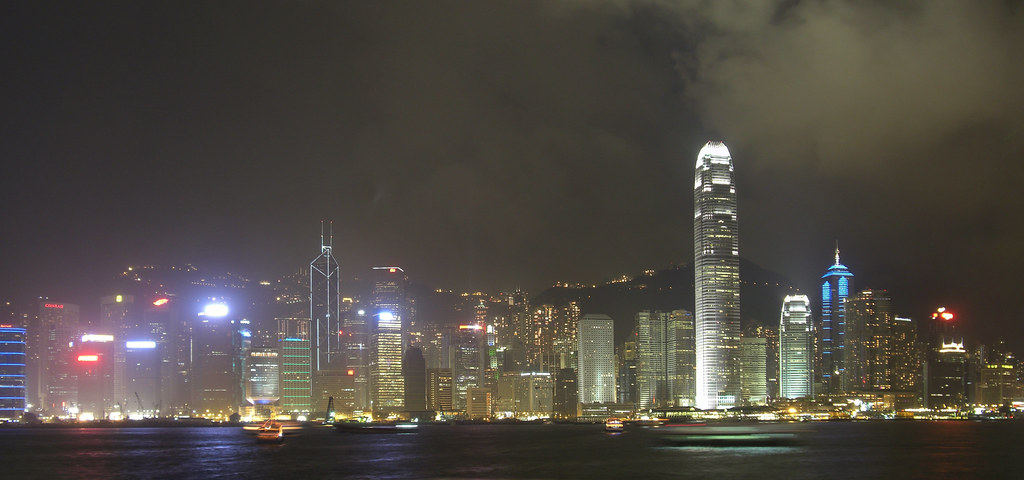
“Hong Kong night Panorama” by Andos_pics is licensed under CC BY-NC-SA 2.0


A decade ago cool cities were all the rage and tax money was pouring into cultural events and buildings to “attract” and densify people because “climate change”. Richard Florida, drawing upon a dubious book about cultural creatives had started his ferocious PR drive towards the mega-city as the apex of modernist civilization, a mixed-race cauldron of creativity and more, an economic engine that would power the world and leave the countryside to the bees and trees. Smart Growth was insinuated into every regulatory structure in order to, just like Captain Picard, make it so.
There were a few oppositional voices. There was me, a very minor chord along with Randal O’Toole, Wendell Cox, Joel Kotkin who detailed the risks. But mostly it was all rah rah rah. If we build it they will come. Masses of public money poured in to attract “them”. Country infrastructure was starved, and if broken, left to rust.
And did they come. To all the glamorous cities came the genius thieves of the modern age, oligarchs creating bolt holes for their money and mistresses, looters from Communist regimes, ditto for Africans stealing aid money. Every crime syndicate facing looser immigration rules started branch-plants, laundering money, and seducing the marginal into lives of misery.
Increased levels of crime was one of our objections, but hell on wheels, the devastation in LA, San Francisco, Chicago, New York and Vancouver sure wasn’t foreseen.
Housing affordability would collapse said Wendell Cox, and was he right. In Vancouver, which has been taken over by Chinese mega-crime-syndicates, is the third most expensive city in the world. People whose families founded the city, can’t afford a studio apartment.
Politicians did nothing but take the laundered cash earned by ruining the lives of their citizens, and used it to build casinos so laundering drug money from all over North America would be easier. We Canadians are so helpful. And nice. To everyone, Even child traffickers. Yeah, come here, the scenery is grand and we can take care of all the people you broke with our “free” health care.
I objected to the potential noise being noise sensitive. Also viruses. That was a big one. Courtesy of my ex-husband’s trips to Asia, I picked up a couple viruses which my immune system couldn’t suppress, since I had no built immunity. The indiscriminate mixing, flooding of people overwhelming resources would create health catastrophes I thought, and lo and behold, it looks like WHO is planning for world-wide pandemics as far as the eye can see.
So, like all the other bad ideas of the age, cool cities failed leaving massive massive debt. Everyone with a scrap of money and initiative is plotting to leave the mega cities for the distinctly uncool country these days. Out here we are bracing ourselves for your bad ideas, but we are also ready. We know what you are like. You are as dumb as rocks, and you would destroy the country just like you ruined the cities. You have zero humility. You are a nightmare coming to join the other nightmare visited on our home places, the mass confiscation of our land. The land that feeds you idiots.
April 18, 2022
Jen Gerson raises the banner of revolution against the Boomergeoisie
In the free-to-read portion of last week’s weekend post from The Line, Jen Gerson channels the anger and frustration of the Millennial sans-culottes (or should that be the sans-maisons?) who are being systematically locked out of the housing market in Canada to protect the paper investments of the Boomer generation:
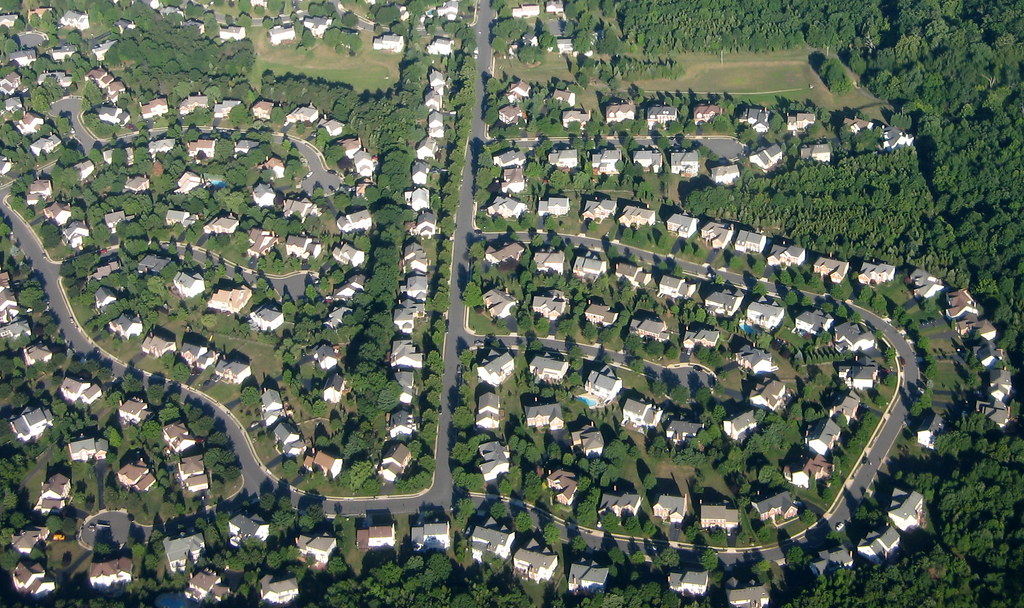
“Green suburbs” by Pierre Metivier is licensed under CC BY-NC 2.0

It’s come to the attention of several of the editors at The Line that some of you Boomers are mad at us. Or, more specifically, you’re mad at co-founder Jen Gerson who popped up a particularly scathing screed about the housing market earlier this week.
To wit:
Our Boomer got his and that’s what matters. We have an entire government apparatus set up to protect that guy. The guy with the money and the guy who votes. The rich-on-paper people are happy, and as long as everybody gets a seat somewhere on this pyramid, then everybody else should be happy too.
We will admit that Gerson didn’t intend this column to come across as an anti-Boomer harangue. She intended it as an anti-government-housing-policy-that-favours-boomers-over-young-people rant, but we can understand why some of our more mature readers took umbrage. We would say we were sorry but … we’re mostly not. A few points:
Firstly, when we talk about macroeconomics and intergenerational equity issues, we are emphatically not talking about individuals. Nobody born between the years 1946 and 1964 is personally, individually morally culpable for the state of the housing market, or the economy, or climate change or any other tragedy of the commons.
[Otherwise, we’d be adopting the tactics of the CRT movement and talking about “Boomer Fragility” and other similar kafkatraps where denial is proof of guilt.]
If you bought a $40,000 house in the ’80s, you couldn’t possibly have known that that purchase would eventually lead to a six-figure real estate portfolio by 2020: you took a risk on the economy as it existed at the time, even struggling through a rough patch of high interest rates, and that risk paid off. No Millennial would have done any differently had we been in your position.
But, let’s be honest, if you are a Canadian Boomer, you were probably born in a country that hadn’t been bombed to the ground just before an historic economic boom so grand that it allowed unprecedented investment in your health, education, development and well being.
That doesn’t mean you didn’t also work hard, and suffer setbacks, as all humans must do over the course of a lifetime. Some of you made bad decisions, and some of you were unlucky, certainly. The bell curve tolls for us all. But you did get to play the game of life during a particularly fortuitous period of history. That period is now ending and the currents of history aren’t going to be as kind to your kids as they were to you (although let’s not kid ourselves. Canadian Millennials and Zers don’t have it so bad in the greater scheme of things, either.) Recognizing this — let’s call it Boomer privilege — doesn’t cost you anything. It doesn’t hurt you. It’s not a personal attack.
What we do find fascinating is the Boomers among our readership who take discussions about intergenerational equity and demographic advantage very, very personally. Forgive us for playing pop psychologist, but it almost feels like some of you park so much of your worth as human beings into your ability to earn wealth that to have someone point out that this wealth accumulation was helped by macroeconomic factors over which you had no control — luck, essentially — seems to be read as an attack on your sense of self, purpose, and identity. (Is this why so many of you struggle to retire? Is there a frisson of guilty conscience at play?)
That is … your issue. Being lucky isn’t an indictment of your character. We assume all of our Line subscribers are genuinely good people who knit little paw mittens for orphaned cats, okay? Otherwise, why else would you be here?
April 17, 2022
The end of the (pandemic-induced) book boom
In the latest SHuSH newsletter, Ken Whyte metaphorically collects his winnings from predicting nearly a year back that the boom in book sales during 2020/2021 would not last once the pandemic lockdowns began to ease off:
I noted last June in SHuSH 103, “Big Guys Lose Their Minds”, that book sales, especially for the leading firms — Penguin Random House, HarperCollins, Hachette, Simon & Schuster — were ramping up during the pandemic, reaching 10% to 20% above 2019 levels. I also noted that the numbers were making some of these publishers giddy.
HarperCollins CEO Brian Murray, for instance, gave an interview in which he proclaimed that humanity had entered a new era of permanently higher book sales and added that he was ratcheting up his spending to meet the increased demand.
“We are being aggressive in terms of buying books. We’ve seen the book pie grow, maybe 15 percent,” says Murray, “and so our response, which is part opportunistic and part defensive, is to be aggressive in buying right now. Because if that pie remains large, we want to make sure that we get a nice share of the larger pie … we want to make sure that we have a lot of new, exciting books in the future that will maintain our revenues at the current levels.” Yikes.
In that June newsletter, I anticipated the world returning to normal and book sales falling back to earth as vaccinations took hold and the coronavirus waned (we also promised to check back in a year — so here we are, a few months early).
It did not feel dangerous, that prediction. While it can sometimes be difficult to distinguish between a temporary spike (or drop) in sales due to extraordinary circumstances and the beginning of a long-term trend, it’s always safest to pick extraordinary-and-temporary amid an unprecedented pandemic with people locked up and not behaving normally. Also, my buddy Jack David at ECW Press agreed with me and he’s been doing this forever. And it wasn’t like Brian Murray had any evidence to back his claim that an era of permanently higher book sales had dawned.
[…]
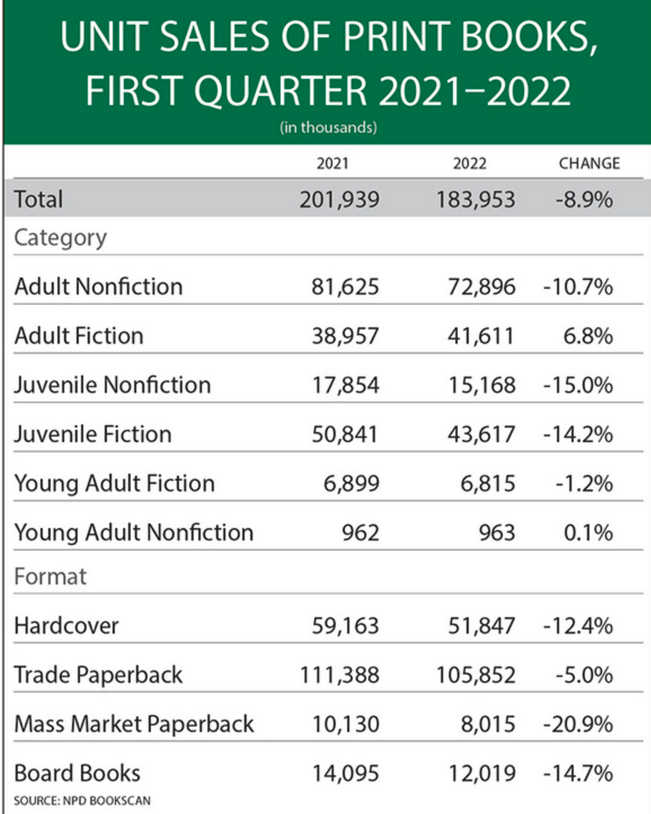
The share prices of big publishing companies don’t tell the same sort of story because they tend not to be pure-play book publishers: Simon & Schuster, for instance, is owned by multimedia giant Viacom; HarperCollins by the omnipresent Rupert Murdoch; Penguin Random House is less than a quarter of Bertelsmann’s business. But first-quarter 2022 revenue figures for those firms are available and they show that the great give-back is underway in the book world, too.
The headline in Publisher’s Weekly reads “The Book Sales Boom is over”. Here’s the US data:
And that’s just the beginning. Sales will continue to slide throughout 2022 and into 2023 as the world normalizes, people concentrate on doing all the things they’ve not been able to do the past two years, run through the extra cash they accumulated in the pandemic, and resume their former library borrowing habits.
What happens at the big publishing companies? If, as Murray’s comments would lead you to suspect, they’ve budgeted and spent for the good times to continue, unhappy times await.
April 16, 2022
QotD: The Edict of Diocletian
Who is … so devoid of human feeling as not to see that immoderate prices are widespread in the markets of our cities, and that the passion for gain is lessened neither by plentiful supplies nor by fruitful years? — so that … evil men reckon it their loss if abundance comes. There are men whose aim it is to restrain general prosperity … to seek usurious and ruinous returns. … Avarice rages throughout the world. … Wherever our armies are compelled to go for the common safety, profiteers extort prices not merely four or eight times the normal, but beyond any words to describe. Sometimes the soldier must exhaust his salary and his bonus in one purchase, so that the contributions of the whole world to support the armies fall to the abominable profits of thieves.
The Edict was, until our time, the most famous example of an attempt to replace economic laws by governmental decrees. Its failure was rapid and complete. Tradesmen concealed their commodities, scarcities became more acute than before, Diocletian himself was accused of conniving at a rise in prices, riots occurred, and the Edict had to be relaxed to restore production and distribution. It was finally revoked by Constantine.
The weakness of this managed economy lay in its administrative cost. The required bureaucracy was so extensive that Lactantius, doubtless with political license, estimated it at half the population. The bureaucrats found their task too great for human integrity, their surveillance too sporadic for the evasive ingenuity of men. To support the bureaucracy, the court, the army, the building program, and the dole, taxation rose to unprecedented peaks of ubiquitous continuity.
As the state had not yet discovered the plan of public borrowing to conceal its wastefulness and postpone its reckoning, the cost of each year’s operations had to be met from each year’s revenue. To avoid returns in depreciating currencies, Diocletian directed that, where possible, taxes should be collected in kind: taxpayers were required to transport their tax quotas to governmental warehouses, and a laborious organization was built up to get the goods thence to their final destination. In each municipality, the decuriones, or municipal officials, were held financially responsible for any shortage in the payment of the taxes assessed upon their communities.
Since every taxpayer sought to evade taxes, the state organized a special force of revenue police to examine every man’s property and income; torture was used upon wives, children, and slaves to make them reveal the hidden wealth or earnings of the household; and severe penalties were enacted for evasion. Towards the end of the 3rd century, and still more in the 4th, flight from taxes became almost epidemic in the Empire. The well-to-do concealed their riches, local aristocrats had themselves reclassified as humiliores to escape election to municipal office, artisans deserted their trades, peasant proprietors left their overtaxed holdings to become hired men, many villages and some towns (e.g., Tiberias in Palestine) were abandoned because of high assessments; at last, in the 4th century, thousands of citizens fled over the border to seek refuge among the barbarians.
It was probably to check this costly mobility, to ensure a proper flow of food to armies and cities, and of taxes to the state, that Diocletian resorted to measures that, in effect, established serfdom in fields, factories, and guilds. Having made the landowner responsible through tax quotas in kind for the productivity of his tenants, the government ruled that a tenant must remain on his land till his arrears of debt or tithes should be paid.
We do not know the date of this historic decree; but in 332, a law of Constantine assumed and confirmed it, and made the tenant adscriptitius, “bound in writing”, to the soil he tilled; he could not leave it without the consent of the owner; and when it was sold, he and his household were sold with it. He made no protest that has come down to us; perhaps the law was presented to him as a guarantee of security, as in Germany today. In this and other ways, agriculture passed in the 3rd century from slavery through freedom to serfdom and entered the Middle Ages.
Similar means of compelling stability were used in industry. Labor was “frozen” to its job, forbidden to pass from one shop to another without governmental consent. Each collegium or guild was bound to its trade and its assigned task, and no man might leave the guild in which he had been enrolled. Membership in one guild or another was made compulsory on all persons engaged in commerce and industry, and the son was required to follow the trade of his father. When any man wished to leave his place or occupation for another, the state reminded him that Italy was in a state of siege by the barbarians and that every man must stay at his post.
Will Durant, The Story of Civilization, Volume 3: Caesar and Christ, 1944.
April 11, 2022
QotD: Programmers as craftsmen
A programmer can sit down in front of a computer and create wealth. A good piece of software is, in itself, a valuable thing. There is no manufacturing to confuse the issue. Those characters you type are a complete, finished product. If someone sat down and wrote a web browser that didn’t suck (a fine idea, by the way), the world would be that much richer.*
Everyone in a company works together to create wealth, in the sense of making more things people want. Many of the employees (e.g. the people in the mailroom or the personnel department) work at one remove from the actual making of stuff. Not the programmers. They literally think the product, one line at a time. And so it’s clearer to programmers that wealth is something that’s made, rather than being distributed, like slices of a pie, by some imaginary Daddy.
It’s also obvious to programmers that there are huge variations in the rate at which wealth is created. At Viaweb we had one programmer who was a sort of monster of productivity. I remember watching what he did one long day and estimating that he had added several hundred thousand dollars to the market value of the company. A great programmer, on a roll, could create a million dollars worth of wealth in a couple weeks. A mediocre programmer over the same period will generate zero or even negative wealth (e.g. by introducing bugs).
This is why so many of the best programmers are libertarians. In our world, you sink or swim, and there are no excuses. When those far removed from the creation of wealth — undergraduates, reporters, politicians — hear that the richest 5% of the people have half the total wealth, they tend to think injustice! An experienced programmer would be more likely to think is that all? The top 5% of programmers probably write 99% of the good software.
Wealth can be created without being sold. Scientists, till recently at least, effectively donated the wealth they created. We are all richer for knowing about penicillin, because we’re less likely to die from infections. Wealth is whatever people want, and not dying is certainly something we want. Hackers often donate their work by writing open source software that anyone can use for free. I am much the richer for the operating system FreeBSD, which I’m running on the computer I’m using now, and so is Yahoo, which runs it on all their servers.
* This essay was written before Firefox.
Paul Graham, “How to Make Wealth”, Paul Graham, 2004-04.
April 3, 2022
Of all the things the future might hold, “food shortages” was never one of the entries I expected to see on the Bingo card
Elizabeth Nickson on the astonishing news that we may be facing actual food shortages in the near future:

Food shortages. Food. Shortages. That’s how incompetent this vast superstructure of over-paid, over-benefited, bullies are. Out of their vast superstructures, their buildings filled with “administrators”, their massive computer systems that track everything and everyone, unending flows of money that they just print when they need it, they have created food shortages.
We haven’t had food shortages since the Blitz in London. You basically have to have been under bombardment by Nazis to have food shortages in the western democracies. Furthermore our wealth has grown since the early 1940s by about 1000%. You have to be bombed by 100 many Nazis as there were Nazis per capita, to have food shortages in the 21st century.
That’s how malignant they are.
I guess destroying millions of businesses in the last two years, blowing up national and sub-sovereign debt way way way past sustainable level, ruining children, setting them back years, having to start math, reading, science all over again, their minds so slippery they have lost a half-decade of learning. Let’s not forget all the doctor’s visits that didn’t happen, the cancers that ran away, the heart disease that bolted given the nightmare stress they created. The domestic violence that spiked, the depression that spiked, the loneliness that turned into addiction. And then they launch a “vaccine” that has killed more people than the cold virus they engineered using elements of HIV using our money.
Everything they do turns to shit.
They expect us to forget this. We won’t. No one outside their civil services, their pet (read funded) satellites, their quangos, the PPPs that have subsumed corporations in their vicious enterprises, believes a word they say anymore. It is all bullshit, all the time.
Why the hell do we put up with them? What kind of forelock-tugging stupor leads us to believe anything they say about anything? They are the stupidest people the world has ever seen. And the most malignant, and that is saying something because history is filled with Game-of-Thrones level malignity.
This is all easier to understand once you take on board the fact that they hate us and want us to die.
Even before the lockdown pandemic theatre we all put up with for much of the last two years, the other globalist hobby horses had been out for quite some time:
The over-arching scam they are using is “climate change”. Which is not happening. No one with even basic statistics on board can read into the science and within a few hours know what a complete fabrication this is. The climate (and nature) is so complex, we probably know about 5% of what we need to know to make the decision that three billion people must die. Early on, it was engineers who realized it was false because engineers build things that can’t be faked. If a building, mine or bridge collapses, it’s because they fudged the math. Climate Change is entirely fudged math.
Everything about green energy is falsified. It doesn’t work. Other than of course, for the people who “invested” in it, which means their returns come from government subsidies, ie other people’s life energy. Here we find an ethical uncoupling at the deepest human level: Who are you to profit by the energy of others, by something that is destroying the energy system? Because destroy it, it does. Nowhere does “green” “energy” deliver sustained power. Literally nowhere. It is always breaking down, always failing, meaning that every winter the coal mines are 100% busy. It might work if the backup systems are reliable, or the climate absolutely perfect, in the desert say, but only on a small scale, never country, state or even county-wide.
“Coal is on the way out”, my CBC radio producer daughter said to me a couple of years ago. I looked at her, and managed not to laugh. Coal delivers 50% of the electricity on the east coast of North America. And it will continue. For fucking ever. Until we have nuclear.
So now, we have energy shortages. Our current inflation is caused by our administrative elites closing down energy creation and transport in the US, Canada and Europe. Energy prices have skyrocketed. Which means old people freezing in their homes.


