
If they are timid in some respects, the Trade Unions are aggressive in negotiation and cannot be otherwise. To keep in business a union has to do something. Each year there must be a fresh demand, without which the union will lose membership. Members expect to see some return for their subscriptions and union officials are not paid to be inactive. Lacking a grievance, they will have to invent one. Realizing this, the directors must make a show of reluctance, postponing the inevitable concession until it looks like a victory for the employees. If the union is quiescent it will lose membership, most probably to another union. Its officials, honorary or paid, can always gain consequence on the other hand, from their decision to do battle. Any Trade Union has, therefore, a built-in aggressiveness, without which it can hardly survive. Nothing can be more damaging to the union official than the rumour that he is friendly with the management. This can only be the result of blackest treachery, it is assumed, and the official has to stage a conflict in order to secure his own re-election. Aggressive toward management, the unions are almost as aggressive toward each other, competing for membership and staging frontier disputes over the exact territory which belongs to each. Nor is this unrest the fault of individuals. It is a characteristic of union organization and one for which there is no obvious remedy.
C. Northcote Parkinson, “The Feet of Clay”, Left Luggage, 1967.
November 13, 2013
QotD: Trade unions
November 10, 2013
Latest federal initiative shows “patronising contempt, arrogant presumption and impressive stupidity”
The federal government is launching a program to help “ordinary Canadians” become better at managing their finances. Richard Anderson points out the amusing aspect of this:
I sometimes wonder if the hacks who put out these releases aren’t giggling to themselves the whole time, amazed at what they’re getting away with. You work for a Conservative government that wades through a sea of red ink every year. This same government has no credible plan to deal with the entitlement crisis, except point out how we’re less screwed than the Yanks. So naturally you go about lecturing the common folk on how to balance their chequebooks. This is like the morbidly obese diet coach of legend.
We see here a unique combination of patronising contempt and arrogant presumption that does not, so far as we have been able to determine, exist outside of Ottawa. Even the Soviets assumed that an ordinary adult could balance their personal budgets without being lectured to by a full time commissar. Then again they were communists, not nannies. Herein lies the great difference between the totalitarian projects of the last century and the petty authoritarianism of this one, the end result. The communist, fascists and Nazis envision a new man who would change the world. Note the underlying assumption: Man.
At some point, after rigorous indoctrination, the boy would become a man. The modern nanny state assumes that the boy never becomes a man, he’s always a boy needing to be hectored to and monitored. As the press release notes: “…brushing up on the basics of money management at any age and will include events for Canadians of all ages.” No matter how old you get, the federal government will be there to tell you how to manage your affairs. That generations of Canadians did this quite well without government involvement never comes up.
Growth forecasts continue to over-estimate Canada’s actual economic progress
In Maclean’s, Debbie Downer Colin Campbell takes a survey of the state of Canada’s economy:
A key qualification for landing a job at the Bank of Canada, it seems, is an unfailing sense of optimism. In 2009, the bank forecast the economy would grow 3.3 per cent in 2011. It grew 2.5 per cent. In 2011, it said the economy would grow 2.9 per cent in 2013. It will likely be just 1.6 per cent. Now it says the economy will grow 2.3 per cent next year. How likely is that? The bank has consistently viewed the economy through rose-coloured glasses in recent years, perhaps believing its low-interest-rate policy will eventually bear fruit. Rates have been held at one per cent for three years now. But the economy seems only to be getting worse.
It grew 0.3 per cent in August, Statistics Canada said last week — mostly attributed to a familiar crutch, the oil business. Elsewhere, things aren’t looking up. A new TD Bank report said corporate Canada is “in a slump,” with profits down 16 per cent from their post-recession peak in 2011. Some observers point out that Canada is still doing better than Europe and Japan. But so are most countries that aren’t in a recession, from South Africa and New Zealand to Equatorial Guinea and Guatemala. After breezing through the recession, Canada is back to old habits: hoping its fortunes (i.e., exports) will rise along with America’s comeback. But the U.S., too, is back in a rut. Last week, the Federal Reserve said it would continue with its $85-billion-a-month bond-buying stimulus program.
With the economy sputtering, Ottawa has meanwhile remained preoccupied with fiscal restraint and balancing the budget within two years. So, with neither low interest rates nor government spending providing a boost, the outcome seems predictable: Official growth forecasts will look nice, but will keep missing the mark.
October 31, 2013
Canada’s shipbuilding strategy – the worst of both worlds
The Royal Canadian Navy (RCN) and the Canadian Coast Guard (CCG) both are badly in need of new ships. The federal government has been aware of this for quite some time and has made plenty of announcements about addressing those needs … but the actual steps taken do not give me hope that the needs will be met economically or in a timely fashion. Canada no longer has a domestic ship-building industry with experience in producing military vessels, and it does not make economic sense to re-create it for the relatively small number of ships the RCN and the CCG actually need.
Politically, it can be a good election ploy to pour lots of government money into new shipyards which will employ hundreds of skilled and unskilled workers. The newly employed will be spending their salaries in Halifax, Vancouver, and Quebec and the visible signs of construction (both of the facilities themselves and of the hulls of the ships) will be a steady reminder to voters that the feds are investing in their cities. From the political viewpoint, it makes lots of sense to design and build the ships in Canada.
Economically, the situation is quite different. None of the remaining shipbuilding firms have the trained staff for either designing or assembling modern military ships. They’ll need to expand their yards and hire new skilled workers to take on the contracts. The civilian economy probably does not have all the necessary trained would-be employees ready to hire, so many would need to be brought in from other countries while training courses eventually turn out enough Canadians able to take those jobs. This will all increase the cost of the shipbuilding program, and delay the already belated eventual delivery of the ships. J.L. Granatstein explains:
The government’s National Shipbuilding Strategy aims to provide Arctic patrol ships, supply vessels and eventually replacements for the RCN’s fine frigates, as well as a large icebreaker and 10 smaller ships for the Coast Guard. The cost, including the frigate replacement, is estimated at $80 billion, and the process involves re-establishing the nation’s shipyards in Vancouver and Halifax, in effect re-creating a defunct industry. Up to 15,000 jobs are to be created.
But this is Canada, so pork and high costs are inevitable. National Defence and Public Works are deeply involved, politicians’ hands are all over the plans, and costs are sky-high. Consider the two Joint Support Ships to be built in Vancouver for $3 billion. They will likely be fine ships when they hit the water, years late. Britain’s Royal Navy, however, is buying four roughly similar ships from South Korean builders for $750 million — for all four. Should the RCN ships cost eight times those of the British? The Dutch navy is buying ships built in Romania; the Danes use ships built in Poland. Why? Because the cost is far less, the quality is good, and the work of installing the armaments and communications systems can be done in home waters, creating good jobs.
Take another case, the 10 small vessels to be built on the west coast for the Coast Guard for $3.3 billion. In 2007, the Danes bought similar, larger ships for $50 million each, ships with an icebreaking capacity the CCG ships will not have. Even with six years of inflation factored in, the CCG ships will cost at least three to five times as much.
But, the government will say, the jobs being created on the coasts are good ones, paying well for the skilled workers who are being trained to fill them. It is true, but will the Canadian public support the RCN and the Coast Guard when it realizes the massive costs involved to create each job? Moreover, no government can bind its successors to follow any policy. Jean Chrétien killed the maritime helicopter project when he came to power two decades ago, and the RCN still has no new ones. A future government might well say that the deficit is too high and the ship projects cannot proceed. After all, governments have killed the shipbuilding industry in this country before — after the two world wars and after the RCN frigate program ended in the 1990s. There are no guarantees in politics, and neither the Liberals nor the NDP seem high on defence spending for anything other than peacekeeping.
However, any time the political equations and the economic equations point in very different directions, you can almost always count on the politicians to go for the most expensive/most politically advantageous answer.
October 30, 2013
Human Progress
At Reason, Marian Tupy introduces a new website celebrating Human Progress:
In a world where we are constantly bombarded with bad news, it can sometimes be difficult to think of “progress” and “humanity” in the same sentence. Are there not wars taking place, people going hungry, children at work, women being abused, and mass poverty around the world?
In fact, for most of human history, life was very difficult for most people. People lacked basic medicines and died relatively young. They had no painkillers and people with ailments spent much of their lives in agonizing pain. Entire families lived in bug-infested dwellings that offered neither comfort nor privacy. They worked in the fields from sunrise to sunset, yet hunger and famines were commonplace. Transportation was primitive and most people never traveled beyond their native villages or nearest towns. Ignorance and illiteracy were rife. The “good old days” were, by and large, very bad for the great majority of humankind.
Average global life expectancy at birth hovered around 30 years from the Upper Paleolithic to 1900. Even in the richest countries, like those of Western Europe, life expectancy at the start of the 20th century rarely exceeded 50 years. Incomes were quite stagnant, too. At the beginning of the Christian era, annual incomes per person around the world ranged from $1,073 to $1,431. As late as 1820, average global income was only $1,274 per person. (Angus Maddison, whose income estimates I use here, gives his data in 1990 dollars. I have adjusted Maddison’s figures for inflation.)
Humanity has made enormous progress — especially over the course of the last two centuries. For example, average life expectancy in the world today is 67.9 years. In 2010, global per capita income stood at $13,037 — over 10 times what it was two centuries ago.
The new website is called Human Progress:
It is perhaps best to start by explaining what the Human Progress website is not trying to accomplish. It will not try to convince you that the world is a perfect place. As long as there are people who go hungry or die from preventable diseases, there will always be room for improvement. To that end, we all have a role to play in helping the destitute in our communities and beyond.
Our goal, then, is not to paint a rosy picture of the state of humanity, but a realistic one. A realistic account of the world should focus on long-term trends, comparing living standards between two or more generations. Crucially, it should compare the imperfect present with a much more imperfect past, rather than with an imagined utopia in the future.
As such, this website has two main aims. First is to inform you about the many ways in which the world has become a better place. Second is to allow you to search for reasons that brought that improvement about. While we think that policies and institutions compatible with freedom and openness are important factors in promoting human progress, we let the evidence speak for itself and hope the website stimulates an intelligent debate on the drivers of human progress.
QotD: The career of Karl Marx
[Karl Marx] was also an unemployed professor, a scholar in the German tradition with a first-rate brain, a vast depth of learning and considerable obscurity of thought. Of his intellect and scholarship there can be no doubt at all. He knew many languages and had read widely in many subjects. A very learned man indeed, he was admirably fitted for the life of a German university. Marx’s complete absorption in his philosophy, history and economics was quite typical of the sort of professor he should by right have become. That mixture of scholarship, vagueness, poverty and practical inexperience would have graced a chair at Heidelberg or Bonn. But for the death in 1840 of Frederick William IV, a man of strictly orthodox views on religion, Marx might have had an academic career. Barred from this, however, as an atheist, he had no class to teach, no pupils from whom he might have learned. There is a sense, of course, in which a professor lives apart from the world. But his duties, even in the mid-nineteenth century, involved some contact with other people. The most professorial of German professors would have examinations to set and appointments to keep. Sessions of Senate and Faculty might give him scope for eloquence or intrigue, and he would find for himself the need to compromise, concede and persuade. Howbeit painfully and slowly, the professor comes to know something of administration and finance. But this was the practical knowledge which Marx was denied. All the experience he had was in his own home, where his failure was catastrophic for his wife and family. Of his children some died of slow starvation and two committed suicide. Retaining and increasing all his professional learning, he became more purely theoretical than even professors are allowed to be. Of the difficulties of organizing human society he knew practically nothing. There was in fact no human society — no province or city, no school or club — of which he could be said to have been a member. His whole life was bounded by the printed page.
C. Northcote Parkinson, “Internal Contradiction”, Left Luggage, 1967.
October 29, 2013
Poverty in America
Zero Hedge recently went on a tear about “soaring poverty in America”, compiling a list of 29 items which “proved” the case. Tim Worstall indulges in a bit of fisking over the mythical claims:
2. New numbers have just been released, and they show that the number of public school students in this country that are homeless is at an all-time record high. It is hard to believe, but right now 1.2 million students that attend public schools in America are homeless.
No, I’m afraid not. In fact, this isn’t possible in the slightest. The numbers for homelessness are here.
In January 2012, 633,782 people were homeless on a single night in the United States. Most (62 percent) were homeless as individuals and 38 percent were homeless as persons in families.
At any one time we have 630,000 homeless people. We cannot therefore have twice that number of children alone being homeless at any one time. This is not one of the mathematical possibilities that this universe offers us.
What is actually being said in the original number is that over the course of a a year 1.2 million children will suffer one or more incidents of homelessness. We can still think that this is appalling, that it shouldn’t happen and that we ought to be doing more about it. But it is not true that “right now 1.2 million students that attend public schools are homeless”.
3. When I was growing up, it seemed like almost everyone was from a middle class home. But now that has all changed. One recent study discovered that nearly half of all public students in the United States come from low income homes.
Well, if you grow up in a middle class area then of course those you grow up with are likely to be middle class. But that nearly half of students coming from low income homes is indeed true. But it’s extremely uninteresting that it is. Here’s the definition of low income they are using:
To be crystal clear, the researchers were not analyzing poverty rates per se. Rather, they tracked at the percentage of children in each state who received free or reduced school lunches, which are only available to students whose families earn below 185 percent of the poverty line. For a family of four, that amounted to about $41,000 in 2011.
As it happens, median household income is around two times that federal poverty line. So, 185% of the federal poverty line is going to be pretty close to the median household income. Median household income being the amount that 50% of households get more than and 50% get less than. So, yes, we would pretty much expect that 50% of children are coming from low income families. Because it’s only in Lake Woebegon that all the children are above average. This is a statistical artifact of the measure they are using as low income, nothing else.
And, of course, the traditional mis-measurement of poverty in the US compared to pretty much every other western country:
6. According to the U.S. Census Bureau, approximately one out of every six Americans is now living in poverty. The number of Americans living in poverty is now at a level not seen since the 1960s.
No, this is not true, as I’ve pointed out in these pages many a time. Many, many, many, many times in fact.
The 15% in poverty measure is the number of people who would be in poverty if we didn’t help them by giving them money, food, housing and health care. It is not the number living in poverty. It is the number in poverty before we help them out of poverty. And as to the comparison with the 1960s, in the 1960s it really was the number in poverty after we helped, now it’s the number before we help.
As to why this is when we calculate the number below the poverty line we look only at cash incomes. This includes any actual money that people might be given to alleviate their poverty. In 1960s America pretty much the only poverty alleviation that was done was to give money to poor people (“welfare”). Today we give very little money directly. But we spend a vastly greater amount in giving people things. Medicaid, Section 8 housing vouchers, SNAP (or food stamps). We also give aid to the low paid through the tax system, with the EITC. However, we do not count all of those things, nor the EITC through the tax system, in our calculation of the number below the poverty line. So, since the 1960s the US measure of poverty has changed. From being one of people who are indeed living in poverty after whatever help they get to one of the number of people who would be in poverty before any help that they get.
When we correct for this the US poverty rate is significantly lower now than it was in the 60s. One estimate is that it is about half the 60s number.
Even selling the USS Forrestal for $1 was a win for the US Navy
Several people have commented about the headlines proclaiming that the very first supercarrier had been sold for a princely sum of $1, but Strategy Page explains why even that token dollar was better than all the other options:
The U.S. Navy recently sold a decommissioned (in 1993) aircraft carrier (USS Forrestal) for scrap. The ship yard that will take the Forrestal apart (All Star Metals of Texas) paid the navy one cent ($.01) for the ship. That’s because this was the best deal the navy could get. That’s because it will cost many millions to take the ship apart in a legal fashion (being careful to avoid releasing any real or imagined harmful substances into the environment). The other alternative was to sink the Forrestal at sea. But this requires partial disassembly (to remove anything that could or might pollute the ocean), that would be even more expensive.
[…]
Since the 1990s, sending warships to the scrap yard has not been considered a viable alternative. It’s all about pollution, bad press, and cost. That was because of the experience with the largest warship to be scrapped to date, the 45,000 ton carrier USS Coral Sea. This ship took until 2000 (seven years) to be broken up. Thus, the new ecologically correct process was not only expensive but it took a long time. Then the navy discovered that the cost of scrapping a nuclear powered carrier like the USS Enterprise would be close to a billion dollars. This was largely the result of a lot more environmental and safety regulations. With so many navy ships (especially nuclear subs) being broken up in the 1990s, and all these new regulations arriving, the cost of disposing of these ships skyrocketed. This was especially true with carriers.
So for over a decade the navy just tied up retired ships and waited for some better solution to appear. That never happened. In fact, the situation has gotten worse. The navy only has one ship scrapping facility (Brownsville, Texas), so only one carrier at a time can be dismantled. Using official estimates of the time required to dismantle each of the biggest ships, it’ll take seven decades to get rid of the surviving conventionally powered carriers. Note also that the conventional carrier in the absolute worst shape, the USS John F Kennedy, is the one being officially retained in category B reserve (but only until Congress forgets all about her, of course). Name recognition really does count.
It gets worse. With the really vast number of single hull tankers being scrapped and large numbers of old, smaller-capacity container ships laid up and likely to be offered for scrap fairly soon, the market for difficult-to-scrap naval ships is going to shrivel and the price for scrap steel will drop. Efforts to get the navy to include the costs of disposal in the budget for lifetime costs has never caught on and now it’s obvious why not. The real nightmare begins with the first nuclear powered carrier (the 93,000 ton USS Enterprise), which began the decommissioning process in late 2012 (with the lengthy removal of all classified or reusable equipment). The cost of dismantling this ship (and disposing of radioactive components) may be close to $2 billion.
October 26, 2013
Another theory on gender wage gaps
A guest-post at the Freakonomics blog by John List and Uri Gneezy looks at an experiment they conducted to test their theory about the gender wage gap:
Scholars have long theorized about the reasons why women haven’t made faster progress in breaking through the glass ceiling. Personally, we think that much of it boils down to this: men and women have different preferences for competitiveness, and at least part of the wage gaps we see are a result of men and women responding differently to incentives.
Being experimentalists, we understood that without actual evidence, this was just a conjecture. Determined to test our idea in the field we launched a large-scale field experiment on Craigslist where we posted ads for an administrative assistant gig we needed to fill. The experiment was conducted with Jeff Flory and Andreas Leibbrandt as coauthors. We received responses from nearly 7,000 interested job seekers from cities all over the U.S.
After a job seeker touched base with us, we gave them more details on the way they’d be compensated. Then we asked them to provide some basic information if they wanted to be considered for the position. Half the job seekers were told that the job paid a flat $15 per hour. The other half were told they would be paid $12 an hour but they would compete with a co-worker for a $6 per hour bonus (so that both ads would pay workers an average of $15 per hour).
What’d we find? Women were 70% less likely than men to go after the job if it had the competitive pay scale.
The blog post is called “A Unified Theory of Why Women Earn Less”, but I don’t think it actually qualifies — if the experiment was repeated in different markets, it might well explain some of the difference, but I suspect that women’s choices of jobs that provide greater flexibility in hours and the specific fields that draw more female than male workers are probably greater influences on the overall employment and compensation picture.
October 23, 2013
Perhaps the “starve the beast” plan is working
In Maclean’s, Stephen Gordon provides an updated look at the Harper government’s ongoing “starve the beast” policy:
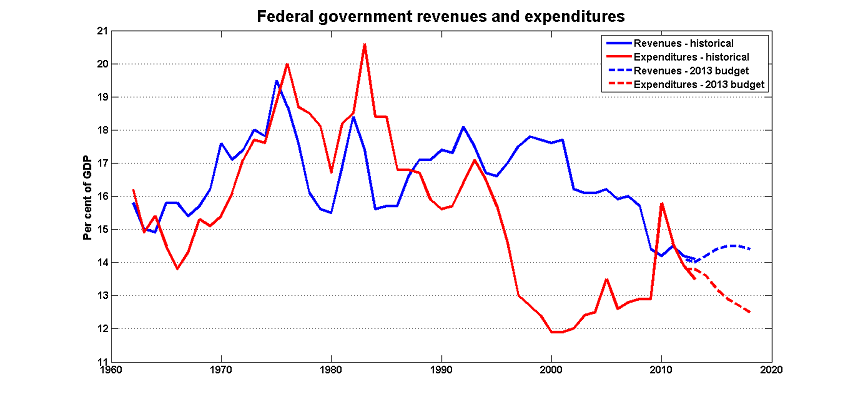
Canadian federal government revenues and expenditure, 1960-2013
As I’ve written before, the Conservatives have applied the “starve the beast strategy“: First, cut taxes; second, cut spending in order to match lower revenues; third, obtain a balanced-budget for a smaller government. As the red line in the chart shows, the Harper government was temporarily thrown off this past by the financial crisis, which required emergency stimulus spending. They are, however, back on track.
Once again though, we need to be careful to see that the government’s revenues are back above expenditures (so the yearly deficit has been reduced over time), but the government’s outstanding debts are still quite substantial: $892 billion for 2012-13. As long as interest rates stay low, the debt should start to decline, but if-and-when interest rates rise, so will that big pile of accumulated debt.
October 21, 2013
The US debt iceberg
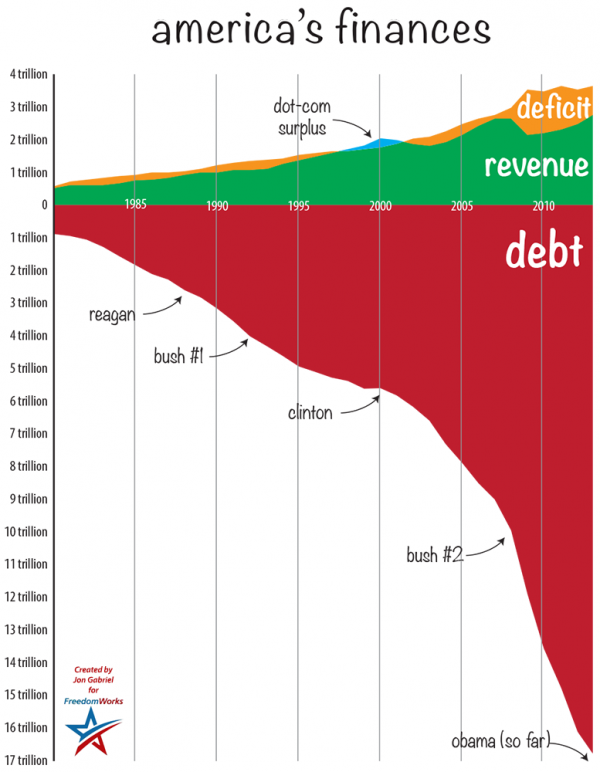
Jon Gabriel has put together a clear, understandable way to show the relationship between the US government’s revenue, deficit and debt numbers:
When Washington raised the debt ceiling this week, the Beltway media breathlessly reported that the fiscal crisis had ended. Lawyers danced in hallways, bureaucrats twerked on the Metro, congressional aides kissed strangers in the streets — the Tea Party has been defeated! It was like VJ day for wonks.
As our political class exchanged high fives and reporters praised a return to “sanity,” I wondered how these odd creatures defined insanity.
America’s fiscal crisis is not that our debt ceiling was too low, the fiscal crisis is that our debt is too high. When I mentioned this to left-leaning folks, they seemed indifferent. “Obama lowered the deficit.” “I think Bush spent more.“ “It’s Reagan’s fault!”
So I made this infographic:
Since most graphs look like this, I focused on just three big numbers: Deficit, revenue and debt.
The analogy is imperfect, but imagine the green is your salary, the yellow is the amount you’re spending over your salary, and the red is your Visa statement. Then imagine your spouse runs into the room and shouts, “great news honey, our fiscal crisis is over. We just got approved for a new MasterCard!” Your first call would be to a marriage counselor or a shrink.
H/T to Nick Gillespie:
What is it that Hemingway always used to say? That thing’s not loaded? Or something about how the “dignity of movement of an ice-berg is due to only one-eighth of it being above water.” Yeah, well, the horrors of federal finances is pretty undignified just looking at the amount of spending versus revenue we do and then it gets really sloppy when you look at the huge amount of debt below the waterline.
Nate Silver on Chinese economic data
The Wall Street Journal‘s China Real Time Report has an interview with celebrity statistician Nate Silver:
Can you apply good data analysis to poor data, for example, in China?
People in the United States and the United Kingdom overestimate the quality of economic data. Even if people are above board, it is simply hard to estimate something like the American economy.
With China, you would have even more difficulty. I think the general lesson is that by looking at a broader consensus of indicators, you do well than just looking at one indicator or one sector.
It is problematic to think about “how do you measure Chinese growth”. One way [is to look at] more public facing measures — by looking, for example, at the amount of light output emanating from China.
I flew through Beijing [on the way to Hong Kong] — there was less physical brightness coming from Beijing than you would have seen from a comparable American city or European city.
A true cynic might suggest that the lights were dimmed by the pervasive air pollution in Beijing…
October 19, 2013
CETA as a lever to (finally) loosen rules on inter-provincial trade
In Maclean’s, Paul Wells thinks that the new free trade deal between Canada and the European Union will be one of the historical successes of Stephen Harper’s career, but also notes it has a potentially great domestic influence:
Flip it around. Every delay in reaching an agreement with the EU on freer trade in goods and services has been merrily mocked by a few critics in the gallery, yours truly first among them. And if Stephen Harper had failed to conclude this deal, having taken negotiations this far, he would have durably wrecked Canada’s reputation as a serious trading nation.
(That goes doubly so now that Canada and the EU have reached an agreement in principle. Could it still fall apart? It could, although my test on this, for reasons I explained long ago, is the reaction of the Europeans. I’m told there is no love lost between Harper and José Manuel Barroso; Barroso would not waste time in Brussels on an empty dog and pony show so Harper could duck a few questions about Mike Duffy. The Europeans think this is real. For now we should take today’s announcement at face value. The Council of Canadians sure does.)
Well, if delay was worth criticism and failure would have been read as a career-threatening personal defeat, success must be counted as a personal triumph for Stephen Harper. When his political career ends, this is one of the first three things the newspapers will mention.
But as he notes, there’s a long-term, nagging domestic trade issue that might also improve under the new international agreement:
Best of all, any advantage offered by any province and its municipalities to European importers must, in simple logic, be made available to businesses from other Canadian provinces. This accord will act powerfully to deepen the still fragmented internal Canadian market. In a week when some cabinet ministers were turning cartwheels because it will now be legal to drive from Hull to Ottawa with a bottle of wine, that’s an overdue change. I’m on the record being skeptical Harper couldn’t close this deal, and I’m happy to eat crow. This CETA deal will be the most powerful pro-market accomplishment of any Canadian government in a quarter century.
As Wells correctly notes, this isn’t a true free trade deal but it’s a “free-r trade” agreement that moves us a few notches closer to actual free trade with the EU. Regulators and bureaucrats of all stripes will still have a lot of say in what goods and services are actually exchanged between the signatories, but that will still be less than the influence they currently wield.
October 18, 2013
Peak America
In the Telegraph, Ambrose Evans-Pritchard reviews the last few times we thought we’d reached “peak America” moments:
Those old enough to remember the 1929 crash on Wall Street and the US exit from the Gold Standard under Franklin Roosevelt — thin in numbers these days — will recall the pervading sense that America had already peaked, its capitalist model overtaken by history.
The Russian trade agency Amtorg in New York famously advertised for 6,000 skilled plumbers, chemists, electricians, and dentists, and suchlike, to work in the Soviet Union, then deemed the El Dorado of mankind, or the “moral top of the world where the light never really goes out”, in the words of Edmund Wilson. It is said that 100,000 showed up.
The commentariat went into overdrive, more or less writing off the United States. The Yale Review, Harpers, and The Atlantic all ran pieces debating the risk of imminent revolution.
Just 12 years later the US accounted for half of all global economic output and was military master of the West, literally running Japan and Germany as administrative regions.
Those a little younger — like me — who remember the impeachment of President Richard Nixon and the last American citizens being lifted by helicopter from the roof of the US embassy in Saigon in 1975, will recall the ubiquitous claims that the US could never fully recover from what looked like a crushing defeat.
The Carter Malaise, the Sandinista Revolution in Nicaragua, the Soviet invasion of Afghanistan, Iran hostage humiliation all followed in quick succession, and seemed to seal the argument.
Oh, but this time it’s different because reasons. The sky really is falling! It’s the end! THE END!


