
[W]hen negotiating with other governments, pharmaceutical companies operate at a severe disadvantage, not because the governments’ buying power is so vast (the national health-care systems of Canada and many European countries cover fewer people than Aetna), but because the people you’re negotiating with can change the rules under which your product gets sold. At any point they can say, like Lord Vader, “I am altering the deal. Pray that I do not alter it any further.”
But if Canada started paying more, that wouldn’t mean we’d pay less. Drug companies are charging what they think we will pay. The result of Canadians and Europeans paying less is not that we pay more for drugs; it’s that fewer drugs get developed. To the extent that they are harming us, it is in hindering the development of cures or better treatments that we are missing, and don’t even know about.
Unfortunately, this is a classic case of Bastiat’s dilemma. It is easy for each country’s government to see the high prices that people are paying and intervene to lower them. It is hard for each country’s government, much less its citizens, to envision the new medical treatments that they might get if they paid more for drugs. So their incentives are heavily skewed toward controlling the price here and now, even if that means losing future cures.
Drug development is essentially a giant international collective-action problem. The U.S. has kept it from being a total disaster because we don’t have good centralized control of our insurance market, and our political system is pretty disorganized and easy to lobby. If that changes — and maybe we just changed it! — we’ll knock down the prices of drugs to near the marginal cost using government fiat, and I expect that innovation in this sector will grind to a halt. Stuff will still be coming out of academic labs, but no one is going to take those promising targets and turn them into actual drugs.
Megan McArdle, “U.S. Consumers Foot the Bill for Cheap Drugs in Europe and Canada”, Bloomberg, 2013-10-14
October 18, 2013
October 17, 2013
Yesterday’s throne speech
The big news from yesterday’s throne speech appears to be that there was no big news. In Maclean’s, John Geddes sounds underwhelmed:
To my ear, the pro-consumer rhetoric is flat. The job-creation talk is slightly better, but still pretty prosaic. I think these Conservatives know what they want to say, and how they want to say it, much better when it comes to Canadian history and the Canadian military.
So the opposition parties should be worried when they hear the revving of the 2017 Anniversary of Confederation engines. That’s a huge political marketing opportunity. Next year’s centennial of the start of World War I isn’t bad either. I was surprised, however, that the Tories risked tarnishing the history-commemoration theme by linking it closely to, of all things, the Senate. “The road to 2017 is a fitting time to strengthen our institutions and democratic processes,” the throne speech said, segueing awkwardly from great moments in Canadian history to the depressing present reality of Parliament’s upper chamber.
On the military, the throne speech hit some effectively brassy notes. For instance, touting their purchase of transport aircraft for the air force, it said: “No longer does Canada have to hitch a ride with out allies. Our serving men and women can now carry out their vital missions.” That’s good, straightforward material. The challenge will be sustaining that tone as the Department of National Defence moves from expanding to cutting.
Paul Wells considers this the government’s moment to “seize Canada’s moment, and suffocate it”:
In an excellent season for Canadian literature, the Prime Minister will pay personal tribute to Stephen Leacock by riding madly off in all directions.
He will introduce balanced-budget legislation as reliable and airtight as his fixed-election legislation. He will sell off federal assets, if he feels like it. He will encourage foreign investment, if he likes it. He will, by state fiat, find the Franklin Expedition. He’ll release a new science strategy. He’ll “crack down on predatory payday lenders,” something he already did once this year when he fired Nigel Wright. He’ll implement the Leslie Report on moving military resources from National Defence Headquarters to someplace more useful — not because the report’s ideas were self-evidently useful, but because Andrew Leslie is now in the business of giving ideas to Justin Trudeau. He’ll make Malala a Canadian citizen. He will celebrate the hell out of Canada’s 150th birthday.
Somewhere in there, at about the point where Tom Hanks would be starting to feel mighty thirsty if this had been a screening of Captain Phillips, there are a few paragraphs about consumer rights. Far less than there is about the 150th birthday celebrations. And far, far less than there is about continuing to crack down on criminals, people who look like criminals, people who might be criminals, and people who might know where there are some criminals. But the PMO assiduously leaked these table scraps about consumer protections for days before the big read, and everyone played the consumer stuff up big in the pre-throne-speech stories, and the CBC spent two hours talking nonstop about the “consumer agenda” after the speech as though there had actually been one in it. The great thing about leaking news is that you can create news where there is none, durably, long after your ruse should have been noticed. No wonder it’s so addictive.
October 16, 2013
US wages and personal mobility
Coyote Blog looks at the widely touted flattening of income growth in the United States and wonders how much mobility (people moving from one state to another) might play a part in the overall picture:
All of this is a long introduction to some thinking I have been doing on all the “Average is Over” discussion talking about the flattening of growth in median wages. I begin with this chart:
Click to see full-sized image
There is a lot of interstate migration going on. And much of it seems to be out of what I think of as higher cost states like CA, IL, and NY and into lower cost states like AZ, TX, FL, and NC. One of the facts of life about the CPI and other inflation adjustments of income numbers is that the US essentially maintains one average CPI. Further, median income numbers and poverty numbers tend to assume one single average cost of living number. But everyone understands that the income required to maintain lifestyle X on the east side of Manhattan is very different than the income required to maintain lifestyle X in Dallas or Knoxville or Jackson, MS.
Could it be that even with a flat average median wage, that demographic shifts to lower cost-of-living states actually result in individuals being better off and living better?
For some items one buys, of course, there is no improvement by moving. For example, my guess is that an iPhone with a monthly service plan costs about the same anywhere you go in the US. But if you take something like housing, the differences can be enormous.
Let’s compare San Francisco and Houston. At first glance, San Francisco seems far wealthier. The median income in San Francisco is $78,840 while the median income in Houston in $55,910. Moving from a median wage job in San Francisco to a media wage job in Houston seems to represent a huge step down. If you and a bunch of your friends made this move, the US median income number would drop. It would look like people were worse off.
But something else happens when you take this nominal pay cut to move to Houston. You also can suddenly afford a much nicer, larger house, even at the lower nominal pay. In San Francisco, your admittedly higher nominal pay would only afford you the ability to buy only 14% of the homes on the market. And the median home, which you could not afford, has only about 1000 square feet of space. In Houston, on the other hand, your lower nominal pay would allow you to buy 56% of the homes. And that median home, which you can now afford, will have on average 1858 square feet of space.

Cultural organizations and unions
Richard Epstein looks at two recent disputes between unionized employees and cultural organizations:
This past week featured two stories about major orchestras dealing with their adamant unions. The first incident occurred on Wednesday, October 2 at Carnegie Hall in New York City. A fancy opening night gala, featuring the violinist Joshua Bell and the young jazz performer Esperanza Spalding, was called off due to a surprise strike by Local One of the International Alliance of Theatrical Stage Employees.
The second dispute, still unresolved, involves the protracted labor impasse at the Minnesota Orchestra. On October 1, true to his promise, star music director Osmo Vänskä resigned because of the inability of the orchestra and its musicians’ union to hammer out a new contract in time to prepare for concerts scheduled at Carnegie Hall on November 2 and 3. The issues in these two labor disputes could scarcely be more different. But each of them, in its own way, illustrates the long-term toll that American labor law takes on the cultural lifeblood of our nation.
The incident at Carnegie Hall raised more than a few eyebrows when it was revealed that the strike was organized by the five full-time Carnegie Hall stagehands who were members of Local One. Their annual compensation in wages and overtime averaged a cool $419,000 per year, making them — one properties manager, two carpenters, and two electricians — five of the seven highest paid workers at Carnegie Hall after Carnegie CEO Clive Gillenson. Other union members in unspecified numbers were called in to help from time to time, presumably at rates on par with those Carnegie Hall paid to its full time workers.
As befits the sorry state of labor relations in the United States, the dispute was not about the status of these five workers. Rather, it focused on the new jobs that would open upon the completion of a new education wing in 2015. Mr. Gillenson was not exactly breathing fire when, well-coached in the pitfalls of labor law, he eschewed any anti-union sentiment and announced that he expected union workers to take the stagehand slots in that new facility. It was just that he insisted on dealing with unions that lacked the clout and the wages of the hardy men from Local One.
[…]
The bargaining dynamics could not have been more different in the Minnesota dispute. It is no secret that unionized musicians command a short-run monopoly premium for their members. The orchestra knows that it can earn back some fraction of that wage premium by securing the most talented musicians. But by the same token, any generous deal opens the orchestra up to financial ruin if its endowment shrinks or if its key donors cut back their support in hard times. But usually the large gains for older musicians carry the day.
Unions in all industries — think of the debacle at General Motors — do not do well in negotiating givebacks to management. Yet, ironically, the higher the premium that unions are able to extract during good times, the larger the give-backs are needed to bring the employer’s fiscal position into balance during bad times.
Just that dynamic was in play with the Minnesota Orchestra. The high wages before 2009 led to one round of union concessions. But in 2011, the budget was still out of balance, and management came back with a request for further cuts of about 32 percent. It later softened its demands to insist on wage cuts that would reach 25 percent after three years. Those cuts would be offset by a one time $20,000 bonus, which would, of course, not be part of the wage base in future years.
The union proposals were for pay cuts in the range of six to eight percent. This would have left an annual deficit in the order of $6 million. In the end, no deal could be reached, which precipitated Vänskä’s departure and the subsequent huge hit to prestige of the orchestra’s hard-earned international reputation.
October 10, 2013
QotD: Micro-economics with a Chinese twist
China’s great economic renaissance began when Deng Xiaoping said that creating a modern China required “opening and reform.” Xiaoping hedged on the precise definition of “opening and reform.” In 1989 he sent tanks and infantry to Tiananmen Square to demonstrate that the process had severe limitations.
But micro-economic innovation? Xiaoping sought a micro-economic revolution. Xiaoping wanted Chinese entrepreneurs to fulfill what economist Joseph Schumpeter dubbed the entrepreneur’s function: “to reform or revolutionize the pattern of production.” The micro-economic opportunity, however, came with the Tiananmen restriction: The Party must remain supreme.
China’s first-generation entrepreneurs of micro-economic innovators pulled it off. In 1980 China had a GDP of about $190 billion. In 1998, the year after Xiaoping died, China’s GDP topped $1 trillion. In 2013 China has the world’s second largest economy, with a GDP of over $7 trillion.
Wei Gu is The Wall Street Journal‘s “China Wealth and Luxury editor” — and in 1980 who’d have predicted that job? In a recent article titled “China’s Second-Generation Entrepreneurs A Different Breed,” Gu reported that the “foreign educated” children of Chinese entrepreneurs are not enthralled with “the endless wining and dining of government officials that is necessary to do business in China.” In China, since personal whim still trumps law, businesspeople must constantly curry favor with government officials. It amounts to micro-economic lobbying.
Austin Bay, “China’s Toughest Economic Problem Is Political”, Strategy Page, 2013-10-8
October 9, 2013
Reasons not to be fearful of “China’s economic threat”
If you’ve been following the blog for a while, you’ll probably have picked up some of my disdain for the “OMG! China’s going to eat our (economic) lunch!” meme that is pretty much a copy-paste of the same worry over Japan in the 1980s. In Maclean’s, Colby Cosh explains why you shouldn’t put too much effort into worrying about the Chinese economic Colossus crushing us any time real soon:
What I always wonder when I encounter a China bull or a Chinaphobe — for they are two sides of the same coin — is this: Even if they think “socialism with Chinese characteristics” is economically superior to ordinary capitalism, where in China are the parallel cultural institutions to support prolonged capitalist-style growth? Maybe China doesn’t need reciprocal free trade to blow our doors off in the race to utopia. Maybe it doesn’t need untidy democratic quarrelling. One presumes it won’t need a high level of achievement in basic science, either, judging by the Nobels: It is well-documented that the Chinese civilian research establishment is awash in fraud and plagiarism, to say nothing of the destructive favouritism inherent to a one-party state.
Rowan Callick’s new book The Party Forever: Inside China’s Modern Communist Party makes a simple, compact judgment on the general state of Chinese higher education: Just look where the Party leadership sends its own children to university: the U.S. Another important leading indicator of cultural progress is press freedom, which, if history has anything to say on the matter at all, appears to be utterly integral to sustained prosperity. But Mainland China has no newspapers as we understand them; it is not even clear that the regimented, spoon-fed “reporters” there could assemble one, even if the Party would allow it.
The Diane Francises of the world would have us reject the relevance of the Soviet experience to China’s future, to the point of ignoring familiar Soviet themes that are increasingly apparent in China: the vast infrastructure projects standing unused in the middle of nowhere, the blind environmental despoliation, the dodgy economic statistics. Beyond mastery of trading, interior China has simply never possessed much of the cultural technique upon which the advanced stages of economic development would seem to depend. Hong Kong is the exception, but having taken it over, China shows little appetite so far for imitating its social openness and individuality — or for those of Taiwan or Japan or South Korea. It still requires a strange leap of faith to believe it possible for China to economically surpass these neighbours, and ourselves, without becoming a great deal more like us.
Regular visitors to the blog know that I’ve been rather skeptical about the official statistics reported by Chinese government and media sources.
Mismeasuring American poverty
It’s always headline-worthy to say that some absurdly high number of Americans are living in poverty — that the richest country in history still has desperately poor people in vast numbers. It’s shocking to see … and it’s mostly bogus:
We get told they do often enough I know, the latest example being this:
About 15% of Americans live in poverty, so why is no one talking about it?
It isn’t true.
In a nation where, according to the US Census Bureau’s poverty statistics released last month, 46.5 million people (roughly 15%) of the nation’s population lives in poverty,
Sorry, but their repeating it does not make it true.
The correct formulation is that 15% of Americans would be living in poverty if it were not for the things that are done to alleviate poverty.
There are two things that make this correction really rather important. The first being that everyone else measures poverty after all the things that are done to alleviate it. Thus any comparison across countries is going to leave the US looking very bad indeed: for others are talking about the residual poverty left after trying to do something about it and the US is talking about the poverty before alleviation. Very different things I hope you’ll agree.
There are reasons why this meme won’t go away (aside from it being a handy eye-catching headline to attract readers for newspapers and websites), including the fact that many civil servants are employed in federal, state, and local organizations to work on programs intended to alleviate poverty. If they are too successful, their caseload goes down and so will their budget and headcount. Any bureaucracy has a prime directive quite separate from their original reason for existing — organizations have primal motivations for surviving and growing. Their incentive is thus merely to ease the problem, not to solve it, or else they’re working to put themselves out of business.
October 8, 2013
In defence of savings
Keynes notoriously thought savings were bad … that a penny saved was a penny “prevented” from working its “magic” in the economy. Gregory Bresiger explains why Keynes’ notion has become the unspoken understanding of most Americans:
Our grandparents believed in the value of thrift, but many of their grandchildren don’t.
That’s because cultural and economic values have changed dramatically over the last generations as political and media elites have convinced many Americans that saving is passé. So today, under the influence of Keynesian economists who champion government spending and high levels of consumption, thrift has been devalued.
“The growth in wealth, so far from being dependent on the abstinence [savings] of the rich, as is commonly supposed, is more likely to be impeded by it,” according to John Maynard Keynes’s The General Theory of Employment, Interest and Money.
“The more virtuous we are, the more determinedly thrifty, the more obstinately orthodox in our national and personal finance, the more incomes will have to fall,” he writes. “Saving,” Keynes wrote in his Treatise on Money, “is the act of the individual consumer and consists in the negative act of refraining from spending the whole of his current income on consumption.”
But saving, pace Keynes, isn’t “negative.” It is deferred consumption. “The great producing countries are the great consuming countries,” writes Benjamin Anderson in Economics and the Public Welfare. More importantly, high rates of savings will lead to higher productivity, which would benefit our children and grandchildren, classical and Austrian economists have explained.
“We are the lucky heirs of our fathers and forefathers whose saving has accumulated the capital goods with the aid of which we are working today,” wrote Ludwig von Mises in Human Action. Saving, ultimately, is consumption, writes Detley S. Schlichter in Paper Money Collapse. “By setting aside some resources for meeting financial consumption needs, we invest them.”
Nevertheless, Keynesian ideas dominate the Obama administration and mass media. Most politicians, including Republicans who often pretend to be friends of thrift and self-improvement, are tacit or overt Keynesians. That’s because politicians, whether they have studied Keynes or not, generally love the idea of cheap money. Most delight in spending taxpayer dollars. They believe this is the way elections are won.
October 7, 2013
Even the “revised” official Chinese economic stats are dodgy
In a survey of China’s military and economic status, Strategy Page mentions the perennial issue of unreliable official economic statistics for China:
Chinese officials are becoming more open about the problems they have getting accurate economic information for such things like annual GDP and unemployment rates. Apparently Chinese GDP has not been growing steadily at near ten percent a year for decades. Chinese officials do eventually (months or years later) get more accurate data and while Chinese GDP has actually been steadily growing over the last three decades the annual growth has actually varied from 5-15 percent. Chinese official policy was to keep everyone calm by issuing less variable annual growth rates. In short, the official numbers were doctored. For more accurate and immediate indicators of economic activity Chinese and foreign economists and business leaders use things like electricity production, railroad traffic and similar data that cannot be manipulated by local officials to make their city or province look more successful. Many financial exerts inside and outside China fear that all this official manipulation of economic data (an ancient practice in China) is masking some serious economic problems that could go sideways at any time and cause a banking crises that would paralyze the economy for a while and cause political chaos. It’s very much a crouching tiger and hidden dragon. This is an ancient phrase warning that behind seeming success and talent lurks the possibility of imminent disaster. Chinese are ever mindful of these bits of ancient wisdom.
October 4, 2013
QotD: Depression-era thinking
Everybody wants everything now. I caution persons slightly younger than me that life was not always as rosy as it has been for the last 20 or 25 years, at least for the most part. There was a time when it was very difficult for a hardworking family to get by, and you jumped on any work situation that promised even a modicum of stability. With both feet. You’d accept work situations that would look like indentured servitude now, more or less. You never ever ever quit your job before you had another one. Never. And it took real nerve to buy a rundown building like this and turn it into something.
My elders warned me about the Depression. It led them to certain habits which seem like madness now — overreaction and paranoia. When you hear about honest people hoarding cash outside of banks, saving newspaper and cardboard and scraps of this and that, never throwing anything away, always afraid that all prosperity is ephemeral — that’s the Depression talking.
Twice in my working life, unemployment in the construction business has exceeded 25% for a substantial stretch. That might be news to you civilians, but the reason you can’t find anyone to do anything for you that involves heavy lifting, hammers, and speaking English, is that everyone but the hardiest souls and people with nothing but a strong back were driven out of the sector for sunnier economic climes. Everybody bailed out if they could manage it.
Sippican Cottage, “I Know That Smell”, Sippican Cottage, 2013-10-03 (originally posted in 2006)
September 25, 2013
Redefining “austerity” (again)
At Coyote Blog, an illuminating comparison of “austerity” measurements, responding to a piece in Mother Jones by Kevin Drum:
He uses this graph to “prove” that our fiscal response to this recession is weak vis a vis past recessions. The graph is a bit counter-intuitive — note that it begins at the end of each recession. His point is that Keynesian spending needs to continue long after (five years ?!) after the recession is over to guarantee a good recovery, and that we have not done that.
[…]
I took roughly the same data and started each line two years earlier, so that my first year is two years ahead of his graph and the zero year in my graph is the same as the zero point in Drum’s chart. His data is better in the sense that he has quarterly data and I only have annual. Mine is better in that it looks at changes in spending as a percentage of GDP, which I would guess would be the more relevant Keynesian metric (it also helps us correct for the chicken and egg problem of increased government spending being due to, rather than causing, economic expansion).
Here are the results (I tried to use roughly the same colors for the same data series, but who in the world with the choice of the entire color pallet uses two almost identical blues?)
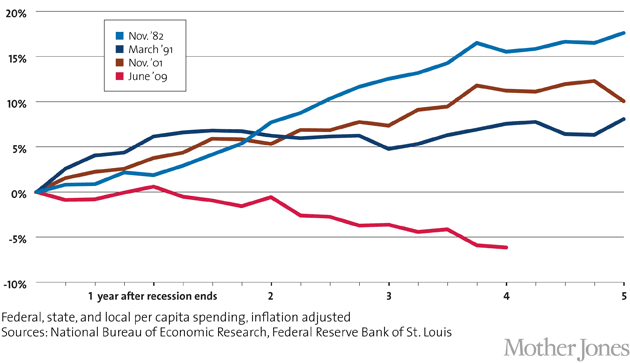
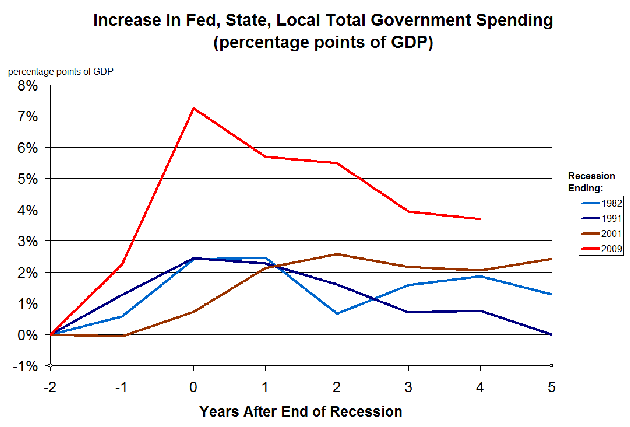
That second image tells a radically different story to the first one, doesn’t it? Hard to make that fit into the traditional definition of the word “austerity” though…
September 23, 2013
Merkel’s victory
German Chancellor Angela Merkel’s conservatives won re-election yesterday, but their Free Democrat coalition partners did not earn enough votes to retain their seats in the Bundestag, so a new coalition will may have to be formed. The Economist has more:
Angela Merkel, chancellor of Germany for eight years, seems likely to stay in office for a few more. She has won for her party, the Christian Democratic Union (CDU), a sparkling election result, with about 42% of the vote when including its Bavarian sister party, the CSU, according to exit polls and estimates. Depending on how the smaller parties fare, that may even suffice for an absolute majority of seats in parliament, allowing Mrs Merkel to govern without a coalition partner as only Konrad Adenauer, also of the CDU, did in the 1950s.
But as of the evening of this election day, September 22nd, other outcomes were still possible. For one, voters delivered a stinging rebuke to Mrs Merkel’s current coalition partner, the liberal Free Democrats (FDP). Having been thrown out of the Bavarian state parliament a week ago, and the state parliament of Hesse today, the FDP seemed likely to be ejected from the federal parliament as well. Its leadership will have to go, its message will have to be renewed, if it is to have any future in German politics.
The greatest unknown on this Sunday evening is the fate of the newest party in German politics, the euro-sceptic (as in: sceptic about the euro, not necessarily the European Union) Alternative for Germany. At 4.9% in the exit polls, it teeters on the edge of the 5% threshold necessary to get into parliament.
Earlier this year, I linked to a Zero Hedge piece which predicted if not the end of the world, the end of stability in Europe following this particular electoral outcome:
There will be nothing but lying until September 22, 2013 which is the date of the German elections. This is the drop dead date that I have been asked about for so long. Then, as soon as the celebration is over that Ms. Merkel is to remain in power, the world will turn on its axis. The status quo will disappear and there will be a “shock and horror” campaign as the Southern nations of Europe demand more help and Germany squirms and then refuses to provide it because it does not have the assets to do so.
Spain, France, Portugal, Greece, Cyprus, and even Italy are all going to line up at the trough only to discover that the promise of water was just that, a promise, and does not exist. A Biblical drought will be upon the Continent and from the political battles will emerge new alliances and new screams calling the traitors by name. The twin towers upon which the markets rest, money from nothing and fairy tale financials, will decompose in the light of this new sun and our old friend, Fear, will return to haunt us.
Let us cast our eyes toward Berlin and see whether this is prophecy or mere doom-mongering.
The growth of Canadian cities in the postwar era
Caleb McMillan has a brief history of the Canadian city after World War 2:
The end of World War 2 marks a good beginning point for this history. North American society went through some big changes and the cities reflect that. In Canada, The Canadian Mortgage and Housing Corporation was created and with it came the regulatory framework that vastly increased the government’s presence in housing. Government intervention — however — always has its unintended consequences. Post WW2, the Canadian government expanded its highway system, got involved in the mortgage business, and allowed provincial and municipal governments to plan and amalgamate city communities. Through monopoly power, central plans have a tendency to hollow out downtown cores that serve the interests of the market. The “Suburban City” is the result of government control over zoning laws and highway construction. These types of communities are sometimes very different from ones created by market means.
While high urban density can be viewed as good or bad, in terms of city functionality, density is a prerequisite for prosperity. City downtowns are market centres. Resources from the periphery are brought to market centres for trade, and within these centres live the people who deal with this market everyday. It has always been the rural farmers and trappers who were the ones on the edge of poverty — surviving the bare elements of nature to reap the rewards later in the city. The city was the centrepiece in the division of labour; a place to go to make a name of ones self. “Simple country living” that suburbia is supposed to reflect was always a Utopian dream. That somehow one could live out in the boonies yet receive the luxuries of a city.
The very idea of “simple country living” was probably an aristocratic notion that somehow took hold of the middle class imagination, because until the 20th century, only the upper classes could afford the luxury of maintaining a residence well outside the cities, yet still well-supplied with the comforts otherwise only available in the city.
This Utopian dream became a reality with the advent of the car. And with government roads, the possibility of suburbia became technically possible. But just because something is technically possible, doesn’t mean that it should necessarily be done. Market signals are the best means of discovering this information. Individual prices revealed through exchange embody information entrepreneurs use to discover consumer demand and determine scarcity. A major factor in Post WW2 Canada was exempt from this process. Roads, and the whole highway system, were already monopolized by the centralized state. The sudden profitability found in developing rural lands for residential purposes was aided by the non-market actions of building government roads.
Critics of suburban life (usually urban types themselves) are at least somewhat correct in their criticism of the suburbs:
But markets in the Suburban City are, in a way, non-existent. For many, the suburban home is an island of private life surrounded by other private islands. Everyone commutes somewhere. The suburban neighbourhood offers nothing more than residential homes, ensuring that streets remain empty and void of commercial activities. Children may play in the streets, but there is no natural adult supervision. Contrast this to a city neighbourhood, where the streets are the best places for children. With a mixture of commercial activity, residential homes, apartments and other city neighbourhoods immediately adjacent to either side — the presence of people is always guaranteed. There is a natural “eyes on the street,” where people ensure law and order through their everyday actions.
September 22, 2013
“By far the worst thing about it is the title”
In the New Statesman, Felix Salmon reviews the latest book by Tim Harford:
Harford […] has a breezy writing style and an infectious sense of humour — but he doesn’t let himself go further than a sober, conservative economist would be comfortable going. He’s trustworthy in a way that most other commentators on economics aren’t. He is not particularly interested in political arguments or in imposing his views on others — instead, he just wants to explain, as simply and clearly as possible, the way in which the economics profession as a whole usually looks at the workings of the world.
Harford, like Levitt, is a microeconomist by training and by avocation; he is most comfortable when faced with questions such as: “Why does a return train ticket on British rail cost only £1 more than a single?” Hence his Undercover Economist franchise: the conceit is that he’s an economist spying on the world, explaining things — and answering readers’ questions — in a way that only an economist would.
With The Undercover Economist Strikes Back, however, Harford has taken a leap out of his microeconomic comfort zone. By far the worst thing about it is the title. There is none of the Undercover Economist about this book, unless you include the dialogue style of writing that Harford has perfected in his FT column. And he’s not striking back at anything at all: no entity was attacking him in the first place. Even the subtitle (How to Run — or Ruin — an Economy) is problematic. No one is going to come away from reading this book convinced that they know how to run an economy.
Instead, what Harford has achieved with his new book is nothing less than the holy grail of popular economics. While retaining the accessible style of popular microeconomics, he has managed to explain, with clarity and good humour, the knottiest and most important problems facing the world’s biggest economies today.
QotD: The personal alienation of Karl Marx
Almost any Jew can be stateless, but Marx was particularly so — born of alien parents in a frontier region between Germany and France, educated in the Rhineland and in Prussia, a student at Berlin but a graduate of Jena, exiled by the age of thirty-two. Nor was this domicile chosen from any love of England or of anything but safety. He knew next to nothing of the English when he died, preferring to live among German exiles, talking German, thinking in German, and for preference writing in German. He knew of the toiling masses only from blue books and parliamentary reports. We hear nothing of his travels among the Lancashire cotton mills and as little of his talks with the London poor. There is no record of his visiting the coal mines, the docks, or even a public house. He was essentially homeless, offering no loyalty and expecting no aid. And with his scorn went hatred. He despised and loathed his rivals, quarreled with this allies and condemned all sympathizers who deviated even by a little from the doctrine he held to be sacred. Karl Marx had no country.
C. Northcote Parkinson, “Internal Contradiction”, Left Luggage, 1967.


