I don’t want to sound like a climate crank — there are more than enough of them out there, on both sides of the issue — and I’m still very much of the opinion that the question of anthropogenic global warming/climate change still needs a lot of work to answer. If human activities are causing the planet’s atmosphere to warm up in excess of what the natural feedback systems of the planet can handle, then we do need to look at ways to reduce our contribution to that warming.
Politicians and power-seeking bureaucrats jumping up and down in front of the cameras, insisting that the crisis is upon us and we need to do something now are in no way to be trusted with additional powers: without sufficient scientific evidence, we’d just be installing petty dictators over all sorts of different areas of our lives.
The specific piece of “evidence” most useful to the “do something now” faction has been the famous Hockey Stick Graph, which has been debunked. The data was carefully selected to support pre-decided conclusions. Everyone who took high school science knows the temptation . . . you know how the experiment is supposed to turn out, and who’ll know if you just write it up as if you got textbook results? The answer is . . . that’s why you do the experiment: to determine if the result matches the expectation. Skipping the whole “do the experiment” step saves time, but it’s not science.
Bishop Hill explains how the hockey stick became the best-known case of junk science in decades:
The story of Michael Mann’s Hockey Stick reconstruction, its statistical bias and the influence of the bristlecone pines is well known. McIntyre’s research into the other reconstructions has received less publicity, however. The story of the Yamal chronology may change that.
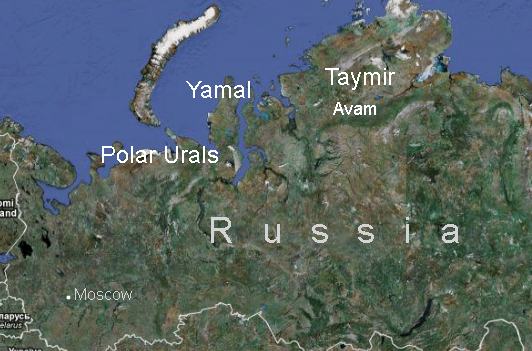
The bristlecone pines that created the shape of the Hockey Stick graph are used in nearly every millennial temperature reconstruction around today, but there are also a handful of other tree ring series that are nearly as common and just as influential on the results. Back at the start of McIntyre’s research into the area of paleoclimate, one of the most significant of these was called Polar Urals, a chronology first published by Keith Briffa of the Climate Research Unit (CRU) at the University of East Anglia. At the time, it was used in pretty much every temperature reconstruction around. In his paper, Briffa made the startling claim that the coldest year of the millennium was AD 1032, a statement that, if true, would have completely overturned the idea of the Medieval Warm Period. It is not hard to see why paleoclimatologists found the series so alluring.
Some of McIntyre’s research into Polar Urals deserves a story in its own right, but it is one that will have to wait for another day. We can pick up the narrative again in 2005, when McIntyre discovered that an update to the Polar Urals series had been collected in 1999. Through a contact he was able to obtain a copy of the revised series. Remarkably, in the update the eleventh century appeared to be much warmer than in the original – in fact it was higher even than the twentieth century. This must have been a severe blow to paleoclimatologists, a supposition that is borne out by what happened next, or rather what didn’t: the update to the Polar Urals was not published, it was not archived and it was almost never seen again.
With Polar Urals now unusable, paleclimatologists had a pressing need for a hockey stick shaped replacement and a solution appeared in the nick of time in the shape of a series from the nearby location of Yamal.
Yes, it’s long, and somewhat convoluted . . . but that is the point. Researchers were being deliberately obstructive to other researchers, concealing data necessary to reproduce the experimental results, yet publishing in numerous journals (who all should have enforced their own standards, but failed to do so) as if the data was impossible to refute.
And it was . . . because the raw data was kept out of the hands of other scientists. This is not science. It’s a deliberate fraud.
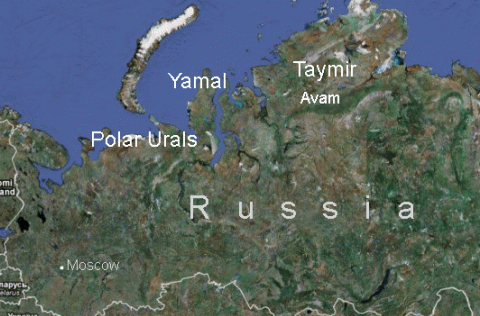
Update: JoNova adds to the story, including an image showing the relative locations of the sampled sites:
Update, the second: Tom Kelley corrects my use of the word “anthropogenic”, which I had idiotically written as “anthropomorphic”. Thanks, Tom.