The Orwell Society
Published Jun 9, 2023DJ Taylor discusses his new biography of Orwell with Les Hurst
Part 2:
The Orwell Society
Published Jun 26, 2023DJ Taylor answers questions and discusses issues raised by Orwell Society members.

The Orwell Society
Published Jun 9, 2023DJ Taylor discusses his new biography of Orwell with Les Hurst
Part 2:
The Orwell Society
Published Jun 26, 2023DJ Taylor answers questions and discusses issues raised by Orwell Society members.
Severian is on a mini-vacation at the moment, but still managed to find time to share some thoughts about Turchin’s “overproduction of elites”:

University graduation – a large crowd of students at a graduation ceremony in Ottawa, Ontario. This was the thumbnail image used on the “Elite overproduction” Wikimedia page, which seemed quite appropriate.
Photo by Faustin Tuyambaze via Wikimedia Commons.
Let us consider “the overproduction of elites”. Those who love Peter Turchin’s work love this phrase, as it finally gives a name to a phenomenon we’ve all noticed: The creation, promotion, and indeed valorization of what would more properly be called social barnacles — they don’t move, can’t change, and eventually bring whatever they infest to a complete halt. Those who dislike his work often haven’t read it, so they object to the use of the word “elite” — again, these are social barnacles; what’s elite about them?
Which is precisely Turchin’s point — “elite” is a descriptor of their lifestyle, and most importantly their self-image; it is almost perfectly opposed to their actual utility. The modern Ed Biz is set up to do little else but produce these (pseudo) elites, and therefore a kind of Say’s Law takes hold. Say’s Law, you’ll recall, is vulgarly summarized as “Supply creates its own demand,” and that’s what we see with the (pseudo) elites churned out by every college in the land — they expect, indeed they demand, “jobs” commensurate with their “education”, and thus make-work “jobs” in the Apparat are brought into being.
They take out massive student loans to get the “jobs”; they “work” the “jobs” to service the debt, and so on.
But that’s true of most “white-collar” “jobs” these days. What separates the “elites”, in Turchin’s usage, from the rest of them is not their utility, or lack thereof — the economy, such as it is, would function just as well (or not) with far fewer lawyers, accountants, insurance adjusters, and so on. The difference, comrades, is what we must call Revolutionary Class Consciousness,
stealingnationalizingsocializingliberating a phrase from Lenin.An accountant, I’d wager, views his work as a technical specialty. They’re “rude mechanicals” (that’s Shakespeare, darlin’; evidently Mr. Ringo is an educated man). Maybe not so “rude” — accountants make good scratch; they’re middle to upper-middle class, economically — but basically technicians. Accounting is a highly-trained, well-compensated job, but that’s all it is: A job. Accounting is what an accountant does; it’s not what an accountant IS. Contrast that to the overproduced “elites”, in Turchin’s sense, and you see what Turchin’s sense really means: An “elite” really IS his job title.
Note the shift: His job title. As we all know, so many of the overproduced “elite” do no meaningful work. How could they? We could easily do this for most any “job” in the Apparat, but one example will suffice. Consider “Journalist”. Formerly called “Reporter”, and back then it required some actual productive output. Some “shoe leather”, as the phrase was. To find out what they were up to at City Hall, you actually had to physically go down to City Hall and follow the Mayor around. These days — the days when Reporters are now Journalists — it’s just stenography. And not even real stenography, Claudine Gay-style stenography — the Mayor’s press secretary (who probably went to college with you) emails you a press release; you change a word or two and then reprint it, basically verbatim, under your byline.
A monkey could be trained to do it. Hell, a chatbot could be trained to do it, and that’s probably a good quick-and-dirty definition of a Turchin-style overproduced “elite”: If whatever “work” he does could easily be replaced by a chatbot, with no appreciable drop-off in either productivity or quality. Because that’s the key to understanding these people: They know damn good and well, at some almost-but-not-quite conscious level, that they’re social barnacles. That is the “base” upon which the “superstructure” — again stealing terms from Onkel Karl — of their Revolutionary Class Consciousness is built.
WW2TV
Published Dec 5, 2023A short live show where I talk about my favourite Juno Beach and Canadian focussed Normandy books
WW2TV Bookshop – where you can purchase copies of books featured in my YouTube shows. Any book listed here comes with the personal recommendation of Paul Woodadge, the host of WW2TV. For full disclosure, if you do buy a book through a link from this page WW2TV will earn a commission.
UK – https://uk.bookshop.org/shop/WW2TV
USA – https://bookshop.org/shop/WW2TV
When asked about Machiavelli’s reputation, people use terms like “amoral”, “cynical”, “unethical”, or “unprincipled”. But this is incorrect. Machiavelli did believe in moral virtues, just not Christian or Humanistic ones.
What did he actually believe?
In 1953, the British philosopher Isaiah Berlin delivered a lecture titled “The Originality of Machiavelli”.
Berlin began by posing a simple question: Why has Machiavelli unsettled so many people over the years?
Machiavelli believed that the Italy of his day was both materially and morally weak. He saw vice, corruption, weakness, and, as Berlin says, “lives unworthy of human beings”. It’s worth noting here that around the time that Machiavelli died in 1527, the Age of Exploration was just kicking off, and adventurers from Italy and elsewhere in Europe were in the process of transforming the world. Even the shrewdest individuals aren’t always the best judges of their own time.
So what did Machiavelli want? He wanted a strong and glorious society. Something akin to Athens at its height, or Sparta, or the kingdoms of David and Solomon. But really, Machiavelli’s ideal was the Roman Republic.
To build a good state, a well-governed state, men require “inner moral strength, magnanimity, vigour, vitality, generosity, loyalty, above all public spirit, civic sense, dedication to security, power, glory”.
According to Machiavelli, these are the Roman virtues.
In contrast, the ideals of Christianity are “charity, mercy, sacrifice, love of God, forgiveness of enemies, contempt for the goods of this world, faith in the hereafter”.
Machiavelli wrote that one must choose between Roman and Christian virtues. If you choose Christianity, you are selecting a moral framework that is not favorable to building and preserving a strong state.
Machiavelli does not say that humility, compassion, and kindness are bad or unimportant. He actually agrees that they are, in fact, good and righteous virtues. He simply says that if you adhere to them, then you will be overrun by more unscrupulous men.
In some instances, Machiavelli would say, rulers may have to commit war crimes in order to ensure the survival of their state. As one Machiavelli translator has put it: “Men cannot afford justice in any sense that transcends their own preservation”.
From Berlin’s lecture:
If you object to the political methods recommended because they seem to you morally detestable … Machiavelli has no answer, no argument … But you must not make yourself responsible for the lives of others or expect good fortune; you must expect to be ignored or destroyed.
In a famous passage, Machiavelli writes that Christianity has made men “weak”, easy prey to “wicked men”, since they “think more about enduring their injuries than about avenging them”. He compares Christianity (or Humanism) unfavorably with Paganism, which made men more “ferocious”.
“One can save one’s soul,” writes Berlin, “or one can found or maintain or service a great and glorious state; but not always both at once.”
Again, Machiavelli’s tone is descriptive. He is not making claims about how things should be, but rather how things are. Although it is clear what his preference is.
He writes that Christian virtues are “praiseworthy”. And that it is right to praise them. But he says they are dead ends when it comes to statecraft.
Machiavelli wrote:
Any man who under all conditions insists on making it his business to be good, will surely be destroyed among so many who are not good. Hence a prince … must acquire the power to be not good, and understand when to use it and when not to use it, in accord with necessity.
To create a strong state, one cannot hold delusions about human nature:
Everything that occurs in the world, in every epoch, has something that corresponds to it in the ancient times. The reason is that these things were done by men, who have and have always had the same passions.
Rob Henderson, “The Machiavellian Maze”, Rob Henderson’s Newsletter, 2023-12-09.
In the latest Age of Invention newsletter, Anton Howes looks at the importance of salt in history:
There was a product in the seventeenth century that was universally considered a necessity as important as grain and fuel. Controlling the source of this product was one of the first priorities for many a military campaign, and sometimes even a motivation for starting a war. Improvements to the preparation and uses of this product would have increased population size and would have had a general and noticeable impact on people’s living standards. And this product underwent dramatic changes in the seventeenth and eighteenth centuries, becoming an obsession for many inventors and industrialists, while seemingly not featuring in many estimates of historical economic output or growth at all.
The product is salt.
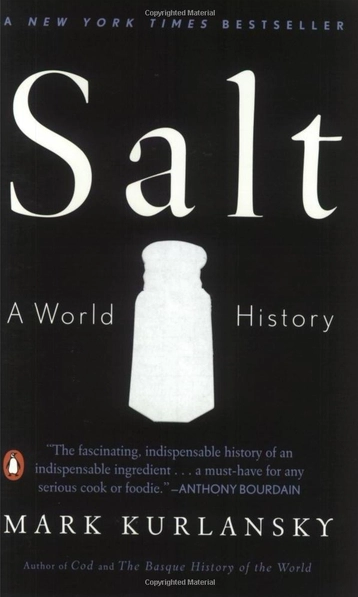
Making salt does not seem, at first glance, all that interesting as an industry. Even ninety years ago, when salt was proportionately a much larger industry in terms of employment, consumption, and economic output, the author of a book on the history salt-making noted how a friend had advised keeping the word salt out of the title, “for people won’t believe it can ever have been important”.1 The bestselling Salt: A World History by Mark Kurlansky, published over twenty years ago, actively leaned into the idea that salt was boring, becoming so popular because it created such a surprisingly compelling narrative around an article that most people consider commonplace. (Kurlansky, it turns out, is behind essentially all of those one-word titles on the seemingly prosaic: cod, milk, paper, and even oysters).
But salt used to be important in a way that’s almost impossible to fully appreciate today.
Try to consider what life was like just a few hundred years ago, when food and drink alone accounted for 75-85% of the typical household’s spending — compared to just 10-15%, in much of the developed world today, and under 50% in all but a handful of even the very poorest countries. Anything that improved food and drink, even a little bit, was thus a very big deal. This might be said for all sorts of things — sugar, spices, herbs, new cooking methods — but salt was more like a general-purpose technology: something that enhances the natural flavours of all and any foods. Using salt, and using it well, is what makes all the difference to cooking, whether that’s judging the perfect amount for pasta water, or remembering to massage it into the turkey the night before Christmas. As chef Samin Nosrat puts it, “salt has a greater impact on flavour than any other ingredient. Learn to use it well, and food will taste good”. Or to quote the anonymous 1612 author of A Theological and Philosophical Treatise of the Nature and Goodness of Salt, salt is that which “gives all things their own true taste and perfect relish”. Salt is not just salty, like sugar is sweet or lemon is sour. Salt is the universal flavour enhancer, or as our 1612 author put it, “the seasoner of all things”.
Making food taste better was thus an especially big deal for people’s living standards, but I’ve never seen any attempt to chart salt’s historical effects on them. To put it in unsentimental economic terms, better access to salt effectively increased the productivity of agriculture — adding salt improved the eventual value of farmers’ and fishers’ produce — at a time when agriculture made up the vast majority of economic activity and employment. Before 1600, agriculture alone employed about two thirds of the English workforce, not to mention the millers, butchers, bakers, brewers and assorted others who transformed seeds into sustenance. Any improvements to the treatment or processing of food and drink would have been hugely significant — something difficult to fathom when agriculture accounts for barely 1% of economic activity in most developed economies today. (Where are all the innovative bakers in our history books?! They existed, but have been largely forgotten.)
And so far we’ve only mentioned salt’s direct effects on the tongue. It also increased the efficiency of agriculture by making food last longer. Properly salted flesh and fish could last for many months, sometimes even years. Salting reduced food waste — again consider just how much bigger a deal this used to be — and extended the range at which food could be transported, providing a whole host of other advantages. Salted provisions allowed sailors to cross oceans, cities to outlast sieges, and armies to go on longer campaigns. Salt’s preservative properties bordered on the necromantic: “it delivers dead bodies from corruption, and as a second soul enters into them and preserves them … from putrefaction, as the soul did when they were alive”.2
Because of salt’s preservative properties, many believed that salt had a crucial connection with life itself. The fluids associated with life — blood, sweat and tears — are all salty. And nowhere seemed to be more teeming with life as the open ocean. At a time when many believed in the spontaneous generation of many animals from inanimate matter, like mice from wheat or maggots from meat, this seemed a more convincing point. No house was said to generate as many rats as a ship passing over the salty sea, while no ship was said to have more rats than one whose cargo was salt.3 Salt seemed to have a kind of multiplying effect on life: something that could be applied not only to seasoning and preserving food, but to growing it.
Livestock, for example, were often fed salt: in Poland, thanks to the Wieliczka salt mines, great stones of salt lay all through the streets of Krakow and the surrounding villages so that “the cattle, passing to and fro, lick of those salt-stones”.4 Cheshire in north-west England, with salt springs at Nantwich, Middlewich and Northwich, has been known for at least half a millennium for its cheese: salt was an essential dietary supplement for the milch cows, also making it (less famously) one of the major production centres for England’s butter, too. In 1790s Bengal, where the East India Company monopolised salt and thereby suppressed its supply, one of the company’s own officials commented on the major effect this had on the region’s agricultural output: “I know nothing in which the rural economy of this country appears more defective than in the care and breed of cattle destined for tillage. Were the people able to give them a proper quantity of salt, they would … probably acquire greater strength and a larger size.”5 And to anyone keeping pigeons, great lumps of baked salt were placed in dovecotes to attract them and keep them coming back, while the dung of salt-eating pigeons, chickens, and other kept birds were considered excellent fertilisers.6
1. Edward Hughes, Studies in Administration and Finance 1558 – 1825, with Special Reference to the History of Salt Taxation in England (Manchester University Press, 1934), p.2
2. Anon., Theological and philosophical treatise of the nature and goodness of salt (1612), p.12
3. Blaise de Vigenère (trans. Edward Stephens), A Discovrse of Fire and Salt, discovering many secret mysteries, as well philosophical, as theological (1649), p.161
4. “A relation, concerning the Sal-Gemme-Mines in Poland”, Philosophical Transactions of the Royal Society of London 5, 61 (July 1670), p.2001
5. Quoted in H. R. C. Wright, “Reforms in the Bengal Salt Monopoly, 1786-95”, Studies in Romanticism 1, no. 3 (1962), p.151
6. Gervase Markam, Markhams farwell to husbandry or, The inriching of all sorts of barren and sterill grounds in our kingdome (1620), p.22
Andrew Doyle‘s imaginary Social Justice Warrior known as Titania McGrath was created as a satire on some of the more extreme goings on among SJWs … today, her work can be seen as amazingly accurate prophecy of how our culture has deteriorated thanks in no small degree to the very, very woke:

“Titania McGrath” and Andrew Doyle
Today is the fifth anniversary of the publication of Titania McGrath’s acclaimed book Woke: A Guide to Social Justice. I created this intersectional activist and slam poet in order to satirise this new intolerant and authoritarian identity-obsessed religion and its stranglehold on society. Having seen so many posh and entitled activists berating working-class straight white people for their privilege, I could think of no more appropriate reaction than mockery. Even Harry Windsor was at it. And he’s an actual prince.
Five years on, and I cannot decide whether I find it funny or depressing that so many of Titania’s ideas in that book ended up becoming reality. Nothing that Titania was ever able to suggest has not eventually been outdone by real-life activists. It is as though they were reading her book for inspiration.
For instance, in a chapter from Woke entitled “Towards an Intersectional Socialist Utopia”, Titania makes the following observation:
Capitalism, after all, is a singularly male phenomenon. The ultimate symbol of capitalism, the skyscraper, is nothing more than a giant cock on the horizon, fucking the heavens.
Sixteen months after the book was published, this article appeared in the Guardian:
Or what about this passage from a chapter in Woke called “White Death”? Here, Titania calls out Hellen Keller for her white privilege:
Consider, if you will, the example of white American author Helen Keller (1880–1968). Even though she was left deaf and blind following an illness as a baby, she still managed to study for a degree, write twelve books and travel the world to give lectures. This kind of privilege is staggering.
Compare this with an article that appeared in Time magazine over a year later, in which the author writes:
However, to some Black disability rights activists, like Anita Cameron, Helen Keller is not radical at all, “just another, despite disabilities, privileged white person”, and yet another example of history telling the story of privileged white Americans.
And how about this tweet from October 2019, in which Titania had some advice for dog owners:
The subsequent outrage ensured that the tweet went viral. And just a couple of months ago, a leading pet talent agency in the UK called Urban Paws was asking owners whether their cats or dogs identified as “gender neutral” or “non-binary”.
After the backlash, the company claimed that it was a mistake. But the specific addition of a “gender identity” category on an application is hardly the equivalent of a typo.
Megan McArdle, writing as “Jane Galt”, Asymmetrical Information, 2004-12.
In UnHerd, Kat Rosenfield considers the original pick-up artist bible, The Game by Neil Strauss, in light of more than a decade of changes in how moderns approach relationships with the opposite sex:
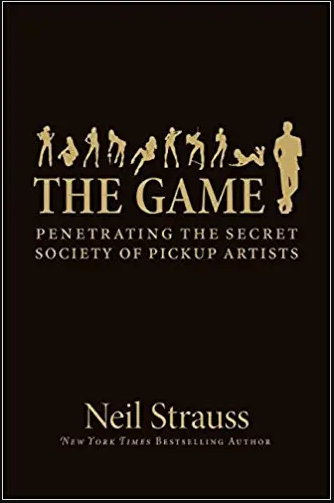
A decade letter, I’m struck by the astonishing prescriptiveness of this line: the notion that any sexual encounter preceded by flirtation, negotiation, or indeed any assessment of a suitor’s desirability should be understood as “less-than-ideal” — and that any man who seeks to make himself desirable to an as-yet-uncertain woman is doing something inherently sleazy. Granted, the anti-Game backlash began in the form of reasonable scrutiny of controversial seduction techniques like “negging” (a slightly backhanded compliment deployed for the sake of flirtation).
But since then it has morphed into something much stranger: the idea that anything a man does to impress a woman, from basic grooming to speaking in complete sentences, should be viewed with suspicion. Behind this is the same low-trust mindset that leads women to treat every date as a hunt for the red flags that reveal her suitor as a secret monster. If he compliments you? That’s lovebombing, which means he’s an abuser. If he doesn’t compliment you, that’s withholding, which also means he’s an abuser. Other alleged “red flags” include oversharing, undersharing, paying for the date, not paying for the date, being too eager, being five minutes late, and drinking water — or worse, drinking water through a straw.
Today, the turn against pick-up artistry can be understood at least in part as a reaction against some of its more prominent contemporary practitioners, including men such as Andrew Tate, who makes Mystery look like a catch by comparison. But it is also no doubt an outgrowth of a culture in which male sexuality has effectively been characterised as inherently predatory, while female sexuality is seen as virtually non-existent. The question that seduction manuals once aimed to answer — “how do I, a shy young man, successfully and confidently approach women?” — is now, in itself, a red flag, one likely to provoke anything from squawking indignation to abject horror to bystanders wondering if they ought to call the police. That you are even thinking of approaching women just goes to show what a troglodyte you really are. What do women want? The contemporary answer appears to be: to be left alone, forever, until they die — or to meet someone in a safe and sanitised way, via dating app … although even that option is increasingly positioned as inherently dangerous.
Meanwhile, I was surprised upon revisiting The Game to realise that the strategies contained within the book are not just useful but mostly in keeping with more traditional dating and courtship advice, from “peacocking” (wearing something eye-catching or unusual that can act as a conversation starter), to passing “shit tests” (responding with humour and confidence when a woman teases you). Even the much-derided negging wasn’t originally designed with the goal of insulting or belittling women, but rather to teach men how to talk to them without fawning and drooling all over the place. In the end, the message of The Game is more or less identical to the one in popular women’s dating guides, like The Rules or He’s Just Not That Into You: that confidence is sexy, and naked desperation is a turnoff.
And while this may just be a function of one too many viewings of the BBC’s Pride & Prejudice (featuring Mr Darcy, a man in possession of £50,000 a year and an absolutely legendary negging game), I wonder if the aim of seduction guides is, paradoxically, to restore our confidence in the tension, the mystery, and the playfulness of courtship in the age of the casual hookup. Even as we rightly rejoice in the fact that society no longer stigmatises women for desiring and pursuing sex, there is surely still something to be said for subtlety — and just because we aren’t consigned to the role of the passive damsel, dropping a handkerchief on the ground in the hope that the right man will pick it up, that doesn’t mean every woman wants to be horny on main. It’s not just that announcing your desire through a megaphone can seem uncouth; it’s also a lot less exciting than the dance of lingering glances, double entendres, and simmering chemistry that characterises a mutually-desired seduction in the making. Certain people might deride this brand of sexual encounter as “less-than-ideal” for its political incorrectness, but it’s wildly popular — in novels, in films, and in the fantasies of individual women — for a reason.
Meanwhile, the contemporary dating landscape is one in which the sheer fun of dating, courtship, and, yes, falling into bed together has been largely back-burnered in favour of something at once formal and immensely self-serious. In a world of handwringing over sexual consent — in which a man just talking to a woman at a coffeeshop can trigger an emergency response protocol — the stakes of sex itself come to seem unimaginably high, a breakneck gamble where one wrong move will result in a lifetime of trauma (or, if you’re a guy, a lifetime on a list of shitty men). Add to this the proliferation of dating apps, which makes the entire romantic enterprise feel more like a job search than a playground, and the whole thing begins to seem not just fraught but inherently adversarial — a negotiation between two parties whose interests are completely at odds, who cannot trust each other, and where there’s a very real risk of terrible and irreparable harm.
Chris Bray isn’t impressed with two new political books hitting the bookstores at the moment:
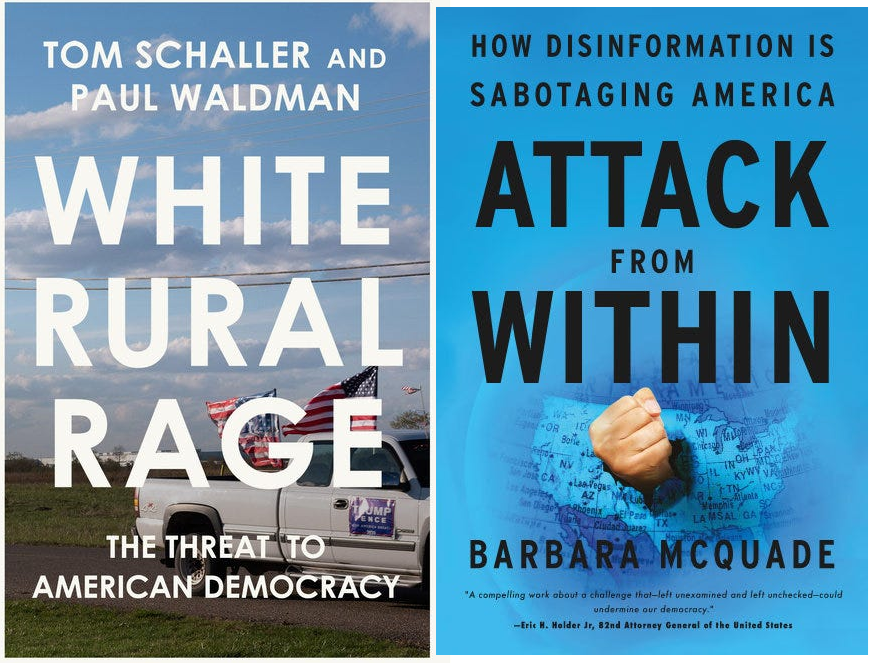
It’s an election year, so get ready. Two astonishingly dullwitted books arrived in bookstores this week, on the same day, as their dreadful authors hit the airwaves to promote them. One was White Rage: The Threat to American Democracy, about the breathtaking stupidity and backwardness of rural whites, who are destroying America. Taking care to be subtle, the publisher gave the book a cover that features a pick-up truck with an American flag and a Trump sign, leaving out only the weird kid with the banjo and the dude who shouts, “Squeal, boy! Squeal like a pig!”
And then there’s the wonderfully nuanced title Attack from Within: How Disinformation is Sabotaging America, by Obama-era US Attorney Barbara McQuade, who is now a law school professor after being asked to resign by Orange Hitler — though apparently a law school professor who is unfamiliar with the text of the 6th Amendment, thinking it exists to confer a right upon the public to have people put on trial right away.
[…]
The cover of McQuade’s book is somehow more obnoxious than the cover of White Rage:
See, it’s a giant clenched fist rising out of Middle America. Get it? Get it? It may take a moment.
These books: If, one day, by some bizarre chain of weird accidents, these are the only remnants of our civilization, no one will have the slightest idea what actually happened while we were alive. They’re miscategorized fiction. Every paragraph is full of obtuse faked reality; if you hold it up to the real world, it doesn’t even sort of match. Go click on the Amazon preview for McQuade’s book, if you’d like to see this for yourself […]
Onward: “Much of the American right glamorizes assault weapons, based on the absurd claim that the Second Amendment protects not only the right to bear arms but also the right to overthrow our government.”
My goodness, where would anyone get the claim that a founding-era American document meant to describe citizens as having a right to overthrow their government?
The Declaration of Independence, the literal founding statement of the nation that gave McQuade a government job:
We hold these truths to be self-evident, that all men are created equal, that they are endowed by their Creator with certain unalienable Rights, that among these are Life, Liberty and the pursuit of Happiness. — That to secure these rights, Governments are instituted among Men, deriving their just powers from the consent of the governed, — That whenever any Form of Government becomes destructive of these ends, it is the Right of the People to alter or to abolish it, and to institute new Government … But when a long train of abuses and usurpations, pursuing invariably the same Object evinces a design to reduce them under absolute Despotism, it is their right, it is their duty, to throw off such Government, and to provide new Guards for their future security.
Thomas Jefferson thought Americans had a right to “throw off” their government; Barbara McQuade finds it an “absurd claim”. Which one do you think understood the topic?
Of course, fraudulent scholars have always existed, but it seems to me — not that I’ve conducted a study of the matter — that clear dishonesty by leading scholars no longer elicits widespread condemnation and no longer discredits the guilty parties to the extent that it used to. The Nancy MacLean affair [her book Democracy in Chains (2017) was an extended character assassination of Nobel Prize winning economist James M. Buchanan] is clear-cut. Thomas Piketty’s work is either blatantly dishonest or spectacularly incompetent. And many other examples might be adduced. Ideology, it seems, has overwhelmed scholars in the humanities and social sciences to an unprecedented degree.
Scholars should be seeking the truth, the whole truth, and nothing but the truth, however much they appreciate that this objective can never be attained fully. They are obliged to strive. If they clearly are not trying, indeed, are twisting and turning in the ideological wind above all, real scholars should drum them out of their professions as unworthy of recognition by genuine scholars.
Bob Higgs, Facebook, 2019-08-28.
I was not aware that it has been a full twenty-five years since J.L. Granatstein published his polemical Who Killed Canadian History?:
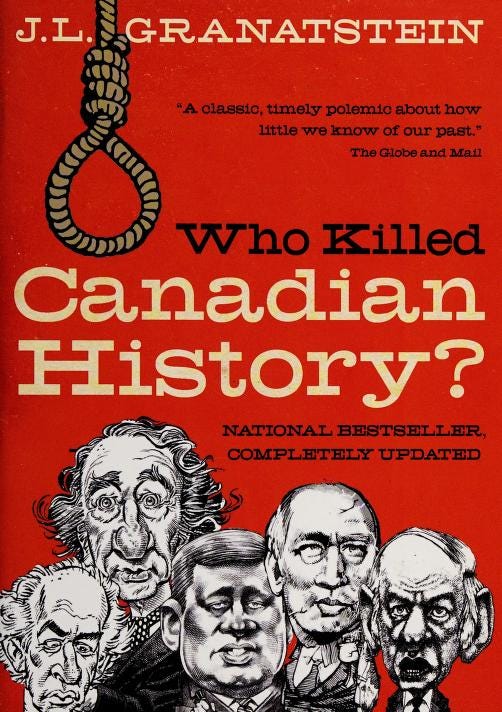
In that work, Granatstein asserts that the rationale for the history taught in Canadian schools was political, not historical. And sexism and racism were being taught, not history.
In the postmodern era, the priority of vast areas of history teaching and historiography, and Granatstein is far from the only academic who noticed this, transitioned from evidence and facts, to morals and emotions. Western oppression became the source of historiographical obsession. And the practice, which has shaped Western historiography since at least the turn of the twentieth century, of injecting moral judgements adjacent to facts and timelines, became entrenched.
This has happened because important areas of historiography, and historical pedagogy, have been subsumed into social sciences. My 9 and 11 year old children do not have a history class. What they learn about history, which isn’t much, is in a class called “social studies”. My son, who is in grade 6, and who was never previously taught anything about the Holocaust, is learning about Nazis Germany’s persecution of the Jews in the most obscure way. His introduction to the Holocaust included a lesson pertaining to the MS St. Louis, a passenger ship carrying 907 Jewish refugees fleeing Nazi persecution that was refused entry into Canada in 1939.
The ship’s Jewish passengers were safely returned to four European countries, but tragically 254 were later killed in the Holocaust. A terrible outcome. Indeed, one of the rare dark stains on Canada’s otherwise quite exemplary record of offering sanctuary to refugees. But if Canadians at the time had known that refusing entry to the MS St. Louis would result in the cold-blooded murder of 254 innocent people, would they have allowed entry? A question not raised in my son’s class.
As well, what Canadians knew or didn’t know about the genocidal ambitions of the Nazis did not come up in my son’s classroom discussions. Indeed, that would be too complex and nuanced for 12 year old’s. They also did not discuss conditions in Canada at the time that may have played a role in the consequential decision to turn away the MS St. Louis. Nor did they mention the Evian Conference, which occurred the year prior to the MS St. Louis‘ ill-fated arrival to Canada.
The Evian Conference of 1938 was held in the French resort town of Évian-les-Bains. There were 32 participating nations, including Canada, who were “to seek, by international agreement, avenues for an orderly resettlement of (Jewish) refugees from Germany and Austria”. Shockingly, at the close of the talks, none of the nations involved had offered to accept any Jewish refugees.
From the London Spectator (1938):
If the Conference has not been a complete failure, it has achieved little to boast about, all the States sympathizing and none desiring to admit refugees. Even the United States, as prime mover, offers no more than the quota.
My son did not come away from his class with an impression that Canada was not alone in its reluctance to accept refugees. This, and other such lessons, seem as if they are designed to implant a sense of revulsion over Canada’s past failures, instead of patriotism over its achievements and victories. What a disservice to young Canadian learners.
This cherry-picked event from history, which doesn’t really deal with the Holocaust, but assumes kids will appreciate related events that occurred over the backdrop of the Holocaust, is doubly misleading in that it presents Canada as a racist country hostile to refugees, before establishing that the opposite was (and is) overwhelmingly true throughout the arc of Canadian history up to the present.
It’s not even clear if my son took away from the lesson that Hitler was the far bigger villain, compared to his “racist colonial” country of Canada.
Clearly, Canada eventually let in Jewish people, and people from all ethnicities. We became the world’s first multiculturalism, and our large cities are among the most cosmopolitan and multicultural places in the world. This needs to be established first for young learners of Canada’s story. Clearly established, before one starts teaching the exceptions to the rule. But my son is getting some weird blend of oddities presented as introductory material to larger subjects which hold historical conclusions opposite to the ones the cherry-picked exceptions portray. It only makes sense that these exceptional events are selected deliberately for political, not educational, reasons.
Twenty-five years ago, Granatstein wrote of Canadian schools,
The material taught stressed the existence of anti-Aboriginal, anti-Metis, and anti-Asian racism, as well as male sexism and discrimination against women, as if these issues were and always had been the primary identifying characteristics of Canada … The history taught is that of the grievers among us, the present-day crusaders against public policy or discrimination. The history omitted is that of the Canadian nation and people.
Who Killed Canadian History? also criticized the teacher-curated practice whereby early exposure to Canadian history is random and discontinuous concerning time periods and individuals, and “without much regard for chronology”. Exactly what I have been experiencing with my kids, decades after Granatstein identified the problem.
In the latest SHuSH newsletter, Ken Whyte contrasts the wholesome intentions of the Canadian federal government on cultural issues with the gruesome reality over which they’ve presided:

Even James Moore, [Liberal cabinet minister Melanie] Joly’s Conservative predecessor in the heritage department, applauded her initiative as good and necessary, although he warned it wouldn’t be easy. Moore had wanted to do the job himself, but his boss, Stephen Harper, didn’t want to waste political capital on fights with the arts community. He told Moore his job in the heritage department was to sit on the lid.
Joly got off to a promising start, only to have her entire initiative scuppered by a rump of reactionary Quebec cultural commentators outraged at her willingness to deal with a global platform like Netflix without imposing on it the same Canadian content rules that Ottawa has traditionally applied to radio and television networks. Liberal governments live and die by their support in Quebec and can’t afford to be offside with its cultural community. Joly was shuffled down the hall to the ministry of tourism.
She has been succeeded by four Liberal heritage ministers in five years: Pablo Rodriquez, Steven Guilbeault, Pablo Rodriguez II, and Pascale St-Onge. Each has been from Quebec and each has been paid upwards of $250,000 a year to do nothing but sit on the lid.
The system remains broken. We’ve discussed many times here how federal support was supposed to foster a Canadian-owned book publishing sector yet led instead to one in which Canadian-owned publishers represent less than 5 percent of book sales in Canada. The industry has been decimated since Ottawa took an active interest in it and while federal policies haven’t been the whole problem, they’ve been vigorous contributors.
Canada’s flagship cultural institution, the CBC, is floundering. It spends the biggest chunk of its budget on its English-language television service, which has seen its share of prime-time viewing drop from 7.6 percent to 4.4 percent since 2018. In other words, CBC TV has dropped almost 40 percent of its audience since the Trudeau government topped up its budget by $150 million back in the Joly era. If Pierre Poilievre gets elected and is serious about doing the CBC harm, as he’s threatened since winning the Conservative leadership two years ago, his best move would be to give it another $150 million.
The Canadian magazine industry is kaput. Despite prodigious spending to prop up legacy newspaper companies, the number of jobs in Canadian journalism continues to plummet. The Canadian feature film industry has been moribund for the last decade. Private broadcast radio and television are in decline. There are more jobs in Canadian film and TV, but only because our cheap dollar and generous public subsidies have convinced US and international creators to outsource production work up here. It’s certainly not because we’re producing good Canadian shows.
[…]
When the Trudeau government was elected in 2015, it posed as a saviour of the arts after years of Harper’s neglect and budget cuts. It did spend on arts and culture during the pandemic — it spent on everything during the pandemic — but it will be leaving the cultural sector in worse shape than it found it, presuming the Trudeau Liberals are voted out in 2025. By the government’s own projections, Heritage Canada will spend $1.5 billion in 2025-26, exactly what it spent in Harper’s last year, when the population of Canada was 10 percent smaller than it is now.
That might have been enough money if the Liberals had cleaned up the system. Instead, they’ve passed legislation that promises more breakage than ever. Rather than accept Joly’s challenge and update arts-and-culture funding and regulations for the twenty-first century, the Trudeau government did the opposite. Cheered on by the regressive lobby in Quebec, it passed an online news act (C-18) and an online streaming act (C-11) that apply old-fashioned protectionist policies to the whole damn Internet.
This comes on top of the Liberals transforming major cultural entities, including the CBC and our main granting bodies, The Canada Council and the Canada Book Fund, into Quebec vote-farming operations. The CBC spends $99.5 per capita on its French-language services (there are 8.2 million Franco-Canadians) and $38 per capita on Canadians who speak English as the first official language. The Canada Council spends $16 per capita in Quebec; it spends $10.50 per capita in the rest of Canada. The Canada Book Fund distributes $2 per capita in Quebec compared to $.50 per capita in the rest of the country. Even if one believes that a minority language is due more consideration than a majority language, these numbers are ridiculous. They’re not supporting a language group; they’re protecting the Liberal party.
It is not that foreigners could not be found in 1949 London, which was then still a port city of some importance. In Hutchinson’s book, Elephant and Castle, set largely in the East End, one of the main characters is half-Italian, and foreigners of various nationalities have walk-on parts. But they in no way affect the strongly English character of the city. Today’s London, by contrast, seems more like a dormitory for an ever-fluctuating population than a home; even much of its physical fabric has been completely denationalized by modernist architecture of a sub-Dubai quality. It is not a melting pot, for little is left to melt into; a better culinary metaphor might be a stir-fry, the ingredients remaining unblended — though, with luck, compatible.
Theodore Dalrymple, “What Seventy Years Have Wrought”, New English Review, 2019-10-26.
Given how far race relations in the United States (and in Canada) have disintegrated since 2009, it’s almost surprising to find someone taking up arms against the race preferences and active discrimination being implemented by governments, organizations, and companies across North America, but Coleman Hughes’ first book does exactly that:
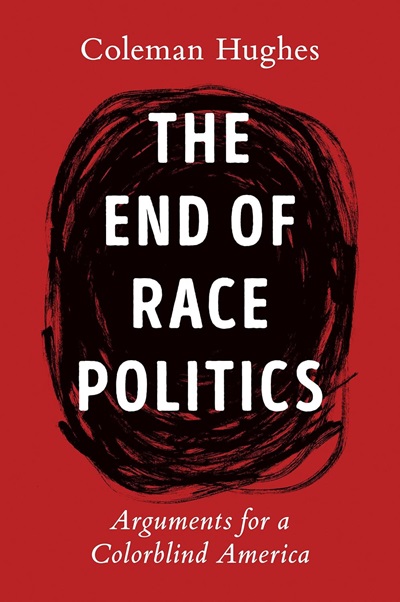
… almost as soon as the 1964 breakthrough in overcoming racial classifications took hold, it was abandoned. In a perverse echo of the past, sanctioned preferential treatment for blacks slowly began to replace sanctioned preferential treatment for whites. Set-asides, quotas, affirmative action all proliferated, all rooted in the old, crude racial classifications. The notion that affirmative action was a temporary adjustment, to be retired in a couple of decades at most, gradually disappeared. In fact, it was extended to every other racial or sexual minority and to women. Even as women and many blacks and other minorities triumphed in the economy and mainstream culture, they were nonetheless deemed eternal victims of pervasive misogyny and racism.
The more tangible the success for women and minorities, the more abstract the notion of “systemic oppression” became. Critical race theorists argued that color-blindness itself was a form of racism; and that all white people, consciously or unconsciously, could not help but be perpetuators of racial hate, whether they intended to or not. That’s how we arrived at a moment when Jon Stewart decided he’d tackle the subject of racial inequality in America by hosting a show called “The Problem With White People”, and when “The 1619 Project” actually argued that the American Revolution was not driven by a desire to be free from Britain but to retain slavery, which Britain threatened.
The poignancy of Coleman Hughes’ new book, The End of Race Politics, lies therefore in the tenacity of his faith in the spirit of 1964. “Color-blindness” is not the best description of this, because of course we continue to see others’ race, just as we will always see someone’s sex. No, as Hughes explains: “To advocate colorblindness is to endorse an ethical principle: we should treat people without regard to race, both in our public policy and private lives”.
That’s a principle the vast majority of Americans, black and white and everything else, support. It was the core principle for Frederick Douglass, Zora Neale Hurston, Martin Luther King Jr, and Bayard Rustin. “If I have advocated the cause of the colored people, it is not because I am a negro, but because I am a man,” insisted Douglass. Henry Highland Garnet — the first African-American to speak in Congress after the passage of the Thirteenth Amendment — even apologized for speaking of various different races, “when in fact there is but one race, as there was but one Adam”.
Fast forward to 2015, when the University of California called the phrase “There is only one race, the human race” a “micro-aggression”; or 2020, when the phrase “All Lives Matter” was deemed evidence of “anti-blackness”. The 21st Century, the brief era of color-blindness behind us, reached back to the 19th to insist that race defines us at our core, can never be overcome, and marks us all either an oppressor or a victim. The left, including the Democratic Party, has now adopted this worldview, along with a legal regime to actively discriminate against some races and not others: “equity”. That’s why Hughes cuts to the chase and calls these reactionaries in progressive clothing “neoracists”. They are. What else would one call them?
They are race-obsessed. They view any human interaction as a racial power-struggle, and compound it with any number of further “intersectional” power-struggles. They do not see two unique individuals with unique life experiences interacting in a free society. They see group identity as determinative everywhere; and therefore want to intervene everywhere, to discriminate against whites and successful non-whites in favor of unsuccessful non-whites. Individual rights? They come second to group identity.
[…]
One in five “black” Americans are immigrants or descended from them, Hughes observes. Only 30 percent of Asian-Americans think of themselves as “Asian” at all, rather as a member of a specific group — like Korean or Indian. Within the Asian box, you also have huge diversity: “In 2015, 72 percent of Indians over 25 had at least a bachelors degree. yet only 9 percent of Bhutanese did.” Ditto “Hispanic”. Any formula that conflates Cubans with Mexicans and Colombians is absurd. And don’t get me started on the LGBTQIA+ bullshit.
The woke also have a staggeringly crude understanding of power. Economic power? No doubt many whites have a huge edge in accumulated wealth in America; but the cultural power of African-Americans is global in reach and far outweighs the cultural clout of, say, white evangelicals or conservatives at home. Political power? Blacks, who are about 14 percent of population, are represented proportionally in the House — covering 29 states — and can claim the last two-term president, the current vice president, the House minority leader, the secretary of defense, the chairman of the Joint Chiefs, the mayors of the four most populous cities last year, and more than a fifth of SCOTUS.
For the neoracists, all racial disparities are entirely explained by “systemic racism”. But this obviously obscures the complexity of American society. “Culture” is a loaded and complex term, but it sure matters. A child with two engaged parents in the home has far more chances to succeed than a kid who barely sees his dad. Now look at the difference between family structure among many Asian-American groups and that of black Americans. And how can one blame “white supremacy” for the constant murderous mayhem of urban black spaces? Only by removing from young black men any concept of their own agency and humanity.
In the latest SHuSH newsletter, Ken Whyte discusses Indigo’s latest earnings report and points out a few things that may indicate better things to come if the firm continues its “refocus” on bookselling as its primary line of business:

“Indigo Books and Music” by Open Grid Scheduler / Grid Engine is licensed under CC0 1.0

Indigo Books & Music last week reported its third quarter financial results, covering the months of October to December 2023. Because retailers make most of their money in advance of the holiday season, Indigo’s third quarter is its most important quarter — the one that makes or breaks the year. It wasn’t good.
Revenue for the three-month period was $371 million compared to $423 million in the same period last year. Net income for the quarter was $10 million compared to $34.3 million in the prior year. Given that the company had already lost more than $40 million in the first two quarters of the year and that its fourth quarter is traditionally soft, Indigo is looking at another annus horribilis come its March 31 year end.
After every quarter, Indigo’s CEO and CFO discuss the company’s results and take questions from shareholders on a conference call. I tuned in to this quarter’s call to hear company founder Heather Reisman, recently returned as CEO, admit that it was a “challenging” time for the business. She attributed the poor performance to the ongoing repercussions of last winter’s ransomware attack, overbuys of the wrong kind of general merchandise (non-book items such as dildos, blankets, and cheeseboards), and “the premature launch of our new e-commerce platform”.
Amid all the ugly results, I heard a few things that might strike anyone interested in the Canadian book publishing industry as positive.
You’ll remember that Heather spent a few months in the doghouse last summer after announcing a terrible fiscal 2023. She retired and then un-retired in September and, on her return, pledged to take SHuSH‘s advice, clear her shelves of the dildos and cheeseboards that represent half of Indigo’s business, and recommit to selling books. I wasn’t sure if she meant it or just wanted the business community to know she was up on SHuSH. Apparently she meant it.
On the call, she spoke at length of her “transformation plan” to “connect meaningfully with book lovers”. She apparently spent the autumn shrinking her general merchandise inventory — much of the poor financial performance was due to unloading it at steep discounts. In fact, if you back out the aggressive discounting of unwanted crap, Indigo’s recent holiday season hit a slightly higher level of profitability than the prior year. Heather meanwhile reinvested in book inventory, “consistent with our long-term brand mission to inspire reading”.
I was heartened by this, more so when it emerged on the call that there are sound business reasons for recommitting to books. The printed word turned out to be Indigo’s most resilient retail channel last year. It was down only 8 percent. General merchandise was down 18.5 percent. Heather thinks general merchandise was hit especially hard because the guy she’d hired to run the place in her absence didn’t have the right assortment in stores at Christmas. That may be true, but 18.5 percent is still a big drop.
The 8 percent decline in books looks okay in relation to the rest of Canada’s retail economy. Canadian Tire just announced its results from the last quarter of 2023 and revenue was down 17 percent across the board. That suggests books more than held their own in a weak environment.
It seems reasonable to expect that if Indigo follows through on Heather’s promise and refocuses its brand and its marketing efforts and its in-store experience on books and reading, the business has a future. It will take time, as she repeatedly reminded listeners on the call. There’s still a canopy bed in the middle of the company’s flagship bookstore in Ottawa.



Powered by WordPress