
World War Two
Published 11 Sep 2021Adolf Hitler sacks Wilhelm List, Army Group Commander in the Caucasus. His replacement does not have military command experience. The fighting there is still successful this week, though, as is the advance through the suburbs of Stalingrad. The Japanese are advancing along the Kokoda Trail and on Guadalcanal, but the Axis attacks in North Africa have failed badly.
(more…)
September 12, 2021
Hitler Finally Fed Up with his Army – WW2 – 159 – September 11, 1942
Comments Off on Hitler Finally Fed Up with his Army – WW2 – 159 – September 11, 1942
September 5, 2021
This War is Three Years Old – WW2 – 158 – September 4, 1942
World War Two
Published 4 Sep 2021As the war turns three there is is no slacking in the fighting. Erwin Rommel launches another Axis attack in North Africa, but it is foiled in only days, though the Axis are advancing in the Caucasus as well as on Stalingrad, where the fight for the suburbs is now beginning. They’re also advancing in the South Pacific, as the Japanese fight their way along the Kokoda Trail.
(more…)
Comments Off on This War is Three Years Old – WW2 – 158 – September 4, 1942
August 29, 2021
Yamamoto: Midway Round Two? – World War Two – 157 – August 28, 1942
World War Two
Published 28 Aug 2021The Battle of the Eastern Solomons takes place this week — another carrier battle. As for the Germans, they’re advancing on Stalingrad, slowing down in the Caucasus, and Erwin Rommel is preparing to launch another assault in North Africa.
(more…)
Comments Off on Yamamoto: Midway Round Two? – World War Two – 157 – August 28, 1942
August 15, 2021
No Soviet Oil for Hitler – WW2 – 155 – August 14, 1942
World War Two
Published 14 Aug 2021The Axis advance into the Caucasus is going great … except the oil towns they take have no oil, and wasn’t that the whole purpose? Meanwhile in the Pacific, the US Navy is suffering perhaps its greatest defeat ever off Savo Island, even as the Marines take Tulagi, Gavutu, and Tanambogo.
(more…)
Comments Off on No Soviet Oil for Hitler – WW2 – 155 – August 14, 1942
August 8, 2021
Australia’s FAL-Based L2A1 Heavy Automatic Rifle
Forgotten Weapons
Published 21 Apr 2021http://www.patreon.com/ForgottenWeapons
https://www.floatplane.com/channel/Fo…
Cool Forgotten Weapons merch! http://shop.forgottenweapons.com
Many the nations that adopted the FAL (or L1A1, in Commonwealth terminology) opted to also use a heavy-barreled variant of the same rifle as a light support weapon. In the Commonwealth, this was designated L2A1 and it was used by Canada, Australia, and New Zealand. The Australian model was build at Lithgow and supplied to the Australian and New Zealand forces, as well as being exported to a variety of other nations including Ghana, India, Singapore, Malaysia, Papua New Guinea, and others (total Lithgow production was 9,557). It has a 21″ heavy barrel and a distinct folding bipod with wooden panels that act as handguard when the bipod is folded up. Doctrinally, the L2A1 was intended to be used in semiauto most of the time, with the bipod and heavy barrel allowing greater sustained semiauto fire than a standard rifle.
A 30-round magazine was developed and issued, but abandoned before long. It was found to be insufficiently reliable, interfered with prone shooting, and contributed to overheating of the guns. Interestingly, Australia also opted to not have an automatic bolt hold open functionality in their FAL type rifles. The control can be used manually, but the rifle does not lock open when empty. This was presumably done in favor of keeping the action closed and clean at the expense of slower reloading (the same compromise was made on the G3 family of rifles).
This particular example is a registered transferrable machine gun made on a Lithgow receiver imported by Onyx in 1985 with other Lithgow-produced parts, including a 1960 bolt, 1961 carrier, and 1961 lower receiver from an L1A1 originally exported to Malaysia.
Contact:
Forgotten Weapons
6281 N. Oracle 36270
Tucson, AZ 85740

Comments Off on Australia’s FAL-Based L2A1 Heavy Automatic Rifle
August 1, 2021
Not a Step Back! – Wehrmacht Closes in on Stalingrad – WW2 – 153 – July 31, 1942
World War Two
Published 31 Jul 2021Operation Edelweiss opens with a blast, and as the Wehrmacht closes in on Stalingrad, Stalin issues that famous order. There aren’t just big actions in the East, the Japanese have landed in New Guinea, the Allies try one more offensive at El Alamein, and the Americans have locked in on Guadalcanal.
(more…)
Comments Off on Not a Step Back! – Wehrmacht Closes in on Stalingrad – WW2 – 153 – July 31, 1942
July 25, 2021
Wehrmacht Conquers 250 Miles of Nothing – WW2 – 152a – July 24, 1942
World War Two
Published 24 Jul 2021The Soviets keep withdrawing from the advancing Axis forces, and Hitler keeps issuing contrary orders to try and stop that, with the results that logistics are getting screwed up and the mobile units are bogged down in huge traffic jams. The Allies have decided not to open a second front in Europe in 1942, but do choose another spot to begin the long counter offensive.
(more…)
Comments Off on Wehrmacht Conquers 250 Miles of Nothing – WW2 – 152a – July 24, 1942
July 7, 2021
QotD: Bad language from Down Under
Barry McKenzie, Australian at Large, made his debut in the 10 July 1964 issue of Private Eye. He was the creation of the comedian Barry Humphries, then, like a number of other creative Aussie expats, resident in London. Hero of a new strip cartoon, illustrations by Nicholas Garland, Bazza, as he would become known, was identified in this first outing as “a strapping young specimen of Australian manhood” and self-described as “an ordinary honest working-class bloke”. His first words “Excuse I, what’s gone flaming wrong?” informed readers that they were in the presence of an antipodean Candide, the classic hick, come to the big city and ready to surf on a tide of Foster’s lager into what within a year would be apostrophised as “Swinging London”.
Naive he surely was — and while over his nine-year career at the Eye he might increasingly turn the tables on the Brits, that innocence never wholly disappeared — in one respect he was omnipotent. His slang-laden, all-Australian language burst into the Eye reader’s consciousness fully-formed and quite astounding. By 1968 Bazza was offering freckle puncher, smell like an Abo’s armpit, bang like a shithouse door, dry as a nun’s nasty, point Percy at the porcelain, siphon the python and perhaps the most celebrated, the Technicolour yawn (aka the liquid laugh or the big spit).
[…]
It was also resolutely carnal: in its concentration on defecation and urination, drinking (and the seemingly inevitable vomiting it induced) and copulation (even if Bazza remains the eternal virgin), Humphries either created or collated a vocabulary that would not be rivalled until Viz magazine’s “swearing dictionary” Roger’s Profanisaurus began appearing in 1997.
Rooted, from Amanda Laugesen, director of the Australian National Dictionary Centre at the Australian National University and chief editor of the Australian National Dictionary, focuses on this side of the Australian vocabulary. Rooted comes from root, a euphemism for fuck, both literally, in the context of sex, and figuratively, as in harm, destroy, and so on. It falls into what Laugesen is happy to term “bad language”, even if one might suspect that with her formidable knowledge it is a term she knows perfectly well is a construct of tabloid moralising and empty religiosity. (Perhaps I am hardened by proximity, but I find it sad she feels the need to warn readers they will encounter the language that is the subject of her work.)
Jonathon Green, “Fair dinkum dictionary”, The Critic, 2021-04-08.
Comments Off on QotD: Bad language from Down Under
June 27, 2021
Fall Blau Starts … or Does it? – WW2 – 148 – June 27, 1942
World War Two
Published 26 Jun 2021Fall Blau, the huge Axis summer offensive in the Soviet Union, is supposed to being this, but is postponed to next. The smaller Operation Fridericus II does begin though, and what does Josef Stalin make of that and the intelligence he’s received? Meanwhile in North Africa, after the fall of Tobruk, the British 8th Army gets a leadership change, but Erwin Rommel is still on the move eastward into Egypt. Where will the Allies try to hold him? Half the world away, the Allies begin to establish a base at Milne Bay, New Guinea. It’s a start, a small one, but a start.
(more…)
Comments Off on Fall Blau Starts … or Does it? – WW2 – 148 – June 27, 1942
May 1, 2021
SMLE MkIII: The Iconic Smelly of World War One
Forgotten Weapons
Published 20 Jan 2021http://www.patreon.com/ForgottenWeapons
https://www.floatplane.com/channel/Fo…
Cool Forgotten Weapons merch! http://shop.bbtv.com/collections/forg…
In 1907, the British adopted the final major pattern in the evolution of the Short, Magazine, Lee Enfield. Designated the ShtLE MkIII (Short Lee Enfield) at the time, it would be retroactively renamed Rifle No1 MkIII in the 1920s. This new design was simpler and more durable than its predecessors while actually improving the practical accuracy of the rifle. The rear sight protector wings were substantially strengthened, the front sight became a square post, the front sight protectors were opened up to allow more light in, and the rear sight windage adjustment was simplified — while retailing 1 MOA adjustment clicks and 25m elevation adjustments. A new bayonet was also adopted in 1907 for the MkIII. The previous 1903 pattern bayonet was deemed too short, and the British essentially copied the Japanese Type 30 Arisaka bayonet as its new Pattern 1907 — hooked quillion and all.
The example we are looking at in today’s video is a fantastic specimen, as it was sold out of service to an Australian reservist in 1912 having not received any post-production modifications or updates. It is still sighted for the early MkVI round-nose ammunition, for example, and its bayonet retains the hooked quillion. The rifle’s owner died prior to World War One, and the gun remained stored away and forgotten through both World Wars, where virtually all existing service rifles were taken back into service and updated. Only in the 1960s was this one found, making it a pristine collector’s example to show how the MkIII was originally produced.
Contact:
Forgotten Weapons
6281 N. Oracle #36270
Tucson, AZ 85740

Comments Off on SMLE MkIII: The Iconic Smelly of World War One
April 29, 2021
“Tokyo Rose” – WW2 Traitor or Victim?
Mark Felton Productions
Published 28 Apr 2021This is the story of “Tokyo Rose”, a Japanese-American from LA who broadcast propaganda for the Japanese during WW2. Was she a traitor or a victim?
Dr. Mark Felton is a well-known British historian, the author of 22 non-fiction books, including bestsellers Zero Night and Castle of the Eagles, both currently being developed into movies in Hollywood. In addition to writing, Mark also appears regularly in television documentaries around the world, including on The History Channel, Netflix, National Geographic, Quest, American Heroes Channel and RMC Decouverte. His books have formed the background to several TV and radio documentaries. More information about Mark can be found at: https://en.wikipedia.org/wiki/Mark_Fe…
Visit my audio book channel ‘War Stories with Mark Felton’: https://youtu.be/xszsAzbHcPEHelp support my channel:
https://www.paypal.me/markfeltonprodu…
https://www.patreon.com/markfeltonpro…Disclaimer: All opinions and comments expressed in the “Comments” section do not reflect the opinions of Mark Felton Productions. All opinions and comments should contribute to the dialogue. Mark Felton Productions does not condone written attacks, insults, racism, sexism, extremism, violence or otherwise questionable comments or material in the “Comments” section, and reserves the right to delete any comment violating this rule or to block any poster from the channel.

Comments Off on “Tokyo Rose” – WW2 Traitor or Victim?
March 7, 2021
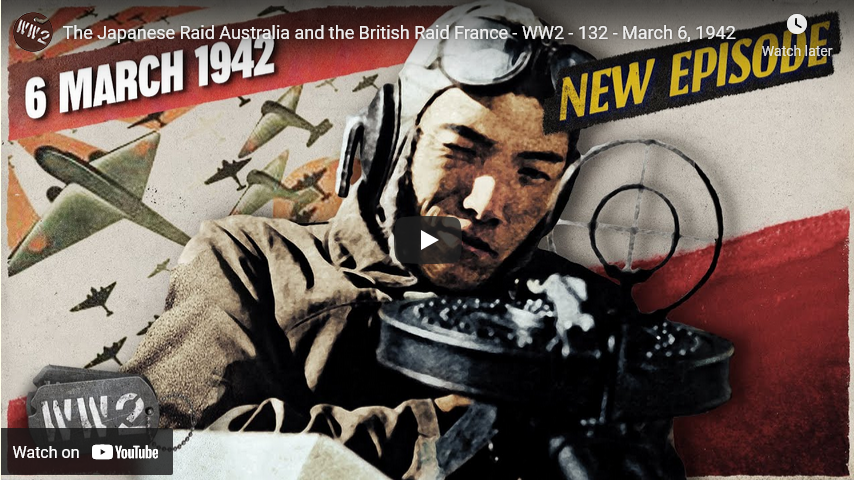
The Japanese Raid Australia and the British Raid France – WW2 – 132 – March 6, 1942
World War Two
Published 6 Mar 2021The Japanese advance in Burma continues, threatening Rangoon, and also make landings on Java and New Guinea. They even go so far as an air raid on Broome, Australia. The British are making raids of their own this week, Operation Biting against Bruneval in German-occupied France. As for the Germans themselves, 100,000 of them are still surrounded by the Red Army at Demyansk, and Hitler is told that the Soviets might have enough reserves to defend against a renewed summer offensive.
Join us on Patreon: https://www.patreon.com/TimeGhostHistory
Or join The TimeGhost Army directly at: https://timeghost.tvFollow WW2 day by day on Instagram @ww2_day_by_day – https://www.instagram.com/ww2_day_by_day
Between 2 Wars: https://www.youtube.com/playlist?list…
Source list: http://bit.ly/WW2sourcesWritten and Hosted by: Indy Neidell
Director: Astrid Deinhard
Producers: Astrid Deinhard and Spartacus Olsson
Executive Producers: Astrid Deinhard, Indy Neidell, Spartacus Olsson, Bodo Rittenauer
Creative Producer: Maria Kyhle
Post-Production Director: Wieke Kapteijns
Research by: Indy Neidell
Edited by: Iryna Dulka
Sound design: Marek Kamiński
Map animations: Eastory (https://www.youtube.com/c/eastory)Colorizations by:
– Mikołaj Uchman
– Olga Shirnina, a.k.a. Klimbim – https://klimbim2014.wordpress.com/
– Cassowary Colorizations – https://www.cassowarycolor.com/
– Norman Stewart – https://oldtimesincolor.blogspot.com/Sources:
– IWM: O1962, CH 16518, IWM A 9580, IWM A 9584
– Arrow by 4B Icons from the Noun ProjectSoundtracks from the Epidemic Sound:
– Rannar Sillard – “Easy Target”
– Jo Wandrini – “Dragon King”
– Howard Harper-Barnes – “Underlying Truth”
– Fabien Tell – “Last Point of Safe Return”
– Phoenix Tail – “At the Front”
– Howard Harper-Barnes – “London”
– Flouw – “A Far Cry”
– Johan Hynynen – “Dark Beginning”
– Wendel Scherer – “Out the Window”Archive by Screenocean/Reuters https://www.screenocean.com.
A TimeGhost chronological documentary produced by OnLion Entertainment GmbH.
From the comments:
World War Two
3 days ago (edited)
CORRECTION: In this episode, Indy says that Franz Halder estimates German losses in the USSR to be up 1.5 million by March 1st. In actuality, Halder estimated them to be 1 million. A simple brain freeze when Indy was writing the script meant that he read out the incorrect statistics on the teleprompter. The vast majority of the time, our fact-checkers ensure this doesn’t happen — unfortunately, this one slipped through the cracks.MAIN COMMENT: The Japanese are still advancing seemingly everywhere, even raiding Australia. In Europe, the German death camp system sees new facilities open this month and kicks into a higher gear.
Comments Off on The Japanese Raid Australia and the British Raid France – WW2 – 132 – March 6, 1942
February 28, 2021
Japan Destroys Allied Armada in Biggest Naval Battle in Decades – WW2 – 131 – February 27, 1942
World War Two
Published 27 Feb 2021The Japanese are advancing in the Dutch East Indies and Burma, brushing aside defenders, but their biggest victory this week is at sea, when they not only brush aside the ABDA Fleet, but literally wipe it out of existence. Meanwhile Italian and German submarines are patrolling the Caribbean, sinking any Allied merchant shipping they find. It is yet another week of Axis successes.
Join us on Patreon: https://www.patreon.com/TimeGhostHistory
Or join The TimeGhost Army directly at: https://timeghost.tvFollow WW2 day by day on Instagram @ww2_day_by_day – https://www.instagram.com/ww2_day_by_day
Between 2 Wars: https://www.youtube.com/playlist?list…
Source list: http://bit.ly/WW2sourcesWritten and Hosted by: Indy Neidell
Director: Astrid Deinhard
Producers: Astrid Deinhard and Spartacus Olsson
Executive Producers: Astrid Deinhard, Indy Neidell, Spartacus Olsson, Bodo Rittenauer
Creative Producer: Maria Kyhle
Post-Production Director: Wieke Kapteijns
Research by: Indy Neidell
Edited by: Iryna Dulka
Sound design: Marek Kamiński
Map animations: Eastory (https://www.youtube.com/c/eastory)Colorizations by:
– Mikołaj Uchman
– Norman Stewart – https://oldtimesincolor.blogspot.com/Sources:
– National Portrait Gallery
– IWM: H 17365, A_238, CB(OPS) 5008Soundtracks from the Epidemic Sound:
– Rannar Sillard – “Easy Target”
– Howard Harper-Barnes- “Underlying Truth”
– Jo Wandrini – “Dragon King”
– Fabien Tell – “Last Point of Safe Return”
– Wendel Scherer – “Out the Window”
– Reynard Seidel – “Rush of Blood”
– Brightarm Orchestra – “On the Edge of Change”
– Craft Case – “Secret Cargo”
– Phoenix Tail – “At the Front”
– Johan Hynynen – “Dark Beginning”
– Wendel Scherer – “Growing Doubt”Archive by Screenocean/Reuters https://www.screenocean.com.
A TimeGhost chronological documentary produced by OnLion Entertainment GmbH.

Comments Off on Japan Destroys Allied Armada in Biggest Naval Battle in Decades – WW2 – 131 – February 27, 1942
February 23, 2021
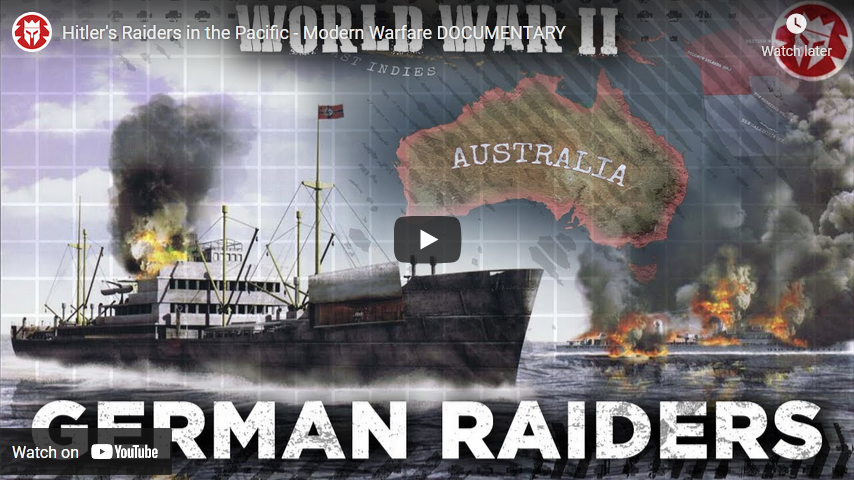
Hitler’s Raiders in the Pacific
Kings and Generals
Published 21 Feb 2021Get your free trial of MagellanTV here: https://try.magellantv.com/kingsandge…. It’s an exclusive offer for our viewers: an extended, month-long trial, FREE. MagellanTV is a new kind of streaming service run by filmmakers with 3,000+ documentaries! Check out our personal recommendation and MagellanTV’s exclusive playlists: https://www.magellantv.com/explore/hi…
Kings and Generals 3d animated historical documentary series on modern warfare continues with a video on the German naval raiding vessels which attacked Australia, New Zealand and other Allied territories in the Pacific Ocean during the early portions of World War II. This episode focuses on the exploits of Orion, Komet, Pinguin, and Kormoran, explaining how the Kriegsmarine‘s vessels attacked the targets in the Pacific Ocean, especially Nauru and its phosphate facilities.
Support us on Patreon: http://www.patreon.com/KingsandGenerals or Paypal: http://paypal.me/kingsandgenerals. We are grateful to our patrons and sponsors, who made this video possible: https://docs.google.com/document/d/1o…
The video was made by Leif Sick, while the script was developed by Ivan Moran. The video was narrated by Officially Devin (https://www.youtube.com/user/Official…)
✔ Merch store ► teespring.com/stores/kingsandgenerals
✔ Podcast ► http://www.kingsandgenerals.net/podcast/
✔ Twitter ► https://twitter.com/KingsGenerals
✔ Instagram ► http://www.instagram.com/Kings_GeneralsProduction Music courtesy of Epidemic Sound: http://www.epidemicsound.com
#Documentary #WorldWar #Raiders
Comments Off on Hitler’s Raiders in the Pacific
February 22, 2021
Australia experiments with social distancing from social media
Arthur Chrenkoff is mildly surprised to find that the Leviathan of social media — Facebook — considers his personal account to be a publisher for Australian ban purposes:

As of this morning, Australian media outlets – as well as government agencies – are not able to post anything on Facebook, and their articles and stories cannot be shared by anyone in the world using Mark Zuckerberg’s now somewhat anti-social network. This is Facebook’s retaliation for a law being introduced by the Australian government that would have companies like Facebook and Google pay Australian media outlets for having their content on their sites. Google has in fact just reached a global agreement with News Corp regarding content use, but Facebook is opting for a much more of a FU negotiating approach.
As much as I dislike Big Tech, I have so far been unable to see a good rationale for the new law. While the media keeps complaining that Facebook and Google (in particular) are monopolising the online advertising revenue, links to media stories are to my mind advertisements that drive online users to the source – and to the source’s advertisers. Perhaps it’s the media who should be paying the socials for this publicity. In the end, the war between the Big Tech and the Mainstream Media is one, to borrow from Henry Kissinger, it’s a pity that both sides can’t lose.
Apart from the fact that various health authorities around Australia are now unable to share COVID information on Facebook, the other ironic casualty of the Aust-Zuck spat is yours truly, whom Facebook has kindly deemed to be an Australian publisher, even though The Daily Chrenk media empire consists of a single ageing desktop in an inner Brisbane suburb utilised (all too rarely and irregularly) by yours truly for the love of it with no commercial element whatsoever. And so, the main avenue of promoting my new posts by sharing their links with the 1000-plus good people around the world who follow TDC page on Facebook has been (I hope only temporarily) lost to me. While it’s flattering to stand shoulder-to-shoulder with The Australian, I’m now somewhat confused: should Facebook be paying me when I voluntarily use their site to try to get eyeballs for my work? Thank you, Australian government, for thinking that should be the model.
I think the whole notion of taxing social media sites like Facebook is cracked … which might explain why the Canadian government has legislation in the works to do something similar … and earlier European attempts to extract money from the “tech giants” have always backfired. That said, I think Facebook’s retaliation is ill-advised, being both disproportional and very likely to induce other governments to look into ways to exercise more control over Facebook and other social media platforms. There are likely no winners in this dispute or the future confrontations that this will likely inform.
Comments Off on Australia experiments with social distancing from social media


