
BBC Earth Lab
Published on 23 Aug 2013James May discusses wings and propellers in these extra scenes from why boomerangs always come back.
June 21, 2018
Extra Scenes! James May Explains Boomerangs | Earth Lab
Comments Off on Extra Scenes! James May Explains Boomerangs | Earth Lab
June 16, 2018
Who will think of the children Australian civil servants???
A tale from Catallaxy Files that’s sure to tug on your heartstrings:
In Canberra today, the Australian Greens announced a new tax fairness policy to remedy a design fault in the current system.
According to the Greens, it seems that it is only Australian public servants (local, state and Federal) who have been able to negotiate salary increases. As a consequence, because of their increased salaries, public servants are constantly pushed into higher tax brackets with the result that impost of bracket creep disproportionately falls on them.
Independent economic research has confirmed this phenomena. The Australia Institute economists have models showing that up to 80% of Commonwealth bracket creep tax receipts are paid by Australian public servants.
The Australian Greens believe that just because public servants earn more than private sector workers, they should not be required to pay more tax. Australian Greens’ Treasury spokesperson Adam Bandt said:
Australian public servants should not be forced to carry the brunt of government spending, including spending on other public sector salaries. This is a role for the private sector. It is manifestly unfair that just because public servants have been able to extract additional salaries that they should be forced into higher tax brackets.
In response, the Australia Greens have announced the Tax Equalisation and Redistribution Designation (TERD). Under the TERD, full-time, part-time and casual public sector workers will be subject to a separate tax schedule with a flat 15% rate for income above $500,000. Public servant income below $500,000 will be tax free.
Of course, it would be even simpler for accounting purposes just to exempt the civil service from paying tax at all — we might expect that to be a Green Party policy plank in a year or two (or even our own NDP, who have a lot of support from our unionized civil service).
Reminder: Catallaxy Files is not a parody site … although this particular story is a parody. Not following Australian politics closely, I only twigged when they got to the acronym for the program…
Comments Off on Who will think of the children Australian civil servants???
June 5, 2018
The Landings At ANZAC Cove And Suvla Bay 1915 I THE GREAT WAR On The Road
The Great War
Published on 4 Jun 2018With thanks to Mr. Ali Serim for making this episode possible.
Indy and our guide Can Balcioglu explore the northern landings sites of Gallipoli where the Australian and New Zealand Army Corps (ANZAC) landed in 1915.
Comments Off on The Landings At ANZAC Cove And Suvla Bay 1915 I THE GREAT WAR On The Road
June 3, 2018
“[Libertarians] are the great optimists of the world”
At Catallaxy Files, Australian senator David Leyonhjelm has a guest post, covering the contents of his maiden speech:
When I became the first overt libertarian to be elected to the Australian Senate in 2013, I thought I would use my maiden speech to try and sum up my world view. In this speech, I outlined why I believe the role of governments should be limited to the protection of life, liberty and private property. I tried to highlight the importance of personal responsibility, the dangers of creeping government interference, and the fundamental right to be left alone so long as we’re not harming anyone else.
If I were to give an elevator spiel to someone who wanted to know more about libertarianism, I’d simply tell them that “a libertarian believes you should be able to keep more of your stuff and be left the hell alone”. It sounds too simple to work, but it does, and that’s what is truly great about it.
When you look at nations that slash government red tape, protect private property rights and safeguard civil liberties, you see societies where opportunity abounds, people escape from poverty, and civil society flourishes.
In fact, these policies have done more to lift people out of poverty than any government program anywhere. Free markets and free trade are responsible for one of the most remarkable achievements in human history: from 35% of the world’s population living on US$1.90 or less in 1990 to 10.7% in 2013, according to the World Bank.
As I see it, those who believe in a limited role for governments and the promotion of personal freedom, aka libertarians, are the great optimists of the world. An optimist would never dream of dictating how and when someone else should do something unless it was to prevent harm to another person. An optimist would never look at someone more successful and seek to grab some of their income or wealth. An optimist would never want to see more restrictions on our everyday lives.
Conversely, people who seek to control others, to take more of their earnings, and to redistribute it according to their values, tend to have a pessimistic view. Only a pessimist could look at society and think, we need more control over the daily lives of others. Only a pessimist would think their better off neighbours should be taxed more heavily or that their hard earned should be used on even more government programs.
A lot of the people who fall on the left side of Australian politics will probably decry the fact that I think they’re pessimists. They’ll say they’re the ones with a true and caring heart, and that redistributing wealth is a lofty goal because it helps those in need. This is demonstrably false, as all the evidence shows, but I will happily admit that such people have a heart, if not brains. The old saying, “if you’re not a socialist at 20 you have no heart, but if you’re still a socialist at 40 you have no brains”, still explains a lot.
Comments Off on “[Libertarians] are the great optimists of the world”
June 1, 2018
Pushing back the beginnings of life on Earth
In Wired, Rebecca Boyle discusses the fossil record of life and how recent discoveries keep moving the date further and further back in Earth’s history:
In the arid, sun-soaked northwest corner of Australia, along the Tropic of Capricorn, the oldest face of Earth is exposed to the sky. Drive through the northern outback for a while, south of Port Hedlund on the coast, and you will come upon hills softened by time. They are part of a region called the Pilbara Craton, which formed about 3.5 billion years ago, when Earth was in its youth.
Look closer. From a seam in one of these hills, a jumble of ancient, orange-Creamsicle rock spills forth: a deposit called the Apex Chert. Within this rock, viewable only through a microscope, there are tiny tubes. Some look like petroglyphs depicting a tornado; others resemble flattened worms. They are among the most controversial rock samples ever collected on this planet, and they might represent some of the oldest forms of life ever found.
Last month, researchers lobbed another salvo in the decades-long debate about the nature of these forms. They are indeed fossil life, and they date to 3.465 billion years ago, according to John Valley, a geochemist at the University of Wisconsin. If Valley and his team are right, the fossils imply that life diversified remarkably early in the planet’s tumultuous youth.
The fossils add to a wave of discoveries that point to a new story of ancient Earth. In the past year, separate teams of researchers have dug up, pulverized and laser-blasted pieces of rock that may contain life dating to 3.7, 3.95 and maybe even 4.28 billion years ago. All of these microfossils — or the chemical evidence associated with them — are hotly debated. But they all cast doubt on the traditional tale.
As that story goes, in the half-billion years after it formed, Earth was hellish and hot. The infant world would have been rent by volcanism and bombarded by other planetary crumbs, making for an environment so horrible, and so inhospitable to life, that the geologic era is named the Hadean, for the Greek underworld. Not until a particularly violent asteroid barrage ended some 3.8 billion years ago could life have evolved.
But this story is increasingly under fire. Many geologists now think Earth may have been tepid and watery from the outset. The oldest rocks in the record suggest parts of the planet’s crust had cooled and solidified by 4.4 billion years ago. Oxygen in those ancient rocks suggest the planet had water as far back as 4.3 billion years ago. And instead of an epochal, final bombardment, meteorite strikes might have slowly tapered off as the solar system settled into its current configuration.
Comments Off on Pushing back the beginnings of life on Earth
April 30, 2018
When “more recycling” is not the answer
Tim Worstall responds to the Australian environment minister on recycling:
Those with a modicum of economic training will be hard put to understand this story out of Australia. Recycling plastics has just got more expensive. So, therefore, the Federal environment minister, Josh Frydenburg, is insisting that everyone must recycle plastics more.
What? Even, whut?
No, no, demand curves slope downwards, when things become more expensive we do less of them, not more. It’s only in religion that we are urged to do even more of the more difficult things. Maybe that is it, we waste more money on plastics therefore we’re worshipping Gaia harder or something. Otherwise this is simply mad:
Plastic packaging on fresh food, groceries and a range of other items will be banned within seven years to cope with Chinese restrictions on Australian recyclables.
State and federal environment ministers held crisis talks in Melbourne yesterday and agreed to prioritise the development of a larger domestic recycling market, with Queensland councils alone expected to face a combined bill of more than $50 million in the face of the new Chinese restrictions.
China has decided, rightly or wrongly – I think wrongly but there it is – that they’ll not take plastic waste from outside the country. That means that everywhere else needs to work out what to do with the stuff they collected and used to send to China. OK, obviously, some sort of response is necessary. But more recycling isn’t it:
We need a national accounting system in which the cradle to the grave costs of waste are borne by the generators of it. We would do well to emulate Germany’s system. Producers and distributors are obliged to take back used packaging. This has resulted in a large reduction of packaging, and the development of a waste management industry which employs about 200,000 people. Municipal solid waste landfill has been reduced to virtually zero.
There’s the make work fallacy at play. Having 200,000 people handling waste is a cost, not a benefit, for that’s the labour of 199,997 more people being used than simply tipping it all into a furnace or a hole in the ground would require. And therefore we’re poorer by the loss of what those 199,997 people would produce if it weren’t for their worshipping Gaia for us.
[…]
As above the only reason I can think of to increase recycling as the costs of it also increase is because people are in the grip of a religious mania. Which isn’t, as much of history shows us, a great way to run a country really, religious mania.
Comments Off on When “more recycling” is not the answer
April 22, 2018
How to begin solving the common problems of big cities
Vladimir “Zeev” Vinokurov is writing about Australian cities in particular, but the same general analysis applies to many Canadian, American, and British urban areas as well:
… our economy and population are growing, and the resulting congestion is costing us thousands of dollars per year individually, and billions to the economy. It isolates us from family, friends and work. But cities can still grow without getting us stuck in traffic, missing increasingly overcrowded and delayed trains, or left unable to afford property. All this is happening because workplaces are too far from residents living in the suburbs, which effectively funnels residents into the inner city for work. It must change.
First, we must unwind planning laws that prevent offices, homes and apartments from being constructed alongside each other and throughout the city. These laws also raise housing prices by hundreds of thousands of dollars. Second, instead of banning cars, charge commuters for using congested roads and trains. Third, stop supporting taxpayer funded ‘road to nowhere’ infrastructure projects. These reforms will cut congestion, grow the economy, cut living costs and reconnect us to family, friends and local communities.
Planning laws cause congestion and social isolation by preventing people from building apartments and commercial offices throughout our city. As a result, rents and property prices become dearer because not enough housing is built to accommodate demand from population growth. Indeed, Reserve Bank economists estimate that planning laws increase average property prices by hundreds of thousands of dollars. This drives residents into the outer suburbs to look for cheaper housing, even as they commute into the inner city for work. If more people lived close-by to their workplaces, commutes would be shorter.
We need multiple CBDs, not just one. Unwinding planning laws that prevent commercial growth outside the CBD will cut housing costs and rents, cut congestion and promote tightly knit, thriving urban communities.
Congestion also occurs because we pay for using roads and public transport with thousands of dollars of time every year, rather than money. Congested public roads or trains cost us no more money to use in peak times, and busier routes cost no more to use than empty ones. As a result, the Grattan Institute think tank estimates that the average Melbournian’s commute to the city is twice as long in peak time. By contrast, Sydney’s trains are less congested, but are used more widely compared to Melbourne’s because its tickets are dearer in rush hour. Congestion charges that reflect market demand for infrastructure will also encourage businesses to open in commercial districts outside the CBD. Reconnecting local commuters with local workplaces will save us time and money overall.
Congestion charges are also a fairer and cheaper way of funding infrastructure projects compared to taxes like fuel tax or stamp duty. Scrapping these two taxes could save property purchasers tens of thousands of dollars or more, and reduce petrol bills by at least a third. If we pay for congested roads and trains with money rather than time and taxes, we may end up paying less.
Comments Off on How to begin solving the common problems of big cities
April 13, 2018
India and the “Quad”
At Strategy Page, Austin Bay discusses India’s position, both geographically and militarily with respect to China:
As the Cold War faded, a cool aloofness continued to guide India’s defense and foreign policies. Indian military forces would occasionally exercise with Singaporean and Australian units — they’d been British colonies, too. Indian ultra-nationalists still rail about British colonialism, but the Aussies had fought shoulder to shoulder with Indians in North Africa, Italy, the Pacific and Southeast Asia, and suffered mistreatment by London toffs. Business deals with America and Japan? Sign the contracts. However, in defense agreements, New Delhi distanced itself from Washington and Tokyo.
The Nixon Administration’s decision to support Pakistan in the 1971 Indo-Pakistani War [Wikipedia link] embittered India. Other issues hampered the U.S.-India relationship. Indian left-wing parties insisted their country was a “Third World leader” and America was hegemonic, et cetera.
However, in the last 12 to 15 years, India’s assessments of its security threats have changed demonstrably, and China’s expanding power and demonstrated willingness to use that power to acquire influence and territory are by far the biggest factors affecting India’s shift.
In 2007, The Quad (Quadrilateral Security Dialogue), at the behest of Japan, held its first informal meeting. The Quad’s membership roll sends a diplomatic message: Japan, Australia, America and India. Japan pointed out all four nations regarded China as disruptive actor in the Indo-Pacific; they had common interests. Delhi downplayed the meeting, attempting to avoid the appearance of actively “countering China.”
No more. The Quad nations now conduct naval exercises and sometimes include a quint, Singapore.
The 2016 Hague Arbitration Court decision provided the clearest indication of Chinese strategic belligerence. In 2012, Beijing claimed 85 percent of the South China Sea’s 3.5 million square kilometers. The Philippines went to court. The Hague tribunal, relying on the UN Convention on the Law of the Sea treaty, supported the Filipino position that China had seized sea features and islets and stolen resources. Beijing ignored the verdict and still refuses to explain how its claims meet UNCLOS [Wikipedia link] requirements.
That is the maritime action. India and China also have mountain issues. In 1962, as the Cuban Missile Crisis diverted world attention, the two Asian giants fought the Indo-Chinese War [Wikipedia link] in the Himalayas. China won. The defeat still riles India.
Comments Off on India and the “Quad”
April 3, 2018
QotD: How to win a trade war
Spartacus has had enough. He has been taken advantage of for too many years and he has suffered trade deficits for far too long. Complaints to the regulators have fallen on deaf ears so now time has come to take the necessary action to put this to an end.
For far too long, Spartacus has run a significant trade deficit with Woolworths and Coles; not only for groceries but for petrol also.
Spartacus keeps buying things from Woolworths and Coles but they never buy anything from him. Those bastards even occasionally “dump” products in their stores meaning that Spartacus can buy groceries for less than he would normally. This is completely unsatisfactory.
Effective immediately, pursuant to SEO 1 (Spartacus Executive Order 1), Spartacus has declared a trade war on Woolworths and Coles. Hence forth, rather than buying quality and (relatively) well priced groceries from these trade cheaters, Spartacus will grow his own fruit, vegetables and meat. And rather than buying petrol, Spartacus will walk or otherwise ride his 2 wheeled chariot. Importantly also, when it comes to paper products, particularly of the toilet paper variety, well, the Fairfax papers will be used for their natural purpose.
Yes. Spartacus will have less leisure time, less disposable income and less grocery choice, but he will no longer have a trade deficit with Woolworths and Coles. This is a trade war Spartacus can win.
And if a sore “butt” comes to pass, what would be colonic damage. Sorry. Collateral damage.
“Spartacus”, “Spartacus’ Trade War”, Catallaxy Files, 2018-03-11.
Comments Off on QotD: How to win a trade war
March 14, 2018
“[Jordan Peterson has] been described as ‘rightwing’ or ‘far right’ by journalists who have apparently forgotten how to think”
In The Guardian, Gareth Hutchens discusses the rise of Jordan Peterson:
Professor Jordan B Peterson is not yet a household name in Australia.
But he’s in the middle of a speaking tour that has found an enthusiastic audience. All four speaking events have sold out, including his Sydney and Brisbane shows this week. Organisers know they could have booked more venues.
Why are Australians paying to hear him talk?
Peterson loathes identity politics, rails against postmodernism and “neo-Marxism”, and despises gender studies and political correctness. He asserts the biological differences between men and women, and delivers pep talks on how to live a meaningful life and how to find the right partner.
He gives lectures on the truths embedded in myths and legends that are thousands of years old.
To appreciate where he’s coming from, it helps to be familiar with Nietzsche and Dostoevsky and their premonition that the death of mass belief in God would lead to nihilism and/or the rise of totalitarian value systems as alternatives.
I’ve watched Peterson’s online lectures for a while now, after he became an internet celebrity in late 2016.
It’s been fascinating witnessing media outlets trying to come to terms with him. He’s been described as “rightwing” or “far right” by journalists who have apparently forgotten how to think.
Does he belong to the far right because he loathes political correctness, identity politics and postmodernism? Noam Chomsky has made similar criticisms for decades. As did Christopher Hitchens.
Is it rightwing to lament the damage done to the left by the increasing tendency of leftist students on North American campuses to harass people who challenge their ideological orthodoxy? Nicholas Christakis, a sociologist and physician from Yale University, who is a self-confessed progressive, says he can’t understand their behaviour. Bret Weinstein, a former biology professor of Evergreen State College, says he can’t understand it either. He considers himself “deeply progressive” but he says the left is “eating itself.”
Peterson deserves to be taken seriously.
Comments Off on “[Jordan Peterson has] been described as ‘rightwing’ or ‘far right’ by journalists who have apparently forgotten how to think”
March 7, 2018
USS Lexington‘s final resting place discovered by Paul Allen’s RV Petrel
As reported by News Corp Australia:

U.S. Navy Martin T4M-1 aircraft of Torpedo Squadron 1B (VT-1B) are launching from the deck of the aircraft carrier USS Lexington (CV-2) in 1931. Note the “four-stacker” (Clemson/Wickes-class destroyer) in the upper right corner.
US Navy photo via Wikimedia.
Now, 76 years after it settled to the bottom, it’s been found.
It’s the latest find by billionaire Paul Allen.
And it’s in a remarkably well preserved condition.
Soon-to-be US ambassador to Australia, US Pacific Commander Admiral Harry Harris says he is elated at the find.
“As the son of a survivor of the USS Lexington, I offer my congratulations to Paul Allen and the expedition crew of Research Vessel Petrel for locating the ‘Lady Lex’,” he said in a tweet.
[…]
Paul Allen’s research vessel Petrel located the wreck of the USS Lexington yesterday.
According to a post on the philanthropist’s website, it rests some 800km off the coast of Queensland at a depth of about 3km.
The find was the result of a six month project.
Photos so far returned by RV Petrel’s submersible show several aircraft that have tumbled out of the carrier and on to the ocean’s floor. Their original markings and paintwork remain remarkably clear.
The ship itself, while showing heavy scarring from the battle and the stresses of diving 3km to the sea floor, is also well preserved. Gun mounts and other fittings show only little sign of corrosion and deterioration.
Vulcan Inc.
Published on 5 Mar 2018Wreckage from the USS Lexington was discovered on March 4, 2018 by the expedition crew of Paul G. Allen’s Research Vessel (R/V) Petrel. The aircraft carrier, “Lady Lex” was found more than 3,000 meters below the surface, resting on the floor of the Coral Sea more than 500 miles off the eastern coast of Australia.
Comments Off on USS Lexington‘s final resting place discovered by Paul Allen’s RV Petrel
February 27, 2018
Australian Prototype Jungle Carbine Enfields
Forgotten Weapons
Published on 24 Mar 2017Shortened No1 Mk3*: Sold for $6,900 – http://jamesdjulia.com/item/1655-396/
No6 Mk1: Sold for $12,075 – http://jamesdjulia.com/item/1652-396/
No6 Mk1/1: Sold for $12,650 – http://jamesdjulia.com/item/1651-396/In 1943, experimentation began in Great Britain, Canada, and Australia into developing a shortened and lightened version of the Lee Enfield rifle. In Australia, the work was done on the No1 Mk3* rifle, as the Lithgow Arsenal had never switched over to production of the No4 rifle.
We have three experimental prototype carbines from Lithgow to look at today. The first is simply a shortened SMLE, with no serious effort given to reducing weight. This rifle is visually very similar to the commercial SMLE “Jungle Carbines” marketed by a number of companies, although the real one here has several features missing form the commercial copies – most notably a simple rear aperture sight.
The other two are examples of the two types of rifle that were ultimately considered for formal adoption (and a large order for one was actually placed, before being cancelled at the end of WW2). These are designated the No6 Mk1 (with a rear aperture sight) and the No6 Mk1/1 (with a rear tangent sight). Approximately 100 of each were made, half with brass buttplates and half with rubber recoil pads. In this form, slightly more than a pound was removed from the standard SMLE, and the reduced length did make for a handier rifle. The Australian need for this type of carbine was removed with the end of the war, although in Great Britain the No5 Mk1 carbine – the same in practical terms as these Australian examples – would be taken into formal service for several years.
Comments Off on Australian Prototype Jungle Carbine Enfields
February 14, 2018
Viral mapping by Sasha Trubetskoy
Have you seen this map by Sasha Trubetskoy?
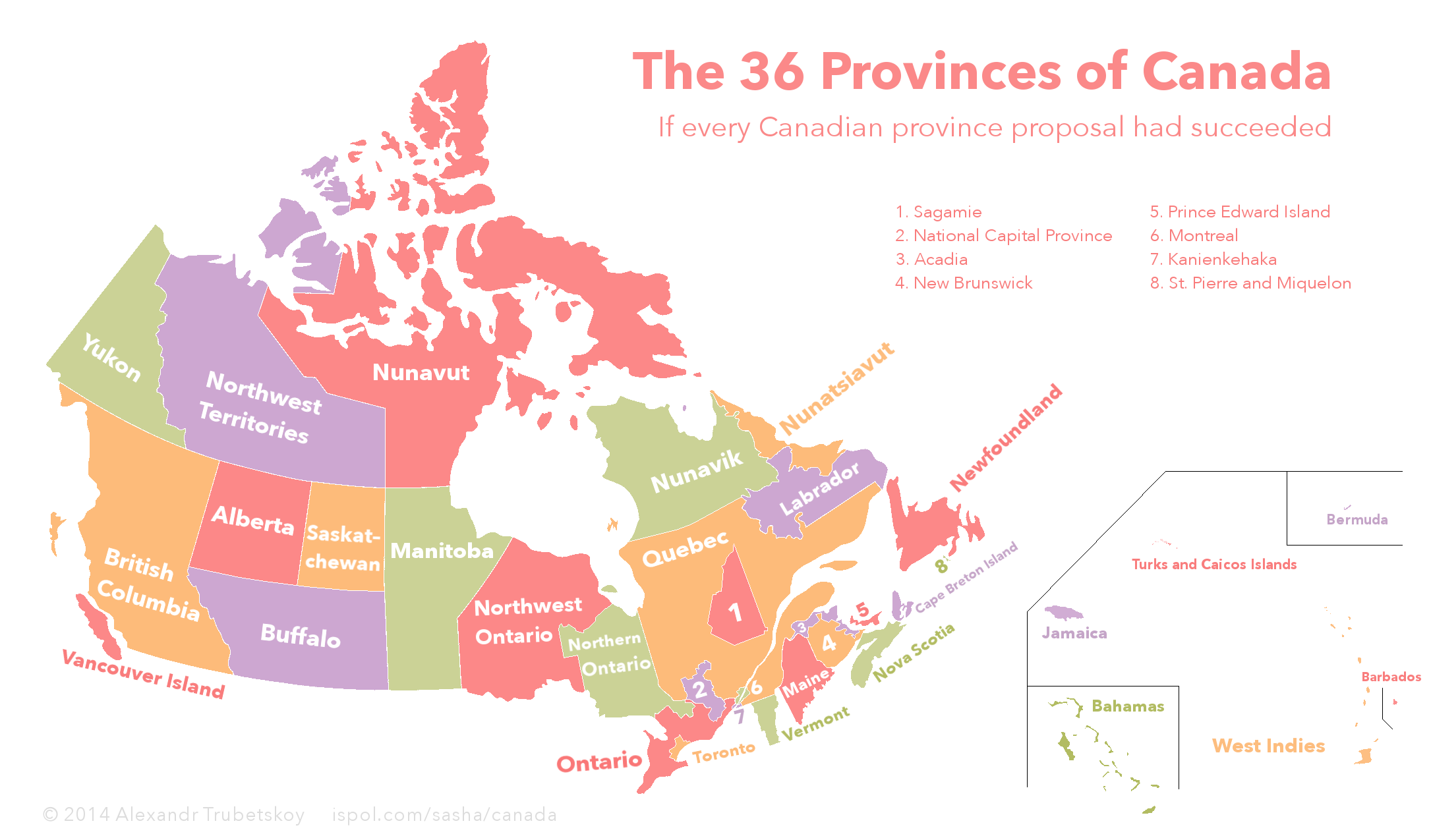
Click to embiggen.
It wasn’t the first time one of his maps went viral, but it provided him a key insight into getting his maps in front of a large number of people:
I learned from Reddit that if a Canadian sees something that mentions Canada, they will upvote out of solidarity. You can game that. So I made a map of every Canadian province, if every Canadian province proposal had succeeded. Not many people know Jamaica was going to be part of Canada. That map got me on Huffington Post Canada.
I was like, Canada worked, let’s try Australia. Same idea, every Australian state proposal. That worked too.
A very popular recurring theme in viral maps is a fictional subway network of some sort. I can see why people like that. It’s cute, it’s bright colors, everything’s nice and organized, it’s fun to look at.
Somehow I stumbled upon the idea of representing the ancient Roman road network. I tried to make it look like a modern publication that the actual Roman Empire would have, like little leaflets at the train station. The map is in Latin. I don’t know Latin, but I have a knack for picking up little bits and pieces, maybe born out of necessity from my childhood. My parents come from Moscow, and at home we only spoke Russian. My grandma speaks French.
Latin has six cases, Russian has six cases, and they’re essentially the same. I had an intuition, like, how would I say this in Russian? Then replace the words with Latin. It turns out that’s a fantastic way of doing it.
H/T to Colby Cosh for the link.
Comments Off on Viral mapping by Sasha Trubetskoy
February 12, 2018
Australia’s unique contribution to hamburger culture – beetroot
On one of my mailing lists, an Australian member made a bit of a to-do about the only “proper” burger having “beetroot” on it, along with other (one assumes lesser) condiments. Having been pranked more than once by Aussie friends, I was sure he was just doing his bit to wind up the American burger purists on the list. Yet, a very cursory search produced this article from back in 2014 that appears to fully back the original assertion:
Australian hamburger sightings started during the ’30s: a by-product, no doubt, of our blossoming post-first world war relationship with America, but it wasn’t until the 1940s that beetroot began regularly appearing alongside tomato, lettuce and onion on burgers. That was thanks largely to the openings of the Edgell and Golden Circle canneries in 1926 and 1947 respectively – but one of the more interesting theories, however, suggests the trend has its origins in pranking US troops ashore on R&R.
“Maybe it was our desire not to be Americanised?” ponders Warren Fahey, Australian folklore collector and author of Australian food history compendium, Tucker Track. “For some reason the idea of hamburger wrapping stained by beetroot juice was accepted as the sign of a great hamburger. People get quite emotional over the subject of Australian hamburgers. Some say a real hamburger must have slices of canned beetroot and others still declare its inclusion as a travesty.”
According to Fahey, beetroot on burgers had its heyday in the ’50s and ’60s. Following the simultaneous 1971 arrival of fast food’s big two – the first McDonald’s opened in the Sydney suburb of Yagoona, while Hungry Jacks, the Aussie nom de plume of Burger King, began its Aussie campaign in Innaloo, just north of Perth – the combination’s popularity began to wane, as did that of milk bars, beachside kiosks and other traditional hamburger vendors.
Despite the sustained growth of American franchises, however, Australia’s burger-with-beetroot population remains stable. Even once the big players pull their seasonal go-Aussie burgers after 26 January, the odds of finding a beetroot-enriched specimen at a neighbourhood lunch bar or new-wave “gourmet” hamburger chain remain good.
[…] the country’s last Australian-owned cannery shut in 2013. Fortunately, the signs are promising that farmers in Queensland’s Lockyer Valley might soon have a processing facility to call their own. It’s a cause we can all get behind, not just for the sake of a rural Australian community, but in the name of national pride: an Aussie hamburger made using beetroot processed overseas just doesn’t seem fair dinkum.
A New Zealand member of the list also chimed in, saying that beetroot was an essential component of Kiwi hamburgers as well. While it might sound weird, it’s probably no more so than pickles or relish as a burger topping, once you get used to it.
Update: In 2017, New Zealand McDonald’s re-introduced the Kiwiburger, including beetroot:

So, you can get your beetroot burger fix in both Australia and New Zealand (for a limited time, anyway).


