
The Korean War by Indy Neidell
Published 12 Nov 2024MacArthur’s forces struggle to make sense of the recent Communist Chinese intervention in Korea, especially when the Chinese vanish as quickly as they arrived. Back in the US, the war’s popularity has reached an all-time low on the eve of the crucial 1950 midterm elections. Is MacArthur about to pay the price for his failure to deliver results on the ground?
Chapters
00:00 Intro
01:01 Recap
01:24 The Chinese Vanish
02:37 The East
04:35 The US Situation
11:28 Bombing the Yalu
13:03 Summary
13:23 Conclusion
14:26 CTA
(more…)
November 13, 2024
The Korean War Week 21 – US Elections Threaten MacArthur! – November 12, 1950
Comments Off on The Korean War Week 21 – US Elections Threaten MacArthur! – November 12, 1950
November 12, 2024
Type 92 Japanese HMG
Forgotten Weapons
Published Mar 9, 2015The Type 92 was the final iteration of a machine gun that began as the Model 1897 Hotchkiss HMG made in France. The Japanese army purchased many of these guns, and then produced their own slightly refined version. These in turn were replaced by the updated Type 3 (1914) heavy machine gun, and finally the Type 92 (1932). A lightened upgrade to the Type 92 was prototyped (the Type 1, 1941), but never went into production. Mechanically, the Type 92 is very much like a scaled-up Type 11 light machine gun, using 30-round strips to feed. Despite being generally derided today, these machine guns were very reliable, accurate, and effective. This particular one happens to have a 7mm Mauser barrel in it, from a South American contract.
http://www.forgottenweapons.com
Theme music by Dylan Benson – http://dbproductioncompany.webs.com
Comments Off on Type 92 Japanese HMG
November 10, 2024
WW2 in Numbers
World War Two
Published 9 Nov 2024World War II wasn’t just the deadliest conflict in history — it was a war of unprecedented scale. From staggering casualty numbers to military production and economic costs, this episode breaks down the biggest statistics that defined the global conflict.
(more…)
Comments Off on WW2 in Numbers
November 9, 2024
Did US Indecision Encourage Stalin in Korea?
The Korean War by Indy Neidell
Published 8 Nov 2024In March 1950, Stalin finally approves Kim Il-sung’s plans for an invasion of South Korea. But why now? Today Indy looks at the wider Cold War context that fed into Stalin and Mao Zedong’s decision making. He also examines whether the lack of a clear and public commitment from the US to defend the Asian theatre helped to invite the invasion.
(more…)
Comments Off on Did US Indecision Encourage Stalin in Korea?
November 7, 2024
Forgotten War Ep4 – Rise of the Chindits
HardThrasher
Published 4 Nov 2024Please consider donations of any size to the Burma Star Memorial Fund who aim to ensure remembrance of those who fought with, in and against 14th Army 1941–1945 — https://burmastarmemorial.org/
(more…)
Comments Off on Forgotten War Ep4 – Rise of the Chindits
November 6, 2024
The Korean War 020 – American Disaster at Unsan! – November 5, 1950
The Korean War by Indy Neidell
Published 5 Nov 2024American forces drive onwards, almost oblivious to the emerging Communist Chinese threat. At Unsan, an American regiment finds itself at the mercy of two Chinese divisions, who bear down on it from three sides. Getting out before being overrun will be no easy feat.
Chapters
01:18 Destruction of the 7th
03:41 Unsan Prelude
05:41 The Disaster at Unsan
10:47 Aftermath
13:31 Elsewhere
16:15 Summary
16:30 Conclusion
(more…)
Comments Off on The Korean War 020 – American Disaster at Unsan! – November 5, 1950
November 4, 2024
Ujjal Dosanjh blames Justin Trudeau for the rise of Sikh extremism in Canada
The Liberal Party normally manages to avoid having any internal differences come to public attention, so having a former Liberal cabinet minister come out and directly criticize Prime Minister Justin Trudeau is rather noteworthy:
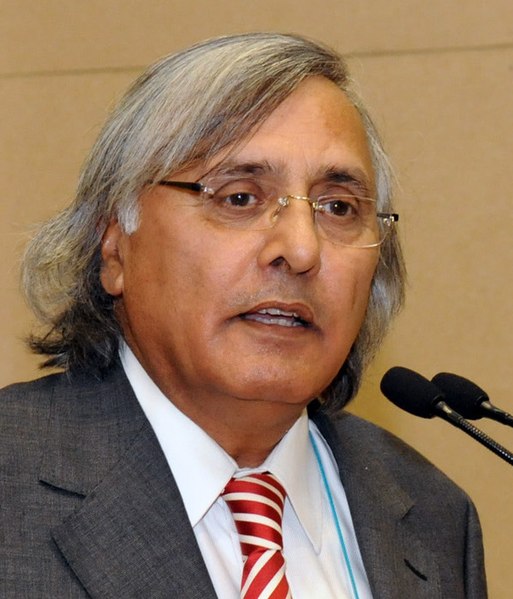
Ujjal Dosanjh speaking at the 12th Pravasi Bharatiya Divas – Engaging Diaspora Connecting Across Generation, in New Delhi on January 08, 2014.
Photo by the Ministry of Overseas Indian Affairs (GODL-India) via Wikimedia Commons.
“A silent majority of the Sikhs do not want to have anything to do with Khalistan. They just don’t speak out because they’re afraid of violence and violent repercussions,” reports Ujjal Dosanjh, as a Sikh living in Vancouver, B.C.
The call for a separate Sikh homeland in Punjab, India — to be called Khalistan — has been brewing since the 1930s, when British rule in India was nearing its end. Although the movement now has marginal support in India, it has taken wings in Canada and escalated into the present derailing of relations between two friendly Commonwealth democracies, India and Canada.
Unlike many of his Sikh peers in Canada, Ujjal — a former NDP premier of British Columbia and a former federal cabinet minister under Liberal prime minister Paul Martin — isn’t afraid to speak out. He’s been extremely vocal, especially since 1985; that’s when the bombing of Air India Flight 182 by Khalistani extremists, killing 329 people, brought the separatist movement to Canada.
Ujjal, now 78, has faced death threats from extremists but remains unwavering in his determination to convince fellow Canadians that the overwhelming majority of the nearly 800,000 Sikhs in Canada do not support the Khalistani movement. “I’d say less than five per cent, less than five per cent,” he emphasizes.
[…]
While accountability for this violence is an imperative, the purpose of my conversation with Uijal is not to sift through the evidence and intelligence. What I want to understand is how we got to this place where Canada’s Sikh population, the largest Sikh diaspora in the world, has in effect been co-opted by the Khalistanis to the point where this obscure separatist movement has become a Canadian problem.
Without hesitation, Ujjal points to Prime Minister Justin Trudeau.
For two reasons, Ujjal blames Trudeau: “One, he’s never really understood the vast majority of Sikhs are quite secular in their outlook, despite the fact that they go to the temple,” he says. And the second reason: “Khalistanis are not a majority, and the fact nobody speaks against them is out of fear”. Through intimidation, Ujjal elaborates, Khalistani supporters control many of the temples in Canada. And it’s Trudeau’s fault, he asserts, “that Canadians now equate Khalistanis with Sikhs, as if we are all Khalistanis if we’re Sikhs”.
Comments Off on Ujjal Dosanjh blames Justin Trudeau for the rise of Sikh extremism in Canada
October 30, 2024
The Korean War 019 – The Chinese Threat Revealed! – October 29, 1950
The Korean War by Indy Neidell
Published 29 Oct 2024Communist Chinese forces make themselves known on the battlefield in a big way, and openly engage UN troops for the first time. What was supposed to be a stroll to the Chinese border turns into a week-long nightmare. How do the South Koreans of ROK II Corps perform in battle against this new threat? And how will Douglas MacArthur and his staff respond?
Chapters
01:07 Reaching the Yalu
02:29 The Chinese Strike
06:16 The West
07:43 Eighth Army Response
14:26 Summary
(more…)
Comments Off on The Korean War 019 – The Chinese Threat Revealed! – October 29, 1950
October 24, 2024
Did the Media Lose the Vietnam War?
Real Time History
Published Jun 21, 2024In late April 1975, dramatic images from Saigon are beamed across the world. North Vietnamese troops proclaimed final victory. Just how did the US lose the Vietnam War?
(more…)
Comments Off on Did the Media Lose the Vietnam War?
October 23, 2024
The Korea War 018 – The Fall of Pyongyang – October 22, 1950
The Korean War by Indy Neidell
Published 22 Oct 2024The North Korean capital falls to the UN forces, which isn’t really surprising since the North Korean armies have been completely routed. However, the Chinese are entering the country in droves to back up the Northern forces, which UN Commander Douglas MacArthur is unaware of despite endless recon sorties every day. In other aerial news, an unlikely apology from MacArthur manages to soothe the Soviets after UN planes hit targets in the USSR, but what’s really the story there?
(more…)
Comments Off on The Korea War 018 – The Fall of Pyongyang – October 22, 1950
October 18, 2024
Belton Repeating Flintlock: A Semiautomatic Rifle in 1785
Forgotten Weapons
Published Jul 1, 2024In 1785, Joseph Belton (an American inventor) and William Jover (an English gunmaker) sold 560 repeating flintlock rifles to the British East India Company. The guns were a very remarkable design which used a detachable magazine tube of 7 rounds stacked in series with a seven sequential touch holes. When the first round was fired, the flintlock ignited a piece of “portfire” slow match that would burn for about one minute. Pulling the trigger would move the portfire rearward one touch hole at a time, firing each in sequence as long as it remained burning. In this way, Belton advertised the gun as being able to fire 21 rounds in a single minute (using three preloaded magazine tubes). If the portfire burned out, it could be replaced and the flintlock reprimed and recocked. This was a truly impressive technological feat in 1785!
Belton had been working on firearms designs since 1758, and he actually got an order for 100 roman-candle-type repeaters from the American Continental Congress in 1777 — but there were pricing disputes and the order was never fulfilled. The British military examined the guns, but declined to purchase any. The 560 guns made for the East India Company (200 muskets, 160 carbines, and 100 pairs of pistols) were shipped from England in 1786, half to Madras and half to Bengal. Unfortunately, no further record of their performance has been found and we don’t know how well they worked in practice. This example is one of the muskets, with a .665″ bore and a 39 inch barrel.
(more…)
Comments Off on Belton Repeating Flintlock: A Semiautomatic Rifle in 1785
October 16, 2024
The Korean War 017 – The Americans invade North Korea! – October 15, 1950
The Korean War by Indy Neidell
Published 15 Oct 2024The American forces — and British Commonwealth ones — join the South Koreans in crossing the 38th parallel and invading North Korea this week, though large scale resistance by the North Korean forces has to a large extent dissolved. This means that the planned Allied amphibious operation against the port of Wonsan — already delayed by minefields — is no longer really useful, since the South Koreans take the port already this week. And even as American brass meets on Wake Island and discounts the thought of Communist Chinese troops helping the North Koreans, Mao Zedong is preparing for an invasion of his own.
(more…)
Comments Off on The Korean War 017 – The Americans invade North Korea! – October 15, 1950
October 14, 2024
The reviews are in for this season of The West and it’s as bad as you think
Spaceman Spiff has been a longstanding fan of The West, but the current season is doing much more than giving him the sadz:

The current season of The West is a disappointing mishmash of bad writing, wooden acting and implausible plot lines.
Critics have known the show has been in decline for years although have been reluctant to say openly.
But with cancellation rumours growing it is difficult to see how it can survive. If the current season is any measure they simply don’t have the writers even if the producers hadn’t lost their minds.
The plot thickens
The West has always been known for its compelling plots. Epoch-defining inventions, new technologies and globe-spanning empires. Even grand moral crusades no one else would consider such as ending slavery or elevating women to equal status.
Just some of the storylines they said would never work and yet we were glued to our screens as they unfolded.
Unfortunately, more recent seasons have shown none of the flair of the past.
The latest drama is the threat of another plague. It is difficult to know how this got the go ahead so soon after the Covid storyline.
The original pandemic idea got off to a roaring start since it was then a novel idea. But as the drama unfolded the plot became increasingly contrived. The writers became carried away and eventually struggled to get out of the hole they had dug themselves.
It ended in absurdity with obvious conflicts between the original lockdown plot and the later mask and vaccine subplots.
It was almost as if different teams of writers were competing with each other instead of cooperating on the story arc, exactly the kind of mistake audiences are increasingly complaining about.
The latest version is a species-jumping virus and is already facing criticism for lazy writing and reheating ideas from last time. Audiences are unimpressed. Time will tell if they can pull it off again.
The second plot they seem to be exploring is even more implausible, war with China.
After the last few seasons mired in the Ukraine storyline it beggars belief the writers went in this direction.
There were rumours of production overruns and expensive reshoots as the Ukraine storyline dragged on. We will never know the full extent of their production woes but tough decisions were clearly made as well as a shakeup of the production team.
Critics had warned wars were rarely popular. People like the drama of course, but audiences quickly get bored. None of this stopped the producers and the writers dutifully did as asked.
Now it is China.
Many are saying this is just a sign the producers have been there too long. It is time for another clear out.
At least war is exciting. But after numerous attempts to sell immigration storylines they are trying it again despite its unpopularity.
Previous attempts to promote immigration plots failed to resonate with audiences although it has always been popular with a small, loud minority.
Most found it too farfetched, millions of young foreign men just wandering into Western nations as if no one would stop them. The critics had a field day.
But this season they are going with climate migration. People moving around because of the weather.
This is partly to shore up their failing climate plot. It was obvious several seasons ago this long running theme, a strong favourite with the showrunners, was no longer popular.

Comments Off on The reviews are in for this season of The West and it’s as bad as you think
October 12, 2024
Government-mandated backdoor access – “weakening security for anybody weakens it for everybody”
After all this time, it’s no surprise to discover that unlike the police — who theoretically only use these government-required “backdoors” with a legal warrant — foreign hackers have been merrily using these “law enforcement tools” for their own purposes:
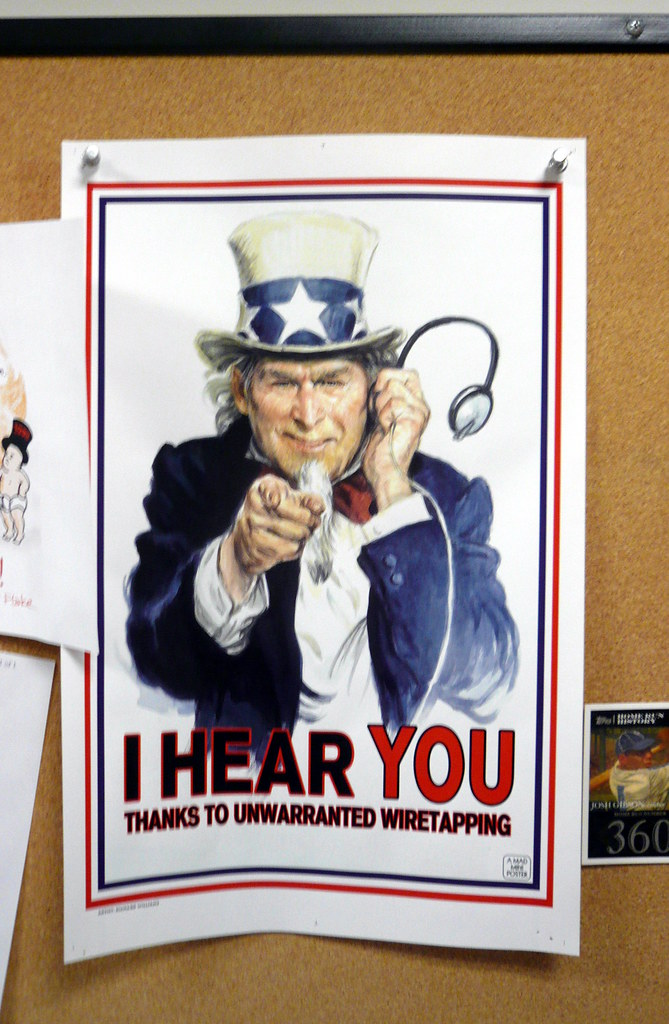
“I Hear You wiretapping poster, Mad Magazine, NYC” by gruntzooki is licensed under CC BY-SA 2.0 

 .
.
For as long as law enforcement has sought a way to monitor people’s conversations — though they’d only do so with a court order, we’re supposed to believe — privacy experts have warned that building backdoors into communications systems to ease government snooping is dangerous. A recent Chinese incursion into U.S. internet providers using infrastructure created to allow police easy wiretap access offers evidence, and not for the first time, that weakening security for anybody weakens it for everybody.
Subverted Wiretapping Systems
“A cyberattack tied to the Chinese government penetrated the networks of a swath of U.S. broadband providers, potentially accessing information from systems the federal government uses for court-authorized network wiretapping requests,” The Wall Street Journal reported last week. “For months or longer, the hackers might have held access to network infrastructure used to cooperate with lawful U.S. requests for communications data.”
Among the companies breached by the hacker group, dubbed “Salt Typhoon” by investigators, are Verizon, AT&T, and Lumen Technologies. The group is just one of several linked to the Chinese government that has targeted data and communications systems in the West.
While the Journal report doesn’t specify, Joe Mullin and Cindy Cohn of the Electronic Frontier Foundation (EFF) believe the wiretap-ready systems penetrated by the Chinese hackers were “likely created to facilitate smooth compliance with wrong-headed laws like CALEA”. CALEA, known in full as the Communications Assistance for Law Enforcement Act, dates back to 1994 and “forced telephone companies to redesign their network architectures to make it easier for law enforcement to wiretap digital telephone calls,” according to an EFF guide to the law. A decade later it was expanded to encompass internet service providers, who were targeted by Salt Typhoon.
“That’s right,” comment Mullin and Cohn. “The path for law enforcement access set up by these companies was apparently compromised and used by China-backed hackers.”
Ignored Precedents
This isn’t the first time that CALEA-mandated wiretapping backdoors have been exploited by hackers. As computer security expert Nicholas Weaver pointed out for Lawfare in 2015, “any phone switch sold in the US must include the ability to efficiently tap a large number of calls. And since the US represents such a major market, this means virtually every phone switch sold worldwide contains ‘lawful intercept’ functionality.”
Comments Off on Government-mandated backdoor access – “weakening security for anybody weakens it for everybody”
October 11, 2024
Japanese Pedersen Rifle
Forgotten Weapons
Published Apr 18, 2015After he failed to win US military adoption of his toggle-locked rifle design, John Pedersen went looking for other countries that might be interested in the gun. One of these was Japan, which experimented with toggle-locked Pedersen rifles and carbines for several years in the early/mid 1930s. This particular one is serial number 8, and has a scope mounting rail attached to it. It functions like a normal Pedersen rifle, but has a rotary magazine instead of the en bloc clip used in the US trial and British-produced rifles.
Comments Off on Japanese Pedersen Rifle


