
World War Two
Published 8 Apr 2023The Soviets are finally going to try and push the Axis out of Sevastopol and the Crimea. They also continue to drive the Axis back in Transnistria. Over in Burma and Northeastern India, the Japanese have the Allies under siege at not one, but two towns, and are also attacking Imphal from several points, but the Japanese have way bigger future plans up their sleeves in China.
(more…)
April 9, 2023
New Offensive in the Crimea – WW2 – Week 241 – April 8, 1944
Comments Off on New Offensive in the Crimea – WW2 – Week 241 – April 8, 1944
April 3, 2023
Goodbye Manstein… Hello Model – WW2 – Week 240 – April 1, 1944
World War Two
Published 1 Apr 2023As the Allies prepare to close in on Germany from all fronts, a shake up of the German military leadership can only achieve so much…
(more…)
Comments Off on Goodbye Manstein… Hello Model – WW2 – Week 240 – April 1, 1944
March 26, 2023
Germany Invades Hungary – WW2 – Week 239 – March 25, 1944
World War Two
Published 25 Mar 2023Germany occupies Hungary this week to prevent any possible Hungarian defection from the war, the Soviets continue pushing back the Axis in Ukraine, pressing them ever more toward Romania, the Japanese advance on Imphal and Kohima continues, but Allied attacks in Italy and Japanese ones on Bougainville come to their ends.
(more…)
Comments Off on Germany Invades Hungary – WW2 – Week 239 – March 25, 1944
March 25, 2023
Beria’s Reward for Ethnic Cleansing – War Against Humanity 100
World War Two
Published 23 Mar 2023Authoritarian regimes on both sides, in the Soviet Union, Nazi Germany, and Imperialist Japan the terror is once again escalating. The bombing war from both sides see continued death of civilians, while Harris of the RAF, Spaatz of the USAAF, and Supreme Allied Commander Eisenhower are getting into a fight about how the bombers should be used for the upcoming D-Day.
(more…)
Comments Off on Beria’s Reward for Ethnic Cleansing – War Against Humanity 100
March 24, 2023
Only a paper dragon?
In UnHerd, Edward Luttwak suggests that China’s military may be much more apparent than real:

The day after Li Keqiang, China’s departing Prime Minister and the last of Beijing’s moderates, called for more market liberalisation to reach this year’s 5% growth target, Xi Jinping responded by announcing a muscle-flexing 7.2% increase in China’s defence spending. That is certainly consistent with Xi’s truculent stance (he replied to Nancy Pelosi’s recent Taiwan visit with a series of ballistic missile launches), and with his official promise to the Communist Party that China will become the world’s dominant power by 2049. But what do those percentages actually mean?
The declared total of China’s newly increased defence budget at 1.56 trillion yuan amounts to $230 billion, according to the current exchange rate. If that were the case, it would mean that China is falling further behind the United States, whose own fiscal 2023 defence spending is increasing to $797 billion (and actually more, since that figure does not include its funding for military construction or the added help to Ukraine).
China’s own figure is also generally assumed by experts to be greatly understated — not by fiddling the numbers one by one, but rather by wholesale exclusions, such as the attribution of research-and-development spending to civilian budgets. Even if a commando team of elite forensic accountants were sent into action to uncover China’s actual defence spending, with another team dispatched to determine what’s missing from the US budget, we would still only have a very loose indication of how much actual military strength China and the United States hope to add.
But one thing can be said with absolute certainty: each side is adding less than the rising numbers imply.
In China’s case, a manpower shortage undercuts military spending in the PLA’s ground forces and naval forces, and soon it will affect manned air units as well. The PLA ground forces now stand at some 975,000, a very small number for a country that has 13,743 miles of borders with 14 countries — including extreme high-mountain borders where internal combustion engines lose power, jungle-covered borders where remote observation is spoiled by foliage, Russian-river borders with endemic smuggling, and the border with India’s Ladakh where an accumulation of unresolved Chinese intrusions have forced each side to deploy substantial ground forces, with at least 80,000 on the Chinese side.Except for Ladakh, which now resembles a war-front, borders are not supposed to be guarded by army troops but by border police. And China did in fact have a substantial dedicated border force, but it was abolished for the same reason that the PLA ground army is so small: a crippling shortage of physically fit Chinese men willing to serve in these regions. Cities and towns, by contrast, do not seem afflicted by such severe manpower shortages, leading to the weird phenomenon on Nepal’s main border crossing to Tibet where, according to an acquaintance, a group of freezing Cantonese city policemen were checking travellers and “guarding the border”. (They said they had been “volunteered” for two months.)
Comments Off on Only a paper dragon?
March 21, 2023
QotD: The elephant as a weapon of war
The pop-culture image of elephants in battle is an awe-inspiring one: massive animals smashing forward through infantry, while men on elephant-back rain missiles down on the hapless enemy. And for once I can surprise you by saying: this isn’t an entirely inaccurate picture. But, as always, we’re also going to introduce some complications into this picture.
Elephants are – all on their own – dangerous animals. Elephants account for several hundred fatalities per year in India even today and even captured elephants are never quite as domesticated as, say, dogs or horses. Whereas a horse is mostly a conveyance in battle (although medieval European knights greatly valued the combativeness of certain breeds of destrier warhorses), a war elephant is a combatant in his own right. When enraged, elephants will gore with tusks and crush with feet, along with using their trunks as weapons to smash, throw or even rip opponents apart (by pinning with the feet). Against other elephants, they will generally lock tusks and attempt to topple their opponent over, with the winner of the contest fatally goring the loser in the exposed belly (Polybius actually describes this behavior, Plb. 5.84.3-4). Dumbo, it turns out, can do some serious damage if prompted.
Elephants were selected for combativeness, which typically meant that the ideal war elephant was an adult male, around 40 years of age (we’ll come back to that). Male elephants enter a state called “musth” once a year, where they show heightened aggressiveness and increases interest in mating. Trautmann (2015) notes a combination of diet, straight up intoxication and training used by war elephant handlers to induce musth in war elephants about to go into battle, because that aggression was prized (given that the signs of musth are observable from the outside, it seems likely to me that these methods worked).
(Note: In the ancient Mediterranean, female elephants seem to have also been used, but it is unclear how often. Cassius Dio (Dio 10.6.48) seems to think some of Pyrrhus’s elephants were female, and my elephant plate shows a mother elephant with her cub, apparently on campaign. It is possible that the difficulty of getting large numbers of elephants outside of India caused the use of female elephants in battle; it’s also possible that our sources and artists – far less familiar with the animals than Indian sources – are themselves confused.)
Thus, whereas I have stressed before that horses are not battering rams, in some sense a good war elephant is. Indeed, sometimes in a very literal sense – as Trautmann notes, “tearing down fortifications” was one of the key functions of Indian war elephants, spelled out in contemporary (to the war elephants) military literature there. A mature Asian elephant male is around 2.75m tall, masses around 4 tons and is much more sturdily built than any horse. Against poorly prepared infantry, a charge of war elephants could simply shock them out of position a lot of the time – though we will deal with some of the psychological aspects there in a moment.
A word on size: film and video-game portrayals often oversize their elephants – sometimes, like the Mumakil of Lord of the Rings, this is clearly a fantasy creature, but often that distinction isn’t made. As notes, male Asian (Indian) elephants are around 2.75m (9ft) tall; modern African bush elephants are larger (c. 10-13ft) but were not used for war. The African elephant which was trained for war was probably either an extinct North African species or the African forest elephant (c. 8ft tall normally) – in either case, ancient sources are clear that African war elephants were smaller than Asian ones.
Thus realistic war elephants should be about 1.5 times the size of an infantryman at the shoulders (assuming an average male height in the premodern world of around 5’6?), but are often shown to be around twice as tall if not even larger. I think this leads into a somewhat unrealistic assumption of how the creatures might function in battle, for people not familiar with how large actual elephants really are.
The elephant as firing platform is also a staple of the pop-culture depiction – often more strongly emphasized because it is easier to film. This is true to their use, but seems to have always been a secondary role from a tactical standpoint – the elephant itself was always more dangerous than anything someone riding it could carry.
There is a social status issue at play here which we’ll come back to […] The driver of the elephant, called a mahout, seems to have typically been a lower-status individual and is left out of a lot of heroic descriptions of elephant-riding (but not driving) aristocrats (much like Egyptian pharaohs tend to erase their chariot drivers when they recount their great victories). Of course, the mahout is the fellow who actually knows how to control the elephant, and was a highly skilled specialist. The elephant is controlled via iron hooks called ankusa. These are no joke – often with a sharp hook and a spear-like point – because elephants selected for combativeness are, unsurprisingly, hard to control. That said, they were not permanent ear-piercings or anything of the sort – the sort of setup in Lord of the Rings is rather unlike the hooks used.
In terms of the riders, we reach a critical distinction. In western media, war elephants almost always appear with great towers on their backs – often very elaborate towers, like those in Lord of the Rings or the film Alexander (2004). Alexander, at least, has it wrong. The howdah – the rigid seat or tower on an elephant’s back – was not an Indian innovation and doesn’t appear in India until the twelfth century (Trautmann supposes, based on the etymology of howdah (originally an Arabic word) that this may have been carried back into India by Islamic armies). Instead, the tower was a Hellenistic idea (called a thorkion in Greek) which post-dates Alexander (but probably not by much).
This is relevant because while the bowmen riding atop elephants in the armies of Alexander’s successors seem to be lower-status military professionals, in India this is where the military aristocrat fights. […] this is a big distinction, so keep it in mind. It also illustrates neatly how the elephant itself was the primary weapon – the society that used these animals the most never really got around to creating a protected firing position on their back because that just wasn’t very important.
In all cases, elephants needed to be supported by infantry (something Alexander (2004) gets right!) Cavalry typically cannot effectively support elephants for reasons we’ll get to in a moment. The standard deployment position for war elephants was directly in front of an infantry force (heavy or light) – when heavy infantry was used, the gap between the two was generally larger, so that the elephants didn’t foul the infantry’s formation.
Infantry support covers for some of the main weaknesses elephants face, keeping the elephants from being isolated and taken down one by one. It also places an effective exploitation force which can take advantage of the havoc the elephants wreck on opposing forces. The “elephants advancing alone and unsupported” formation from Peter Jackson’s Return of the King, by contrast, allows the elephants to be isolated and annihilated (as they subsequently are in the film).
Bret Devereaux, “Collections: War Elephants, Part I: Battle Pachyderms”, A Collection of Unmitigated Pedantry, 2019-07-26.
Comments Off on QotD: The elephant as a weapon of war
March 19, 2023
The Japanese Invade India! – WW2 – Week 238 – March 18, 1944
World War Two
Published 18 Mar 2023Operation U-Go, Renya Mutaguchi’s invasion of India, is in full swing this week, as his men aim at Imphal and Kohima; three Soviets Fronts batter their way through the Axis positions all over Ukraine; and there is a huge Allied bombing campaign at Cassino in Italy, which mistakenly kills a lot of Allied soldiers. That’s one busy week.
(more…)
Comments Off on The Japanese Invade India! – WW2 – Week 238 – March 18, 1944
March 16, 2023
Field Marshal Slim’s one and only demotion … from lance-corporal back down to private
William Slim, arguably the best British general of the Second World War, didn’t have the fastest start to his military career, as recounted in an article by Frank Owen, the editor of the WW2 South East Asia theatre publication Phoenix. This and many others appear in Dr. Robert Lyman’s upcoming book Slim, Master of War:
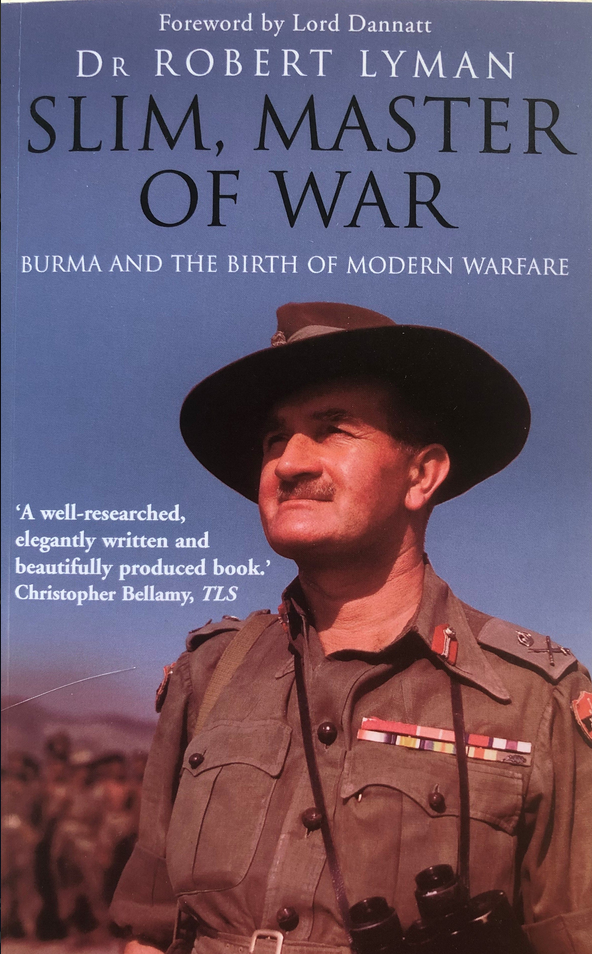
The General stood on an ammunition box. Facing him in a green amphitheatre of the low hills that ring the Palel Plain, sat or squatted the British officers and sergeants of the 11th East African Division. They were then new to the Burma Front and were moving into the line the next day. The General removed his battered slouch hat, which the Gurkhas wear and which has become the headgear of the 14th Army. “Take a good look at my mug”, he advised. “Not that I consider it to be an oil painting. But I am the Army Commander and you had better be able to recognize me — if only to say “Look out, the old b…. is coming round”.
Lieutenant-General Sir William Slim, KCB, CB, DSO, MC (“Bill”) is 53, burly, grey and going a bit bald. His mug is large and weather beaten, with a broad nose, jutting jaw, and twinkling hazel eyes. He looks like a well-to-do West Country farmer, and could be one. For he has energy and patience and, above all, the man has common sense. However, so far Slim has not farmed. He started life as a junior clerk, once he was a school teacher, and then he became the foreman of a testing gang in a Midland engineering works. For the next 30 years Slim was a soldier.
He began at the bottom of the ladder as a Territorial private. August 4, 1914, found him at Summer camp with his regiment. The Territorials were at once embodied in the Regular Army, and Slim got his first stripe as lance-corporal. A few weeks later he was a private again, the only demotion that this Lieutenant-General has suffered.
It was a sweltering, dusty day and the regiment plodded on its twenty-mile route march down an endless Yorkshire lane. At that time British troops still marched in fours, so that Lance-Corporal Slim, as he swung along by the side of his men, made the fifth in the file, which brought him very close to the roadside. There were cottages there and an old lady stood at the garden gate.
“I can see her yet”, Slim reminisces. “she was a beautiful old lady with her hair neatly parted in the middle and wearing a black print dress. In her hand she held a beautiful jug, and on the top of that jug was a beautiful foam, indicating that it contained beer. She was offering it to the soldier boys.”
The Lance-Corporal took one pace to the side and grasped the jug. As he did, the column was halted with a roar. The Colonel, who rode a horse at its head, had glanced back. Slim was hailed before him and “busted” on the spot. The Colonel bellowed “Had we been in France you would have been shot.” Slim confides, “I thought he was a damned old fool – and he was. I lost my stripe, but he lost his army.” In truth he did, in France in March 1918. Bill soon got his stripe back.
Now in this corner of Palel Plain, one of India’s bloodiest battlefields and the scene of one of his greatest victories, Slim tells the officers and men of the 11th Division, “I have commanded every kind of formation from a section upwards to this army, which happens to be the largest single one in the world.” (At that time, Slim had under his command half a million troops.) “I tell you this simply that you shall realize I know what I am talking about. I understand the British soldier because I have been one, and I have learned about the Japanese soldier because I have been beaten by him. I have been kicked by this enemy in the place where it hurts, and all the way from Rangoon to India where I had to dust-off my pants. Now, gentlemen, we are kicking our Japanese neighbours back to Rangoon.”
Slim commanded the rear guard of the army that retreated from Burma in 1942. He is proud of that. His men marched and fought for a hundred days and nights and across a thousand miles. But this retreat was no Dunkirk. Says Slim “We brought our weapons out with us, and we carried our wounded, too. Dog-tired soldiers, hardly able to put one foot in front of another, would stagger along for hours carrying or holding up a wounded comrade. When at last they reached India over those terrible jungle mountains they did not go back to an island fortress and to their own people where they could rest and refit. The Army of Burma sank down on the frontier of India, dead beat and in rags. But, they fought here all through the downpour of the monsoon, and they saved India until a great new Army – which is this one – could be built up to take the offensive once again. In those days, if anyone had gone to me with a single piece of good news I would have burst out crying. Nobody ever did.”
He tells another story. One day he entered a jungle glade in a tank. In front of him stood a group of soldiers, in their midst the eternal Tommy. Assuming an optimism which he did not feel, Slim jumped out of the tank and approached them. “Gentlemen!” he said (which is the nice way that British generals sometimes address their troops) “Things might be worse!”
“‘Ow could they be worse?” inquired the Tommy.
“Well, it could rain” said Slim, lightly. He adds “And within quarter of an hour it did.”
Comments Off on Field Marshal Slim’s one and only demotion … from lance-corporal back down to private
March 12, 2023
Zhukov hits the Ground Running – WW2 – Week 237 – March 11, 1944
World War Two
Published 11 Mar 2023The Soviets launch not one, not two, but three offensives in Ukraine this week, designed to destroy the entire southern wing of the German forces. The Japanese counterattack against the Americans on Bougainville finally begins after months of preparations, but there are more Japanese attacks elsewhere that get going: the operation to invade India.
(more…)
Comments Off on Zhukov hits the Ground Running – WW2 – Week 237 – March 11, 1944
March 4, 2023
Nigel Biggar’s Colonialism: A Moral Reckoning
In The Critic, Robert Lyman reviews a recent book offering a rather more nuanced view of the British empire:

The book is a careful analysis of empire from an ethical perspective, examining a set of moral questions. This includes whether the British Empire was driven by lust or greed; whether it was racist and condoned, supported or encouraged slavery; whether it was based on the conquest of land; whether it entailed genocide and or economic exploitation; whether its lack of democracy made it illegitimate; and whether it was intrinsically or systemically violent.
Biggar’s proposition is simple: that we look at Britain’s history without assuming the zero-sum position that imperialism and colonialism were inherently bad, that motives and agency need to be considered and that good did flow from bad, as well as bad from good.
Whether he succeeds depends on the reader’s willingness to appreciate these moral or ethical propositions, and to re-evaluate accordingly. In my view, he has mounted a coolly dispassionate defence of his proposition, challenging the hysteria of those who suggest that the British Empire was the apotheosis of evil. Biggar’s calm dissection of these inflated claims allows us to see that they say much more about the motivations, assumptions and political ideologies of those who hold these views than they do about what history presents to us as the realities of a morally imperfect past.
He reminds us that British imperialism had no single wellspring. Most of us can easily dismiss the notion that it was a product of an aggressive, buccaneering state keen to enrich itself at the expense of peoples less able to defend themselves. Equally, it is untrue that economic motives drove all imperialist or colonial endeavour, or that economics (business, trade and commerce) was the primary force sustaining the colonial regimes that followed.
As Biggar asserts, both imperialism and colonialism were driven from different motivations at different times. Each ran different journeys, with different outcomes depending on circumstances. The assertion that there is a single defining imperative for each instance of imperial initiative or colonial endeavour simply does not accord with the facts.
Whilst other issues played a part, it was social, religious and political motives which drove the colonial endeavour in the New World from the 1620s: security and religion drove the subjugation of Catholic (and therefore Royalist) Ireland in the 1650s; social and administrative factors led to the settlement in Australia from 1788; and social and religious imperatives drove the colonisation of New Zealand in the 1840s.
In circumstances where trade and the security of trade was the primary motive for imperialism — think of Clive in the 1750s, for example — a wide variety of outcomes ensued. Some occurred as a natural consequence of imperialism. In India, Clive’s defeat of the Nawab Siraj-ud-Daulah in 1757 was in support of a palace coup that put Siraj’s uncle Mir Jafar on the throne of Bengal, thus allowing the East India Company the favoured trading status that Siraj had previously rejected.
This led in time to the Company taking over the administrative functions of the Bengal state (zamindars collected both rents for themselves and taxes for the government). Seeking to protect its new prerogatives, it provided security from both internal (civil disorder and lawlessness) and external threats (the Mahratta raiders, for example). The incremental, almost accidental, accrual of power that began in the early 1600s stepped into colonial administration 150 years later, leading to the transfer of power across a swathe of the sub-continent to the British Crown in 1858.
Biggar’s argument is that, running in parallel with this expansion came a host of other consequences, not all of which can be judged “bad”. We may not like what prompted the colonial enterprise at the outset (not all of which was morally contentious, such as the need to trade), but we cannot deny that good things, as well as bad, followed thereafter.
Comments Off on Nigel Biggar’s Colonialism: A Moral Reckoning
February 26, 2023
Tojo Takes Control – Week 235 – February 25, 1944
World War Two
Published 25 Feb 2023Now that the Americans have seized the Marshall Islands, they can bypass the Japanese base at Truk. This impels Prime Minister Hideki Tojo to shake up both army and navy command, and he even takes personal control over the Japanese Army. On the Anzio Front, Lucian Truscott replaces John Lucas as Allied Commander. In the field, the Allies win a big victory in Burma, and in Ukraine, the Soviets are still on the move.
(more…)
Comments Off on Tojo Takes Control – Week 235 – February 25, 1944
February 19, 2023
The Destruction of Monte Cassino – Week 234 – February 18, 1944
World War Two
Published 18 Feb 2023The Allies bomb the monastery atop Monte Cassino in Italy, but just to the Northwest it’s the Germans attacking them at Anzio this week. In the Soviet Union, the Axis break out of the Korsun Pocket, but at great cost, and in the Pacific comes a major Allied raid on the Japanese base at Truk and landings on Eniwetok Atoll.
(more…)
Comments Off on The Destruction of Monte Cassino – Week 234 – February 18, 1944
February 18, 2023
Nikki Haley’s presidential bid is clearly doomed because … she uses her middle name? Let me read that again.
Jim Treacher (whose name I should now probably put in scare quotes because it’s a nom-de-plume) explains why Nikki Haley is a no-hoper in the next Republican presidential primaries:
As I revealed over a decade ago, “Jim Treacher” isn’t my real name. This is just a message-board pseudonym that got way out of hand, and now I guess I’m stuck with it. My government name is Robert Sean Medlock, but my parents have always called me Sean. I don’t know why they didn’t just name me Sean Robert Medlock, but I was in no position to argue my case at the time because I couldn’t talk yet.
So now, every time I need to fill out paperwork somewhere, I have to explain that I go by my middle name. Doctors, dentists, car repairs, insurance, what have you. The routine is kind of annoying, but at this point I’m used to it.
I’m not deceiving anybody by using my middle name. It’s just my name, man. Lots of people go by their middle name.
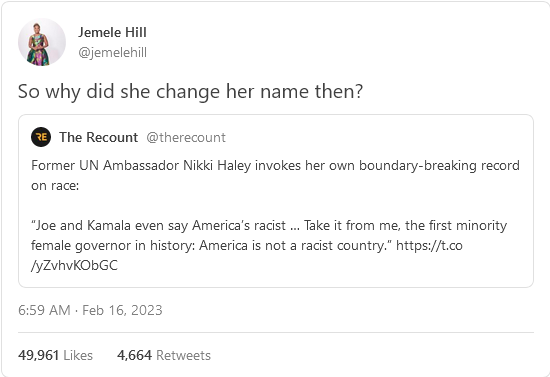
In other news: This week Nikki Haley announced she’s running for president. I don’t know if she has a shot, but the libs sure seem to think so. They’re already attacking her for … going by her middle name.
Check out this idiot:
She didn’t. Her birth name was Nimarata Nikki Randhawa. Not “Nimrata”, as it’s commonly misspelled by supposedly sophisticated libs:
My goodness. Guess it runs in the family, huh?
The Randhawa family referred to their daughter as Nikki, which is Punjabi for “little one”. And she changed her last name to Haley when she married a man named Michael Haley.
Y’know, like Hillary Rodham did when she married Bill Clinton.
Here’s another dummy, who of course works for CNN:
Yeah. Wait. What?

And if that scandal wasn’t enough to sink Nikki Haley’s chances utterly, CNN’s Don Lemon helpfully points out that she’s way, way, way past her peak:
Now, you know I’m not one to cry sexism often. Frankly, when I found out a hot college professor of mine had been fired for doing a #MeToo, I was offended for not being involved. I’d gone to office hours, for godsakes. But there is sexism this week we have to call out. Nikki Haley announced she is running for president. She’s a reasonable Republican candidate who is, of course, a long shot against Trump. There are plenty of ways to criticize her politics, but for some reason a bunch of people we are meant to respect tried to say that the real problem is that she’s a woman, that she’s not young, and that she’s Indian.
You may think I’m exaggerating.
Here is Don Lemon on CNN: “Nikki Haley isn’t in her prime. Sorry”, he says, looking to camera, a little smile on his face. “When a woman is considered to be in her prime in 20s and 30s and maybe 40s …” His co-hosts, both women, balk. (“Prime for what?”) But Lemon keeps going. Watch the extremely stressful video here, where he goes on … and on … about how Nikki Haley, who is 51, cannot criticize Biden’s age. Because women peak in their 20s, and she’s long past that.
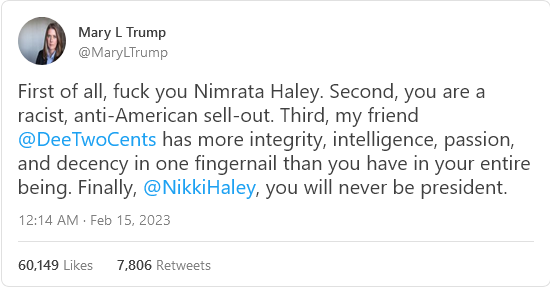
Or here’s progressive hero Mary Trump, Donald’s niece, who disavowed him and became a star of the intelligentsia. She decided that the best way to insult Nikki Haley this week was by highlighting that she’s Indian, because Nikki is her middle name. Again, this is a real statement Mary Trump released on Twitter: “First of all, fuck you Nimrata Haley.” Sorry, I’m slow: If you’re a white person trying to insult someone who’s not white and you do it by highlighting their race, what’s that called again? I’m sure there’s a Robin DiAngelo chapter on this somewhere.
Comments Off on Nikki Haley’s presidential bid is clearly doomed because … she uses her middle name? Let me read that again.
February 14, 2023
China’s awkward actions on the world stage do not charm the neighbours
CDR Salamander explains why the BRIC (Brazil-Russia-India-China) “coalition” is as unlikely to occur in the real world as any other opium pipe-dream:
Yes, the USA and Canada had our Balloons of February, but in the last year or so, what has China been doing to seem like a pleasant alternative to the United States to the rest of the world?
Her largest neighbor? They get sticks:
The root cause is an ill-defined, 3,440km (2,100-mile)-long disputed border.
Rivers, lakes and snowcaps along the frontier mean the line can shift, bringing soldiers face to face at many points, sparking a confrontation.
The two nations are also competing to build infrastructure along the border, which is also known as the Line of Actual Control. India’s construction of a new road to a high-altitude air base is seen as one of the main triggers for a deadly 2020 clash with Chinese troops.
How bad is the situation?
Despite military-level talks, tensions continue. In December 2022 troops clashed for the first time in more than a year.
It happened near the Tawang sector of Arunachal Pradesh state, the eastern tip of India. Some soldiers suffered minor injuries.
De-escalation work has taken place since a major clash in June 2020. The Galwan Valley battle — fought with sticks and clubs, not guns — was the first fatal confrontation between the two sides since 1975.
At least 20 Indian and four Chinese soldiers died.
Another face-off in January 2021 left troops on both sides injured. It took place near India’s Sikkim state, between Bhutan and Nepal.
The “I” and “C” in the B.R.I.C. are not going to be close friends, ever — one of the reasons I roll my eyes at those who propose the BRIC nations as some kind of power block — something only slightly sillier than the Cold War “Non Aligned Movement.”
With the “B” being the basket case Brazil (always the nation of the future, and always will be), and the “R” being Russia, I mean, child please.
Another nation that if the PRC was just slightly more subtle and less arrogant they might have a chance to make things more difficult for the USA-Japan-Australia defense concerns is The Philippines. They had a window in the last couple of decades, but … if they’re doing this;
The PRC Wolf Warrior Lack of Charm Campaign perhaps may play well internally — and that may be all they care about — but there was a window not long ago that the PRC was playing smart on the world stage — making significant impact in Australia and having the USA happy to let them set up Confucius Institutes at our major universities, etc … but the last decade or so they somehow decided to play a different game.

Comments Off on China’s awkward actions on the world stage do not charm the neighbours
February 1, 2023
Changing views of Gandhi
In UnHerd, Pratinav Anil recounts some of the changes to Gandhi’s reputation and place in Indian public memory:
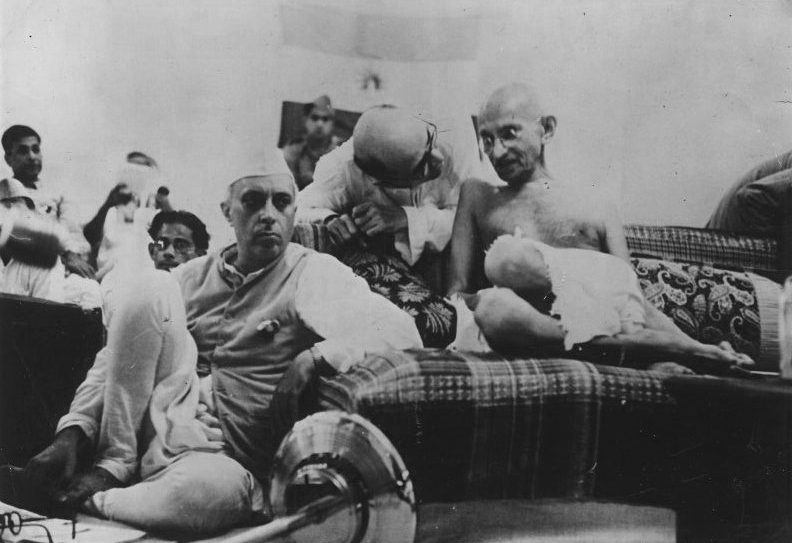
Nehru with Gandhi, August 1942.
Photographer unknown, public domain image via Wikimedia Commons.
Gandhi, poor fellow, had his ashes stolen on the 150th anniversary of his birth. “Traitor”, scrawled the Hindu supremacist malcontents on a life-size cut-out of the Mahatma at the mausoleum. That was a couple of years ago, but it’s a sentiment that’s grown shriller since. Unsurprisingly. In government as in schools, in newsrooms as on social media, the founding father’s defenders are being put out of business by his detractors. His Congress Party, after 50 years of near-uninterrupted rule since independence in 1947, is now in ruins, upstaged by the Bharatiya Janata Party. Hindu supremacists have stolen the show, while India’s Muslims, Christians, and Dalits are persecuted. With the changing of the guard, Gandhi’s extravagant ideal — unity in diversity — has gone the way of his ashes.
His reputation, too, is in tatters. Last year, the National Theatre staged a play about his assassination. But The Father and the Assassin centred not on Gandhi but Godse, the man who killed him 75 years ago this week. Here is a tender portrait of a tortured soul, a blushing boy raised as a girl to propitiate the gods who had taken away his three brothers, who becomes radicalised and blames Gandhi for betraying Hindus and mollycoddling Muslims, so causing Partition. It is no accident that Godse was a card-carrying Hindu supremacist, a member of the parent organisation of the BJP, to which India’s new ruler Narendra Modi belongs. Today, statues of Godse are going up across the country just as statues of Gandhi are being pulled down across the world.
Needless to say, this is a most disturbing development. Yet the reaction of liberals, Indian as well as Western, has been no less troubling. An unthinking anti-imperialism of old has joined up with an unthinking anti-Hindu supremacism of new to beget a bastardised Gandhi. What we have is not a creature of flesh and blood, possibly a great if also flawed man, but rather a deified hero. This is the Gandhi with a saintly halo around him who greets you from Indian billboards, grins at you from rupee notes, stares down at you from his plinth on Westminster’s Parliament Square, and, in Ben Kingsley’s portrayal of him, slathered in a thick impasto of fake tan, moves you to a standing ovation.
This is the easily comestible fortune-cookie Gandhi you encounter in airport bestsellers such as Ramachandra Guha’s double-decker hagiography, and also the sartorial icon whose wire-rim glasses were emulated by Steve Jobs. There is the Gandhi of the gags, most famous for a retort he probably never made: asked what he thought of Western civilisation, the Mahatma is reported to have replied: “I think it would be a good idea.” Ba-dum ching! Then there’s the Christological Gandhi, a modern messiah turning the other cheek: “An eye for an eye leaves the whole world blind.” There’s also Gandhi the self-help guru: “Be the change that you wish to see in the world.” One could go on.
Here’s where the historian in me says, would that it were so simple. Gandhi was no liberal. And if those who sing his praises today knew a little more about Gandhi the man, rather than Gandhi the saint, their adulation would very quickly dry up. The fact is that the Mahatma hasn’t aged well. He detested democracy, defended the caste system, and had a deeply disturbing relationship with sex.
None of this should surprise us. Unlike some of the more cerebral thinkers of his cohort, figures such as Ambedkar and Periyar, Gandhi possessed a shallow mind. The product of a rather parochial education, admittedly the best that could be bought in turn-of-the-century western India, he struggled to juggle academic and conjugal demands. His precocious marriage to Kasturbai at 13 was a misalliance, perennially troubled by his suspicions of her infidelity. Not the sharpest knife in the drawer, he dropped out of Samaldas College. It was only in London, where he went to read law, that his horizons widened.
Then again, not for the better.
Comments Off on Changing views of Gandhi


