Quotulatiousness

January 30, 2022

QotD: Montgomery on the advance after El Alamein

Filed under: Africa, Britain, History, Military, Quotations, WW2 — Tags: , , , , — Nicholas @ 01:00

A curious incident occurred as our light forces were moving forward south of Benghazi. I was right up behind the leading armoured cars, reconnoitering the area; I had a small escort with me. We had outstripped the fighter cover and from time to time enemy aircraft strafed the road; it was not a healthy place and I suppose that I ought not to have been there.

Suddenly I saw a lorry coming up from behind, and on it a large boat; a naval Petty Officer sat with the driver and some sailors were inside.

I stopped the lorry and said to the Petty Officer: “What are you doing here? Do you realise that you are right up with the most forward elements of the Eighth Army, and you and your boat are leading the advance? This is a very dangerous area just at present, and you are unarmed. You must turn round and go back at once.”

He was dreadfully upset. He had been ordered to open up a “petrol point” at a small cove well to the north of Mersa Brega; small naval craft were to land petrol at this point in order that the leading armoured car regiments could refill their tanks; this was the easiest way of getting petrol and oil to them. He explained this to me, looking at me with pleading eyes rather like a spaniel asking to be taken for a walk to hunt rabbits.

He then said: “Don’t send me back, sir. If the armoured cars don’t get their petrol, they will have to halt and you will lose touch with the Germans. Couldn’t I go on with you? I would then be quite safe.”

That Petty Officer was clearly a student of psychology! In point of fact I did not know about these small petrol points for the armoured cars; it was a staff plan and a very good one. I took the naval party forward with me and saw them safely to their cove, where I was their first customer for petrol. I have often thought of that Petty Officer; he was from the Merchant Navy and in the R.N.V.R.; his sense of duty was of the highest order, and Britain will never lose her wars so long as the Royal Navy can count on men like him.

Bernard L. Montgomery, The Memoirs of Field-Marshal Montgomery, 1958.

January 27, 2022

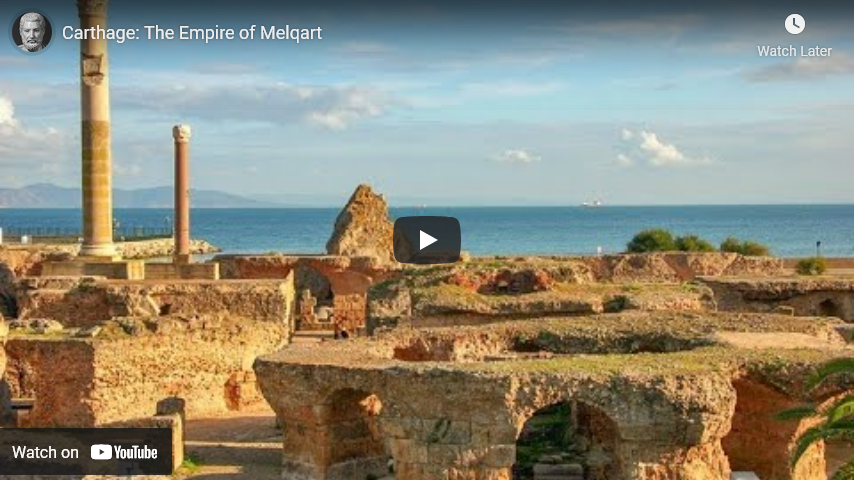
Carthage: The Empire of Melqart

Filed under: Africa, Europe, History, Military — Tags: , , , , , — Nicholas @ 04:00

Thersites the Historian
Published 11 Nov 2021

In this lecture, we look at why it is so hard to find Punic material remains and where one can search for what little there is left to find.

Patreon link: https://www.patreon.com/thersites

PayPal link: paypal.me/thersites

Discord: https://discord.gg/QCaXXFr

Brave Browser: https://brave.com/noa557

Twitter link: https://twitter.com/ThersitesAthens

Minds.com link: https://www.minds.com/ThersitestheHis…

Steemit/dtube link: https://steemit.com/@thersites/feed

BitChute: https://www.bitchute.com/channel/jbyg…

January 16, 2022

Food for Leningrad, Breaking the Siege! – WW2 – 177- January 15th, 1943

World War Two
Published 15 Jan 2022

Soviet attacks are launched this week to destroy the Hungarians, all while the German desperation at Stalingrad and Velikie Luki continues, but in the far north the Soviets have broken through the siege of Leningrad after 16 months. And the Casablanca Conference begins, a meeting to guide the war’s future progress.
(more…)

January 12, 2022

“You feel instantly at home when you arrive in Kenya because Kenya was once everyone’s home!”

Filed under: Africa, Media, Science — Tags: , , , , — Nicholas @ 03:00

When I was in middle school, my favourite teacher was a huge fan of the Leakey family’s discoveries in central Africa, and took every opportunity to show us films on the latest hominid remains uncovered (and by “latest”, it usually meant several years old, as 16mm films distributed through the county school system were rarely all that “new”). I assume she was a frustrated anthropologist herself, honestly, although I found her to be a very good teacher even if she’d “settled” for teaching as a career. In The Iconoclast, Geoffrey Clarfield remembers the late Richard Leakey, “the last Victorian scientist”, who died earlier this month in Kenya:

Richard Leakey at the WTTC Global Summit 2015.
Detail of original photo by the World Travel & Tourism Council via Wikimedia Commons.

Kenyan paleoanthropologist Richard Leakey died on January 2nd at age 77, following an extraordinary career devoted to the scientific exploration of human origins. Richard was once my boss. And although we never became friends, I came to know him fairly well.

He died peacefully in his house overlooking Kenya’s Great Rift Valley, where he’d made his most notable discoveries, and which occupied his imagination from an early age until his final days. It was fitting that he was buried beside his home, amid the same terrain from which he’d dug up humanity’s long-buried early ancestors. As I once heard him say to a group of visitors, “You feel instantly at home when you arrive in Kenya because Kenya was once everyone’s home!” (Essayists are supposed to shun exclamation marks, but this was simply the way the man spoke.)

To an outsider, Richard’s work history may appear to comprise a series of disconnected, sometimes testosterone-driven adventures. By turns, he was a wildlife trapper and animal trader, safari guide, bush pilot, gifted (albeit informally trained) fossil hunter, archaeological excavator, scientific autodidact, museum and civil-service administrator, member of parliament, opposition leader, cabinet minister, conservation activist, Kenyan patriot, fundraiser, public speaker, and prolific writer. The public knew him best as a television and film presenter. But those who knew him privately will also remember him as an enthusiastic team leader and mentor of young talent.

In my case, he helped advance my own project to train young Kenyan researchers to record and document traditional music in the northern part of their country, the Turkana District in particular. When I’d raised funds for this initiative, he brought it under the auspices of the National Museums of Kenya (NMK), of which he was then director.

While he may have seemed like something of an (enormously) overachieving dilettante to some, there was in fact a unity to his life and work. The times being what they are, many will focus on the fact that he was a white man taking a prominent role in a largely black country. But in truth, he likely attracted more scrutiny for being a fervent admirer of Charles Darwin, and a secular atheist, in a religious part of the world. He once published his own edited and illustrated version of Origin of Species, which I read when I was working for him, and his contributions to that volume gave me insight into what I believe was his fundamentally edifying professional motivation. I still have it on my shelf.

Richard emphasized that humankind had evolved in the Great Rift Valley, and from there had spread “out of Africa”, as the saying goes. He also believed that a previously underestimated factor in human evolution had been our species’ relationship to evolving biodiversity and prehistoric climate fluctuation — “paleoenvironments” as they came to be called.

January 7, 2022

Desert War – Dysentery, Disease, and Dehydration – WW2 Special

World War Two
Published 6 Jan 2022

North Africa. The Axis and Allies are fighting each other but even more, they’re fighting the desert itself. The men of the desert burn during the day and freeze at night. They do most of their fighting on a litre of water and a packet of army biscuits. What is life in such a hostile environment?
(more…)

December 20, 2021

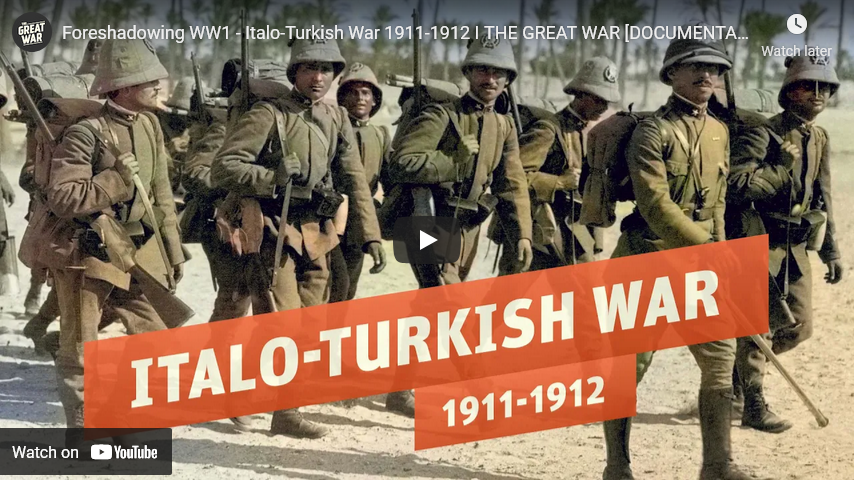
Foreshadowing WW1 – Italo-Turkish War 1911-1912 I THE GREAT WAR

The Great War
Published 17 Dec 2021

Sign up for Audible and get 60% off your first three months: https://audible.com/greatwar or text greatwar to 500-500

The Italo-Turkish War 1911 was one of the last classic imperial wars over colonial processions between two great powers. But it was in many ways also a first glimpse into what would come during the First World War: trenches, artillery, combat aircraft, motorboat attacks. This war in Ottoman Libya was fought between the Italian Army and Ottoman-led local Senussi forces.

» SUPPORT THE CHANNEL
Patreon: https://www.patreon.com/thegreatwar

» THANKS TO OUR CO-PRODUCERS
John Ozment, James Darcangelo, Jacob Carter Landt, Thomas Brendan, Kurt Gillies, Scott Deederly, John Belland, Adam Smith, Taylor Allen, Rustem Sharipov, Christoph Wolf, Simen Røste, Marcus Bondura, Ramon Rijkhoek, Theodore Patrick Shannon, Philip Schoffman, Avi Woolf,

» SOURCES
Askew, William C., Europe and Italy’s Acquisition of Libya, 1911-1912, (Durham, NC: Duke University Press, 1942)

Caccamo, Francesco, “Italy, Libya and the Balkans” in Geppert, Dominik; Mulligan, William & Rose, Andreas (eds.), The Wars before the Great War: Conflict and International Politics Before the Outbreak of the First World War, (Cambridge: Cambridge University Press, 2016)

Childs, Timothy W, Italo-Turkish Diplomacy and the War Over Libya, 1911–1912, (Leiden: Brill, 1990)

Griffin, Ernest H., Adventures in Tripoli: A Doctor in the Desert (London: Philip Allen & Co., 1924)

Hindmarsh. Albert E. & Wilson, George Grafton, “War Declared and the Use of Force”, Proceedings of the American Society of International Law at Its Annual Meeting (1921-1969) Vol. 32 (1938)

McCollum Jonathan, “Reimagining Mediterranean Spaces: Libya and the Italo-Turkish War, 1911-1912”, in Mediterraneo cosmopolita, 23 (3) 2015.

McMeekin, Sean, The Ottoman Endgame (Penguin, 2013).

Paris, Michael, “The First Air Wars – North Africa and the Balkans, 1911-13”, Journal of Contemporary History, Vol. 26, No. 1 (1991)

Stephenson, Charles, A Box of Sand: the Italo-Ottoman War 1911-1912: the First Land, Sea and Air War, (Ticehurst: Tattered Flag Press, 2014)

Tittoni, Renato, The Italo-Turkish War (1911-12). Translated and Compiled from the Reports of the Italian General Staff, (Kansas City, MO: Frank Hudson Publishing Company, 1914)

Uyar, Mesut, The Ottoman Army and the First World War, (Abingdon: Routledge, 2021)

Vandervort, Bruce, Wars of Imperial Conquest in Africa 1830-1914, (Bloomington, IN: Indiana University Press, 1998)

Wilcox, Vanda, Italy in the Era of the Great War, (Leiden: Brill, 2018)

Wilcox, Vanda, “The Italian Soldiers’ experience in Libya, 1911-12” in Geppert, Dominik; Mulligan, William & Rose, Andreas (eds.), The Wars before the Great War: Conflict and International Politics Before the Outbreak of the First World War, (Cambridge: Cambridge University Press, 2016)

»CREDITS
Presented by: Jesse Alexander
Written by: Mark Newton, Jesse Alexander
Director: Toni Steller & Florian Wittig
Director of Photography: Toni Steller
Sound: Toni Steller
Editing: Jose Gamez
Motion Design: Philipp Appelt
Mixing, Mastering & Sound Design: http://above-zero.com
Research by: Mark Newton
Fact checking: Florian Wittig

Channel Design: Yves Thimian

Contains licensed material by getty images
All rights reserved – Real Time History GmbH 2021

December 19, 2021

Guadalcanal Life Expectancy: 30 Days- WW2 – 173 – December 18, 1942

World War Two
Published 18 Dec 2021

Just a few weeks ago massive offensives were launched in North Africa and the Soviet Union, against the Axis. These operations and offensives have now morphed into fully fledged campaigns, and the nature of these theatres of the war has been transformed.
(more…)

December 17, 2021

Death Squads Arrive in North Africa – WAH 048 – December 1942, Pt. 1

Filed under: Africa, Germany, History, Italy, Military, WW2 — Tags: , , , , , — Nicholas @ 04:00

World War Two
Published 16 Dec 2021

Despite Allied occupation, the situation of the Jews in North Africa hardly improves, in newly German-occupied Tunisia it deteriorates. Meanwhile, the world learns more of the details of the Holocaust — they cannot believe their ears.
(more…)

December 13, 2021

The Battle of Cannae (216 B.C.E.)

Filed under: Africa, Europe, History, Italy, Military — Tags: , , , , — Nicholas @ 02:00

Historia Civilis
Published 29 Jun 2015

Patreon | http://historiacivilis.com/patreon
Donate | http://historiacivilis.com/donate
Merch | http://historiacivilis.com/merch
Twitter | http://historiacivilis.com/twitter
Website | http://historiacivilis.com

Music is Beethoven’s “Sonata No. 32 in C Minor, Op. 111” – I. Maestoso – Allegro con brio ed appassionato, performed by Daniel Veesey

December 12, 2021

One Year Since Pearl Harbor – WW2 – 172 – December 11, 1942

World War Two
Published 11 Dec 2021

The Japanese try and fail to supply their starving soldiers. The Allies fail to break through in Tunisia and New Guinea. The fighting in the USSR is bloody, but the Axis prepare for a new offensive there.
(more…)

December 10, 2021

History Summarized: Britain and the Empire

Overly Sarcastic Productions
Published 20 Aug 2021

How is it that the history of some islands off the northern coast of Europe balloons into a worldwide history? Empire is how! Let’s dig into the history of Britain since Union of the Crowns of England and Scotland in 1603, and follow that narrative through the monumental rise and precipitous fall of the British Empire.

Special thanks to the community members on Discord who assisted me with my script: Corvin the Crow, Johnny, Jdedredhed, Joud, Jéuname, Klieg, RileyTheProcrastinator, The Missing Link, and thesleepingmeerkat

SOURCES & Further Reading: The Great Courses Lecture series Foundations of Western Civilization II: A History of the Modern Western World by Robert Buchols lectures 11, 12, 13, 14, 15, 18, 19, 20, 21, 22, 30, The History Of England volumes 3 Rebellion, 4 Revolution & 5 Dominion by Peter Ackroyd, Scotland: A Concise History by Fitzroy MacLean, The Great Cities in History by John Julius Norwich, A Concise History of Wales by Geraint H. Jenkins, Sea Power: The History and Geopolitics of the World’s Oceans by James Stavridis.

Our content is intended for teenage audiences and up.

PATREON: https://www.Patreon.com/OSP

PODCAST: https://overlysarcasticpodcast.transi…

DISCORD: https://discord.gg/osp

MERCH LINKS: http://rdbl.co/osp

OUR WEBSITE: https://www.OverlySarcasticProductions.com
Find us on Twitter https://www.Twitter.com/OSPYouTube
Find us on Reddit https://www.Reddit.com/r/OSP/

December 6, 2021

The Battle of Lake Trasimene (217 B.C.E.)

Filed under: Africa, Europe, History, Italy, Military — Tags: , , , , — Nicholas @ 02:00

Historia Civilis
Published 22 Jun 2015

Patreon | http://historiacivilis.com/patreon
Donate | http://historiacivilis.com/donate
Merch | http://historiacivilis.com/merch
Twitter | http://historiacivilis.com/twitter
Website | http://historiacivilis.com

Music is Beethoven’s “Sonata No. 07 in D Major, Op. 10 No. 3” – I. Presto, performed by Daniel Veesey.

December 5, 2021

Axis Armies Facing Starvation – WW2 – 171 – December 4, 1942

World War Two
Published 4 Dec 2021

The Soviets have launched offensives on the entire eastern front and by now hundreds of thousands of men are surrounded at Stalingrad. The Japanese win a battle at sea, but are losing a war of attrition.
(more…)

December 3, 2021

The Battle of the Trebia River (218 B.C.E.)

Filed under: Africa, Europe, History, Italy, Military — Tags: , , , , — Nicholas @ 02:00

Historia Civilis
Published 12 Jun 2015

Patreon | http://historiacivilis.com/patreon
Donate | http://historiacivilis.com/donate
Merch | http://historiacivilis.com/merch
Twitter | http://historiacivilis.com/twitter
Website | http://historiacivilis.com

Music is Beethoven’s “Sonata No. 11 in B Flat Major Op. 22” – I. Allegro con brio. Performed by Daniel Veesey

November 28, 2021

Bigger Than Uranus? – Mars – WW2 – 170 – November 27 1942

World War Two
Published 27 Nov 2021

Last week’s counterattack was just the beginning, for the Soviets launch another giant offensive this week. And things look bad for the Axis powers in the south of the USSR. Meanwhile in France, the French scuttle their navy rather than allow it to fall into German hands.
(more…)

« Newer PostsOlder Posts »

Powered by WordPress