
On the social media site formerly known as Twitter, Handre explains the iniquity of most “capital gains” tax schemes in the west:
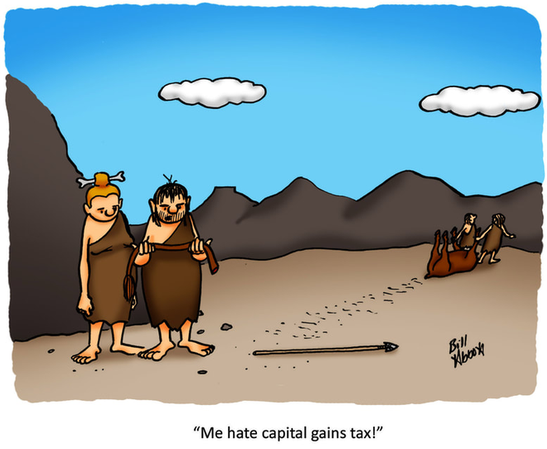
Capital gains tax is theft, committed twice against the same dollar.
You earn income. The government takes its cut immediately, in the US it’s between 22% and 37% depending on your bracket. What remains is yours, after-tax money, already processed through Washington’s collection machine. You choose not to spend it. You save it, invest it, buy assets with it. The discipline required to delay consumption is precisely the behavior that funds capital formation across the economy.
Then the asset grows. You sell it. The government appears again, demanding 20% (plus the 3.8% Net Investment Income Tax for higher earners) on the nominal gain, which often includes pure inflation adjustments that represent no real increase in purchasing power whatsoever.
The IRS treats your patience as a second taxable event. The original dollar was already taxed. The “gain” frequently reflects nothing more than the dollar losing value while you held the asset. Murray Rothbard identified this pattern: the state punishes capital accumulation.
Consider a simple case. You invest $50,000 of after-tax earnings in 2016 into an S&P 500 index fund. By 2026, it’s worth $115,000. Inflation consumed a meaningful slice of that $65,000 gain. You pay capital gains tax on the full nominal figure regardless.
Capital gains taxation suppresses investment, shrinks the capital pool available for productive enterprise, and forces entrepreneurs to seek financing from a shallower pond. Fewer productive investments get made. Workers carry that cost through lower wages and fewer opportunities. The state expands, while you suffer.


