Quotulatiousness

September 18, 2025

NYC smokers get most of their cigarettes from the black market

Filed under: Bureaucracy, Business, Government, Health, USA — Tags: , , , , — Nicholas @ 03:00

Smokers in New York City pay very high taxes for their nicotine delivery systems, so it shouldn’t have surprised public health officials that many would turn to the black market … but the state and local taxes add so much to the price of a pack of cigarettes that most of the supply now comes from the black market:

“Enjoyin’ a cigarette at busy Time Square, NYC” by Mel Schmidt is licensed under CC BY 2.0 .

In 2023, New York raised its cigarette excise tax by $1.00 to $5.35 per pack. New York City imposes its own tax of $1.50 per pack, and that’s before you include federal and sales taxes, making for the most expensive smokes in the country. That is, cigarettes are expensive in New York for those who pay those taxes. But state officials were warned that such a high rate would drive consumers to the black market, and that’s exactly what happened. According to recent research, more New Yorkers than ever are turning to tax-evading illicit sources for their nicotine needs.

Taxes Into Good Health — or Not

When the New York excise tax was hiked, the Albany Times-Union noted, “it’s the nation’s highest and brings a pack of cigarettes at many retailers to about $12 … Health advocates hailed the increase, saying it will lead to fewer smokers and cancer deaths. Anti-tax groups, though, predicted it will increase trafficking in illicit untaxed cigarettes in the state.”

Health advocates like taxing vices on the theory that raising taxes simultaneously generates government revenue while escalating prices for allegedly bad things — like cigarettes — out of reach of many consumers. What they rarely consider is that there are other options, such as buying cigarettes smuggled from jurisdictions with lower levies.

“New York has created a cigarette-smuggling empire, and the worst is yet to come,” Todd Nesbit, an economics professor at Ball State University, and Michael LaFaive, of the Mackinac Center for Public Policy, warned even before the 2023 tax increase. “It’s the unavoidable consequence of the state’s decades long history of raising the cigarette tax.”

“If enacted, consumers will go across borders to do their shopping or rely on black-market suppliers,” agreed the Tax Foundation’s Adam Hoffer. “Tax revenues will fall, illicit activities will thrive, and law enforcement spending will need to increase.”

In fact, as Nesbit, LaFaive, and Hoffer emphasized, even before the dollar-per-pack tax hike, more than half of cigarettes sold in the state of New York lacked local tax stamps and were smuggled from elsewhere. Since 2023, illicit dealers appear to have claimed even more market share.

“The British fleet is strong and at the ready” (1939)

Filed under: Britain, History, Media, Military, WW2 — Tags: , , , , — Nicholas @ 02:00

British Pathé
Published 12 Nov 2020

GAUMONT BRITISH NEWSREEL (REUTERS)

Comprehensive documentary of the Royal Navy in the lead up to war

Full Description:

SLATE INFORMATION: Britain’s Navy Ready for Any Challenge, The Combined Fleets Filmed by Gaumont-British News

Comprehensive documentary of the British fleet and their preparedness for action including shots of numerous ships at sea and at anchor, sailors on deck, aircraft on deck, ship’s guns, officers in quarters, destroyers, aircraft flying off deck and landing on water

Archive: Reuters
Archive managed by: British Pathé

QotD: Americans, poker, and chess

Filed under: Europe, Gaming, Government, History, Quotations, USA — Tags: , , — Nicholas @ 01:00

The game of chess has never been held in great esteem by the North Americans. Their culture is steeped in deeply anti-intellectual tendencies. They pride themselves in having created the game of poker. It is their national game, springing from a tradition of westward expansion, of gun-slinging skirt chasers who slept with cows and horses. They distrust chess as a game of Central European immigrants with a homesick longing for clandestine conspiracies in quiet coffee houses. Their deepest conviction is that bluff and escalation will achieve more than scheming and patience (witness their foreign policy).

J.H. Donner, “The King: Chess Pieces”, New In Chess, 2008.

September 17, 2025

The Korean War Week 65: Another Bloody Ridge Begins? – September 16, 1951

Filed under: China, History, Japan, Military, USA — Tags: , , , , , , — Nicholas @ 04:00

The Korean War by Indy Neidell
Published 16 Sep 2025

Bloody Ridge is barely over, but orders have come for the UN forces to already attack the next ridge to the north, and UN planes violating the Kaesong neutral zone sabotage Matt Ridgway’s plans for conquest.

Chapters
00:00 Hook
00:49 Recap
01:27 Van Fleet’s Planning
08:44 The War and the Conference
14:28 Summary
14:46 Conclusion
15:20 Call to Action
(more…)

“It would be a grave error to scrap NORAD”

Filed under: Cancon, Media, Military, Politics, USA — Tags: , , , , , , — Nicholas @ 03:00

J.L. Granatstein makes the case that abandoning NORAD in a fit of pique over the antics of the Bad Orange Man would be worse for Canadian national defence interests and might not even be noticed in Washington DC:

There are beginning murmurings that Canada should get out of the North American Aerospace Defence agreement (NORAD). Given the Trump administration’s hostile tone — its 51st state suggestions, its tariffs, and its growing concerns with Arctic defence — the United States has become a difficult partner and a threat to Canadian sovereignty. But would this be a sensible decision for Ottawa to make?

Not at all. In the first place, NORAD is a joint alliance to defend North America against Russian, Chinese, or other potential attackers. Canada provides aircraft, radars, personnel, and expertise to this role that serves our national interests. It would be a grave error to scrap NORAD and to take on the role of defending our part of North America on our own. It would also be hugely expensive.

The problem, however, is that the Trump administration is right: Canada is, in fact, not doing enough today to defend our portion of North America and protect our sovereignty in the region.

The Royal Canadian Air Force has 1980s vintage CF-18s flying patrols and occasional larger surveillance aircraft monitoring traffic in Arctic waters; there are snowmobile and ATV patrols of Canadian Rangers armed with rifles; and a few army exercises in the north each year. The Royal Canadian Navy has a half dozen new Arctic Offshore Patrol Vessels that have limited utility in Arctic waters and are very lightly armed, and the Canadian Coast Guard (CCG) has only one 66-year-old icebreaker capable of clearing thick ice. The CCG is now under the authority of the Department of National Defence, but its members, unlike those in the Canadian Armed Forces, are unionized, and its vessels are unarmed. This could be a problem in a conflict.

Yes, Ottawa has promised to do more. The Trudeau government agreed to the $38.6 billion NORAD Modernization Plan, which includes the new Northern Approaches Surveillance System featuring the Arctic Over-the-Horizon Radar and a Polar Over-the-Horizon Radar, enhancing early warning and threat tracking from the North for air and maritime threats. These systems will not be fully operational until the 2040s.

There’s more, but it’s behind the paywall.

Dark Forest Deterrence: Bureaucrats are Destroying the Universe

Filed under: Books, Bureaucracy, Space — Tags: , , — Nicholas @ 02:00

Feral Historian
Published 2 Sept 2022

A quick look at a minor and neglected detail of Cixin Liu’s Three Body Problem series. I trust that everyone has done the reading.

QotD: Indecision

Filed under: Government, History, Military, Politics, Quotations, USA — Tags: , , , — Nicholas @ 01:00

For those who’ve seen Band of Brothers, there’s a very telling conversation between Carville and Winters, as the sergeant complains about his platoon commander, Lt. Dyke:

    “It’s not that he makes bad decisions; it’s that he doesn’t make any decisions at all.”

Any time you see that situation in a manager, any manager, it is a flashing neon sign of incompetence.

One of the reasons why Marxists make such poor managers is that if they are presented with a situation which cannot be addressed by Party doctrine, they are largely indecisive. Even worse, if that doctrine runs counter to good management, they will use that as the underpinning for their indecisiveness. We saw this a lot under Obama, who was pathetically underqualified as a manager, having had no executive experience in his entire life before becoming POTUS. More often than not, when faced with a decision, he simply froze and allowed events to dictate the outcome, even if that outcome was inimical to the interests of the country he was supposed to be governing. (And to prove my point above, his Marxist doctrine held that the United States was a malignant force in world affairs, so allowing harm to befall the country was — to his mind — actually the proper thing to do as it “corrected” or atoned for America’s past sins.)

Kim du Toit, “Failure”, Splendid Isolation, 2020-06-04.

September 16, 2025

No sensible person wants to start a civil war

Filed under: Media, Politics, USA, Weapons — Tags: , , , — Nicholas @ 04:00

There are always angry folks online who take any current event as a conversational pretext for talking about taking up arms against … whoever they always seem to want to take up arms against. In decades past, you could more easily find tantrums like that among the conspiratorial right but today it seems that the left is leading the charge, so to speak. As a bit of a follow-on to this post, here’s more from Tom Kratman and Harry Kitchener on what might need to be done to start that unwanted-by-all-sensible-folks conflict:

Let’s assume, though, that you people want to kick off what we might call a hard debate – that you plan to use organized and precise violence to combat your enemies and promote your views.

Actually doing it is pretty easy – a patsy with a hunting rifle has a pretty good chance, assuming a bit of talent, to take out any given public figure (assuming no Secret Service protection, that makes things much more difficult). He’ll almost certainly be caught, of course; in a best case, arrested, tried and sentenced to life … or death, in a worst case, killed during the arrest. If you’ve got an inexhaustible supply of these patsies I suppose that’s sustainable – it’s meaningless, of course, as it’ll just bring the other side to the conclusion that if this is the game in future, they’ll happily play along (and they have more guns, more training and probably more immediate support than you do. And they’re starting to really hate you, too).

If you actually *want* to kick off a low-level civil war (I have to say I can’t understand why you would want this, but, hey ho, your call), you need to think in more sustainable terms. Read back on our pieces for some hints on the operational, logistic and security considerations you need to establish a covert, violent organization. Particularly consider the issue of finance – this stuff costs big money to organize and execute and I’m not sure you have access to the sort of volumes of laundered cash you’re going to need.

You’re also going to need to be tough, properly tough in order to cope with the immense pressure you’re going to feel from government and the Right alike, to say nothing of the moral (and morale) impact of inevitable casualties, not just those arrested and sentenced, but also those killed and maimed. Don’t underestimate the impact on one of your “active service units” losing one or two of their members, or of the occasional need just to abandon them in order to get away.

Assuming – and, to be frank, I don’t see this working – but, assuming you do manage to organize some sort of covert violent organization, what would it be *for*? What’s the end state you’re looking to achieve? Proletarian revolution, the righteous rage of the mobilized working class? Not a fucking chance, not in the USA. Every historical example we have of the left trying this kind of thing to raise an oppressive right wing government, to mobilize the masses for the left, shows, instead, massive cheering from those masses for the government that then proceeds to exterminate you.

Cowing the Right through violence? Again, not a hope – the Right (as you call it, a better term might be “the majority of the US population”) tends to be pretty much OK with justified violence, tends to have a larger proportion of people who’ve seen the elephant (this is military slang for “the greatest show on earth”, which is to say, war) and tends to be much better armed than your folks are. On the plus side, you’re in America so becoming better armed is easy. Becoming better armed without leaving a trail pointing straight at you, on the other hand, is hard. And you don’t have the criminal connections to avoid this.

Your base is relatively small and relatively concentrated in certain areas and in certain sectors – soft states, academia, the media, that kind of thing. Don’t believe a word big tech says, they’ll drop you and switch immediately as their share price is adversely affected. And note that the “disciplines” your sort of people tend to undertake in college – gender studies, ethnic studies, gay studies, feminist interpretive dance – are great for motivation to act for the left, but not very good for competence in action.

This makes your base incredibly vulnerable. No matter how effective your “active service units” might be in doing dreadful things to individuals on the Right, you’ll always be outgunned – and every single successful operation you carry out will generate greater support for your opponents. What’s that? Yes, of course it’s unfair and unjust. Deal with it.

What you have, always, to remember is that however important some things are to you, most people are either indifferent to them, or actively hostile to them. No amount of killing is going to change that, probably quite the contrary.

Update, 17 September: Welcome, Instapundit readers! Please do have a look around at some of my other posts you may find of interest. I send out a daily summary of posts here through my Substackhttps://substack.com/@nicholasrusson that you can subscribe to if you’d like to be informed of new posts in the future.

A rare thing … Canada’s Parliament in session

Filed under: Cancon, Media, Politics — Tags: , , — Nicholas @ 03:00

On his Substack, Brian Lilley noted on Monday that we’ve had very little chance to see the Canadian Parliament in action so far in 2025:

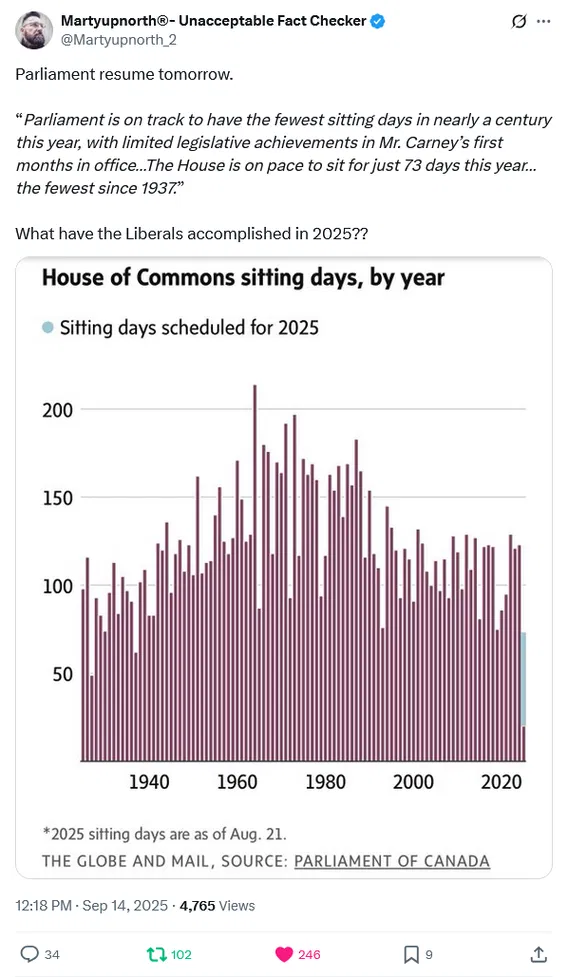
Parliament returns for the fall sitting today, it’s the first time the House of Commons has met since June 20. What’s remarkable is that in the 257 days that we’ve counted in 2025, the House has only met for 20 of them.

As it stands now, the House has not met in 87 days.

More remarkable, the House didn’t sit between December 17, 2024 and May 2025, all during a time of national crisis. Add to that the fact that between the end of September 2024 and the opening of the new Parliament on May 26, 2025 no government business was conducted due to the green slush fund scandal and the Trudeau government’s refusal to release documents to the House.

To say our democratic institutions haven’t been well served over the last year would be an understatement.

Over the last year, the oversight function of the House of Commons hasn’t been working as it should in our system. We’ve either had inaction by government or for most of this year, government by decree with little to no oversight by the people’s representatives.

Hopefully that changes today with a new sitting.

A change in tone…

One thing we’ve heard lots of chatter about is the need for a new tone, but primarily that’s been aimed at Conservative Leader Pierre Poilievre. Let me point out that Prime Minister Mark Carney is also new to this and we didn’t get the full measure of the man back in the spring.

The relationship between Justin Trudeau and Pierre Poilievre was acrimonious to say the least.

Trudeau towards the end was despised by Canadians and Poilievre couldn’t hit him hard enough in Question Period. Canadians would cheer as Poilievre would use his formidable Parliamentary skills to skewer Trudeau in the House of Commons.

Of course, Trudeau was part of the demise of the relationship and civility in the House as he showed utter contempt for the opposition, for Parliamentary rules and by extension to millions of Canadians.

Well, it’s a new government, a new leader in Carney and so yes, we can expect a new tone coming from both sides. We’ve already seen it from Poilievre in his many media appearances and news conferences over the past several months.

Poilievre has said that he and his party will oppose the government on issues where they disagree, support them on areas where they agree and offer practical solutions to the problems facing the country. That’s exactly what you want from an opposition party, which should in fact operate as a government in waiting.

Fenian Needham Conversion: Just the Thing for Invading Canada

Filed under: Britain, Cancon, History, Military, USA, Weapons — Tags: , , , , — Nicholas @ 02:00

Forgotten Weapons
Published 10 May 2025

The Fenian Brotherhood was formed in the US in 1858, a partner organization to the Irish Republican Brotherhood. The groups were militant organizations looking to procure Irish independence from the British, and they found significant support among the Irish-American immigrant community. In November 1865 they purchased some 7500 1861- and 1863-pattern muskets left over from Civil War production, and used them to invade Canada in April 1866. The idea was to capture the country and then trade it to the British in exchange for Irish independence … but the invasion went quite badly. The Fenians briefly held Fort Erie, but were pushed out after a few hours and largely arrested by American forces.

The Fenians’ muskets were confiscated, but all returned by the end of 1866 in exchange for promised Irish-American support of embattled President Johnson. By 1868, the group was making plans for another attempt at conquering Canada. This time they would have better arms — they obtained a disused locomotive factory in Trenton NJ and set up the Pioneer Arms Works to convert 5,020 muskets into centerfire Needham Conversion breechloaders. These were given chambers that could fire standard .58 centerfire ammunition, or the .577 Snider ammunition that the Fenians expected to be able to procure once in Canada. Most of the guns also had their stocks cut, to allow them to be packed in shorter crates for transit. These usually have a distinctive “V” cut in the stock, which was spliced back together before use.

When the second invasion came in April 1870, it was again a failure. Only 800-1000 men turned out of the 5,000+ expected. They were scattered among several different muster points on the border, and the Canadians were once again aware of their plans. The most substantial fight was at a place called Eccles Hill, where the Missisiquoi Home Guard was ready and waiting for them with good Ballard rifles. Upon crossing the border, the Fenians were soundly defeated.

This second time, the guns were confiscated and not returned. Instead, the Watervliet Arsenal sold them as surplus in 1871. They were purchased by Schuyler, Hartley & Graham for commercial resale, and thanks to that several hundred remain in collector hands today.
(more…)

QotD: The Dictatorship in the late Roman Republic

I’d also argue that the office [of Dictator as created by Sulla and then by Caesar] didn’t work for the goals of either of the men that recreated it.

For Sulla, the purpose of using the dictatorship was to offer his reforms to the Republic some degree of legitimacy (otherwise why not just force them through purely by violence without even the fig leaf of law). Sulla was a reactionary who quite clearly believed in the Republic and seems to have been honestly and sincerely attempting to fix it; he was also a brutal, cruel and inhuman man who solved all of his problems with a mix of violence and treachery. While we can’t read Sulla’s mind on why he chose this particular form, it seems likely the aim here was to wash his reforms in the patina of something traditional-sounding in order to give them legitimacy so that they’d be longer lasting, so that Sulla’s own memory might be a bit less tarnished and to make it harder for a crisis like this to occur again.

And it failed at all three potential goals.

When it comes to the legitimacy of Sulla’s reforms and the memory that congealed around Sulla himself, it is clear that he was politically toxic even among many more conservative Romans. A younger Cicero was already using Sulla’s memory to tarnish anyone associated with him in 80, casting Chrysogonus, Sulla’s freedman, as the villain of the Pro Roscio Amerino, delivered in that year. In the sources written in the following decades at best Sulla is a touchy subject best avoided; when he is discussed, it is as a villain. Our later sources on Sulla are uniform in seeing his dictatorship as lawless. Moreover, his own reforms were picked apart by his former lieutenants, with key provisions being repealed before he was even dead (in 78 BC so that’s not a long time).

Finally, of course, far from securing the Republic, Sulla’s dictatorship provided the example and opened the door for more mayhem. Crucially, Sulla had not fixed the army problem and in fact had made it worse. You may recall one benefit of the short dictatorship is that no dictator – indeed, no consul or praetor either – would be in office long enough to secure the loyalty of his army against the state. But in the second and early first century that system had broken down. Gaius Marius had been in continuous military command from 107 to 100. Moreover, the expansion of Rome’s territory demanded more military commands than there were offices and so the Romans had begun selecting proconsuls and propraetors (along with the consuls and praetors) to fill those posts. Thus Sulla was (as a result of the Social War in Italy) a legate in 90, a propraetor in 89, and consul in 88 and so had been in command for three consecutive years (albeit the first as a legate) when he decided to turn his army – which had just, under his command, besieged the rebel stronghold of Nola – against Rome in 88, precisely because his political enemies in Rome had revoked his proconsular command for 87 (by roughing up the voters, to be clear). And then Sulla has that same army under his command as a proconsul from 87 to 83, so by the time he marches on Rome the second time with the intent to mass slaughter his enemies, his soldiers have had more than half a decade under his command to develop that ironclad loyalty (and of course a confidence that if Sulla didn’t win, their service to him might suddenly look like a crime against the Republic).

Sulla actually made this problem worse, because one of the things he legislated by fiat as dictator was that the consuls were now to always stay in Italy (in theory to guard Rome, but guard it with what, Sulla never seems to have considered). That, along with Sulla having butchered quite a lot of the actual experienced and talented military men in the Senate, left a Senate increasingly reliant on special commands doled out to a handful of commanders for long periods, leading (through Pompey‘s unusual career, holding commands in more years than not between 76 and 62) to Julius Caesar being in unbroken command of a large army in Gaul from 58 to 50, by which point that army was sufficiently loyal that it could be turned against the Republic, which of course Caesar does in 49.

For Caesar, the dictatorship seems to have been purely a tool to try to legitimate his own permanent control over the Roman state. Caesar is, from 49 to 44, only in Rome for a few months at a time and so it isn’t surprising that at first he goes to the expedient of just having his appointment renewed. But it is remarkable that his move to dictator perpetuo comes immediately after the “trial balloon” of making Caesar a Hellenistic-style king (complete with a diadem, the clear visual marker of Hellenistic-style kingship) had failed badly and publicly (Plut. Caes. 61). Perhaps recognizing that so clearly foreign an institution would be a non-starter in Rome – unpopular even among the general populace who normally loved Caesar – he instead went for a more Roman-sounding institution, something with at least a pretense of tradition to it.

And if the goal was to provide himself with some legitimacy, the effort clearly catastrophically backfired. The optics of the dictatorship were, at this point, awful; as noted, the only real example anyone had to work with was Sulla, and everyone hated Sulla. Many of Caesar’s own senatorial supporters had probably been hoping, given Caesar’s repeatedly renewed dictatorship, that he would eventually at least resign out of the office (as Sulla had done), allowing the machinery of the Republic – the elections, office holding and the direction of the Senate – to return. Declaring that he was dictator forever, rather than cementing his legitimacy clearly galvanized the conspiracy to have him assassinated, which they did in just two months.

It is striking that no one after Caesar, even in the chaotic power-struggle that ensued, no one attempted to revive the dictatorship, or use it as a model to institutionalize their power, or employ its iconography or symbolism in any way. Instead, Antony, who had himself been Caesar’s magister equitum, proposed and passed a law in 44 – right after Caesar’s death – to abolish the dictatorship, make it illegal to nominate a dictator, or for any Roman to accept the office, on pain of death (App. BCiv, 3.25, Dio 44.51.2). By all accounts, the law was broadly popular. As a legitimacy-building tool, the dictatorship had been worse than useless.

So what might we offer as a final verdict on the dictatorship? As a short-term crisis office used during the early and middle republic, a tool appropriate to a small state that had highly fragmented power in its institutions to maintain internal stability, the dictatorship was very successful, though that very success made it increasingly less necessary and important as Rome’s power grew. The customary dictatorship withered away in part because of that success: a Mediterranean-spanning empire had no need of emergency officials, when its military crises occurred at great distance and could generally be resolved by just sending a new regular commander with a larger army. By contrast, the irregular dictatorship was a complete failure, both for the men that held it and for the republic it destroyed.

The real problem wasn’t the office of dictator, but the apparatus that surrounded it: the short duration of military commands, the effectiveness and depth of the Roman aristocracy (crucially undermined by Sulla and Marius) and – less discussed here but still crucial in understanding the collapse of the Republic – the willingness of the Roman elite to compromise in order to maintain social cohesion. Without those guardrails, the dictatorship became dangerous, but without them any office becomes dangerous. Sulla and Caesar, after all, both marched on Rome not as dictators, but as consuls and proconsuls. It is the guardrails, not the office, that matter.

Bret Devereaux, “Collections: The Roman Dictatorship: How Did It Work? Did It Work?”, A Collection of Unmitigated Pedantry, 2022-03-18.


September 15, 2025

A few thousand deplorable “gammons” disrupt the peace in London

Filed under: Britain, Media, Politics — Tags: , , , — Nicholas @ 05:00

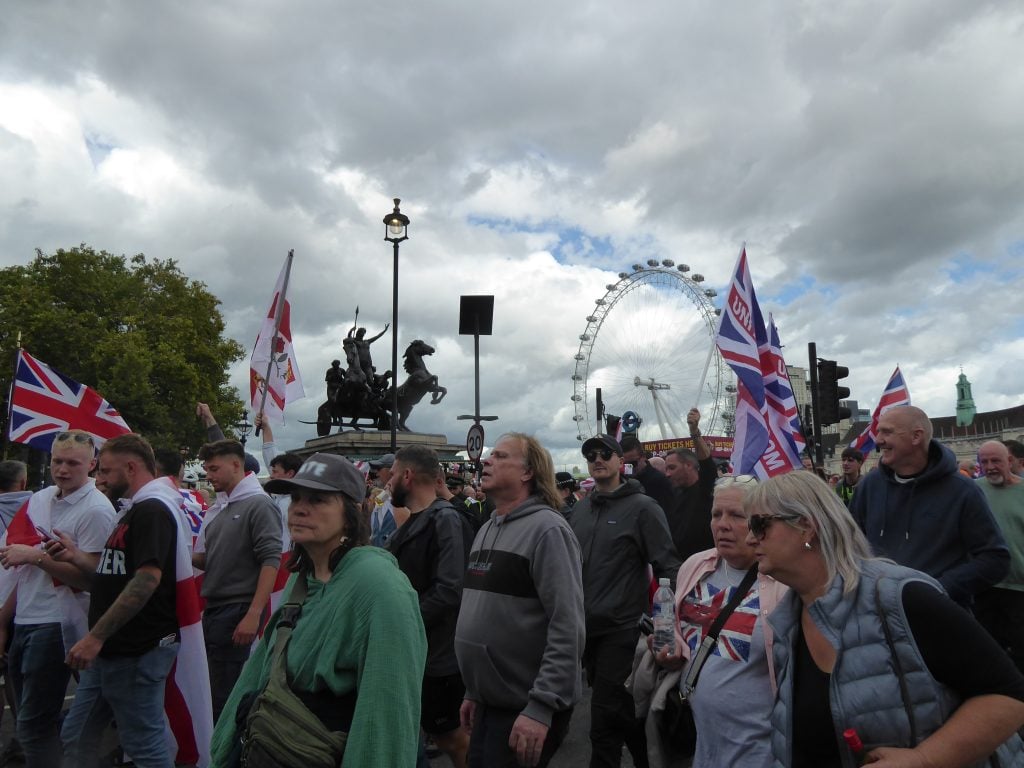
At least, the headline is how I assume most establishment types in Britain would try to describe the Unite the Kingdom march in London over the weekend (all photos by Esmeralda Weatherwax of the New English Review):

As I said earlier I have never seen a crowd like it – the police were overwhelmed with the numbers and I think even the organisers were pleasantly surprised at the turnout.

I gave up all hope early on of getting near enough to a screen to see or hear the speakers. But you can catch them up on line. I’m sure there are already links to Katie Hopkins, Laurence Fox, Tommy himself, Elon Musk by video link and the others.

I decided I was of most use photographing the numbers and variety, talking to people and following events away from the stage.

The march was scheduled to muster at Waterloo on the south bank. Knowing the turn out would be good attendees were advised to leave at Blackfriars Station and cross Blackfriars Bridge to join the march in Stamford Street east of Waterloo Station. The route was to be along the South Bank, over Westminster Bridge and into Whitehall at the south end. Antifa and Stand up to Racism were expected to march from Russell Square and would be rallying in the north end of Whitehall by Trafalgar Square with a long corden sanitaire between. Well that worked well last time.

I went straight to Whitehall and went to greet friends who were involved as marshals. Already the area was filling up fast and there were queues for the portaloos. They had to be provided as Westminster Council had shut and locked the public ones outside Westminster Station and on Westminster Pier. I don’t know why they do this. There will be mess afterwards.

The Cold War in Latin America Begins: Coups, Communists, and Castro – W2W 44

Filed under: Americas, History, USA — Tags: , , , , , , , , — Nicholas @ 04:00

TimeGhost History
Published 14 Sept 2025

Spy rings, covert operations, coups, street violence, and sudden regime changes. This is the turmoil that awaits Latin America after the Second World War. As new ideas from the East gain momentum, the United States tries to hold on to its role as the region’s self-appointed guardian. Which side will ultimately shape the future of this rich and populous region?
(more…)

When folks built their houses from Sears, Roebuck & Co. kits

Filed under: Business, History, Railways, USA — Tags: , , — Nicholas @ 03:00

I thought I’d discussed the Sears kit homes about a decade back, but perhaps it wasn’t for the blog. Anyway, there’s a nice summary by Katrina Gulliver of how Sears and other companies made home-building great a century ago:

A hundred years ago, kit homes were more common in the US. Sold by Sears, Montgomery Ward, and other local firms, buyers received the plans and the pieces for a house and put it together themselves. Economies of scale made these a viable option for someone looking to build a house in the expanding suburbs.

The 1914 Sears Modern Homes catalog shows three homes that could each be bought for $656 (in the small print, they admit your outlay would be more like $1,250 all-in, including brick, cement, plaster — which they don’t supply — and labor). Your kit house would be delivered by rail; it was generally assumed householders would be handy enough (or know whom to hire) to put it all together from the supplied plans.

According to a 1930 report by the National Bureau of Economic Research, National Income and Its Purchasing Power, in 1914, the average clerk could be making $1,000, and a factory manager earning $2,300. That means these houses were within reach of lots of people — especially bearing in mind that land costs in many cities were also relatively low. In Chicago, lots within 5 miles of downtown were available for less than 50¢/square foot in 1914.

Those kit homes included wood, metal, and glass, and reflected both the tastes of consumers and the economies of bulk production. The various styles in the catalog over the years included craftsman, Dutch colonial, Federal, and cottage — styles that have continued to be popular in residential architecture of the US.

The Sears catalog of 1936 states: “This is the age of modern efficiency. No longer can human hands compete with machine precision and production. ‘Speed with accuracy’ is the watchword in any department of our great factories.”

(For those curious about such houses, fans of Sears kit homes put together lists of examples still standing.)

HBO’s Rome – Ep 11 “The Spoils” – History and Story

Filed under: History, Media, Military — Tags: , , , , , , — Nicholas @ 02:00

Adrian Goldsworthy. Historian and Novelist
Published 23 Apr 2025

This time we look at episode 11 — and only this episode as there is more to talk about when it comes to the historical background. Some of the plot doesn’t fit too well to the actual history, but there are some nice details that crop up and make it worthwhile. In the main, I get excited about a coin and a court.

« Newer PostsOlder Posts »

Powered by WordPress