
Perhaps the most fascinating component of [Prof. Thomas] Courchene’s paper is his subtle discussion of what, precisely, equalization is for. Is it meant to render every province in Canada equally well off in general? Or is it meant only to correct inequities introduced by the provinces’ different geographic and natural circumstances? Or is it meant even more narrowly, as a scheme to ensure that the federal government doesn’t accidentally worsen those inequities? Or it is meant merely to discourage culturally harmful labour migration?
There is no official answer to this question, and all the possible answers lead to moral and mathematical absurdities. It’s not just that we don’t know whether equalization works, as Terence Corcoran observed in the Financial Post yesterday. We literally don’t even know what it’s meant to accomplish
Colby Cosh, “Economist plays ethicist”, National Post, 2005-09-01.
September 15, 2025
QotD: Federal equalization payments
September 14, 2025
Funny … I saw multiple reports that the accused assassin was an extremist “conservative” …
I don’t normally lean on content from the social media site formerly known as Twitter, but there’s more solid information there than in 99% of the legacy media. For instance, here’s ESR on the background of the alleged assassin (I use the word “alleged” because I can’t afford lawyers for nuisance suits):

The Salt Lake City FBI office released these photos of a “person of interest” in the Charlie Kirk assassination.
Two newspapers are now reporting that Tyler Robinson was living with a transsexual who is cooperating with the FBI, so I’m going to consider this confirmed.
Rather than talking about the obvious stuff, I want to focus on the questions I think the FBI will be asking the boyfriend.
Not about the assassination itself. They’ve already got Robinson dead to rights on aggravated murder. Given that he apparently had to be dissuaded from committing suicide when he was caught, he may even plead guilty and confess.
No, the interesting question is his connections. With probability approaching unity, he was Antifa. The question is: explicit Antifa, or stochastic?
I think we can take it as given that Robinson wasn’t given orders to kill Kirk by some supervillain sitting at the top of a command hierarchy. Antifa doesn’t work that way.
Antifa is not a unitary conspiracy, it’s a whole bunch of interlocking directorates with common ideological goals. This trades away some capacity for large-scale organization in order to gain resistance against single-point attacks.
To the extent Antifa as a whole takes orders at all, it’s by paying attention to the targets suggested by above-ground left-wing figures. Yes, including Democratic politicians, who treat Antifa as a conveniently deniable militant wing. The decentralization of its organization helps with the deniability, too.
Robinson may have been part of an Antifa cell that provided him with logistical support, knowing what they were contributing to.
Or, he may have been acting alone in a direction shaped by Antifa propaganda. There’s actually a continuum of possibilities; he might have dropped deniable hints to Antifa associates as a way of gaining status within the group.
I think what the boyfriend is going to get the most serious grilling about is the nature and scope of those connections. That is, if Robinson doesn’t reveal them himself.
They’re going to get his cell, if there is one. They may be able to nail down the entire Antifa chapter it’s part of.
Further connections are going to be tough to prove. It is highly unlikely, for example, that there are direct command links from the Democratic National Committee to Antifa.
It will probably be more productive to follow the money; if they can flip the right people in his chapter they may be able to go after dark-money groups like Arabella, the Tides Foundation, and the Open Society Foundations.
Which, to be fair, probably don’t know they’re funding assassinations? But are probably carefully averting their eyes from the fact that they fund people who fund other people who fund assassinations. The network is carefully designed to preserve deniability in all directions.
The long play in smashing a terror network is always to cut its funding chain. That job got well started with the dismantling of USAID, but there’s a lot more work to do.
Charlie Kirk’s assassination may give us the thread that unravels the whole weave.
Also on former-Twitter, Larry Correia:
Oilfield Rando @Oilfield_Rando
Imagine the newsroom editor meetings where they’re trying to figure out some way, any way, to spin the news that the shooter was shacked up with a trooner before they publish articles about it.Because make no mistake, they can’t avoid publishing it. They know it.
My bet for the news blitz narrative that’s coming —
It’s the fault of his conservative, religious family, for driving this young man to kill because they couldn’t accept his forbidden love. How tragic. The real bad guys here are those conservative Christian hate mongers who won’t let love be love, and as usual liberals are the real victims. Plus a single shot from a really old deer rifle shows why we need to ban assault weapons. If you grew up with a Republican father that means you are MAGA forever and pay no attention to the millions of militant leftists and rainbow haired pronoun people on TikTok bragging about how much they hate and rebelled against their conservative religious parents, that’s different.
Larry Correia, Twitter, 2025-09-13.
“When must we kill them?”
On the social media platform previously known as Twitter, Tom Kratman provides an excerpt from The Care and Feeding of Your Right Wing Death Squad:
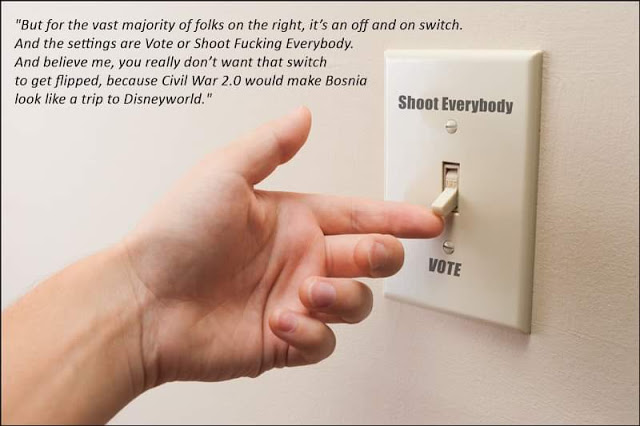
Reposting this seems apropos:
The Care and Feeding of Your Right Wing Death Squad, Chapter 32 Copyright © 2025, Tom Kratman, Harry Kitchener
“When must we kill them?”
That question was asked recently by a leftist student, one Nicholas Decker, from George Mason University. It’s a very interesting question, and one that most, and perhaps all, hard leftists in the United States are contemplating. Indeed, we see now, from an NCRI / Rutgers survey, that something over half of leftists believe that assassinating Trump would be justified, and nearly half think the same thing about Musk.
Note, here, that this was of all people identifying as left of center. I would suggest that this means that almost nobody who is slightly left of center would agree with that and nearly everybody who is far left of center agrees with that. And if we needed any more proof, just contemplate the number of would be groupies moistening their panties over murderer Luigi Mangione, as pointed out by former New York Times reporter Taylor Lorenz.
Why do they think so or why are they wondering about it? It’s actually more understandable than most on the right and perhaps even many on the left would understand. They’re wondering about it because, with the destruction of the Deep State, with so many billionaires turning against the left and – horrrors! – no longer letting the left wing narrative control online and legacy media political discourse, with no prospect of the kind of money being shunted from the taxpayer, through the Federal Government, to left wing NGOs to help swing elections, they do not really think there is any serious prospect of the left ever winning a national election again or, at least, not in their lifetimes. And they may be right about that.
With James Carville telling the Democrats to give the boot to the gender and woke ideologues, the identity politics losers, the little boy penis choppers and little girl breast destroyers and vagina removers; they see themselves being marginalized, losing their influence, and losing their dream, forever. And this seems fairly likely. With no possibility, once Trump gets finished deporting all the illegals, of turning just enough of those illegals into client voters to swing elections just enough for control, they think that leftism will be hopeless in the United States. And they’re probably right about that. With the Communist factories of higher education being broken to the will of the right, with Gramsci’s / Rudi Dutschke’s “Long March Through the Institutions” being walked back, and quickly, they’re thinking about it and wondering about it because leftism is dead in the United States, a corpse just awaiting burial.
So, though the point of this entire exercise in the Right Wing Death Squad has been to convince the left to chill out, FFS, it seems that certain key point bear repeating.
1. Urban Guerilla movements invariably succeed in creating the kind of oppressive government that they believe will infuriate the people and lead to a general uprising. Those governments then proceed to exterminate the Urban Guerillas and all their supporters, and do so to general popular applause.
2. The armed forces, barring some political generals and morally cowardly colonels, hate you and everything about you. Posse Comitatus is only a law, not something in the constitution that would require going through the difficult process of amendment. Change the law – and do but note who has control of the House, the Senate, and the Supreme Court (so that constitutional grounds could not be manufactured to create an objection to getting rid of the law) – and the military would be very happy to round you all up. And you’re completely, incompetently, incapable of resisting this.
3. Moreover, though you have a few people with some military experience and training, the key word there is “few”. Yes, yes, I know that, since Vietnam, the left has been obsessed with the inner city black cannon fodder meme, but it wasn’t true then and it isn’t true now. Conversely, the white working class and conservative populations at large – to the limited extent these categories may differ – are replete with people with a lot of military training and experience and they hate you, too. They also have most of the guns. Your side has fairly few, in comparison, and little skill in using what you do have, alone or in groups.
4. You also fundamentally misunderstand the difference between your approach to violence – as a rheostat to be turned up or down, to suit – with the right’s – which is an on-off switch marked “peace and good feelings” on the one hand, and “kill every one of them” on the other.
You know all those terrible things you and your pals like to say about right wing, especially but not always white, Americans? Well, we know you don’t really believe those things because if you did you would be afraid ever to leave your mom’s basement. But you really ought to try to grasp this; sometimes those things are true.
Although our purpose with this project has been to try to get you to save yourselves, still, one cannot help but look forward to the prospect of young Mr. Decker finding this out.
So, if you were to succeed in killing the president, you will get Vance. Vance will have a mandate, in that case, to obliterate you. If he fails to carry out that mandate then genuine Right Wing Death Squads will take up the slack. No trial, no due process at all; they will proceed to obliterate you and every safe harbor and supporter you have, and often in creatively disgusting ways.
Amusingly enough, your only safety, in such a case, would be in being sent to some variant on El Salvador’s CECOT. I could see the population of El Salvador roughly doubling in the course of a few years as millions of American leftists find out just how grim a Latin American prison can be.
But, seriously, why would they or anybody waste the money when you could as easily just become an unfortunate statistic? Were I betting on it, I’d bet that few of you see a flight – or even half a flight – to El Salvador, but that many of you would have a long last moment staring down into a ditch you had just been forced to dig while a man with a pistol walks up behind you.
So the answer to young Mr. Decker’s question, “When must we kill them?” is “When you want to die.”
History of Britain VIII: Welsh, Picts, and Irish in the Early Middle Ages
Thersites the Historian
Published 7 Mar 2025In this video, we look at the other major ethnic groups in the British Isles and trace their development, insofar as our limited sources allow.
QotD: Intersectionality theory
More importantly, however, I do agree with Christina Hoff Sommers that Intersectionality Theory is dangerous for humanity, dissolving the complexity of human nature and culture down to an overly simple Manichean model of Oppressor and Oppressed, Them and Us, Good and Evil, and Black and White (literally and figuratively). It’s is another instantiation of Identity Politics and it is dangerous because it threatens to reverse everything that the Civil Rights movement fought to obtain, and it is the very opposite of what Dr Martin Luther King Jr. dreamed about in his most famous speech:
I have a dream that my four little children will one day live in a nation where they will not be judged by the color of their skin but by the content of their character.
Michael Shermer, interviewed by Claire Lehmann, “The Skeptical Optimist: Interview with Michael Shermer”, Quillette, 2018-02-24.
September 13, 2025
“It was about control before green policy became popular, and it is about control now”
In the National Post, Carson Jerema identifies the common thread among all of Prime Minister Mark Carney’s efforts since becoming Liberal party leader:

Then-Governor of the Bank of Canada Mark Carney at the 2012 Annual Meeting of the World Economic Forum in Davos, Switzerland.
WEF photo via Wikimedia Commons.
Prime Minister Mark Carney may not be as obnoxiously progressive as Justin Trudeau, but that doesn’t mean he isn’t stubbornly left wing in his own right, though he has managed to convince many critics otherwise.
Over the past decade, the Liberals were particularly self-righteous over climate policy, so much so that the deviations made by Carney since assuming office have been met with praise — or, on the left, with scorn — that he is somehow pro-business and represents the return of the centre-right Liberals. Some even think he’s a conservative. Others have suggested that Conservative Leader Pierre Poilievre is now entirely redundant.
This narrative is just more proof of how utterly captured the media is in this country by the Liberal party. It is true that Carney gives the appearance that he is abandoning many of the government’s environmental policies. He set the carbon tax rate to zero, paused the EV mandate and, on Thursday, he refused to endorse his government’s own carbon-emissions targets.
None of this, however, should be taken as evidence that Carney represents some sort of rightward or pro-business shift in the Liberal party. He is not proposing to let markets determine what infrastructure projects get built. Nor is he proposing to minimize regulations to attract investment.
Instead, Carney wants to command the economy by himself, laying bare the reality that what attracts left-wing politicians to climate policy is not saving the planet from carbon, but using environmental objectives to manage the economy. It was about control before green policy became popular, and it is about control now. For Carney specifically, before he entered politics, “decarbonizing” markets was quite remunerative in his various banking roles.
Noticeably absent from the five infrastructure projects that the prime minister said on Thursday would be fast-tracked under the Major Projects Office was an oil and gas pipeline. Also noticeable was the fact that all five of the projects had already been approved, but the government tried to pass them off as something new anyway.
Even if the projects had been all brand new, the lack of a pipeline would still be of no surprise, as what private investor would be willing to back a pipeline when the Liberals’ Impact Assessment Act, tanker ban and emissions cap all exist to conspire against energy projects of any kind?
One thing that became incredibly obvious early in Justin Trudeau’s premiership was that the prime minister — and his ministers in general — really did seem to believe that talking about doing something was as effective in solving problems as actually doing the thing. Many had hoped that Mark Carney would be different … but as Dan Knight points out, he may actually be worse:
From there, [Poilievre] broadened the attack. He spoke of an entire generation priced out of homeownership, of immigration growing “three times faster than housing and jobs”, of crime rising, and of what he called “the worst economy in the G7”. And then he turned squarely on Carney: “Mr. Carney is actually more irresponsible than even Justin Trudeau was“, citing an 8% increase in government spending, 37% more for consultants, and 62 billion dollars in lost investment — the largest outflow in Canadian history, according to the National Bank.
The message was simple: Liberals talk, Conservatives build. Poilievre painted Carney as a man of speeches and promises, not results. “The mistake the media is making is they’re judging him by his words rather than his deeds“, he said.
It was an opening statement designed less to introduce policy — those details came later — and more to frame the battle. For Poilievre, Carney isn’t just Trudeau’s replacement. He’s Trudeau’s sequel, and in some ways worse.
[…]
Pierre Poilievre didn’t hold back when asked about Mark Carney’s record. His words: “Mr. Carney is actually more irresponsible than even Justin Trudeau was“. That’s not a throwaway line, he backed it with numbers.
According to Poilievre, Carney inherited what he called a “morbidly obese government” from Trudeau and made it worse: 8% bigger overall, 37% more for consultants, and 6% more bureaucracy. He says Carney’s deficit is set to be even larger than Trudeau’s.
Then the jobs number: 86,000 more unemployed people under Carney than under Trudeau. That, Poilievre argued, is the real measure, not the polished speeches Carney gives. His line: “The mistake the media is making is they’re judging him by his words rather than his deeds“.
Lorenzo Warby on the “conspiracy error”
Note that this piece was published before the assassination of Charlie Kirk the next day, and it does not directly address issues stemming from that crime.
On Substack, Lorenzo Warby explains why conspiracy theories spring up so readily:
Analysis of events abhors an analytical vacuum. That is, if your mental architecture lacks certain key analytical tools or framing, then you will be driven to mischaracterise — potentially seriously mischaracterise — events.
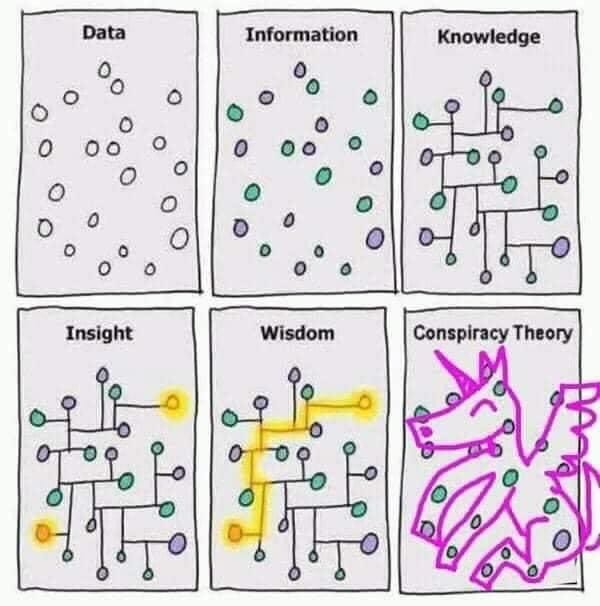
Given the human propensity for identifying patterns, and awareness of human intentionality, what can very easily fill in an analytical gap is some form of conspiracy theory. A conspiracy theory alleges that there are centrally organised people operating in secrecy — usually in a malign way — controlling events.
A conspiracy theorist is someone who advances such an idea. The term can also be used as a term of abuse for anyone who inconveniently notices patterns — such as folk advancing claims and beliefs that suit people like themselves — or simply advances claims that people find inconvenient or awkward.
There are actual conspiracies. We know there are actual conspiracies, because they have been exposed.
The question is whether the claimed level of coordination and control over events, and the required level of continuing secrecy, is what is happening. The more restricted one’s analytical tools, the more conspiracy is likely to seem the default explanation for any coordinated pattern of behaviour.
Something that people do openly is not a conspiracy. Nor is conspiracy the only way for people to coordinate. It is perfectly possible to coordinate via mutual signalling, for instance. This is particularly true if people are engaged in shared status games. It is even more true if networks share common interests, common information sources and are playing shared status games.
Among us Homo sapiens, much of the point of status is to generate currencies of cooperation. We are a very status-driven species because we are very social beings, so prestige (conspicuous competence) and propriety (conspicuous conformity to norms) have been currencies of cooperation for our highly cooperative subsistence and reproduction strategies that developed across hundreds of thousands of years.
In thinking about the dramatic changes brought about by the Sexual Revolution of the 1960s, it became clear to me that there were always sexual outliers, there are always folk trying different life strategies. Due to the Pill and legally available abortion, which life strategies worked suddenly changed, so folk shifted to them and the norms that enabled them.
Thinking seriously about the mechanisms by which sexual mores changed leads to considering networks, signalling, life strategies. Once you grasp the power of these social mechanisms, you are in a much better situation to see how much conspiracy theories are a product of a lack of analytical breadth and depth. Conspiracy theories are a mechanism to “explain” events, one that occurs naturally to our pattern-seeking minds aware of human intentionality. They do so, however, in the absence of analytical alternatives, if we do not have better operational mechanisms to explain events — and especially observed social coordination — by.

Jennings 5-Shot Repeating Flintlock Pistol
Forgotten Weapons
Published 9 May 2025Isaiah Jennings patented an improvement to the Belton repeating flintlock system in 1821 — but we don’t know exactly what his idea was because the Patent Office lost his patent (and many others) in a large 1836 fire. Jennings’ system was used by several gunsmiths, though. In 1828/9 the State of New York contracted to convert 521 of their muskets to Jennings’-pattern repeaters. We also have a few examples like this custom five-shot pistol made by John Caswell of upstate New York.
Jennings’ system uses superposed charges loaded in the barrel along with a movable lock. Each charge has its own touch hole, and the cover plates for them act as stops for movement of the lock, to ensure proper alignment. The trigger will fire the lock in any position, and it is also fitted with an automatic magazine frizzen — so cocking the hammer automatically charges priming powder into the pan and closes the frizzen. These were very advanced arms for the early 1800s, and expensive to produce.
Belton Repeating Flintlock:
• Belton Repeating Flintlock: A Semiaut…
(more…)
QotD: The Peter Principle in football, the military, and life in general
Is that true in other jobs where you need a combo of a certain physique, a certain IQ, and a certain attitude? The military, say, or the police? Would the average platoon sergeant be a better lieutenant than the average lieutenant? (I’m seriously asking, even though I know that the average corporal’s opinion of the average butterbar lieutenant and vice versa makes the town-gown split in college look like a friendly rivalry). What about the best NCO — would he make a good general? How about the best patrolman vs. the best detective?
And of course this is complicated by the outliers. SWAT guys generally don’t become police chiefs, Special Forces guys don’t become generals (that McChrystal bastard being an unfortunate exception), and so on, but those are extreme outliers, like quarterbacks — physical freaks with fast-firing heads; they don’t want desk jobs, I imagine.
The reason I’m rambling on about this (other than “I’m jet lagged and I have the flu”) is that our whole society seems to have fucked up its competence sorting mechanism, and that flaw seems to be structural. You don’t want a coach who never played, or a general who never fought, but at the same time there’s fuck-all relationship between “being good at playing / fighting” and “being good at coaching / strategizing” that I can see. The same applies in all bureaucracies, of course, we call it the “Peter Principle” — the guy who was good at answering phones in the call center might or might not be any good at supervising the call center, but there’s only one way to find out …
… or is there? Football is interesting in that there’s only one metric for success, and it’s easy for everyone to see. There’s absolutely zero question that So-and-So was a good player, in the same way that there’s zero question So-and-So was a good coach. You can always find nerds and lawyers to niggle around the edges — oh, So-and-So is overrated, and here’s my charts and graphs to prove it — but we all know what that’s worth. Figuring out a better way to sort talent in a binary system like football would go a long way to help us figure out how to fix our society’s fucked-up competence sorting mechanism.
Severian, “Friday Etc.”, Founding Questions, 2022-02-04.
September 12, 2025
Canada’s temporary foreign worker programs
At Acceptable Views, Alexander Brown calls for the end to the Canadian federal temporary immigration scam programs:

It’s not hyperbole to say that Canada has built an entire economy on exploiting cheap, foreign labour through TWFP, as well as the International Mobility Program (IMP). These are two slightly different programs that allow foreign nationals to work in Canada, with most going to Ontario. But contrary to its name, there is nothing “temporary” about the TFWP. Its original purpose was to remedy proven labour shortages while Canadians were hired and trained to eventually do the jobs in question. Meanwhile, the IMP allows international students to work—with or without a proven labour shortage—while they’re studying in Canada.
Between 2019 and 2023, the TFWP increased by 88 percent and the IMP increased 126 percent. They account for close to 1.58 million work permit holders, equal to roughly 7 percent of Canada’s labour force.
Taken together, the results of the TFWP and IMP are deplorable. The TFWP allows foreign nationals to be recruited abroad in vast numbers, brought to Canada, housed in degrading conditions, paid the minimum wage, forced to work long hours, pressured into not joining a union, and required to work for only one employer. Yes, the IMP is more flexible, but it’s more pernicious because it does not even pretend to address labour shortages.
Both schemes are also of course bad for Canadians themselves. The problem is especially grievous for young Canadians trying to get started in the labour market. Canada lost 40,800 jobs this past July, the unemployment rate is now 6.9 percent, and youth unemployment (those between 15 and 24 years old) is now 14.6 percent.
Both the TFWP and IMP are used as business models. Hiring foreign nationals at minimum wage keeps prices low and profits high—most notoriously in the hospitality and trucking sectors, but no industry seems untouched now.
Addicted to cheap foreign labour
The use of the TFWP in the healthcare sector, for example, has grown by an appalling 1,700 percent since 2000. That dramatic rise has no doubt been abetted by the absence of uniform standards and credential recognition among Canadian provinces. If medical personnel could move easily from one province to another, shortages could be filled by Canadians. But historically this has not been possible, and so medical institutions have had to turn to the TFWP. Ontario’s recent determination to solve this problem by speeding up recognition of 50 “in-demand” professions from other provinces is a step in the right direction, and hopefully not too little too late.
Meanwhile, the IMP is a vehicle for outright fraud, ranging from fake acceptance letters from bogus “colleges” to elaborate human-trafficking schemes. Not long ago, nearly 50,000 holders of foreign student visas were working and attempting to settle here, rather than studying at any Canadian university or college. Most were migrants from India, and some were trying to cross the border illegally into the United States. The RCMP is now working with Indian law-enforcement to investigate alleged links between dozens of “colleges” in Canada and two “entities” in India allegedly facilitating passage into the U.S. When we reflect that an astounding 4.9 million temporary visas are set to expire this year, we have reason to believe that this abuse, exploitation, and fraud are on a much larger scale that we understand.
The consequences for young Canadians
Both the TFWP and the IMP serve to keep wages artificially low and profits high, and to price Canadians out of the job market. It wouldn’t be wrong to view these programs as distortionary government subsidies or welfare for unproductive businesses. The effects disproportionately harm younger Canadians who are priced out of the labour market, given that temporary workers overwhelmingly earn less than the median wage. And yet, we’re constantly hectored about labour shortages, Canadians’ “unwillingness” to do certain jobs, and the need for foreign workers.
It shouldn’t take much intellectual effort to see that the use of foreign labour and the difficulties of employing younger Canadians are two sides of the same ugly coin. Foreign workers are more cooperative because they are bound to their employers like serfs. They face normally insurmountable barriers to joining unions and have no attachment to the community in which they’re expected to work. In comparison, the domestic population is generally better educated and rooted in the local community.
Young Canadians can afford to be discriminating and should rightly expect higher wages than foreign nationals. Employers should instead work harder to invest in and reward their domestic workforce. In any other era, this would have been obvious. But now there is little incentive for businesses to look beyond cheap, foreign labour.
To get an idea of the magnitude of our collective failure here, consider the following fact. A 2024 study by RBC Economics revealed that Canadian businesses are sitting on a stockpile of cash worth almost a third of our country’s GDP. In other words, Canadian companies have the means to invest in hiring and training Canadians, but simply refuse to do so. The results of this refusal are stagnant wages, structural unemployment, and a de-skilling of the domestic population.
Britain’s network of weather stations is becoming less and less reliable
Well-sited weather stations can provide useful raw data on temperature ranges, wind speed, precipitation, and other measurables, but that “well-sited” makes a huge difference. Older weather stations situated in areas of rapid urban expansion will often be less reliable as they become part of the urban heat island and report higher temperatures due to locally generated heat sources rather than the ambient temperature they were able to record before. This is what has apparently happened to far too many of the UK’s temperature measuring sites, according to Chris Morrison in The Daily Sceptic:

The latest WMO Class figures at the Met Office shown in block graph form. The higher the class number, the less reliable the station reports become.
Image from The Daily Sceptic
In March 2024 the Daily Sceptic shocked the science and political world by disclosing that nearly 80% of the UK Met Office’s temperature measuring sites were so poorly located that potential “uncertainties” could corrupt the readings by a numbers of degrees of centigrade. World Meteorological Organisation (WMO) Classes 4 and 5 in its CIMO scale come with “uncertainties” up to 2°C and 5°C respectively, and a Freedom of Information (FOI) request found that 77.9% of its sites were in these two “junk” categories. It should have been a wake-up call demanding immediate improvement of the nationwide network, not least because the Met Office frequently catastrophises its temperature figures in the interest of promoting the Net Zero fantasy. Alas, no. A new FOI has found that the Classes 4 and 5 junk sites have increased significantly over the last 18 months and now total an appalling 80.6% of the entire network. Pristine Class 1 sites – which measure a credible ambient air temperature with little chance of unnatural heat corruption – are just 4.9% of the total, having fallen in number in this short period from 24 to 19.
Hundreds of millions of pounds have flowed through this Government department over the last 18 months but little effort seems to have been made to improve its basic and important meteorological measuring function. What is worse is that the Met Office doesn’t seem to understand the scale of the problem. Over the 18 months, it appears that 20 new sites have been opened in its now 387-strong network. Seventeen of these have been given WMO classifications, of which a frankly ludicrous 64.7% are starting life in the Class 4/5 junk lane.
The WMO rates weather stations by the degree of possible temperature corruption caused by nearby unnatural or natural influences. Classes 1 and 2 are considered what we might call pristine, with no significant errors arising from artificial influences. The latest figures show that the Met Office has just 12.1% of its sites in these two unadulterated categories. Class 3 comes with an uncertainty of up to 1°C and accounts for 7.23% of the total. The real shocker is Class 4 where the percentage of the total has risen from 48.7% to over half at 50.1%. Class 5 has no defining conditions and could be located next to a blast furnace door. It has risen over the last 18 months from 29.2% to 30.5%. The WMO states that a Class 1 location can be considered a “reference site”. A Class 5 site is said to be a location “where nearby obstacles create an inappropriate environment for a meteorological measurement that is intended to be representative of a wide area”.
Despite this, Class 5 “extremes”, often caused by temporary but obvious heat spikes, litter the Met Office databases and record books. Of course such Class 5 data, unsuitable for providing an accurate temperature for a “wide area”, are loaded into databases producing “hottest evah” days, months, seasons and years. Their final destinations are the global datasets that exaggerate recent warming, again to promote Net Zero. Sprinkling the Class 4 and 5 fairy dust over the figures adds a bit more of the urgency required for elite political purposes.
A primer on patterns in past political assassinations
On the social media site formerly known as Twitter, ESR shares his observations on common patterns in political assassinations which may be relevant to the investigation of the assassination of Charlie Kirk:
The Salt Lake City FBI office released these photos of a “person of interest” in the Charlie Kirk assassination.
I don’t know anything other than public information about the assassination of Charlie Kirk.
However, a primer follows about patterns in past political assassinations. I will sketch what scenarios an intelligence analyst would come up with looking at this one.
The first and most important rule in this kind of investigation is: when you hear hoofbeats, think horses not zebras.
In political assassinations, as an ordinary murders, the correct suspect is usually the most obvious suspect. Airport-thriller-style convoluted plots and false-flag ops pulled off by unlikely people or organizations are rare in the real world.
Accordingly, when you’re trying to solve a political assassination, the right question to ask is “Who said they wanted him dead?”
Then, you infiltrate those organizations, or arrest a bunch of members, and do contact tracing. Usually you do in fact find your killer that way. It’s not very different from ordinary police work except for the stakes.
There are broadly speaking three different kinds of assassin: the nutter, the zealot, and the pro. They are not difficult to distinguish once you got your hands on them.
Nutters don’t have a coherent political ideology, though they may spout semi-random slogans that political actors can seize on to pretend that they do. They generally have quite an obvious history of mental illness
Before capture, given the kind of public evidence we have now in Charlie Kirk’s assassination, it’s difficult to tell the zealots from the pros by their MO. It used to be easier, but as I noted in a previous post sniper doctrine and technique have been leaking into popular culture for decades.
It’s easier to spot the nutters; they tend to have poor forward-planning capacity. A very obvious way this manifests is a weak or non-existent plan for exfiltrating after the hit. Thus, the nutter is very likely to get caught quite soon after the assassination, often at the site.
This also produces a false-prominence effect – people think political assassins are more likely to be nutters than is actually the case.
Pros – professional assassins working for intelligence agencies or militaries – are also rare. They do occasionally strike – as when, for example the Bulgarian secret service whacked Pope John Paul – but high-profile public assassinations carry a risk of diplomatic and political blowback the most nations are unwilling to assume.
Also, trained assassins are a scarce resource and exfiltrating in the hue and cry following a very public assassination is chancy. Usually you’re going to send them against more obscure targets like exiled dissidents that you think might still be dangerous, hoping not to trigger a full law-enforcement and counterintelligence response.
There’s been talk in some of the wackier corners of the Right that the Mossad did this one. No analyst would take this seriously; the blowback risk to the Israelis is far too high to justify any gain. Same goes for the Russians, though they have a higher risk tolerance than the Israelis and had a much higher tolerance in Soviet times.
In the case of Charlie Kirk it’s pretty high odds we’re looking at a zealot. That’s usually the way to bet, and in this case, the quality of his exfiltration plan and the fact that he has successfully disappeared raises the odds.
Given all these factors, LEOs are going to be looking for zealots associated with domestic organizations that said they wanted Charlie Kirk dead.
Yes, this seems boring and obvious. The main point I’m trying to drive home here is that the boring and obvious theory about a political assassination is usually the correct one.
Accordingly, the first place investigators of the assassination of Charlie Kirk are going to be looking is gun clubs associated with Antifa and the hard left, like the John Brown Gun Club and Redneck Revolt.
It’s not certain that Kirk’s assassin is a member of one of those groups, but if you had to place a bet that would be where to put it.
Update: while I was composing my analysis there was a leak from inside the ATF. They found a .30-06 with engravings expressing “anti-fascist” and transgender ideology.
As I said: When you hear hoofbeats, think horses not zebras. The obvious suspect is usually the correct one.
And later, on the particulars of this particular assassin’s work:
PSA for those speculating about the sniper who killed Charlie Kirk:
No, the shot he made was not a difficult one, and does not constitute evidence that he was a professionally-trained sniper.
His choice of hide and the quality of his exfiltration plan was impressive. That could indicate pro-level training. Or, it could just mean he played the right videogames.
Information about sniper practice has been leaking into popular culture for decades. It used to be that good practice could enable you to make deductions about the background of the sniper, but that time is past.
Nothing has yet been released about what ammunition or weapon he used. It is highly likely that the bullet has been recovered and identified.
About the most we’re likely to be able to extract from the caliber is whether the sniper used an American traditional caliber like .30-06, NATO-standard 7.62, or Russian 7.62. The latter two cases may not be distinguishable if the bullet is deformed.
Knowing this won’t really tell us anything, as rifles in all plausible calibers are generally available in the United States. Furthermore, if this were a pro-level hit, misdirecting investigators by choosing an adversary or third party weapon is part of normal covert operations doctrine.
All in all, it is not possible to deduce anything of significance about the sniper from the publicly available information. Mistrust anyone who claims otherwise.
Ancient Roman Table Manners & Etiquette
Tasting History with Max Miller
Published 8 Apr 2025Spiral-shaped fritters drizzled with honey and sprinkled with white poppyseeds
City/Region: Rome
Time Period: 2nd Century B.C.E.These fritters are kind of like a mix between globi and jalebi. The batter is simple like the globi, made of just spelt flour and ricotta, but they’re piped into hot fat in spiral shapes like jalebi. The technique can be a little tricky to get right so that the spirals hold together, but you should get about 12 to 15 tries out of the amount of batter this recipe makes.
The encytum are delicious and kind of remind me of a healthy pancake, but with honey instead of maple syrup. They don’t stay crispy for very long, so plan on serving them right away if you’d like to retain maximum crispness.
Make encytum the same way as globi, except that you use a vessel with a hole in the bottom which you can stream through into hot fat, and shape like the spira, coiling and turning it with two sticks. Spread and color with honey while still warm. Serve with honey or mulsum.
— De Agri Cultura by Cato the Elder, 2nd century B.C.E.
QotD: Modern riot-control gear
I’ve hinted already at my severe disenchantment with the riot control manual. Most of the following will tend to indicate some of why. Note that this is pretty military specific, but you all ought to know what’s happening, what should happen, and what isn’t happening with regards to riot control.
Head: Protection of the head involves also protection of the face, neck, and, especially, the eyes. The standard military issue Kevlar helmet is adequate for protecting the head from blunt force trauma and even some bullets . It does nothing for the face. There are shields that attach to the helmets to protect the face and which usually reach down enough for neck guard. However, after a cursory search or three for what’s on offer now, as with the old style ones I discussed previously, they can be blurred and ruined with solvents. Yes, this would seem to include polycarbonate as well; that’s how pieces of Lexan are glued together, actually. It’s a problem. Neither can I find a face shield that is glass over Lexan, though they may exist.
Moreover, while there are masks – nicely intimidating motorcycle rider masks, for example – that are black and which could have relatively cheap replaceable clear eyepieces made, they are close fitting, hence would interfere with donning the protective mask when it comes time to use RCA or when smoke from burning buildings gets to be a bit much. The only solution I can see is twofold: 1) Have a ready supply of extra face shields on hand, and 2) make the immediate penalty for attacking a mask with solvents a reasonably severe beating with some kicks and stomping.
Special Tip #1: If you’re using your issued helmets, troops and commanders, turn the camouflage band around so the rioters can’t see your name. This is for two reasons. One is to prevent personal retaliation against your men or their families. The other is to send a message the rioters will understand very clearly because they’re using anonymity for the same purpose, to stay out of court. In other words, the message you send is, “Get close enough to this soldier or policeman for him to hurt you and he will, all the more readily because you can’t identify him for civil suit or criminal complaint.
Chest: The current issue torso armor seems adequate for most threats it will encounter in riot control, but, at thirty-three pounds, strikes me as awfully heavy for an activity that is already about as physically intense as a battlefield, if not even more so. With an E-SAPI plate in front, that runs nearly to forty pounds, which is simply too damned much. There is room for some minor weight savings, as will be shown below, under “Protective Mask.”
There are lighter and quite likely better armor suites coming along or already on hand for the special operations folks, but if they are not available for a unit tasked for riot control, I’ll have to say, “Suck it up; wear the vests you have; keep about ten percent of your force in reserve, unarmored but ready and drilled to suit up in a hurry, to relieve people who become exhausted from the weight and heat retention.
Special Tip #2: You want the armor not only to protect your men, but also to protect them enough to keep them from losing their tempers and running wild. When they hurt somebody, it needs to be because the commander wants that somebody hurt, that the mission is advanced by that somebody being hurt, and not because of a breakdown in discipline.
Armament: For a number of reasons, I recommend against using bayoneted rifles. The downsides are numerous, so I’ll limit myself to a few. 1) They require both hands; this means that the riot controller cannot use a shield. 2) The act of fixing bayonets, all on its own, constitutes deadly force. Yeah, just fixing them. So you won’t be allowed to do it. 3) That means you end up with this bullshit:
https://en.wikipedia.org/wiki/Flower_Power_(photograph)
Instead, use batons. However, for that I have no less than two tips.
Special Tip #3: Grease the last eighteen inches or so of the batons with something non-water soluble, like Vaseline. No, this is not as an aid to anally raping the rioters with the batons, however tempting that may come to seem. Rather, it is to keep the rioters from snatching your batons away, which snatching encourages them to no end. If you don’t have petroleum jelly handy, thicker rifle lubricant, like LSA, can work, but spread it very thinly, so it doesn’t run.
Special Tip #4: Drive finishing nails into the ends of your batons and snip them off to leave about an inch sticking out. No need to sharpen the part sticking out; it’s sharp enough to penetrate and leave a painful puncture wound, whether directed at arms or torsos or thighs or groins (ouch!).
Shields: There are any number of makers of perfectly serviceable riot control shields, some of which are, although frightfully heavy, bullet proof. If you need bullet proof shields, I would suggest that you’re way past the point of suppressing a riot and already involved in a civil war. In that case, shoot back accordingly.
Assuming for discussion’s sake, however, that we aren’t quite at that point yet, the shields are extremely useful. They deflect rocks and bags of shit. They can cause a Molotov to go off somewhere other than on the riot controller or at his feet. They are, themselves, offensive weapons. As Suetonius said, just before kicking Boudicca’s Britannic ass: “Knock them down with your shields, then finish them off with your swords”.
The world being as it is, however, full of iniquity and injustice, when Battalion X of the YYth division gets alerted for riot control, the shields will probably not be available. A careful search by J4 will show that “They are either in Iraq or were left behind on Johnson Island, lest Greenpeace show up some day. Or maybe they were turned into a reef for some endangered fish. Who knows?” Hence, make your own. The example below was made by one of the handier troops of B-3/5 Infantry, Panama Canal Zone, in 1983. It’s just half inch plywood, 19 by 24 inches, though they can be cut larger to fit the larger troops, with arm straps cut from condemned nylon webbing and bolted on. The almost horizontal piece is one shoulder strap from the harness of nylon load bearing equipment, stapled on and serving as a shock pad for the arm. Yes, if you actually have to make something like these do not forget the shock pad. I’d recommend not painting them with unit insignia. We were, at the time, on testosterone overload and wanted people to know who was kicking their butts.
Note, a larger shield doesn’t necessarily protect more, it just moves more slowly to protect what needs protection. These shields are very light and, given the geometry of the matter, able to be moved very quickly indeed to protect any exposed part of the body, to include the thighs and crotch. Speaking of the …
Crotch: Move your/have the troops move their protective mask and carrier from the left hip to right in front of the family jewels. It won’t slow down donning the mask appreciably and it will save a little weight while providing adequate crotch coverage.
Tom Kratman, Twitter, 2025-06-09.


