Quotulatiousness

September 21, 2025

“What do you remember of the summer when the English awoke?”

Filed under: Britain, History, Media, Politics — Tags: , , , , , , — Nicholas @ 03:00

In The Critic, David Shipley says that the rapid, visible rise in English nationalism is a new and positive thing in Britain:

“Union Jacks and crosses of St George” by Ben Sutherland is licensed under CC BY 2.0 .

What do you remember of the summer when the English awoke? The summer of arguments over what “English” means, hotel protests, and of “flagging”. Overnight the England flag was everywhere. On lampposts, on bridges over motorways, and even painted on roundabouts, the St George’s cross appeared, as a challenge to the old regime, and a threat, or promise, of something new.

For this is new, make no mistake. In my lifetime, England’s flag has only been seen in force during football tournaments and at the rugby. Political figures of the left have seized upon this novelty as they have tried to resist the challenge. The Green Party leadership candidate Ellie Chowns insisted that “it’s traditionally not part of British culture to hang flags”, while Zack Polanski, the party’s new leader, said he wouldn’t fly the flag outside of football tournaments because “of what it represents to people who worry about that problematic history”, before going on to say he’s “worried that we’re importing fascism”. Meanwhile John McTernan, former advisor to Tony Blair insisted that flag flying isn’t an expression of “national pride”, but rather “being used to other people” (my italics).

Notionally sensible centrists, The News Agents suggested that the flag should be redefined as representing “tolerance, liberalism, democracy and Shakespeare” and that would deter “right-wing thugs” from using it. The propagandists of the regime recognise that it is in danger, and seem to believe that “British Values” are enough to hold back the tide.

York Council went ever further, saying that flagging has “coincided with a rise in racist incidents” and have decided to remove hundreds of England and Union flags, to which York’s “Flag Force” responded by announcing they would promptly replace every flag which was removed.

England’s flag was everywhere at the hotel protests too — standing for resistance against a Westminster regime that continues to force migrants upon communities which do not want them.

At the end of the summer, as the Last Night of the Proms coincided with the “Unite the Kingdom” march, the flag divide could not have been wider. On the streets of London that Saturday a sea of Union and St George flags, while at the Albert Hall it seemed one could wave any nation’s flag but England’s.

A Times cartoon from July caught the year’s mood. It depicted a group of unthreatening families protesting, holding signs saying We’re not far right – we’re worried about our kids and Deport Foreign Criminals. Beneath them, buried in the earth lurks a bald, beefy man with H A T E tattooed on his knuckles, and Made in England alongside the red cross of St George tattooed on his shoulder. Here, in the favoured paper of the British establishment, we see their fear that a deeper, more dangerous Englishness threatens to rise up, and threaten, or even destroy their order.

Chatham Dockyard – Half a millennium of supporting the Royal Navy

Filed under: Britain, History, Military — Tags: , , , , — Nicholas @ 02:00

Drachinifel
Published 16 Feb 2022

Today we take an overview look at the history of Chatham Royal Dockyard and some of what you can find today at in its preserved premises!

Visit the dockyard – https://thedockyard.co.uk/
(more…)

QotD: Herbert Hoover, an epitaph

Filed under: History, Quotations, USA — Tags: , , , , , , — Nicholas @ 01:00

Hoover was a man who did everything wrong. He was the quintessential High Modernist. He was arrogant, he was authoritarian, he didn’t listen to anyone, he put no effort into pleasing people or making his ideas more palatable. He never solicited stakeholders’ opinions. He lied like a rug, constantly and egregiously. He lived his life like a caricature of exactly the sort of person who should fail at philanthropy and become a horror story to warn future generations.

But he won anyway. He started from a measly few million dollars and beat out Rockefellers and Carnegies to become the most successful philanthropist in early 20th century history. Whyte’s estimate of 100 million lives saved seems much too high; there were only 100 million people in Europe total during the relevant period. But even during his own time, people universally credited him with saving millions. And he did it again and again and again. I didn’t even have space to talk about the time he saved the Southern United States from a giant flood, or half a dozen other impressive accomplishments. Maybe the rules are wrong. Maybe all of this stuff about how authoritarian approaches never work, and you need to let the people you are helping lead the way, is all just modern prejudices, and putting a brilliant and very rich engineer in charge of a hypercentralized organization is just as good as any other way of doing things.

But even this I find less interesting than his psychology. He combined a personal callousness with a love for all humanity. When he was inspecting mines in Australia, he fired the worst-performing X% of workers. One worker begged him to reconsider – he had a family to support. Hoover raised $300 for the man’s family – a lot of money at the time! Probably more than Hoover made in a month! – but fired him anyway. In 1932, when the Bonus Army marched on Washington, Hoover was adamant that he would not give these men – poor, starving veterans – a single cent more than they were entitled to by their existing benefits. But he also instructed his staff to go around to their encampments and give them food and supplies in secret.

Sometimes his stubborness calls to mind the fictional Inspector Javert, who refuses to bend the law for any reason. In this model, Hoover sympathizes with everybody, but his honor forbids him to bend the rules in favor of underperforming employees or protesters who want more than their contracts entitle them to. But this picture of a hyper-honorable Hoover crashes into his constant willingness to lie, cheat, and bend the rules in his own favor. Sometimes his lies are for the greater good, like when he tells Britain that Germany is preparing to feed Belgium. Other times they seem entirely selfish, like his various Chinese mining scams. The best that can be said about Hoover is that if he decides a principle is involved, he sticks to it.

And this is actually really good! Again and again through the book, Hoover feels like the only person with a moral compass. When it is in everyone’s strategic interest to let Belgium starve, Hoover is the only one who is able to keep fixated on the potential human toll. When it is in everyone’s interest to let the USSR starve, only Hoover – despite his fanatical anti-communism – is able to stick to the frame where the Russians are human beings and politics is beside the point. When Americans are starving during the Great Depression …

… okay, Hoover totally dropped the ball on that one. In fact, one of his Democratic opponents wrote something about how maybe if unemployed American workers pretended to be Belgians, they could get Hoover’s sympathy. I don’t have a great explanation for this. But Hoover’s weak and inconsistent sympathies are often enough to let him outdo everyone else. Or at least, he is uncorrelated with everyone else and succeeds when they fail. Again and again Hoover is accused of treating people like numbers on a piece of paper. But if this is true, it seems to be linked to the reverse talent – the ability to remember that numbers on a piece of paper represent people, even when other people would rather forget.

I’m equally confused about Hoover’s politics, although it’s not really his fault. The whole era confuses me. The Progressives, Hoover’s own faction, seem clearly related to modern progressives. But they also give me more of a technophile, rationalist feel than their modern counterparts. Am I imagining things? If not, where did this go?

And how did Hoover so deftly merge authoritarian centralizing technocratic engineer side with his small-government individual-freedom pro-capitalism side? Maybe it wasn’t that deft? Maybe he started his life as a centralizing technocrat, then made a 180 after becoming a small-government individualist helped him dunk on FDR more effectively? But it didn’t feel that way. It felt like all of it was coming from some central set of core beliefs throughout his life.

[…]

I get the impression that Kenneth Whyte is a bit of a revisionist historian, too sympathetic to his subject to tell his story the way everyone else does. But at least in Whyte’s telling, the Hoover presidency was a great missed opportunity, or at least a fulcrum of history. If a few key economic events had been a few months off in one direction or the other, FDR might have been a footnote to history, and a four-term President Hoover might have left an indelible mark on America. Instead of a New Deal, we might have gotten a optimistic small-government technocratic meritocracy that was able to merge the best aspects of a dying frontier America with the best aspects of the industrial age.

In one of the most poignant passages in the book, Commerce Secretary Hoover fires back at his socialist critics. He points out that of the top dozen US officials – the President, VP, and ten Cabinet Secretaries – eight, including himself, had begun as manual laborers and worked their way up. That was the America Hoover was working to defend. He lost, and now we have this shitshow. But it’s hard to begrudge him the attempt.

Scott Alexander, “Book Review: Hoover”, Slate Star Codex, 2020-03-17.

September 20, 2025

Feds move to neuter the “notwithstanding clause” to frustrate Alberta

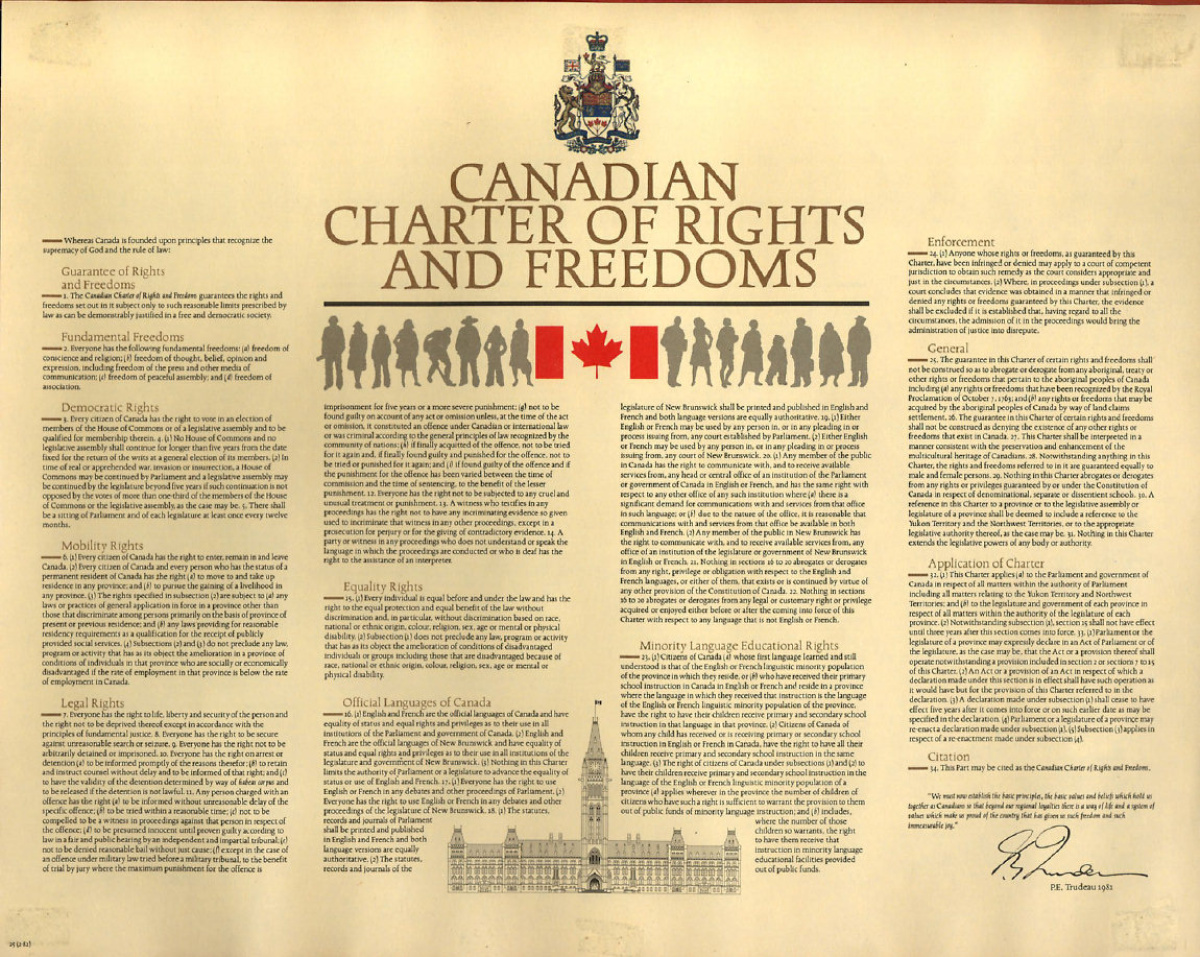
To be honest, I wasn’t a fan of the Charter of Rights and Freedoms when it was forced down our throats in 1982, on the basis that if Pierre Trudeau thought it was a good idea then it must be the opposite. All these years later, although I’m still not a huge fan, I support the provinces who now need to combat Mark Carney’s minority Liberal government’s attempt to use the Supreme Court to limit or eliminate the provinces’ use of the notwithstanding clause:

You might be hearing a lot about the notwithstanding clause these days and wondering what is going on. The fact is, the Carney government is trying to change the constitution via a Supreme Court case on Bill 21 – a heinous bill in my opinion – but not an excuse to scrap or weaken the notwithstanding clause.

We’ve been here before with this debate before and I’m still of the same position, leave the clause alone.

It was in 2018 that Ontario Premier Doug Ford was looking to use the notwithstanding clause to shrink the size of Toronto city council. He should never have had to do this, but a lower court ruled that Ford’s actions were unconstitutional.

Which is really weird because the constitution is clear, municipalities are creations of the province. A provincial government can merge municipal governments, they can even abolish them if they wish.

Eventually, a higher court overturned the very politically driven decision against Ford, but for a time, he seemed to need the notwithstanding clause, otherwise known as section 33 of the Charter of Rights and Freedoms.

I’ll never understand why some claim the notwithstanding clause is against the Charter when it is part of the Charter.

On the social media site formerly known as Twitter, Sean Speer notes the Liberals seem to be taken by surprise at the negative reactions to their plans:

I suspect that non-conservatives are a bit surprised by the magnitude of the reaction to the Carney government’s factum on the notwithstanding clause. That’s mainly because I think liberals and progressives don’t quite understand how much the past decade or two of judicial activism has come to animate Canadian conservatism. Even as a somewhat moderate conservatism, I admit to being radicalized on these issues.

The Carter decision on MAID was a key moment in this evolution. Not necessarily because of the issue per se — though a lot of us oppose it. But mainly because it was such a naked example of judicial lawmaking. The clearest case that it’s just power and politics all the way down.

After having ruled that there was no right to physician-assisted death in the Charter, just over twenty years later the Supreme Court unanimously decided there was indeed such a right.

There had been no constitutional amendment in the meantime. Parliament had considered the issue and carefully and consistently voted against it. And yet nine judges decided that the right should exist and so they created one.

If the judiciary isn’t merely protecting constitutionally-prescribed rights but manufacturing them based on the political preferences of judges themselves—if it’s in effect just politics from the bench — then we might as well have the politicians who we’ve duly elected to be making these decisions for us.

Before Carter I would have said that I was broadly supportive of S.33 as part of our constitutional order but today it’s much bigger part of my core political identity as the only check we have on judicial politicking.

The Carney government’s factum then isn’t just objectionable because it threatens to constrain the notwithstanding clause but precisely because it invites the Supreme Court to once again alter the constitution in its own image.

Brian Peckford, the last surviving signatory to the patriation of the Constitution in 1982:

Tragically, it is not surprising that we see this further emasculation of our 1982 Constitution.

It has been ongoing almost since its inception. Witness the 1985 Court Opinion twisting the meaning of the opening words: “the Supremacy of God”.

And the constant distortions ever since, accelerated during the false covid crisis.

This is The Tyranny of The Judiciary —The Destruction Of Parliamentary Democracy!

How important is Section 32 — the notwithstanding clause?

There would be no Constitution Act 1982 — no Charter of Rights and Freedoms without Section 32.

When PM Trudeau Sr. tried to unilaterally Patriate the Constitution and failed miserably because of the Provinces’ opposition before the Courts, he validated the suspicion most Premiers had about the Federal Government and its intentions during that time. The ability of the Provinces to continue democratically to initiate specific exemptions was crucial to solidify the federal nature of this country.

The Supreme Court was right in Sept 1981 in denying the Federal Government such sweeping powers.

None of the 10 First Ministers who signed the Patriation Agreement intended for this Section to be amended in any other way except by the Amending Formula that was achieved for the first time in our history in that Agreement.

The Federal Justice Minister’s action to ask the court is wrong — totally against the intent of those who authored the Patriation Agreement and defies and denigrates one of major accomplishments of 1982, The Amending Formula, a crucial part of the earlier 1981 Agreement, the foundation document, “The Patriation Agreement”.

The Canadian Press carries this:

    OTTAWA — The federal government’s request to Canada’s top court for limits on the notwithstanding clause isn’t only about Quebec’s secularism law, Justice Minister Sean Fraser said on Thursday.

    In a media statement, Fraser said he hopes the Supreme Court’s eventual decision “will shape how both federal and provincial governments may use the notwithstanding clause for years to come”.

Excuse me, Mr Fraser, this is the job, the solemn responsibility, for Canada’s Elected First Ministers and Their elected Parliaments not the Judiciary. Making law is the job of the elected, interpreting law the role of the Judiciary.

This brazen action of the Federal Government would enlarge the Judiciary power to make law — it deciding the powers of The Governments of this Nation.

Ironic in the extreme it is to ponder that Canada sought for decades to find an amending formula — self criticizing itself for not having a legitimate avenue for Constitutional Change.

Now that it has such an avenue instead of using it, it cowardly asks The Court?

Should not a majority of the Provinces have to agree — that’s what the Supreme Court said in 1981?

Hence, the Supreme Court, consistent with it predecessor views of 1981 should refrain from hearing the matter, and inform the Governments that it is they who have the power through the legitimate constitutional process present in the Constitution to make such significant change ie the powers of the Governments, adhering to Section 38, the Amending Formula.

“[V]iolent crime [in Canada] had increased by 30% over the last decade”

Filed under: Cancon, Government, Law — Tags: , , , , — Nicholas @ 04:00

A lot of Canadians are noticing how much social peace has deteriorated in and near major cities, but police and local media increasingly are not sharing full information about suspects — often to avoid accusations of racism. It’s gotten bad but as James Pew points out … it’s just getting worse and worse:

Some of the 18 people charged with violent home invasions and carjackings in the Peel Region, July 2025.

Almost every day we hear new stories of violent crime in Canada. Many of us are shocked into speechlessness. Violent youth offences, home invasions, arsons and assaults are on the rise. The rate of car jackings in the York Region increased by 523% between the years 2019 and 2024. Home invasions in Canada are now a regular occurrence. Last year, Kiernan Green did some number crunching for The Hub. He found that violent crime had increased by 30% over the last decade. And Livio Di Matteo, of the Fraser Institute found that “while Canadian homicide rates remain lower than in the U.S., the Canadian rate has increased at a higher rate since 2014”. In the blink of an eye Canada went from a safe high trust society to a dangerous low trust society. Everything is upside down.

The swarming attack and murder of 59-year old homeless man Kenneth Lee of Toronto in December of 2022 was a somewhat early indication that something was dreadfully off. Eight girls, ranging in age from 13 to 16 attacked Lee, stabbing him with knives and small scissors multiple times. He later died in hospital. Initially charged with second degree murder, ultimately all eight girls had their charges reduced and were sentenced to probation only. The Mayor at the time, John Tory, referred to the judgment as “deeply disturbing.”

So far this year there have been thirteen cases in which youth offenders were charged with homicide in the Greater Toronto Area. The most recent involves a 12-year old who has been charged with murdering a 62-year old homeless man. He had been on a release order at the time of the murder. He was also accompanied by a 20-year-old man named Isaiah Byers. The two went on a spree of unprovoked violent attacks in downtown Toronto, targeting vulnerable individuals. Five in total were attacked with a hammer.

Frustrated with the city’s catch-and-release protocol, the Toronto Police Association recently took to X and asked, “Where are the judges who make these decisions?” And further, in a written statement the TPS pointed out, “Our members are held accountable for the decisions they make and the actions they take. Why isn’t anyone else?”

The Youth Criminal Justice Act (YCJA) is currently protecting the identities of youth offenders involved in shocking levels of violence across the GTA. On July 17th, a 14-year old boy, described as a black youth, was charged with fatally stabbing a 71-year-old woman, Shahnaz Pestonji, while attempting to rob her in a grocery store parking lot. The youth admitted later on a social media livestream that he “didn’t mean to kill the old lady” and was just trying to steal her car.

On August 16th, 8-year old Jahvai Roy was shot and killed by a stray bullet while at home sleeping in his mothers bed. Many bullets were shot that night by thugs outside the Roy home in North York, but tragically one of them passed through a window of Holly Roy’s bedroom and struck Jahvai. She wrote on Facebook, “My baby was preparing for one of his best friend’s birthday celebration. He was so excited he couldn’t sleep!” A 16-year old boy has been arrested, and two others are still being sought by police on Canada-wide warrants: 17-year old Ibrahim Ibrahim of Toronto, and 18-year old Amarii Lindner of Toronto.

On August 23rd a 16-year-old girl was charged with aggravated assault and assault with a weapon after stabbing a woman in her 80s in Scarborough, Ontario. Due to the YCJA, the name of the woman, who is suffering in hospital with life-threatening injuries, was not disclosed by the media. It was reported that the teen and the victim lived in the same residence. The story seems to have vanished. After August 23rd, there are no more media reports.

BC Ferries, federal financing and Chinese shipyards

Filed under: Cancon, China, Government — Tags: , , , , , , — Nicholas @ 03:00

As you may have heard, at the same time that Canadian politicians of all parties were thumping the tub about buying Canadian, British Columbia’s provincially owned ferry corporation decided to buy new ships from China … and the federal government not only gave the deal their blessing, they added in a billion dollar underwriting guarantee to boot:

In Ottawa they call it “arm’s-length”. Out in the real world, people call it duck-and-cover. At Meeting No. 6 of the House of Commons transport committee, MPs confronted a simple, damning timeline: Transport Canada’s top non-partisan official was warned six weeks before the public announcement that BC Ferries would award a four-ship contract to a Chinese state-owned yard. Yet the former transport minister, Chrystia Freeland, told Parliament she was “shocked”. Those two facts do not coexist in nature. One is true, or the other is.

There’s an even bigger betrayal hiding in plain sight. In the last election, this Liberal government campaigned on a Canada-first message — jobs here, supply chains here, steel here. And then, when it actually mattered, they watched a billion-dollar ferry order sail to a PRC state yard with no Canadian-content requirement attached to the federal financing. So much for “Canada first”. Turns out it was “Canada … eventually”, after the press release.

Conservatives put the revelation on the record and asked the only question that matters in a democracy: what did the minister know and when did she know it? The documents they cite don’t suggest confusion; they suggest choreography — ministerial staff emailing the Prime Minister’s Office on how to manage the announcement rather than stop the deal that offshored Canadian work to a Chinese state firm.

Follow the money and it gets worse. A federal Crown lender — the Canada Infrastructure Bank — underwrote $1 billion for BC Ferries and attached no Canadian-content requirement to the financing. In plain English: taxpayers took the risk, Beijing got the jobs. The paper trail presented to MPs is smothered in black ink — hundreds of pages of redactions — with one stray breadcrumb: a partially visible BC Hydro analysis suggesting roughly half a billion dollars in B.C. terminal upgrades to make the “green” ferry plan work. You’re not supposed to see that. You almost didn’t.

How did the government side respond? With a jurisdictional shrug. We’re told, over and over, that BC Ferries is a provincial, arm’s-length corporation; the feds didn’t pick the yard, don’t run the procurement, and therefore shouldn’t be blamed. That line is convenient, and in a technical sense it’s tidy. But it wilts under heat. The federal lender is still federal. The money is still public. If “arm’s-length” means “no accountability”, it’s not a governance model — it’s a get-out-of-jail-free card.

The fallback argument is economic fatalism: no Canadian shipyards bid, we’re told; building here would have taken longer and cost “billions” more. Maybe that’s true, maybe it isn’t — but it’s the sort of claim that demands evidence, not condescension. Because the last time Canadians heard this script, the same political class promised that global supply chains were efficient, cheap and safe. Then reality happened. If domestic capacity is too weak to compete, that’s not an argument for outsourcing permanently; it’s an indictment of the people who let that capacity atrophy. And if you swear “Canada first” on the campaign trail, you don’t bankroll “China first” from the Treasury bench.

Dr. Leslyn Lewis on X:

Dutch Navy Luger: From World War One to the End of Neutrality

Filed under: Europe, Germany, History, Military, Weapons, WW1, WW2 — Tags: , , , , — Nicholas @ 02:00

Forgotten Weapons
Published 12 May 2025

The Dutch Navy first acquired Luger pistols in 1918 specifically for its aviators. They had 12 German P04 Lugers taken from a German submarine stranded in the (neutral) Netherlands, and 28 more were purchased from DWM in 1918 to round out the 40 guns needed to equip the Naval Air Service. The pistol was formally adopted as Automatische Pistool Nr.1. In 1928, the Dutch Army adopted the 1906 New Model Luger for its own service, and the Navy decided to update its revolvers at the same time. The Navy opted not to get grip safeties, and so took a copy of the German P08 model instead of what the Army had. The first order was placed in 1928 through BKIW in Germany, and deliveries would run until 1939 with a total of 2654 delivered before German invaded in May 1940.

Dutch Army Luger trials:
Politicians Ruin Everything: Dutch Lu…

Dutch East Indies Lugers:
Lugers for the Dutch East Indies Army
(more…)

QotD: Why modern dishwashers suck

    The current standards for dishwashers took effect in 2013. The standards, which were based on a consensus agreement between manufacturers and efficiency advocates, specify minimum energy and water efficiency levels. The standards require that standard-size dishwashers use no more than 307 kWh per year and 5.0 gallons of water per cycle.

    In 2024, DOE finalized amended standards for dishwashers based on a joint recommendation from manufacturers and efficiency advocates. The new standards for dishwashers will cost-effectively reduce energy consumption by 15% relative to the current standards while also cutting water waste. Dishwashers

It is a general problem, but what started me thinking about it was being told by my dishwasher that it would take three and a half hours to wash the dishes. That seems, judging by a quick search online, to be longer than average but still within the normal range. I have not been able to find figures online for how long dishwashers took twenty or thirty years ago but, by what I remember, it was substantially less — and the dishes ended up dry, which ours don’t.

The explanation is in the final word of the quote above, “waste”. The owners of dishwashers pay for water and power, so if making them more efficient in those dimensions was costless, did not require giving up something else, there would be no need for the Department of Energy to make the manufacturers do it. I conclude that it was not costless, that it either made dishwashers cost more or do their job less well — take longer, not dry the dishes as well, not clean them as well. Using more power or water to do a better job is not waste.

David Friedman, “Optimizing On A Single Variable”, David Friedman’s Substack, 2025-06-02.

September 19, 2025

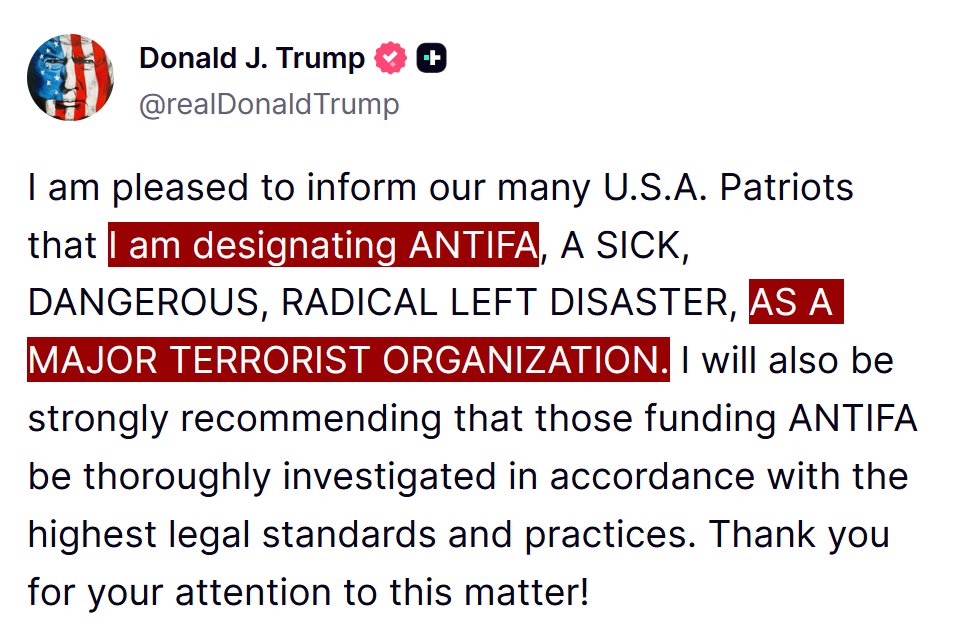
What’s the next thing to be devoured on Trump’s menu? Ah, Antifa it is …

Filed under: Government, Media, Politics, USA — Tags: , , , , , , — Nicholas @ 05:00

Again leaning heavily on the social media site formerly known as Twitter, ESR has several posts on Donald Trump’s announcement that Antifa is in his crosshairs:

Next comes the part where every NGO/nonprofit implicated in funding a major terrorist organization gets a proctological exam by people with no sense of humor at all.

As I have emphasized several times in the last week: the long game in taking down a terrorist network is to smash its funding chain.
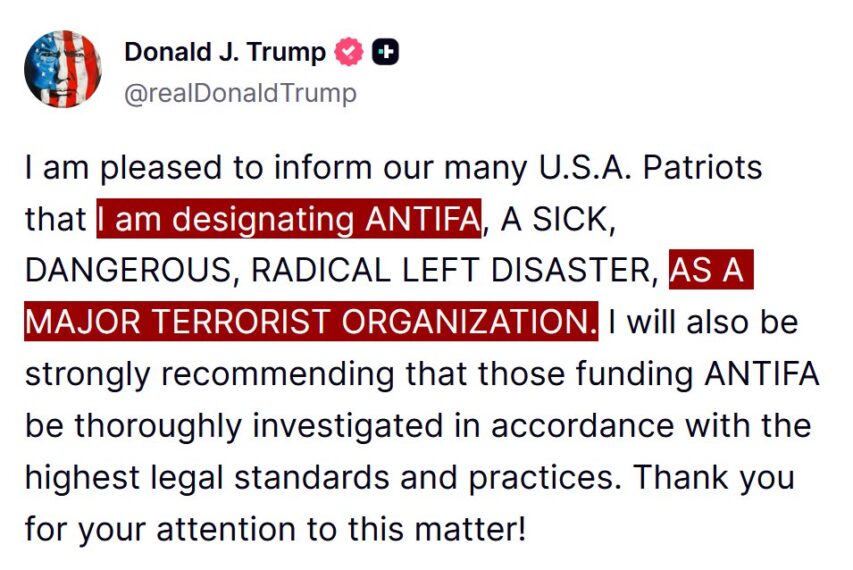
ESR’s analysis begins thusly:

Antifa has just been declared a “major terrorist organization”. Putting on my intelligence-analyst hat again, I’m going to examine its strategic options in the new political and legal conditions following the assassination of Charlie Kirk.

I’m going to start with a briefing on what Antifa is and what it does.

A reminder: Antifa is not a unitary conspiracy. It’s a cluster of horizontally-networked cells, some visible aboveground, some semi-covert, possibly some that are fully underground. By design it doesn’t have a central command.

So we’re really asking what range of behaviors Antifa cells normally choose, or can choose.

Before we can explore that we have to identify what Antifa is for and how it fits into the political ecology of the U.S.

None of what I’m about to tell you is speculation. It can be verified by reading Antifa’s propaganda and watching its behavior.

Antifa is an organization of Communists and Left-Anarchists; thus the red and black flags in the main Antifa logo. Its ultimate goal is a violent anti-capitalist revolution that will destroy American constitutional government. The Communists and Left Anarchists have agreed to argue about the shape of what comes afterwards after the revolution.

In practice, Antifa acts as willing street muscle for a range of associated Communist and Socialist organizations, most notably the DSA (Democratic Socialists of America), CPUSA (Communist Party of the USA), the SWP (Socialist Workers Party), and various SWP splinter groups.

Antifa also takes strategic direction from the left wing of the Democratic Party. My readers can make their own judgments about whether there is anything remaining in the Democratic Party other than a left wing; the answer to that question is not relevant to the rest of this analysis.

An important point is that the links between the Democratic party and Antifa are personal and deniable. They probably do not run through the Democratic National Committee. A good place for counter-terror analysts to look (and I’m sure Palantir already has this mapped) would be the politicians known as “the Squad” and their close associates.

The strategic sub-goal that was being executed when Charlie Kirk was shot was the creation of a climate of fear that would inhibit public speech by conservatives. This is an explicit goal of Antifa direct action.

Antifa’s funding is deliberately obscure. Before USAID was dismantled, a significant percentage of it was probably coming from the American taxpayer through several layers of shadowy NGOs.

It is very likely that one way or another most of its money comes from low-profile liberal dark money groups such as Arabella, the Tides Foundation, and the Open Societies Foundations.

The effectiveness of Antifa as a political actor has always depended on its ability to act as a terror instrument for left-wing American politicians while maintaining deniability that the politicians’ rhetorical hate-targeting of opponents ever cashes out as violent action.

The first major constraint on Antifa’s future behavior is that this deniability is going to be much more difficult to maintain from now on. Because while the deliberate diffusion of its structure makes legal proof that something called “Antifa” shot Charlie Kirk difficult, it also made Antifa affiliation of any left-wing assassin impossible to effectively deny.

In my next post, I will examine the consequences of this shift.

Continuing the discussion:

Mafia families don’t have membership cards.

Why am I bringing this up now? Because one attempt to head off the hammer coming down on Antifa that we’re hearing from its aboveground allies is that Antifa doesn’t exist.

It’s just an idea. There’s no central command. No common funding. No membership cards. No way to tell who’s a member and who isn’t.

The reductio ad absurdum of this bullshit is to point out that, following the argument, the Mafia cannot possibly exist. Which would be interesting news to all the people it murdered.

Historical note: there was a period when the Mafia was structurally different from Antifa in that it had a Boss of All Bosses, but the position was abolished by assassination in 1931.

In reality, when you’re dealing with a criminal or terrorist conspiracy that doesn’t have membership cards, you identify members of it the same way that other members do: by their willingness to cooperate with each other on shared projects.

And sometimes, by their participation in shared bonding rituals like a Cosa Nostra initiation ceremony or a “bash the fash” demonstration.

None of this is difficult, and it’s exactly the kind of situation that the RICO (Racketeering and Corrupt Influence) laws were written to address.

From Trump’s public statements, I’m guessing that they’re going to go right past RICO to a Foreign Terrorist Organization designation.

This won’t be difficult either. If you have any doubt that at least some Antifa chapters are funded by Chinese Communist money, you really need to get out more.

The announcement clearly didn’t come out of the blue:

Still wearing my intel-analyst hat, and have realized something.

Trump’s announcement that Antifa is being designated a “major terrorist organization” doesn’t make any sense unless law enforcement is already holding evidence that the assassination of Charlie Kirk was an Antifa op.

Otherwise, the risk of political blowback from that announcement would be way too high. Trump can be erratic, but he’s cunning about stuff like this and obviously has a shrewd sense of what he can get away with.

So, yep. The most likely scenario was the correct one. The hoofbeats really were horses, not zebras. Everybody still in denial about this is destined for more pain.

And back to the analysis:

“antifa 8973ag” by cantfightthetendies is licensed under CC BY 2.0

Continuing my analysis of Antifa’s strategic options following the Charlie Kirk assassination. These have changed yet again — narrowed considerably — following President Trump’s declaration yesterday.

The Federal Government has legal instruments that it can employ. The RICO (Racketeering and Corrupt Influence) laws were specifically designed to attack a different headless network of horizontally connected nodes — organized crime. The fact that Antifa doesn’t have membership cards or a unitary command structure isn’t even going to slow the Feds down.

I think that it’s likely the Feds will designate Antifa a foreign terrorist organization, zeroing in on Chinese Communist funding of some Antifa chapters. This will allow the direct use of the CIA, which is normally heavily restricted from operations on American soil.

Nothing Antifa itself can do as an organization will be able to prevent or deflect a massive multi-agency investigation. It is very likely that Palantir already has their core membership identified and their communications channels mapped. Fusion centers will be capturing an unknown but probably large percentage of Antifa message traffic.

(They’ll be helped by the fact that Antifa’s communications security is terrible — it uses Discord for most comms, which is strictly amateur-hour. To be fair, the inner membership is likely to be savvy enough to be using Signal.)

Antifa’s only hope is pressure by its aboveground allies in politics and media. The cells with intelligent leaders will understand that they must cease all direct actions in order to avoid putting those allies in any position of appearing to support assassinations.

Unfortunately for Antifa, in order for hunkering down to work, every single cell has to have leadership that is both strategically patient and capable of restraining its more mentally unstable footsoldiers.

A related problem is that subversive and terrorist organizations that don’t act tend to develop morale problems. A certain minimum level of satisfying violence is required to keep their troops engaged.

Antifa probably has a worse issue here than the average terrorist organization because they recruit so heavily from sexual deviants and borderline mental cases who are likely to have other MBD-related issues including impulsivity and high time preference.

Over time, external pressure for Antifa to look easy for its aboveground allies to defend will remain steady or increase. This is especially so if the Democratic Party line remains Joe Biden’s “Antifa is just an idea”.

At the same time, internal pressure for direct action will increase. Antifa’s survival may depend on how long it is able to manage that pressure.

Antifa needs the investigation to be stalled out and paralyzed by Democratic lawfare before its stupidest cells do something too public and violent for its allied mainstream media to willfully ignore or suppress.

Longer-term, if Antifa survives, it faces a different problem. It dreams of revolution, but is only capable of operating on the sufferance of a general public that largely dismisses it as a LARP for nose-ringed freakazoids. Having committed a gaudy murder of an Everyman figure, it is not likely to get that sufferance back.


Edmund Burke, lawfare, and the East India Company

In The Coolidge Review, Amity Shlaes discusses “the most outrageous campaign of lawfare in the history of the Anglosphere”, as Edmund Burke assailed Warren Hastings, the first governor general of India:

Why do even principled statesmen — and there are some in this administration, too — not dig in their heels and try to arrest the chain of revenge? Why do even cautious, logical men and women succumb to the passion of lawfare?

The most outrageous campaign of lawfare in the history of the Anglosphere, the impeachment and trial of the first governor general of India, Warren Hastings, was mounted by Mr. Incrementalism himself, Edmund Burke. The father of modern conservatism spent nearly a decade of his time in Parliament—from 1787 to 1795—crusading against Hastings, antagonizing allies all around.

Impeaching the “Wicked Wretch”

There were reasons to investigate what was going on in India: Hastings exploited the fact that the East India Company was, at that time, an adjunct of the Crown. That connection between a powerful company and a government — a far more powerful company than, say, Intel — was the trouble, for as Burke would put it, it created “a state in disguise of a merchant“.

Burke chose to prosecute Hastings — and failed. The “wicked wretch”, one of Burke’s slime phrases for Hastings, emerged from the ordeal with a pension, not a conviction. Burke biographer Russell Kirk has argued that the public flaying of Hastings served posterity — in England at least. After Burke’s death, at “every grammar and public school”, the story of Burke and Hastings “impressed upon the boys who would become colonial officers or members of Parliament some part of Burke’s sense of duty and consecration in the civil social order”. That slowed another chain, the chain of abuse by Britons of Indians. After Burke, England recognized that, as Kirk puts it, she had a “duty to her subject peoples in the East”.

Still, even Kirk’s excellent biography leaves readers wondering: Was Hastings truly the archest of the arch villains, as Burke maintained? And is this the right way to go about it all? A book that Burke penned in the same years that he waged his Hastings war, Reflections on the Revolution in France, influenced a far greater number, and in a greater number of lands, than the Hastings story. Burke might have had the same reach with a Reflections on the Abuses of the East India Company.

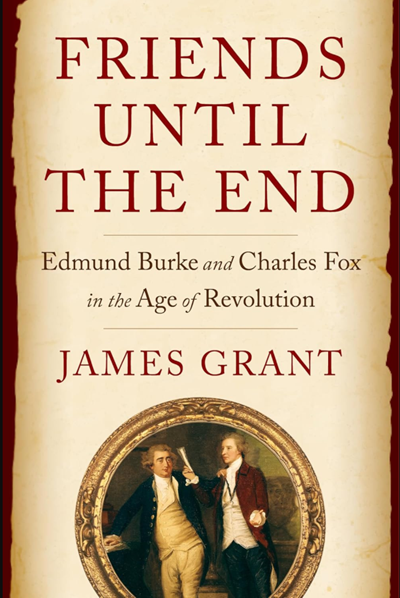
All the more welcome then is James Grant’s Friends Until the End, which gives the best-yet account of the chain reaction in Burke’s soul that drove him to weaponize government, what his crusade cost him, and what such crusades may cost all of us.

[…]

Next, however, came a challenge that deeply frustrated Burke. Scanning the empire’s horizon for a place to commence a model reform, Fox and Burke settled on the East India Company, which abused the some thirty million Indians it oversaw with the same admixture of plunder, condescension, and cruelty familiar to Catholics of Ireland. The pair put their hearts into the Indian reform: Fox promised a “great and glorious” reform to save “many, many millions of souls”. They also put their minds into the project. To track the East India Company, Burke personally purchased sufficient shares to win him rights to attend and vote at quarterly meetings. He steeped himself in knowledge of a land he’d never seen, learning names of “numerous Indian nawabs, rajas, nizams, subahs, sultans, viziers, and begums“.

Such prep work, as Grant points out, enabled the Whigs to identify the correct solution: de-mercantilization. “Separate the company’s two incompatible missions: sovereign rule and moneymaking”, Grant writes. The compromised statute that emerged from the House of Commons was not as neat: A seven-man commission would rule India, while a board would govern East India’s commercial operations. But the commercial board would be a subsidiary to the commission. And in marshaling their votes for the measure, the pair still confronted the formidable obstacle of East India shareholders in Britain, furious at the threat to their fortunes that such reform represented. Fox might emancipate Hindus, their opponent William Pitt warned, but he must also “take care that he did not destroy the liberties of Englishmen”.

The king and his allies in any case defeated Fox’s India Bill, as it was known, in the House of Lords. The king, who had that prerogative, booted Fox and Burke from paid posts. In the 1784 general election, Burke held on to his seat in Parliament, as did Fox (by a hair), but so many Whigs, now labeled “Fox’s martyrs”, were ousted by voters from Parliament that the Whigs’ opponent, Pitt, became prime minister. Burke’s disillusionment ran deep: “I consider the House of Commons as something worse than extinguishd”, he wrote.

It was thus, at the age of fifty-nine and merely an opposition parliamentarian, that Burke risked his high-stakes lawfare. He commenced impeachment proceedings with a four-day anti-Hastings polemic. Of course, Burke universalized his point: The Hastings trial was “not solely whether the prisoner at the bar be found innocent or guilty, but whether millions of mankind shall be made miserable or happy”. And of course he raised the stakes for fellow lawmakers by appealing to their honor: “Faults this nation may have; but God forbid we should pass judgment upon people who framed their laws and institutions prior to our insect origin of yesterday!” The House must join him in impeachment, the Lords convict Hastings.

The House did join him, handing to the Lords charges that Hastings had “desolated the most flourishing provinces”, “pressed, ruined, and destroyed the natives of those provinces”, and violated “the most solemn treaties”. In thousands of hours of speeches before a jury from the House of Lords, the eager prosecutor, Burke, dwelt on Hastings’s cruelty to the Rohillas, an Afghan tribe from land bordering Nepal. He also charged that Hastings had taken revenge on a crooked tax collector, Nandakumar, for alleging that he — Hastings — had taken a bribe, seeing to it that Nandakumar was convicted and hanged for forgery. Not all of this was proven. And, as the jury of Lords slowly considered the charges, as the months and years passed, Burke found himself more and more isolated. Fox, Burke’s initial ally in the undertaking, faded. By the time the Lords’ jury voted not to convict, eight years on, a full third of their original number had already passed away.

After the Charlie Kirk assassination, here are three possible futures

Filed under: Government, Media, Politics, USA — Tags: , , , — Nicholas @ 03:00

On the social media site formerly known as Twitter, ESR lays out what he sees are the three most likely short-term futures for the United States after the assassination of Charlie Kirk:

I’m a student of history. Here are three possible futures following the assassination of Charlie Kirk. They’re based on historical examples of what happens when a Communist subversion campaign or insurgency overplays its hand and triggers broad popular resistance.

1. Popular revulsion against aboveground leftists celebrating the murder gives the Trump administration political cover to go after Antifa and its shadow funding network hard. Both are smashed.

Communist agents of influence in the mainstream media and academia continue to self-discredit.

Relatively few Communists are arrested, but their millions of aboveground tools become isolated and demoralized.

Propelled by a huge swing in voter registrations that we are already seeing happen, the Democrats get crushed in the 2026 midterms.

The long period of fever, madness, and Left ascendancy that began with the assassination of JFK by a Soviet agent in 1963 ends not with a bang but with a whimper.

This is the best case scenario for everybody, including the Communists who don’t get thrown out of helicopters or shot down in the streets.

If things don’t go this way it will likely be because Democratic lawfare prevents the counter-subversion push from being fully effective. An obvious index of this failure would be another high-profile political assassination or attempt against a conservative target after about 4 months out.

What happens in the event of that failure, especially if the third public attempt to kill Trump succeeds:

2. A period of Caudillismo. A charismatic strongman rides popular anger into power. If this happens, the Left better pray that the strongman is an infuriated JD Vance, because any alternative to him is likely to be worse for them.

The crackdown against the Communist network becomes brutal and routinely uses extra-Constitutional means, possibly thinly covered by a declared state of emergency.

At the harder end of this range of possibilities, right-wing death squads not exactly formed by government but winked at by it go after Communist public figures that are out of reach of the law because they’ve carefully preserved deniability. Many journalists are at the top of this target list.

It is not likely that the Communist network can survive this future. The only way it happens is if they have enough popular support to develop a semi-militarized resistance — in effect making certain parts of the country no go regions for Federal agents.

Going by historical precedents, the index of this failure would be a resurgence of banditry by armed groups, initially with overtly political goals but decaying into general predation.

This would land us at:

3. Low-grade civil war, a la Bosnia or the Irish troubles. Anybody wishing for this has no idea how bloody, ugly, and brutal it would probably be. Especially if the Left succeeds at what it will with absolute certainty try to do, which is racialize the conflict.

I don’t think there is any realistic scenario in which the Communists win any of these confrontations. Not in the U.S., not in the 21st century. The question is how much blood and agony the rest of us will go through before they are finally defeated.

Update, 20 September: Welcome, Instapundit readers! Please do have a look around at some of my other posts you may find of interest. I send out a daily summary of posts here through my Substackhttps://substack.com/@nicholasrusson that you can subscribe to if you’d like to be informed of new posts in the future.

What Medieval Fast Food Restaurants Were Like

Filed under: Britain, Food, France, History — Tags: , , , , , — Nicholas @ 02:00

Tasting History with Max Miller
Published 15 Apr 2025

Golden brown fried pastries filled with a fruit and spice paste

City/Region: Paris
Time Period: c. 1393

Fast food has been around since the Middle Ages, and while a lot has changed in food production and cooking in the last six hundred years or so, then, as now, you could get a fried apple pie.

Rissoles were fried filled pastries (modern versions are usually some kind of filling rolled in breadcrumbs and fried), and they could be made savory or sweet. These ones are made with roasted apples, raisins, figs, and sweet spices. I chose cinnamon, ginger, and nutmeg, but you can choose whatever spices you like.

    It is common that rissoles are made of figs, raisins, roast apples, and nuts peeled to imitate pine nuts, and powder of spices [and a little fine salt]; and let the paste be well saffroned and then let them be fried in oil [and sugar them].
    Le Ménagier de Paris, c. 1393

(more…)

QotD: The sub-generations of Generation X

Filed under: Media, Quotations, Technology, USA — Tags: , , , , , , — Nicholas @ 01:00

… “Gen X” is actually a misnomer, as there are at least three distinct subgroups. There’s the very earliest Xers, the guys who were in high school in the late 1970s. They often get lumped in with the Baby Boomers, too, though they’re as different from the Boomers as they are from us, the “mid” Xers. Think Wooderson from Dazed and Confused. Brian Niemeier calls them “Generation Jones”, and while I don’t like that tag I don’t know what else to call them (except maybe “Woodersons”), so roll with it.

Then there’s the group that was in high school in the late 1980s. I squeak into this group (barely). We’re the mid-Xers. The real “grunge” generation. If Dazed and Confused is a pretty decent late-90s approximation of late-70s high school kids, then the best description I can give you of a “grunge” kid is the movie Deadpool. Made in 2016, by guys who were born in the mid-1970s. That’s grunge, in a way Kurt Cobain couldn’t even imagine. Fourth wall breaks! Sarcastic asides about the fourth wall breaks! Profanity! Masturbation jokes! And snark, snark, snark — unrelenting snark, about everything, all the time. Every second of that movie screams “I can’t believe you fags are amused by this, but since you obviously do, here’s lots more! Choke on it!!!”

The writers obviously wanted to work on Buffy the Vampire Slayer, but Joss Whedon was too cool for them — imagine the twisted psyche of a person who thinks Joss Whedon is cool — and Sarah Michelle Gellar just laughed at them, so they made Deadpool out of spite.

Then there’s the late Xers. They were in high school in the late 1990s, which is why us oldsters call them “Millennials” (as the term is now used, it seems to mean “those born around 2000”, i.e. the generation just now getting out of college. We took it to mean “those who were just getting out of college around the turn of the century”). Obviously I use the Internet. I’m using it now, but I’m not on the internet, and I’m certainly not an Internet Person. The very late Xers are Internet People. The very first Internet People; they invented the concept of Internet People. Mark Zuckerberg (born 1984) is a late Xer. The people behind Twitter (Jack Dorsey born 1976; Biz Stone 1974; Evan Williams 1972) are mid-Xers; they were ahead of the curve.

Severian, “Addendum to Previous”, Founding Questions, 2022-02-24.

September 18, 2025

Stop calling it “Turtle Island”

Filed under: Americas, Cancon, History, Media, Politics, USA — Tags: , , , , , — Nicholas @ 05:00

At Woke Watch Canada, Igor Stravinsky strenuously objects to calling North America “Turtle Island” and all the other woke shibboleths of the modern progressive cant:

As another school year rolls out, we can hope a more honest and realistic portrait of Canadian history will start to take shape in our schools. Students have been brainwashed into believing that Canada was a racist state bent on the extermination of Indigenous people, who were peaceful and wise, living in harmony with nature and each other. But reconciliation between Indigenous and non-Indigenous people is only possible if we base policy and action on the truth, not fairy tales, hearsay, anecdotes, or ideologies. We need facts, evidence, and reasoned debate. A good start would be for people to stop referring to North America as “Turtle Island”.

Calling it that is essentially to call the current geopolitical organization of the world invalid. If Canada, the United States, and other Western countries are in fact illegitimate, then that means national and international laws are also null and void. So, unless you are the direct descendent of an aboriginal person who was alive before first contact with Europeans, you are just a guest here — a second-class citizen at best. Non-Indigenous Canadians will simply never accept that. Nor should they.

In any case, “Turtle Island” is a nonsensical name on several levels. Firstly, North America is a continent, not an island. It is connected to South America by the Isthmus of Panama, which means it is not even surrounded by water. In any case an island is defined as a land mass surrounded by water that is part of a tectonic plate such as Greenland which is part of the North American Plate, thus is not a continent.

Then there is the fact that Indigenous North Americans were oblivious to the geography of the vast continent on which they lived. Like people everywhere in the distant past, they only knew the area they lived in, which could be substantial in the case of nomads, but was still a tiny fraction of North America’s 20+ million square kilometers. Of course, they knew nothing about the geography of the world with its 7 continents and 5 oceans.

Most importantly, the Turtle Island creation story is a myth believed by a particular cultural group. There is nothing wrong with believing in myths: I personally believe in the myth of human rights, as most Canadians do (pre-contact Indigenous people certainly did not). Myths are powerful: Our common belief in human rights has helped to make the Western world contain the safest and most prosperous societies ever. But when our institutions subscribe to myths not shared by the majority of Canadians, they are choosing to elevate one culture’s belief system above all others.

In the past, the Christian religion was regarded as the one true religion in Canada by most people, and the spiritual beliefs of Indigenous people were often denigrated as primitive superstition. But elevating Indigenous spirituality in our secularized 21st century world by treating it as a knowledge acquisition system equivalent to (or superior to) the scientific method is an attempt to correct for that past ethnocentrism. This is Critical Theory in action: It always strives to alleviate past wrongs with present wrongs, a formula for social disaster if ever there was one.

Broken feedback paths lead to broken organizations … like government

Lorenzo Warby on the ever-increasing dysfunction of most western governments due to the deliberate sabotage of what used to be functional feedback paths:

That institutions within Western democracies have deteriorated in recent decades is clear. That the march of progressivism through the institutions is at the heart of this deterioration is also clear.1

This has been progressives acting like progressives, with all the perverse relationship with information that is at the heart of progressivism. A perverse relationship that leads directly to their degradation of institutions.

Progressives use the imagined future as their benchmark of judgement, but there is no information from the future, so there is no reality-test in their benchmark of judgement. The imagined future can, however, be as glorious as one likes.

Conversely, anything actually created by humans will have downsides and even sins attached. This gives progressives a great rhetorical advantage over anyone who attempts to defend anything humans have actually built. All of the painful history of human achievement is rendered as naught, as mute, in the face of the splendours in their head.

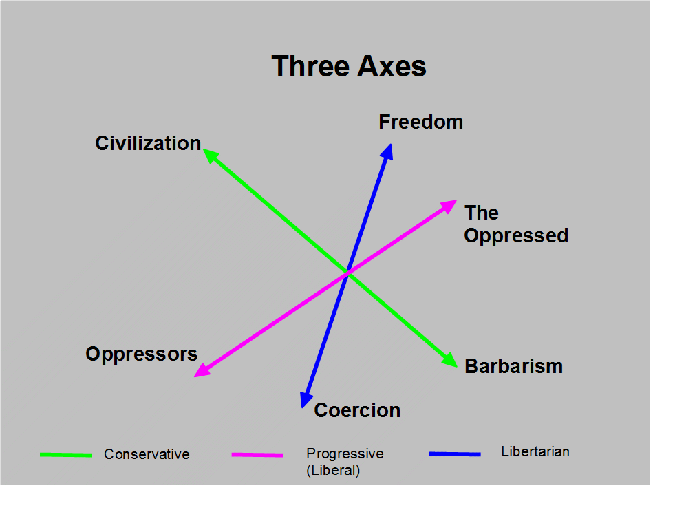
Arnold Kling’s Three Languages of Politics model.

If a group is disproportionately successful, that is not an example to emulate but a sign of their oppressor status. If they are comparatively unsuccessful, that is not a warning about what to avoid, but a sign of their oppressed status. This is an outlook deeply hostile to learning from what does, and does not, work.

For using the glorious imagined future as the benchmark of judgement creates the basis for denigrating anything that comes from the past: which is all the information we have about what works and does not. This includes denigrating the embedded learning in institutions. Even fundamental questions about what is required to sustain a social order get written out of acceptable discourse as not fitting with their imagined-future benchmark of judgement, with the splendours in their heads.

Using the imagined future as one’s benchmark of judgement also naturally leads to concluding that one owns morality, as any opposition to the glorious imagined future is clearly immoral. This leads to, at best, comprehensive disengagement with, and at worse, systematic denigration and delegitimisation of, those who disagree. A systematic denigration and delegitimisation that often involves systematic misrepresentation of those who disagree. The consequence of all this is to block feedback about one’s political projects.

The most extreme instance of this has been the UK, where the BlairBrown Governments of 1997-2010 took power away from elected officials (apart from the PM) and handed it to “experts” in quangoes, to judges via human rights legislation and to the EU. Those with the “correct” understandings could do their thing, insulated from voters. This made the UK a state, a polity, with broken feedbacks.

Modern Western civilisation is a civilisation with broken feedbacks — as I discuss here, here, here, here and here — but the Blair-Brown constitutional vandalism extended that pattern of broken feedbacks systematically to the British state. The consequences have become grimly obvious. Massive waves of unwanted migrants as part of a massively dysfunctional British state.

If you systematically kill feedbacks from voters, you systematically kill accountability. Of course dysfunction will spread across the organs of the state, as it has. (See here for a discussion of aspects of that horrifying dysfunction.)


  1. Feminisation of institutions has also been a corrosive factor, but that is deeply intertwined with the march of progressivism through the institutions.

Update, 19 September: Welcome, Instapundit readers! Please do have a look around at some of my other posts you may find of interest. I send out a daily summary of posts here through my Substackhttps://substack.com/@nicholasrusson that you can subscribe to if you’d like to be informed of new posts in the future.

« Newer PostsOlder Posts »

Powered by WordPress