Quotulatiousness

June 30, 2025

“This is not toxic empathy, it’s psychotic empathy”

Filed under: Media, Politics, USA — Tags: , , — Nicholas @ 05:00

Elizabeth Nickson suggests that we’re well past peak political feminism:

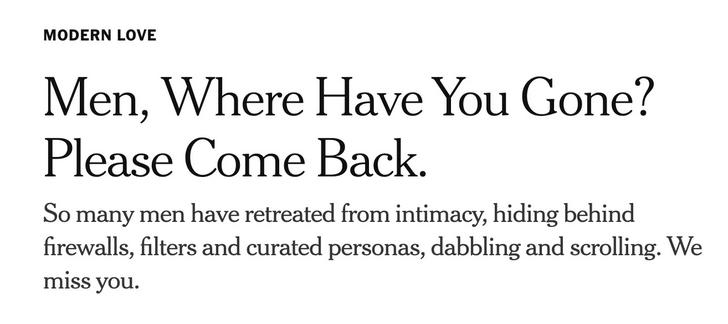
Last week, no month, there have been cries from the heights of official culture begging men to come back. I joked on Facebook that they are all at my house, hiding out with someone who doesn’t hate them, which is sort of true; my immediate family is all male, and Christmases are a bro-fest with me in the kitchen. I exaggerate. No. Yes. I don’t know. Of course they help but I do wish for one daughter/sister in law to keep the chaos down. My father once said, “women civilize men, that’s their job”. I don’t think he meant harangue, demand, prosecute and imprison.

In any case, I started the first feminist theatre in Canada. I know this because a grad student did her master’s thesis on Feminist Theatre in Canada (poor thing) and called to interview me. I was 22, and dumb as a rock. But eager to tell the world its faults (plus ca change). My artistic director Svetlana — who was in the MFA program — and I decided that we would only hire women, do women’s plays, etc.

Problem was there were no plays. Aphra Behn was the only one we could find that wasn’t trivial, and she lived 250 years ago. That was when I discovered I loved writing because we had to write our own. Now, of course, there is a massive, over the top, gold-platinum-diamond-and rubies Renaissance in women’s art, and my silly self was as usual so far ahead of the game I didn’t profit from it. Well, I did, it helped my college expenses no end.

So I got a couple of grants, and we collected box office, and ran “plays” and workshops on how to have difficult feminist conversations, one memorably at the Vancouver Art Gallery, where the wife of a famous poet told us that all this guff was going to be forgotten once the estrus cycle kicked in. Svetlana telegraphed ignorance at me, and I back; no one had any idea what she meant. We 22 year olds argued her down, she clung to her thesis and, guess what, turned out she was right. Everyone “met” someone, got pregnant, built marriages and families, but Svetlana who decided she was gay (at the time we worked together she was married), and died young from alcoholism. Is that my fault? It was my idea.

Feminism marched on. To this:

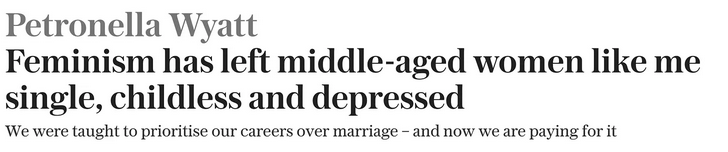
I repent here and now. What feminism has become is anathema. I am actually scared of women. I am afraid of their anger, and I am afraid of their cruelty, their harshness, and I see it everywhere. Luckily through my work I have met women who think like me and we are friends and I am not afraid of them. But I shrink from all other friendships. Female friendships today are built on one thing: are you on side? Are you for abortion, against the patriarchy, for Hamas and most recently, the Mullahs, celebrate female politician wins as long as they are on side, ally with the LBGTZQ+ community, etc.? I am none of these things, so were I to venture into ‘women’s spaces’ eventually the furies would plot revenge. I would be cast afloat, thrown into the wild to fend for myself, as an uppity woman would have been in clan or tribal times, to which we are reverting.

In business, conform or be ruined. Think like us or we cancel your dates, your performance, your promotion. Even the mega-famous:

Therefore I now avoid the friendship of women, in which I used to luxuriate. So if I can’t even spend time in their presence, how the hell are men supposed to marry them?

This is how stupid political women have become. This was last weekend in Germany, and, well, everywhere these women breathe, and that means everywhere in the west.

This is not toxic empathy, it’s psychotic empathy.
Day Five – Massive Allied Air Attack – Ten Days in Sedan

Filed under: Britain, France, Germany, History, Military, WW2 — Tags: , , , , — Nicholas @ 04:00

World War Two
Published 28 Jun 2025

May 14 1940. The blitzkrieg continues in today’s episode of Ten Days in Sedan. British and French bombers roar over Sedan, braving curtains of flak and German fighters in a bid to smash Guderian’s hastily built bridges across the Meuse. Further north, French infantry and tanks battle against the German crossings at Houx, Dinant, and Monthermé. German general Erwin Rommel has a narrow escape as the French nearly blow him and his tank to pieces!
(more…)

DOGE couldn’t address the structural problems with the US government

At the Foundation for Economic Education, Mohamed Moutii looks at the reasons DOGE was unable to come close to achieving the lofty goals it was launched with:

DOGE’s biggest failure was its inability to deliver its promised sweeping transformation. From the start, its $2 trillion savings target was unrealistic. Cutting nearly 30% from a $7 trillion budget was never feasible, especially with politically untouchable programs like Social Security, Medicare, Medicaid, and Defense off the table.

Musk’s claim that eliminating waste alone could close the gap didn’t hold up. While most budget experts support cutting inefficiencies, they agree that waste isn’t the main driver of the fiscal crisis. Even slashing all discretionary spending would save only $1.7 trillion. The real pressure comes from mandatory programs, which account for nearly two-thirds of the budget, leaving only a quarter of spending truly up for debate.

As reality set in, Musk’s savings claims shrank from $2 trillion to just $150 billion. While DOGE cites $170 billion saved, independent estimates suggest closer to $63 billion, less than 1% of federal spending, with many claims either inflated or unverifiable. Some savings were credited to long-canceled contracts. Though headline-grabbing layoffs and cuts were made, they were often botched, forcing agencies to rehire staff or reverse course. Meanwhile, federal spending rose by $166 billion, erasing any gains. Trump’s fiscal agenda worsens the outlook with the first-ever $1 trillion defense budget, sweeping tax cuts, and protected entitlements — all while annual deficits approach $2 trillion.

Yet DOGE’s failures ran deeper than mere fiscal naiveté. What began as Musk’s role as a “special government employee” quickly expanded into an unchecked exercise of executive power, raising constitutional alarms. His team reportedly accessed classified data, redirected funds, and sidelined entire agencies — actions taken without Senate confirmation, potentially in violation of the Appointments Clause of the Constitution. Legal pushback swiftly followed, with fourteen states suing Trump and Musk over the constitutionality of Musk’s White House-granted authority.

Meanwhile, glaring conflicts of interest became impossible to ignore. Musk’s companies — X, SpaceX, and Tesla — hold $38 billion in federal contracts, loans, tax breaks, and subsidies while facing over 30 federal investigations. His push to dismantle regulatory agencies like the Consumer Financial Protection Bureau (CFPB) — while X launches the “X Money Account“, a mobile payment service subject to CFPB oversight — only deepened concerns. Musk was legally obligated to separate his business dealings from government decisions. One major result has been the impact on Musk’s reputation. Once hailed as a visionary for his promotion of electric cars, he is now viewed unfavorably by many former fans.

Small Arms History of the Falkland Islands Defense Force

Forgotten Weapons
Published 12 Feb 2025

Various militias existed on the Falkland Islands since its earliest settlement, but the Falkland Islands Defense Force of today traces its roots to the 1892 Falkland Islands Volunteer Corps. This force was equipped with Martini Henry rifles. With the outbreak of World War One, the Falklands were a strategically important naval station, and the FIDF grew significantly in size and was fitted out with more modern arms. They expanded again in World War Two, with Lee Enfield rifles, Sten MkV SMGs, and Bren, Lewis’s and Vickers machine guns. Eventually in 1972 the force modernized, acquiring British L1A1 SLR rifles, L2A3 Sterling SMGs, and GPMGs (FALs and FN MAGs) and updating its Bren guns to 7.62mm. These were the standard arms at hand during the Argentine invasion in 1982, although the FIDF was not really an active participant in the resistance to the invasion. In fact, the British Marine party on the island was in the middle of being replaced when the invasion happened and twice the normal number of Marines were present. They armed themselves with most of the FIDF SLRs, leaving the FIDF with mostly just SMLE rifles.

After the war, the FIDF was reconstituted. It kept its SLRs until the early 1990s when they were replaced with 5.56mm rifles. Instead of adopted the British L85A1, the FIDF opted to purchase Steyr AUGs. The intention was to replace the GPMG with the heavy-barreled AUG, but this did not work out in practice. Instead, the GPMGs remained in service and the heavy-barreled AUGs were converted to standard rifles. In the post-war years the FIDF also began to acquire more specialty arms, starting with a Parker-Hale M85, a couple of Steyr HS-50s, and ultimately a batch of LMT 7.62mm rifles. They remain a small but quite well-equipped for today, offering valuable reconnaissance and local knowledge to the British Army garrison should conflict break out again.

Many thanks to the FIDF for giving me access to their armory to dig out these arms to film for you!
(more…)

QotD: Britons and their NHS

Anecdotes, neither positive nor negative, are not the way to assess the performance of the NHS or any other healthcare system. But I suspect that I am not alone in finding it distinctly difficult, intimidating and unpleasant even to get to see a doctor (though I am middle-class and tolerably prosperous).

I have to run a gamut of procedures to do so and face a receptionist who treats me as a fraud trying to get something to which I am not entitled, and I have no practitioner whom I can call my doctor. The NHS has crowded out private competition, and the nearest private doctor is 25 miles away. Suffice it to say that, if I want to see a doctor, it is easier, quicker and more pleasant for me to go to France than to the health centre about 300 yards from my house in England.

I cannot in all honesty say, however, that my health has suffered in any measurable way as a result of this unpleasantness, because my health is good and I am not a doctor-botherer. But it does reveal something about Britain that is not true in France: in our dealings with the NHS, we are a nation of paupers who must accept what we are given by grace and favour of the system. It may be good or it may be bad, but we have to accept it.

Furthermore, under the NHS doctors themselves are becoming ever less members of a liberal profession and ever more executors of orders from on high, with little leeway to consider whether these orders are good or bad in the case of the individual case before them.

This is a problem in all systems in which a third party pays for patients’ treatment, but it is particularly acute in a highly-centralised and dirigiste system such as the NHS, in which uniformity is the goal, even if it be uniformity of error. And increasingly, it creates an atmosphere of technical, managerial and ethical conformity.

Theodore Dalrymple, “Empire of conformists”, The Critic, 2020-04-29.

June 29, 2025

Carney’s insane determination to keep the Digital Services Tax

One of the most noted features of Prime Minister Mark Carney’s attitude toward, well, everything is his unwillingness to take the concerns of his opponents into account. He seems to feel that he always knows best and therefore any opposition is therefore, by his definition, wrong. The government had been warned by pretty much every observer that the attempt to impose a protectionist digital service levy had incredibly high chances of triggering blowback … and it has:

Mark Carney’s thought process when he encounters dissent, probably

In other words, you can have many reactions to the current DST battle, but surprise should not be one of them. Canada pushed ahead despite efforts at an international agreement on the issue and later dismissed the increasing friction over the issue with the U.S., which has been signalling its opposition to the DST for many years. Donald Trump has taken action, but his views are not dissimilar from Joe Biden’s on the issue nor Members of Congress from both parties. Further, the companies directly affected by the rules have been similarly responsive. For example, Google began levying a 2.5% DST fee on Canadian advertisers last year in anticipation of the DST taking effect in 2025, thereby passing along much of the DST cost to Canadian businesses and consumers.

To be clear, Canada is free to adopt whatever tax policies it wants and tech companies should pay their fair share of taxes. Ensuring tech companies collect and remit sales taxes on digital sales and services is now well established in Canada. But the government’s policy of “making web giants pay” by going above taxes all companies pay with a percentage of revenues to support Canadian film and television, millions for the news sector, and now the DST was always going to spark a reaction.

Further, the Canadian DST is exceptionally complex, covering a wide range of digital revenues that occur in Canada. The baseline applicability is for companies that generate 750 million euros (about C$1.1 billion) in global revenue of which at least $20 million is digital services revenue in Canada. Digital services revenue can arise from (1) online marketplace services revenue (which would cover an Ebay, Airbnb or Uber), (2) online advertising services revenue (Google or Microsoft), (3) social media services revenue (Facebook or TikTok), and (4) user data revenue (any company that collects and sells user data). Targeting these services means there is a lot stake, estimated by the Parliamentary Budget Officer at $7.2 billion over five years.

Other countries have DSTs, but Canada was the only one to introduce one despite an agreement to institute a moratorium on new DSTs years ago at the OECD. And then it was one of the only countries to reject an extension of that moratorium. The government insisted it would move ahead without delays and indicated it was confident it could avoid retaliation.

Given the trade tensions with the U.S. since the election of Donald Trump, unilaterally dropping the DST in the midst of a trade battle did not make much sense as we needed policy certainty under a broader deal. In other words, the DST was a card we had to play as part of a negotiation. But once we played that card by announcing the tax would take effect next week, it virtually guaranteed the U.S. would respond as it did. The priority should have been a broader deal. The government could have adopted a Trump-style delay for a month to give more time for negotiations. It could have have followed the UK model of weaving it into a broader agreement and committing to a larger digital trade deal. Instead, the government continued years of dismissing the trade risks associated with the DST, potentially creating bigger economic problems in the process.

Dan Knight on how Ottawa deliberately baited Trump, despite all the warnings that this was an incredibly stupid idea:

Donald Trump has officially walked away from the negotiating table. The trigger? Canada’s ill-conceived Digital Services Tax (DST) — a reckless, retroactive grab for revenue targeting U.S. tech firms. Trump isn’t mincing words: he’s calling it a “blatant, discriminatory attack” on American innovation, and now he’s moving to punish Canada economically for it.

So what exactly is this tax?

The Digital Services Tax, passed by the Liberal government and implemented under Mark Carney’s leadership, applies a 3% levy on revenue — not profits — earned by large digital firms operating in Canada. And it’s retroactive. That means it’s being applied to earnings from as far back as January 1, 2022, with companies forced to make lump-sum payments by June 30, 2025.

This tax specifically targets companies with global revenue of at least 750 million and Canadian digital revenue of at least CAD 20 million. Translation: It’s a direct hit on American giants like Google, Amazon, Meta, Airbnb, and Uber, and it spares Canadian firms and EU-based entities from equivalent exposure. It’s not tax fairness — it’s protectionism with a smiley-face sticker.

Trump has responded in kind. As of June 27, all trade negotiations with Canada are suspended. Retaliatory tariffs — already mounting since February — are set to escalate. Trump is drawing a red line, and he’s daring Canada to cross it.

What’s at stake?

Everything. Canada sends over 75% of its exports to the United States. We’re talking about nearly a trillion dollars in annual trade. With Trump now actively leveraging tariffs and ending negotiations, entire sectors — from automotive to agriculture, energy to manufacturing — are in the crosshairs.

Already this year, Trump has slapped 25% tariffs on Canadian imports, with specific hits to steel, aluminum, vehicles, and auto parts, and 10% tariffs on Canadian oil, gas, and potash. These moves have already disrupted markets. Ending trade negotiations is a body blow to an already wobbly Canadian economy — still reeling from Trudeau-era mismanagement and Carney’s corporate globalist agenda.

So who could have seen this coming?

Almost everyone.

The oddity of Donald Trump’s personal “golden share” in US Steel

Filed under: Business, Government, Japan, USA — Tags: , , — Nicholas @ 04:00

In the National Post, Colby Cosh points out the weirdest element of President Trump’s deal with Nippon Steel for the takeover of venerable US Steel:

A “golden share” is a special kind of equity that gives its holder veto power over specified corporate decisions. It is often used in privatizations to give governments some vestige of control over corporate entities originally created by the state (or, in Canada, the Crown) for public purposes. In this unusual case, the U.S. government is magically gaining a golden share in exchange for permitting the sale of one private company to another. The government will be given the right to choose some U.S. Steel board directors, to forbid any name change, and to veto factory closures, offshoring, acquisitions and other moves.

As the Cato Institute immediately pointed out, this is a de facto nationalization of U.S. Steel — the sort of thing that would have had Cold War conservatives climbing the walls and hooting about socialism. But at least socialism professes to be social! Yesterday a lefty energy reporter named Robinson Meyer was nosing around in the revised corporate charter for the newly-acquired U.S. Steel, and he discovered a remarkable detail that the Cato folks had missed: the decision powers of the golden share have been legally assigned to Donald Trump in person and by name for the duration of his presidency. Only after Trump has left the White House do those golden-share powers revert to actual U.S. government departments (Treasury and Commerce).

The stench of banana-republicanism here is truly overwhelming. Again, any species of government foreign-investment review is bound to have a personal character, but such decisions are not supposed to involve the legally explicit assignment of a valuable corporate asset to the decision-maker in his own person. Can this be described as anything but legalized, open bribery — assuming that U.S. courts will find it legal if the terms of sale are challenged? Where in the U.S. Constitution, or in the history of the United States, can any warrant for this extraordinary behaviour conceivably be found? And will unholy bargains of this nature soon become routine?

A parent reviews “Alpha School”

Filed under: Education, Technology, USA — Tags: , , — Nicholas @ 03:00

At Astral Codex Ten, an anonymous reviewer offers his views on a new “AI-powered” school that claims radically better results for children than traditional schooling methods:

Unbound Academy website screencap

In January 2025, the charter school application of “Unbound Academy“, a subsidiary of “2 Hour Learning, Inc“, lit up the education press: two hours of “AI-powered” academics, 2.6x learning velocity, and zero teachers. Sympathetic reporters repeated the slogans; union leaders reached for pitchforks; Reddit muttered “another rich-kid scam“. More sophisticated critics dismissed the pitch as “selective data from expensive private schools”.

But there is nowhere on the internet that provides a detailed, non-partisan, description of what the “2 hour learning” program actually is, let alone an objective third party analysis to back up its claims.

[…]

Unfortunately, the public evidence base on whether this is “real” is thin in both directions. Alpha’s own material is glossy and elliptical; mainstream coverage either repeats Alpha’s talking points, or attacks the premise that kids should even be allowed to learn faster than their peers. Until Raj Chetty installs himself in the hallway with a clipboard counting MAP percentiles it is hard to get real information on what exactly Alpha is doing, whether it is actually working beyond selection effects, and if there is anyway it could scale in a way that all the other education initiatives seemed to fail to do.

I first heard about Alpha in May 2024, and in the absence of randomized-controlled clarity, I did what any moderately obsessive parent with three elementary-aged kids and an itch for data would do: I moved the family across the country to Austin for a year and ran the experiment myself (unfortunately, despite trying my best we never managed to have identical twins, so I stopped short of running a proper control group. My wife was less disappointed than I was).

Since last autumn I’ve collected the sort of on-the-ground detail that doesn’t surface in press releases, or is available anywhere online: long chats with founders, curriculum leads, “guides” (not teachers), Brazilian Zoom coaches, sceptical parents, ecstatic parents, and the kids who live inside the Alpha dashboard – including my own. I hope this seven-part review can help share what the program actually is and that this review is more open minded than the critics, but is something that would never get past an Alpha public relations gatekeeper:

  1. Starting Point: My Assumptions: how my views on elite private schools, tutoring and acceleration shaped the experiment (and this essay). WHAT is the existing education environment.
  2. A Short History of Alpha: from billionaire-funded microschool to charter aspirations. HOW Alpha came to be.
  3. How Alpha Works Part 1: Under the Hood: What does “2-hour learning” actually look like – what is the product and the science behind the product? HOW is Alpha getting kids to learn faster (Spoiler: “Two hour learning AI learning” closer to three hours, with a 5:1 teacher:student ratio and zero “generative AI”).
  4. How Alpha Works Part 2: Incentives & Motivation: The secret sauce that doesn’t get mentioned in the PR copy, but I have discovered is at least as important as the fancy technology. The “other HOW” that no one is talking about.
  5. How Alpha is Measured: Effectiveness: The science says it should work, but how do you measure if it is working? How is the vaunted “2.6x” number calculated? WHAT data is Alpha using to make its claims and what does that data actually say?
  6. Why this time might be different: Most promising educational initiatives fail to have impact when expanded beyond their initial studies. Bryan Caplan might argue this is because most education education is just signaling anyway (“The Case Against Education“). He also argues that most parental interventions have no impact (“Selfish Reasons to Have More Kids“) – He claims that how kids turn out is a combination of genetics and non-shared environment (randomness; nothing to do with parenting choices). How can we reconcile Caplan’s buttoned-up data with the idea that the “parenting choice” to educate your kids differently (like with Alpha) might result in different outcomes than would be expected from genetics alone? WHY could Alpha work?
  7. What Comes Next? The Scaling Problem: The Alpha founders have a vision of completely re-inventing the way the world serves education. But even if Alpha works, it is up against a history of education programs that were never able to scale. It is also going to face resistance for being “weird”. WHAT comes next?

After twelve months I’m persuaded that Alpha is doing something remarkable — but that almost everyone, including Alpha’s own copywriting team, is describing it wrong:

  • It isn’t genuine two-hour learning: most kids start school at 8:30am, start working on the “two-hour platform” sometime between 9am-930am and are occupied with academics until noon-1230pm. They also blend in “surges” from time to time to squeeze in more hours on the platform.
  • It isn’t AI in the way we have been thinking about it since the “Attention is all you need” paper. There is no “generative AI” powered by OpenAI, Gemini or Claude in the platform the kids use – it is closer to “turbocharged spreadsheet checklist with a spaced-repetition algorithm”
  • It definitely isn’t teacher-free: Teachers have been rebranded “guides”, and while their workload is different than a traditional school, they are very important – and both the quantity and quality are much higher than traditional schools.
  • The bundle matters: it’s not just the learning platform on its own. A big part of the product’s success is how the school has set up student incentives and the culture they have built to make everything work together

… Yet the core claim survives: Since they started in October my children have been marching through and mastering material roughly three times faster than their age-matched peers (and their own speed prior to the program). I am NOT convinced that an Alpha-like program would work for every child, but I expect, for roughly 30-70% of children it could radically change how fast they learn, and dramatically change their lives and potential.

Does Russia Always Win Its Wars?

Real Time History
Published 17 Jan 2025

The Russian Federation is at war with Ukraine, and some of its supporters insist it will win because Russia doesn’t lose wars. They point to its vast territory, its cold climate, its manpower reserves, or its peoples’ ability to endure hardship and accept death – and they point to great Russian victories of the past. So let’s put this claim to the test and see what history has to say about Russia’s record on the battlefield.

Chapters:
00:00 Intro
02:03 Mongol Invasion of Kyivan Rus’
03:29 Livonian War
04:52 Time of Troubles
06:13 3rd and 4th Coalition Wars
08:12 Crimean War
09:31 Russo-Japanese War
11:44 First World War & Russian Civil War
14:07 Polish-Soviet War
15:25 Winter War
16:48 Soviet-Afghan War
18:34 First Chechen War
19:33 Conclusion
(more…)

QotD: People in the past believed their own religion

What I think this show [Game of Thrones] has fallen into is the assumption – almost always made by someone outside a society looking in – that the local religion is so silly that no one of true intelligence (which always seems to mean “the ruling class” – I am amazed how even blue-collar students will swiftly self-identify with knights and nobles over commoners when reading history) could believe it. This is the mistake my students make – they don’t believe medieval Catholicism or Roman paganism, and so they weakly assume that no one (or at least, none of the “really smart” people) at the time really did either. Of course this is wrong: People in the past believed their own religion.

It is an old mistake – Polybius makes it of the Romans, writing in c. 150 BC. Polybius notes that Roman religion was “distinctly superior” for maintaining the cohesion of the Roman state, but that “they (= the ruling class) have adopted this course for the sake of the common people” (Plb. 6.56.6-8), by which he means for the sake of the “fickle multitude” which must be “held in invisible terrors and pageantry”. Polybius, I should note, immediately contradicts himself – one benefit of this religion, he says, is that Roman magistrates (read: elite Senators) do not steal from the public treasury even when they are not watched, which would seem to imply that even many very elite Romans believed their own religion (also, irony alert: those famously incorruptible Romans …). Poor men, after all, are not elected to watch the treasury.

Fortunately, Polybius is not our only source on Roman culture, so it is possible to say – and I want to be clear here – Polybius is wrong (on this point at least). Roman elites took their religion very seriously. There are exceptions, of course – Julius Caesar was an Epicurean philosophically, although this does not seem to have altogether disrupted his performance of the duties of Rome’s highest priesthood (he was Pontifex Maximus). Nevertheless, such philosophically minded men were generally regarded with scorn by even the Roman elites (Cicero heaps such scorn on Cato in the Pro Murena in what were clearly intended as friendly “ribbing” before a mostly elite audience), who nevertheless greatly valued religious character (in contrast, Cicero is quick to accuse his hated enemy Catiline of irreligion before the Senate). Roman leaders vowed temples and sacrifices in duress, and built and gave them in victory. Lavish dedications to the gods from all levels of Roman society confirm the overall picture: the Romans believed their religion. Yes, even the elite Romans (there is, I should note, some complicated in that elites tended to separate what they viewed as religion from common “superstition”, but that’s a topic for another day.) And, if anything, the evidence for elite “buy-in” to Medieval religion is far more voluminous.

Yet none of the main characters of Game of Thrones, apart from perhaps Catelyn Stark, is devoted to their region’s traditional religion in any private sense. I cannot recall at any point any character protesting an action on account of religion – no marches held up by high holy days (a regular occurrence in ancient and medieval literature), no groups, individuals or places religiously exempt from violence. The Faith has certain rules about sexuality, but they’re rules that are not only flouted privately by individuals in the show, but also quite publicly by the last ruling dynasty for centuries.

Moreover, none of the ruling characters seem to have any religious functions – or if they do, they simply ignore them most of the time. Keep in mind, these people believe that their gods – be it the Seven or the Old Gods – are powerful divine beings who are directly and immediately interested in the world and who act on that interest. Keeping such beings happy is vitally important – it is not an afterthought. No society, so far as I can tell, has ever believed there is enough gold or enough armies to save you if you have enraged the gods. There is simply no off-setting an angry divinity (and before the smart guy asks, “what about a favorable divinity?” the Greeks had an answer for that – go read Euripides’ Hippolytus. It ends badly for the mortals).

The lack of religious duties or functions for characters who are kings is particularly surprising. Kingship has three core roles in almost all human cultures where the institution appears: kings are 1) chief judge, 2) chief general, and 3) chief priest. That third role appears more or less prominently in almost all societies. In ancient Egypt and (at times) in Mesopotamia, kings were held to literally be either earthly incarnations of major gods or minor gods in their own right. Roman Emperors held the office of Pontifex Maximus, and took over as the chief priest of the state, before becoming gods on their deaths. The Chinese emperor was the “Son of Heaven” and was tasked with maintaining the right relationship with the divine (the “mandate of heaven”). The emperors of Japan are purported to be direct descendants of the goddess Amaterasu (and they have a family tree to back it up).

The relationship between medieval kings and the Church was more complicated, because of the existence of a clear religious head (the Pope) outside of secular authority, but medieval kingship retained a strong sense of religious purpose. Coronation rituals often involved the clergy and were essentially religious rituals, because kingly power was still thought to be bestowed by God. Kings, in turn, had a special role in keeping their kingdom in right relationship with the divine, both through just rule (which included protecting the Church) and through the performance of religious rituals. Those rituals, of course, worked both ways: both believed to be religious efficacious (as in they helped bring about God’s good favor), but also valuable tools of building royal legitimacy (hat tip to my colleague Elizabeth Hassler’s excellent dissertation on the topic of holy kingship). In some places (England and France most notably), kings were thought holy enough to be able to heal certain diseases miraculously by touch – a king who couldn’t was clearly insufficiently pious.

Bret Devereaux, “New Acquisitions: How It Wasn’t: Game of Thrones and the Middle Ages, Part II”, A Collection of Unmitigated Pedantry, 2019-06-04.

June 28, 2025

Punctuation microaggression

Filed under: Media, Technology — Tags: , , , , , , — Nicholas @ 04:00

We appear to have an entire generation — Gen Z — suffering undue trauma from, checks notes, aggressive and distressing punctuation marks:

“American typewriter keyboard layout” by Любослов Езыкин is licensed under CC BY-SA 4.0 .

What is more delicious than casting sweeping judgements over entire generations? Contrary to prevailing wisdom, studying and mocking the mores and manners of Generation Z is not only morally just but entirely natural. Not to mention good fun.

At the end of this paragraph, re-read this string of sentences. Study the punctuation. You’ll notice that each sentence ends with a satisfying symbol. What Americans call a period and what Britishers call a full stop signifies the end of the sentence — that the sentence contains a complete thought. How lovely.


That unassuming little dot was good enough for Shakespeare, Hemingway, Ibsen, Miller — every writer who mastered the well-mannered violence of the English Language. They understood, too, the writerly compulsion to kneel before that impossible mistress. Submission sets the writer free.

Submission, however, is not in vogue. Submission implies hierarchy, which implies standards — forbidden notions to anyone under 45.

Generation Z. The Zoomers. Those with the misfortune to have spawned here on Earth between 1997 and 2012. This swarm of digital natives has never known a world without the internet. Or, it appears, one with grammatical standards.

According to linguists, Zoomers view the full stop as Bill Clinton views a well-adjusted woman: with intrinsic horror. For Zoomers, the full stop is the mark of unbridled aggression. Zoomers refuse full stops — period.

In The Telegraph, one-linguist-cum-exorcist said that Zoomers find the full stop deeply troubling. That little dot before these seven words provokes a generational panic attack: “Full stops signify an angry or abrupt tone of voice”.

Another expert chimed in. Dr Lauren Fonteyn tweeted, “If you send a text message without a full stop, it’s already obvious that you’ve concluded the message. So, if you add that additional marker for completion, they will read something into it, and it tends to be a falling intonation or negative tone.”

To renew my sense of horror, I probed further. In a 2015 study at New York’s Binghamton University, undergraduates perceived text messages ending with a full stop as “less sincere” than the same message without one.

Language, like the fish, rots from the head. Researchers also found that exclamation marks, those hyperactive symbols of faux cheer, achieved the opposite of full stops. Those employing an exclamation mark appeared “more sincere and engaged”.

Breathtaking hypocrisy in the BC Ferries deal to buy ships from China

Filed under: Cancon, China, Government — Tags: , , , , — Nicholas @ 03:00

As you’d imagine, with the coastal geography of British Columbia, there’s a lot of demand for ferry service between the mainland and Vancouver Island (and other less-accessible-by-land locations). BC Ferries runs a fleet of ships to handle this traffic and needed some new ferries to replace older vessels. They decided, in the middle of a trade war, to source the ships from China rather than a Canadian shipyard. And the federal government financially backed the purchase:

So just to recap — because this one’s almost too absurd to believe: BC Ferries cuts a billion-dollar deal with a Chinese state-owned shipyard to build four new ferries. Canada’s Deputy Prime Minister Chrystia Freeland — always quick to perform outrage when the cameras are on — writes a stern letter saying how “dismayed” she is. She scolds British Columbia for daring to do business with a hostile foreign regime that’s literally attacking our critical infrastructure in real time.

And then — wait for it — it turns out her own federal government quietly financed the whole thing.

Yes, really.

According to an explosive report from The Globe and Mail, the Canada Infrastructure Bank — a federal Crown corporation — provided $1 billion in low-interest financing for the very same China shipbuilding deal Freeland claimed to oppose. The contract was signed in March 2025. The outrage? That only came later, when the public found out about it in June.

Freeland’s letter to BC’s Transportation Minister was loaded with warnings. She talked about China’s “unjustified tariffs” and “cybersecurity threats”. She demanded assurances that “no federal funding” would support the purchase. But what she didn’t mention — what she conveniently left out — was that Ottawa had already cut the cheque. The financing was already in place. The loan had been approved. Freeland just didn’t say a word.

And when reporters asked for clarification, what did her office say? Nothing. They passed the buck to another minister. The new Infrastructure Minister, Gregor Robertson, now claims the government had “no influence” in the procurement decision. No influence? You loan a billion dollars to a company and have no opinion on where it goes?

Let’s be clear: This wasn’t some harmless miscommunication. If it wasn’t a cover-up, then it was sheer incompetence — the same brand of incompetence that’s driven our shipyards into obsolescence, our economy into dependence, and our country into managed decline. An entire federal cabinet stood by, watched this unfold, signed the cheque — and then pretended they had nothing to do with it.

And British Columbia’s government? Just as bad. Premier David Eby, the man who pretends to champion “BC First”, claims he was “not happy” with the China deal but says it’s “too late” to change course. Too late? This isn’t an asteroid heading for Earth. It’s a contract. And contracts can be rewritten, canceled, renegotiated — if anyone in charge had the political will to stand up and say, “No, we don’t hand billion-dollar infrastructure projects to hostile regimes”.

But instead, we get excuse after excuse. They say BC Ferries is independent. They say there was no capacity in Canada. They say we had no choice. All the while, Canadian shipyards sit idle, unionized workers are frozen out, and the Canadian taxpayer is stuck subsidizing Chinese shipbuilding — and Chinese espionage.

The Original Beef Stroganoff of Imperial Russia

Filed under: Food, History, Russia — Tags: , , — Nicholas @ 02:00

Tasting History with Max Miller
Published 28 Jan 2025

Tender cubes of beef seasoned with allspice and served with a delicious sour cream and mustard sauce

City/Region: Russia
Time Period: 1871

Beef stroganoff has certainly gone through a lot of changes since this recipe was printed in 1871. Nowadays mushrooms are often added, and the allspice has pretty much disappeared, but I think it’s a delicious and unusual flavor for modern palates. The mustard flavor is present in the sauce without being super mustardy, and the beef is tender and flavorful.

This tasty dish comes together fairly quickly after the meat has rested with the seasonings, so I definitely recommend giving this a try.

    Two hours prior to cooking take two funts of tender beef, cut in small cubes, and sprinkle with salt and allspice; take 30 grams butter and 1 tablespoon of flour and mix, lightly fry in a skillet, then mix with 2 glasses of stock, add 1 teaspoon of Sarepska mustard, a little bit of pepper, mix well, bring to a boil, then strain and add 2 tablespoons of the best fresh sour cream. Then fry the beef in butter, then add it to the sauce, boil again, and serve.
    Podarok molodym khozyaykam (A Gift to Young Housewives) by Elena Molokhovets, 1871

(more…)

QotD: Shakespeare – game designer

Filed under: Gaming, Humour, Quotations — Tags: , — Nicholas @ 01:00

If Shakespeare were alive today, he would create video games. You can see the “player” mentality in his plays — where role-playing and playacting are everywhere.

Consider the case of Hamlet. The title character wanders from scene to scene in a dark castle, encountering ghosts, villains, etc. But nothing gets resolved as he tries to level up — although eleven people are killed along the way. The play starts again the next night, with similar results.

Ted Gioia, “More Entries from My Private Journal”, The Honest Broker, 2025-03-25.

June 27, 2025

RAF Brize Norton apparently had almost no security for its planes at all

Filed under: Britain, Media, Military, Politics — Tags: , , , , — Nicholas @ 05:00

Domestic terrorists got into RAF Brize Norton, one of Britain’s main airbases, last week and committed damage that may range into the tens of millions of pounds … and were in and out with the RAF none the wiser:

So this was a serious attack; it’s also an intensely embarrassing one. The terrorists got in and out completely undetected; it appears nobody at Brize Norton was aware of the attack until the perpetrators had already escaped. This would be bad enough if they’d been Spetsnaz-trained infiltrators, flitting silently from shadow to shadow towards their targets. In fact, however, they were a couple of unwashed hippies from Palestine Action, and they “infiltrated” the base on electric motorbikes. It is absolutely staggering that they were able to get in, attack two valuable aircraft and then get out again without being intercepted.

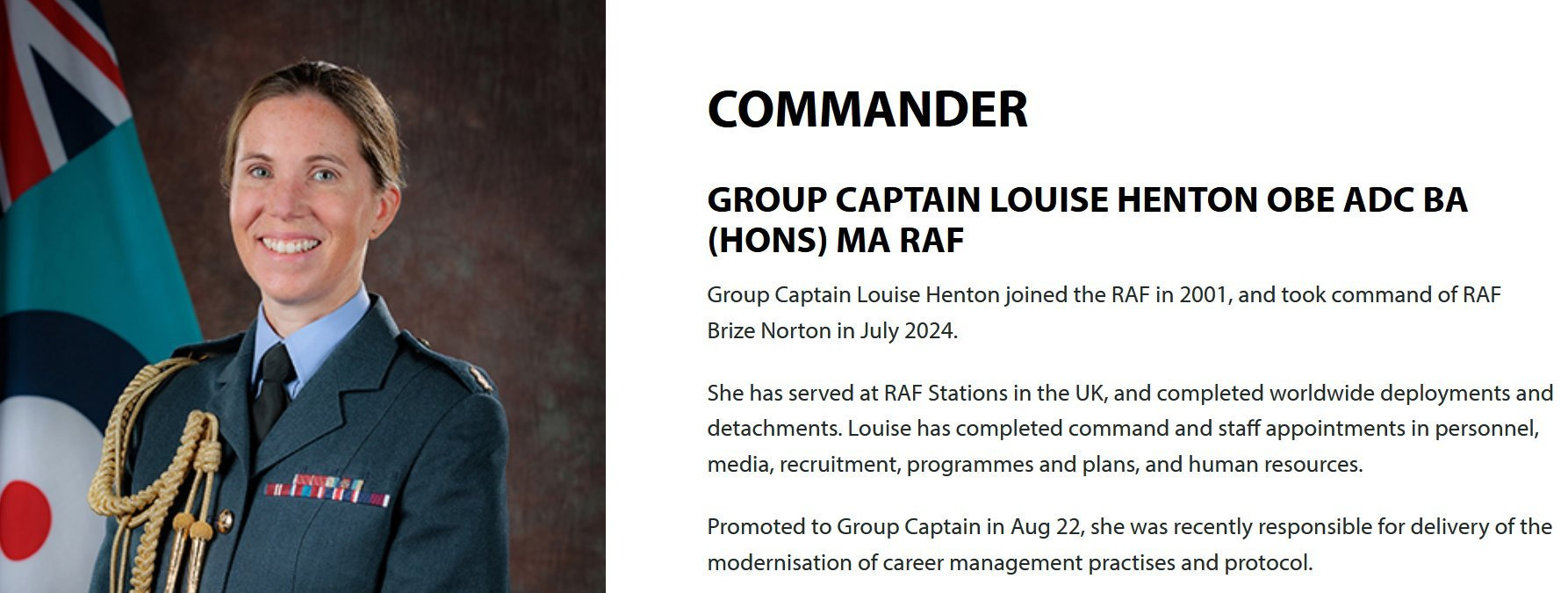
Or maybe it isn’t. This is the station commander of RAF Brize Norton:

Gp Capt Henton appears to have spent her entire career in non-operational roles. She also seems to have some very strange ideas about concepts such as masculinity and even patriotism. In a paper she wrote (which is available online) Henton appears strongly critical of traditional military culture, particularly that in the combat units she has never been part of. Is it just coincidence that, under the command of someone who is effectively an HR manager in a uniform, traditional military concerns such as security appear to have been badly neglected?

It’s undeniable that security at Brize Norton was neglected. One of the things I was trained in, as an Intelligence Corps operator, was protective security. We tended to focus on the protection of classified information, but the same principles apply to the protection of anything else (for example aircraft), and one of those principles is that if the security around an asset is weak in one respect — for example, physical barriers like fences — you can plug that gap by deploying other assets — for example, guards.

I used Google Street View to do a perimeter recce of Brize Norton, and took this screenshot looking from Station Road at the eastern end of the base’s runway:

This shot is taken from a public road, outside the base. The only perimeter security is a simple, easily climbed wooden fence less than six feet high. For a long stretch it has no “topping” — security jargon for razor wire or other anti-climb obstacles. There is also no perimeter security lighting along this section of the road. There aren’t even streetlights on the road itself. This is a massive weakness in physical security, which any terrorist can easily identify using open-source tools like Google Street View. The red ellipse I have drawn on the image highlights aircraft — seven of them, a mix of Voyagers and A400M transports — parked on the apron. They are less than three-fifths of a mile (900m in new money) from the perimeter fence, a distance that an electric scooter can cover in around 90 seconds. This level of physical security is completely unacceptable for the protection of such valuable assets, so it should have been supplemented with armed guards. It wouldn’t take all that many. A twelve-man guard under the command of a corporal could easily supply a pair of two-man prowler patrols, one on the apron and one randomly checking vulnerable points around the perimeter. That would have been enough to intercept and stop this attack.

Older Posts »

Powered by WordPress