Quotulatiousness

May 22, 2020

The NFL’s (tentative) plan for the 2020 season

Filed under: Business, Football, Health — Tags: , , , , — Nicholas @ 05:00

At FEE, Jon Miltimore explains what the league’s officials are thinking based on the announcement earlier this week:

Football fans around the world have been anxiously waiting for signs as to whether the NFL season will kick off in September despite concerns about the COVID-19 pandemic.

This week, they got the “burning bush” of signs.

The NFL on Tuesday had a soft opening of sorts, opening a number of facilities around the country to personnel, owners, and players rehabilitating from injuries. But it was in a post-meeting conference call with media that NFL officials delivered a bombshell of sorts.

According to multiple reports, NFL executive vice president Jeff Miller and Allen Sills, the NFL’s chief medical officer, told reporters the NFL fully expects to have COVID-19 cases during the NFL season, and are planning accordingly.

“We have a task force working very diligently on that,” Sills told reporters. “We fully well expect that we will have positive cases that arise because we think that this disease will remain endemic in society. And so it shouldn’t be a surprise if new positive cases arise. Our challenge is to identify them as quickly as possible and to prevent spread to any other participants. So we’re working very diligently on that, and we’ll have some detailed plans to share about that at a later time.”

It did not take long for reporters to process and interpret what the NFL was saying.

“You didn’t even have to read deeply between the lines,” said Charles Robinson, Yahoo’s senior NFL reporter. “What I just heard from the NFL was, ‘Hey, guess what? We are going to open. There is going to be a season. And we are going to have some people test positive for coronavirus once that season begins. And we’re working on a plan to not stop anything. We’re going to work through it.'”

Terez Paylor, a senior writer who also covers the NFL for Yahoo, concurred.

“He’s saying they’re going to play,” Paylor said in a podcast with Robinson. “Basically [they’re saying], ‘People are gonna get it. We’ll try to deal with it the best we can.'”

To be clear, the NFL has made no official decision yet. That being said, it looks like they are heading in that direction.

While some will say it would be reckless to hold the NFL season during a pandemic, it appears the NFL is making its decision based on some of the same assumptions Sweden used in its unique approach to COVID-19.

Anders Tegnell, Sweden’s top infectious disease expert and the architect of its “soft-approach” strategy, said one of the reasons he rejected sweeping lockdowns is because the measures simply are not sustainable, considering COVID-19 is going to be with us for years.

May 19, 2020

Some changes to the working world … when the world gets back to working

Filed under: Britain, Business, Economics — Tags: , , , , , , — Nicholas @ 05:00

Sean Gabb has some thoughts on the post-lockdown return so … well, not normal, but as the economy reaches toward a new working equilibrium:

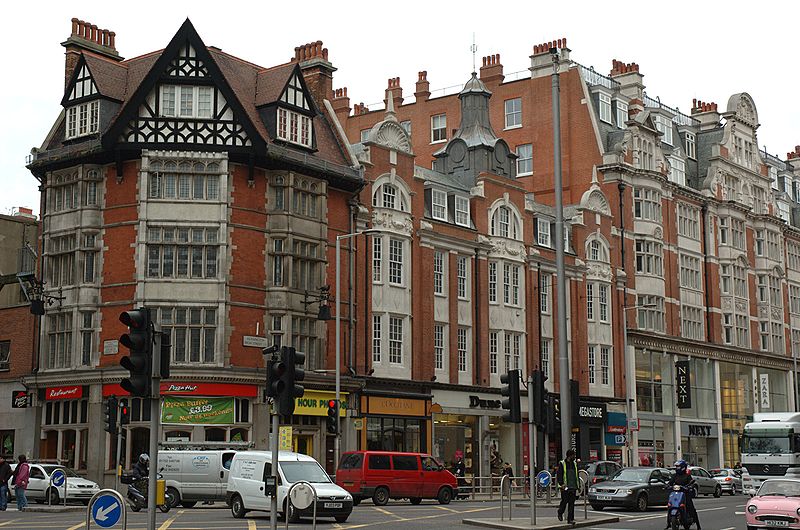
Kensington High Street at the intersection with Kensington Church Street. Kensington, London, England.
Photo by Ghouston via Wikimedia Commons.

The Coronavirus and its aftermath of lingering paranoia are the perfect excuse. Decentralisation and homeworking must be done. They must be done for the duration. They must be continued after that to maintain social distancing. No one will think ill of Barclays and WPP for taking the leap. No one will blame them for taking the leap in a way that involves a few deviations from course and a less than elegant landing. A year from now, these organisations will be making measurably larger profits than they would be otherwise. The mistakes will have been ignored.

And other organisations will follow. Whether the present crash will bring on a depression shaped like a V or an L, there is no doubt that, even if slowly at first, the wheels of commerce will continue turning. But they will be turning on different rails. As with any change of course, there will be winners and losers. I have already discussed how I can expect to be among the winners. I will leave that as said for the other winners — these being anyone who can find a market for doing from home what was previously required by custom and lack of imagination to be done somewhere else. I will instead mention the losers.

Most obvious among these will be anyone involved in commercial property. Landlords will find themselves with many more square feet to fill than prospective tenants want to fill. Rental and freehold values will crumble. Bearing in mind how much debt is carried by commercial landlords, there will be some interesting business failures in the next few years. Then there are the ancillary sectors — property management companies, commercial estate agents, maintenance companies. These employ swarms of architects and surveyors and lawyers and negotiators, of builders, plumbers, electricians, of drivers and cleaners. If the humbler workers will eventually find other markets, many with degrees and professional qualifications can look to a future of straitened circumstances.

The lush residential estates in and about Central London will follow. I think particularly of the aristocratic residential holdings in Kensington. Houses here go for tens of thousands a week to senior bank workers from abroad. If the City and Canary Wharf are emptied out, who needs to live in a place like Kensington? It has poor Underground connections. It is close by places like Grenfell Tower. Its residents keep predators at bay only by heavy investment of their own in security and by suspecting every knock on the door and every sound in the night. Many of the shops and eateries that make its High Street an enjoyable place to be will not reopen. Those that do reopen will be hobbled by continuing formal and informal rules on social distancing.

As a result, restaurants and pubs and coffee bars will begin to disappear. All but a few of these were barely making normal profit before they were closed last month. So few are in liquidation as yet only because so few petitions have been lodged in the courts. Most of them will now be surplus to requirement. The same can be said of hotels. Speaking for myself, I used to visit Cambridge twice a year on examinations business. I was always put up there for a couple of nights. I shall now do from home all that I did in Cambridge. I doubt I am alone. Zoom will destroy business travel. In the same way, bigger televisions plus continued social distancing will finish off the theatres and cinemas — also in decline before last month.

The Karenist coup

Filed under: Government, Health, Law, Liberty, USA — Tags: , , , , , , — Nicholas @ 03:00

L. Neil Smith on our current self-inflicted plight:

We find ourselves here, in this particular time and this particular place in the history of our republic, because of a 239-year-old oversight made by the Founding Fathers, in that the first ten amendments to the United States Constitution, commonly known as the Bill of Rights (the name itself is a mistake), contain no penalty clause for those — politicians, bureaucrats, policemen — who violate them. I’m not entirely sure it was accidental, but, as a result, they are violated daily, hourly, as a matter of course, and this Corona Virus farce — many others come to mind — is simply the most recent and most preposterous example.

(The name itself is an error because this document is not a mere list of privileges that the government generously lets the people exercise. Quite the opposite, it is a list of things that the government is absolutely forbidden to do It should have been called the “Bill of Limits”. And if the Founders, who had just fought and won a desperate, bloody war against the world’s most brutal and rapacious super-power, hadn’t meant them to be absolute, then why — for all you “living document” idiots out there — would they have even bothered to write them down?)

All over this bruised and battered country, a flock of mean, moronic, petty tyrants have issued illegal orders to those they clearly regard as the peasantry: stay home, avoid your fellow human beings, and above all, shut down the Machinery of Freedom which we know as capitalism. If it’s ever allowed to start up again, it must strictly be on terms that are essentially Marxist in character. No mere individual can ever again scratch his ass without written government approval and permission. In effect, the left has the revolution — as usual, achieved by somebody else — it has wanted for 180 years, since the days of Pierre-Joseph Proudhon.

What’s more, many otherwise decent and intelligent folks are out there begging for their rulers to let them be free again. I find that repulsive and unAmerican. And to those boobies (including Sean Hannity and Joy Behar) blubbering about patriots bring their weapons to demonstrations, listen up: the Founders meant the government to be intimidated by the people, you hapless buffoons.

My bottom line, here, is that, in the short run, we must free ourselves — now — from what we have to call Faucism. Scientific pleaders like the dictatorial doctor must be made painfully aware that when their pronouncements have clear political and economic consequences, their protests of innocence sound a bit too much like “I was just following orders”.

May 18, 2020

Safetyism

Matthew Crawford:

Safetyism is a disposition that has been gaining strength for decades and is having a triumphal moment just now because of the virus. Public health, one of many institutions that speak on behalf of safety, has claimed authority to sweep aside whole domains of human activity as reckless, and therefore illegitimate.

I suspect the ease with which we have lately accepted the authority of health experts to reshape the contours of our common life is due to the fact that safetyism has largely displaced other moral sensibilities that might offer some resistance. At the level of sentiment, there appears to be a feedback loop wherein the safer we become, the more intolerable any remaining risk appears. At the level of bureaucratic grasping, we can note that emergency powers are seldom relinquished once the emergency has passed. Together, these dynamics make up a kind of ratchet mechanism that moves in only one direction, tightening against the human spirit.

Acquiescence in this appears to be most prevalent among the meritocrats who staff the managerial layer of society. Deferring to expert authority is a habit inculcated in the “knowledge economy”, naturally enough; the basic currency of this economy is epistemic prestige.

Among those who work in the economy of things, on the other hand, you see greater skepticism toward experts (whether they make their claim on epistemic or moral grounds) and less readiness to accept the adjustment of social norms by fiat ­– whether that means using new pronouns or wearing surgical masks. I am regularly in welding supply stores, auto parts stores and other light-industry venues. Nobody is wearing masks in these places. They are very small businesses: an environment largely free of the moral fashions and corresponding knowledge claims that set the tone in large organisations. There is no HR in a welding shop.

A pandemic is a deadly serious business. But we would do well to remember that bureaucracies have their own interests, quite apart from the public interest that is their official brief and warrant. They are very much in the business of tending and feeding the narratives that justify their existence. Further, given the way bureaucracies must compete for funding from the legislature, each must make a maximal case for the urgency of its mission, hence the necessity of its expansion, like a shark that must keep moving or die. It is clearer now than it was a few months ago that this imperative of expansion puts government authority in symbiosis with the morality of safetyism, which similarly admits no limit to its expanding imperium. The result is a moral-epistemic apparatus in which experts are to rule over citizens conceived as fragile incompetents.

But what if this apparatus were revealed to be not very serious about safety, the very ideal that underwrites its authority? What then?

May 17, 2020

China sees their public image damaged in the wake of the Wuhan Coronavirus

Filed under: Australia, China, Health, Media — Tags: , , , , — Nicholas @ 03:00

Arthur Chrenkoff on the ways other countries regard China after the epidemic spread beyond their borders and the Chinese Communist Party’s antics on the world stage:

Welcome to the political chaos theory – or, should we say, fact: a bat flapping its wings in China produces a hurricane… pretty much everywhere around the world. It seems likely that three decades’ worth of good PR painstakingly build up by the Chinese authorities after the downer of the Tiananmien Massacre have all been undone in a few short months of domestic and international missteps, from initially covering up the truth about COVID, through gifting or selling faulty personal safety and medical goods around the world, to now retaliating against countries like Australia which are asking some uncomfortable questions about the origins of the virus.

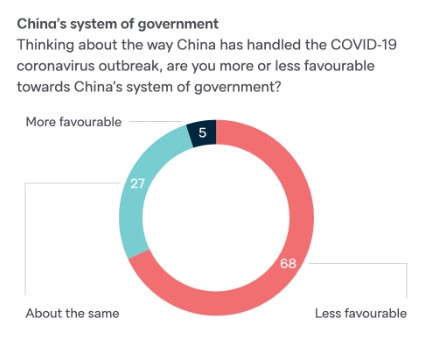
Earlier today, Australia’s Lowy Institute has released the results of its COVID poll on public attitudes about the Corona pandemic. Of particular interest, the perception of China’s rulers:

At the same time, 37 per cent of Australians think that China will emerge more powerful after the dust (or the viral load) settles, while 36 per cent believe in no change, and only 27 per cent think China will be weaker in the aftermath. By contrast, a majority of 53 per cent and a plurality of 48 per cent believe that the United States and Europe respectively will be less powerful in the post-pandemic future. Reading the two sets of figures together it seems that the prospect of China’s rebound to international power is viewed more with apprehension rather than enthusiasm.

As Lowy’s Natasha Kassam observed, the public trust in China has been already declining, falling dramatically from 52 to 32 per cent in just one year between 2018 and 2019. It will be interesting to see the figure for this year. It’s unlikely that the behaviour of the communist government so far in 2020 would have improved the perception.

Such findings mirror similar public opinion research elsewhere. Pew Research Center’s polling last month showed that the negative view of China in the United States has risen from 47 per cent in 2017 to 66 per cent this year. Seventy-one per cent have no confidence in China’s President for Life Xi and 61 per cent view China’s power and influence as a major threat.

May 16, 2020

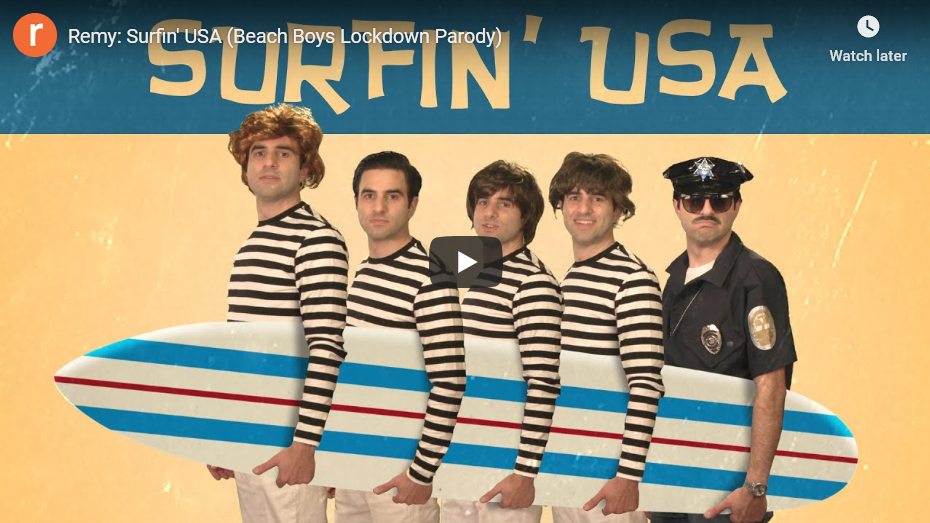
Remy: “Surfin’ USA” (Beach Boys Lockdown Parody)

Filed under: Government, Health, Humour, Law, Liberty, USA — Tags: , , , , , , — Nicholas @ 04:00

ReasonTV
Published 15 May 2020

Remy discovers the dangers of exercising alone.

Written and performed by Remy. Music tracks, mastering, and background vocals by Ben Karlstrom. Video produced by Meredith and Austin Bragg.

LYRICS:
If you go out on the ocean
Across the USA
And you’re wearing a swim shirt
‘Cuz of your scrawny weight (it’s for the sun, I swear)

Well, uh, you just might notice
The police in your wake
Cuz it’s illegal to be surfing
In the USA

They’re catching them out paddle boarding
Letting their children play
While they’re releasing this guy
A logical checkmate

You’re out in nature alone now
No one in six-foot range?
Well it’s illegal to be surfing
In the USA

If only you had flashed some children
It’d be your release date!
But you’re going to jail for surfing
In the USA

You’ve been distancing for months now
To keep the spread rate down
The only places you’ve been going
Are where there are no crowds

You’re making sacrifices
For your community
Now put your hands on your head because you are surfing
In the USA

He’s helping the flattening the curve now
He’s exercising alone
Rocking a super baggy swim shirt
To hide his muscle tone (I said it’s for the sun)

If only you had flashed some children
It’d be your release date!
But you’re going to jail for surfing
In the USA

The Wuhan Coronavirus, the excuse for an emergency without end

Mark Steyn on the seven-hundred-and-fifty-third day of our captivity:

Emergency without end is the staple of almost every futuristic dystopia — and that’s true for real life, too. So Americans shuffle shoeless through the airports for twenty years while their governments negotiate with the very organization that enabled those attacks — the Taliban — to restore them to power. Is a culture that cannot see off goatherds with fertilizer really going to rouse itself to decouple from a global superpower that supplies everything from its crappy “These Colors Don’t Run” T-shirts to its surgical masks and pharmacy medications?

~For my own part, I have been reading ancient accounts from Occupied France and Vichy for tips on finding workarounds for restraints on the citizenry. As wily and innovative as the French Resistance were, I wonder if their efforts would even be possible in an age when cheap Chinese-made drones can hover unseen and monitor every conversation.

[…]

Even without governors terrorizing those tavern-keepers or hairdressers who defy them, the lockdown has exaggerated the contradictions: The state wants open borders for “migrants” but a security perimeter around the homes of its citizens. Maybe the absurdities become so obvious that there is widespread rejection of them. Or maybe, one by one, the poor put-upon over-surveilled citizenry take a cue from their undocumented non-brethren. Perhaps I should just mug an illegal immigrant and steal his fake ID…

~The emergency is already feeling permanent. It starts with the social norms: Dr Fauci tells us the handshake is gone for good. That’s not a small loss. I don’t care for the suggested replacements, like the lame-o hand-on-heart gesture. I bow from the neck to the Queen — and just last year I did so to her Canadian vicereine, Mme Payette. Her Excellency then stepped forward and gave me a hug. But I don’t suppose she’s doing that anymore…

People ask me why I haven’t been on TV lately. Well, I mainly like going on TV to behave like a person who’s on TV. So, if you notice, on the “Fox & Friends” live-audience shows, I come bounding in like Tigger and do a lot of gladhanding with those on the aisle (including the odd hug), and then I give Steve and Brian manly handshakes and do a little light kissy-kissy with Ainsley. And all that — the basic language of telly for seventy years — is gone, apparently forever.

[…]

The WHO, the Beijing public relations firm whose pronouncements the BBC, The New York Times et al insist on taking as gospel, now says Covid-19 is here to stay — like HIV. With HIV, it wasn’t that difficult to avoid catching it, because it required the exchange of bodily fluids, which is a fairly intense and specific degree of intimacy. With Covid, we are rolling a protective condom down over every routine social intercourse.

A contributor at the Continental Telegraph explains why he no longer supports the lockdown:

First, it turns out that the drastic steps we were taking were based on one model. That no one outside the team using it was allowed to review. We were even told that we couldn’t check the coding because it was so old & patched together that it’s too hard to follow. That’s like saying you can’t check the brakes because you won’t be able to see all the duct tape and Velcro we’re using. Further, we’re told that this software doesn’t provide the same results from one run to the next.

Next, I heard about Dr. Ferguson’s history of wildly overestimating the fatalities from mad cow disease and bird flu (50k compared to <200, 200 million versus <500 respectively). Also, the CDC’s estimate of Ebola deaths in Sierra Leone (1.4 million compared to 8k). And let’s not forget the U.S. Public Health Service’s overshoot on the number of AIDS infections in 1993 (450k versus 17k). At this point I gave more thought to the issue of modeling – prior to retiring I was an actuary and modeling was what I did for a living. A few points about how modeling works: The more complex a system is, the more difficult it is to build a good model. And, more importantly, the more difficult it becomes to test your model and confirm that it accurately mirrors the real world. And this looks like one of the most complex systems to model I’ve ever heard of. How can you test this against reality? I don’t think you can. You can run simulations and confirm it looks like you expected, but that doesn’t mean the virus behaves like your model. Another point about modeling is that the results are extremely dependent on the assumptions you’re using. And in this case two critical assumptions are how infectious the virus is and how lethal it is. We still have a poor understanding of these variables months after we started Lockdown. Then a lot of us noticed that the goal shifted from “flattening the curve” to avoid a catastrophic overflow at hospitals to Lockdown until “fill in the blank” (in some states a vaccine, in others no deaths for 14 days, etc.). And the lockdown rules are inconsistent and illogical – in Michigan you can’t buy plant seeds but you can buy lottery tickets. To add insult to injury, many of the people with their foot on our necks violate the rules (the mayors of Chicago and New York, Dr. Ferguson, etc.). I’m stunned and angry at how little attention the human costs of the Lockdown receive. We know that this will lead to increased suicides, homicides and drug overdoses. Let’s not forget more child abuse, domestic violence, depression, drug and alcohol abuse, the list of miseries goes on a very, very long way (I may write up an article just on this, the Lockdown harpies should have to admit to all the harm they’re so enthusiastically spreading).

May 15, 2020

Wuhan Coronavirus muzzles mandated by “politicians who are completely-fall-down-drunk on Chateau d’House Arrest”

Filed under: Government, Health, Liberty, Science — Tags: , , , — Nicholas @ 05:00

Laura Rosen Cohen at Steyn Online:

Hello again, and welcome to week eleventy billion gazillion of CCP-Style Lockdown in the Allegedly Free World.

Another week of hypocrisy from the politicians who are completely-fall-down-drunk on Chateau d’House Arrest.

And another week of me feeling like I look rather like this penguin when attempting to articulate how disgusted I am with the governments of western countries – my own country and province in particular.

I don’t want any more “we’re all in this together” e-mails. I don’t want to hear “Covid-19” uttered in a morose, yet sadistically gleeful, tone with odd, demonic-like smiles. I don’t want to see any more playgrounds taped up. I don’t want to see any more “Stay Home” notices. And I most certainly will refuse the “new normal” being offered to us by the power-drunk politicians and nanny-craving, safe space lunatic multitudes.

I was talking to my wonderful and brilliant partner-in-crime Kathy Shaidle about why we hate masks. (Oh go on, just admit it, you hate them as well). First of all, like with the WuFlu, we have no exact science about them, and the reasons for wearing or not wearing keep changing, just like the reasons for continued lockdown. For a while now, I’ve been looking at them as a kind of pandemic virtue signalling device. Like a Health & Safety Boy Scout badge. But I couldn’t articulate exactly what else was bothering me about them. She sent me this:

and said ‘leave it to a Hitchens to articulate it’. Bingo.

I replied to my dear Kathy that they are indeed like a burkah, something that anonymizes you and that renders normal civil discourse and interaction, like smiles, conversation and flirtation impossible. She added that they are also a kind of affront, a dare to others who you imply are inferior for not wearing yours. Then I saw this: indeed it is, the Corona Niqab. Nuts to that. And if you think I’m pissed, I urge you to listen to this interview with novelist Lionel Shriver who puts it better than I ever could. Shriver delivers the outstanding righteous fury we need to hear, a level of outrage matched and raised to a new level each day by my gracious and prophetic host himself.

May 12, 2020

Dave Grohl on live music

Filed under: Government, Health, Media — Tags: , , , , , — Nicholas @ 03:00

Writing in The Atlantic, he regrets having to miss a particular event:

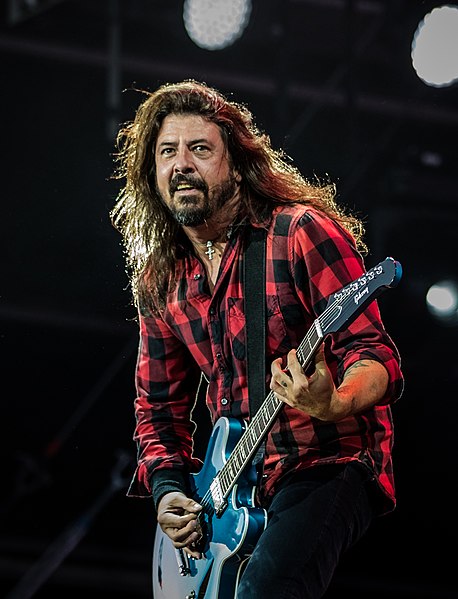
Dave Grohl and the Foo Fighters at Rock am Ring, 3 June 2018.
Photo by Andreas Lawen via Wikimedia Commons.

Where were you planning to be on the Fourth of July this year? Backyard barbecue with your crankiest relatives, fighting over who gets to light the illegal fireworks that your derelict cousin smuggled in from South Carolina? Or maybe out on the Chesapeake Bay, arguing about the amount of mayonnaise in the crab cakes while drinking warm National Bohemian beer? Better yet, tubing down the Shenandoah with a soggy hot dog while blasting Grand Funk Railroad’s “We’re an American Band”?

I know exactly where I was supposed to be: FedExField, outside Washington, D.C., with my band Foo Fighters and roughly 80,000 of our closest friends. We were going to be celebrating the 25th anniversary of our debut album. A red, white, and blue keg party for the ages, it was primed to be an explosive affair shared by throngs of my sunburned hometown brothers and sisters, singing along to more than a quarter century of Foo.

Well, things have changed.

Unfortunately, the coronavirus pandemic has reduced today’s live music to unflattering little windows that look like doorbell security footage and sound like Neil Armstrong’s distorted transmissions from the moon, so stuttered and compressed. It’s enough to make Max Headroom seem lifelike. Don’t get me wrong, I can deal with the monotony and limited cuisine of quarantine (my lasagna game is on point!), and I know that those of us who don’t have to work in hospitals or deliver packages are the lucky ones, but still, I’m hungry for a big old plate of sweaty, ear-shredding, live rock and roll, ASAP. The kind that makes your heart race, your body move, and your soul stir with passion.

There is nothing like the energy and atmosphere of live music. It is the most life-affirming experience, to see your favorite performer onstage, in the flesh, rather than as a one-dimensional image glowing in your lap as you spiral down a midnight YouTube wormhole. Even our most beloved superheroes become human in person. Imagine being at Wembley Stadium in 1985 as Freddie Mercury walked onstage for the Live Aid benefit concert. Forever regarded as one of the most triumphant live performances of all time (clocking in at a mere 22 minutes) Freddie and Queen somehow managed to remind us that behind every rock god is someone who puts on their studded arm bracelet, absurdly tight white tank, and stonewashed jeans one pant leg at a time just like the rest of us. But, it wasn’t necessarily Queen’s musical magic that made history that day. It was Freddie’s connection with the audience that transformed that dilapidated soccer stadium into a sonic cathedral. In broad daylight, he majestically made 72,000 people his instrument, joining them in harmonious unison.

May 10, 2020

London’s Metropolitan Police live down to expectations … and then some

Filed under: Britain, Health, Law, Liberty — Tags: , , , , , — Nicholas @ 06:00

Brendan O’Neill observes the latest sweep by the Metropolitan Police, relentlessly cracking down on scofflaws and evil-doers who … were walking peacefully in the sunshine?

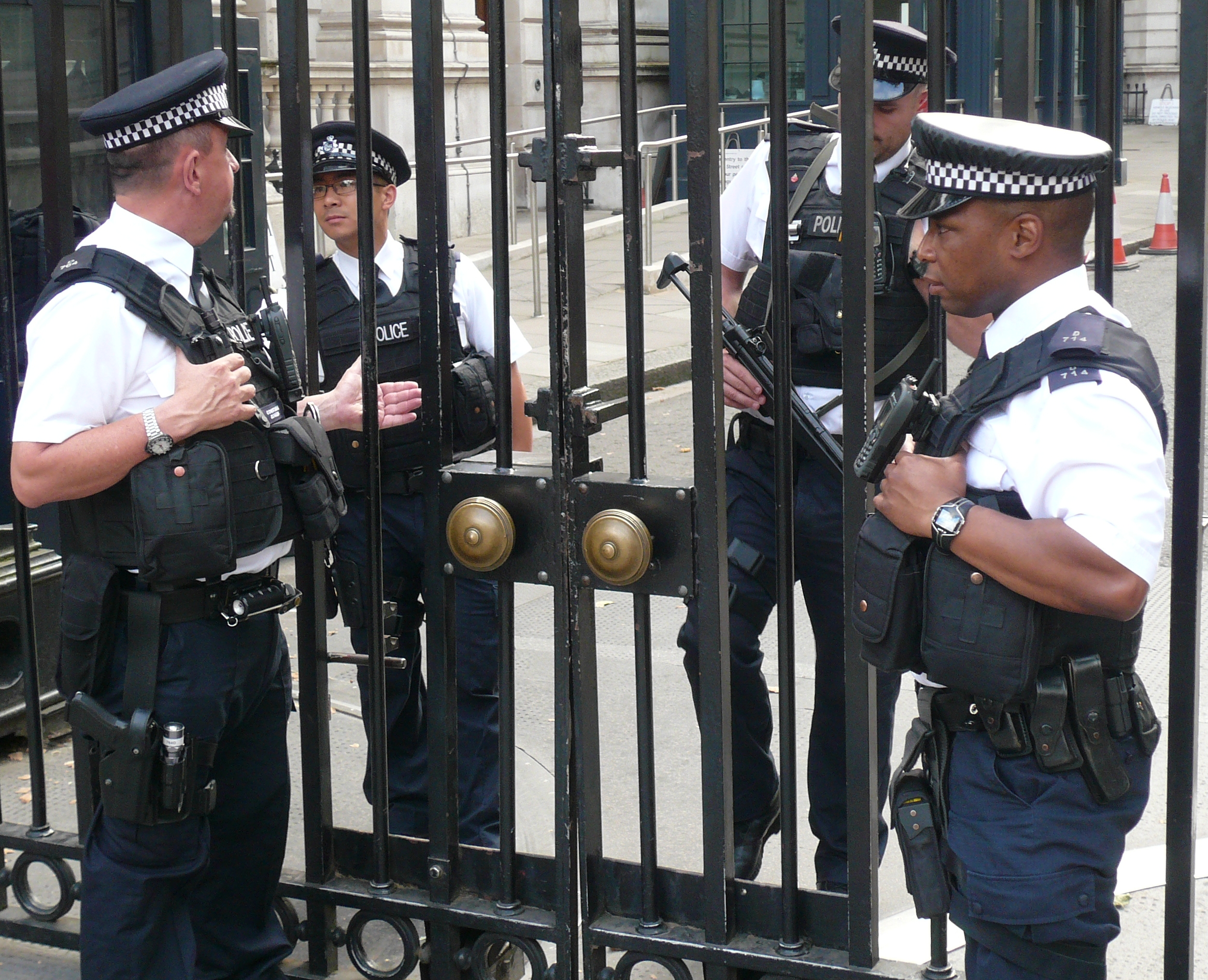
Armed Metropolitan Police near Downing Street in London.
Photo by Stanislav Kozlovskiy via Wikimedia Commons.

You heard them before you saw them. It sounded like a platoon of soldiers. The one in charge was barking orders to “move forward!” and then came the trudge of their boots. Scores of them, making military manoeuvres, marching in a long, thin line through one of Britain’s prettiest parks: St James’s Park in London. This was the Metropolitan Police today, enforcing the lockdown, sweeping through parks and streets and issuing the same warning to everyone they came across, from young lovers to dads playing football with their kids to homeless people with nowhere else to go: “Move on.” It’s one of the most disturbing things I’ve ever seen the police do.

Watching them stream through St James’s Park, looking for all the world like a line of soldiers conquering a small town, you’d think they were on their way to confront some serious organised crime. But of course their targets were sunbathers, those apparently selfish people demeaned in the media and now harassed by the cops. And a dad playing football with his toddler. “Aren’t we allowed to exercise?”, the dad asked. “For one hour”, came the reply. “How long have you been out?” And young lovers and friends. I saw a copper on horseback shouting down at two young men as if they were in the process of committing some awful crime. I guess they were in the eyes of the lockdown fanatics: they were sitting under a tree.

A young Muslim mum sitting down and watching her two kids play with little tennis bats was confused, too. Can’t kids play outside? She was told she couldn’t sit still. She had to walk. “How about walking your kids around the park?”, said the spectacularly patronising cop. They even threw out homeless people. I saw them tell four individual homeless people (ie, not a group of homeless people) to move on. Where to? Must they also walk and walk, forever, and never sit down anywhere? The most despicable thing I saw was a policeman telling an elderly homeless gentleman to move on. Inarticulately, the man explained he had nowhere else to go. I stepped in and explained to the cop that there is no home for him to go to, and he has to be able to sit down somewhere on a hot day. “I don’t make the rules”, came the snivelling, officious reply.

The police’s reputation will have taken a severe beating in London today. Anyone who argued back — as two young women did, patiently explaining that they are from the same household and that they were metres away from everyone else — was patronised or even insulted. “You’re putting other people’s lives at risk”, the women were told, which is completely untrue — being outside and socially distanced on a very warm day carries virtually zero threat of infection. I heard an officer call someone an idiot. Another officer made fun of someone who asked about his right to be outside. It was staggeringly rude and even repugnant behaviour. A politician, or someone, needs to get a grip on these people.

May 8, 2020

The Wuhan Coronavirus lockdown – “perhaps the worst policy mistake ever committed by Western governments during peacetime”

Toby Young on the fall of “Professor Lockdown”, the former top advisor to the British government on the response to the Wuhan Coronavirus epidemic:

The reason for looking into the political affiliations of the scientists and experts who’ve been advising governments across the world during this crisis is that it may throw some light on why those governments have made such poor policy decisions. Will the vast majority of those advisers turn out to be left-of-centre, like Professor Ferguson? I’m 99% sure of it, and I think that will help us to understand what’s happened.

I don’t mean they’ve deliberately given right-of-centre governments poor advice in the hope of wrecking their economies for nefarious party political reasons or because they’re members of Extinction Rebellion and want to destroy capitalism. Nor do I believe in any of the conspiracy theories linking these public health panjandrums to Bill Gates and Big Pharma and some diabolical plan to vaccinate 7.8 billion people. I have little doubt they’ve acted in good faith throughout – and that’s part of the problem. The road they’ve led us down has been paved with all the usual good intentions.

The mistakes these liberal policy-makers have made are depressingly familiar to anyone who’s studied the breed: overestimating the ability of the state to solve complicated problems as well as the capacity of state-run agencies to deliver on those solutions; failing to anticipate the unintended consequences of large-scale state interventions; thinking about public policy in terms of moral absolutes rather than trade-offs; chronic fiscal incontinence, with zero inhibitions about adding to the national debt; not trusting in the common sense of ordinary people and believing the only way to get them to avoid risky behaviour is to put strict rules in place and threaten them with fines or imprisonment if they disobey them (and ignoring those rules themselves, obviously); arrogantly assuming that anyone who challenges their policy preferences is either ignorant or evil; never venturing outside their metropolitan echo chambers; citizens of anywhere rather than somewhere… you know the rest. We’ve seen it a hundred times before.

More often than not, the “solutions” these left-leaning experts come up with make the problems they’re grappling with even worse, and so it will prove to be in this case. The evidence mounts on a daily basis that locking down whole populations in the hope of “flattening the curve” was a catastrophic error, perhaps the worst policy mistake ever committed by Western governments during peacetime. Just yesterday we learnt that the lockdowns have forced countries across the world to shut down TB treatment programmes which, over the next five years, could lead to 6.3 million additional cases of TB and 1.4 million deaths. There are so many stories like this it’s impossible to keep track. We will soon be able to say with something approaching certainty that the cure has been worse than the disease.

May 7, 2020

Interesting change in shipping patterns … to avoid the Suez canal

Filed under: Business, Economics, Middle East — Tags: , , , , — Nicholas @ 05:00

Colby Cosh linked to this story at gcaptain.com which would have been an unbelievable one in the pre-epidemic world:

A column of ships along the Suez Canal on 3 December, 2011.
Photo by https://web.archive.org/web/20161022104657/http://www.panoramio.com/user/2433337?with_photo_id=64163879 via Wikimedia Commons.

The Suez Canal Authority (SCA) is set to lose over $10m in revenue from container lines routing vessels via the Cape of Good Hope rather than its waterway.

According to new Alphaliner research, “the number of containerships that have opted to use the Cape route and bypass the Suez Canal has risen to a historic peace-time high,” including at least 20 sailings on the Asia-Europe, Europe-Asia and North America east coast-Asia trades.

“A unique combination of a container tonnage surplus and rock-bottom bunker prices has increasingly prompted ocean carriers to avoid the canal – and thus its fees,” the analyst noted today.

“Rather unusually, even three westbound Asia-Europe headhaul sailings have opted for the Cape route, all operated by CMA CGM.

“Carriers very rarely choose this longer route for the time-sensitive headhaul, but the low bunker price and lack of demand in European markets, hit by the Covid-19 lockdowns, have suddenly made such moves viable,” it added.

“When it’s over we can shave the heads of a few easy victims and vilify a few who enjoyed it too much. But I collaborated too.”

Filed under: Britain, Government, Health, History, Politics — Tags: , , , — Nicholas @ 03:00

The mandatory shutdown of most of the world’s economy is inducing some introspection:

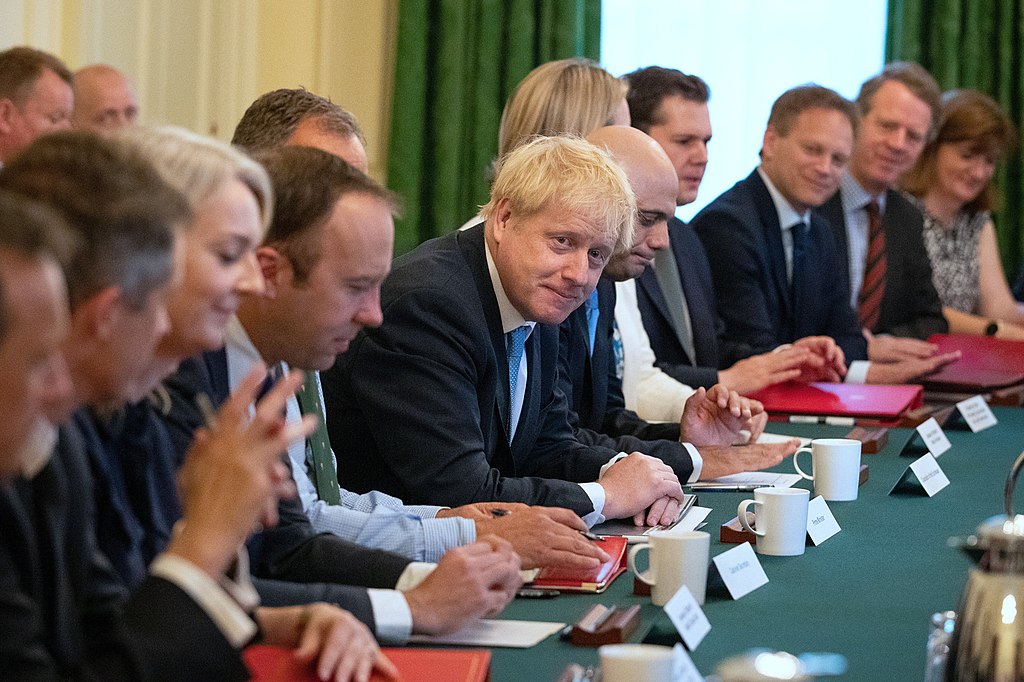
Prime Minister Boris Johnson at his first Cabinet meeting in Downing Street, 25 July 2019.
Official photograph via Wikimedia Commons.

I looked again at the decisions of the Johnson government. Should they have followed my instincts? No lockdown. Shield the elderly and the vulnerable, like my elder daughters immuno-deficient boyfriend, but let all normal life continue. Let the virus rip. Let the football league play out its conclusion and more to the point let out beloved Dundee Stars Elite Ice Hockey Club break our hearts and miss the playoffs. Such a government would probably have fallen within days, battered by the broadcast media, backbench rebellion and a nation that preferred to be kept safe from the unknown that they feared. Had they survived the month, then the elderly who by choice refused to be shielded would have pitched up in their thousands at A&E, to be faced with experienced nurses like my wife who triaged them on the doorstep and sent many of them home to die, to preserve the ICU beds for those who could be saved. Instead of admitting them so that they could die with every bit as much certainty. Had he survived the first month, Johnson would have fallen regardless and nation would be traumatised by the memory of grandparents sent home to die

Had I been in his shoes, I too would have sued for peace. My nation demanded it of me. I would have convinced myself it was the right thing and when the chest pain and cough arrived, I would have felt relief that I had made the correct call. I would have looked at the Malice of Piers Morgan and convinced myself that I was still moderate. I would have dismissed the feeble objections of lunatic libertarians.

When it’s over we can shave the heads of a few easy victims and vilify a few who enjoyed it too much. But I collaborated too.

May 6, 2020

Essential private sector workers and non-essential government workers

Filed under: Business, Economics, Government — Tags: , , — Nicholas @ 03:00

A couple of articles at the Foundation for Economic Education look at the arbitrary division of peoples’ jobs into two broad categories:

In a recent TV appearance with Dana Perino on The Daily Briefing, [Mike] Rowe made it clear he’s not a fan of the terms “essential” and “non-essential” worker. The problem with such a view, Rowe said, is that such terms have little actual meaning and the economy makes no such distinction.

“There’s something tricky with the language going on here, because with regard to an economy, I don’t think there is any such thing as a nonessential worker,” Rowe said. “This is basically a quilt … and if you start pulling on jobs and tugging on careers over here and over there, the whole thing will bunch up in a weird way.”

Rowe’s message is precisely what FEE president and economist Zilvinas Silenas was getting at in a recent article published at Townhall.

    Allowing politicians to decide which businesses and products are “essential” is an invitation for disaster. If we continue to deny these businesses the ability to do the one essential thing they are best at — providing goods and services to millions of everyday Americans — we risk more than unemployment or recession of stock price plunge. We deprive ourselves of the best resource — our people — during the time of need.

The truth is, all workers are essential.

Unfortunately, all too often what is deemed “essential” is simply what’s convenient to state leaders making the decisions. Few would suggest that liquor store owners are inherently more essential than pizza parlor owners — except perhaps state revenue collectors. No doubt this is the same reason Michigan Gov. Gretchen Whitmer concluded that lottery tickets are essential, but gardening seeds are not.

Liquor stores and lottery tickets aren’t especially “essential” to Americans, just state budgets. But as one Washington State sheriff noted in April, this seems to be the criteria state leaders often use to determine what is “essential” and “non-essential”: whether it helps the government’s bottom line.

When the state picks winners and losers it’s not only unfair, however. It’s also destructive.

In the other piece, J. Kyle deVries points out that government cannot be immunized from the economic harm the shutdown has and continues to inflict on the private sector:

So far millions in the private sector have lost their jobs or have been furloughed — but not many in government have. Many government employees continue to get salaries and benefits despite not working. Their agencies most certainly will not have as much work to do since major portions of the economy are closing down. Many agencies won’t even be needed any longer, but you better believe they will continue to be funded and probably expanded over time. That is outrageous. As we suffer economically, government should not be exempted.

This phenomenon is truly confounding and unfair. After all, government does not exist without taxes and taxes can only come from people who produce and earn a living — in other words, the private sector. The private sector supports government employees who, on average, receive higher pay, better perquisites and much better retirement plans. That should change. As we restructure our economy in the wake of the coronavirus, government should be restructured as well.

Businesses have no guarantee they will remain in business — they must provide their customers with a quality product or service at a competitive price or they will go bust. But government agencies remain in place for life, even if they continue to provide lousy services at outrageous expense. Government needs to show us they are with us during this fight. Part of doing so is to take a hard look at various agencies and departments to see if they can be improved or if they need to be eliminated. Before you say that would be difficult, let’s look at some obvious choices.

May 5, 2020

The perverse incentives of the Wuhan Coronavirus outbreak

Filed under: Economics, Government, Health, Media — Tags: , , , — Nicholas @ 03:00

David Warren has clearly taken his cynical pills today:

The daily count of deaths from the Red Chinese Batflu is among the prized, scare-mongering features of our mass media. I am among those who consider these numbers to be significantly overstated, for a reason that Nikolai Gogol would understand. Each corpse is worth cash to some public authority, usually from a higher authority; and as always, finally from the taxpayers. Each also saves money for government programmes, that can be reallocated to the purchase of new votes. As the corpse providers from this virus are very old, and suffering from other life-threatening conditions, in almost every case, this statistical inflation is easy to perform. Death certificates are issued for any who died with “Covid-19,” whether or not they died from it, and more are then added of those who were never tested. Anything respiratory will do. It’s all judgement calls — on which side of the bread is buttered.

Compare if you will the Hong Kong Flu of 1968 and 1969. I was just reading a memoir, from down that memory hole. The death toll was actually higher then, than ours is now, and from within a smaller population; the victims included children and the young. Yet there were no interruptions in economic life; no public emergency theatricals; and at the height of the second wave of that scourge, we had events like Woodstock. (Those were the days, my friend.)

A neat way to correct for all our “judgement calls” might be to look at overall death rates, and see if they have risen or fallen. It is too early to get a clear view, but soon it may be too late, for vested interests will have tampered with them. All my life I have been learning to trust statistics, less — especially from those who dress in labcoats and affect that earnest look. Sometimes an exception must be considered, however. An unpredictable minority may be honest; some others might get numbers right by mistake.

« Newer PostsOlder Posts »

Powered by WordPress