Quotulatiousness

May 4, 2020

Government “problem solving” is an oxymoron

Antony Davies and James R. Harrigan explain why you should back away quickly when you hear a variant of “We’re from the government and we’re here to help”:

A central theme of our recent book, Cooperation & Coercion, is that all governments are hamstrung when they attempt to fix problems. Policymakers suffer from the knowledge problem: they don’t know enough to foresee every eventuality that will follow from what they do. Politicians see a problem, speak in sweeping statements, then declare what will happen, assuming their edicts will settle matters. But that is always just the beginning. More often than not, all manner of unintended consequences emerge, often making things worse than they were before their policies went into effect.

Consider the United States’ three high-profile wars against common nouns over the past half-century. Lyndon Johnson declared a War on Poverty in the 1960s, Richard Nixon a War on Drugs in the 1970s, and George W. Bush declared a War on Terror in the early 2000s.

How are those wars working out? Because a back-of-the-envelope calculation indicates that we have spent somewhere in the neighborhood of $23 trillion in our attempt to eradicate poverty, drugs, and terror. Not only have we not won any of these wars, it is unclear that any of them can be won. These three so-called wars have managed to saddle future generations of taxpayers with unprecedented debt. And, as is the case with all coercive endeavors, policymakers ask us to imagine how bad things would have been had we not spent the trillions we did spend. And then they ask for even more money. So now we have unwinnable wars along with institutionalized boondoggles to support them.

We see the same sort of thing happening now in the face of the COVID-19 threat that has induced the largest panic attack in world history. In the name of safety, policymakers have shut down myriad productive endeavors. And there will be a raft of unintended consequences to follow. We are already seeing them manifest, and they portend potential disaster as supply chains fail.

The first cracks in US supply chains appeared in the meat industry. Smithfield Foods, reacting to a number of workers contracting the virus, shut down its Sioux Fall plant. Kenneth M. Sullivan, President and CEO, explained in a press release that, “the closure of this facility, combined with a growing list of other protein plants that have shuttered across our industry, is pushing our country perilously close to the edge in terms of our meat supply.” But it’s not just the meat plant that’s implicated. It’s everyone from the cattle farmer to the person who cooks dinner, and there are a number of people who have a place in that process who might first escape attention. The people who make packing materials needed to ship food, the maintenance workers who service machines up and down the supply chain, the truck drivers who move product from one place to another, the grocers who sell the product, the daycare workers who care for the grocers’ children so the grocers can work, and many, many more are all at risk.

[…]

In declaring some jobs “necessary” and others not, in focusing on one supply chain versus another, policymakers show how little they know about the nation’s economy. In their view, they can simply declare things they want to happen, and then those things will happen. But that is not how economies work. An economy is the sum total of everyone’s activities, and when the government declares that something must happen, all kinds of other things happen too.

Consider how all the “non-essential workers” have been sent home for the past two months. Who gets to declare which workers are non-essential to the economy, and by what standard? Most assumed that politicians had the correct answers to these questions. But, as we are discovering, there is no such thing as “non-essential” workers. All workers are essential. How do we know? Because their jobs existed. Profit-driven businesses do not create non-essential jobs. Those people’s jobs were essential to their employers. Further, those people’s jobs were incredibly essential to the people themselves. They need their wages to pay the rent, buy their food, make their car payments, and for everything else that makes their lives livable.

But policymakers simply declared them non-essential, as if there would be no fallout from that decision.

May 2, 2020

Drawing some conclusions from our Wuhan Coronavirus experiences

At Catallaxy Files, Justinian the Great provides an expanded list of nine lessons we should learn from our still ongoing Wuhan Coronavirus (aka “Chinese Batflu”, “Kung Flu”, “Bat-biter Bronchitis” and other names our betters insist we not use):

1. Models are not infallible.

When dealing with complex subject matter involving lots of uncertainties, unknowns and data gaps, modelling will almost certainly be wrong. That doesn’t make them worthless but nor does it mean they should be elevated to infallible status and acted upon as though they constitute proof of something.

If we can’t get epidemiological models right involving trajectories of months what is the chance of climate models being correct considering they involve substantially greater uncertainty, unknowns and data problems involving trajectories of decades to centuries?

[…]

2. Experts can get it wrong.

The pandemic has shown that epidemiologists and health experts the world over have got COVID-19 wrong at one stage or another.

The most famous example is the Imperial College model that forecast 2.2m deaths in the United States and over 500,000 deaths in the UK. Critics have argued this was never plausible but it was the catalyst for UK lockdown policy.

[…]

3. Experts can disagree

Experts can disagree and this is normal in science (and policy making).

During the pandemic, health experts across the world have disagreed over epidemiology models (e.g. R0) ranging from thousands of deaths to millions, over treatments (i.e. the efficacy of anti-virals and anti-malarials), over who and how to test (targeted (symptomatic) versus broad based (even antibody testing), how to record cases and fatalities (e.g. Italy counting deaths with COVID the same as due to COVID, Belgium recording deaths suspected to be COVID related but not verified), the origin and nature of the virus (laboratory/synthetic or wet market/natural), over what the public health response should be (full lockdowns, targeted lockdowns, Sweden (minimal) or something in-between), and the susceptibility of children to the virus, leading to divergence on school closures.

[…]

4. The Precautionary Principle – No such thing as a free lunch

The COVID-19 crisis is a classic case of the precautionary principle in action. The policy measures put in place have been justified by the worse case scenarios of epidemic models forecasting mass deaths and hospital systems in collapse. These scenarios have been hyped up by an alarmist media presenting such scenarios / predictions as established fact.

Part of the problem stems from politicians abdicating responsibility for decision-making and hiding behind health experts as human shields. These experts have nothing to gain and everything to lose from underestimating the epidemic. No-one wants to be blamed for hundreds of thousands of preventable deaths.

[…]

5. If you can’t trust the WHO in a pandemic why would you trust the IPCC on climate change?

The neo-liberal (in international relations terms) notion that the UN (and other international institutions) are independent actors working altruistically for the global good has been blown to bits during the COVID-19 pandemic.

The conduct of the WHO and its complicity with China throughout the pandemic has demonstrated what realists have always known, i.e. international institutions are not independent actors, but instead reflect the interests of great powers in the international system.

[…]

6. If you can’t trust the Chinese in a pandemic how can you trust them on climate?

The COVID crisis also demonstrates why should not trust a communist dictatorship to act truthfully, transparently or ethically, much less put global interests above national interests even in times of an international crisis.

If we can’t believe China about infection rates, how can we believe their carbon accounting? If we can’t trust China to reduce the spread of a virus, how can we trust China to reduce the growth in CO2 emissions? If we believe China has captured/corrupted the WHO how do we know it hasn’t captured/corrupted the IPCC? If China will prioritise national interest in a health crisis, why won’t China prioritise national interest in a climate crisis? If we don’t believe China action/excuses in a pandemic why would we believe China action/excuses on climate change? If we can acknowledge China is trying to exploit the health crisis geo-strategically (i.e. South China Sea military manoeuvres) and geo-economically (belt and road and coercive threats), why will it not exploit climate change in the exact same way?

May 1, 2020

Theodore Dalrymple on the authoritarian innovations we’ve so meekly accepted thanks to the Wuhan Coronavirus epidemic

Filed under: Britain, Government, Health, Law, Liberty — Tags: , , , , , — Nicholas @ 03:00

Getting back to “normal” is going to be much more difficult now that the powers-that-be know for certain that we’re all quite comfortable tugging the forelock and bending the knee given the right kind of orders:

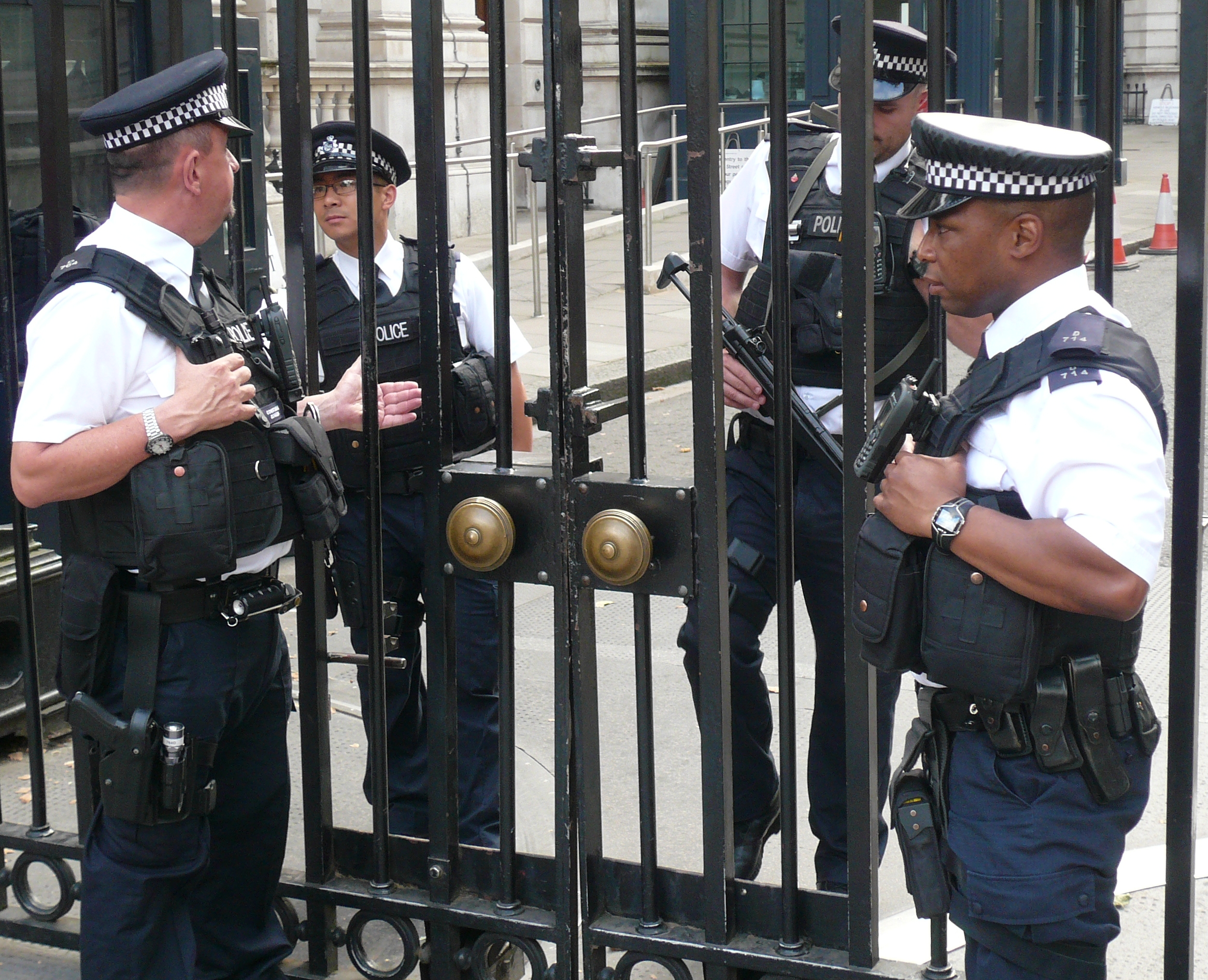
Armed Metropolitan Police near Downing Street in London.
Photo by Stanislav Kozlovskiy via Wikimedia Commons.

As for the collective or political lessons of the epidemic, I fear them more than rejoice in them. They seem to me likely to reinforce a tendency to authoritarianism, and to embolden bureaucrats with totalitarian leanings. One of the surprising things (or perhaps I should say the things that surprised me) was how meekly the population accepted regulations so drastic that they might have made Stalin envious, all on the say-so of technocrats whose opinions were not completely unopposed by those of other technocrats. There was, as far as I can tell, no popular demand for the evidence that supposedly justified the severe limitations on freedom that were imposed on the population. I suppose an encouraging interpretation of this readiness of the population to do as it was told is that it demonstrated that, all the froth and foam of opposition to political leaders notwithstanding, fundamentally the authorities were trusted by the population to do the right thing. Much as we lament, therefore, the intellectual and moral level of our political class, there are limits to how much we despise it. In other words, we believe that our institutions still work even when guided or controlled by nullities.

A less optimistic interpretation, as usual, is possible. Our population is now so used to being administered, supposedly for its own good, under a regime of bread and circuses, that it is no longer capable of independent thought or action. We have become what Tocqueville thought the Americans would become under their democratic regime, namely a herd of docile animals. Only at the margins — for example, the drug-dealers of banlieues of Paris — would the refractory actually rebel against the regulations, and that not for intellectual reasons or in the name of freedom, but because they wanted to carry on their business as usual. (I should perhaps mention here that I number myself among the sheep.)

In Britain, at any rate, the epidemic revealed how quickly the police could be transformed from a civilian force that protects the population as it goes about its business into a semi-militarised army of quasi-occupation. This transformation is not entirely new, alas; it has been a long time since the policeman was the decent citizen’s friend. Under various pressures, not the least of them emanating from intellectuals, he has become instead a bullying but ineffectual keeper of discipline, whom only the law-abiding truly fear.

I first sensed this development many years ago this when a traffic policeman asked to see my licence. “Well, Theodore …” he started, calling me by my first name when a few years before he would have called me “Sir.” This change was significant. I had gone from being his superior, as a member of the public in whose name he exercised his authority, to being a kind of minor, whom it was his transcendent right to call to order. He was now the boss, and I was now the underling.

The change in uniform, too, has worked in the same direction. Traditionally, since the time of Sir Robert Peel, the uniform of the British policeman was unthreatening, deliberately so, his authority moral rather than physical. Now, he is festooned with the apparatus of repression, if not of oppression, though in effect he represses very little of what ought to be repressed in case it fights back. The modern police intimidate only those who do not need deterring; those who do need it know that they have nothing much to fear from these whited sepulchres, these empty vessels. Incidentally, the French police have undergone a similar deterioration in appearance: gone is the reassuring képi in favour of the moron’s baseball cap, and some of them now dress in jeans with a black shirt with the word POLICE across its back, which is not difficult to imitate and makes it impossible to know whether a policeman really is a policeman or a lout in disguise.

French Gendarmerie at the Eurockéennes of 2007.
Photo by Rama via Wikimedia Commons.

The Covid-19 epidemic has come as a great boon to the British police. Increasingly criticised for their concentration on pseudo-crimes such as hate speech at the expense of neglecting real crimes such as assault and burglary, to say nothing of organised sexual abuse of young girls by gangs of men of Pakistani origin, they could now bully the population to their heart’s content and imagine that in doing so they were performing a valuable public service, preserving the law and public health at the same time. Thus they transformed their previous moral and physical cowardice into a virtue.

Of course, in bullying the average citizen who was very unlikely to retaliate they took no risks, unlike with genuine wrongdoers and law-breakers, who tend to be dangerous; but the fact remains that most individual policemen joined the force motivated by some kind of idealism, a desire to do society some service, though they soon had these naïve fantasies knocked out of them by the morally corrupt or bankrupt leadership of the hierarchy which owes its ascendency to its willingness to comply with the latest nostrums of political correctness. The faint embers of the policeman’s initial idealism were no doubt rekindled by the opportunity to prevent the spread of the virus, as they supposed that they were doing, but some of them, at least, far exceeded even their flexible and vaguely-defined authority and began to inspect citizens’ shopping bags to determine whether they were hoarding goods that might be in short supply. This was a step too far, and at last there were protests; the police desisted.

April 30, 2020

Desperate Mayors React to Coronavirus: A Timeline

Filed under: Government, Health, Humour — Tags: , , — Nicholas @ 04:00

ReasonTV
Published 29 Apr 2020

The past few months have been difficult on politicians. It’s hard to look like you know what you’re doing when you have no idea what you’re doing.

Performed by Austin Bragg and Andrew Heaton. Written by Austin Bragg, Meredith Bragg, and Andrew Heaton. Edited and Produced by Austin Bragg. Cameras by Andrew Heaton and Austin Bragg.

Music: “Wholesome,””Marty Gots a Plan,” “Anamalie,” “Anguish,” and “The Cannery” by Kevin MacLeod used under an Attribution 3.0 Unported (CC BY 3.0) license.

CITIZENS! Report any non-socially-distanced deviationist behaviour to this number immediately!

Filed under: Cancon, Government, Health, Liberty — Tags: , , , , , — Nicholas @ 03:00

In Maclean’s, Jen Gerson admits that she has not (yet) reported any of her neighbours for their failure to obediently follow the rules of social distancing. She must be reported to the appropriate state authorities!

Commemorative badges of the German Democratic Republic’s Ministry of State Security (Stasi).
Wikimedia Commons.

Look, I know I’m going to get flak for this, but someone needs to say it: think twice before you narc on your neighbours.

Snitching may work, but the downsides to citizen-policing are grim — to say nothing of the historical antecedents.

Firstly, “you can play havoc with somebody just by snitching on them with an anonymous snitch line,” noted Sharon Polsky, the president of the Privacy and Access Council of Canada. In addition to the risk of malicious reports, if people of colour aren’t disproportionately subject to snitching, I’d be shocked.

Totalitarian states turned neighbour against neighbour and family against family, in order to maintain the illusion of social cohesion.

Authoritarians use this tactic because there are never enough police or soldiers to force compliance upon an entire population, not unless everyone consents to become an agent of his or her own mutual oppression.

The term “fascism” has an innocent history. It comes from the Roman term “fasces,” which means a bundle of sticks bound together. One stick breaks, but the fasces remains strong. It’s another term for unity. That’s what makes it so seductive, especially in times of uncertainty and mortal dread. We’re all in this together. Nary a stick shall stray.

“We are now living amid the very tactics that the West [once] criticized,” Polsky added. “With state controls on commerce, industry, speech, and media.”

The federal government, for example, is already considering legislation that would bar the spreading of misinformation about COVID-19 online.

“Extraordinary times require extraordinary measures and it is about protecting the public,” Privy Council President Dominic LeBlanc told reporters with a line that should give any student of history the creeps.

“This is not a question of freedom of speech. This is a question of people who are actually actively working to spread disinformation, whether it’s through troll bot farms, whether [it’s] state operators or whether it’s really conspiracy theorist cranks who seem to get their kicks out of creating havoc.”

No doubt LeBlanc et al are operating under the noblest of intentions. But repressive measures buy conformity at a terrible price. Snitch lines turn us against one another. They teach us to fear the people we need to survive, thus making us more dependent on the apparatus of the state.

April 29, 2020

“The war on ultraviolet radiation because it might help Trump is an educational moment”

Arthur Chrenkoff on the sudden decision that the World Health Organization is the ultimate arbiter of what we’re allowed to say on social media platforms like Twitter and YouTube:

There is of course no evidence that the video represents any disinformation. It relates to legitimate scientific research by a medical company conducted in association with a respected hospital to develop a novel treatment of possibly crucial importance in the current conditions and into the future. The only problem with the video is that is indirectly supports Trump’s flight of fancy speculation about using light and chemicals to “disinfect” the body. Ergo, according to a NYT journalist it represents a problem and YouTube agrees. YouTube now has a standing policy of removing COVID information that goes against the World Health Organisation’s guidelines. Putting aside the question of the WHO’s credibility in the wake of the pandemic, we are not talking here about some guy in a tinfoil hat talking about 5G towers spreading the virus; this is a video relating to ongoing, respectable scientific research. Will it work? Probably not. But perhaps neither will any of the 150 or so COVID-19 vaccines being currently developed around the world. We won’t know until we know. But in the meantime, scientific news should not be censored, period.

[…]

Goldsmith and Woods are correct in pointing out not only the greater role that governments have been playing in regulating speech but more importantly how much of that effort has been embraced and driven by the big tech — and by the private individuals enabled and encouraged by the big tech — what I have previously called the “democratised censorship”. The difference is that people like Goldsmith and Woods think that’s a good thing.

The dirty little secret is that a great number of leftists, progressives and even centrist technocrats and activists look at China, with its authoritarian government, social credit score system, ubiquitous surveillance, and the ability to “get things done” and done quickly and supposedly efficiently (in China, bullet trains run on time, I hear), and pine for such a system to be applied in their own countries — as long as, of course, they are the ones in power and decide what is right, important and valuable. The left’s objections are rarely against authoritarianism and its means and methods per se, just with the possibility that someone else — like Trump — is the one behind the wheel, implementing their, not the left’s, agenda.

The war on ultraviolet radiation because it might help Trump is an educational moment. One could say, first they came for crazy conspiracy theorists and I said nothing because I’m not an anti-vaxxer or anti-5G activist — and so on. The problem with censorship is that it keeps creeping up on everyone else. And those who do the censoring — who decide what the ignorant masses should and shouldn’t be allowed to read — are not some detached and impartial spiritual beings but people with political agendas. People who think that ideas and beliefs of one half of the society are harmful and offensive. People who will censor news that doesn’t fit the agenda and support the narrative.

And then they came for ultraviolet radiation… You have been warned.

“If it saves just one life…”

Filed under: Economics, Government, Health, Liberty — Tags: , , — Nicholas @ 03:00

Antony Davies and James R. Harrigan on the rallying cry of the Karens of all genders:

In times of crisis, politicians want to look like they’re doing something, and don’t want to hear about limits on their authority. In times of crisis, people want someone to do something, and don’t want to hear about tradeoffs. This is the breeding ground for grand policies driven by the mantra, “if it saves just one life.” New York Governor Andrew Cuomo invoked the mantra to defend his closure policies. The mantra has echoed across the country from county councils to mayors to school boards to police to clergy as justification for closures, curfews, and enforced social distancing.

Rational people understand this isn’t how the world works. Regardless of whether we acknowledge them, tradeoffs exist. And acknowledging tradeoffs is an important part of constructing sound policy. Unfortunately, even mentioning tradeoffs in a time of crisis brings the accusation that only heartless beasts would balance human lives against dollars. But each one of us balances human lives against dollars, and any number of other things, every day.

Five-thousand Americans die each year from choking on solid food. We could save every one of those lives by mandating that all meals be pureed. Pureed food isn’t appetizing, but if it saves just one life, it must be worth doing. Your chance of dying while driving a car is almost double your chance of dying while driving an SUV. We could save lives by mandating that everyone drive bigger cars. SUVs are more expensive and worse for the environment, but if it saves just one life, it must be worth doing. Heart disease kills almost 650,000 Americans each year. We could reduce the incidence of heart disease by 14 percent by mandating that everyone exercise daily. Many won’t want to exercise every day, but if it saves just one life, it must be worth doing.

Legislating any of these things would be ridiculous, and most sane people know as much. How do we know? Because each of us makes choices like these every day that increase the chances of our dying. We do so because there are limits on what we’re willing to give up to improve our chances of staying alive. Our daily actions prove that none of us believes that “if it saves just one life” is a reasonable basis for making decisions. Yet, when a threat like the coronavirus emerges, we go looking for an imaginary cure that will save lives without tradeoffs.

April 26, 2020

“If it saves just one life…”

Filed under: Economics, Government, Health, Liberty — Tags: , , , , — Nicholas @ 03:00

Hector Drummond illustrates the moral failure of falling back on the “if it saves just one life” trope as a justification for any and all restrictions on free people:

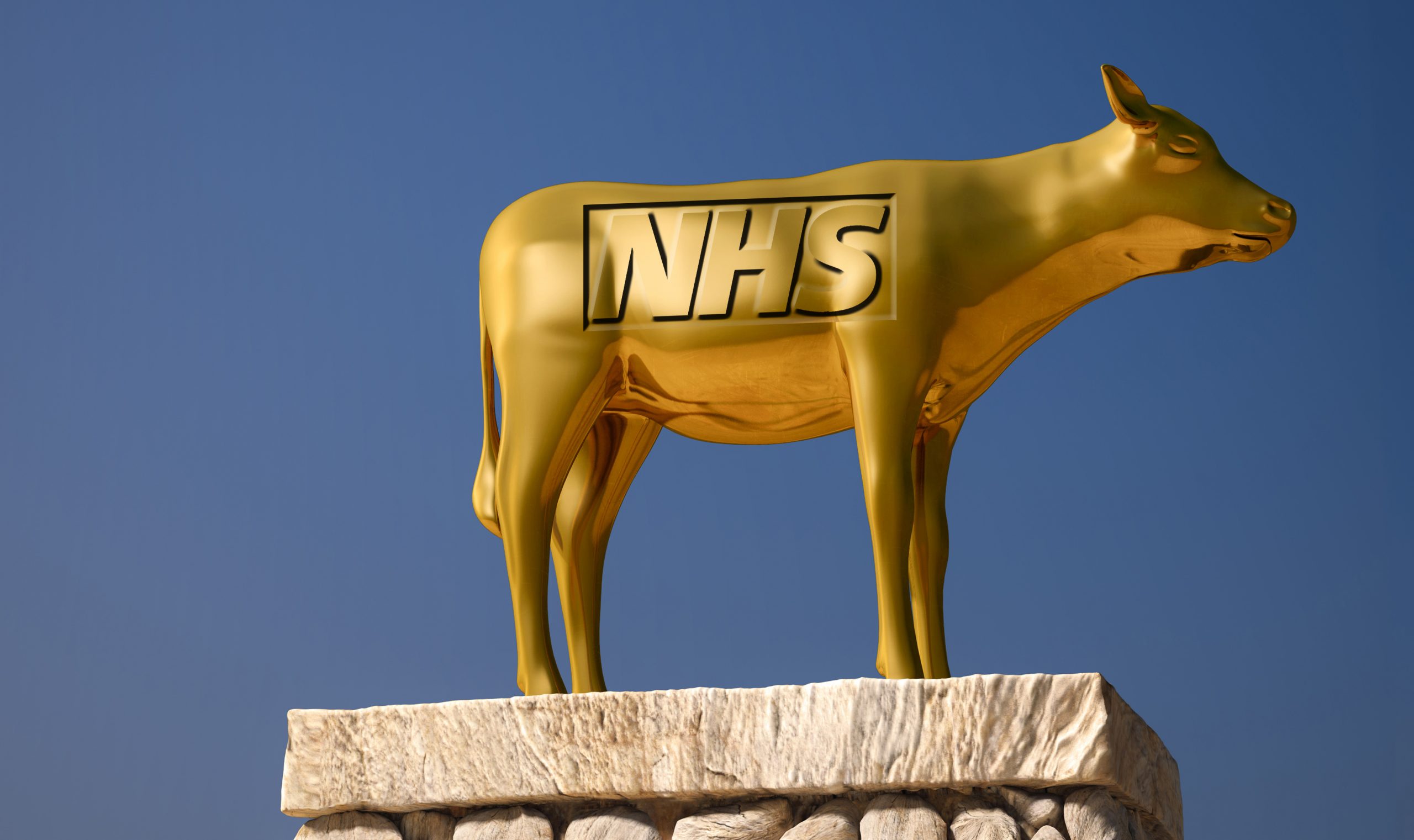
Not actually the official symbol of Britain’s National Health Services … probably.

Let me ask you a question. Would you give up your job, your savings, your kids’ economic future, your pension, your parents’ current pension, your house, and your mental health, if I told you that doing so may possibly extend my old, sick grandfather’s life by a year or two? I don’t suppose you’d be too keen, would you? In fact, even the most mild-mannered of people is likely to get angry at the sheer effrontery of such a request.

What if I told the world the same thing? What if I told the world that if everyone in every country gave up their wordly possessions, and spent the rest of their lives in grinding poverty, then it’s possible that my grandfather might get to see Christmas? And suppose that there was some bare plausibility to this, based on a computer model developed by scientists at Imperial College. What do you think the world is likely to say to me? The polite response would be, “Sorry to hear about your grandfather, but we’re not going to do this”. The less polite response would be more like … well, just incredulous laughter, and slammed doors.

The reason I bring up these hypothetical scenarios, though, is that all over social media we are hearing about the Covid-19 lockdown being “worth it if it saves just one life”. But would the people saying this really be willing to give up, say, their own house, car and possessions and teenage daughter to someone who is suicidally depressed over their lack of prospects in life? No. Would they be prepared to serve ten years in jail if it saved the life of someone at risk of being killed by gangsters? No. Would they be happy with having the government forcibly remove a kidney from them to extend the life of someone with failing kidneys? No. Economic ruin and loss of liberty is not something we generally regard as a fair trade for a stranger’s life. Generally even the bleeding hearts among us will say, and rightfully so, “I’m sorry for this person, but they are not entitled to this, and I will not damage my life to any great extent for them”. Charitable donations are one thing. So is volunteer service. But that’s it.

Another thing I am seeing is people who say, “Anything is worth it if it saves lives”. Anything? Really? Shall we ban alcohol then? Because some people die from alcohol. Cars? Paracetamol? Steak knives? Shall we ban mobile phones, because terrorists might use them to communicate with? Shall we lock up for life anyone convicted of a minor juvenile crime, in case they turn out to be a killer? The whole idea is too ridiculous for words, yet all over the world there are fearful people hiding in their homes and posting such thoughts. It is one thing to feel sorry for them, but their stupid ideas shouldn’t pass unchallenged.

April 25, 2020

Professor Neil Ferguson – “I wrote the code (thousands of lines of undocumented C) 13+ years ago to model flu pandemics…”

Filed under: Britain, Government, Health — Tags: , , , — Nicholas @ 03:00

An anonymous guest post at Hector Drummond’s blog pivots on the disturbing quote in the headline from one of the key advisors to the British government on the Wuhan Coronavirus epidemic:

To say I was gobsmacked at his admission is an understatement. He’s one of the experts advising the government about the Covid-19 pandemic, and was consulted in previous health crises such as Foot & Mouth disease. Like the approach to combating that, we’re seeing a kind of scorched earth approach to containing another transmissible disease.

Even though the “C” programming language that Ferguson used is nearly 50 years old, the language chosen isn’t the problem. Undocumented means that modules and other code fragments are not commented, so their purpose may be unclear to someone unfamiliar with the code. In the worst case it means that modules and variables don’t have self-documenting names. For example, an accounting program could have the variables BalanceBroughtForward and BalanceCarriedForward, but a sloppy programmer might call them B1 and B2 instead – a sure recipe for confusion.

The “C” language is good to work with but has some inherent issues which can lead to subtle bugs affecting the output without causing an error. A common problem is the conditional which uses two equals signs rather than one.

To compare variables A and B for equality you would write this: if (A == B). However, it’s easy to accidentally write this: if (A = B). The latter always returns true and assigns the value of variable B to A. I have no idea whether Ferguson’s code contains any bugs, this is just one minor example of the need for strict testing.

The reason for commenting code extensively and properly is so that the programmer himself, and anyone else who maintains it, can understand what it does and how it works, reduce the chance of mistakes and avoid unnecessary effort. During my IT career I would have terminated the contract of any contractor working for me who wrote thousands of lines of undocumented code. Not only is such code a nightmare for others to work on, it can be difficult for the original programmer to maintain if coming back to it after a long time. Sloppiness in the coding raises the worry of a concomitant lack of rigour in testing, although that’s not to assert Ferguson’s code isn’t working as intended and/or wasn’t tested.

April 21, 2020

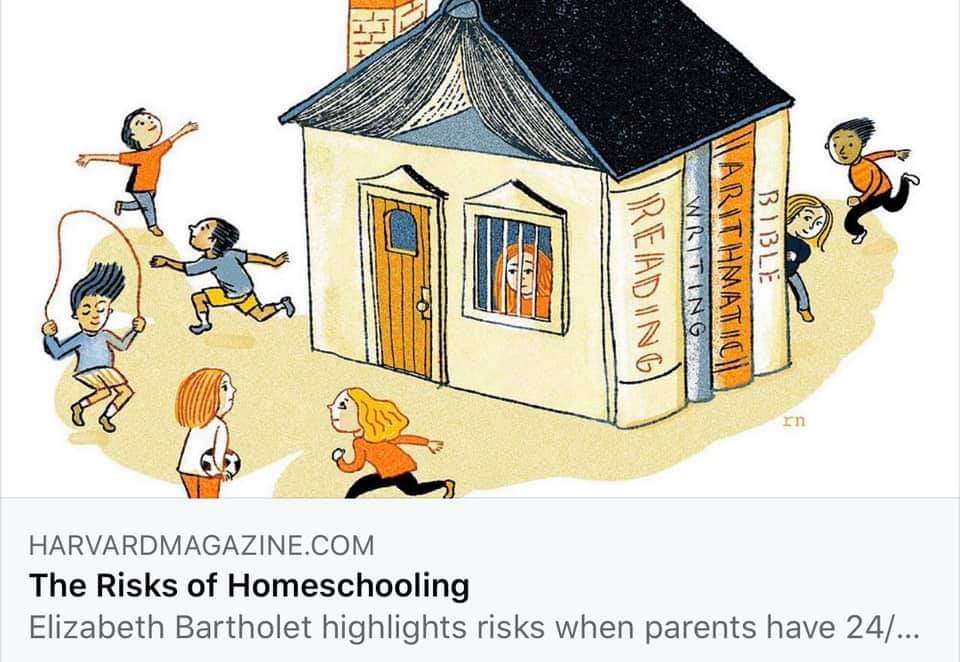
Homeschooling is bad and should be tightly regulated or banned, says Harvard Professor of Karenism

An article in Harvard Magazine draws heavy fire from people who do not automatically demand to speak to the manager:

Illustration from Harvard Magazine via Twitter.

Harvard Magazine decided that this moment was the PERFECT time to take a gigantic shit on homeschooling parents. Author Erin O’Donnell decided write a piece on Elizabeth Bartholet, a “professor” who knows the best way to handle child education, and that is to turn them over to the State, immediately. Her rationale? Parents are simply too stupid to educate children without the state looking over their shoulder.

    Yet Elizabeth Bartholet, Wasserstein public interest professor of law and faculty director of the Law School’s Child Advocacy Program, sees risks for children — and society — in homeschooling, and recommends a presumptive ban on the practice. Homeschooling, she says, not only violates children’s right to a “meaningful education” and their right to be protected from potential child abuse, but may keep them from contributing positively to a democratic society.”

    “We have an essentially unregulated regime in the area of homeschooling,” Bartholet asserts. All 50 states have laws that make education compulsory, and state constitutions ensure a right to education, “but if you look at the legal regime governing homeschooling, there are very few requirements that parents do anything.” Even apparent requirements such as submitting curricula, or providing evidence that teaching and learning are taking place, she says, aren’t necessarily enforced. Only about a dozen states have rules about the level of education needed by parents who homeschool, she adds. “That means, effectively, that people can homeschool who’ve never gone to school themselves, who don’t read or write themselves.” In another handful of states, parents are not required to register their children as homeschooled; they can simply keep their kids at home.”

    This practice, Bartholet says, can isolate children. She argues that one benefit of sending children to school at age four or five is that teachers are “mandated reporters,” required to alert authorities to evidence of child abuse or neglect. “Teachers and other school personnel constitute the largest percentage of people who report to Child Protective Services,” she explains, whereas not one of the 50 states requires that homeschooling parents be checked for prior reports of child abuse. Even those convicted of child abuse, she adds, could “still just decide, ‘I’m going to take my kids out of school and keep them at home.'”

Bartholet goes on to cite an example of one woman, who was raised by “Idaho survivalists” and was working in the family business instead of getting an education. Conveniently, while lauding “teachers and other school personnel” as mandated reporters, Bartholet fails to cite or even acknowledge that there is plenty of child abuse that happens on school property, by school employees, and maybe there are just evil people who do evil things to children because they have the opportunity to do so. Giving someone the title of “mandated reporter” does not magically make them into an upstanding citizen and defender of children.

Bartholet – and by extension, O’Donnell – makes no rational argument against homeschooling. It’s only her gut feeling that if the nanny state isn’t over the shoulder, trying to mold “young skulls full of mush” (as Rush Limbaugh has said more than once) into educated and functional adults, then there could be shenanigans afoot! Why, these children might end up RELIGIOUS. *GASP!*

Shruti Rajagopalan noted that the original illustration (which appears to have been corrected since the image at the top of this post was published) included the word “ARITHMATIC” on the spine of one of the books.

One of the few good things happening during the Wuhan Coronavirus epidemic – deregulation

Filed under: Bureaucracy, Government, Health, USA — Tags: , , , , — Nicholas @ 03:00

Patrick McLaughlin, Matthew D. Mitchell, and Adam Thierer on the benefits of suspending many existing regulations during the ongoing epidemic:

As the COVID-19 crisis intensified, policymakers at the federal, state, and local levels started suspending or rescinding laws and regulations that hindered sensible, speedy responses to the pandemic. These “rule departures” raised many questions. Were the paused rules undermining public health and welfare even before the crisis? Even if the rules were well intentioned or once possibly served a compelling interest, had they grown unnecessary or counterproductive? If so, why did they persist? How will the suspended rules be dealt with after the crisis? Are there other rules on the books that might transform from merely unnecessary to actively harmful in future crises?

In many cases, rule departures or partial deregulations undertaken during the crisis are tantamount to an admission by policymakers that some policies that were intended to serve the public interest fail to do so. “The explanation for many of these problems is that outdated 20th-century rules stymie 21st-century innovation,” noted former Florida Governor Jeb Bush in a recent Wall Street Journal editorial. “In an emergency, many of those rules can be waived by executive order. After the crisis, there will be momentum to challenge the stale rules that hindered our response. This is likely to go well beyond dealing with pandemics,” he argued. Similarly, lawyer and commentator Philip K. Howard has asserted that “the same kind of energy and resourcefulness will be needed to get America’s schools, businesses, government agencies and nonprofits up and running again” and has suggested the need for a “temporary Recovery Authority with a broad mandate to identify and waive unnecessary bureaucratic hurdles to recovery.” In addition, Wall Street Journal columnist and Brookings Institution Senior Fellow William A. Galston has called for a “Coronavirus 9/11 Commission” to study the governance failures witnessed during the crisis, arguing that “the immediate effects of Covid-19 are bad enough. Failing to learn from it would be criminal negligence for which future generations won’t forgive us.”

The crisis has been a stress test for American institutions. It has laid bare the outdated, overlapping, and often contradictory morass of rules that make it difficult for public and private organizations to respond to changing circumstances. In many cases, these rules persist not because they protect the public from danger but because they protect organized interest groups from new competition. Rules also persist because agencies rarely prioritize retrospective reviews aimed at eliminating unnecessary or potentially harmful rules. On the contrary, agencies typically have a vested interest in maintaining regulations that often took years to generate. Agency employees who have developed expertise in those rules, just like their counterparts in the private sector, have a financial interest in preserving these rules. In this way, “Agencies are stakeholders with respect to their own regulations.”

Once the COVID-19 crisis subsides, there is likely to be considerable momentum to review the rules that have slowed down the response. Some of those rules should probably be permanently repealed and others amended to allow for more flexible responses in the future.

April 20, 2020

“New York City subways were ‘a major disseminator — if not the principal transmission vehicle — of coronavirus infection'”

Filed under: Government, Health, Politics, Railways, USA — Tags: , , , , , — Nicholas @ 05:00

Randal O’Toole wonders why the lone sacred cow of mass transit is still running, despite its potential role in spreading disease:

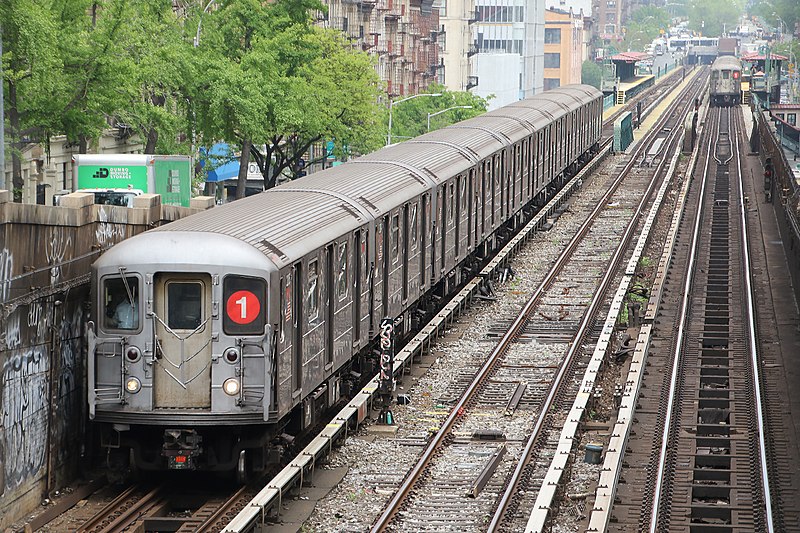
MTA NYC Subway 1 trains at 125th St., 14 May, 2018.
Photo by Mtattrain via Wikimedia Commons.

Sit‐​down restaurants and bars have been shut down. Public officials are discouraging or even forbidding people from doing “unnecessary travel,” even if it is to visit a second home where they might be able to socially distance themselves better than in their first, more urban home. All sorts of other rules are being passed, all supposedly for our own good.

So why are urban transit systems still running? A 2018 study found that “mass transportation systems offer an effective way of accelerating the spread of infectious diseases.” A 2011 study found that people who use mass transit were nearly six times more likely to have acute respiratory infections than those who don’t. Not surprisingly, a study published a few days ago found that New York City subways were “a major disseminator — if not the principal transmission vehicle — of coronavirus infection.”

Transit agencies say they are helping “essential workers” go about their business. But if they are so essential, isn’t it important to find them a safe way of getting to work? If we truly cared about people’s safety, then transit services should have shut down at the same time we closed other non‐​essential businesses and asked people to stay at home.

[…]

Unfortunately, the transit lobby has successfully turned government‐​subsidized transit into a sacred cow. Transit is supposedly greener than driving when in fact it’s an energy hog. Transit is supposedly needed to help poor people get to work when in fact the people most likely to commute by transit are those earning more than $75,000 a year.

When the pandemic took away most of transit’s customers, instead of shutting down, which would have been the responsible thing to do, transit agencies demanded that Congress give them $25 billion, tripling federal support to transit this year. Thanks to transit’s sacred cow status, Congress agreed without any serious debate.

Effectively, Congress rewarded the agencies for spreading disease. It would have been better to use that money to help transit‐​dependent essential workers buy a car so they could have a safe way of getting to work.

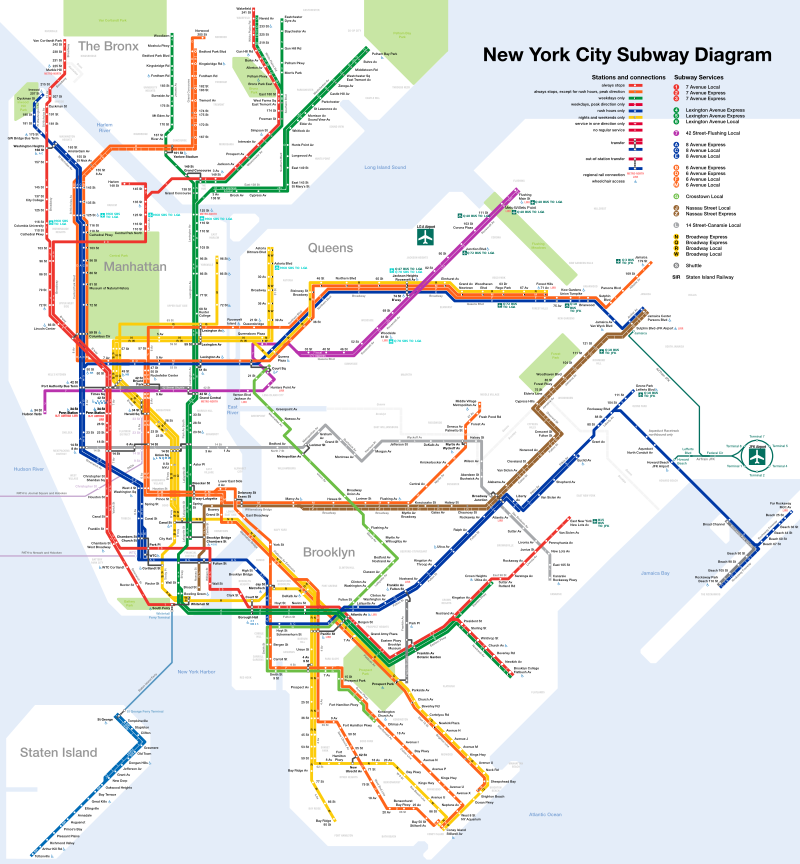
New York City subway system.
Image by Jake Berman (maps.complutense.org) based on information from the MTA, via Wikimedia Commons.

April 18, 2020

Chairman Xi, the Wuhan Coronavirus, and the “Mandate of Heaven”

Filed under: China, Government, Health, Politics — Tags: , , , — Nicholas @ 03:00

David Warren:

It is a little-known fact that no government can do anything, without the cooperation of its victims. Of course that cooperation may be obtained by force and falsehood, but there will always be a few people who won’t play along. This creates a “technical problem” for the tyrant, which can also be solved by violence and deceit, but in the heart of every dictatorship there must be calculations. At what point do so many people want us dead, that they will actually kill us?

This is a political calculation, and it can turn even a genocidal maniac into a thoughtful politician. A monstrously evil country, such as Red China, can be moderated in this way. Superficially, it may sometimes come to resemble a bourgeois, Westernized, rule-of-law state, like Japan, Taiwan, South Korea. It may, indeed must in its own interest, pretend to be benign. But under sufficient pressure it has only two choices. One is to be openly monstrous, with all the risks that entails; and the other is to disintegrate.

My interest has been piqued as a China-watcher. Recent events have been bringing that kettle back to the boil. That the Peking politburo has been making serious mistakes, we may observe. It could not possibly have intended the Batflu crisis, which its own malign incompetence brought about. But as it tries to manage the crisis, for its own purposes, the mistakes multiply. Even the people it had diligently bought — such as our progressive journalists, politicians, and businessmen — are turning against it.

Within China itself, the unthinking default loyalty of the masses, has been disturbed. “Narratives” which conflict with the official ones are circulating, along with the virus — and even among those who “test negative,” as it were. These are people who would never rebel, but they become sympathetic to rebels. Moreover, the state’s image of invincibility — the Mao/Xi portrait, a hundred feet tall — is cracking. Imagined lines of contempt appear in the plaster. Chairman Mao, of course, is dead, but Chairman Xi must be sensing his mortality.

As the Soviet Union was collapsing from within, progressive Westerners tried to ignore it. This wasn’t something they wanted to look at, which is why they were all taken by surprise. The fall of the Berlin Wall inwardly distressed everyone on the Left. For a few years their confidence was shaken, slowing their efforts to regroup around “environmentalism,” or some alternative leftwing cause, that wasn’t in shambles like socialism. But eventually their smugness recovered, and those revealed to have been absolutely wrong about everything they had ever told us, were able to resume their status as “experts.”

From Wikipedia‘s entry on the Mandate of Heaven:

The Mandate of Heaven (Chinese: 天命; pinyin: Tiānmìng; Wade–Giles: T’ien-ming, literally “Heaven’s will”) is a Chinese political and religious teaching used since ancient times to justify the rule of the King or Emperor of China. According to this belief, Heaven (天, Tian) — which embodies the natural order and will of the universe — bestows the mandate on a just ruler of China, the “Son of Heaven” of the “Celestial Empire”. If a ruler was overthrown, this was interpreted as an indication that the ruler was unworthy, and had lost the mandate. It was also a common belief that natural disasters such as famine and flood were divine retributions bearing signs of Heaven’s displeasure with the ruler, so there would often be revolts following major disasters as the people saw these calamities as signs that the Mandate of Heaven had been withdrawn.

[…] The Mandate of Heaven was often invoked by philosophers and scholars in China as a way to curtail the abuse of power by the ruler, in a system that had few other checks. Chinese historians interpreted a successful revolt as evidence that Heaven had withdrawn its mandate from the ruler. Throughout Chinese history, times of poverty and natural disasters were often taken as signs that heaven considered the incumbent ruler unjust and thus in need of replacement.

April 17, 2020

Chris Selley – “… if John Q. Bylaw is hassling you just for taking a walk, for heaven’s sake get your smart phone out and make a righteous stink”

Our proto-surveillance society is moving rapidly toward all-surveillance, all the time and the current justification is to fight the Wuhan Coronavirus epidemic:

For civil libertarians, these are alarming times — but less alarming than they might be. During a pandemic, when everyone agrees life cannot go on as normal, people who place maximum value on individual freedom are liable to look rather selfish. “Trust our leaders” types get a big boost.

But if Canadian officialdom has not botched its response to this crisis, neither has it excelled. Theresa Tam’s defenders are right that official advice will naturally change over the course of a pandemic — but nothing justifies her proactive downplaying of the COVID-19 risk at a time when several Canadian governments were, we now know, woefully unprepared. The pandemic doesn’t care that Prime Minister Justin Trudeau went to Harrington Lake, against advice from three governments including his own to stay away from any second homes — but it would have been so bloody easy for him not to go, to set an example. It’s equally inconsequential that Andrew Scheer added six more human beings than necessary to a government charter flight from Regina to Ottawa — and it would have been equally easy for him not to bring his family along.

Meanwhile, certain big Canadian cities have so obviously overstepped the mark, by cracking down on perfectly safe behaviours — walking in parks, notably — as to highlight the value of some don’t-tread-on-me pushback. An unscientific survey of social media suggests not a single real human being supports the City of Ottawa’s latest ridiculousness: Days after its bylaw officers threatened a father and son for kicking a ball around [noted here], fined a man $880 for walking his dog, and allegedly assaulted a man questioning his eviction from a park — none of which seems to be supported by the provincial emergency act they were ostensibly enforcing — a public health official now advises against exchanging properly distanced outdoor pleasantries with one’s neighbours lest it “turn into a parking lot or backyard party.” (Don’t laugh: Studio 54 was a cozy little jazz bar before Mick Jagger and Debbie Harry showed up one night with some records and a pound of blow.)

For civil libertarians who remember life before smart phones, meanwhile, the plan Google and Apple are working on to help governments control COVID-19 might as well be custom-designed to induce heebie-jeebies. The basic idea is that your phone’s operating system would reach out to other phones via Bluetooth and record the date, time, duration and location of the meeting. No personal information need be attached to those data points, just the identity of the device. When someone reports a COVID-19 diagnosis on an app, using a code provided by their public health department, devices that had been nearby would receive a warning that their owners might have been exposed, and should take such measures as local authorities advise.

It could be the stuff of dystopian sci-fi. You can just see the guy with the giant translucent computer screen shouting “magnify! Enhance!” Really, though, this comes down to a simple question: Whom do you least distrust? A co-production between Google, which is not at all known for respecting users’ privacy, and Apple, which at least seems to make an effort? Or governments?

April 16, 2020

Canada’s temporary foreign workers

Filed under: Business, Cancon, Economics, Government, Health — Tags: , , , , — Nicholas @ 03:00

Chris Selley points out some of the weirdness of Canada’s claimed dependence on temporary foreign workers because “Canadians still need to eat.”:

Temporary foreign workers picking fruit in a Canadian orchard.
Image from http://www.yorkfeed.com/apple-picking-urgently-canada/

If all goes as it should at Canada’s airports, temporary foreign workers will be informed of their responsibilities. They should be made aware of their employers’ responsibilities as well. And there’s no particular epidemiological reason to worry about them more than anyone else landing on a Canadian runway from abroad — or domestically, for that matter. The vast majority of temporary foreign workers are from Mexico, Jamaica or Guatemala, which have reported 39, 25 and nine COVID-19 cases per million residents. Canada’s tally works out to 713 per million.

But the official advice to employers provides little comfort. It doesn’t prohibit putting people up in shared accommodations; it merely says residents must be able to keep two metres from each other at all times. We know the limitations of such measures from experience in seniors’ homes and homeless shelters. It’s not necessarily “the state’s duty” to quarantine arriving temporary foreign workers, as Bloc Québécois leader Yves-François Blanchet argued this week. But the state could certainly do far more than it is.

For one thing, the cities in which workers typically first arrive are much better suited to proper self-isolation — i.e., in a hotel or motel room — compared to the farm country they are eventually headed for. Sourcing 45,000 hotel rooms is a huge job even in cities — that’s roughly how many rooms there are in the entire Greater Toronto Area — but it will never be easier than right now. It would prevent any bad-actor employers from breaking the rules. It would be much more reassuring than a government cheque for what works out to less than $80 per worker per day of isolation.

The whole situation is completely bizarre, though — one of several longstanding, bizarre and sometimes embarrassing Canadian situations that COVID-19 has highlighted. Economically speaking, the idea of temporary foreign workers essentially amounts to cheating. It reaches peak absurdity when businesses like Tim Hortons outlets claim to need them — that is, when they’re being brought in to do work that Canadians are demonstrably willing to do. It’s just a skeevy way to artificially depress wages and the price of fast food. People seemed to sense that back in 2014, when the government tightened the rules.

In agriculture, however, the idea seems thoroughly entrenched. Perhaps it’s a case of out of sight, out of mind. But it’s the same absurdity: If you can identify a group of 45,000 people without whose labour we literally wouldn’t be able to feed ourselves — or so we are told — then on what possible grounds are we denying them a path to Canadian citizenship? In 2017, the Toronto Star profiled a 66-year-old Saint Lucian man who had busted his hump on Canadian farms for 37 years in a row, with his paycheques deducted for income tax, EI and CPP, but who had no claim to stay. The highly skilled and educated immigrants we compete to attract bring many important things to Canada’s table; they don’t bring anything more important than food. And food is something COVID-19 has very much taught us not to take for granted. Who would have thought supermarket checkout clerks would achieve hero status?

« Newer PostsOlder Posts »

Powered by WordPress