
World War Two
Published 7 Jan 2023That’s what the headlines say as the Red Army continues its advance in Ukraine. There are also plans afoot for a northern offensive to end the siege of Leningrad. There are also plans afoot for an Allied amphibious attack in Italy at Anzio. Both of these are set to go off within a couple weeks, so January promises to be full of active conflict.
(more…)
January 8, 2023
“Russians 27 miles from Poland!” – Ep 228 – January 7, 1944
Comments Off on “Russians 27 miles from Poland!” – Ep 228 – January 7, 1944
January 1, 2023
Canadians Take Little Stalingrad – WW2 – 227 – December 31, 1943
World War Two
Published 31 Dec 20221943 reaches its end with no end in sight for the war. In Italy, the Canadians take Ortona after bloody close fighting, the US Marines advance on New Britain, and a new Soviet offensive makes huge gains in the USSR. This isn’t enough for the Allies, though, who have a big shake up in their European Command to help prepare for future attacks.
(more…)
Comments Off on Canadians Take Little Stalingrad – WW2 – 227 – December 31, 1943
December 25, 2022
Stalin’s Christmas Surprise – Major Offensives to Come – WW2 – 226 – December 24, 1943
World War Two
Published 24 Dec 2022Twas the night before Christmas and the war was grinding on. The Moro River Campaign continues in Italy with Canadian infantry pushing past the Gully and into “Little Stalingrad”. Generally, the Allied advance to Rome is turning into a stalemate though, but Winston Churchill still believes an amphibious landing is the way to break this. Joseph Stalin also has some pretty big plans to bring the USSR back to its pre-Barbarossa borders. In the Pacific, there is attrition over Rabaul and stalemate on Bougainville.
(more…)
Comments Off on Stalin’s Christmas Surprise – Major Offensives to Come – WW2 – 226 – December 24, 1943
December 23, 2022
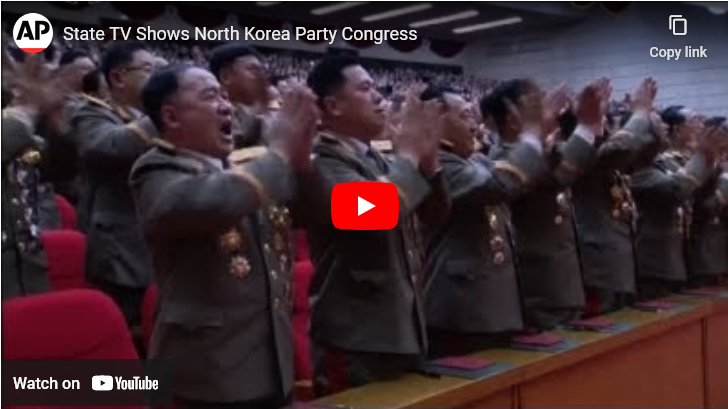
Never, ever be the first to stop clapping
Chris Bray on the echoes of Soviet-era mandatory celebrations expected of US elected politicians during a speech by Comrade Stalin to the Politburo state visit by the President of Ukraine:
I hesitate to say any of this, because it’s December 22 and none of us should be thinking about the grotesqueries of the political and media classes, but it’s been a busy week for them. I started writing here a little more than a year ago, and have argued since the beginning that our notional leadership classes have developed a set of ritual behaviors that are entirely severed from any form of reality you’ll ever see in your own daily life. (Dana Loesch: “You can’t run a country you’ve never been to.”)
And so here’s one of the least subtle court eunuchs with a message about ritual obedience:
I wish I could replicate the awkward burst of nervous laughter that came out of me at the moment that I saw this message. The policing of performative applause in a formal political setting is so obviously a theme of totalitarian societies that … well, that Chief Eunuch Michael Beschloss can be counted on to not notice what he’s just done. I didn’t get a harumph outta that guy, he said, from deep inside a cloud of obtuse self-regard.
“They insist on inflicting on us such bloated theater & they seem not to know how false it all appears.” The Ukrainian president made it all the way to the Capitol in his combat fatigues, doncha know, and was greeted with a rapturous standing ovation by members of Congress, seen here in this actual footage:
Are there any normal human beings who don’t taste bile when they see this performance? And, Thomas Massie and Rand Paul aside, are there any normal human beings left inside the Beltway?
“Squee! Squee! Squee!” they explained, shaking their pom poms in a dignified ritual of state.


Comments Off on Never, ever be the first to stop clapping
December 22, 2022
It may have taken most of the year, but Canada finally figured out its Ukraine position
In The Line, Andrew Potter theorizes that the Canadian government finally “got it right” on Ukraine, but only after having exhausted all the other possibilities:
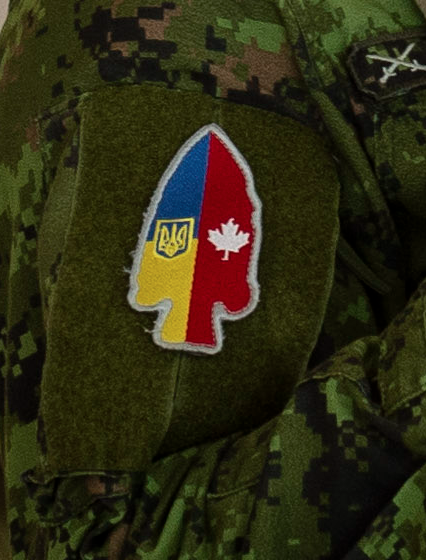
Operation Unifier shoulder patch for Canadian troops in Ukraine.
Detail from a photo in the Operation Unifier image gallery.
When Russia started massing troops on the border in Ukraine this time last year, Canada was one of the first Western countries to close its embassy in Kyiv, moving everyone to Lviv on February 12. Hours after Russia launched its illegal, insane, nihilistic, genocidal full invasion of Ukraine on February 24, all non-Ukrainian employees of our embassy scooted across the border into Poland.
For months after the invasion, that highly risk-averse attitude infected every aspect of Canada’s approach to helping Ukraine. Whether it was diplomacy (hesitant), military aid (slow and limited), financial support (inadequate) or straight-up moral fortitude (lacking), the Trudeau government made it clear that it would do the least amount necessary, while taking the most credit possible, in supporting Ukraine.
[…]
The weird thing about Canada’s foot-draggy-as-she-goes approach to helping Ukraine is how little sense it made politically, for both domestic and international audiences. Canada has one of the largest Ukrainian diaspora populations in the world. We were the first Western country to recognize Ukrainian independence in 1991. The deputy prime minister of Canada is half Ukrainian and has been a loud supporter of the country for years. Privately and publicly, our allies were pleading for us to do more.
Who knows what it was that finally shook some sense into the Trudeau government. Maybe it was Freeland, maybe it was a call from Uncle Joe Biden, maybe it was just a sense in the PMO that, having exhausted all other options, the only thing left to do was the right thing. Whatever it was, over the last three or four months, Canada is finally punching its weight on the global stage on the Ukraine file. In particular, we seem to have finally figured out that the best way to help is to provide the sorts of support that draws on our strengths.
So for example, while the handful of M777 howitzers we sent were certainly useful (and the ammunition we’re continuing to supply will be well spent) we’re never going to compete with the Americans or Brits when it comes to heavy arms supplies. That’s why, back in October, it was probably more helpful for us to send 400,000 pieces of winter gear and to provide a few million dollars worth of satellite communications to the Ukrainians through Telesat. And it was great to see Canada re-engage with its training commitments to the Ukrainian armed forces through the deployment of 40 combat engineers to train Ukrainian sappers in Poland, to complement our ongoing training of recruits in the U.K.
Comments Off on It may have taken most of the year, but Canada finally figured out its Ukraine position
December 11, 2022
An Amphibious Landing to take Rome? – 224 – December 10, 1943
World War Two
Published 10 Dec 2022There are plans afoot to hit the enemy from behind in Italy. Allied leaders are meeting again in Cairo to go over other plans, notably what to do about China and Burma. There is active fighting on two fronts in Italy too, though this week it doesn’t go particularly well for the Allies. Attacks in the USSR are unsuccessful for the Soviets, but do go well for the Germans, and there are Allied attacks by air in the Marshall Islands and over France.
(more…)
Comments Off on An Amphibious Landing to take Rome? – 224 – December 10, 1943
December 4, 2022
Operation Overlord Confirmed at Teheran – WW2 – 223 – December 3, 1943
World War Two
Published 3 Dec 2022The Teheran Conference is in full swing and the Allied leadership and plan for a cross channel invasion of Europe is agreed upon by Stalin, Churchill, and Roosevelt. There are new Allied attacks across Italy, but at Bari a German air raid releases deadly poison gas.
(more…)
Comments Off on Operation Overlord Confirmed at Teheran – WW2 – 223 – December 3, 1943
December 1, 2022
Crisis? Which crisis?
In The Line, Matt Gurney makes the case that was NATO (and western governments in general) needs is something called “deliverology”:
I couldn’t have asked for a more topical example of exactly what I’m talking about here: the lull between realization and reaction. There were no problems with “expectations” at the top of the federal government in February [during the Freedom Convoy 2022 protests]. Everyone in a position of authority was seized with the urgency of the situation and the need for rapid action. There wasn’t any denial, doubt or incomprehension, which are the usual enemies when I write about our expectations being a problem.
February was an example of a different issue: realizing there was a crisis but not really knowing what to do about it, or whose job it was to do it, and wasting a lot of precious time trying to figure it all out. When days and even hours count, governments can’t spend weeks or months figuring out what to do. But that’s what happened during the convoys, and during COVID, and other incidents I could rattle off. Does anyone think it won’t happen again next time, whatever that threat may be?
And some version of that concern came up over and over in Halifax [at the Halifax International Security Forum]. And not just among Canadians. The world is changing very quickly and even when we recognize a problem, we aren’t moving fast enough to keep up. So on top of our expectations, we’ve got another challenge: response times. They’re just too damned long.
I hope the readers will forgive me for being a little vague in this next section; some of the conversations I’m thinking of here were in off-the-record sessions. Rather than trying to splice together any specific quote or anecdote, I’ll just wrap it all up under the theme of “There are things we should be doing now that we weren’t, and things we should have been doing a long time ago that we only started on way too late.”
An obvious example? The rush to get Europe off of Russian fossil fuels and on to either locally generated renewables or energy imports from allies and friendly nations. (If only there was a “business case” for Canada doing more. Sigh.) Another fascinating example that came up was air defences. Two decades of post-Cold-War-style thinking among the allies has led to widespread neglect among the NATO countries of air-defence weapons. Why bother? The Taliban didn’t have an air force, right?
Most countries have fighter jets and inventories of air-to-air missiles suitable for their planes. However, across the alliance, there are very few ground-based air-defence systems suited to shooting down not just attacking aircraft, but incoming cruise missiles and drones.
Drones pose a particular challenge. They fly slow and low and are highly manoeuvrable, plus they are so cheap that they can be a true asymmetrical weapon: you’ll go broke real quick firing million-dollar missiles at a drone that costs your enemy $50,000 or so. And your enemy may send a few hundred at once in a swarm that simply overwhelms your defences. It’s not that drones are unbeatable. The opposite is true: drones are easily destroyed, if you have the right defences available.
We don’t, though. Oops.
The NATO powers actually had a preview of this element of the ongoing war between Ukraine and Russia during the 2020 conflict between Azerbaijan and Armenia, where drones were used to devastating effect. Every military affairs watcher I know sat up a bit straighter after watching what the Azeris did to Armenia, with shocking speed. Swarms of drones first killed Armenia’s air defences and then went to work on Armenian ground forces. The U.S. and NATO allies have been studying that conflict, and considering how to adapt our own strategies, for both offence and defence. But right now, nine months into the Ukraine war and two years after the conflict in the Caucasus, there still aren’t enough NATO systems available even for our own needs, let alone to share with Ukraine. Russia keeps hammering away at critical Ukrainian civilian infrastructure and the Ukrainians keep begging for help, but we have nothing to send. To be clear, a few systems have been sent to Ukraine, which include not just the weapons but the radars and computers necessary to detect and engage targets. But they can only be delivered as fast as they can be built. There is no real production pipeline here, and certainly no pre-stocked inventories in NATO armouries.
Comments Off on Crisis? Which crisis?
November 29, 2022
Near Peer: Russia
Army University Press
Published 25 Nov 2022AUP’s Near Peer film series continues with a timely discussion of Russia and its military. Subject matter experts discuss Russian history, current affairs, and military doctrine. Putin’s declarations, advances in military technology, and Russia’s remembrance of the Great Patriotic War are also addressed. “Near Peer: Russia” is the second film in a four-part series exploring America’s global competitors.
Comments Off on Near Peer: Russia
November 27, 2022
The Costliest Day in US Marine History – WW2 – 222 – November 26, 1943
World War Two
Published 26 Nov 2022The Americans attack the Gilbert Islands this week, and though they successfully take Tarawa and Makin Atolls, it is VERY costly in lives, and show that the Japanese are not going to be defeated easily. They also have a naval battle in the Solomons. Fighting continues in the Soviet Union and Italy, and an Allied conference takes place in Cairo, a prelude for a major one in Teheran next week.
(more…)
Comments Off on The Costliest Day in US Marine History – WW2 – 222 – November 26, 1943
November 24, 2022
Pavlov’s House, codenamed “Lighthouse” in Stalingrad
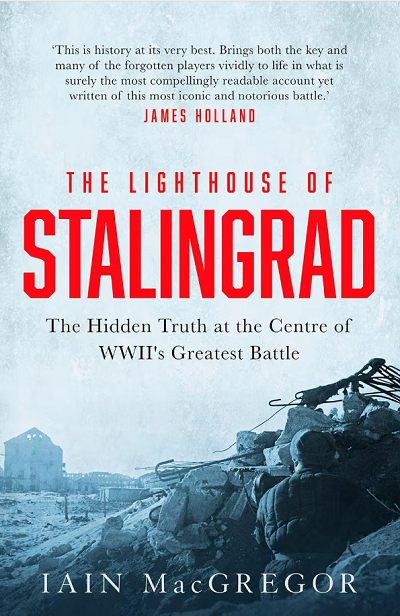
In The Critic, Jonathan Boff reviews The Lighthouse of Stalingrad: The Hidden Truth at the Centre of WWII’s Greatest Battle by Iain MacGregor:
In the summer of 1942, with the German army deep inside the Soviet Union, Adolf Hitler launched Operation Blue, an attack from around Kharkiv in south-east Ukraine across hundreds of miles of steppe towards the oil fields of the Caucasus. Part of the plan required the German Sixth Army under General Paulus to secure the flank by seizing the industrial city of Stalingrad on the banks of the Volga.
By the middle of September Paulus’s troops were fighting their way, street by street, building by building, and sometimes room by room, through a city reduced to ruins by artillery shelling and the bombs of the Luftwaffe. The fighting was ferocious. Although by November most of Stalingrad was in German hands, several pockets of resistance still held out. Meanwhile, the Red Army was secretly massing for a counter-attack in the open terrain on either side of the city.
On 19 November 1942, General Zhukov unleashed a giant pincer attack which quickly overran the Romanian, Hungarian and Italian forces protecting Paulus’s flanks. Within days the German Sixth Army found itself trapped in a giant pocket, cut off from the rest of the German army. Here, in the depths of a Russian winter, nearly 300,000 surrounded men tried to hold out as their supplies of food, fuel, ammunition and medicine dwindled away.
By the end of January 1943, all hope of relief was gone. To Hitler’s disgust, Paulus ordered the remnants of his army to lay down their weapons. Of the 91,000 German soldiers sent into captivity in Siberia, only 5,000 would survive to ever see their homes again. Immense and terrible as the battle was — we will never know exactly how many troops took part, nor how many died, but it is probable that the total of dead, wounded and captured on both sides reached two million — Stalingrad was not the biggest battle of the war, nor even the bloodiest. Nonetheless, it remains, alongside Dunkirk and D-Day, among the touchstones of the Second World War, largely because it encapsulates three linked but distinct stories. Iain MacGregor does a fine job of covering each in his rich study.
First, Stalingrad was one of the most important battles of the war. It marked the high-water mark of the Nazi invasion of the USSR and an end to Hitler’s genocidal dreams of destroying the Soviet Union. Before Stalingrad, and the other crushing defeats the Axis suffered at around the same time in Tunisia and the Solomon Islands, the initiative had always lain with Germany and Japan. Afterwards, the Allies decided where, when and how the war would be fought.
MacGregor establishes this context neatly. He explains with just the right amount of detail why Operation Blue was launched and what it hoped to achieve. He offers a clear discussion of the decisions taken, and mistakes made, on both sides; and he hints at the logistical weaknesses that probably damned the Germans to disappointment from the start.
The strongest point of this book, however, is its description of the street-fighting in the heart of the city around a building known as “Pavlov’s House” (codename Lighthouse: hence the title of the book). Here the German 71st and Soviet 13th Guards rifle divisions fought for months. By focusing on this small area and these two formations, MacGregor is able to dig deep enough into the tactical detail to give us a clear sense of the difficulty, violence and terror of urban warfare, without swamping us with repetitive detail. His descriptions of fighting have a cinematic quality, swooping smoothly from panoramic tracking shots of the initial German charge down towards the waters of the Volga into close-ups of bullet-riddled mannequins fought over in the ruins of a department store.
Comments Off on Pavlov’s House, codenamed “Lighthouse” in Stalingrad
November 23, 2022
“What we’re witnessing is, in short, the least expensive generational kneecapping of a geopolitical rival in world history”
Stephen Green on the still ongoing Russo-Ukraine war:
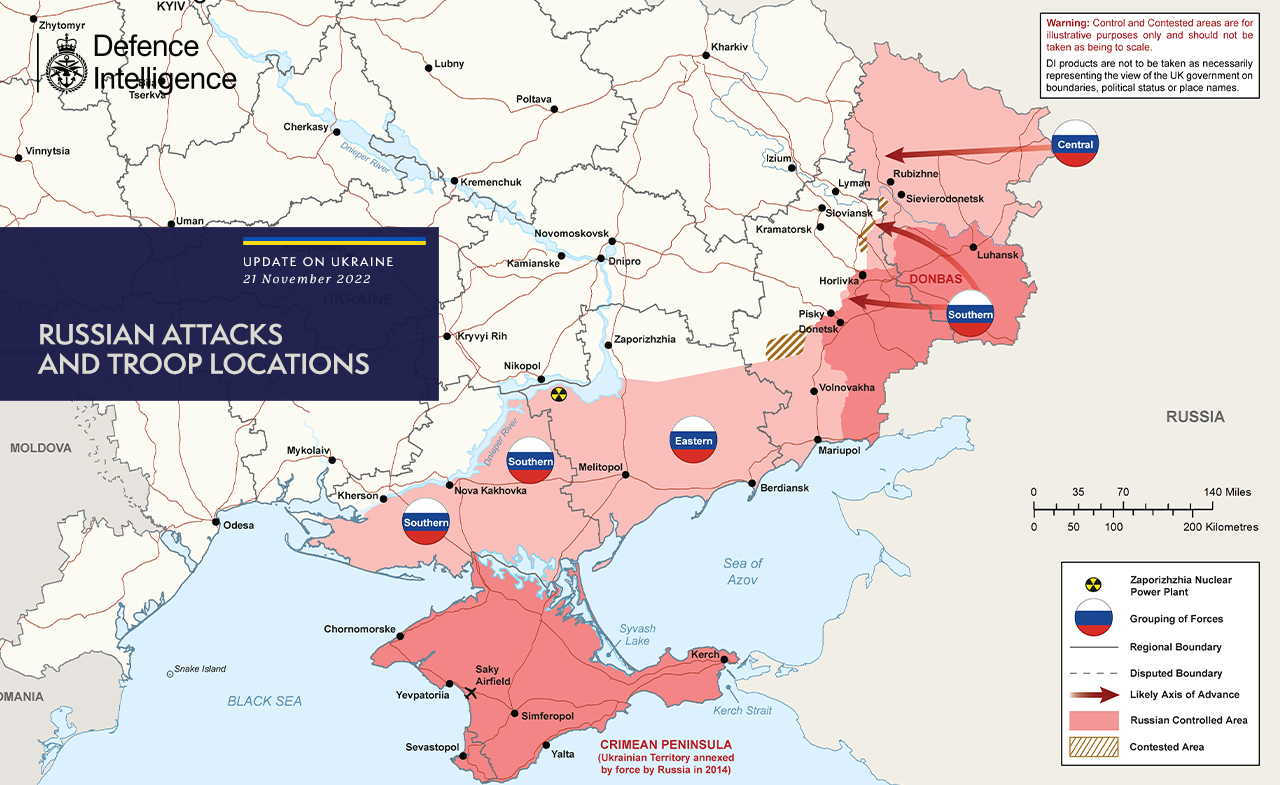
Here’s a hard truth our friends in Kyiv need to remember: Lying isn’t helpful. There are limits to our tolerance.
Here’s another: You’re going to have to make some compromises to end this war because your total victory isn’t in America’s interest here; punishing aggression is. When we decide that Russia has suffered enough, you might find yourselves on your own. Come to the table and negotiate accordingly.
Here is a hard truth for conservative Americans — there are fewer of them than you’d assume from reading Twitter or internet comments sections — opposed to us aiding Ukraine for domestic reasons.
There is no doubt in my mind that much of Ukraine remains what it was: A financial playground for America’s rich elites, and that they have done nothing but increase their ill-gotten gains thanks to our part in keeping Ukraine in the fight. But that’s just one of the many prices we pay for letting our civic structures become so rotten.
The hard truth is, enriching a few corruptocrats is still cheap compared to a continent-wide war in Europe — which is exactly what we risked had we let the Russians march right through.
Here’s a hard truth for my Russian friends and their supporters: The point where Putin & Co. had hoped to aggrandize their country or themselves has long passed. It’s time to ask for a ceasefire and come to the negotiating table.
They know this already, of course, except for the most deluded of true believers. The trick is constructing Sun Tzu’s golden bridge for them to retreat across.
The hard truth I must always keep in mind is that Western leadership, particularly our own, is not up to Sun Tzu’s task.
There is another hard truth that Moscow must come to grips with: Putin threw the dice on an expansionary war but shrank his country’s standing instead.
Russia spent more than a decade modernizing its military. It is becoming increasingly de-modernized with every day of fighting in Ukraine. Destroyed T-80 and T-90 tanks — the most modern in Moscow’s inventory — are being replaced by T-62s that were obsolete 50 years ago. Soldiers in their 20s, casualties of war, are being replaced by ill-trained “mobiks” in their 30s, 40s, and even 50s.
It will take far longer than a decade to replace what Putin has wasted.
The way this war has squandered Russian resources, finances, and demographics has serious geopolitical implications. For a few tens of billions of dollars — admittedly, some of them squandered — our Number Two geopolitical rival has had the heart cut out of its conventional military forces, all without spilling the blood of a single American soldier.
Comments Off on “What we’re witnessing is, in short, the least expensive generational kneecapping of a geopolitical rival in world history”
November 20, 2022
A Conspiracy to kill America’s President? – WW2 – 221 – November 19, 1943
World War Two
Published 19 Nov 2022A torpedo attack against the President; a Marine invasion in the central Pacific that turns very bloody in a hurry; German counterattacks in the Soviet Union; a bombing raid in Italy against a secret weapons site — all of that this week.
(more…)
Comments Off on A Conspiracy to kill America’s President? – WW2 – 221 – November 19, 1943
Cold War echoes on the Polish-Ukrainian border
In The Line, what Matt Gurney calls a “surprise fire drill” for a potential nuclear war:
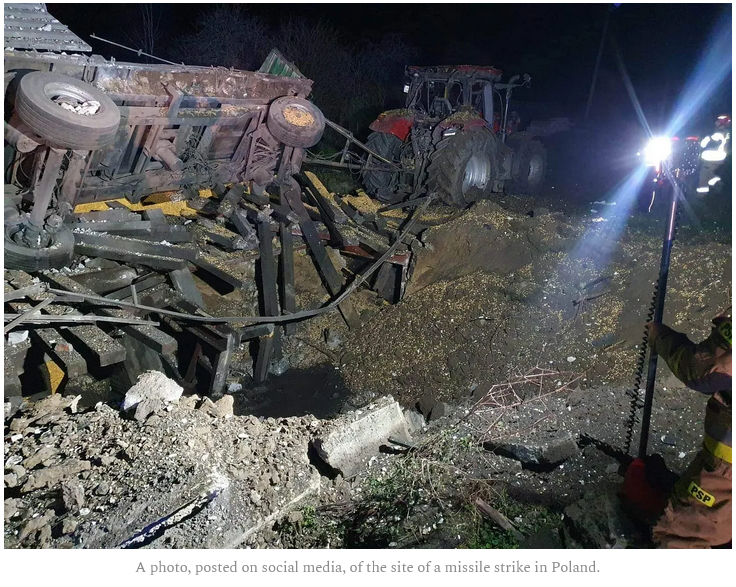
Those with any memory of the Cold War probably got a bit of a cardio workout even if they were sitting still earlier this week when Polish news sources, which were quickly matched by American ones, reported that a Russian missile had landed in Poland, killing two civilians. An armed attack by Russia, in other words, on a NATO member state, even if a likely accidental one — Russia was bombing targets in Ukraine at the time and the site of the Polish blast was quite near the border with its embattled neighbour.
Still. Oops.
It didn’t take long before doubt emerged. At present, the official theory offered by Poland and accepted by NATO is that the missile that killed the two unfortunate Poles was actually a Ukrainian air-defence missile that was fired at incoming Russian missiles in self-defence. It somehow malfunctioned and landed in Poland. The Ukrainians themselves seem unconvinced and there are certainly those wondering if a wayward Ukrainian missile is a cover story to de-escalate a Russian mistake. Personally, I’d guess no. It probably was a Ukrainian missile. And if it is all a cover story in the cause of keeping tension between Moscow and the West at a low-sweat stage, I can live with that, for now.
The point isn’t for me to pretend I’m a munitions expert, capable of instantly solving the case with only the briefest glance at photos of a fragment of twisted missile debris. It’s more to consider what this event felt like, and what it easily could have been: one of the scarier scenarios Western officials and analysts have been worried since this war began nine months ago — accident kicking off a conflict neither side wanted but neither will back down from once it’s begun.
This isn’t a new fear. It was a fear during the Cold War. And a justified one. At several points during that long standoff, technical malfunctions or political miscalculations raised the danger of a nuclear war to horrifying levels. On a few occasions American defense commanders wrongly believed that the Soviets were launching an attack; luckily for everyone, the Americans had redundancies and were well trained and cooler heads always prevailed. In 1983, Soviet satellites reported the Americans were firing ballistic missiles at the Soviet Union. Tensions were high at the time and the Soviets had decided to launch a full strike on the West as soon as any NATO launches were detected. But Lieutenant Colonel Stanislav Petrov, a relatively low-ranked Soviet officer working the night shift, concluded that the warnings were probably a glitch — it didn’t make sense to him that America would open a surprise attack with a handful of missiles instead of the full arsenal. Rather than pass on a warning that would have triggered Soviet launches against NATO, he reported that the launch detections were a technical malfunction in the Soviet equipment. He did that again when further launches were detected. Lt. Col. Petrov then spent a few long and anxious minutes waiting to see if any NATO nuclear weapons exploded over targets in the Soviet Union. Waiting to see what happened was the only way the colonel could know if he’d made the right call, or a very, very bad one.
He was right, of course. It was a glitch. New Soviet satellites were being tricked by sunlight bouncing off clouds at high altitude. But for a few minutes, the fate of the world hung on one mid-ranked Soviet officer’s middle-of-the-night judgment call.
These real-life examples are horrifying. But learning of them never hit me quite as hard as the fictional scenario portrayed in the 1962 film Fail-Safe. Released around the same time as the more famous Doctor Strangelove, Fail-Safe, adapted from the novel Red Alert, was a grimly serious counterpart to Kubrick’s dark comedy. With an all-star cast that includes Walter Matthau and Henry Fonda, Fail-Safe depicts a series of small accidents that result in a group of American bomber pilots concluding that they have been ordered to conduct a retaliatory strike on the Soviet Union. There is no war. It’s entirely a misunderstanding, a fluke of American technological glitches and Soviet jamming. But the American pilots, trained to expect Soviet tricks and lies and to accept no order to abort (as such an order could be faked) relentlessly bore in on their targets, truly believing that they are avenging a Soviet strike on America.
Comments Off on Cold War echoes on the Polish-Ukrainian border
November 13, 2022
Kiev Liberated! Celebrations in Moscow! – WW2 – 220 – November 12, 1943
World War Two
Published 12 Nov 2022The Red Army has driven the Axis forces out of Kiev, the third largest city in the USSR. The Allies are also advancing, albeit slowly and at great cost, in Italy, but in the South Pacific, they launch a massive air strike against Rabaul … and what is the result?
(more…)
Comments Off on Kiev Liberated! Celebrations in Moscow! – WW2 – 220 – November 12, 1943


