
World War Two
Published 16 Mar 2023Across Europe, non-Germans are filling the ranks of Heinrich Himmler’s forces. These foreign fighters certainly don’t meet the racial standards of the SS but times are tough and the Reichsführer-SS needs warm bodies. So, does that mean Himmler’s given up on the idea of a Germanic master race? Not at all. And he uses all sorts of twisted esoteric logic to justify his latest moves.
(more…)
March 17, 2023
Ukrainian, Yugoslav and Baltic Nazis? – ϟϟ Foreign Fighters Part 2
Comments Off on Ukrainian, Yugoslav and Baltic Nazis? – ϟϟ Foreign Fighters Part 2
March 13, 2023
People in high places like “Pryam Farll”
Elizabeth Nickson on the kakistocratic “elites” of the west and the dangerous policies they’ve been pushing:

How our leaders are seen by the people, their prey.
Around early Trump, a character calling himself Pryam Farll acquired a host of “friends” on Facebook among the most influential intellectual activist/writers on the right. He claimed to be a member of the Danish Royal Family, related to Prince Phillip, who spent Christmas at Sandringham, mentored Prince Harry and who read Putin’s email. He hated Putin with all his strength, claimed to be a General in US Intelligence, had worked in Reagan White House, and spent his time dropping into NATO, the EU, and Defence Departments in countries adjacent to Russia in the service of marshalling power against Putin, surrounding him with armies and bases and, as it turns out, bioweapons labs. He was also, tongue-in-cheek, “6’8″, devastatingly handsome and mind-blowingly rich”. He posted a dozen times a day, hilarious, way too bright, and substantive. Around the time that the first lie emerged about the Russia Hoax, which he claimed to have helped invent, he said he was in at the War Office in Romania, and to “start no trouble whilst he worked”.
Then he vanished.
And whether he was a genius kid in the basement or a mock-up by MI6 counter-intelligence meant to influence the influential, he serves as a type, the type that got us into this mess, where we are ghost-walking into nuclear conflict. The British since McKinder have had it out for the Russians and Russia-hate is baked into their intellectual class. Did the U.S. blow up Nordstream? Maybe, maybe not, but we very probably paid for it. More like MI6 and General Farll did the deed, and theirs is the ghastly world we now inhabit.
The early neo-cons promoted war as a way to get the “common” people “exhilarated and unified”. Get them off rock and roll, sex and shopping onto a spiritual crusade for “democracy”, they thought, demonstrating one of the aspects of this type: they didn’t have much fun in high school.
Iraq 1 and 2 were a result of this thinking. And now Ukraine. This crowd has spent almost a decade since Trump’s throwaway remark that maybe we should ally with Russia, stirring up hate. This entirely, entirely to cover for their thefts and crimes. And now they present us with another opportunity to be exhilarated and unified. Aren’t we just blessed?
If the Ukraine had signed and executed Minsk 2, we wouldn’t be in this mess. This was created by slender boy-men like Antony Blinken and little-girl-women like Samantha Power and Victoria Nuland, playing the Great Game without any notion of the actual effect of their ambitions on those they see as servile nothings, good for tax dollars like us, or foreign meatsuits to bomb to death. They have killed or wounded 500,000 Ukrainians in the last two years. Britain alone has issued 190,000 visas to terrified Ukrainians. Soros’s 2014 Color Revolution, where they installed a puppet over an actually elected Russian-friendly President, started the rush and ever since it’s all Pryam Farll angling for nuclear conflict.
[…]
Of course this is all centered around the intellectual fatuity of the Davos plan to enslave humanity in a technocratic prison because “climate change”. Russia under Putin is rapidly reclaiming its thousand year old culture, reintegrating the church, refusing the revolting ambi-sexual garbage of our culture. Davos couldn’t tolerate that. Plus Davos Man wants Russian resources, the vast wealth locked up in the steppes and Siberian wastes can power unimaginable wealth. So, they are willing to destroy the culture that created Tolstoy. No other literature approaches Russia’s in its prime, nor is there a more transcendent music. This is what Big Money and Davos want to bend to the west’s corrupt values? Imagine the arrogance it takes to decide to destroy a 1000 year old culture. And one that is nuclear-armed. And to do it with the bodies of Ukrainians.
They will spend eternity experiencing the pain of those families they ruined in service of their vanity. The sooner we get rid of them, the better.
Comments Off on People in high places like “Pryam Farll”
March 12, 2023
Zhukov hits the Ground Running – WW2 – Week 237 – March 11, 1944
World War Two
Published 11 Mar 2023The Soviets launch not one, not two, but three offensives in Ukraine this week, designed to destroy the entire southern wing of the German forces. The Japanese counterattack against the Americans on Bougainville finally begins after months of preparations, but there are more Japanese attacks elsewhere that get going: the operation to invade India.
(more…)
Comments Off on Zhukov hits the Ground Running – WW2 – Week 237 – March 11, 1944
February 26, 2023
Tojo Takes Control – Week 235 – February 25, 1944
World War Two
Published 25 Feb 2023Now that the Americans have seized the Marshall Islands, they can bypass the Japanese base at Truk. This impels Prime Minister Hideki Tojo to shake up both army and navy command, and he even takes personal control over the Japanese Army. On the Anzio Front, Lucian Truscott replaces John Lucas as Allied Commander. In the field, the Allies win a big victory in Burma, and in Ukraine, the Soviets are still on the move.
(more…)
Comments Off on Tojo Takes Control – Week 235 – February 25, 1944
February 25, 2023
One year into Vladimir Putin’s “Three-Day War”
Tsar Vlad launched his short, victorious war a full year ago, expecting to have the troops home by spring if not sooner. It hasn’t worked out to his timetable at all. Ukraine still stands, although it’s taken one hell of a battering in the process and drawn in more and more vocal support in the west, which has belatedly been followed by actual military supplies and equipment to replace those expended holding back the Russian forces. CDR Salamander follows up his predictions from last year on how things looked to him at that moment in time:
On the day the war started I made 7-points. Let’s review them and see how I did back on 24 FEB 22.
1. The remaining delusions about the post-Cold War security arrangements in Europe should be firmly buried. History is back and she has her Festivus pole front and center. She has some issues with us, and we’re going to hear about it.
This continues to get firmer and displayed in stark relief. All the “offsets” and “transformations” and “war is new” snake oil sold the last few decades really should not be allowed to have any public space besides to say, “I was wrong.” Rest assured, that won’t stop them — but the issues we raised over the almost 18-yrs of this blog and 14-yrs of the Midrats Podcast remain true. From the shallow magazines to the fact you never have enough large caliber guns to no war is short … we — and a lot of other people tut-tut’d for years — were correct.
2. NATO has a German problem. While all the “right people” will not shut up about how wonderful former Chancellor Angela Merkle was, people need to be very clear eyed about what a complete disaster she and the German political class have been over the last two decades. They have starved what should be continental European NATO’s most potent military into irrelevance. Her disastrous feel-good, ethno-masochistic immigration policy weakened European cohesion and fed the worst parts of European political subcultures. Yes, she made a lot of well meaning Germans feel good about themselves, but it was a sugar-high that rotted the teeth and poisoned the national metabolism. While willing to defend Europe to the last Pole and Germany to the last American, she decided to preen in her neo-pagan EuroGreen superiority onomastic politics by ditching clean nuclear power and through the complete corruption of her elite, shacked herself to Russian energy oligarchs and thus the Kremlin. Germany needs to fix herself, and NATO needs to work around her and punish her until she starts to behave like a constructive 21st Century security partner.
Germany has made great progress, but is being dragged kicking and screaming in to the 21st Century.
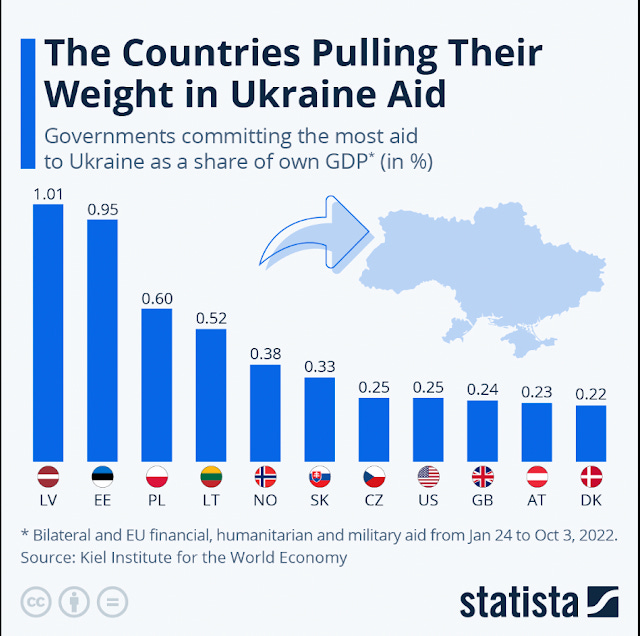
3. As our friend Jerry Hendrix pointed out yesterday, the moral leaders in NATO right now are the Baltic Republics and I would add Visegrad nations. You can throw Romania in there too. France will go hot and cold as she fights her desire to do the right thing for European security while at the same time nurse her 1,000 year old drive to be the premier leader of Western Europe. Serious but weaker nations will lean on a reluctant USA and limited United Kingdom … simply because — to be frank — much of the rest of the alliance is not that capable.
I think this graph tells that story well;
The front-line nations are putting their money where their existential threat is.
4. In line with #1 above, it is time for Finland at least, and probably Sweden, to join NATO. They both have a long and bloody history with the Russians and should see clearly what time it is.
Another check.
5. Ukraine waited too long to rearm. Weakened and distracted by a corrupt elite, the good parts of her nation could not get ready fast enough. After the first Russo-Ukraine war of 2014 she should have modeled the armed neutrality of Switzerland with a civilian populace trained and armed to the teeth. As we’ve discussed here before with the former Soviet republics and Warsaw Pact nations, every village needs a few ATGM militia teams trained to slow any advance through their patch of land. If Ukraine can, in whole or part, survive without vassalhood, perhaps they could get there. They can only get there if they build a nation people are willing to fight and die for.
Everyone is rediscovering the utility of a good military-industrial complex that can quickly grow to scale. Amazing what the green-eye-shade accounts forced those who actually are supposed to study war to believe.
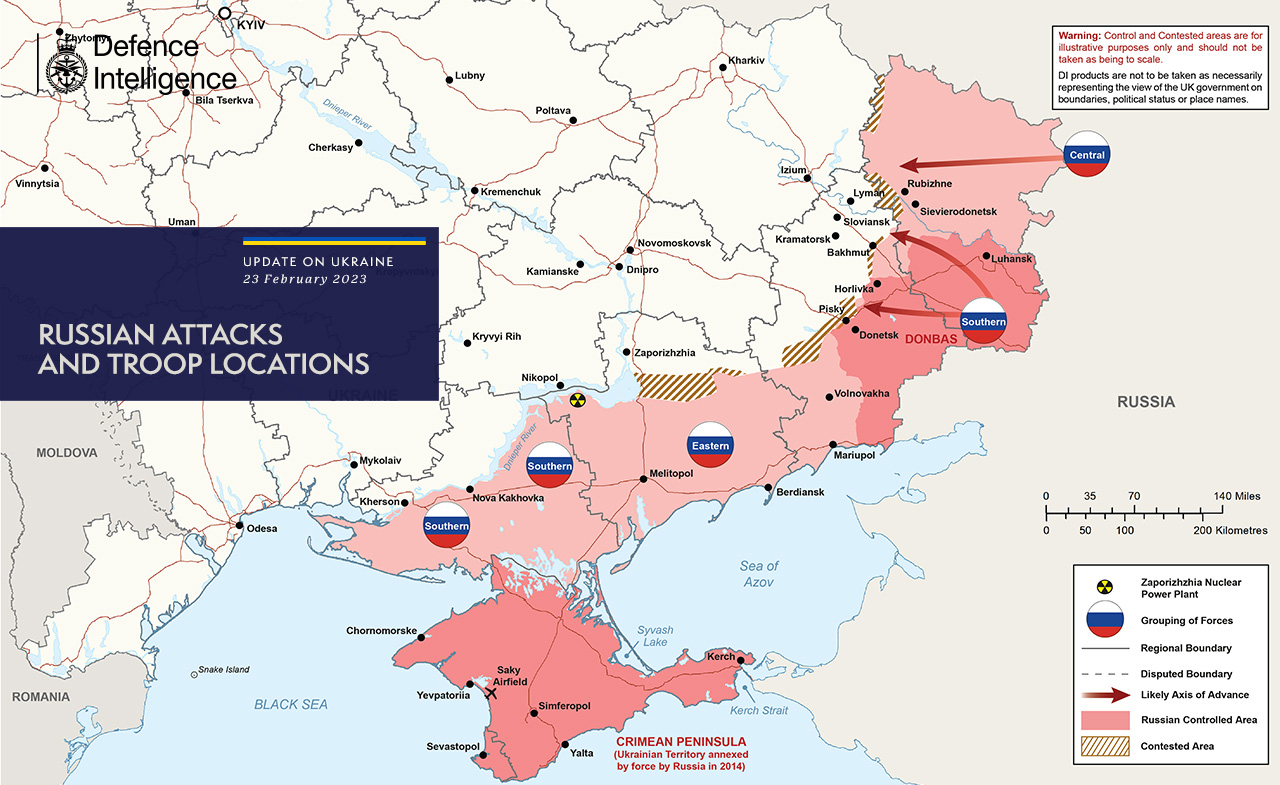
A few days ago, Dominic Sandbrook explained that the Ukraine-Russia conflict “is not complicated”:
A year ago, as Vladimir Putin launched his so-called “special military operation” to seize the Ukrainian capital, kill Volodymyr Zelenskyy and wipe much of the latter’s country from the map of Europe, who’d have imagined that the third week of February 2023 would begin with Joe Biden strolling around the streets of Kyiv in sunglasses? For that matter, who would have predicted that Mr Zelenskyy, only recently returned from his own trip to London, would be at his side — still the president of a free country, and still very much alive?
Sometimes it’s nice to be wrong. Like many, probably most Western observers, I held out little hope for Ukraine once the drums of war began to beat in earnest. A couple of days after Mr Putin’s brutal invasion began, I wrote a bullish essay looking back at Ukraine’s history of suffering and resilience. But even as I was agonising over my prose, the bleak news continued to pour in. “Now, while I have been writing, Russian tanks are rolling into the suburbs,” I wrote at one stage. Did I think they would be driven back? I didn’t. “Kyiv will rise again,” I wrote at the end. Stirring words, or so I hoped. But the person I was really trying to persuade was myself, and I didn’t succeed.
In truth, I underestimated the Ukrainian people’s resilience, their courage, their love of country. And I was wrong, too, about the Western alliance. After more than a decade of drift and inaction, from the shameful failure to respond to the seizure of Crimea to the near-criminal indifference to the suffering in Syria, I doubted whether any major Western leader would make more than a token protest about the first full-scale European invasion since the Forties. I never expected to see Finland and Sweden jump off the fence and apply for Nato membership. Nor did I imagine that Joe Biden would be so unswerving in his commitment, or so generous with US military aid. Above all, I never anticipated that Kyiv would hold out, that Kharkiv would stand or that Kherson would be retaken. As I say, it’s nice to be wrong.
It’s often said that the war in Ukraine feels like a throwback, returning us to an age when nationalistic strongmen nursed atavistic dreams of conquest, sending thousands of men to die so that they might scratch new frontiers into the soil of Europe. For all the drones and social media gimmicks, the fighting certainly feels old-fashioned: reading David Patrikarakos’s harrowing dispatch from the front line in Bakhmut, it’s impossible not to think of Passchendaele or Verdun. But for a child of the Seventies, perhaps the most old-fashioned thing of all is the spectacle of a genuinely clear-cut conflict, an unambiguous clash of right and wrong, that feels closer in spirit to the struggle against Hitler’s Germany than to most of the wars in my lifetime.
Andrew Sullivan is convinced that the war is just, but worries whether it is prudent — and he calls it not Ukraine’s but “the West’s defensive war against Russia”:
It is right and just to defend a sovereign country from attack by a much larger neighbor; to fight back against an occupying force committing war crimes on a massive scale; to oppose the logic of dictatorships and defend the foundations of democracy; to uphold a post-Cold War international order which forbids the redrawing of borders by force; to unite democratic countries in Europe against a resurgence of imperial Russia; to defang and defeat a poisonous chauvinism that despises modern freedoms for women and gay people.
It is indeed right and just. But is it prudent?
That’s the question I’m still grappling with, in a week which saw the conflict deepen and the two sides entrench their positions further. President Biden’s trip to Kyiv and his speech in Poland have heightened the stakes, turning this into a more obvious proxy war between the United States and Russia … edging gingerly but relentlessly toward something more direct.
He’s all in now: declaring that Ukraine “must triumph” and that Russia cannot win a war that the Russian leader deems existential. NATO armaments are pouring into Ukraine at an accelerating rate. The training of Ukrainian troops is happening across the Continent. Germany is sending tanks. Pressure is building on Britain to send fighter jets.
The US is ratcheting up arms production as fast as it can, while seriously depleting our own Stinger surface-to-air missiles, 155mm howitzers and ammunition, and Javelin anti-tank missile systems. These are good times for arms producers:
The Army is planning a 500% increase in artillery shell production, from 15,000 a month to 70,000, according to Army acquisition chief Doug Bush … and intends to double the production of Javelin anti-tank missiles, make roughly 33% more Guided Multiple Launch Rocket Systems surface-to-surface medium-range missiles a year, and produce each month a minimum of 60 Stinger anti-aircraft missiles — which were “almost not in production at all”, according to Bush.
When Ukraine’s effective military is made up almost entirely of NATO equipment, and trained by NATO forces, there surely comes a point at which claiming NATO is not actually at war with Russia gets fuzzy.
Comments Off on One year into Vladimir Putin’s “Three-Day War”
February 19, 2023
The Destruction of Monte Cassino – Week 234 – February 18, 1944
World War Two
Published 18 Feb 2023The Allies bomb the monastery atop Monte Cassino in Italy, but just to the Northwest it’s the Germans attacking them at Anzio this week. In the Soviet Union, the Axis break out of the Korsun Pocket, but at great cost, and in the Pacific comes a major Allied raid on the Japanese base at Truk and landings on Eniwetok Atoll.
(more…)
Comments Off on The Destruction of Monte Cassino – Week 234 – February 18, 1944
February 12, 2023
German Desperation in Korsun Pocket – Week 233 – February 11, 1944
World War Two
Published 11 Feb 2023It is crisis mode in the Korsun Pocket this week for the Axis troops surrounded, but they are also losing ground all over the Eastern Front this week, including the big prize of Nikopol. In Italy, it is a different story as the Germans play offense at Anzio, though with only small gains.
(more…)
Comments Off on German Desperation in Korsun Pocket – Week 233 – February 11, 1944
February 4, 2023
Poland’s Descent into Civil War – War Against Humanity 097
World War Two
Published 2 Feb 2023Poland, occupied, abandoned or even threatened by her allies is left to fight her own war. A war that under the influence of internal and external forces looks more and more like a full blown civil war inside the world war.
(more…)
Comments Off on Poland’s Descent into Civil War – War Against Humanity 097
January 29, 2023
Anzio Begins – Allies Already Pinned Down – Week 231 – January 28, 1944
World War Two
Published 28 Jan 2023Some big news is the Allies amphibious offensive to hit the Germans behind their lines at Anzio in Italy, some other big news is that after nearly two and a half years, the Soviets have broken the siege of Leningrad and their twin northern offensives keep pushing back the enemy. Yet more big news is that the Soviets have managed to surround and cut off over 50,000 Axis troops near Korsun. This is one big week of action!
(more…)
Comments Off on Anzio Begins – Allies Already Pinned Down – Week 231 – January 28, 1944
January 26, 2023
Ukraine to receive Challenger II, M1 Abrams, and Leopard 2 tanks … both a solution and a new set of problems
In The Line, Matt Gurney outlines some of the benefits Ukraine will receive with this new transfusion of AFVs … and also the new and exacerbated set of practical problems that goes along with fielding so many different makes and models of tanks:
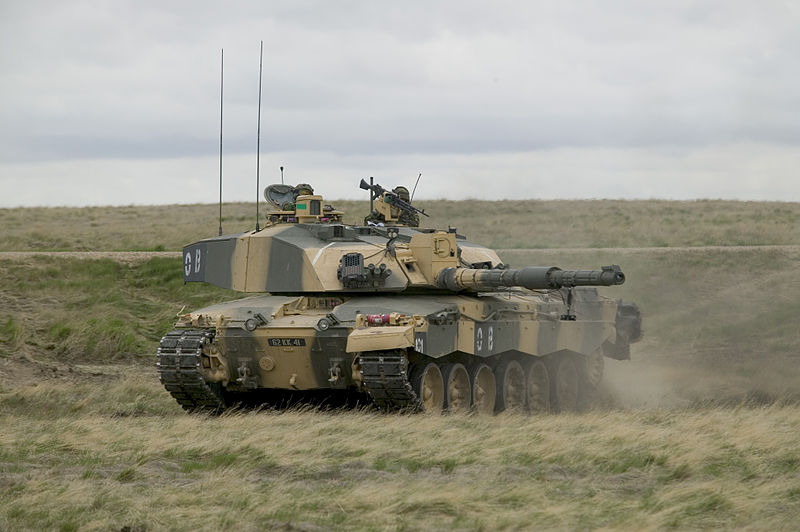
A British army Challenger Main Battle Tank, of 1 Royal Regiment of Fusiliers (1RRF), is shown returning to base after completing a firing mission as part of Exercise MedMan.
1RRF Battle group were based at the British Army Training Unit Suffield (BATUS) in Canada.
MOD photo by Mike Weston via Wikimedia Commons.
A column getting into all the details of why [the German government] were withholding said blessing would be several times longer than this one will be. Suffice it to say this is just the latest manifestation of Germany’s extreme discomfort with this war. Some of it relates to the lingering fallout of Germany’s blood-soaked history. But we would be naïve not to attribute at least some of the reluctance to Russia’s deep influence among some segments of the German ruling elite.
Germany has contributed to the defence of Ukraine, and it would be unfair to deny that. It would not be unfair to note that Germany has typically only done so later than the other allies, and under enormous pressure.
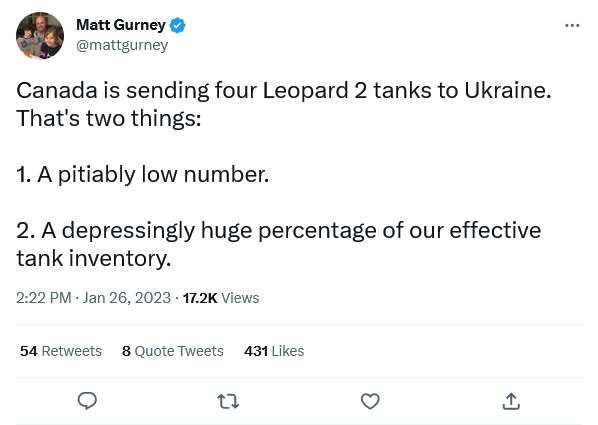
As part of the deals being announced, the United States will be sending several dozen of its M1 Abrams tanks, and Germany will send Leopards. Berlin will also allow other allies to send further Leopards. (Canada hasn’t committed to sending any of ours yet, but our few remaining Leopards are reported to be in poor shape, and are also all the way across an ocean, so we might not even be asked.) The British will send the Challengers. This gives Germany the ability to claim, with a reasonably straight face, that it has not chosen to escalate the conflict. Heavens, no! It’s simply moving in lockstep with its allies! As fig leaves go, it’s a pretty small and transparent one, but for the purposes of diplomacy and maintaining the appearance of allied solidarity, it’ll do.
And this brings us to the problem that the plan is exacerbating. A year ago, the Ukrainian military was largely armed and equipped along Russian lines — both militaries were, after all, descendants of the Soviet Red Army. Since then, much of its original equipment has been destroyed or lost, but this has generally been offset by an influx of Western weapons into the country as the allies empty their arsenals and get their production lines running again. This has allowed Ukraine to keep fighting, far more effectively than the Russians, among many others, expected. Despite huge losses of manpower, the Ukrainian military seems to actually have grown stronger as the war has gone on, thanks to the power of its new weapons.
Sending news is good news to that extent. It will make Ukraine stronger still. But it is also producing a situation where the Ukrainians are armed with an absurdly unwieldy mix of weapon systems. This is laying the groundwork for a future logistics disaster.
Any individual soldier can learn to use any specific piece of equipment. That’s just a matter of training and experience. Soldiers are smart. The longer they serve, the quicker they’ll get at picking up new pieces of equipment and kit. The challenge is more on the backend. The logistics of sustaining an arsenal of completely mixed weapon systems is a nightmare. Not only must Ukraine procure a huge variety of calibers of ammunition, it must also procure, sort, and then distribute a bewildering array of spare parts to keep all these weapons running. It’s not that this is impossible. The fact that Ukraine fights on is proof that it is not. But it adds tremendous cost and complexity, and requires a much larger effort to sustain than would be the case if Ukrainian units were equipped with standard weapons across comparable units.
The numbers of NATO tanks are initially small enough that only a few battalions can be re-equipped with the donated AFVs, but each different “brand” needs its own specialized support in the way of maintenace, repair, and re-supply. Ukraine is going to have to have at least a company-sized, fully trained maintenance unit for each battalion of NATO tanks and the logistics system will have to ensure that the different types of ammunition and ordinary wear-and-tear maintenance spares are delivered quickly enough to keep those battalions combat-ready. Some NATO nations with much better facilities sometimes struggle to do this for a single type of AFV, never mind for several different types.
Update: Can’t help but agree with Matt here.
Comments Off on Ukraine to receive Challenger II, M1 Abrams, and Leopard 2 tanks … both a solution and a new set of problems
January 24, 2023
An alternative theory about German Chancellor Olaf Scholz’s hesitation to allow Ukraine access to Leopard 2 tanks
I’ve been going on the assumption that the German government was terrified of Russian reaction if they allowed some Leopard 2 tanks to be donated to the Ukrainian forces, but eugyppius points out there’s another strong contending explanation:
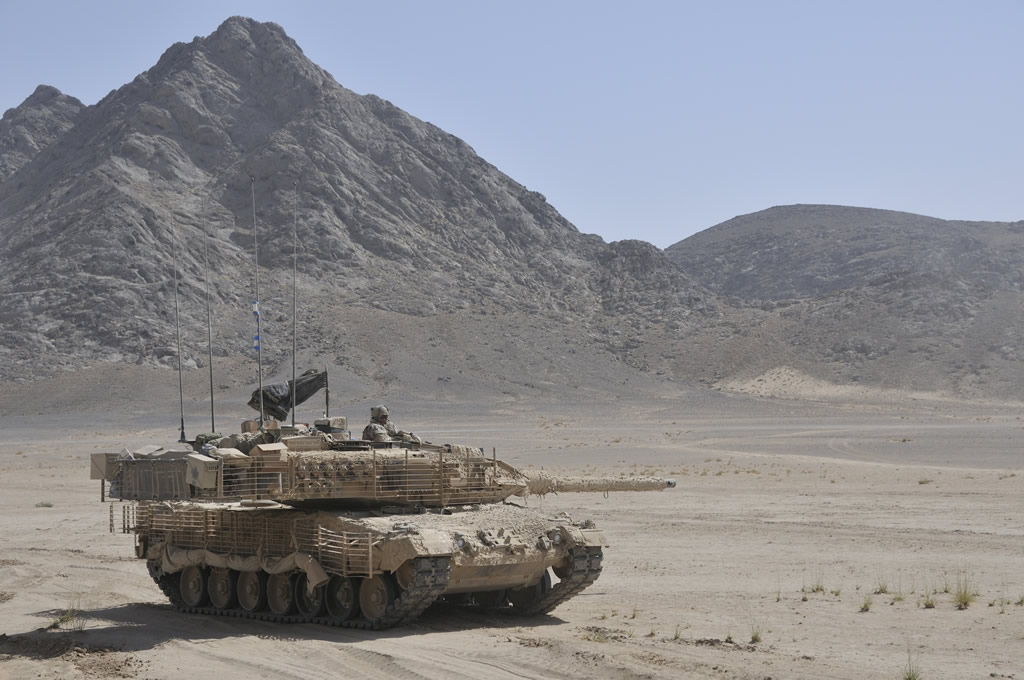
Leopard 2A6M in Afghanistan
Years of peace in Europe, an ageing population and a corresponding focus on expensive social programmes have caused Germany to put its defence industry into near-hibernation. Only a little over 2,000 Leopard 2s have ever seen the light of day. Each one is a hand-built machine that takes two years to make. If Germany permits the export of the European supply of Leopard 2s to Ukraine, the Russians will grind them to nothing within months, and then Europe will have no tanks except the tanks that the Americans sell them:
Defence industry representatives, who wish to remain anonymous, report that the Americans are offering their own used tanks as replacements to [European] countries able to supply Leopard 2s to Ukraine, together with a long-term industrial partnership. Any country that accepts the American offer would be hard to win back for the German tank industry. Berlin’s influence in armament policy would decrease correspondingly.
Tanks are driven by men, who have to be trained in the operation of specific models. Their use moreover requires a whole supply chain of munitions and especially spare parts, which the Americans are eager to offer. The upshot is that, once Europe opts into American armour, it will never switch back, and Germany will be out of the game for good. Nor should we lend much credence to the idea that our very few tanks will make any difference either way for Ukraine’s prospects. The insistence that Scholz release the Leopard 2s is simply an attempt to edge Germany further out of the European arms industry and into a position of lesser political and economic influence in Europe, so that the United States can fill the gap.
Noah Carl, over at the Daily Sceptic, drew attention last week to remarks by the French intellectual Emmanuel Todd that “this war is about Germany“:
After the collapse of the Soviet Union, Zbigniew Brzezinski called Eurasia the new “great chessboard” of world politics … The Russian nationalists and ideologues like Alexander Dugin indeed dream of Eurasia. It is on this “chessboard” that America must defend its supremacy – this is Brzezinski’s doctrine. In other words, it must prevent the rapprochement of Russia and China. The financial crisis of 2008 made it clear that with reunification Germany had become the leading power in Europe and thus also a rival of the United States. Until 1989, it had been a political dwarf. Now Berlin let it be known that it was willing to engage with the Russians. The fight against this rapprochement became a priority of American strategy. The United States had always made it clear that they wanted to torpedo [Nord Stream 2]. The expansion of NATO in Eastern Europe was not primarily directed against Russia, but against Germany. Germany, which had entrusted its security to America, became the Americans’ target [in the destruction of the pipeline]. I feel a great deal of sympathy for Germany. It suffers from this trauma of betrayal by its protective friend — who was also a liberator in 1945.
After the anti-Russian sanctions regime and its clear deindustrialising effects on the German economy, followed by the attack on the Baltic Nord Stream pipelines, and even smaller things, such as the high-profile anti-industry protests by the American-funded activist group Letzte Generation, I am willing to believe many conspiratorial things about the Ukraine war.
Comments Off on An alternative theory about German Chancellor Olaf Scholz’s hesitation to allow Ukraine access to Leopard 2 tanks
January 23, 2023
Monte Cassino, the Battle Begins – Ep 230 – January 21, 1944
World War Two
Published 21 Jan 2023The Allies have reached the linchpin of the German defenses in Italy, but a first attack proves disastrous. It does, though, divert troops from where they soon plan to make landings behind enemy lines. Meanwhile in the USSR, the huge Soviet offensive in the north makes great gains against the stunned Axis forces.
(more…)
Comments Off on Monte Cassino, the Battle Begins – Ep 230 – January 21, 1944
January 19, 2023
The Partisan War Behind the Frontlines – WW2 Documentary Special
World War Two
Published 18 Jan 2023There is a second war raging on the Eastern Front. From the huge expanses of no man’s land behind the German lines, Moscow’s battle-hardened and well-armed partisan bands are waging a Rail War in support of Red Army offensives. But every successful mission brings down the wrath of the genocidal Axis war machine.
(more…)
Comments Off on The Partisan War Behind the Frontlines – WW2 Documentary Special
January 18, 2023
QotD: Tanks for Ukraine?
Lately we’ve been tap dancing up to even heavier gear [for Ukraine]. The US has announced we’ll be sending some M2 Bradley IFVs, and France chipped in some AMX-10 RC heavy armored cars. While referred to as a char, or tank, in French service and apparently some obscure EU regulation classifies anything above a certain weight and with a big enough gun as a tank … and the AMX-10 clears those hurdles … war nerds will insist that unless it comes from the tank region of France it’s just a sparkling armored fighting vehicle.
It looks like the inhibition on sending tanks is finally cracking, though. While Germany is still dithering over letting Poland send some of its Leopard 2’s, Britain has announced it’s sending 14 Challenger 2 main battle tanks.
I found that particular number interesting. Late Cold War and post-Cold War Russian armored units use three-tank platoons and three platoons plus a commander’s tank make a ten tank company.
The British Army, from whose stores the Challengers will be pulled, uses some archaic TO&E, possibly left over from the Wars of the Roses or Cromwell’s New Model Army, wherein four tanks equal a Bonnet*, and four Bonnets plus two more tanks in a headquarters Bonnet equal an eighteen-tank Spanner†.
Fourteen tanks, however, is enough for three four-tank platoons plus two tanks for an HQ platoon, equalling a fourteen tank US-style armored company. Apparently the Ukies are using a US/(most of)NATO TO&E for their armored units. So the Ukrainians will have at least one company of Western MBTs.
* Bonnet = Troop
† Spanner = SquadronTamara Keel, “Clank Clank Goes the Tank”, View From The Porch, 2023-01-15.
Comments Off on QotD: Tanks for Ukraine?
January 15, 2023
Time to Liberate Leningrad! – Ep 229 – January 14, 1944
World War Two
Published 14 Jan 2023Three Soviet Fronts launch major offensives to try and finally free Leningrad, under siege for nearly two and a half years now. The Soviets are, in fact, making attacks along most of the Eastern Front. In the South Pacific, the Allies step up their aerial assault to wreck Rabaul’s air power, thus neutralizing it as a base.
(more…)
Comments Off on Time to Liberate Leningrad! – Ep 229 – January 14, 1944


