Quotulatiousness

July 2, 2023

Of course they’re lying – the interesting thing is how they sell the lies

Filed under: Media, USA — Tags: , , , — Nicholas @ 05:00

In his Friday Mailbag, Severian answers a reader question about the reports coming out of Ukraine about casualties in the recent fighting:

Back in the worst of the covid days (so far), I often said that we’re stewing in so many obvious lies, I’m starting to question the very existence of a country called “China”. Not to mention the germ theory of disease. Is there actually a war at all in Ukraine? How do we sift and weight sources?

My rules of thumb (two thumbs, two rules) for judging the underlying truthiness of a Media story are what I’ll call “the Goebbels factor” and “admission against interest”.

The “Goebbels factor” is that fellow’s well-known dictum that the best propaganda is mostly true. Outright lies — straight up, 100% false-to-facts whoppers — are actually extremely rare, even in the AINO Media. This is because out-and-out lies take a tremendous amount of effort to maintain. Not only that, their opportunity cost is off the charts, because once you’ve peddled the lie, you’re stuck with that specific lie forever. You have to keep investing in the lie, and you must also keep investing in what I guess we’ll call the “information infrastructure” surrounding that lie. It’s just not cost-effective.

The second factor — “admission against interest” — is, of course, just the second step in everyone’s favorite dance, the Media Shuffle. The first step is “That’s not happening!” The second step is “… and here’s why it’s good that it is.” Think of it as the retooling of the previous “information infrastructure.” Lies have to be supported, one way or the other. If the lie is “there’s no inflation!”, then the “information infrastructure” consists of semi-plausible (for Juggalo values of “plausible”) “explanations” of all the very obvious inflation that’s very obviously happening. You know the drill: Putin’s price hikes! Global Warming!! Systemic Racism!!!

It’s much easier to flip those around, to “explain” why all those are actually good for you, than it is to keep investing in the original lie. It’s important to note — as if y’all need the reminder! — that the “admission against interest” is ALSO chock full of lies; you have to cross check the new lies against the old lies to reach an approximation of the truth (the discipline known as FNG-ology; the practitioners of which are stoyakniks).

Given all that: Yeah, the war in Ukraine is real, and the Ukrainians really are getting keestered. My heart goes out to the Ukrainian people, who did nothing to deserve it, and I only ask that you remember who did this to you: Brandon and the Juggalos. It’s ALL on them. Putin really had no choice.

June 27, 2023

“No one seems to understand what the hell just happened in Russia”

Filed under: Government, Media, Military, Russia — Tags: , , , , , — Nicholas @ 03:00

Discussing anything to do with the Russo-Ukraine war is difficult enough due to the signal-to-noise ratio in the information we get from both sides and (theoretically) disinterested observers. Trying to read the tea leaves in the events over the weekend was just an utter waste of time, despite the potentially earth-shaking possibilities being thrown up. The weekend dispatch from The Line doesn’t pretend to have any deep analysis to offer, which I think is by far the wisest approach:

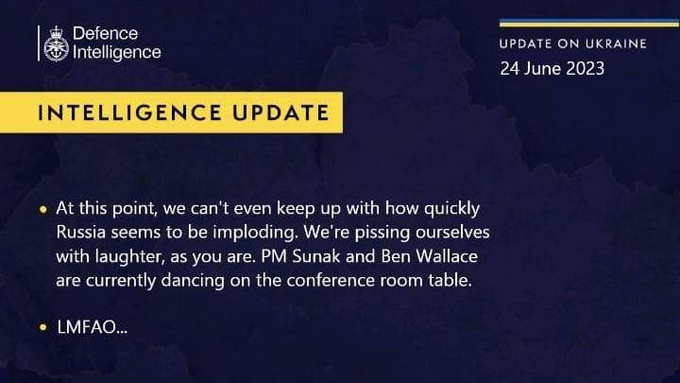
“Sir Humphrey Appleby” tweeted this, saying it was “the intelligence update slide every DI analyst secretly dreams of producing …

As we write this, roughly a day has passed since the sudden end of what briefly looked like a massive event with the potential to reshape global politics for a generation … before it fizzled. The rebellion of Russia’s Wagner mercenary group and its bolt toward Moscow was a stunning story, until it wasn’t. And that itself is a stunning story. Yevgeny Prigozhin, former chef and now Wagner leader, suddenly called off his mutiny, and it just … ended.

Really?

When the mutiny began on Friday, and especially when Wagner seized the southern city of Rostov, home to a major Russian military headquarters overseeing the invasion of Ukraine as well as a million other people, we were surprised, but the more we thought about it, we weren’t particularly shocked. There had been obvious signs of an imminent rupture of some kind in recent months; Line editor Gurney had wondered on Twitter how long it could last before something snapped. That was about three hours before the entire country seemed to snap and Prigozhin marched into Rostov and began moving north.

Events proceeded at a fairly frantic pace after that, with Wagner troops advancing almost all the way to Moscow while Russian security forces fortified the city and tore up roads along the route. It wasn’t clear to us that Wagner had enough men to actually take the city and potentially capture key members of the government. But it wasn’t clear that he didn’t: there are two sides of that equation — the troops Prigozhin had and the troops Putin could count on to oppose Wagner. It was the latter group that captured our interest.

Wagner encountered some resistance along the way, but not much. Most of Russia’s army is deployed in Ukraine, of course, and much of what’s left is now of famously poor quality and morale. But even those military and security forces that were able to block Wagner’s advance didn’t seem that interested in the job. There are reports that some units went over to Prigozhin’s side, but it seems that most of them just did … nothing in particular. And waited to see what happened. For a few hours, we wondered if Prigozhin’s small force would be just large enough in the face of a Russian military that seemed to have no appetite for battle on its own soil.

We can’t pretend to explain the bizarre conclusion to this chaotic day and a half, with an apparent deal brokered by Belarus seeing Wagner’s advance on Moscow called off, a broad amnesty granted to all participants and Prigozhin apparently set to continue to oversee Wagner’s global operations from Belarus in some kind of exile. This is all just wildly unrealistic. Prigozhin cannot be the last person around to realize that he’s put a target on his back and that he’ll soon experience some kind of fatal medical emergency or tragic tumble out of an open window. The moment his mercenaries took Rostov, he had only one path forward: all the way to the Kremlin. What the hell he’s thinking is frankly beyond our ability to guess, and we have fairly vivid imaginations. It’s baffling.

Nor will we try to guess what this will mean for Russia. In a situation like this, your Line editors would normally simply confess that we don’t have the deep knowledge of Russian domestic politics to turn ourselves into credible instant-experts on this. We’d seek out someone with that knowledge. We could interview them, solicit a column from them, or even — as we’ve done in the past — allow someone with deep expertise but who isn’t permitted to speak on the record in public to provide a blurb for one of these dispatches, to run under our shared byline. But in this case, we had to reject all those options, because at least for right now, all the experts seem as baffled as we are. No one seems to understand what the hell just happened in Russia.

We can say with at least reasonable confidence that if you happen to be named Vladimir Putin, it isn’t good. When Prigozhin announced that he was ending his mutiny and began withdrawing his forces from Rostov, the locals cheered them like some kind of conquering heroes. That’s gotta be on Putin’s mind. Also on his mind: the apparent, ahem, reluctance of much of his military and domestic security force to rally to his side during the crisis. This has wounded Putin. Time will tell how badly. Time will also tell how many other people in Russia today have carefully watched recent events, have adjusted their understanding of the facts on the ground there, and are now pondering a variety of intriguing options accordingly.

And the last thing time will tell is what Putin feels he must now do to assert his authority, such as it is. We must recall that whatever Putin’s domestic troubles, he has problems on the battlefield, too. While we haven’t yet seen major breakthroughs by Ukrainian forces, they are not yet fully committed, and their counteroffensive does seem to be making gradual progress in multiple sectors. Events of recent days can only hurt Russia’s combat performance and morale.

We wish we could offer you all a more firm and decisive statement to wrap all this up. But the best we can honestly promise you is that we’ll keep pondering this, trying to figure out what the hell happened, and we’ll certainly be watching this. It’s been a strange war. And we suspect it might get stranger still before it finally ends.

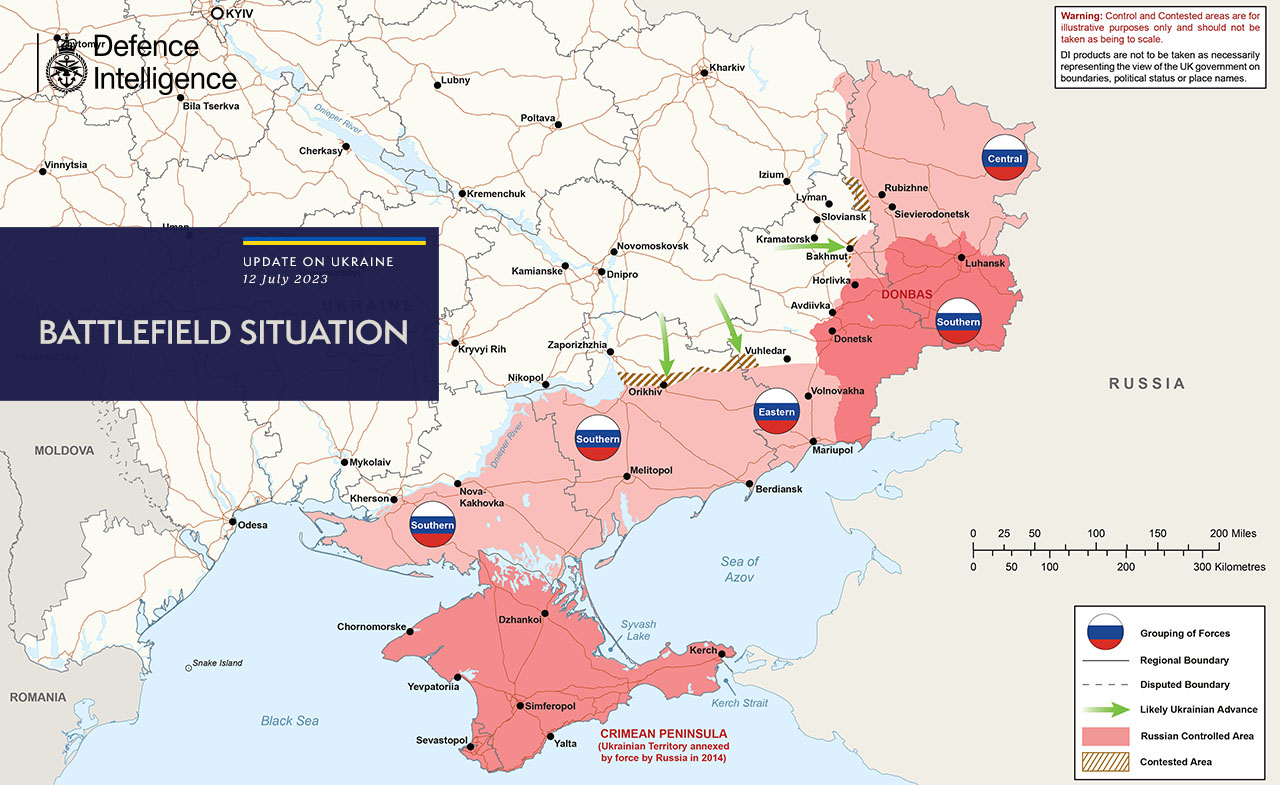
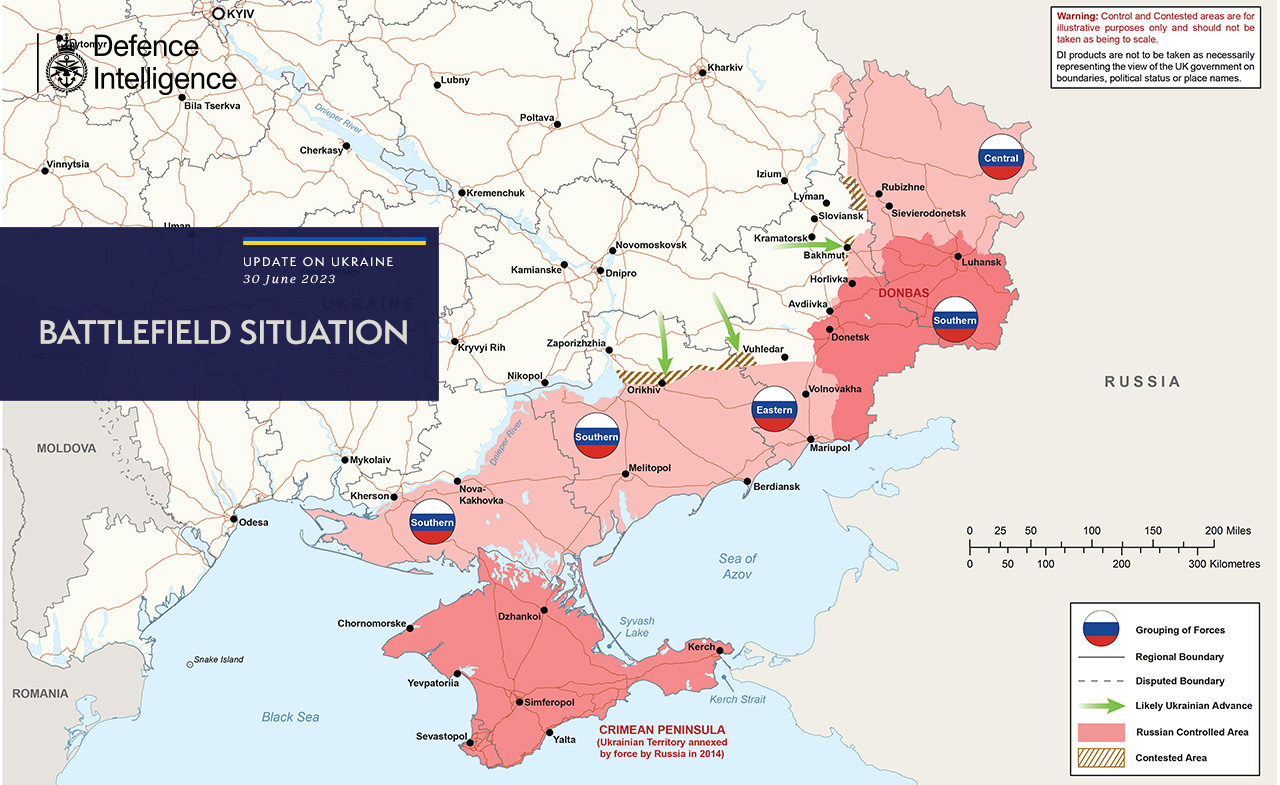
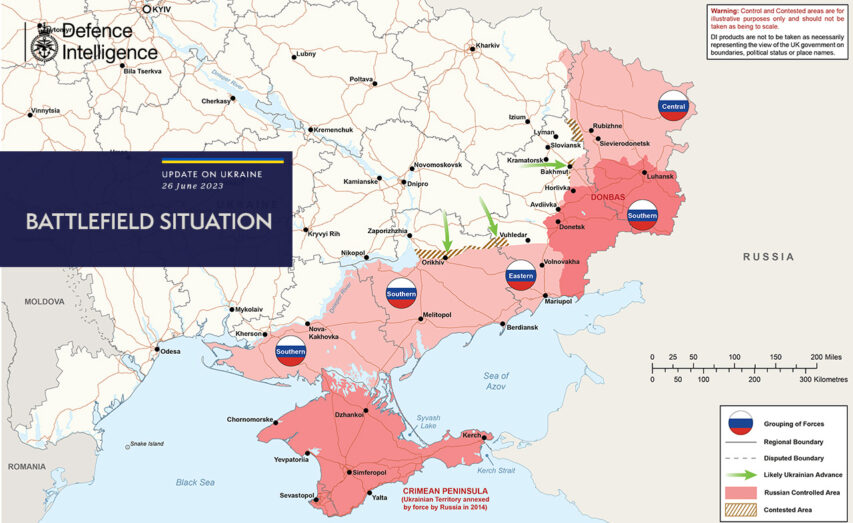
The most recent Defence Intelligence update map from the British Ministry of Defence shows what is thought to be a reasonably accurate representation of the battlefront in eastern Ukraine:

June 22, 2023

QotD: Nuclear non-proliferation and the Russo-Ukraine war

The failure of the earlier League of Nations was crucial to preparing the way for the Second World War. Today, we see none of this, with most participants — excepting North Korea and Iran — still playing by the rules. This is where we return to Nevil Shute. Twice, using his technical expertise, Shute attempted to predict future war in a novel, and twice he got it wrong. With On the Beach, the author wrote of a 37-day war that “had flared all around the northern hemisphere”. Albania had dropped a “cobalt bomb” on Naples, which escalated into wider conflicts and eventually a Russo-Chinese exchange.

As one of Shute’s characters, a scientist, explained, “The trouble is, the damn things got too cheap. The original uranium bomb cost about fifty thousand quid towards the end. Every little pipsqueak country like Albania had a stockpile of them, and every little country that had that, thought it could defeat the major countries in a surprise attack”. Significantly, Shute’s future war, set in 1963, wasn’t triggered by the usual NATO-Warsaw Pact arsenals of nuclear weapons, but the proliferation of them elsewhere. Then, as now, it is not Russian or Chinese aggression that should worry those with nightmares of nuclear cataclysm, but that of other countries. Thanks to the NPT, IAEA and the UN, these possibilities are contained. Today, the world’s weapons of mass destruction stand at one tenth of their number during the Cold War.

Indeed, the very origins of the current Ukraine crisis illustrate how the international order has managed to contain potential proliferation. When the Soviet Union disintegrated in 1991, Ukraine possessed the world’s third largest nuclear arsenal, greater than those of Britain, France and China combined. Kyiv soon realised it couldn’t afford to maintain the warheads and remain a credible nuclear military power. A solution was found, whereby the weapons would be destroyed, but only in exchange for security assurances that the United States and Russia would respect Ukraine’s independence, sovereignty and territorial integrity.

What Ukraine signed on 5 December 1994 was the Budapest Memorandum of Security Assurances, in which Bill Clinton for the United States, Boris Yeltsin for Russia and John Major for Great Britain promised to protect Ukraine and its territorial integrity in recognition of Kyiv surrendering the protection of its nuclear arsenal. There was no mention of military guarantees, which Ukraine assumed were implied. Additionally, Kyiv promised to adhere to the Non-Proliferation Treaty (NPT).

After the annexation of Crimea by Russia in 2014, the G7 nations complained that Russia had breached the Budapest Memorandum. Vladimir Putin replied evasively that since, in his view, a new regime had seized power from Ukraine’s previously pro-Moscow premier Viktor Yanukovych, “Russia has not signed any obligatory documents with this new state”. Since then, Russia has lied and prevaricated over its betrayal of Budapest. In 2016, Sergey Lavrov went so far as to claim, “Russia never violated Budapest memorandum. It contained only one obligation, not to attack Ukraine with nukes” — a gross distortion of the Memorandum’s many obligations.

However, the West responded in 2014 only with mild economic sanctions. Arguably, the apathy of the anti-interventionist Barack Obama and David Cameron, influenced by a London awash with Russian money, emboldened Vladimir Putin. Few experts disagree that had the West responded in 2014 as they did in 2022, Russia’s expansionist ambitions into Ukraine would have ended long ago. Yet, there is plenty of room for optimism. The Russo-Ukraine conflict has not spread because of the international order and its treaties. Apart from North Korea and Iran, neither of whom have quite perfected their devilish devices, nuclear proliferation of third parties has been held in check.

The Kremlin shows no sign of taking steps to escalate to a nuclear level. It is not in its interests, or those of its allies, to do so. None of the 32 nations who recently abstained from condemning Russia in the 24 February UN vote would welcome Vladimir Putin and his cronies flinging nukes around. The qualified support of major powers like China, India and Pakistan is attached to the cheap oil and arms procurements they have negotiated with Moscow. Any hint of Tsar Vladimir “going nuclear” would see their abstentions morph into support for the West. Putin, for all his rhetoric, cannot afford to go it alone with just the six who voted with him at the UN. In military terms, they offer nothing.

The world’s various international arms treaties provide plenty of optimism that this will remain a regional war. So far, Putin’s threats have melted away as the morning mist. The scenario he implies, akin that in On the Beach and other nuclear-war-scare novels and films, is so unlikely as to be discounted. They and all the rest of the post-apocalyptic genre are written as nail-biting entertainment, not history or current affairs.

Peter Caddick-Adams, “Putin, Shute and nukes”, The Critic, 2023-03-09.

April 19, 2023

Time to remove US nuclear weapons from Europe?

Filed under: Germany, History, Italy, Military, Russia, USA, Weapons — Tags: , , , — Nicholas @ 03:00

CDR Salamander has long advocated getting the final few American “tactical” nuclear weapons off European soil and makes the case for doing it now:

It may seem like a strange thing to propose while there is the largest land war in Europe since 1945 going on, but as it is something I’ve been a supporter of for a few decades I might as well be consistent: we are long overdue to remove American nuclear weapons from Europe.

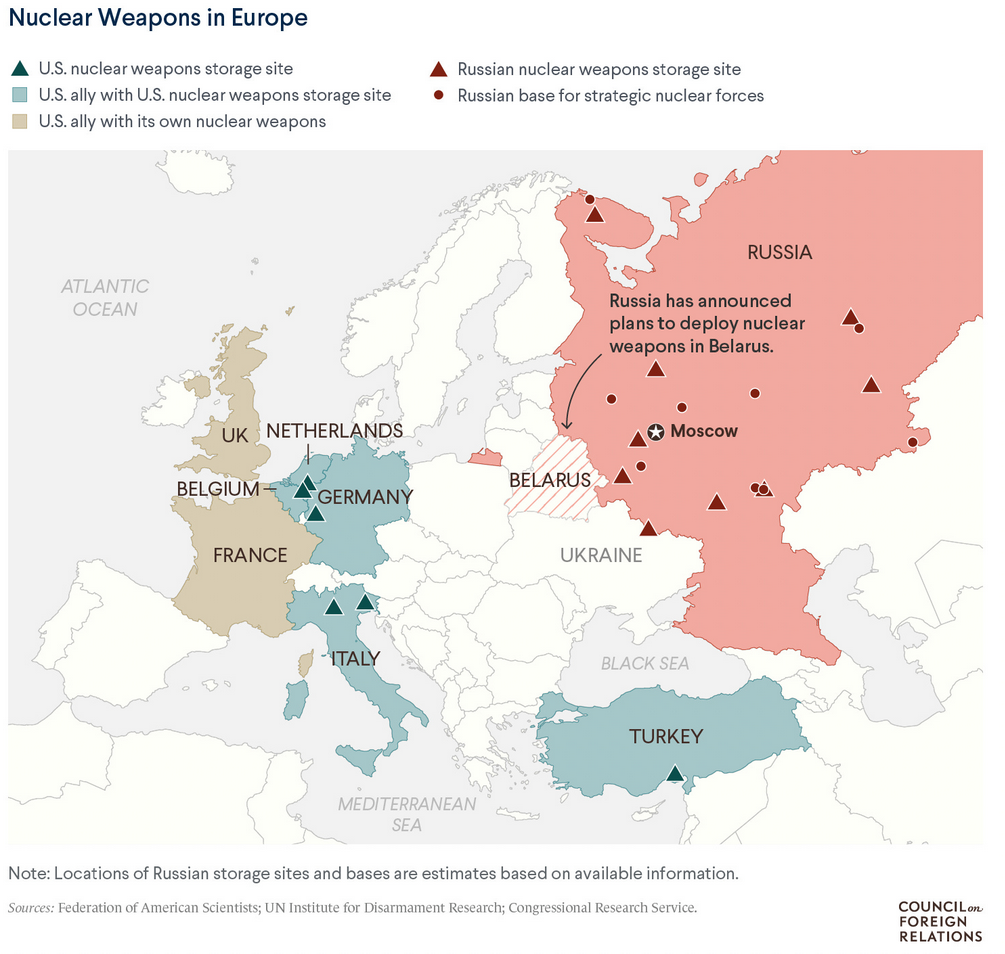
It is 2023. Just look at this map.

[…]

The Soviet Union stopped existing over three decades ago.

Even though we’ve decreased from 7,000 warheads down to 100 … there really is no reason to keep what remains in Europe.

  1. Gravity bombs on continental Europe – that require tactical aircraft to deliver them – are the least survivable, reliable, or timely way to deliver a nuclear weapon.
  2. There is no such thing as a tactical nuclear weapon. I don’t care what some theorist proposes to defend their pet theories, you lob one nuke an order of magnitude larger than the Hiroshima bomb and only a foolish nation would let their strategic nuclear forces stay unused and in danger.
  3. Gravity bombs are not a first strike weapon and are a poor second strike weapon. As such, you have to consider that the the time gap from approval to flash-boom would be so long the war would be over before your F-XX pickled their nuke over their target – even if the aircraft made it off the ground.
  4. If they are NATO weapons, you not only have to get NATO to approve their use, but host nation to as well … in addition to the USA. Do you really think the Russians would not leverage their influence with the useful idiots in the Euro-Green parties, former communists, and general black-block anti-nuke activists to politically of physically stop the use of the nukes, especially in BEL, NLD, DEU, and ITA? Add that to point 3 above.
  5. Especially with the weapons in Turkey – the risk of these bombs having a bad day due to human or natural causes is non-zero. In the days of mutually assured destruction, those non-zero odds were manageable, but there is no reasonable person in the third decade of the 21st Century who can with a straight face explain to you why any tactical, operational, or strategic use justify their presence. They deter no enemy, but puts every friend in danger.
  6. Look again at the map above. Exactly what target set are you going to “service” at that range (non-refueled)?
  7. If things go nuclear in Europe then the right weapons are either British, French, and if they must be American are sitting in a silo in CONUS, a SSBN in the Atlantic, or a B-2 in Missouri.

April 16, 2023

4,000 German teens trapped in Tarnopol – WW2 – Week 242 – April 15, 1944

Filed under: Britain, China, Germany, History, India, Japan, Military, Russia, WW2 — Tags: , , , , — Nicholas @ 04:00

World War Two
Published 15 Apr 2023

Thousands of German soldiers, mostly new teenage recruits, are obeying Hitler’s “Fortress Directive” and are surrounded in Tarnopol; it does not go well for them. German forces in Ukraine manage to all pull back across the Dniester, but they are under serious pressure in the Crimea. Meanwhile, in India, the Japanese siege of Kohima continues, and in China they are poised to launch a gigantic offensive.
(more…)

April 10, 2023

It’s totally normal for a country to send troops overseas and neglect paying to feed them, right?

Filed under: Bureaucracy, Cancon, Military — Tags: , , , , , — Nicholas @ 06:00

This week’s Dispatch post from The Line includes some commentary on the story I linked to last week from the Ottawa Citizen, reporting that Canadian soldiers sent to Poland to train Ukrainian troops are being stiffed by the Department of National Defence on their food bills:

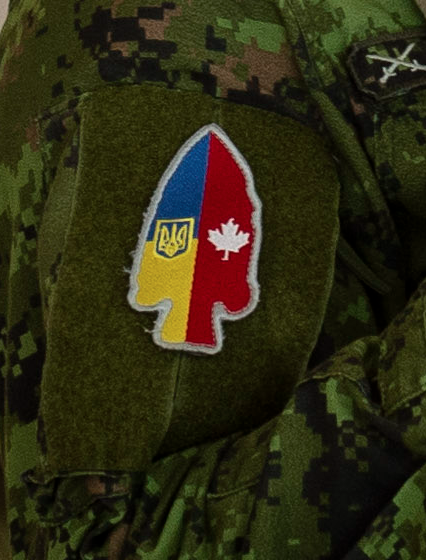
Operation Unifier shoulder patch for Canadian troops in Ukraine.
Detail from a photo in the Operation Unifier image gallery

Here’s a totally normal story from a well-functioning country that isn’t at all broken: it turns out that processing per diems for a hundred or so folks is now beyond the capability of the federal government.

This story came to us courtesy the Ottawa Citizen, where David Pugliese reported that the company sized unit of Canadian military personnel operating in Poland has seen months worth of expense filings go unpaid. In some situations, a military unit sent abroad would include its own logistical support team, including cooks. In other situations, a relatively small unit sent to a place with functioning civilian infrastructure is told to feed themselves and keep the receipts for reimbursement. For our troops in Poland, there to provide logistical and training support to Ukrainian forces since October, the government went the latter route.

And that’s fine. Really. Frankly, we’re sure the troops are happier eating out at local places and enjoying delicious Polish food — really, it’s amazing — than getting three servings of military slop a day. The problem, though, as these poor troops discovered, is that the military and national defence bureaucracy no longer has the ability to process the expense payments. So these balances are just sitting on their personal credit cards. For months.

[…]

The mission began in October.

It seems almost pointless to add much actual insight and analysis here. This kind of dysfunction speaks for itself. We’ll limit ourselves to two comments: operational deployments are incredible stressful on military personnel and their families on the homefront. That’s uncontroversial, and unavoidable. That’s why military service is recognized as a sacrifice even during peacetime deployments. The basic bargain we make with our servicemembers is while they are serving their country abroad, their country will take care of their families at home. Leaving these families with high-interest credit-card balances they can’t pay off because the Canadian government is too broken to reimburse soldiers for expenses they were told to incur is an on-the-nose failure of Canada to honour its debt to the the military parents, spouses and children who have been, in effect, ordered to advance the Canadian government money to subsidize military deployments.

The second comment we’ll make, is that this isn’t just further evidence in support of the Canada-is-broken thesis — it’s a very specific kind of break. We’ve all known that Canadian governments, at all levels, have struggled to turn new policies into new programs. That’s not new. But even granting that failure, we’ve generally been able to keep doing the things we already do. There seemed to be enough residual muscle memory in our governments. Can we do new things? No, not really. But we’ll keep doing the stuff we already do.

This military fiasco is alarming because it’s a sign that our state-capacity issues are now extending into areas that previously worked. Not only are we struggling to do new things, we’re forgetting how to do things we used to be able to do. This goes beyond what our typical gripes about state capacity. This is something else. This is state atrophy, or rot.

Now that the public is paying attention, we suspect we’ll see some reasonably rapid progress. The government will throw bureaucrats and maybe consultants at the problem until it goes away. This is how they have reacted to similar issues: we hurled ground staff at airport delays until they cleared, and bureaucrats at passport offices until the backlogs eased.

But we have to ask why we now require exceptional redeployments of staff to maintain typical levels of service. And we don’t like the answers we can come up with. Ottawa has added tens of thousands of civil servants, at an annual cost of tens of billions, in recent years. During that time Ottawa has also sharply ramped up spending on consultants; the annual cost now surpasses $20 billion.

And yet.

What the hell is going on?

I’ve been saying for literally years now, the more the government tries to do the less well it does everything, and this fiasco is a perfect example of that sclerosis spreading further.

April 9, 2023

New Offensive in the Crimea – WW2 – Week 241 – April 8, 1944

Filed under: Britain, China, Germany, History, India, Japan, Military, Russia, USA, WW2 — Tags: , , , , , , — Nicholas @ 04:00

World War Two
Published 8 Apr 2023

The Soviets are finally going to try and push the Axis out of Sevastopol and the Crimea. They also continue to drive the Axis back in Transnistria. Over in Burma and Northeastern India, the Japanese have the Allies under siege at not one, but two towns, and are also attacking Imphal from several points, but the Japanese have way bigger future plans up their sleeves in China.
(more…)

April 5, 2023

The modern Canadian Army – go on deployment to Poland, train Ukraine troops … and have to buy your own rations

Filed under: Bureaucracy, Cancon, Military — Tags: , , — Nicholas @ 05:00

Is it hard to figure out why the Canadian Armed Forces are having recruiting shortfalls when they can’t even manage to feed the troops they send overseas to train Ukrainian soldiers?

Operation Unifier shoulder patch for Canadian troops in Ukraine.
Detail from a photo in the Operation Unifier image gallery – https://www.canada.ca/en/department-national-defence/services/operations/military-operations/current-operations/operation-unifier.html

The Canadian soldiers are in Poland to train Ukrainian military personnel but since Canada did not send military cooks on the mission, the troops were told to eat at local restaurants.

But there is a massive backlog with the Canadian Forces reimbursing the soldiers for those costs, sending some of them thousands of dollars into debt. Their families contacted this newspaper to complain about the situation they say is causing financial stress at home.

After this newspaper [the Ottawa Citizen] inquired about the situation, the Canadian Forces confirmed Monday that there are problems with payments of per diems and the reimbursement of other expenses. The Canadian Forces is now promising to speed up the process.

“We apologize to the members and their families for the distress this has caused, and thank them for their patience,” said Capt. Nicolas Plourde-Fleury, spokesman for Canadian Joint Operations Command (CJOC). “We want them to know we have implemented measures to better support them moving forward.”

Approximately 100 Canadian military personnel are currently serving in Poland as part of a contingent to train Ukraine troops. The first arrived in October 2022 but the mission added more personnel in February and March.

As part of Operation Unifier, the Canadian soldiers are providing training in basic and advanced engineering skills, the use of explosives for demolition work, demining and skills relating to the use and operation of the Leopard 2 tanks in combat.

The Canadian Forces usually has its own cooks to provide troops with food. But in this situation, the Canadians initially received their meals from the Polish military. Later, the Canadian soldiers were told to eat in local restaurants and they would be reimbursed by the Canadian Forces.

April 3, 2023

Goodbye Manstein… Hello Model – WW2 – Week 240 – April 1, 1944

World War Two
Published 1 Apr 2023

As the Allies prepare to close in on Germany from all fronts, a shake up of the German military leadership can only achieve so much…
(more…)

March 27, 2023

Why Russia Lost the Polish-Soviet War

Filed under: Europe, History, Military, Russia — Tags: , , , , , , , — Nicholas @ 04:00

The Great War
Published 24 Mar 2023
The Polish-Soviet War was one of the most important conflicts in the aftermath of the First World War when Eastern Europe was in flux. Both the Polish and the Bolshevik Army had the advantage numerous times and at the Battle of Warsaw is looked like the Bolsheviks would carry the revolution into Western Europe.
(more…)

March 26, 2023

Germany Invades Hungary – WW2 – Week 239 – March 25, 1944

World War Two
Published 25 Mar 2023

Germany occupies Hungary this week to prevent any possible Hungarian defection from the war, the Soviets continue pushing back the Axis in Ukraine, pressing them ever more toward Romania, the Japanese advance on Imphal and Kohima continues, but Allied attacks in Italy and Japanese ones on Bougainville come to their ends.
(more…)

March 19, 2023

Ron DeSantis as an American Neville Chamberlain

Filed under: Media, Politics, USA — Tags: , , , , , — Nicholas @ 05:00

Andrew Sullivan points out the inanity of comparing Florida Governor and potential presidential candidate to former British PM Neville Chamberlain over DeSantis not including the idea of increasing support to Ukraine as “a new Munich”:

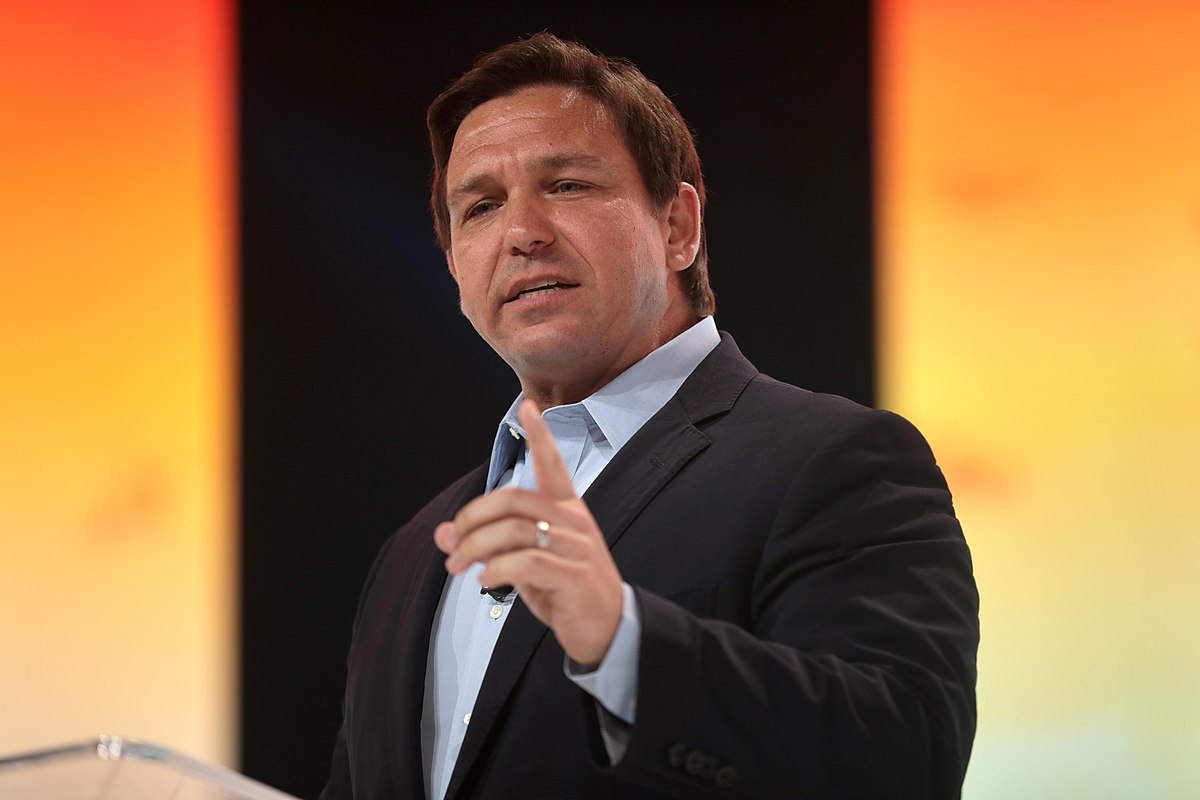
Governor Ron DeSantis speaking with attendees at the 2021 Student Action Summit hosted by Turning Point USA at the Tampa Convention Center in Tampa, Florida on 18 July, 2021.
Photo by Gage Skidmore via Wikimedia Commons.

For a written statement on foreign policy from a potential presidential candidate, it was, I suppose, a big deal. The salient sentence from Governor Ron DeSantis:

    While the U.S. has many vital national interests — securing our borders, addressing the crisis of readiness with our military, achieving energy security and independence, and checking the economic, cultural and military power of the Chinese Communist Party — becoming further entangled in a territorial dispute between Ukraine and Russia is not one of them.

It’s open to some interpretation. DeSantis says the Ukraine war is not in the “vital national interests” of the US, but is it maybe still in our general interests? Not clear. And he commits to no further entanglement, which could mean sticking with where we are now, but no more. Sure: no F-16s. But that’s also Biden’s position.

“Territorial dispute?” That set a lot of people off. But of course it’s undeniably, at some level, a border dispute. The entire post-Soviet settlement was a redrawing of national borders — and marked an extraordinarily rapid advance of Western arms and allies to the edge of Russia itself. In any kind of perspective, the current war has come at the end of that now-disputed settlement, and is indeed a debate over where Russia ends and Ukraine — which literally means “borderland” — begins. DeSantis didn’t blame Ukraine for its self-defense. He didn’t defend Putin. He merely proffered a different view of vital US national interests in the medium-term.

The gall!

The Blob declared another “Munich!” — an ancient neocon ritual — and declared the DeSantis candidacy all-but-over. Chris Christie called DeSantis “Neville Chamberlain“; Chuck Schumer asked, “I have to wonder what [DeSantis] would’ve thought if he was around in the 1930s”; Jenn Rubin called DeSantis “pro-Putin“; and the WSJ warned of a return to “isolationism in the 1930s”. This morning, the WaPo dusted down and wheeled out their perennial “appeasement!” editorial. And we got a French-Brooks double-whammy direct from 1983. Churchill envy never dies.

And I’m sorry. But I don’t get it. It is surely perfectly fine for a country to have two political parties that differ on foreign policy. In fact, it’s a critical advantage that democracies have over more rigid regimes: it helps us correct mistakes in time (and sometimes not), change personnel, and adjust to an always changing reality.

And in the 21st century, after the collapse of the imperial ideologies of the 20th, the role and reach of the United States is legitimately open to debate. It makes sense that one party would be more interventionist and one would be less so; it makes even more sense for the conservative party to be the one more skeptical of wars, small and large, and the unintended consequences they invariably entail.

That’s what’s happening — partly in reaction to the catastrophic, and bipartisan, hyper-interventionism of the first two decades of this century, and partly because of the rise of China. And it’s a good, normalizing thing. It will keep pressure on Biden not to escalate any further; and force us to think through the ugly compromises that will almost certainly confront us in the future. DeSantis’ position is pretty much where Obama was on Ukraine — and Obama was not some far-right fanatic. Money quote:

    The fact is that Ukraine, which is a non-NATO country, is going to be vulnerable to military domination by Russia no matter what we do. … We have to be very clear about what our core interests are and what we are willing to go to war for. And at the end of the day, there’s always going to be some ambiguity.

Replace “core” with “vital” and it’s DeSantis’ outrageous position. Yes, Putin miscalculated badly and invaded Ukraine, which means a new situation, and defense of Ukraine. But the core reality of America’s and Russia’s interests is unchanged. And Putin is not in command of a huge war economy and occupying the Sudetenland. He’s stuck in Eastern Ukraine, for Pete’s sake, and can barely move. China is maneuvering to counter and exploit our escalation. We need flexibility. What we absolutely do not need is some kind of shrill, bipartisan consensus on yet another war — and the usual McCarthyite smears of critics.

The Japanese Invade India! – WW2 – Week 238 – March 18, 1944

World War Two
Published 18 Mar 2023

Operation U-Go, Renya Mutaguchi’s invasion of India, is in full swing this week, as his men aim at Imphal and Kohima; three Soviets Fronts batter their way through the Axis positions all over Ukraine; and there is a huge Allied bombing campaign at Cassino in Italy, which mistakenly kills a lot of Allied soldiers. That’s one busy week.
(more…)

March 17, 2023

Ukrainian, Yugoslav and Baltic Nazis? – ϟϟ Foreign Fighters Part 2

Filed under: Europe, Germany, History, Military, WW2 — Tags: , , , , , , , , — Nicholas @ 04:00

World War Two
Published 16 Mar 2023

Across Europe, non-Germans are filling the ranks of Heinrich Himmler’s forces. These foreign fighters certainly don’t meet the racial standards of the SS but times are tough and the Reichsführer-SS needs warm bodies. So, does that mean Himmler’s given up on the idea of a Germanic master race? Not at all. And he uses all sorts of twisted esoteric logic to justify his latest moves.
(more…)

March 13, 2023

People in high places like “Pryam Farll”

Filed under: Media, Politics, Russia, USA — Tags: , , , , , , — Nicholas @ 05:00

Elizabeth Nickson on the kakistocratic “elites” of the west and the dangerous policies they’ve been pushing:

How our leaders are seen by the people, their prey.

Around early Trump, a character calling himself Pryam Farll acquired a host of “friends” on Facebook among the most influential intellectual activist/writers on the right. He claimed to be a member of the Danish Royal Family, related to Prince Phillip, who spent Christmas at Sandringham, mentored Prince Harry and who read Putin’s email. He hated Putin with all his strength, claimed to be a General in US Intelligence, had worked in Reagan White House, and spent his time dropping into NATO, the EU, and Defence Departments in countries adjacent to Russia in the service of marshalling power against Putin, surrounding him with armies and bases and, as it turns out, bioweapons labs. He was also, tongue-in-cheek, “6’8″, devastatingly handsome and mind-blowingly rich”. He posted a dozen times a day, hilarious, way too bright, and substantive. Around the time that the first lie emerged about the Russia Hoax, which he claimed to have helped invent, he said he was in at the War Office in Romania, and to “start no trouble whilst he worked”.

Then he vanished.

And whether he was a genius kid in the basement or a mock-up by MI6 counter-intelligence meant to influence the influential, he serves as a type, the type that got us into this mess, where we are ghost-walking into nuclear conflict. The British since McKinder have had it out for the Russians and Russia-hate is baked into their intellectual class. Did the U.S. blow up Nordstream? Maybe, maybe not, but we very probably paid for it. More like MI6 and General Farll did the deed, and theirs is the ghastly world we now inhabit.

The early neo-cons promoted war as a way to get the “common” people “exhilarated and unified”. Get them off rock and roll, sex and shopping onto a spiritual crusade for “democracy”, they thought, demonstrating one of the aspects of this type: they didn’t have much fun in high school.

Iraq 1 and 2 were a result of this thinking. And now Ukraine. This crowd has spent almost a decade since Trump’s throwaway remark that maybe we should ally with Russia, stirring up hate. This entirely, entirely to cover for their thefts and crimes. And now they present us with another opportunity to be exhilarated and unified. Aren’t we just blessed?

If the Ukraine had signed and executed Minsk 2, we wouldn’t be in this mess. This was created by slender boy-men like Antony Blinken and little-girl-women like Samantha Power and Victoria Nuland, playing the Great Game without any notion of the actual effect of their ambitions on those they see as servile nothings, good for tax dollars like us, or foreign meatsuits to bomb to death. They have killed or wounded 500,000 Ukrainians in the last two years. Britain alone has issued 190,000 visas to terrified Ukrainians. Soros’s 2014 Color Revolution, where they installed a puppet over an actually elected Russian-friendly President, started the rush and ever since it’s all Pryam Farll angling for nuclear conflict.

[…]

Of course this is all centered around the intellectual fatuity of the Davos plan to enslave humanity in a technocratic prison because “climate change”. Russia under Putin is rapidly reclaiming its thousand year old culture, reintegrating the church, refusing the revolting ambi-sexual garbage of our culture. Davos couldn’t tolerate that. Plus Davos Man wants Russian resources, the vast wealth locked up in the steppes and Siberian wastes can power unimaginable wealth. So, they are willing to destroy the culture that created Tolstoy. No other literature approaches Russia’s in its prime, nor is there a more transcendent music. This is what Big Money and Davos want to bend to the west’s corrupt values? Imagine the arrogance it takes to decide to destroy a 1000 year old culture. And one that is nuclear-armed. And to do it with the bodies of Ukrainians.

They will spend eternity experiencing the pain of those families they ruined in service of their vanity. The sooner we get rid of them, the better.

« Newer PostsOlder Posts »

Powered by WordPress