Quotulatiousness

November 9, 2022

The Big Mac’s “peacekeeping magic” is gone

Filed under: Books, China, Europe, History, Media, Russia, USA — Tags: , , — Nicholas @ 05:00

In The Critic, Christopher McCallion illustrates the irrational optimism that countries having McDonald’s restaurants wouldn’t go to war with one another:

“Toledo, McDonald’s, 1967” by DBduo Photography is licensed under CC BY-SA 2.0 .

In 1910, Norman Angell wrote his famous book The Great Illusion, which argued that it would be irrational for the European great powers to go to war with one another when their prosperity was so interconnected by mutual trade and investment. The subsequent outbreak of WWI confirmed for many observers that competition for relative power and security trumped the pacific pursuit of reciprocal gains in wealth.

Following the Cold War, however, the sheer scope and intensity of globalization convinced many that a new era of capitalist peace had arrived. Thomas Friedman famously proposed a “Golden Arches Theory of Conflict Prevention”, which claimed that no two countries with a McDonalds had ever gone to war. There were many propitious augurs for a new era of peace: the lines stretched for blocks when McDonalds first opened in Moscow, and even still-nominally Communist China proclaimed, “to get rich is glorious.”

Simply put, the “capitalist peace theory” says that mutual gains from trade reduce incentives for conflict between economically engaged states, making the prosperity of each dependent on the other and producing high opportunity costs for war.

Realists have long countered this theory by claiming that states prioritize relative gains over absolute gains. State X and State Y may both be made wealthier in absolute terms by trading with one another, but if Y’s wealth grows at a faster pace than X, X may fear that Y’s rapidly growing wealth could be translated into a surplus of military power putting X’s security at risk. Realists contend that states will ultimately prioritize security over all other goals for the simple reason that without security, no other goals can be assured, including the pursuit of prosperity. Realists tend to reverse the logic of interdependence, claiming that low barriers to the cross-border flow of goods and capital are effects, rather than causes, of peace.

It appears that the realists are being proven right. On the eve of the unveiling of the Nordstream-2 pipeline between Russia and Europe, Moscow decided to invade Ukraine, which (literally) blew up the multi-billion-dollar project and all its future returns. Even McDonald’s, the golden harbinger of perpetual peace, shuttered its operations in Russia.

An even more important example is provided in East Asia. The US and China, the two largest economies in the world, are engaged in a rapidly escalating economic, technological, and military rivalry. Not only did the US initiate a trade war against China, it has also launched an increasingly severe series of export restrictions on advanced technology to China, clearly designed to halt China’s economic growth and limit its growing military power. America’s attempts to cut China off at the knees are reminiscent of the measures taken early in the Cold War to contain the Soviet Union and isolate it from the other industrial centers of the world.

November 6, 2022

Allies Launch New Phase in Pacific War – WW2 – 219 – November 5, 1943

Filed under: Britain, China, Germany, History, Italy, Japan, Military, Pacific, Russia, USA, WW2 — Tags: , , , , , — Nicholas @ 04:00

World War Two
Published 5 Nov 2022

The Allies hit the beaches of Bougainville, largest and last of the Solomon Islands. They create and expand a beachhead there and also win battles there at sea and in the skies. In the USSSR, the Soviets are closing in on Kiev and in the south have isolated the Crimea, but in spite of that, Adolf Hitler issues a new directive that Germany’s focus for the future should be in the west and the threat of an Allied invasion there.
(more…)

November 1, 2022

Ukraine unleashes the modern descendent of the “fireship” against Sevastopol

Filed under: Europe, Military, Russia — Tags: , , — Nicholas @ 05:00

CDR Salamander on the Ukrainian attack on Russian shipping in Sevastopol harbour over the weekend:

The big navalist news over the weekend was unquestionably what appears to be a successful attack on the Russian Navy at Sevastopol by remotely piloted surface craft by the Ukrainians.

Some reports call them “drones” or other such descriptors, but really they appear to be an upscaled militarized remotely piloted surface vessel on a one way trip. There is a lot of expected hyperbole about the attack, and that is what I wanted to address today. I am concerned that the overhype by the ignorant, click hunting, or agenda driven people in the public space will cause us to miss the most important lesson here.

This attack was not historically significant in a larger sense, no more than the attack on the Moskva was. This is not a glimpse into the future of naval warfare. This was simply a continuation of sound naval tactics with a pedigree directly tracible thousands of years in to the past. Not to understand this is to dangerously not understand what happened.

First of all, let’s take a moment to state the obvious: the Russians should have been ready. They had about as clear of a warning as possible in September.

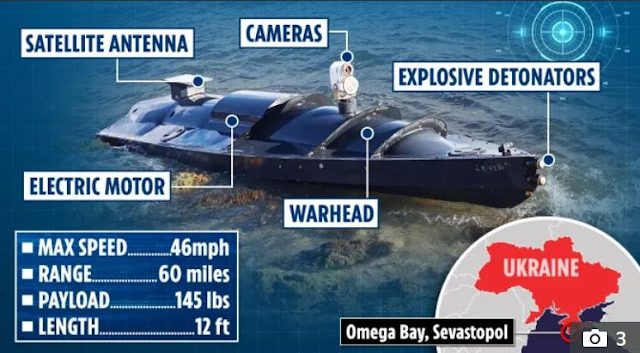
    A MYSTERIOUS vessel widely believed to be a Ukrainian suicide drone has washed up near to a Russian naval base.

    The vessel was found in Omega Bay, by the port of Sevastopol, which is home to Vladimir Putin’s Black Sea fleet.

We can safely assume — as the videos below seem to demonstrate — that the ones used in the attack are of the same design.

We will loop back to this point later, but just behold the simplicity of it via the article from The Sun linked above;

This is all COTS technology riding on either a canoe or ocean going kayak. If you have someone with an understanding of explosives and communications (the only part requiring military expertise +/-) and then any garden variety electrician, small engine pro, and fiberglass guy … you can run a production line of these on a shoestring budget at scale.

[…]

This is another demonstration that the military culture of Russia is broken. The human element in the Sevastopol was manifested in the complete lack of preparation for the attack in spite of the warnings so clearly provided in September.

As old as “fire ships” are to naval warfare are the defenses against them. They are as simple as the weapons you need to defend against them. Barriers at the water level and crew served weapons — preferable optically sighted — as a backup.

Part of the video above you can see both surface ship and helo gunfire taking out the threat from one boat, but other boats were able to approach surface ships underway and penetrate deep in to port.

Why?

What is one of the things we have repeatedly discussed here for the last 18-years? When war comes you never have enough of what? That’s right, anti-aircraft defenses and medium caliber guns including crew served weapons.

We build our ships around the most high-technology threats and equally exquisite defenses against them, but completely overlook the low-tech weapons that are just as deadly. We ignore mine warfare, and we also ignore threats as simple as a converted kayak. It isn’t sexy and the contracts awarded are small … but the threats are real.

October 30, 2022

Fresh German Armor in the USSR! – WW2 – 218 – October 29, 1943

World War Two
Published 29 Oct 2022

Erich von Manstein finally gets the reserve armor he’s been begging Hitler for, so he can carry out his counteroffensive in Ukraine. The Soviets are still on the move themselves though. In Italy, though, the Allies are moving at a crawl since the Germans have mined and booby trapped everything. There’s also new action in the Solomons and a celebration in Japan.
(more…)

October 23, 2022

Stalin Agrees to the United Nations – WW2 – 217 – October 22, 1943

World War Two
Published 22 Oct 2022

A conference in Moscow lays out some postwar plans of the Allies, but the war has to be won first. The Allies fight their way across both the Dnieper and Volturno Rivers, but the going looks like it’s going to be tougher after the crossings. Meanwhile, in the South Seas the Japanese change plans in the face of Allied advances over there.
(more…)

October 16, 2022

Zaporizhzhia! – WW2 – 216 – October 15, 1943

Filed under: Britain, Germany, History, Italy, Japan, Military, Pacific, Russia, USA, WW2 — Tags: , , , , — Nicholas @ 04:00

World War Two
Published 15 Oct 2022

The Allies begin an aerial bombing campaign against the Japanese base at Rabaul. It has big success, though Allied bombing in Europe this week achieves big failure. The Allied advance in Italy is slowing down to a crawl, but in the USSR the advance across the Dnieper continues, specifically at the Zaporozhe bridgehead.
(more…)

October 9, 2022

Could the Soviets Cut Off Crimea? – WW2 – 215 – October 8, 1943

Filed under: Australia, Germany, History, Italy, Japan, Military, Pacific, Russia, USA, WW2 — Tags: , , , , — Nicholas @ 04:00

World War Two
Published 8 Oct 2022

The Germans booby-trapped Naples when they evacuated last week and local civilians now pay the price. In the Mediterranean, Kos falls to the Germans while Corsica is liberated by the French. There is action all along the Dnieper in the USSR, and the Australians advance in New Guinea, and the Japanese evacuate Vella Lavella in the Solomons.
(more…)

October 6, 2022

This vehicle belongs in a museum. Why is it still being used in Ukraine?

Filed under: Europe, History, Military, Russia, Weapons — Tags: , , , , , , — Nicholas @ 04:00

Imperial War Museums
Published 5 Oct 2022

The BMP-1 is a Soviet infantry fighting vehicle from the 1960s. Ours was captured during Operation Desert Storm in 1991 and has been on display at IWM Duxford for over 30 years. Yet vehicles just like It are still being used by both sides in the ongoing Russo-Ukrainian War, with heavy losses. So why are museum pieces being fielded in a 21st century war? And how are they performing?
(more…)

October 4, 2022

Sweden: The Jews’ Salvation? – WAH 080 – October 2, 1943

World War Two
Published 2 Oct 2022

As the Allies advance in southern Italy, the people of Naples join them in fighting the Wehrmacht. In Denmark, the biggest rescue operation of Jews thus far begins.
(more…)

October 3, 2022

“We’re one breaking news alert from seeing a day’s work dramatically reduced in importance, if not rendered obsolete forever”

Filed under: Europe, Military, Russia — Tags: , , , , — Nicholas @ 03:00

It’s a very weird moment in time, as The Line‘s weekly editorial wrap-up notes:

This is perhaps the strangest dispatch we’ve ever written. It is a fact of life in the news business that top headline can change in an instant. We’re one breaking news alert from seeing a day’s work dramatically reduced in importance, if not rendered obsolete forever. Every journalist has known that frustration. And today, as Western officials remain concerned about the risk of nuclear attack, this seems more true than usual. All our little insights into Canadian politics and cultural issues would make a weird second and third item in a dispatch where the lead item was Kyiv going up in a mushroom cloud.

So yes. This is where our minds are. As discussed at some length in our podcast and video this week, your Line editors have been closely watching developments in the war between Ukraine and Russia, and indeed take very seriously threats by the Russians to use nuclear weapons. We understand fully that it is very possible that all of Putin’s talk of nukes is a bluff, intended to rattle the West and encourage Ukraine to accept Russian gains and negotiate.

Neither seems likely — Ukraine is motivated and Western support, though imperfect, remains strong. We also see little indication that Putin could win the war in which he has stranded himself and his country, and we believe that things will only get worse for him. His attempt to mobilize 300,000 has turned into an item of mockery abroad, as pictures of old men and rusted equipment spread across social media. The “annexation” of occupied areas into Russia clearly didn’t deter either Ukraine or its Western backers; Ukraine’s forces remain on the move, with more Western weapons arriving all the time. And meanwhile, on the battlefield, the Ukrainian Armed Forces grow ever stronger: in just the last few hours, they have handed the Russians another embarrassing defeat in the city of Lyman. That city, a local rail junction, was important for Putin’s logistical efforts in the region, and fell into Ukrainian hands with a shocking lack of resistance.

See what we mean? This isn’t going well for Russia, and everything he tries is just stranding Putin deeper in the shit. He could have de-escalated this war at several points. At every juncture he has chosen escalation instead, and that has only made his problems worse — more deaths, more unrest, more humiliation. All of his efforts to intimidate the West or crush the Ukrainians have failed. What can he do? How can he get himself out of this problem? What will happen to him if he can’t?

These are the questions keeping us up at night. Seeing the conflict through his eyes, it’s not hard for us to imagine that Putin will come to view some kind of nuclear use as his only remaining chance to escape this war with his power still in place, or perhaps even simply with his life. After all, all this talk about whether Putin is “rational” depends entirely on how he understands his own circumstances. What may seem insane to us may, in fact, make perfect sense to him, and we suspect one’s definition of reason undergoes a radical re-evaluation when one feels a noose getting ever-tighter around the throat.

So that’s why we think it’s possible. Let’s talk what we think is possible. There are a few different ways he could use nuclear weapons. We are not the experts on this, but your Line editors are, if nothing else, reasonably well read on the topic, and we have spent the last few weeks talking with genuine experts. If we do see the use of a nuclear weapon, Putin could use a single small device on a minor target in Ukraine (or perhaps over the Black Sea) in hopes of shocking NATO and the world through his sheer willingness to break the nuclear taboo. We would expect him to go a bit further, and hit Ukraine with a series of small strikes intended to disrupt its military and seize some kind of conventional military advantage on the ground, on top of the political shock.

Or hey: he could go fully insane and try to terrorize the world into bending to his will by, for instance, attacking NATO directly, or using one of his larger nuclear weapons to utterly destroy a city in Ukraine.

October 2, 2022

Smolensk and Naples Liberated! Both in ruins – WW2 – 214 – October 1, 1943

World War Two
Published 1 Oct 2022

Major prizes are taken by the Allies this week on two fronts — Naples in Italy and Smolensk in the USSR, but they are advancing all over the Eastern Front, across the Italian peninsula, and in the South Seas, but the enemy is leaving a trail of destruction as he pulls back.
(more…)

October 1, 2022

American Empire, question mark

Filed under: Books, China, History, Politics, USA — Tags: , , , , , , , — Nicholas @ 03:00

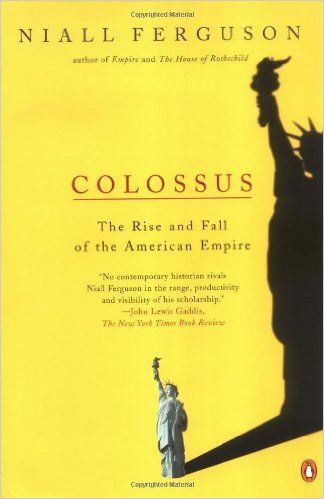
An interview with Niall Ferguson in the Dartmouth Review by Lintaro Donovan revisits Ferguson’s 2005 book Colossus in light of what has happened during the nearly two decades since it was published:

TDR: In your 2005 book Colossus: The Rise and Fall of the American Empire, you advance the thesis that the United States is an empire in denial and that such denial will be our undoing, both domestically and abroad. Does that thesis still hold in the world of 2022?

NF: I think it has withstood quite well the test of nearly 20 years. If you recall, the analysis was that the United States was trying essentially an imperial enterprise in Afghanistan and Iraq and that there were three deficits that were going to make it fail. There was the manpower deficit, because people really did not want to spend that much time in Afghanistan and Iraq – hence the short tours of duty. There was the fiscal deficit, which was already obviously a problem and has only gotten worse. And then there was the attention deficit. The prediction was that the US [BREAK] public would become disillusioned with these endeavors just as it became disillusioned with Vietnam. And if anything, the surprising thing is how long it took to get out of Afghanistan.

I wouldn’t have predicted it would be 2021. I expected it sooner than that. But I think that the overall framing of the US as an empire-in-denial works because it’s so deeply rooted in the way Americans think about themselves and the language that their leaders use. What was odd was that some neo-conservatives back then really were willing to say, “We’re an empire now”.

Of course, it kind of blew them up politically so that they’re now an irrelevant bunch of never-Trumpers. So I feel that book stood up remarkably well to the test of time. I’d stick by it.

TDR: What I’m hearing from your answer is that our denial is sort of endemic to what Americans are and that there were issues that were already present before the invasion of Iraq. Do you think that there’s any personality in American public life today who might be able to get us out of our denial and fix these issues that you’re talking about?

NF: No, because I think, if anything, the kind of aversion to empire has grown on both the left and the right. And so you have different versions of it.

Those wings, the progressive wing of the Democratic Party and the Trumpian wing of the Republican Party, are much stronger than they were then. I don’t think we are going to see any revival until the US suffers the kind of attack that it suffered at Pearl Harbor or 9/11.

Until there’s a punch landed, what will happen is that the US will try to exercise power through indirect means like sanctions or getting Ukrainians to fight Russians or arming the Taiwanese. And, in that sense, I think we’ve reverted to a Cold War playbook without calling it a cold war.

The problem is that we aren’t as far ahead [of China] economically and technologically as we were relative to the Soviet Union. If you’re doing a cold war with China, you have to reckon with quite a formidable antagonist, but that I think is where we are.

It’s amazing how far there is now a bipartisan consensus that China’s the problem. The continuities from the Trump to Biden Administration are very striking in that respect. I don’t see that changing until something bad happens, whether it’s a showdown over Taiwan that the US actually loses, or the collapse of Ukraine, which I guess is a conceivable if now unlikely scenario, or another terrorist attack, though I think that’s not especially likely these days.

The other thing to watch out for is the Middle East. Basically, as in the Cold War, you’ve got the potential for a crisis to happen. The problem for the US is that it’s quite overstretched. If there’s a crisis in Eastern Europe and a crisis in the Far East, say Taiwan, and one in the Middle East, then the US is going to be completely unable to respond to all of those.

It’s already in the position that it can’t give Stinger and Javelin missiles to the Taiwanese, because they’ve already been given to the Ukrainians and we can’t actually make that many new ones. It feels like we are doing Cold War but with quite a bit more overstretch than was true certainly in the 1980s.

September 29, 2022

Considering weird possible scenarios in Ukraine

Filed under: Military, Russia — Tags: , , , , — Nicholas @ 05:00

In The Line, Matt Gurney walks through some until recently unimaginable outcomes of the Russian invasion of Ukraine:

It’s probably time for us to start thinking through some weird possible scenarios for what’s happening in Russia. Because the spectrum of what could happen is a lot broader than it seemed only six months ago.

But let’s start with an important exercise in accountability. In previous commentary, I predicted a lot of things well: that Ukrainian resistance would be very effective, that Russia would have major logistics problems, that the Russians would use mass artillery fire against civilians in place of military advances. I was quick to grasp that Ukraine was overperforming and that Russia was struggling early in the conflict.

But getting some details right didn’t help me avoid blowing the conclusion: I thought Russia would win. Not a total victory, but I thought Russia would seize a lot more of the country before its logistical problems and Ukrainian resistance brought their offensives to a halt, leaving Ukraine with some kind of rump state in the west. I certainly didn’t believe in February that Russia could lose, and I never would have believed that Ukraine could actually win on the battlefield, as it now seems more than capable of doing.

I don’t know if I underestimated Ukrainian capabilities, per se. I always expected them to fight bravely and well, and understood the lethality of modern man-portable weapons against tanks and armoured vehicles. It’s probably closer to the mark to say that I overestimated Russia’s capabilities — I was a cynic on their military and expected it to perform badly, but it’s somehow fallen well short of my already low expectations. It is absolutely delightful to be wrong on this one, but readers deserve the truth: I expected Russia’s military to perform better and grab a much bigger chunk of Ukraine before having to stop in the face of logistical dysfunction and Ukrainian resistance. Part of me wonders if the Russians themselves are surprised by how hollowed out their military had become.

With that on the record, let’s flash forward to the present. As noted above, Ukraine now seems fully able to win the war. As I write this, Ukrainian forces are on the move again in the northeast, and seem to be encircling Russian positions in occupied Lyman. If able to complete this latest manoeuvre, Ukrainian forces will cut off a large force of Russian troops and will also seize control of an important local rail junction, threatening Russian logistics (such as they are) in the surrounding area. Perhaps more importantly to the overall conduct of the war, Russia’s effort to mobilize 300,000 men for the war is running into obvious challenges. Men of military age are fleeing the country. Reports from Russia reveal that the army has little in the way of equipment and weapons for the new draftees, and no system in place to train them. There have been comically bizarre stories of infirm old men getting call-up notices, and of draftees being sent to the front after only a day or two of training … at best.

This isn’t a solution to Putin’s problems. It’s a new problem being created in real time. Even if Putin can find 300,000 men, it seems unlikely he can equip them, and even less likely that he can train them. Whether or not he can transport what men he does round up into the battle area is an open question, as is whether or not he can supply them once they get there.

This is the long way of saying something I’ll now just state bluntly: Russia is losing. Putin’s latest actions reveal that he knows he’s losing. If the mobilization flops, as seems likely, he’ll be losing even worse than he was losing before, and he’ll have damn few options to turn that around.

And this is why we need to start thinking through some weird scenarios.

September 28, 2022

Putin’s nuclear option may not be as decisive in Ukraine as many fear

Filed under: History, Military, Russia, Weapons — Tags: , , — Nicholas @ 05:00

Like almost everyone else, I’m still hopeful that the Russians will not resort to nuclear weapons as their invasion of Ukraine drags on and on — especially as it’s expected that any first use of nuclear weapons will trigger a global crisis or even a new world war. At Quora, John Mark McDonald offers his take on the issue that certainly doesn’t match what most pundits appear to believe:
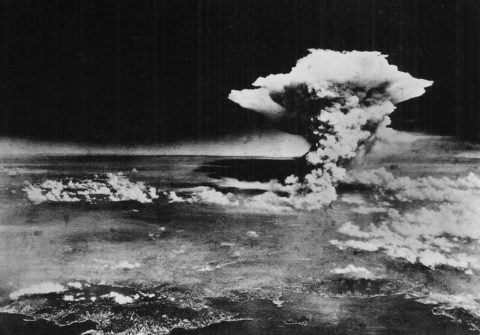
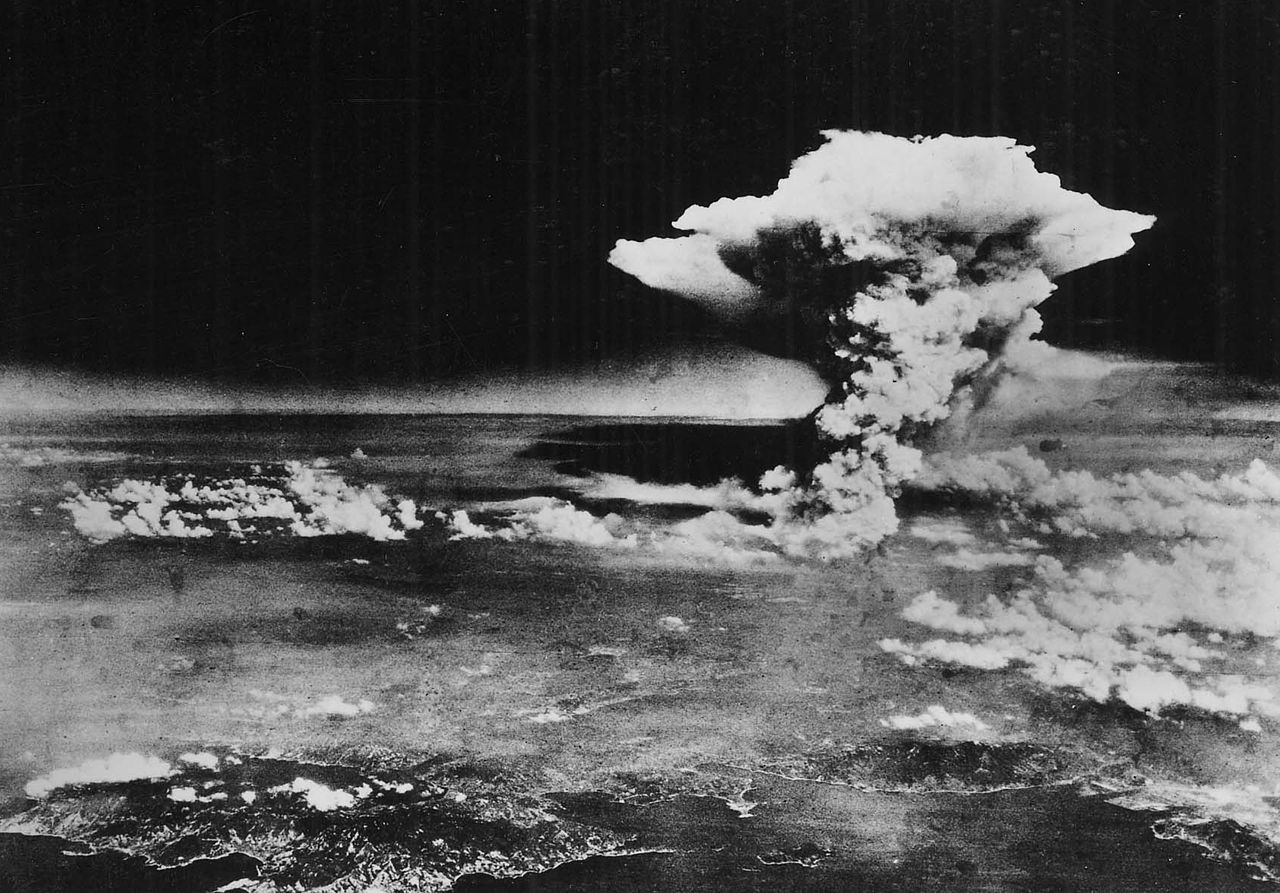
Atomic cloud over Hiroshima, taken from “Enola Gay” flying over Matsuyama, Shikoku, 6 August, 1945.
US Army Air Force photo via Wikimedia Commons.

As someone who has studied nuclear war for close to forty years now, I am going to give you an answer that will blow your mind. Even if the entire Russian nuclear arsenal were used against Ukraine, it wouldn’t substantially change the course of the war. How could I possibly say that? Because, the power of nuclear weapons has been used as a boogeyman for so long that the actual power of a nuclear detonation has almost no relation to their actual destructive power. No nuclear power can afford to actually use one in combat because it would expose the mythical nature of nuclear weapons.

Nuclear weapons are hyped to the point that no one contradicts it when a media outlet publishes a statement indicating that even a single nuclear device will destroy the world. This is a blatantly, stupidly, obviously untrue, but never corrected. After all, two were used in WWII. BUT that is just the tip of the iceburg. I thought there had been a couple of hundred nuclear test that prove this point. I was off by over an order of magnitude. There have been nearly THREE THOUSAND NUCLEAR DETONATIONS ALREADY, that are either known or suspected and this has not effected the survivability of life on Earth even slightly.

Well then, how dangerous are nuclear weapons? Nuclear weapons, if they weren’t their own catagory, would be classified as incendiary weapons. They set stuff on fire. They set a lot of stuff on fire. In fact they can set things on fire as far as two miles away from the actual detonation. Besides this, nuclear detonation are very bright, capable of blinding people 20–30 miles away. This is only constrained by the curvature of the earth. They also create hurricane force winds as the air around the detonation expands and contracts. If you are outside and unshielded and within a mile of a nuclear detonation, you are going to die.

The problem here is that Ukraine is really big. I mean the size of Texas big. Cities there tend to be spread out in modern times and their larger ones cover over a hundred square miles. The average nuclear detonation are only burn 2–3 square miles of territory. A city the size of Kiev would take on the order of 200 warheads to cover the whole thing.

Which brings us to our next point. Modern cities are just not that vulnerable to incendiaries. Modern city centers and industrial areas are made of concrete and steel. Most of the damage in Hiroshima and Nagasaki was done because almost all the buildings were made of wood and paper. The initial blast set the city centers on fire which spread and ended up burning down most of the city. Modern cities are just not that vulnerable. In Ukraine, despite millions of rounds of being poured into their cities, not one of them caught fire and burned to the ground like the Great Chicago or Great London Fires in the 19th century or the fire storms of WWII. In the Japanese nuclear detonations, the brick buildings were still standing, despite being much less sturdy than modern buildings. This leads to the most surprising revelation about nuclear detonations: If you are not outside, you stand a good chance of surviving even within the blast zone. Nuclear blasts are mainly line of sight killers. The vast majority of “radiation” created by an nuclear detonation is infrared radiation, or heat the same as a gas stove or fireplace makes. Unless the building you are in is collapsed by the wind or you fail to leave if it catches on fire or you happen to be in front of a window with a direct line of sight to the detonation, you are probably going to be fine.

Thus we get to the real reason why Putin will not use nuclear weapons: they’re just not all that effective compared to the boogeyman that is in our collective imaginations. Were a nuclear missile to detonate over central Kiev, no one would believe that it was an actual nuclear blast because the city is still there and all the major buildings are still standing.

Secondly, he doesn’t have very many of them. The numbers given for the Russian nuclear arsenal are an outright farce. You get that number by taking of bombs that the USSR claimed to have built, and subtract the number used in their testing program. This leaves you with about 9,000 warheads. First of all, Russia doesn’t have nearly enough delivery systems to put those warheads on. The second problem here is that nuclear warheads have a very short shelf life. Nuclear warheads require a detonator made of conventional explosives. These detonators are some of the most precision pieces of engineering in the history of mankind. A series of explosives has to go off in such a way that the core is hit by the same amount of pressure from all directions simultaneously. If any of those explosives are even slightly off, the nuclear warhead will not go off. You now have an extremely precise machine sitting around a core of material emiting hard radiation. Hard radiation is not friendly to machines. Nuclear warheads need to be rebuilt a least every five years and maintained a lot more often than that. Even with that, a twenty year old warhead is a piece of junk. It’s been more than twenty years since the Putin kleptocracy came to power. I’m sure that Russia has a number of Potemkin warheads that are kept in top shape for inspectors, but given the current Russian system, the Russian nuclear arsenal most likely resembles the Russian tank reserves: the bare minimum kept in service while the rest is a scrap pile.

Currently, the spector of the vast Russian nuclear arsenal is the last card he has in his hand. If he were to actually use it, it would expose that he never had anything but a junk hand and bluffing to back it up.

H/T to Never Yet Melted for the link.

CDR Salamander also looks at the nuclear question:

Some are looking closer at the nuclear option that Russia has. I think they are looking too hard. A good example of this line of concern was in yesterday’s WaPo by Joseph Cirincione.

NB: Before the pull quotes, a fair warning – Cirincione is selling a book titled, Nuclear Nightmares: Securing the World Before it is Too Late, so keep that in consideration;

    Russian President Vladimir Putin is losing his war. If the Ukrainians continue to liberate areas of their country from his invading army, would he actually use nuclear weapons as he has threatened? If so, how? And what would the U.S. response be?

    It is difficult to put percentages on risk. Nor does it really matter. Given the stakes, if the chances are 10 percent or 40 percent, the response would be the same: Minimize the possibility of nuclear use, and prepare responses in advance.

This is when I remind everyone that “we” are horrible at predicting the next war early enough to prevent them. The track record is simply not very good. However, Cirincione has invested a lot of time and effort in looking at this — so we should give his ideas some consideration;

The next quote reminded me of a little reminder a peer gave me back when I was a NATO staff weenie at the other end of the HQ p-way from him. As a JO, he was on the other side of the wire as an JO in the Warsaw Pact. “Americans may not follow their doctrine very well, but Russians do.”

    Russian military writings describe in detail how, if Russia is losing a conflict, it could use nuclear weapons to force its enemy to retreat. This “escalate to de-escalate” or “escalate to win” strategy is somewhat controversial, but it is not dissimilar to various U.S. plans for using nuclear weapons first.

Well, sometimes we follow our doctrine. Sometimes the Russians don’t … but if you are playing odds …

I still stand by my belief — and that is a weak thread, I know — that in the next war, nuclear weapons will be what chemical weapons were during WWII. Everyone had them; no one used them.

If nuclear weapons were to appear on the Ukrainian stage, Cirincione does not have this COA as his most likely … but it is my most likely if one must choose from the “Nuke” basket;

    Demonstration shot. One option is for Russia to fire a nuclear weapon over an uninhabited area — say, part of the Black Sea — as a demonstration of its seriousness in hopes that the West will back down. Some scientists involved in the Manhattan Project urged just such a demonstration shot as an alternative to bombing Japanese cities at the end of World War II. While no one would be killed and there would not be physical damage, the explosion would stop the world in its tracks. There has not been a nuclear weapon used in combat in 77 years. No one has even seen a nuclear explosion above ground since 1980.

This is their neighborhood and fallout will drift to their lands if nukes are used. Is anyone going to buy grain downwind? No. Next to underground explosions, explosions high over the water or in the atmosphere create the least secondary radiation effects. Don’t underestimate the lingering memory of Chernobyl. I see “Demonstration Shot” of the most likely COA of the least likely Nuke COAs.

    As shocking as this would be, Russia would likely reject this option for the same reason U.S. military leaders did in 1945: It is not shocking enough.

Don’t agree. Russia believes their own FITREPs, so to speak. The arrogance of their initial OPLAN speaks to this. They hold most of Central and especially Western Europe in contempt. I am sure a nuke over the Black Sea would be shocking enough (and they’re right).


September 25, 2022

Red Army Reaches the Dnieper – WW2 – 213 – September 24, 1943

World War Two
Published 24 Sep 2022

Benito Mussolini proclaims a new fascist republic in Italy, but this time it is a full puppet state to Germany. There is scattered fighting around Italy and the Dodecanese — including a massacre of Italian POWs, but the big Allied advances this week are the Australians in New Guinea and the Soviets retaking their own territory. They take ground, in fact, from near Smolensk all the way south to the Sea of Azov.
(more…)

« Newer Posts — Older Posts »

Powered by WordPress