Quotulatiousness

March 20, 2019

A Supreme Court case that created huge sales tax problems for online firms

Filed under: Business, Government, Law, USA — Tags: , , — Nicholas @ 03:00

Eric Boehm explains why an obscure US Supreme Court ruling is making life extremely complicated for thousands and thousands of online businesses:

… Until last year, that meant Heitman was responsible for collecting and paying sales taxes to exactly one place: the Wisconsin Department of Revenue. But thanks to an under-the-radar ruling from the U.S. Supreme Court in June, he’s now receiving letters, phone calls, and emails from revenue officials across the country, each wanting a piece of his business.

The source of Heitman’s frustrations is Wayfair v. South Dakota, which allowed states to collect sales taxes from online businesses located beyond their borders. Many states view the Wayfair ruling as a potential tax revenue windfall in which the taxes are paid by non-residents who can’t vote against them. That’s why businesses like Heitman’s are now facing the chilling prospect of owing taxes in dozens, and possibly hundreds, of different jurisdictions — while being hounded by out-of-state tax collectors.

Since the Supreme Court issued its ruling in June, Heitman has been scrambling to become compliant with tax commissions and revenue departments from coast to coast. He’s spent thousands of dollars on new software to help navigate the complexities of state sales tax law, but that’s only been so much help. “It almost seems like I have another full time job dumped on me with this sales tax thing,” he says. “It’s burning me out.”

As the 2019 tax season begins, states are ramping up efforts to squeeze extra revenue out of remote retailers like Heitman, putting an expensive new burden on businesses that have found broad customer bases online. The burden is particularly large in the five U.S. states that charge no sales tax, where entrepreneurs could now be charged with paying a tax they have never had to pay before, to a government over which they have no voice. And while Congress could clean up the Supreme Court’s mess, it’s far from certain that it will.

Warren Meyer points out that it’s not just the individual states who are taking advantage of this windfall opportunity to collect taxes from non-residents:

Like most writers, Mr. Boehm actually understates the problem. Because the potential exists not to have 50 new taxing authorities for every sales, but thousands. I have to deal with this every day. I wrote a while back:

    Take Arizona, which seems from my experience to be roughly average. The sales tax rate table is 18 pages long in a small font. There are 29 separate rate categories which each have different rates in each of Arizona’s 15 counties. My business is in 6 counties and we have 3 rate categories that apply, or 4 if you consider items with no tax as another rate category. This is 24 different state/county sales tax rates we charge. But that is the easy part. Because then there are, in addition to county taxes, 92 different towns and cities that have their own rate tables with up to 29 different rate categories that add to the base state/county rate. Other states such as Washington (rule of thumb — if the state has no income tax then it has a LABYRINTHIAN sales and business tax systems) have additional overlay taxes such as for transit and stadium districts.

    When my company opens a new location, we have to spend hours on the Internet and with maps trying to figure out what sales taxes to collect, and even with good due diligence we sometimes get it wrong and find in an audit we are actually just inside or outside some line where the rate changes (we once had a location 30 miles outside of Seattle on a long dirt road where we found we had to collect the Seattle Rapid Transit tax). Thatcher, AZ is a town of like 4000 people but has its own special sales tax rates — do you know where the town line is? Well neither do they, because last time I checked they did not have any sort of online lookup system to tell one automatically if the address is inside or outside the town and its sales tax district…

    But even after registering in all 50 states, you are STILL not done, because many states don’t have a fully unified sales tax collection system. In Arizona, for example, the larger cities require their own registration and monthly reporting.

Meyer is operating a company that has physical assets and employees in each of the states and lesser jurisdictions to which taxes are due. Internet businesses generally only have physical assets in a single state, yet an expansive reading of the Wayfair ruling (the type of reading most jurisdictions will prefer) makes them liable for taxes almost everywhere.

February 21, 2019

“Excessive fines can be used … to retaliate against or chill the speech of political enemies”

The US Supreme Court delivered a unanimous body blow to excessive use of asset forfeiture by state and local police:

Timbs challenged that seizure, arguing that taking his vehicle amounted to an additional fine on top of the sentence he had already received. The Indiana Supreme Court rejected that argument, solely because the U.S. Supreme Court had never explicitly stated that the Eighth Amendment applied to the states.

On Wednesday, the high court did exactly that.

“For good reason, the protection against excessive fines has been a constant shield throughout Anglo-American history,” wrote Justice Ruth Bader Ginsburg in the opinion. “Excessive fines can be used, for example, to retaliate against or chill the speech of political enemies,” she wrote, or can become sources of revenue disconnected from the criminal justice system.

Indeed, some local governments do use fines and fees as a means to raise revenue, and that has created a perverse incentive to target residents. After the 2014 shooting of Michael Brown in Ferguson, Missouri, a federal investigation into the city government found that 20 percent of its general fund came from criminal fines. And Ferguson is not alone in relying heavily on revenue from fines. Making clear that the Eighth Amendment applies to the states will make it far easier to challenge unreasonable fines and fees — including not just asset forfeiture cases, but also situations where local governments hit homeowners with massive civil penalties for offenses such as unapproved paint jobs or Halloween decorations.

Some of those cases are already getting teed up. As C.J. Ciaramella wrote in this month’s issue of Reason, a federal class action civil rights lawsuit challenging the aggressive asset forfeiture program in Wayne County, Michigan, that was filed in December argues that the county’s seizure of a 2015 Kia Soul after the owner was caught with $10 of marijuana should be deemed an excessive fine.

November 4, 2018

That pesky Supreme court ruling on the Churchill Falls deal

Filed under: Cancon, Economics, Law — Tags: , , , — Nicholas @ 03:00

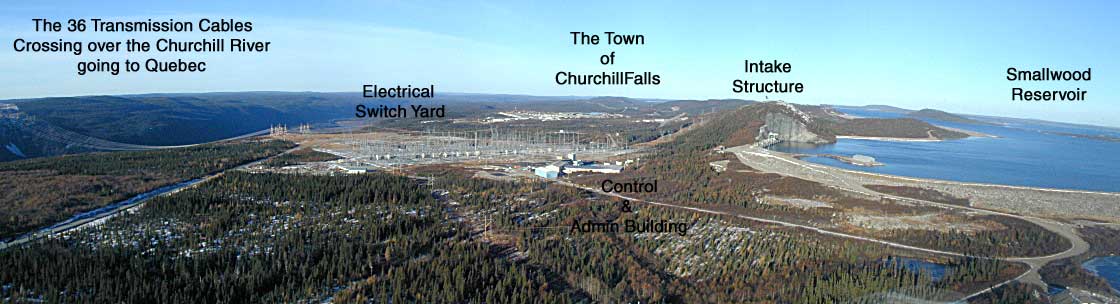
I use the term “pesky” in the headline to avoid being slagged by one or possibly even both of my Newfoundland and Labrador readers … to curry favour with them, I’d need to escalate from somewhere between “ethically doubtful” and “outrageous”, and even that might not capture the essence of anger and resentment at Quebec’s amazingly great deal long-term on cheap hydro-electric power from the Churchill Falls facility. It is, as Wikipedia says, “the second largest hydroelectric plant in North America, with an installed capacity of 5,428 MW”, and thanks to Quebec financing and astute negotiations, most of that output is sold to Quebec at a very small proportion of today’s open market price. Colby Cosh arches an eyebrow over a Supreme Court justice’s lone vote of dissent on the case:

Churchill Falls generating station, Labrador.
Photo via Wikimedia Commons.

It is my solemn duty to perform one of the important functions of a newspaper columnist: raising one questioning eyebrow. On Friday the Supreme Court issued a judgment in the long battle between Churchill Falls (Labrador) Corp., a subsidiary of Newfoundland and Labrador Hydro, and Hydro-Québec. CFLco is the legal owner of the notorious Churchill Falls Generating Station in the deep interior of Labrador, close to the border with Quebec.

The station was built between 1966 and 1971. Hydro-Québec provided backing when the financing proved difficult for the original owner, an energy exploration consortium called Brinco. This led to the signing of Canada’s most famous lopsided contract: a 1969 deal for Hydro-Québec to receive most of the plant’s output for the next 40 years at a quarter of a cent per kilowatt-hour, followed by 25 more years at one-fifth of a cent. The bargain ends in 2041, at which time CFLco will get full use and disposal of the station’s electricity back.

This has been a heck of a deal for Quebec. It took on the risk of financing and building the station in exchange for receiving the electricity at a low fixed price — one that both sides in the court case agree was reasonable at the time. But it meant that Newfoundland saw no benefit from decades of oil price shocks, from the end of nuke-plant construction in the U.S., or from the increasing market advantage hydroelectricity enjoys while dirtier forms of power generation attract eco-taxation.

It has been maddening for Newfoundland to remain poor while Hydro-Québec grows fat on the profits from a Newfoundland river. Quebec, for its part, has never been completely convinced of the legitimacy of its border with Labrador, and it sees its good fortune as a sort of angelic reward for having to be part of Confederation. The Churchill Falls deal is (quite reasonably) regarded as proof that Quebec’s homegrown industrialists were able to beat resource-exploiting Anglo financiers at their own game. There are thus reasons beyond the bottom line that Quebec has never wanted to renegotiate the Churchill Falls contract. But the bottom line is enough.

October 11, 2018

QotD: The radical, right wing US Supreme Court

Filed under: Law, Politics, Quotations, USA — Tags: , , , , — Nicholas @ 01:00

We don’t have a “radical right-wing Supreme Court,” despite lots of mewing on the left to the contrary. Here are some things that would be at the top of the list for a radical right-wing Court: (1) ban abortion nationwide as a violation of the right to life protected by the due process clause; (2) rule that publicly-provided (but not funded) education is unconstitutional because it inherently involves viewpoint discrimination by the government, or at least require vouchers for those who object to the public school curriculum; (3) overrule an 1898 precedent and completely abolish birthright citizenship; (4) Use the First Amendment as a sword to require “fairness” in the left-dominated media. Not only is the Supreme Court not about to do any of things, I don’t think any of these things would even get one vote on the current Court. Moreover, merely bringing the scope of Congress’s constitutional back to where it was, say, in 1935, which was already much broader than the original meaning of the Commerce power, probably wouldn’t get more than one or two votes. What you are looking at right now is a conservative Court that will only affect society on the margins, not a “radical right-wing” Court.

David Bernstein, “WE DON’T HAVE A ‘RADICAL RIGHT-WING SUPREME COURT'”, Instapundit, 2018-10-09.

September 30, 2018

Contempt for the voters (even their own voters)

Filed under: Media, Politics, USA — Tags: , , , , — Nicholas @ 05:00

Steve Kates has been watching the confirmation hearings and associated circus acts in the US senate:

Let me start by explaining the basic framework. This is all politics. No one among the Democrat senators believes a word of Ford’s testimony. Not one of them would say a word were Kavanaugh a Democrat nominee. It is all show for the morons who vote for them. The disdain the Democrats have for their own voters is gigantic. They see them in the same way as I do: as low information, dumb beyond belief fools without a shred of common sense. They can see perfectly well that all of this has no other purpose but to make it harder for a government from the other party to govern. They want to pack the court with judges who will vote to do those things that cannot be done via a democratic legislative process. They understand perfectly well that they are trivialising accusations of rape. They comprehend without a shred of doubt that they are making the United States less governable. They can see without any hesitation that Ford is a stooge that has been put forward because the saps in their electorates across America eat all this up and hunger for more. They therefore do it because they enjoy the power this provides to them. They do it because they believe it will attract more voters than it will repel. They are making it as plain as day that they think their own constituency is ignorant and repulsive. But this is their line of work and if they are to keep their jobs, this is what they must do.

The Republicans think exactly the same – that Democrat voters are fools. And they know just as well as the Democrats that there is a proportion of the voting population that will make their vote depend on this and this alone. They understand rape is a terrible event in anyone’s life and would not nominate anyone if there were any genuine evidence that any of the accusations made against Kavanaugh are true. Aside from those members of their Senate caucus who prevented a majority vote from succeeding, they would have nevertheless taken the risk of the bad press that will follow when and if they confirm Kavanaugh’s nomination. They have a razor-thin majority in the Senate that can only survive a near-unanimous vote from their side of the aisle. They are counting on there being enough common sense and sound judgment left with the voting public to be able to succeed and retain the House and Senate majorities in November. They see the Democrat tactics for what they are.

As for the notion of sexual assault, to really believe that is the issue makes you so stupid that it is painful to see what nitwits politicians have to deal with routinely.

September 13, 2018

The lasting impact of Haida Nation vs. British Columbia

Filed under: Cancon, Government, History, Law — Tags: , — Nicholas @ 03:00

I was not aware that a single case had such a major influence on relations between the federal and provincial governments on the one hand and First Nations groups on the other. Barbara Kay explains just how we got to the point of overturning decades of settled legal practice in the wake of the Haida Nation decision:

In his newly published book, There is no Difference: An Argument for the Abolition of the Indian Reserve System, lawyer Peter Best devotes a chapter to unpacking the consequences of Haida Nation. It makes for fascinating reading.

Before this decision, Best says, it was understood “that aboriginal claims and rights over the land were more than ‘reconciled.’ In fact, Canadians, Indians and non-Indians alike, thought they were, especially in treaty areas, extinguished, plain and simple,” apart from the right to hunt, fish and trap on unoccupied wilderness Crown land, and even then with Crown sovereignty. Haida Nation – and cases decided since then – reversed the meaning of the treaties.

The SCC read in an intent “merely to ‘reconcile’ Indians’ prior sovereign occupancy of the land with the new sovereignty of the Crown.” That is, they were “instruments of power and land-sharing, not instruments of rights extinguishment.”

So it seems we are now in a never-ending power-sharing arrangement, “requiring the constant, expensive, uncertain fine-tuning and adjustment from time to never-ending time of the granted Crown rights with the retained sovereign Indian rights.” This new jurisprudence, Best says, decrees a devolution of Crown sovereignty to Indians – a handing back of previously surrendered power, effectively turning Indian bands into a third order of government.

The key words, “to consult and where appropriate, accommodate the Aboriginal interests…” give Indian bands across the country power over all kinds of economic development – mines, forestry, wind power installations, roads, and of course pipelines.

Following Haida Nation, any band that asserts a proposed off-reserve project affects an Indian interest, actual or projected, the “consultation and accommodation if necessary” process is automatically launched. No evidence has to be produced, no threshold of importance to be met. (“Sacred ground” is always effective – and what ground is not sacred to aboriginals who live on it?).

In most negotiations with conflicting interests, each party has a motive to see the deal done. But “consultation” is not negotiation, and aboriginals often have no particular reason to settle. Best notes that during consultations, there’s a great deal of travel, expense account living, important meetings and pleasant busywork, with most politicians lacking the courage to utter the words “not appropriate” with regard to further “consultation.”

There is also no incentive for aboriginals to settle for anything less than exactly what they want. The Lax Kw’alaams of B.C. turned down a billion dollars in exchange for their support of an industrial project. There was no downside for them. They had the power and knew it. No matter how long they held out, their transfer payments flowed in as usual, and they took no economic risks if the project failed. If one side has nothing to lose and the other side has everything to lose, Best says, “you don’t have negotiations – you have a shakedown.”

September 2, 2018

Amtrak service and the “takings” clause

Filed under: Business, Economics, Law, Railways, USA — Tags: , , , — Nicholas @ 03:00

Back in August, Fred Frailey reluctantly came to the conclusion that at some point American freight railways are going to have to challenge in court Amtrak’s legislated ability to pre-empt freight traffic on their networks:

Amtrak’s
Eastbound Empire Builder crossing Two Medicine Trestle at East Glacier MT on 20 July 2011.
Photo by Steve Wilson via Wikimedia Commons.

We all know about “taking the Fifth.” It’s our right under the Fifth Amendment to the U.S. Constitution not to be compelled to testify against ourselves. In other words, a court cannot force us to admit to driving 60 mph in a 45-mph zone (or something worse). That amendment has another, less-well-known clause, which says government cannot take away our property without just compensation. Lawyers know this as the “Takings Clause.” The Fifth came to mind the other day as I rode Amtrak’s Empire Builder from Seattle to Chicago. I’ll get to my point, but first the experience.

[…]

All of this did terrible things to our schedule-keeping. By the third morning, as the train approached Devils Lake, N.D., we were more than eight hours late (the next day’s eastbound Builder was even later). But imagine what the Empire Builder does to BNSF’s freights every day. The Amtrak Improvement Act of 1973 reads: “Except in an emergency, intercity passenger trains operated by or on behalf of [Amtrak] shall be accorded preference over freight trains in the use of any given line of track, junction, or crossing.”

BNSF appears totally committed to obedience of this law but doing so devours the capacity of this route. It’s not just that freights give way; whizzing along at a 79 mph versus 55 or 60 for the freights, the Empire Builder eats capacity as if it were two or three freights, Six high-priority Z trains prowl the northern Transcon every day, and I don’t think a single one of them that I observed was moving as we went by. One Z train was sandwiched between two stopped manifest trains, all making way for our Builder.

Obviously, Amtrak pays BNSF for the right to run trains over the freight railroad. But whatever it pays is but a fraction of the cost in delays to its own trains incurred by BNSF. Were the northern Transcon double-tracked all the way, these delays would obviously be minimized. But at $3 million or more a mile, double tracking consumes capital like a dry sponge, and it’s not Amtrak’s capital, either.

So now to my point: Isn’t it fair to say that Amtrak, which the U.S. Supreme Court in 2015 decreed to be an arm of government, is confiscating the property (track capacity) of host railroads? And if it is, shouldn’t the freight railroads be fairly compensated for the delays to their freights caused by the loss of this capacity? Try as I might to say otherwise, I am forced to answer “yes” to both questions.

July 9, 2018

Nominating Amy Barrett “would be a tactical masterpiece on the level of Napoleon’s conduct of the Battle of Austerlitz, or Hannibal at Cannae”

Filed under: Law, Media, Politics, Religion, USA — Tags: , , , , — Nicholas @ 05:00

I have no idea who President Trump will announce later today as his nominee for the vacancy on the US Supreme Court, but Conrad Black is plumping for one particular candidate:

The desperation of the Democrats to stop the apparently inexorable rise of a president they so completely discounted and despised, and assumed they could remove or emasculate just by turning up the volume and activity of their media organ monkeys, may drive them to accidental suicide over the latest Supreme Court vacancy. I have no standing at all to intuit whom the president may nominate. But if, as I suspect, it is Judge Amy Barrett, it would be a tactical masterpiece on the level of Napoleon’s conduct of the Battle of Austerlitz, or Hannibal at Cannae.

The U.S. Senate confirmed Barrett to the Seventh U.S. Circuit Court of Appeals on October 31, by a 55-43 vote. Three Democrats voted for her and two did not vote. It would not be easy to justify changing their votes now, as she has served unexceptionably. At her confirmation hearings, Senator Dianne Feinstein, the Judiciary Committee’s aged ranking Democrat, asked Barrett about her religious views, and the nominee responded that no judge should allow personal views, whether based on faith or anything else, to influence the imposition of the law. “The dogma lives loudly within you, and that is a concern,” Feinstein said infamously. This was an outrageous comment; Feinstein doesn’t know anything about the dogma of the Roman Catholic Church, and she has no idea what privately motivates Judge Barrett.

The fury and haste of the Democrats once the starting gun went off with the announcement of the retirement of Justice Anthony Kennedy from the Supreme Court, expressed their blind panic that their entire protracted regime of encroachments and embellishments on the Constitution — buttressing their centralized and authoritarian notion of administrative juridical governance with pretense to defending the rights of women, affirmative action, and the legislative role of the judiciary generally — was now under mortal assault.

[…]

I believe the president will nominate Barrett, that the Democrats will take definitive leave of their depleted senses, apostrophize the judge as a Trojan Horse of female submission, that she will clear her hearings with flying colors while the president’s formidable battery of social media and talk show supporters roast the Democrats for attacking an exemplary female achiever and a fine jurist whose only offense is to be a member of the Roman Catholic Church, by far the largest in the country with more than 70 million adherents. Remember, too, the Supreme Court in the final days of its term ruled that crisis pregnancy centers need not advertise the virtues of abortion with Planned Parenthood, and in 2016 said the Little Sisters of the Poor could not be compelled to pay for birth control and sterilization.

As at Cannae and at Austerlitz, the center of the defending force (Democrats), will crumble and President Trump will sweep the field. The Democratic playbook of endless ear-splitting allegations of serial outrages by the president, will not, finally, bring him down. On this issue, of mobilizing unfounded sexist paranoia against a flawless nominee, thereby insulting tens of millions of American women and U.S. Roman Catholics, before raising the objections of fair-minded non-Catholic men, at least another 20 percent of the population, the Democrats will immolate themselves in an unprecedentedly spectacular launch of their midterm election campaign.

Of course, no matter who is put forward, that person will immediately become the target of a supersized version of the “two-minute hate” that will literally last for months, or until the nominee is driven to decline the nomination, at which point the hate will be directed at the next nominee. Pedantically, however, Black’s use of Cannae and Austerlitz is only metaphorical: at Austerlitz, the allied centre did crumble, but at Cannae, it was the Roman cavalry on the flanks that crumbled, allowing the Carthaginians to envelop the rear of the main Roman army. Two very different battles.

July 5, 2018

The soon-to-be-announced target of the two-minute unceasing hate

Filed under: Law, Politics, USA — Tags: , , , , — Nicholas @ 05:00

At Reason, Jacob Sullum says Trump did well with his first Supreme Court pick, and the unwillingness of Trump’s opponents to acknowledge that shows how much blind partisanship has gripped the left:

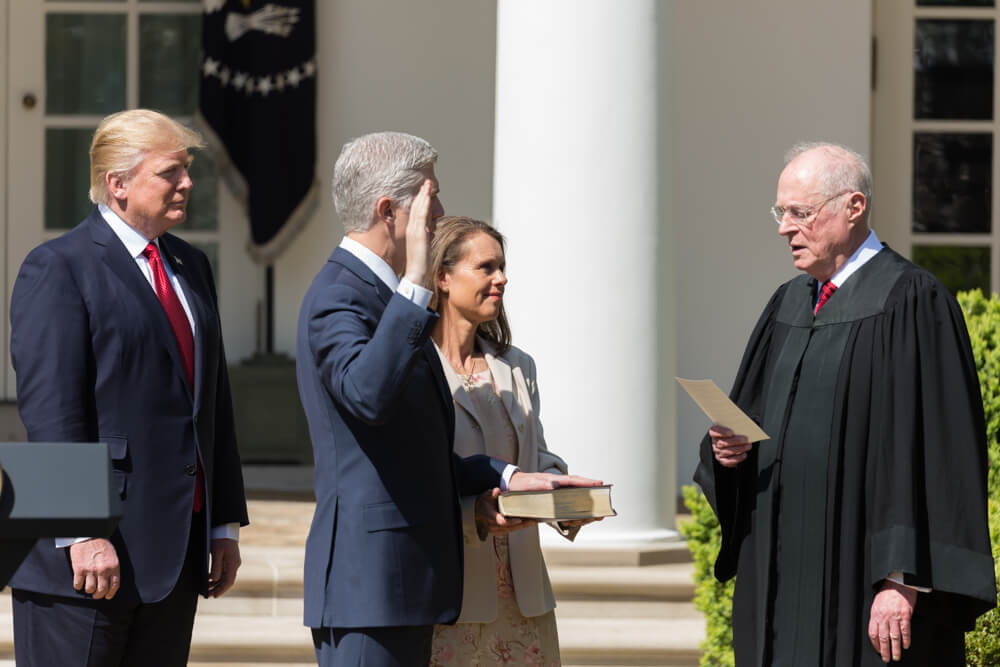
Anthony M. Kennedy, Associate Justice of the Supreme Court of the United States, swears in Supreme Court Justice Neil M. Gorsuch on Monday, April 10, 2017, in the Rose Garden of the White House in Washington, D.C. Also shown, Gorsuch’s wife Louise stands on stage holding a family Bible. Justice Gorsuch is the Supreme Court’s 113th justice.
White House photo via Wikimedia Commons.

“We have to STOP the next Trump nominee!” says a pop-up solicitation on People for the American Way’s website. Before you rush to “donate now,” you might want to consider the organization’s assessment of Trump’s last Supreme Court nominee.

“Far from being a fair-minded constitutionalist,” PFAW says, Neil Gorsuch “has proven to be a narrow-minded elitist who consistently votes in favor of corporations and the powerful.” The gap between that description and Gorsuch’s actual performance on the Court speaks volumes about the blind partisanship of Trump critics who care more about scoring political points than defending civil liberties.

PFAW is echoing the criticism of Democratic senators who worried, before Gorsuch was confirmed in April 2017, that he was not inclined to stand up for “the little guy.” Gorsuch’s record during a decade on the U.S. Court of Appeals for the 10th Circuit belied that claim, and his 15 months on the Supreme Court provide further evidence that he is not shy about defending the principles that protect politically disfavored individuals from the whims of the powerful.

In sharp contrast with the man who nominated him, Gorsuch worries about abuses of the government’s power to take people’s property “for public use.” In June 2017, when the Court declined to hear a case that raised the question of whether a state can impose limits on the “just compensation” it owes for takings under the Fifth Amendment, Gorsuch, joined by Clarence Thomas, urged his colleagues to address that issue at the “next opportunity.”

That pairing was notable because Gorsuch is on record as admiring Thomas’s passionate dissent from the widely condemned 2005 decision in which the Court approved the use of eminent domain to transfer property from one private owner to another in the name of economic development. Big businesses routinely use such arrangements to override the wishes of little people who get in the way of their plans.

July 4, 2018

It’s never a good idea to expand the power of the state

Francis Porretto on the problem of giving the state yet another tool for its already overflowing toolbox:

    The party in power is smug and arrogant. The party out of power is insane.” – Megan McArdle, a.k.a. “Jane Galt”

Among the older maxims of politics is to beware handing the State a new power without first reflecting on how your opponents could use it against you. For as sure as the Sun rises in the East, your opponents will return to dominance someday, and whatever powers you awarded the State will be in their hands.

Just now, the focus is on President Trump’s choice of a replacement for retiring Supreme Court Associate Justice Anthony Kennedy. The Democrats are tearing their collective hair out over this, as now that the filibuster is a dead letter for judicial appointees, their minority status in the Senate leaves them no way to block his selection. Yet it was Senate Democrats during the Obama Administration who first attacked the filibuster – when they were in the majority and sought to confirm Obama appointees. Coulda told ‘em then, but they weren’t in a mood to listen.

Today’s critical battles are over freedom of expression and “deplatforming.”

Some folks of sound mind and generally good will are exercised about how Silicon Valley giants such as Facebook and Twitter regulate their immensely popular social-media platforms to disfavor conservatives. The complaints have been many, and a great many of them are both accurate (i.e., the things complained about really happened) and valid (i.e., only persons of conservative or libertarian bent were silenced). However, they come up against a barrier that’s proved impassable to date: the right of private property.

So a lot of those folks have embraced the notion that those platforms could be regulated by the federal government as public accommodations. That’s the conception under which the Civil Rights Acts were deemed to hold legitimate authority over restaurants, hotels, movie theaters, and other nominally private properties. If you present your facility as “open to the public,” the logic runs, then you can be forbidden to discriminate – i.e., to provide your services to some members of the “public” but not others.

(For those who remember the “nationwide Bell System,” the phrase common carrier might rise to mind. The concept is essentially the same, as was the federal government’s assertion of authority over it. However, in that particular case, the rationale was that the Bell System was a monopoly, protected by that same federal government. Telecom deregulation and the breakup of the Bell System put paid to that scheme, thank God.)

Those in the Right who favor this notion are asking for trouble. Someday the balance of power will shift leftward once again. What would the Democrats – an increasingly totalitarian bunch who’ve never seen a law, a regulation, or a tax it didn’t love – do with the precedent that an Internet platform can be regulated as a public accommodation, despite being private property?

H/T to Bill St. Clair for the link.

June 28, 2018

US Supreme Court rules on the Janus case

Filed under: Law, Liberty, Politics, USA — Tags: , , , , — Nicholas @ 05:00

Eric Boehm reported soon after the decision was announced on Wednesday morning:

More than four decades after the Supreme Court ruled that public sector workers could be required to pay dues to unions even if they do not join one, a 5–4 majority on the high court overturned that precedent in a closely watched case that could have major ramifications for the future of public sector unions.

“Under Illinois law, public employees are forced to subsi­dize a union, even if they choose not to join and strongly object to the positions the union takes in collective bar­gaining and related activities,” Justice Samuel Alito wrote in the majority opinion. “We conclude that this arrangement violates the free speech rights of nonmem­bers by compelling them to subsidize private speech on matters of substantial public concern.”

In the short-term, the ruling in Janus v. American Federation of State, County and Municipal Employees means that plaintiff Mark Janus was successful in his decade-long fight to prevent the union from taking $50 out of his paycheck every two weeks. Over the years, Janus estimates, he’s contributed more than $6,000 to the union.

More broadly, Wednesday’s ruling could end the automatic deduction of union dues from millions of public employees’ paychecks, forcing unions like AFSCME to convince workers to voluntarily contribute dues — something workers would do, presumably, only if they have a reason to do so.

“So many of us have been forced to pay for political speech and policy positions with which we disagree, just so we can keep our jobs. This is a victory for all of us,” said Janus in a statement. “The right to say ‘no’ to a union is just as important as the right to say ‘yes.’ Finally our rights have been restored.”

The ruling is “a landmark victory for rights of public-sector employees,” said Mark Mix, president of the National Right to Work Legal Defense Foundation, which supported Janus’ lawsuit.

While today’s ruling certainly shifts the balance towards worker freedom, groups like the National Right to Work Legal Defense Foundation, which represented Janus, say they are already prepared for additional rounds of litigation. In states that previously have embraced right-to-work policies, unions have often tried to make it as difficult as possible for workers to renounce their membership.

At Hot Air, Jazz Shaw highlights a few of the key points:

Justice Alito wrote the decision and it followed along with the expectations of those who watched the case play out before the court. Also as expected, this was a 5-4 decision, split along partisan lines. At the heart of Janus was the question of whether or not unions can forcibly extract dues from workers’ paychecks without the worker proactively volunteering to contribute. In parallel to that, the court had to determine whether or not those extracted fees, being put toward lobbying efforts, constituted involuntary political speech on the part of the worker. The ruling answers both questions definitively.

You can read the full decision here [PDF] but I’ve extracted a couple of the key points from the syllabus. First is the issue of whether the previous ruling in Abood (which went in the unions’ favor) erred in allowing the forcible extraction of dues. Alito leaves no room for doubt.

    The State’s extraction of agency fees from nonconsenting public sector employees violates the First Amendment. Abood erred in concluding otherwise, and stare decisis cannot support it. Abood is therefore overruled.

The second question was the one about subsidizing the speech of others when it runs contrary to your personal beliefs. Again, Alito is definitive.

    Forcing free and independent individuals to endorse ideas they find objectionable raises serious First Amendment concerns. E.g., West Virginia Bd. of Ed. v. Barnette, 319 U. S. 624, 633. That includes compelling a person to subsidize the speech of other private speakers.

A union official, Paul Shearon, the IFPTE Secretary-Treasurer, put out an immediate statement saying that this was based on, “a bogus free speech argument.” He went on to say that the justices voting in the majority “are little better than political hacks.” That was followed up by a threat to take it to the streets.

    In the short run, the Janus decision may hurt some unions financially, but in the long run it will serve to make unions and their members more militant and force a stronger culture of internal organizing. The recent statewide teacher strikes demonstrate that when public sector workers face limitations on their bargaining rights they take their case to the streets.

This is going to send shockwaves through not just the unions, but the Democratic Party at large. The amount of money that the unions flush into Democratic coffers every year is likely more than most of you imagine.

Steven Malanga in City Journal provides some rough figures on how much money was at stake for the unions and their political activities:

With the appointment of Justice Neil Gorsuch, unions feared the outcome of the Janus case. After all, many union members have stated that they would give up their memberships if the court ruled that compulsory fees were illegal. An officer of the Communications Workers of America, which represents government employees in New Jersey, told an AFL-CIO convention last fall that only 54 percent of its 60,000 members said that they would remain in the union if they could opt out of paying fees. The California Teachers Association, meanwhile, crafted a 2019 budget that anticipated that as many as 23,000 members would leave if the court overturned the Illinois law. The union will also suffer from the loss of revenues from 28,000 nonmembers who’ve been paying agency fees, and will presumably stop doing so now that they’re no longer compelled. The union, according to a published report, estimated it could suffer a loss of some $20 million annually as a result.

Even before the ruling, government unions were reeling. Their membership has declined from a peak of 7.9 million in 2009 to 7.2 million today — a drop of nearly 9 percent. The portion of government workers in unions, which peaked in the mid-1990s at 38.7 percent, is now down to 34.4 percent, according to unionstats.com. Some of the decline is due to a significant reduction in the number of government workers after the 2008 financial crisis; even today, nine years into a recovery, the total number of government workers remains 10 percent lower than before the recession — a loss of 233,000 positions. But unions have suffered an even bigger falloff, because when government employment began trending back upward in 2014, union membership stayed flat. Many of the gains in government jobs since then have been in nonunion positions.

Unions have suffered big losses in Wisconsin, which banned compulsory unionization in the public sector in 2011. Some 140,000 union positions have dried up as workers chose not to retain their memberships. But other states that continued to compel workers to join a union or pay agency fees have also seen major losses, including New York, where union membership has fallen by 150,000, Illinois (down 88,000), Pennsylvania (down 54,000), and New Jersey (down 50,000). Those declines are reflected in union numbers, too. The National Education Association, the largest teachers’ union, has lost nearly 250,000 members, or about 8 percent of its membership, since 2009. AFSCME’s national membership has shrunk by 200,000, or 13 percent.

May 16, 2018

QotD: The presidency and the Supreme Court

Filed under: Law, Liberty, Quotations, USA — Tags: , , , , , , — Nicholas @ 01:00

… I also like Jerry Jeff Walker, the Scofflaw King of New Orleans and a lot of other people I don’t necessarily believe should be president of the United States. The immense concentration of power in that office is just too goddamn heavy for anybody with good sense to turn his back on. Or her back. Or its back…. At least not as long as whatever lives in the White House has the power to fill vacancies on the U.S. Supreme Court; because anybody with that kind of power can use it – like Nixon did – to pack-crowd the Court of Final Appeal in this country with the same kind of lame, vindictive yo-yos who recently voted to sustain the commonwealth of Virginia’s antisodomy statutes……. And anybody who thinks that 6-3 vote against “sodomy” is some kind of abstract legal gibberish that doesn’t really affect them had better hope they never get busted for anything the Bible or any local vice-squad cop calls an “unnatural sex act.” Because “unnatural” is defined by the laws of almost every state in the Union as anything but a quick and dutiful hump in the classic missionary position, for purposes of procreation only. Anything else is a felony crime, and people who commit felony crimes go to prison.

Hunter S. Thompson, “Fear and Loathing on the Campaign Trail ’76: Third-rate romance, low-rent rendezvous — hanging with Ted Kennedy, Jimmy Carter, and a bottle of Wild Turkey”, Rolling Stone, 1976-06-03.

March 18, 2018

Border privacy issue should (eventually) get to the US Supreme Court

Filed under: Law, Liberty, USA — Tags: , , , — Nicholas @ 03:00

In Reason, Damon Root reports on two duelling precedents about US citizens’ right to privacy and the government’s interest in what’s on your smartphone when you re-enter the United States:

In its 2014 decision in Riley v. California [PDF], the U.S. Supreme Court held that law enforcement officials violated the Fourth Amendment when they searched an arrestee’s cell phone without a warrant. “Modern cell phones are not just another technological convenience,” Chief Justice John Roberts wrote for the majority. “With all they contain and all they may reveal, they hold for many Americans ‘the privacies of life.’ The fact that technology now allows an individual to carry such information in his hand does not make the information any less worthy of the protection for which the Founders fought.”

But what about when an American citizen is returning home from abroad and U.S. border officials want to thoroughly search the contents of that person’s cell phone? Does the Fourth Amendment require the government to get a warrant before searching cell phones at the border? According to a decision issued this week by the U.S. Court of Appeals for the 11th Circuit, the answer to that question is no.

[…] a divided panel of the 11th Circuit took a different view. “The forensic searches of Vergara’s cell phones occurred at the border, not as searches incident to arrest,” declared the majority opinion of Judge William H. Pryor. “And border searches never require a warrant or probable cause.”

Writing in dissent, Judge Jill Pryor wrote that while she agrees “with the majority that the government’s interest in protecting the nation is at its peak at the border,” she disagrees “with the majority’s dismissal of the significant privacy interests implicated in cell phone searches.” In Riley, she noted, the Supreme Court recognized “the significant privacy interests that individuals hold in the contents of their cell phones.” And in her view, “the privacy interests implicated in forensic searches are even greater than those involved in the manual searches at issue in Riley.” If it were up to her, “a forensic search of a cell phone at the border [should require] a warrant supported by probable cause.”

One thing is clear: We have not heard the last of this debate. Either this case, or one very much like it, is almost certainly headed for the Supreme Court.

December 16, 2017

Why not try a truly independent “independent counsel”?

Filed under: Cancon, Law, Politics, USA — Tags: , , , — Nicholas @ 03:00

Jay Currie suggests someone the US government could bring in to investigate the whole “deep state” mess who would not be in any way tainted by past contacts or entanglements:

The American mess is deep and sordid and, frankly, needs to be cleaned up. But by who?

The fact is that virtually any special counsel appointed by the DOJ will be tainted one way or another. And so, apparently, will investigators drawn from the FBI. It is a mess but it also needs to be resolved.

So, a friendly suggestion from Canada.

Our deeply respected, longest serving, Chief Justice of the Supreme Court of Canada is retiring at the end of the year. Beverly McLaughlin, while I disagree with some of her opinions, is tough, fair-minded and very, very, smart. By the nature of her position, she is “read in” on intelligence and security cleared. She’ll be bombarded with job offers but, if asked nicely, might be willing to lead an investigation into the whole ball of wax which the 2016 American election created. Russians, Hilly’s server and how it was dealt with by the FBI, Lynch on the tarmac with Bill, Mueller, Comely: the whole thing.

But Bev is not enough. Sending a small detachment of the RCMP – white collar and intelligence – with her, with really serious investigative powers, would get the whole mess cleared up in six months. (The scarlet tunics would be optional but would make great tv as they raided offices and homes of the swamp creatures.) McLaughlin would not proffer charges, rather she would write a report and recommend such charges as arise.

Better still, the Chief Justice and the Horsemen would be paid for – independently – by the Canadian government with a bill to be presented to our American cousins at the end of the investigation.

Sometimes the mess is so big you need an independent professional to clean it up. This is one of those times.

August 26, 2017

QotD: The American Constitution

Filed under: History, Politics, Quotations, USA — Tags: , , , , — Nicholas @ 01:00

All things considered, this New Republic piece on Randy Barnett and the libertarian constitutional movement is really pretty good. But I thought this part was revealing:

    Barnett believes the Constitution exists to secure inalienable property and contract rights for individuals. This may sound like a bland and inconsequential opinion, but if widely adopted by our courts and political systems it would prohibit or call into question basic governmental protections — minimum wages, food-safety regulations, child-labor laws — that most of us take for granted. For nearly a century now, a legal counterculture has insisted that the whole New Deal project was a big, unconstitutional error, and Barnett is a big part of that movement today.

If your entire program is called into question by the notion that individuals have property and contract rights, maybe the problem is with your program.

And to the extent that, as believed by many, the Supreme Court’s eventual accommodation to the New Deal was the product of duress in the form of FDR’s court-packing scheme, then isn’t that accommodation, in fact, illegitimate?

Glenn Reynolds, Instapundit, 2015-08-31.

« Newer PostsOlder Posts »

Powered by WordPress