Quotulatiousness

November 11, 2012

Royal Navy patrol sees off Spanish corvette

Filed under: Britain, Europe, Military — Tags: , , , , — Nicholas @ 11:25

Gibraltar. Scenic and historic port at the mouth of the Mediterranean Sea. Oh, and ongoing point of friction between the UK and Spain:

A Royal Navy patrol boat has confronted a Spanish warship off the coast of Gibraltar in the latest and most serious clash over Britain’s territorial waters.

The Government has accused Spain of an ‘unlawful incursion’ after the Vencedora, a 288ft-long naval corvette, came within three miles of Gibraltar’s coast, apparently heading towards its port.

The Vencedora, which means ‘winner’, was equipped with Harpoon anti-ship missiles, multiple guns and torpedoes when it entered Gibraltar’s territorial waters on Wednesday afternoon.

The Spanish ship ignored radio warnings to leave the area, and HMS Scimitar, a seven-man patrol boat, was scrambled to intercept.

Gibraltar has been British territory since the early 1700’s, but the current Spanish government would like to change that. As the Wikipedia article points out, the inhabitants strongly prefer staying as British citizens to becoming Spanish:

In the 1950s, Franco renewed Spain’s claim to sovereignty over Gibraltar and restricted movement between Gibraltar and Spain. Gibraltarians voted overwhelmingly to remain under British sovereignty in the Gibraltar sovereignty referendum, 1967, which led to the passing of the Gibraltar Constitution Order in 1969. In response, Spain completely closed the border with Gibraltar and severed all communication links. The border with Spain was partially reopened in 1982, and fully reopened in 1985 prior to Spain’s accession to the European Community.

In a referendum held in 2002, Gibraltarians rejected by an overwhelming majority (99%) a proposal of shared sovereignty on which Spain and Britain were said to have reached “broad agreement”. The British government has committed itself to respecting the Gibraltarians’ wishes. A new Constitution Order was approved in referendum in 2006. A process of tripartite negotiations started in 2006 between Spain, Gibraltar and the UK, ending some restrictions and dealing with disputes in some specific areas such as air movements, customs procedures, telecommunications, pensions and cultural exchange.

Update, 13 November: And here they come again:

November 3, 2012

Remembering the ill-starred Darien expedition

Filed under: Americas, Britain, History — Tags: , , , — Nicholas @ 09:18

History Today notes that the Darien Colony was founded by Scottish would-be colonists in what is now Panama on November 3, 1698:

On July 12th, 1698 five ships carrying 1,200 eager colonists left the Port of Leith in Scotland to a rapturous send-off. Most of the ill-fated emigrants did not know where they were going and did not find out until the sealed orders were opened at Madeira, but they were brimming with enthusiasm anyway.

A voyage of three months took them across the Atlantic to a harbour on the mangrove-studded Caribbean coast of Panama. On November 3rd, they took formal possession of their new territory, confidently naming it Caledonia and laying the foundations of the settlement of New Edinburgh. But it all went horribly wrong. Hundreds died of fever and dysentery before the colony was abandoned.

[. . .]

Scotland blamed the whole fiasco on the English. Paterson himself was bankrupt, but still believed in his scheme and tried vainly to revive it. Meanwhile, the Darien disaster seems to have persuaded hard-headed Scotsmen that their country could not prosper by itself, but needed access to England’s empire, and it helped to pave the way for the Act of Union between the two countries in 1707. Under the Act the investors in the Darien scheme were quietly compensated for their losses at taxpayers’ expense.

October 21, 2012

Animated map of the Battle of Trafalgar, 21 October, 1805

Filed under: Britain, France, History, Military — Tags: , — Nicholas @ 10:51

The BBC created an animated map you can view either with interpretations or non-stop, showing the tactics of Vice Admiral Nelson and Vice Admiral Villeneuve at the Battle of Trafalgar.

On 21 October 1805, the Royal Navy clashed with the Combined French and Spanish fleet at Cape Trafalgar, off the coast of Spain. The battle had massive repercussions for Napoleon’s France and the future of the British Empire.

August 16, 2012

George Orwell, “the moral compass of the 20th century”

Filed under: Books, Britain, History, Media, WW2 — Tags: , , , — Nicholas @ 08:15

A review of Diaries by George Orwell in the Wilson Quarterly:

The early entries cover Orwell’s days as a tramp, a period that provided material for Down and Out in Paris and London (1933), and his subsequent investigation of poverty in the industrial north of England, from which he drew for The Road to Wigan Pier (1937). This volume’s lacuna is Orwell’s experience fighting the fascists during the Spanish Civil War. Plainclothes policemen in Barcelona seized the one or two diaries that recorded those events, and delivered the work to the Soviets. Though the writings likely remain in the archives of the former KGB, Orwell transformed them into literature as well, with the extraordinary memoir Homage to Catalonia (1938).

Of greatest interest are entries from the periods of Orwell’s life that he did not turn directly into books. His World War II diaries are the highlight. Although all of the entries feature Orwell’s direct prose style, there are occasional hints of the novelist at work: “Characteristic war-time sound, in winter: the musical tinkle of raindrops on your tin hat.” And there are ominous passages that reveal his unusually clear view of the awful century unfolding, such as this one from June 1940 that prefigured his 1945 novel Animal Farm:

Where I feel that people like us understand the situation better than so-called experts is not in any power to foretell specific events, but in the power to grasp what kind of world we are living in. At any rate I have known since about 1931 . . . that the future must be catastrophic. I could not say exactly what wars and revolutions would happen, but they never surprised me when they came. Since 1934 I have known war between England and Germany was coming, and since 1936 I have known it with complete certainty. . . . Similarly such horrors as the Russian purges never surprised me, because I had always felt that — not exactly that, but something like that — was implicit in Bolshevik rule. I could feel it in their literature.

June 13, 2012

“… there simply aren’t enough lifeboats!”

Filed under: Economics, Europe, Greece, Italy — Tags: , , , , — Nicholas @ 13:18

Nigel Farage speaking in the European Parliament:

Another one bites the dust. Country number four, Spain, gets bailed out and we all of course know that it won’t be the last. Though I wondered over the weekend whether perhaps I was missing something, because when the Spanish prime minister Mr Rajoy got up, he said that this bailout shows what a success the eurozone has been.

And I thought, well, having listened to him over the previous couple of weeks telling us that there would not be a bailout, I got the feeling after all his twists and turns he’s just about the most incompetent leader in the whole of Europe, and that’s saying something, because there is pretty stiff competition.

Indeed, every single prediction of yours, Mr Barroso, has been wrong, and dear old Herman Van Rompuy, well he’s done a runner hasn’t he. Because the last time he was here, he told us we had turned the corner, that the euro crisis was over and he hasn’t bothered to come back and see us.

I remember being here ten years ago, hearing the launch of the Lisbon Agenda. We were told that with the euro, by 2010 we would have full employment and indeed that Europe would be the competitive and dynamic powerhouse of the world. By any objective criteria the Euro has failed, and in fact there is a looming, impending disaster.

You know, this deal makes things worse not better. A hundred billion [euro] is put up for the Spanish banking system, and 20 per cent of that money has to come from Italy. And under the deal the Italians have to lend to the Spanish banks at 3 per cent but to get that money they have to borrow on the markets at 7 per cent. It’s genius isn’t it. It really is brilliant.

So what we are doing with this package is we are actually driving countries like Italy towards needing to be bailed out themselves.

In addition to that, we put a further 10 per cent on Spanish national debt and I tell you, any banking analyst will tell you, 100 billion does not solve the Spanish banking problem, it would need to be more like 400 billion.

And with Greece teetering on the edge of Euro withdrawal, the real elephant in the room is that once Greece leaves, the ECB, the European Central Bank is bust. It’s gone.

It has 444 billion euros worth of exposure to the bailed-out countries and to rectify that you’ll need to have a cash call from Ireland, Spain, Portugal, Greece and Italy. You couldn’t make it up could you! It is total and utter failure. This ship, the euro Titanic has now hit the iceberg and sadly there simply aren’t enough life boats.

June 2, 2012

The Eurovision Song Contest and the European Union

Filed under: Europe, History, Humour, Media — Tags: , , , , , — Nicholas @ 09:45

Mark Steyn on the similarities between the top TV event in Europe and the EU itself:

One recalls the 1990 Eurovision finals in Zagreb: “Yugoslavia is very much like an orchestra,” cooed the hostess, Helga Vlahović. “The string section and the wood section all sit together.” Shortly thereafter, the wood section began ethnically cleansing the dressing rooms, while the string section rampaged through the brass section pillaging their instruments and severing their genitals. Indeed, the charming Miss Vlahović herself was forced into a sudden career shift and spent the next few years as Croatian TV’s head of “war information” programming.

Fortunately, no one remembers Yugoslavia. So today Europe itself is very much like an orchestra. The Greek fiddlers and the Italian wind players all sit together, playing cards in the dressing room, waiting for the German guy to show up with their checks. Just before last week’s Eurovision finale in Azerbaijan, The Daily Mail in London reported that the Spanish entrant, Pastora Soler, had been told to throw the competition “because the cash-strapped country can’t afford to host the lavish event next year,” as the winning nation is obliged to do. In a land where the youth unemployment rate is over 50 percent, and two-thirds of the country’s airports are under threat of closure and whose neighbors (Britain) are drawing up plans for military intervention to evacuate their nationals in the event of total civic collapse, the pressing need to avoid winning the Eurovision Song Contest is still a poignant symbol of how total is Spain’s implosion. Ask not for whom “Ding-Ding-A-Dong” dings, it dings for thee.

May 22, 2012

Spanish navy faces cuts

Filed under: Europe, Military — Tags: , , — Nicholas @ 09:29

Strategy Page on the plight of the Spanish navy in the current tough economic climate:

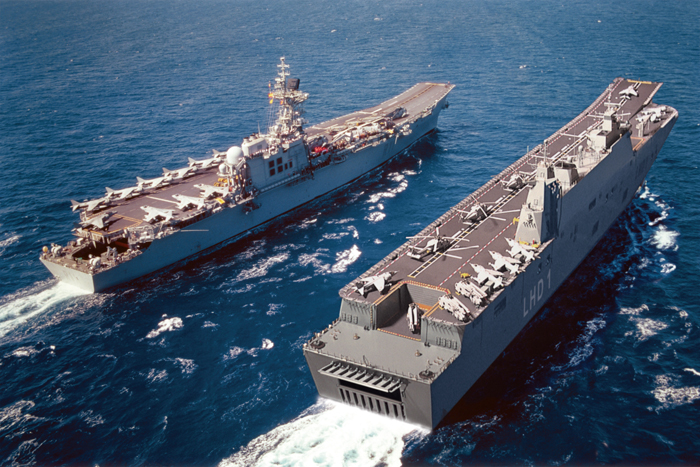
Forced to deal with continuing budget reductions, the Spanish Navy (Armada Españolais) is preparing to put six frigates and their only aircraft carrier into storage. Many naval commanders are opposed to this and as a compromise the ships will first be put on “restricted duty” and then as they lose their crews (to more budget cuts) they will shift to “reserve” status. These seven ships will probably never return to active duty once this process begins. If the naval budget keeps shrinking, it will begin.

Since their housing bubble burst in 2008, Spain has been suffering a sustained economic recession. So far the defense budget has been hit by cuts amounting to 25 percent a year. Unless the economy makes a dramatic turnaround, the navy budget will keep shrinking.

[. . .]

The carrier Principe de Asturias entered service in the late 1980s. It has been overdue for a $500 million refurbishment. This 16,700 ton ship can operate up to 29 fixed wing (vertical take-off Harriers) and helicopter aircraft.

April 21, 2012

Argentina: Canada without the boring politics and grey politicians

Filed under: Americas, Cancon, Economics, Politics — Tags: , , , — Nicholas @ 09:58

Robert Fulford sees lots of similarities between Argentina and Canada, except the one difference that makes all the difference:

In some ways it’s much like Canada, a huge one-time colony with a talented population and endless natural resources — arable land, oil and gas and much else.

Except it is not like Canada. It doesn’t work. And the reason it doesn’t work is that it lacks a reliable, careful government, not subject to sudden bouts of hysteria. Argentina has few of the boring politicians who irritate people like Sid.

Public life in Argentina expresses itself through spasms of showmanship, braggadocio, paranoia and demagoguery. It’s the land of the eternal crisis, where a military coup is never unthinkable.

Argentina’s many economic failures, generation after generation, are self-created, politically induced. In all the world there’s no more obvious example of a nation that has squandered, through flawed governance, the riches provided by nature.

This week Cristina Fernández de Kirchner, President of Argentina, and the widow of the last president, announced she’s grabbing YPF, the country’s biggest energy company, taking it from Spain’s Repsol. Cristina, as she’s usually called in Argentina, thinks she can run YPF better than the Spanish. Of course the Spanish are furious and will sue as well as blacken Argentina’s name wherever possible. What Cristina has announced is a brazen, heedless act, with nothing to recommend it but high-handed nationalist fury.

Yet Cristina believes that when you encounter economic trouble, the best course is to strike out against something foreign. At the moment she’s also making anti-British noises, agitating to annex the Falklands Islands, which Argentina seized in 1982 and had to give back when it lost the war with the U.K. Somehow the Falklands (called the Malvinas in Argentina) are linked with the oil-company seizure as nationalist issues. A T-shirt has appeared on Cristina’s supporters: “The Malvinas are Argentine, so is YPF.”

April 13, 2012

Mapping 18th century shipping patterns

Filed under: Africa, Americas, Asia, Economics, Europe, History, Science — Tags: , , , , — Nicholas @ 09:06

An interesting post at the Guardian on tracing historical shipping patterns:


(Larger version at the original URL)

James Cheshire, of Spatial Analysis, has taken historical records of shipping routes between 1750 and 1800 and plotted them using modern mapping tools.

The first map, above, shows journeys made by British ships. Cross-Atlantic shipping lanes were among the busiest, but the number of vessels traveling to what was than called the East Indies — now India and South-East Asia — also stands out when compared to Dutch and Spanish records.

I was surprised to see how many trading voyages there were to and from the Hudson Strait — fur trade traffic, I assume.


(Larger version at the original URL)

This second map shows the same data for Dutch boats. The routes are closely matched to the British ones, although the number of journeys is noticeably smaller.

You can also see the scattering of journeys made by Dutch ships to Svalbard, off the North coast of the Norwegian mainland

December 6, 2011

Argentina puts more pressure on Britain to negotiate over the Falkland Islands

Filed under: Americas, Britain, Military — Tags: , , , — Nicholas @ 13:07

The Argentinian navy has been boarding fishing vessels for “illegal” operations in Argentinian waters (that happen to be the seas around the Falklands, South Georgia, and the South Sandwich Islands — all British territories):

Argentine patrol vessels have boarded 12 Spanish boats, operating under fishing licences issued by the Falkland Islands, for operating “illegally” in disputed waters in recent weeks.

Argentine patrol commanders carrying out interceptions near the South American coast told Spanish captains they were in violation of Argentina’s “legal” blockade of sea channels to the Falklands.

[. . .]

President Cristina Kirchner has adopted a steadily more beligerent stance towards Britain’s South Atlantic possessions.

A newly formed gathering of South American nations meeting in Venezeula backed Argentina’s sovereignty demands at the weekend.

Argentina’s claim over the Falklands was backed by a newly formed block of South American and Caribbean countries, CELAC, on Saturday with unanimous approval. Mrs Kirchner used the last UN General Assembly meeting to put Argentina’s claims of sovereignty over the Falklands on a par with Palestinian claims to statehood.

As predicted, now that Britain’s Royal Navy no longer has any aircraft carriers, there’s literally no way that Britain can prevent Argentina from another invasion (the one nuclear submarine on patrol in the area could cause damage, but not repel Argentinian forces). Back in the last war between Britain and Argentina, the United States had to be cajoled into supporting Britain: I very much doubt that Barack Obama would be as willing to provide support to a country he clearly disdains.

November 28, 2011

The real reason the German bond auction failed

Filed under: Economics, Europe, Germany, Italy — Tags: , , — Nicholas @ 08:58

Tyler Cowen explains:

If Germany and a few other, smaller AAA countries were to guarantee or monetize the debts of Italy, Spain, and possibly France and Belgium, never mind Greece and Portugal, Germany would not be AAA itself. The German median voter has very little interest in guaranteeing the above-mentioned debts. If German yields are flipping upwards, it is, in my view, because investors now see the whole euro deal as unraveling and don’t want to deal with the complexities and flak. A big chunk of the German auction didn’t sell at all. You don’t have to think that Germany is ripe to default to see that markets are warning Germany not to take on the whole burden.

The only remaining question, if Germany isn’t willing to take on the entire burden of European debt, is when will the whole edifice come crashing down and who’ll manage not to be crushed by falling debris.

July 14, 2011

The Eurozone crises

Filed under: Economics, Europe, Greece, Italy — Tags: , , , , — Nicholas @ 17:30

That’s right, crises, not crisis. There are three interlinked crises, not just one:

The crisis in the Eurozone has been lurching from one country to another over the past year or so. After bailouts for Greece, Ireland and Portugal, and with a second bailout for Greece in the offing, the financial markets this week turned their attention to Italy, a far larger economy than those previously affected. Spain, another country struggling to pay its way, has also been hit by austerity measures and political turmoil. But while it is easy to get caught up in the specifics of each new stage of the crisis, it is worth taking a step back to understand what is going on and the possibilities for the future.

The Euro crisis, like just about every other economic story these days, has a three-fold character. It is not, in fact, a single crisis; it has three inter-related elements: financial, economic and political.

Of the three, the financial crisis is, paradoxically, the least significant, even though it is the most prominent of the three and the one which threatens to spin out of control with serious broader consequences. Alongside the financial, the economic aspect is the most entrenched and material of the three, while the political crisis — that is, the failure of the political elites to get on top of the other two challenges — is the most critical, as it is, or should have been, the key to the resolution of the other two. The shift in focus to Italy, the Eurozone’s third largest economy, indicates that time may have run out for effective containment. The Euro genie is probably out of the bottle.

June 19, 2011

“It is clear they are running out of options”

Filed under: Britain, Economics, Europe, Greece — Tags: , — Nicholas @ 10:29

It looks as though the British banks are starting to get very nervous about Eurozone bank defaults:

Senior sources have revealed that leading banks, including Barclays and Standard Chartered, have radically reduced the amount of unsecured lending they are prepared to make available to eurozone banks, raising the prospect of a new credit crunch for the European banking system.

Standard Chartered is understood to have withdrawn tens of billions of pounds from the eurozone inter-bank lending market in recent months and cut its overall exposure by two-thirds in the past few weeks as it has become increasingly worried about the finances of other European banks.

Barclays has also cut its exposure in recent months as senior managers have become increasingly concerned about developments among banks with large exposures to the troubled European countries Greece, Ireland, Spain, Italy and Portugal.

H/T to Elizabeth for the link.

April 15, 2011

Arousing the voters, Menorcan style

Filed under: Europe, Media, Politics — Tags: , , , — Nicholas @ 09:45

It’s a perennial problem: how do you manage to get the voters interested in your candidacy? How can you get them excited? Sole Sánchez Mohamed has an answer for you:

A Menorcan political candidate has caused a bit of a rumpus ahead of Spain’s forthcoming municipal elections with a seriously in-your-face advert in the local press.

Sole Sánchez Mohamed, head of the Partit Democràtic de Ciutadella (PDC), posed with an evidently willing pair of male hands to make her point, or rather, pair of points. The caption declares: “Two great arguments.”

To further her election cause, the wannabe mayoress of Ciutadella appeared in monthly magazine Més Iris Menorca dressed only in her smalls while adopting “sadomasochistic poses”, as you can see here (NSFW).

And you folks complain about “attack ads” in Canadian elections.

April 11, 2011

Political grandstanding at the expense of Muslim women

Filed under: Europe, France, Law, Liberty, Religion — Tags: , , , , — Nicholas @ 09:22

Josie Appleton points out the logical inconsistencies of the various European “Ban the Burkha” movements:

In spite of the grave crisis of the Euro, the French cabinet will today (19 May[, 2010]) find the time to discuss a draft law banning the wearing of full-face veils in public places. Spain has just slashed public wages and is on the verge of economic collapse, yet the minister of work yesterday made the effort to visit Lleida and voice his support for the mayor’s plan to prohibit full Islamic facewear in the streets. Last month, Belgium’s coalition government had dissolved and there was talk of splitting up the country, yet the parliament managed to unite 136 out of 138 deputies to vote through a law banning the burqa and niqab.

How is it that European leaders, in such difficult times, have invested such energy in the matter of women’s facewear? Why was a Spanish schoolgirl who insisted on wearing a headscarf so fascinating as to draw the media’s attention away from government cuts? Why such detailed discussions on the intricacies of Islamic veils? Newspapers feature pullouts on the different forms of Islamic veil, and commentators explain why the niqab is so much worse than the shayla or the chandor, and indeed how the hijab is fine and even liberating for Muslim women.

The burqa-ban laws were introduced with such displays of speechmaking that anybody would think the fate of these countries hung on this single point of principle. One Belgian deputy admitted that ‘the image of our country abroad is more and more incomprehensible’, but said this near-unanimous vote banning the burqa and niqab rescued ‘an element of pride to be Belgian’. A French commission on the veil said the veil was ‘contrary to the values of the Republic’ and the parliament should make it clear that ‘all of France is saying “no” to the full veil’. The Spanish work minister said this clothing ‘clashes fundamentally with our society and equality between men and women. The values of our society cannot go into retreat.’

Lovely sounding stuff in front of the microphones, to be sure. Good photo ops for ambitious politicians, to a clamour of general approval and risking the loss of very little: there were so relatively few women wearing these articles of clothing — and few of them or their husbands/fathers/brothers likely have the vote anyway.

Now, pay heed to the Law of Unintended Consequences. Many of these women now have a choice: disobey the family head by going out in public without wearing the niqab/hijab/burkha (and risk beatings or even honour-killing), or follow the dictates of the family head and risk being arrested by the gendarmes.

How, exactly, is this going to benefit those poor women?

Update: The ban in France was passed in October and goes into effect today:

The centre-right government, which passed the law in October, has rolled out a public relations campaign to explain the ban and the rules of its application that includes posters, pamphlets and a government-hosted website.

Guidelines spelled out in the pamphlet forbid police from asking women to remove their burqa in the street. They will instead be escorted to a police station and asked to remove the veil there for identification.

[. . .]

In Avignon, Vaucluse, Reuters TV filmed a woman boarding a train wearing a niqab, unchallenged by police.

“It’s not an act of provocation,” said Kenza Drider. “I’m only carrying out my citizens’ rights, I’m not committing a crime … If they [police] ask me for identity papers I’ll show them, no problem.”

France has five million Muslims, but fewer than 2,000 women are believed actually to wear a face veil.

Many Muslim leaders have said they support neither the veil nor the law banning it.

« Newer PostsOlder Posts »

Powered by WordPress