
As for […] the idea that we could lose our freedom by succumbing to a wave of religious hysteria, I am sorry to say that I consider it possible. I hope that it is not probable. But there is a latent deep strain of religious fanaticism in this, our culture; it is rooted in our history and it has broken out many times in the past.
It is with us now; there has been a sharp rise in strongly evangelical sects in this country in recent years, some of which hold beliefs theocratic in the extreme, anti-intellectual, anti-scientific, and anti-libertarian.
It is a truism that almost any sect, cult, or religion will legislate its creed into law if it acquires the political power to do so, and will follow it by suppressing opposition, subverting all education to seize early the minds of the young, and by killing, locking up, or driving underground all heretics. This is equally true whether the faith is Communism or Holy-Rollerism; indeed it is the bounden duty of the faithful to do so. The custodians of the True Faith cannot logically admit tolerance of heresy to be a virtue.
Nevertheless this business of legislating religious beliefs into law has never been more than sporadically successful in this country — Sunday closing laws here and there, birth control legislation in spots, the Prohibition experiment, temporary enclaves of theocracy such as Voliva’s Zion, Smith’s Nauvoo, and a few others. The country is split up into such a variety of faiths and sects that a degree of uneasy tolerance now exists from expedient compromise; the minorities constitute a majority of opposition against each other.
Could it be otherwise here? Could any one sect obtain a working majority at the polls and take over the country? Perhaps not — but a combination of a dynamic evangelist, television, enough money, and modern techniques of advertising and propaganda might make Billy Sunday’s efforts look like a corner store compared to Sears Roebuck.
Throw in a Depression for good measure, promise a material heaven here on earth, add a dash of anti-Semitism, anti-Catholicism, anti-Negrosim, and a good large dose of anti-“furriners” in general and anti-intellectuals here at home, and the result might be something quite frightening — particularly when one recalls that our voting system is such that a minority distributed as pluralities in enough states can constitute a working majority in Washington.
Robert A. Heinlein, “Concerning Stories Never Written”, Revolt in 2100, 1953.
October 11, 2019
QotD: Religious hysteria
October 4, 2019
QotD: Freedom of thought
Robert A. Heinlein, “If This Goes On —”, 1940.
September 16, 2019
QotD: If we’d been taken over by aliens, how would we know?
- Our schools in America teach that the system under which America lives, from constitutional protections to (relatively … very relatively) free markets are evil and the cause of all evils in the world.
- Our schools further teach that all the problems in the world at large are the fault of “Imperialists” to include not just America, but the West which is America’s mother culture. They ignore the sins of other nations, many of which, still today, commit female mutilation and slavery, to concentrate ONLY on the West and the sins of the West, thereby obviating any possible pride the students might have in their own culture.
- Further, the schools, under the guise of environmentalism, promote the view that humanity is the worst plague on the planet. Without pointing out that any species can drive others to extinction, or that humans are the only species capable of self-regulating their impact on the environment, they concentrate on those extinctions humans have caused and fantasize that without humans the world would be a paradise.
- Without pointing out the difficulty of global censuses or that in fact we don’t and can’t know how large the world population is, our learning institutions, our cultural institutions, even our entertainment continually scare us with the idea of overpopulation. Without taking into account that there are more trees now in North America than when the colonists arrived, they picture humanity as creating deserts. Schools push middle schoolers to sign agreements never to reproduce.
- As if this weren’t enough, feminists picture women – in Western, well off, more or less equalitarian (at least before the law as it existed before feminist tampering made it take sides with women most of the time) systems – as perpetual victims, stoke a sense of outrage and anger at any and all males, and encourage women to consider normal intercourse “rape” and marriage a prison.
- As if this weren’t enough, the insanity has descended to preaching that there is no such thing as biological sex, and that one’s gender is a sort of “mood” which can be determined before a child is even fully developed. Parents giving hormones to children, to change their sex before the age of reason (let alone physical or emotional maturity) and effectively encouraging castration/neutering and precluding future generations aren’t considered deranged abusers. In fact, educational and medical establishments will encourage parents to thus destroy their progeny and will take the children away if the parents don’t do it, on the flimsiest of pretexts based on stereotypes, such as a boy who disdains male toys, or a girl who doesn’t like dolls. The rich panoply of human expression is ignored in a – dare we say it – alien attempt to make individual people fit stereotypes.
- Three generations into this, our leading lights in intellectual life, be it fiction, non-fiction, academia or even research, get plaudits and advancement ONLY from conclusions and policies that objectively hurt humans and prevent humans from reproducing. A subset of this is hate of the West, the most successful culture in the world, ever, in terms of extending life, preventing early death, preventing or curing disease and preventing and curing famine. Another and even more vociferous subset is the hatred of America, which took all of Western virtues and made them more so.
If aliens, hostile to the very idea of humanity and wanting to prevent us from prospering, let alone going into space (another cause that all so called “progressives” hate with a burning passion and try to prevent by all means possible, from telling us that there is still need on Earth so we shouldn’t spend money on going to space, to telling us that we must first learn to “take care of this planet” to just sustained screaming that the human plague shouldn’t propagate) had managed to take control of our culture, what would they do differently?
Sarah Hoyt, “What if We Have Been Invaded by Aliens?”, PJ Media, 2017-07-21.
September 11, 2019
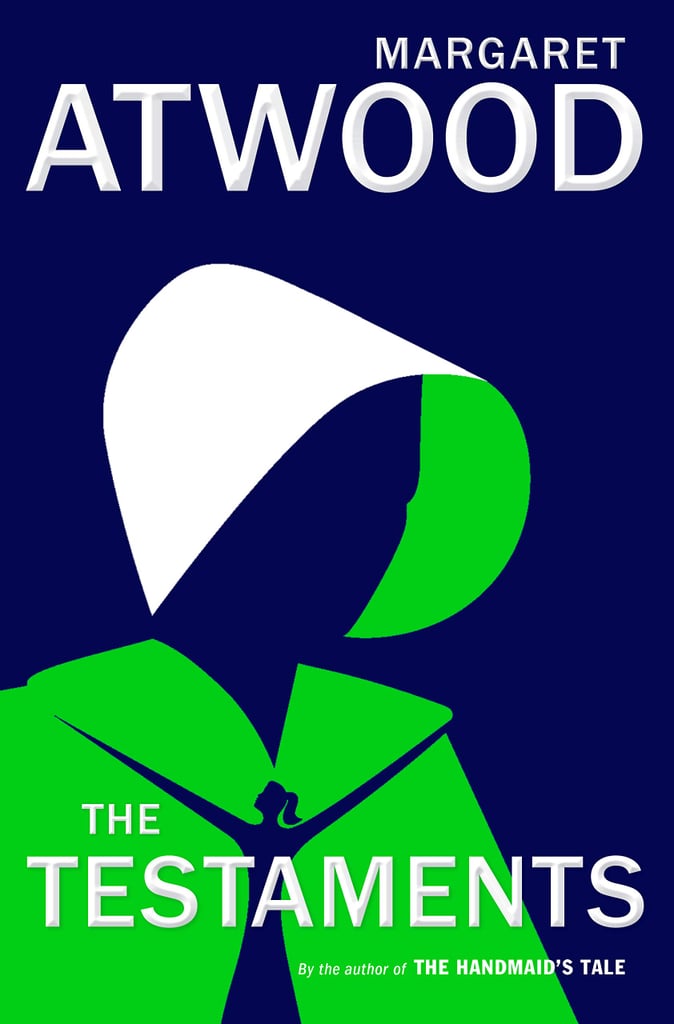
Margaret Atwood’s The Testaments
Colby Cosh discusses the genesis of Atwood’s best-known work from 1984, The Handmaid’s Tale and the new sequel published this week, The Testaments:
In a CBS interview broadcast on Sunday, Atwood insisted again, as she always has, that her book wasn’t a prediction. People who read her book in a spirit of active dread, the kind of people who dress up as Handmaids and march on legislatures, will say that, well, dystopias are created specifically so that they won’t come true. What Atwood is trying to say goes deeper than that, and contradicts it. She won’t even insist that the book was intended as a warning. “I’m not a prophet,” she pleads, while everyone around her tells her what a terrific prophet she is.
What she means, but cannot say because it would sound arrogant, is: “I’m not a prophet, dammit, I’m an artist.” If tyrannies were easy to predict and prevent by spritzing around a bit of literary bug spray, they couldn’t come about in the first place. Atwood knows better than this; she knows that tragedies of this scale never take the form that an author might anticipate. Moreover, people who read The Handmaid’s Tale as a mere tract are deaf to its satirical elements — particularly those of the epilogue, in which the story is revealed to have been unearthed by scholars in a still-more-distant future.These people are also failing to see that The Handmaid’s Tale is a book — researched, not merely imagined — about the past of humankind. The whole book is predicated on the observation (also made implicitly in Orwell’s Nineteen Eighty-Four) that totalitarian regimes are never libertine; they all police sexuality at least as strenuously as they do trade and creative activity, and always come with puritanical, sexually homogenizing features. The novel was heavily influenced by Ceausescu’s Romania and its pro-natalist Decree 770, which abolished contraception and imposed mass gynecological inspection on women of fertile age. Europeans and students (or veterans) of the Cold War will notice this, but how many of the young folk who dress up as Handmaids at protests have any idea? (Are some of them also cosplaying on Twitter as postmodern retro-communists?)
I am curious to see what the critics make of the sequel, because the act of writing one seems a bit cynical, and yet perhaps Atwood has found some clever way of making it work. Offred’s narrative in The Handmaid’s Tale is, as I say, unearthed in a later future; it is important to the functioning of the book that we come to see her as a figure from the past, a human voice whose plea from an obscure period has been flung forward into the hands of half-comprehending and unsympathetic scholarly boobs.
August 29, 2019
QotD: Imagining a world made up only of women
So what would a world made up totally of women really be like? It would be tyrannical beyond belief. No one would be willing to speak against the accepted narrative unless they were willing to be unpersoned or killed. Think of a mix between 1984, the very worst social aspects of socialist regimes, and the Borg. There would be constant pushing for position, usually by starting whisper campaigns or setting someone above oneself up to be badly embarrassed. Look at the SJWs of today’s world and see how they operate. That’s what it would look like, writ large across the entire planet. They attack anyone outside the group who doesn’t comply with their demands, and if someone inside the group says a single word out of line according to the ever-shifting standards the entire group turns on them without mercy. The only way to get back in their good graces is to loudly proclaim your “sin” and accept their abuse until they get bored of you. Even afterward, you’ll forever be “tainted” with the sin of noncompliance.
When you write your books and send them out into the world, please stop writing women as soft, cuddly pacifists. We aren’t. Kipling was completely right about the female of the species being the more dangerous sex. He was also right about the price of letting women control society. If any thinking individualist finds themselves in a society run by women, may God have mercy on their souls because those women will have none at all.
“outofthedarkness”, guest posting at According to Hoyt, 2017-08-09.
August 2, 2019
QotD: What we mean by “civilization”
Which is when the dime dropped and I realized you guys immediately translated civilization to “as good as we have or better.” Which, of course, made me giggle. Because I’d have liked you to tell a Roman, with their world-bestriding empire that they weren’t civilized. Or, before that a classical Greek.
Understand I am not imagining others before us had the internal combustion engine, or steam, or trains, or … Sure, they might have, but that’s a heck of a coincidence, since those things usually come about by an individual stroke of genius, and even when they do they often aren’t used the way we did (Romans and their mechanical toys.)
To imagine other civilizations of which we’ve forgotten every trace followed exactly the same route we did to the same place we’re at requires believing that inventing steam and the internal combustion engine and harnessing electricity is as natural to humans as dams to beavers.
Now, maybe that’s true. It would certainly make for a very good science fiction story. (Short story, I think. Too much of a punchline thing for a novel.) BUT the odds defy rationality.
I was imagining, you know “builds houses of wood or stone. Domesticated SOME animals. Has villages and cities. Might have trade over long routes. MIGHT have had wheeled vehicles.” (The last, as we know, one can have quite sophisticated civilizations without.)
Look, it’s not your fault. Since the seventies, we’ve been bombarded by crazy BS about superior aliens or superior lost civilizations. (And before that, there was a trickle of it, too, going back I think to the eighteenth century, just couched in different terms.) You’ll get stuff about how the pyramids were built of stones that floated at the sound of a certain note. (A C note, or the equivalent, I bet. “Listen, Mac, you take this stone to the top of the pyramid, I give you a C Note. A hundred Amontheps in your pocket, bucko. Buys a lot of fish and falafel.”)
Part of this, and part of the reason it intensified since the seventies were the “unilateral disarmament people.” You know, those jokers who wanted us to get rid of our own nukes and stand disarmed in front of the USSR, who would then realize we were peaceful, and not attack, and everyone would live in peace and harmony with rainbows and farting unicorns. Yes, it was a stupid and crazy idea since the continued survival of the USSR depended on plunder and conquest. But I’ll remind you our last president still believes that bag of moonshine. All of it, including the unicorn farts.
Sarah Hoyt, “We Are The Superior Civilization”, According to Hoyt, 2017-05-15.
July 30, 2019
Moira Greyland discusses how she came to write The Last Closet
Tamara Wilhite discusses some of the events that prompted Moira Greyland to write about her mother, Marion Zimmer Bradley and some of the reactions from readers of the book:
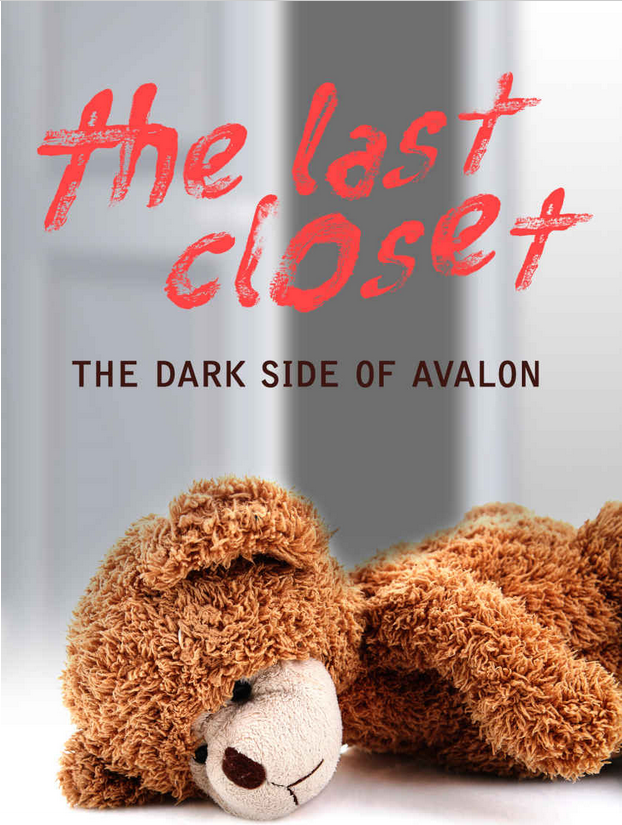
The Last Closet was written by Moira Greyland. She’s the daughter of Marion Zimmer Bradley, author of The Mists of Avalon and Walter Breen. It is Marion Bradley’s book from which the book title is drawn. “The Last Closet: The Dark Side of Avalon” is equal parts autobiography and true-crime thriller with a tragic sprinkling of the history of science fiction fandom mixed in.
Moira’s book includes large sections of horrifying personal stories, but she has gone to great length to document what happened. For example, her father’s repeated arrests on pedophilia charges (he died in prison) and her mother’s testimony during such trials are public record. She’s backed up everything she can from external sources.
I had the opportunity to interview Moira, and the transcript is below.
Tamara: Some of the events in the book go back forty years. What prompted you to write the book in 2017?
Moira: In 2014, a blogger named Deirdre Saoirse Moen contacted me. She was protesting Tor book’s publication of a puff piece lauding my mother, which did not mention either my father’s conviction or her court-documented collusion with him.
I only knew Deirdre as a woman from science fiction fandom who had hired me for a harp concert, and I did not realize how famous she was. My responses to her email consisted of a brief assent that my father had indeed done all that he was accused of and convicted for and more, but it also included the new for her information that my mother had been a great deal worse than my father. I also included my two poems “Mother’s Hands” and “They Did Their Best.”
Deirdre was horrified, and reported that she had lost her lunch upon reading my reply. Her blog posts about my mother and my responses were reblogged to 92 countries all over the world. There was furious controversy, mostly consisting of everyone who tried to defend my mother getting shouted down. Some people read my mother’s appallingly callous court testimony and pronounced her guilty from her own words. Other people saw themselves in my poetry, in the flatness and horror so familiar to the trauma patient. Still others recognized things in my mother’s books about incest and sexual abuse which had never quite seemed right to them.
I was astonished at the volume of response, and at the many, many, MANY letters addressed directly to me. Most of the letters included both sympathy for me and my brother, but nearly all contained reports of the letter writer’s own abuse, many containing the words “I never told anyone this before.”
I was asked to fill in the rest of my story, and I did so, in a blog post called “The Story of Moira Greyland,” hosted on the blog of Katy Faust, another child of gays and lesbians as I am. My blog post was nominated for a Hugo in 2015, and I was offered a book contract by Vox Day of Castalia House.
The only concern I had about writing my book was that my late brother Mark was having a very hard time with the unplanned public exposure. He was having flashbacks about our father, and beginning to have a lot more trouble managing his health. The reason that was so problematic for him was that we both identified our mother as being the scary, dangerous one, where our father was comparatively gentle and loving. Having to deal with his history meant that there was no even remotely good parent left for him, even as a matter of memory.
His distress predated the book, though, and I did not think that it would be relieved by my silence.
I was given a year to complete the book, and I beat my deadline. It would do no good to mention the particular kind of hell it was to tell the story, and I credit my beloved late husband with sticking by my side through the entire process. Anyone with a trauma history can imagine that all of my trauma symptoms from flashbacks to ataxia got worse. It became very clear to me while writing exactly why it was that so few people talk about their injuries.
July 18, 2019
QotD: “They might speak English, but they don’t speak Western”
But something happened to me last night, I had a kind of realization. It suddenly hit me WHY that is.
It’s because Harry Potter is literally all they collectively know.
Schools don’t teach history anymore.
They no longer teach the canon of Western literature.
They certainly don’t teach the Bible.So Millennials literally have no points of common reference. It’s not that they all just want to look like complete morons by infantilizing their political metaphor to the level of a children’s book, it’s that they have no other choice.
They’re literally bereft of the allegorical language of the West. I’m sure there’s some Harry Potter monster analogy I could use to explain it to them, how it’s like monsters have come along and literally stolen their ability to speak, their common language, and their birthright.
They can no longer express or understand the set of references we have from our past, our most prized stories, and our culture’s religious quotations. They can’t do Shakespeare, Milton, or even Mark Twain because they’ve never learned any of these while they were being taught Indonesian multicultural dancing and given participation awards. They don’t know what happened at Hastings in 1066, at Runnymede in 1215, or even at Sarajevo in 28th June 1914, because they were being given feminist diversity training instead of learning the history of their civilization. They certainly don’t know what “the least of these” refers to or where it comes from, as a recent event with a White House staffer proved.
They’ve lost the entire allegorical language of the West. They might speak English, but they don’t speak Western. To them, it’s like a foreign, dead, alien language. A set of stories they do not know.
RPGPundit, “Harry Potter and the way Millennial Leftists Don’t Even Speak Western Anymore”, The RPGPundit, 2017-02-02.
July 15, 2019
Galaxy Quest – still the best Star Trek movie ever made
At Mark Steyn’s site, guest movie reviewer Kathy Shaidle lovingly reviews the cult classic — and one of my all-time favourite movies — Galaxy Quest:
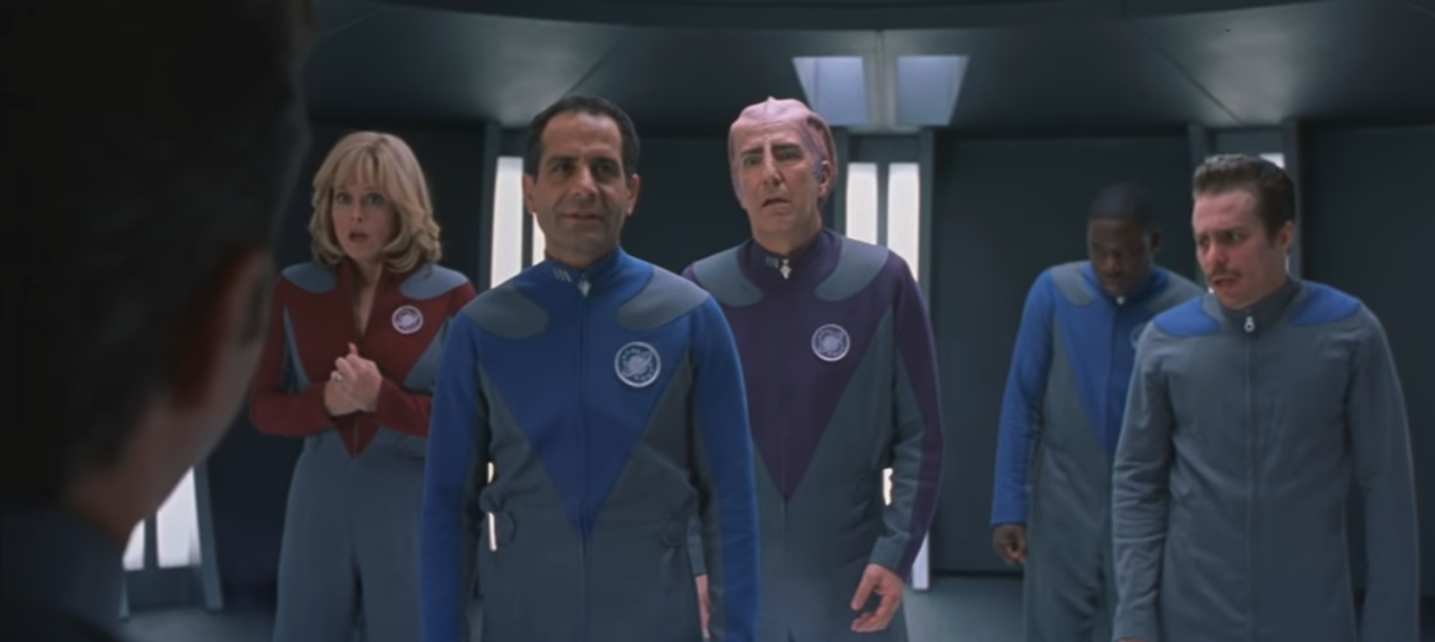
In a just world, O.J. Simpson would currently be serving the 24th year of a double life sentence; Ronald Reagan would have been president during America’s bicentennial instead of Jimmy Carter — and Galaxy Quest would’ve earned half-a-billion bucks at the box office when it came out in 1999.
But inept and indifferent studio marketing (plus competition from another “sci-fi” comedy, Ghostbusters) relegated Galaxy Quest to semi-cult status. Which is ironically appropriate, given its plot:
At a science fiction convention, fans await an appearance by the cast of Galaxy Quest, a hokey interstellar TV adventure series unceremoniously cancelled in the early 1980s. The show’s fatally typecast has-been “stars” (played by Tim Allen, Alan Rickman, Sigourney Weaver, Tony Shalhoub and Daryl Mitchell) are reduced to reluctantly signing autographs at tacky gatherings like this one, when they’re not cutting ribbons (in full costume) at supermarket openings.
That is, until genuine aliens — who, in cargo cult fashion, have based their civilization on Galaxy Quest re-runs transmitted through space — touch down and beg “the crew of the NSEA-Protector” to help them defeat the villain bent on destroying their planet. The adorable Thermians innocently believe the program’s “crew” are fearless, intrepid space warriors and technological geniuses, not just washed-up actors in laughable uniforms. Their language has no word for “pretend”…
Lazily calling this movie “a Star Trek spoof” unfairly slots it alongside broad, coarse parodies like Blazing Saddles or the soulless Mars Attacks! In truth, Galaxy Quest is a tender, big hearted valentine — more My Favorite Year than Airplane.
That the film’s jokes and, more incredibly, its special effects, hold up so well twenty years later is a testament to the loving care with which Galaxy Quest was crafted. Obeying the first (yet often ignored) commandment of movie comedy, all the actors “play it straight”
June 20, 2019
A Clockwork Orange – Dystopias and Apocalypses – Extra Sci Fi
Extra Credits
Published on 18 Jun 2019Go to https://NordVPN.com/ExtraCredits to get 75% off a 3 year plan and use code
ExtraCreditsto get an extra month free. Protect yourself online today!A Clockwork Orange reflects a cultural fear of society’s moral decay in the 1960s. Its usage of a mashup slang language known as “nadsat” illustrates the complexities of rebellious youth culture. Ultimately, Anthony Burgess’s work asks us to think about if or when free will should ever be suppressed, but the major differences between the book and the film version of this story present contrasting takeaways.
Where the dystopias of Brave New World and 1984 warned against the easy slide into totalitarianism, and painted for us worlds in which freedom is nearly a forgotten thing… A Clockwork Orange presents us with a protagonist who has almost an excess of freedom, and in doing so it shows us the shift in societal fears.

June 12, 2019
A Canticle for Leibowitz – Dystopias and Apocalypses – Extra Sci Fi
Extra Credits
Published on 11 Jun 2019A Canticle for Leibowitz is a book about cycles and violence — about the cost of progress. But it is also about the persistence of humanity’s quest for knowledge and endless resilience. Unlike other post-apocalyptic fiction tropes, it is focused on the lives and goings of everyday people, rather than on the setting itself, and is a critical work to study if you want to understand the post-apocalyptic genre better.
Inspired by his own experience being part of the bombing campaign that leveled the ancient monastery of Monte Cassino during World War 2 and the fear of nuclear annihilation that gripped America during the Cold War, Walter M. Miller Jr. imagined the world in a brand new dark age, ushered in by the hubris of humankind — in the only novel he ever published.

June 10, 2019
QotD: Robert Heinlein on “honest work”
The beginning of 1939 found me flat broke following a disastrous political campaign (I ran a strong second best, but in politics there are no prizes for place or show).
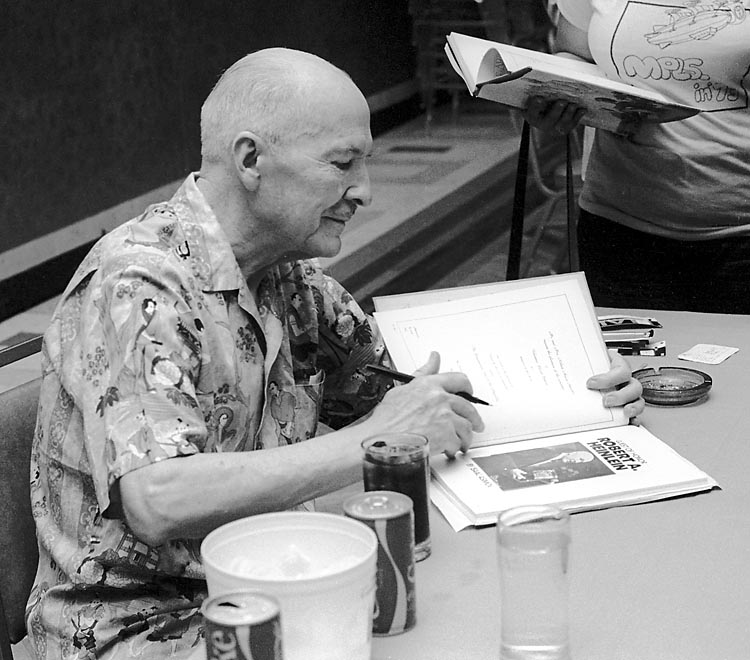
Robert A. Heinlein at the 1976 World Science Fiction Convention
Via Wikimedia Commons.I was highly skilled in ordnance, gunnery, and fire control for Naval vessels, a skill for which there was no demand ashore — and I had a piece of paper from the Secretary of the Navy telling me that I was a waste of space — “totally and permanently disabled” was the phraseology. I “owned” a heavily-mortgaged house.
About then Thrilling Wonder Stories ran a house ad reading (more or less):
GIANT PRIZE CONTEST —
Amateur Writers!!!!!!
First Prize $50 Fifty Dollars $50In 1939 one could fill three station wagons with fifty dollars worth of groceries.
Today I can pick up fifty dollars in groceries unassisted — perhaps I’ve grown stronger.
So I wrote the story “Life-Line.” It took me four days — I am a slow typist. I did not send it to Thrilling Wonder; I sent it to Astounding, figuring they would not be so swamped with amateur short stories.
Astounding bought it… for $70, or $20 more than that “Grand Prize” — and there was never a chance that I would ever again look for honest work.
(“Honest work” — an euphemism for underpaid bodily exertion, done standing up or on your knees, often in bad weather or other nasty circumstances, and frequently involving shovels, picks, hoes, assembly lines, tractors, and unsympathetic supervisors. It has never appealed to me. Sitting at a typewriter in a nice warm room, with no boss, cannot possibly be described as “honest work.”)
Robert A. Heinlein, 1980.
May 30, 2019
Fahrenheit 451 – Dystopias and Apocalypses – Extra Sci Fi
Extra Credits
Published on 28 May 2019Ray Bradbury not only cautions against censorship (the primary theme of Fahrenheit 451), but offers interesting commentary on who censors works at all, and why humans do it anyway.
Fahrenheit 451 is about many things. In Bradbury’s younger days, just coming out of the McCarthy era, he said the book was about censorship and book burning. Later in life, he said it was about the dangers of easy entertainment. Let’s analyze these viewpoints a little further.
May 29, 2019
QotD: Past civilizations
… when anyone says “there was a civilization before us” your head (our head) jumps to airplanes, trains, steel mills, refrigerators, dentistry.
I’m telling you the chances of that are negligible, though I won’t scruple using a more advanced than us past civilization to give my characters a nasty shock when they get to space. I won’t because that’s just cool.
However of things like Ancient Greece or Rome? I almost think the chances against it are worse. And of course civilizations that live and die by coastal sailing would be mostly engulfed in the great melt of the last ice age.
And no, Europe hasn’t been extensively studied. As I said before, Europe is mostly built on Europe. And you can’t dig in a field without finding SOMETHING. If you think everyone runs to the academics or the authorities when something is found, you don’t understand people’s interest in building a house, or sowing a field, as opposed to you know, giving up ownership of their land in all but fact. Frankly I’m amazed so many people do report discoveries.
But the thought of “superior civilizations” got me to thinking of what say the Romans or the Greeks, or those other ancient civilizations if they ever existed, would make of us in the West. We cross the globe by flying through the air. Not just heads of state or priests, no, common people. Hell, our pets fly. Most places have clean, fresh water that someone doesn’t have to carry a mile or so (which has been most of the work of humanity I think, forever.) Forget aqueducts. We have water that comes from our faucets whenever we want it. Cold AND hot. We have temperature control inside our houses, allowing us ignore the weather and keep warm in winter and cold in summer. We can magically cure diseases that killed millions of people by injecting this magical elixir into the sick person’s veins. Our old live a long time in relative comfort. We get our teeth fixed and replaced, so most people can chew to the end of their lives. Most of us can read, and most of us have access to untold wisdom of the sort their hermetic orders would kill for.
We are the superior civilization. We are the enlightened ones, the shining and resplendent inhabitants of the wonderful future.
And we worry about what gender we feel like being that day, who is allowed to pee where, whether someone used the wrong word to refer to someone else who might be offended, whether our use of fossil fuels offends Gaia, whether slapping a kid on the behind is a criminal offense, whether we are doing all we could do with our lives.
In other words, we’re neurotic, unsatisfied, and a bit crazy like most of people who were born and raised rich throughout most of human history.
Which is why if we really were doomed to repeating a cycle, and if the civilizations before us were the same but more advanced, the message of the pyramids would be “Don’t use so much toilet paper. Just wash one square and reuse it.”
Perhaps we should be grateful they are truly profoundly unlikely to ever have existed or tried to send us any message.
Sarah Hoyt, “We Are The Superior Civilization”, According to Hoyt, 2017-05-15.
May 15, 2019
1984 – Dystopias and Apocalypses – Extra Sci Fi
Extra Credits
Published on 14 May 2019What makes 1984 still relevant to modern readers is that it serves as a warning against fascism in all its possible forms. George Orwell’s service fighting in the Spanish Civil War led him to see that the heart of totalitarianism is about xenophobia and nationalism no matter which kind of government it came from.
The idea that Orwell presents us in 1984 is that people subtle enough and brutal enough can take the undirected dissatisfaction and anger of a society and point it at whatever they will, using us to damn ourselves.


