
Extra Credits
Published on 22 Dec 2018Sun Yat-sen moves to a new city for safety, but it will not last long — a year after the Revive China society is destroyed and scattered, he is unwittingly kidnapped in London. He must rely on the ingenuity of his outside ally, Dr. James Cantlie…
Join us on Patreon! http://bit.ly/EHPatreon
December 24, 2018
Sun Yat-sen – A Kidnapping in London – Extra History – #2
Comments Off on Sun Yat-sen – A Kidnapping in London – Extra History – #2
December 20, 2018
China’s Cultural Revolution
In Quillette, James David Banker describes the beginnings of Mao Zedong’s Cultural Revolution:
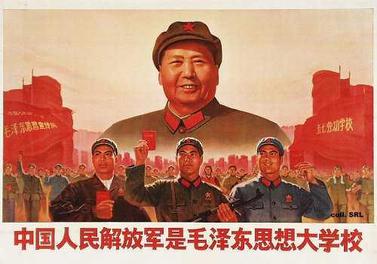
“The Chinese People’s Liberation Army is the great school of Mao Zedong Thought”, 1969.
A poster from the Cultural Revolution, featuring an image of Chairman Mao, published by the government of the People’s Republic of China.
Image via Wikimedia Commons.
“Nobody is more dangerous than he who imagines himself pure in heart,” wrote James Baldwin, “for his purity, by definition, is unassailable.” This observation has been confirmed many times throughout history. However, China’s Cultural Revolution offers perhaps the starkest illustration of just how dangerous the “pure in heart” can be. The ideological justification for the revolution was to purge the Chinese Communist Party (CCP), and the nation more broadly, of impure elements hidden in its midst: capitalists, counter-revolutionaries, and “representatives of the bourgeoisie.” To that end, Mao Zedong activated China’s youth — unblemished and uncorrupted in heart and mind — to lead the struggle for purity. Christened the “Red Guards,” they were placed at the vanguard of a revolution that was, in truth, a cynical effort by Mao to reassert his waning power in the Party. Nevertheless, it set in motion a self-destructive force of almost unimaginable depravity.
The Cultural Revolution commenced in spirit when Mao published a letter indicting a number of Party leaders on May 16, 1966. But it was a seemingly minor event nine days later that ignited the revolution in effect: a young philosophy professor at Peking University named Nie Yuanzi placed a “big-character poster” (a handwritten propaganda sheet featuring large Chinese characters) on a public bulletin board denouncing the university president and others in the administration as bourgeois revisionists. Mao immediately endorsed her protest, which set off a chain reaction of student revolt that swept through China.
That chain reaction was accelerated by “working groups” of ideologues sent to administer schools. Under their tenure, schools became centers of activism rather than learning. Students were encouraged to create big-character posters exposing their own teachers, officials, and even parents. The accused were humiliated in daily “struggle sessions” in which their students and colleagues interrogated them and demanded confessions. The viciousness of these sessions rapidly intensified. Students beat, spat upon, and tortured — in horrifically creative ways — their often elderly teachers and professors. In one case, students demanded their biology professor stare at the sun with wide open eyes. If he blinked or looked away, they beat him. Even middle and elementary school students participated in the struggle sessions, sometimes beating their teachers to death with sticks and belt buckles.
Students were also encouraged to turn on their classmates. As the sins of one generation passed to the next, a new hierarchy was born: the children of revolutionaries on top and the children of “landlords,” “capitalists,” and “rightists” at the bottom. These students were labeled “rotten eggs” and were fair game for the same treatment meted out to their parents. The current president of the People’s Republic of China, Xi Jinping, endured this fate. He was only 15 years old when his father, a loyal Maoist and one-time propaganda chief, was purged, his sister executed, and his own mother forced to denounced Xi as a reactionary. Amid the hysteria, teachers, professors, and intellectuals did not dare to stand up to the students or defend their colleagues lest they suffer similar fates. But they could not escape by being bystanders. With every word and action becoming potential evidence of capitalist sympathy, teachers and intellectuals enthusiastically joined their students in the struggle sessions and screaming rallies.
Comments Off on China’s Cultural Revolution
December 17, 2018
Sun Yat-sen – A Killing in Hong Kong – Extra History – #1
Extra Credits
Published on 15 Dec 2018Growing up in Honolulu, Sun Yat-sen had an expansive, exciting education, which would inspire him when he moved to Hong Kong as a young adult ready to change the world as a doctor — and as the leader of the “Revive China Society” interested in overthrowing the Qing government.
Sun Yat-sen was a dangerous man. The Qing were right to fear him. After all, he’d bring 2,000 years of imperial rule crashing down.
Join us on Patreon! http://bit.ly/EHPatreon
Comments Off on Sun Yat-sen – A Killing in Hong Kong – Extra History – #1
November 11, 2018
Armistice – But Peace? I THE GREAT WAR Week 225
The Great War
Premiered 4 hours agoOn November 11 1918, the German delegation and the Allies reach an agreement for an armistice. At the 11th hour the guns go silent and the First World War is over, well at least the guns go silent but is it a peace already? Germany is struggling with revolution and civil war at home, the break up of the Austro-Hungarian Empire causes a lot of chaos. And in Romania, the men are taking up arms again.
Comments Off on Armistice – But Peace? I THE GREAT WAR Week 225
November 10, 2018
Hitler’s Beer Hall Disaster I BETWEEN 2 WARS I 1923 Part 1 of 2
TimeGhost History
Published on 10 Nov 2018When Germany spirals into hyperinflation and the French occupy the Ruhr, Adolf Hitler and Erich Ludendorff make a grab for power.
Join us on Patreon: https://www.patreon.com/TimeGhostHistory
Hosted by: Indy Neidell
Written and directed by: Spartacus Olsson
Writing and Research Contributed by: Rune V. Hartvig
Produced by: Astrid Deinhard
Executive Producers: Bodo Rittenauer, Astrid Deinhard, Indy Neidell, Spartacus OlssonArchive by Screenocean/Reuter https://www.screenocean.com
A TimeGhost chronological documentary produced by OnLion Entertainment GmbH
And from the comments:
We jump ahead briefly to 1923 as this week is the anniversary of the Hitlerputsch and the Georg Elser Bomb in 1939. We will return to part 4 of 1920 in shortly. Many thanks to Rune V. Hartvig for contributing to the writing of this episode.
READ BEFORE YOU COMMENT: This episode was recorded before we had our studio, therefore our the sound is not great. Also READ OUR RULES:
RULES OF CONDUCT
STAY CIVIL AND POLITE we will delete any comments with personal insults, or attacks.
AVOID PARTISAN POLITICS AS FAR AS YOU CAN we reserve the right to cut off vitriolic debates.
HATE SPEECH IN ANY DIRECTION will lead to a ban.
RACISM, XENOPHOBIA, OR SLAMMING OF MINORITIES will lead to an immediate ban.
PARTISAN REVISIONISM, ESPECIALLY HOLOCAUST AND HOLODOMOR DENIAL will lead to an immediate ban.Thanks for reading, and now…. let’s make history!
Comments Off on Hitler’s Beer Hall Disaster I BETWEEN 2 WARS I 1923 Part 1 of 2
November 9, 2018
Revolution in Germany – Armistice in Austria I THE GREAT WAR Week 224
The Great War
Published on 8 Nov 2018Unrest within the German Empire is spreading, resentment against the war, the hunger and the elites is turning into revolutionary action and with a mutiny in Kiel the wheels begin to turn quickly. Austria signs an armistice, the Macedonian Front collapses, Romania might enter the war again and the new German political leaders send a delegation through the lines in France. Their goal: An Armistice.
Comments Off on Revolution in Germany – Armistice in Austria I THE GREAT WAR Week 224
October 28, 2018
QotD: Revolutionary price controls and the plight of Washington’s army at Valley Forge
By the end of 1775, Congress had already increased the nation’s money supply by 50 percent in less than a year, and state paper issues had already begun in New England. The Congressional Continental bills followed what was to become a sequence all too familiar in the western world: runaway inflation. As paper money issues flooded the market, the dilution of the value of each dollar caused prices in terms of paper money to increase; since this included the prices of gold, silver, and foreign currencies, the value of the paper money declined in comparison to them. As usual, rather than acknowledge the inevitability of this sequence, the partisans of inflationary policies urged further accelerated paper issues to overcome the higher prices and searched for scapegoats to blame for the price rise and depreciation. The favorite scapegoats were merchants and speculators who persisted in doing the only thing they ever do on the market: they followed the push and pull of supply and demand. In another familiar attempt to deal with the problems of inflationary intervention, they outlawed the depreciation of paper, or the rise of prices.
[…]
State and local governments presumed to know what market prices of the various commodities should be, and laid down price regulations for them. Wage rates, transportation rates, and prices of domestic and imported goods were fixed by local authorities. Refusing to accept paper, accepting them for less than par, charging higher prices than allowed, were made criminal acts, and high penalties were set: they included fines, public exposure, confiscation of goods, tarring and feathering, and banishment from the locality. Merchants were prohibited from speculating, and thereby from bringing the needed scarce goods to the public. Enforcement was imposed by zealots in local and nearby committees, in a despotic version of the revolutionary tradition of government by local committees.
Price controls made matters far worse for everyone, especially the hapless Continental Army, since farmers were thereby doubly penalized: they were forced to sell supplies to the army at prices far below the market and they had to accept increasingly worthless Continentals in payment. Hence, they understandably sold their wares elsewhere; in many cases, they went “on strike” against the whole crazy-quilt system by retiring from the market altogether and raising only enough food to feed themselves and their own families. Others reverted to simple barter.
Murray N. Rothbard, Conceived In Liberty, Volume IV, 1979.
Comments Off on QotD: Revolutionary price controls and the plight of Washington’s army at Valley Forge
October 24, 2018
QotD: The diminishing importance of the Russian revolution of 1917
Few 20th-century historians doubted that the 1917 Russian revolution was one of the most influential events of their time, indeed of all time. As the centenary commemoration approaches, however, it seems remarkable how far and how fast the ideology that inspired Lenin and millions of his worldwide followers has receded in significance. Many are the imperfections of capitalism, but almost nobody outside Jeremy Corbyn’s office any longer supposes that communism, least of all the old Soviet brand, offers a credible alternative. This would amaze our grandparents’ generation on both sides of the struggle.
The novels of C.P. Snow are indifferent fiction but intriguing middle-class social history. During the interwar era, many of the intelligent acquaintances of Lewis Eliot, Snow’s fictional alter ego, took it for granted that socialism, or perhaps communism, not only should but would prevail as the guiding doctrine of most democracies.
Lower down the social scale, Clyde shipworkers, indeed most of the world’s industrial classes, saw the Bolsheviks as harbingers of hope. The bayonets thrust into the bosoms of the imperial family in the cellar at Ekaterinburg roused a pleasurable frisson in some radical hearts. Ten Days that Shook the World, the American reporter John Reed’s eyewitness account of October 1917, conveys the thrill the revolution evoked among those who, like himself, considered capitalism doomed.
Max Hastings, “The centenary of the Russian revolution should be mourned, not celebrated”, The Spectator, 2016-12-10.
Comments Off on QotD: The diminishing importance of the Russian revolution of 1917
September 6, 2018
Feature History – Chinese Civil War
Feature History
Published on 25 Jul 2017Hello and welcome to Feature History, featuring a civil war that done happened in China.
Help me recognise Taiwan (or not)
https://www.paypal.me/FeatureHistory
Patreon
https://www.patreon.com/FeatureHistory
Discord
https://discord.gg/Zbk4CvR
———————————————————————————————————–
I do the research, writing, narration, art, and animation. Yes, it is very lonely
Comments Off on Feature History – Chinese Civil War
September 5, 2018
QotD: Why did appeasing the Fascist dictators seem such a sensible policy?
It is a familiar student essay question, whether the revolution could have been averted, but for the world war and resultant loss of up to three million Russian lives. It seems more useful merely to suggest that, in the political and ideological climate of the early 20th century, the collectivist experiment was bound to be attempted somewhere, and Russia or China were obvious testbeds. The consequences for millions of Russian peasants, together with the ferocity of Soviet oppression, were successfully concealed from most western eyes for half a century. The 1789 French revolution killed only a few thousand aristocrats and transferred land to peasants, who thus became ardent upholders of property rights. The Russian version required liquidation of the entire governing class and transfer of land to collective ownership, an incomparably more radical proceeding. Douglas Smith’s 2012 book Former People gives a harrowing account of the fate of the Tsarist aristocracy.
In the West, the gullibility of the Webbs, Bernard Shaw and the rest of the ‘true believers’ was fed by a desperation to suppose the Soviet example viable. ‘Looking around us at our own hells,’ wrote the historian Philip Toynbee, who became a communist at Cambridge, ‘we had to invent an earthly paradise somewhere else’. As late as 1945, the leftist publisher Victor Gollancz brought posterity’s contempt upon himself by declining to publish Animal Farm, George Orwell’s great satire on Bolshevism.
For a counter-revolutionary contemporary perspective, it is impossible to understand the 1930s appeasement of the dictators without grasping the traumatic impact of events in Russia on the propertied classes everywhere. The Winter Palace was stormed only 16 years before Hitler came to power. For at least two decades, Europe’s ‘haves’ were far more frightened of Bolshevism than of fascism.
The ‘clubland hero’ novels of John Buchan and Sapper offer embarrassing glimpses of the British bourgeois view of Lenin’s people and their followers in the decades following the revolution. A belief took hold in polite circles that the bloodiest revolutionaries were not merely communists but also Jews, which meant they were doubly damned in St James’s clubs.
Max Hastings, “The centenary of the Russian revolution should be mourned, not celebrated”, The Spectator, 2016-12-10.
Comments Off on QotD: Why did appeasing the Fascist dictators seem such a sensible policy?
August 19, 2018
Recruits from Alsace – Angel of Siberia I OUT OF THE TRENCHES
The Great War
Published on 18 Aug 2018Next to the Chair of Wisdom, Indy Neidell talks about how the German Army dealt with recruits from Alsace-Lorraine and how Elsa Brändström became the Angel of Siberia to many prisoners of war.
Comments Off on Recruits from Alsace – Angel of Siberia I OUT OF THE TRENCHES
May 10, 2018
Enter ADOLF HITLER stage left I BETWEEN 2 WARS I 1919 Part 4 of 4
TimeGhost History
Published on 8 May 2018The fledgling democracy in Germany struggles to survive as the German Revolution escalates into a downright civil war. In one of the German States Bavaria, Adolf Hitler appears on the stage within the context of the Bavarian Soviet Revolution.
Click here for the rest of the Between 2 Wars series: http://goo.gl/enXJWf
Join the TimeGhost Army at https://timeghost.tv
or on Patreon: https://www.patreon.com/TimeGhostHistoryHosted by: Indy Neidell
Written by Spartacus Olsson and Indy Neidell
Directed by: Spartacus Olsson
Produced by: Astrid Deinhard
Executive Producers: Bodo Rittenauer, Astrid Deinhard, Indy Neidell, Spartacus OlssonA TimeGhost chronological documentary produced by OnLion Entertainment GmbH
CORRECTION: Article 48 of the Weimar Constitution gave the PRESIDENT of the German Reich the power to suspend civil rights and take armed action, nothing else… our apologies. In this episode we meet Adolf Hitler for the first time. Now some might be surprised about how we portray Hitler and his political views in 1919 and this needs some commentary. Before you go off in any specific direction about Hitler and Naziism, you should therefore read our commentary here https://community.timeghost.tv/t/enter-adolf-hitler-from-the-left-between-2-wars-1919-part-4-of-4/262/3:
Commentary regarding our portrayal of Hitler:
Those of you who follow our work since a longer time will know that we are loath to tell a skewed or biased version of the events we portray. Our aim with how we tell Hitler’s story is neither to exonerate him, nor to vilify him; the facts speak for themselves and we are convinced that we neither need to add, nor subtract emphasis to the story of Hitler and the Nazis.
In many other works covering Hitler you will see a tendency to hang the events of this epoch on the leaders that rose to power in the period. While it is unquestionable that the impact of those leaders was far reaching and instrumental in how the events evolved, it should not be forgotten that these men (and a few women) were not created in a bubble. As postulated in the main historiographical theory dealing with the impact of leadership, Zeitgeist Theory (from where we take or brand name btw.) it is easily seen at that it was not the characters that created the times, but the times that created the characters who then steered the events as they evolved.
This is an uncomfortable position to take, because it leads to the next conclusion: Germany, Japan and Italy did also not exist inside bubbles. This in turn leads us to have to look at the entire picture of the world to understand the events that followed. Inevitably this will not lead to a black and white picture of good guys vs. bad guys. Instead we face a complex situation where many cogwheels interact to bring about the situation that eventually leads to war.
To be clear: once again we are not seeking to exonerate, or vilify anyone. What with the extensive crimes against humanity perpetrated by the Axis powers before and during the war, there is always the risk of comparing apples and oranges when you dive into this area. To avoid that conundrum, the war crimes perpetrated by the Allies are often brushed aside, or simply justified as an unfortunate part of war. Again to be clear: while the firebombing of Dresden, Hamburg, Tokyo, Osaka and many other cities does constitute war crimes, it does not exonerate the murder of tens of millions of people by the Nazis. Furthermore the sheer difference in numbers and method speak for themselves (if you must look at a comparison of who was worse than the other).
Our interest will always be to tell the story as accurately as we can and let the story itself provide judgement. At no point will we waiver from telling a part of the story just because it makes one side or the other look better or worse. Also, we will not get involved in the moral arguments surrounding this, such as that certain acts were justified because they led to victory, or were the lesser evil. It is not our job to make that kind of moral judgement – that is up to the philosophers of the world and we’re mere tellers of history.
Regarding Hitler’s political views in 1919:
The fact that Hitler had liberal sympathies in 1919, should not be misunderstood as a foundation for an argument that Naziism was a left wing ideology. While Hitler and Drexler did incorporate social welfare concepts and anti-capitalist ideas into their agenda, the national socialist doctrine is clearly a derivative of conservatism, not progressivism.
Contrary to communism that focuses on class and internationalism, Naziism focuses on race and nationalism. Naziism espouses traditional social conservative views regarding gender roles, division of labour, social values, and foreign relations. Communism claims to be egalitarian while Naziism espouses an elitist world view. Communism seeks to create a completely new economic system based on overthrowing traditional trade and profit ideas, Naziism espouses economic protectionism and state regulated capitalism. In one aspect the two ideologies do share a common denominator, namely in the repression of the financial transfer economy (money lending, property speculation and so on). This last bit has often been misrepresented as proof that Naziism is a left-wing ideology, but that would be a fallacious conclusion as this is not at the centre of the ideology, but rather an artifact of the somewhat contradictory antisemitic ideas of Naziism.
Last but not least the main unique feature of Naziism that differentiates it from Fascism is the outspoken antisemitism at the heart of the ideology. Absurdly Hitler came to equate Jews with robber capitalists AND communism. As strange as that is, it’s a way of thinking that was not only prevalent with Hitler, but also with other political thinkers like Charles Maurras, a Frenchman who formulated an early form of Naziism already in the late 1880s and 1890s (yes we will cover him). The basis of this is their belief in a world conspiracy led by the Jews that was aimed at the overthrow of what they perceived as ‘their race.’ Based on that, robber capitalism and Bolshevik Communism were seen as instruments in this imaginary war of the races. The idea was also promoted within the context of the Russian Revolution, where for instance the fabricated Protocols of The Elders of Zion, aimed to show that the ‘Jewish conspiracy’ was a driving force behind the revolution.
April 15, 2018
Rise of the Nations I BETWEEN 2 WARS I 1918 1 of 2
TimeGhost
Published on 14 Apr 2018After the War to End All Wars, there’s more of two things. More nations and more wars. Wars of independence, civil wars, ethnic wars, ideological wars and just plain old wars. In the first Prelude to the Between 2 Wars series, covering the years 1919-1939 from WWI to WWII chronologically, we look at the rise of nationalism out of the ruins of The Great War. Indy Neidell and Spartacus take you on a historical journey through 20 years of dawn, light, and dusk back into the darkness of war.
Join the TimeGhost Army on : http://timeghost.tv
Or on Patreon: https://www.patreon.com/TimeGhostHistoryHosted by: Indy Neidell
Written by: Spartacus Olsson & Indy Neidell
Produced by: Astrid Deinhard
Executive Producers: Bodo Rittenauer, Astrid Deinhard, Indy Neidell, Spartacus Olsson
Camera and Edit by: Spartacus OlssonA TimeGhost chronological documentary produced by OnLion Entertainment GmbH
From the comments:
TimeGhost
20 hours ago (edited)PLEASE READ BEFORE YOU COMMENT (AVOIDS REPEATING FEEDBACK): The first episode of Between 2 Wars focuses on what happened after The Great War. Out of respect for those of you that are anxiously waiting for the TGW series finale later this year, we’ve avoided any references to WWI as far as possible. This episode is a prologue to future episodes that go into more detail of the actual events starting in 1919. The episode focuses in broad strokes on the rise of nationalism and the conflict that this creates, as well as the situation in Germany and Russia at the end of 1918. Here some notes on feedback we have already received:
1. We will avoid text and pictures at the same time when Indy speaks in the future.
2. There is an error in the map on the Balkan peninsula, we missed to turn off the country layer for modern Macedonia, this country does not exist at the time as it is part of Serbia, Bulgaria and Greece in 1919. Our apologies. [Iceland is also labelled as “Island”.]
3. Some borders are drawn as the modern countries (e.g. Finland) although this is not correct at the time. This is a conscious decision to avoid an impossible dilemma. As pointed out in the video borders are in a state of flux in 1919, or even more often; just recently created. In cases where there is border contention that is not relevant to the current events of the video we have to choose between the following scenarios: A) Draw the border as one or the other side saw it – leads to controversy that we would like to avoid. B) Draw the contended area in as contended – doing that for one place leads to us having to do that for the rest of the world, we don’t have the capacity for that. C) Accept that we can’t solve this as the basis is not an exact fact base, but political problems that are way out of our program scope. We have tried other solutions, but C was the only one that worked (B would be the right thing to do, but we just can’t afford to invest the time it requires).
4. Some borders are not exactly right even when they are drawn for the events we speak of. This is due to 3. as well, but also because borders shift even within the year we speak of so that it becomes impossible to choose exactly the right line. We try our best to hit the least erroneous approximation, but it won’t always be perfect.
Comments Off on Rise of the Nations I BETWEEN 2 WARS I 1918 1 of 2
Stalin in WW1 – Quebec – Scottish Home Rule I OUT OF THE TRENCHES
The Great War
Published on 14 Apr 2018Chair of Wisdom Time!
Comments Off on Stalin in WW1 – Quebec – Scottish Home Rule I OUT OF THE TRENCHES
April 4, 2018
DicKtionary – I is for Investment – Gregor MacGregor
TimeGhost
Published on 3 Apr 2018I for investment, for financial success,
Or for a failure, cause it’s hard to guess,
But if there’s one man who could make you a beggar,
It’s today’s star, Gregor MacGregor.Join us on Patreon: https://www.patreon.com/TimeGhostHistory
Written and Hosted by: Indy Neidell
Based on a concept by Astrid Deinhard and Indy Neidell
Produced by: Spartacus Olsson
Executive Producers: Bodo Rittenauer, Astrid Deinhard, Indy Neidell, Spartacus Olsson
Camera by: Ryan Tebo
Edited by: Bastian BeißwengerA TimeGhost format produced by OnLion Entertainment GmbH
Comments Off on DicKtionary – I is for Investment – Gregor MacGregor


