Quotulatiousness

June 3, 2022

Why the people who don’t freak out politically are the ones politicians pay the least attention to

Filed under: Cancon, Media, Politics, Railways — Tags: , , , — Nicholas @ 03:00

In the free-to-cheapskates portion of this Paul Wells essay, he shows why it’s the weirdos, the whackos, and the cheerleaders who get political parties to pander to them and the hair-not-on-fire, steady-as-they-go, non-freaking-out normies who get ignored:

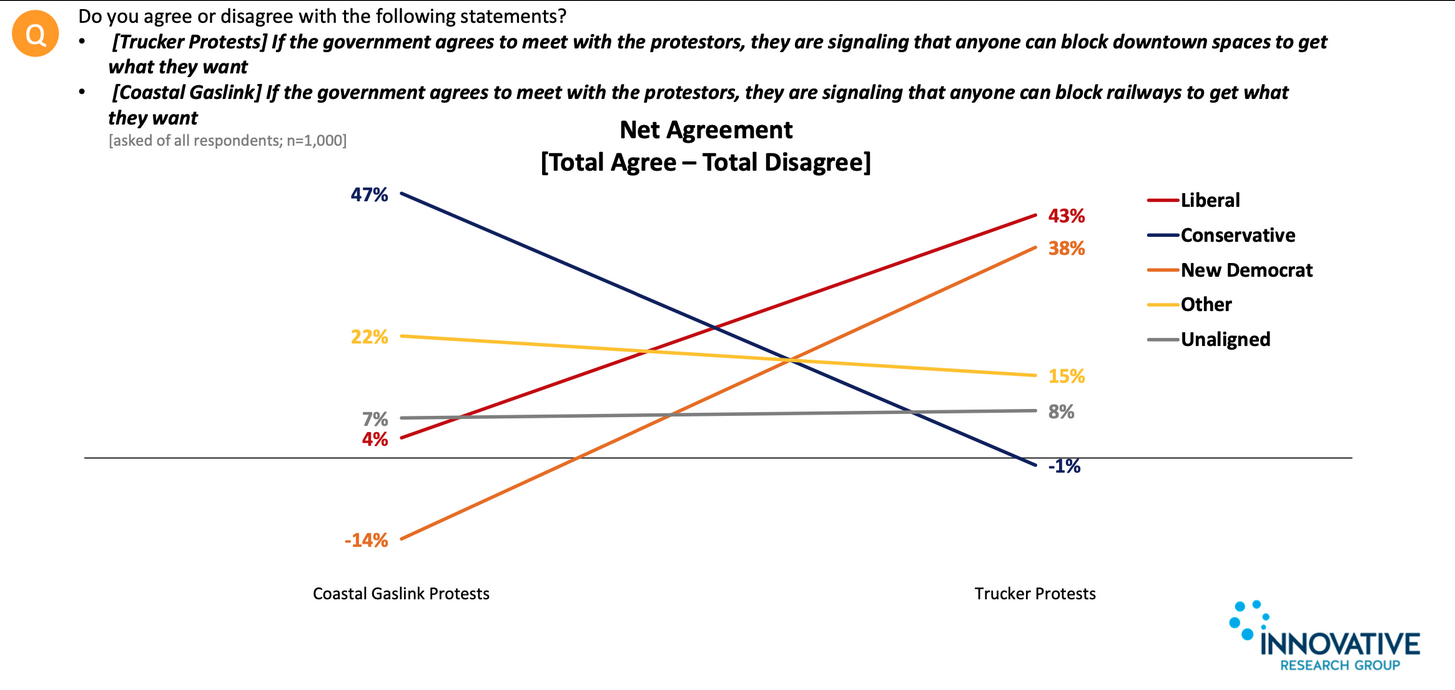
This graph is the best illustration of Canadian politics I’ve seen this year. It comes from Greg Lyle, the pollster who runs Innovative Research Group. He published it in February when downtown Ottawa was full of trucks. It takes some explaining, but we have time today.

On the left are results from a poll Lyle did in 2020. Rail blockades and protests had flared up across Canada, in support of Wet’suwet’en hereditary chiefs who opposed the Coastal GasLink pipeline project. One of the questions Lyle asked in 2020 was, Do you agree or disagree that “If the government agrees to meet with the protestors, they are signaling that anyone can block railways to get what they want”?

On the right are results from a poll Lyle did two years later, in March of this year. Agree/disagree, “If the government agrees to meet with the protestors, they are signaling that anyone can block downtown spaces to get what they want”?

[…]

In addition to NDP, Liberal and Conservative supporters, Lyle tracked opinions of people who support other parties. That’s the yellow line above. It’s nearly useless, a jumble of Green, People’s Party, Bloc Québécois and who knows what else.

But he also tracked responses of people who didn’t express support for any political party. That group’s responses didn’t swing at all between 2020 and 2022. That’s the black line above. Does meeting protesters encourage protests? Sure, on balance, a bit, these non-aligned voters said in 2020 (net +7%). People like them said the same thing in 2022 (net +8). Call this group the people who don’t freak out.

Now. Who gets heard in our politics? It goes without saying that the people in political parties, including the people in governments formed by political parties, are partisan. Liberals will tend to be on that upward-sloping red line in our graph. But what’s more important is that these days, only the people on the steeply-sloping partisan lines pay for our politics.

Since 2011, individual donors are the only source of funds for Canadian federal political parties. Corporate and union donations were eliminated in 2006. Public per-vote subsidies were eliminated in 2011. Today the only way I can pay my political party’s bills is if I can persuade lots of people like you to give me many small sums of money. And the people on that nice, even-keel, non-sloping black line in our graph? The people who don’t view every sparrow that falls as a little morality play about their heroes and the villains they face? Those people will never give anyone a dime. It’s the people who mood-swing wildly — who think our gang is great and their gang is the demon — who can be provoked into donating, again and again, until they max out for the year, and then again starting in January.

Irving Gerstein, the Conservative Party’s chief fundraiser under Stephen Harper, explained all of this in a 2013 column by Ken Whyte that stands as one of the most important documents for understanding our times: “Message creates momentum creates money.” Parties that reside permanently on the sloping lines of a Greg Lyle poll — that think, talk and act like their most fervent supporters — are able to separate those people from their money. Parties that exit the slope for the level meadows of moderation go nowhere.

May 30, 2022

QotD: The end of Nicolae Ceaușescu

Filed under: Europe, History, Quotations — Tags: , , , — Nicholas @ 01:00

On the morning of the 21st of December, 1989, Romanian General Secretary Nicolae Ceaușescu was in a foul mood. The Berlin Wall had fallen, and Mikhail Gorbachev and George H.W. Bush had recently announced the end of the Cold War, making the end of Ceaușescu’s rule inevitable, though he couldn’t see this yet. Worse, his security leaders had just failed to violently put down protests in the city of Timisoara, a fact that enraged his wife Elena.

“You should have fired on them, and had they fallen, you should have taken them and shoved them into a cellar,” she said. “Weren’t you told that?”

Long one of the world’s most vicious dictators, Ceaușescu’s most recent plan for winning over the heartland was forcing half the country’s villagers to destroy their own homes — with pick-axes and hammers, if they couldn’t afford a bulldozer — and packing them into project apartments in new “agro-industrial towns”, for a “better future”. Despite this, and his long history of murder, terror, and spying, Ceaușescu to the end did not grasp that his unpopularity had an organic character. He was convinced ethnically Hungarian “terrorists” were behind the latest trouble.

After reaching the balcony of Bucharest’s Central Committee building to give a speech that December day, he’s genuinely surprised when the crowd turns on him. When he tells them to be quiet, he’s befuddled by their refusal, saying, “What, you can’t hear?” Elena jumps in and yells, “Silence!”, to which Ceaușescu, hilariously, replies, “Shut up!” The crowd listens to neither of them.

Paul Kenyon’s Children of the Night describes the morbid black comedy that ensued. The Ceaușescus and a motley gang of undead apparatchiks that included the “morbidly obese Prime Minister, Emil Bobu” later tried to load into a single helicopter — Bobu “waddled, walrus-like, to the rear” Kenyon writes — but there were too many of them, and the copter barely got off the ground. “Where to?” asked the pilot, and nobody knew, because there was no plan, since none of them had ever considered the possibility of this happening.

The sky was full of stuff, including other helicopters, which were dropping leaflets on the crowd giving what Kenyon described as a Marie Antoinette-like order to ignore “imperialist conspiracies” and return home “to a Christmas feast”. Four days later, a firing squad put the Ceaușescus against a wall and gave them their final, solid lead Christmas presents.

Ceaușescu’s balcony will forever be a symbol of elite cluelessness. Even in the face of the gravest danger, a certain kind of ruler will never be able to see the last salvo coming, if doing so requires any self-examination. The neoliberal political establishment in most of the Western world, the subject of repeat populist revolts of rising intensity in recent years, seems to suffer from the same disability.

Matt Taibbi, “Justin Trudeau’s Ceausescu Moment”, TK News by Matt Taibi, 2022-02-10.

May 17, 2022

Mary Whitehouse, “The avenging angel of Middle England”

Filed under: Britain, History, Media, Politics — Tags: , , , , , , , , — Nicholas @ 05:00

At First Things, Jonathon Van Maren considers the legacy of Mary Whitehouse, the often mocked champion of public decency and crusader against pornography and blasphemy in the media from the mid-60s onwards:

I was surprised to find few public domain images of Mary Whitehouse available, so here is a selection of thumbnails (hopefully this won’t violate any copyright restrictions)

We have reached the point where our post-Christian elites, having safely enshrined the sexual revolution in law, can afford the luxury of occasionally admitting that their opponents were right. Exhibit A is the new BBC documentary Banned! The Mary Whitehouse Story, which details the life of Great Britain’s most infamous morality campaigner. Beginning with a crusade to keep smut and blasphemy off TV in 1964, Whitehouse rallied hundreds of thousands of women (and ordinary Britons) to her campaigns against “the permissive society”, culminating in her war against the porn industry. Alas, she lost most of her battles — but her warnings proved prophetic.

Mary Whitehouse was born in Warwickshire in 1910. She first started organizing in the 1960s because she — and millions of other mothers — did not like what her children were seeing on TV. A committed traditional Christian, she watched with dismay as the country she loved began to change around her. The metropolitan elites she faced off with thought she was “a provincial Birmingham housewife”. They didn’t underestimate her for long. She hosted her first mass meeting in 1964, and her organizing skills soon highlighted the subterranean power of Britain’s women. Whitehouse tapped into the gardening associations, the mothers’ unions, and other grassroots community organizations filled with folks who cared deeply about their children and the moral fabric of their nation. She brought them together, and when she spoke, it was with the voices of legions of little people. Her nickname summed it up: “The avenging angel of Middle England”.

Whitehouse’s first major campaign was to “Clean Up TV”, and her parliamentary petition to that end garnered around 500,000 signatures. In 1971, Whitehouse began organizing against sex ed in schools, triggered by an “educational” video she saw that was filled with pornographic scenes. Whitehouse was accused of hysteria — but Banned! features a pornographer admitting that, by using sex ed, “we gradually pushed back the barriers”, much as Whitehouse warned they would. Now that they’ve won, they can admit they were lying.

Whitehouse and others appalled by attempts to corrupt their children were accused of being “horrified by sex”. In reality, they were horrified by the version of sex presented by sex educators — in much the same way an art lover would be appalled to see vandals approaching a great masterpiece with cans of spray-paint and lewd laughter. Progressives never understood this, and consequently Whitehouse has been almost entirely defined by what she fought against rather than what she fought for.

Whitehouse’s lobbying resulted in several pieces of legislation, including the 1981 Indecent Displays Act, which sought to restrain sex shops and the display of porn, as well as the 1984 Video Recordings Act, intended to limit the sale of extreme video content. Unfortunately, these acts were rendered moot by the internet. But her greatest achievement was the 1978 Protection of Children Act, which criminalized child pornography. It seems remarkable that such a law did not already exist, but in the ’70s the Paedophile Information Exchange (PIE) was operating openly in Britain; it was supported by some British elites who believed that sex with children was the natural next step in sexual liberation.

April 4, 2022

Reconsidering the legacy of conservative activist Mary Whitehouse

Filed under: Britain, History, Media, Politics — Tags: , , , , , , , — Nicholas @ 03:00

Mary Whitehouse was a figure of mockery and abuse for much of her time on the public stage, a one-woman British equivalent to the American “Moral Majority” in the 1980s, without the performative religious connections. Even those who agreed with her concerns were careful to distance themselves from her, yet Alexander Larman wonders if she wasn’t more right than wrong after all:

I was surprised to find few public domain images of Mary Whitehouse available, so here is a selection of thumbnails (hopefully this won’t violate any copyright restrictions)

“The Queen of Clean”. “The Archangel of Anti-Smut”. Whatever you thought of the campaigner and activist Mary Whitehouse, she was hard to ignore. From her heyday in the 60s until her gradual decline in both relevance and physical faculties in the late 80s, she became the physical embodiment of social conservatism, loudly demanding that “family values” be placed at the heart of the national conversation, and that national evils (including pornography, abortion, swearing, homosexuality and the BBC in general) should be either tamed or dispensed with altogether.

Whitehouse died in 2001, and the obituaries trod a fine line between acknowledging her impact — even, at times, her importance — and denigrating her as someone who was almost driven insane by her campaign to clean up Britain’s screens. The Daily Telegraph, a newspaper that one might have assumed was a natural ally, sighed “[she was] seemingly as concerned to eliminate the occasional ‘damn’ or ‘bloody’ as to prevent the worst excesses of pornography or violence” and the Guardian, a long-standing and probably inevitable bête noire, marked her passing by calling her “a self-appointed and much-derided guardian of public morals”, sneered at her “simplistic and nannyish” views and approvingly cited Ned Sherrin’s comment that “If she had been ignored for the last 30 years the world would have been a better place”.

It also, with some reluctance, admitted that “it was possible for many middle-of-the-roaders to think she was just possibly right”. The debate continues as to whether Whitehouse was an oddly prurient figure, whose apparently endless campaigning was dictated by some sort of strange mental imbalance (she boasted about her “direct line to God”, as if the Almighty were responsible for guiding her attempts to rail against the likes of Dennis Potter) or an ahead-of-her-time master of both media relations and social understanding. And now, for some reason, Whitehouse has once again returned to our screens and airwaves, two decades after her death.

The journalist Samira Ahmed recently presented a Radio 4 documentary, Disgusted, Mary Whitehouse, that attempted to ask whether Whitehouse had somehow anticipated the rise of the internet, social media and society’s concomitant, and doomed, attempts to preserve the nation’s innocence amidst the ready availability of virtually every human depravity imaginable at the jab of an eager finger. This was followed by another two-part documentary on television, Banned! The Mary Whitehouse Story, in which various luminaries debated whether Whitehouse was simply a bigot who should best be forgotten about, or if she had a salient point that has, if anything, become more relevant since her death.

On the one hand, there is little doubt that Whitehouse was a proudly ignorant and even destructive figure when it came to arts and culture. She refused to watch most of the programmes that she organised campaigns against, announcing, “I have too much respect for my mind,” and declined to consider such things as artistic merit, creative intentions or context. For her, nudity, violence and sex were things that had no place in British public life, and she was happy to roll up her sleeves and lead well-organised campaigns against things that she disapproved of. It was partly because of her that Kubrick withdrew A Clockwork Orange from exhibition in Britain for two decades, and her private prosecutions of Gay News and the director Michael Bogdanov for, respectively, blasphemous libel and staging a homosexual rape scene in The Romans in Britain, were vindictive and viciously closed-minded. The first was successful, the second was not, and its failure in 1983 saw the beginning of her decline from public relevance.

March 11, 2022

Donate money to a legal, peaceful protest and be deprived of your rights on a governmental whim. Welcome to Canada!

Filed under: Cancon, Government, Law, Liberty — Tags: , , , , , — Nicholas @ 05:00

In First Things, Craig A. Carter recaps the events of February here in Canada after the government suddenly decided to treat non-violent protests as existential threats to the regime:

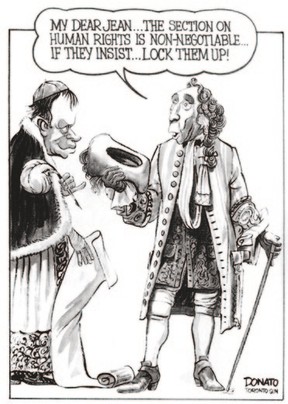
A Toronto Sun editorial cartoon by Andy Donato during Pierre Trudeau’s efforts to pass the Canadian Charter of Rights and Freedoms. You can certainly see where Justin Trudeau learned his approach to human rights.

Last month, Canadian Prime Minister Justin Trudeau’s cabinet used special powers under the Emergencies Act to freeze the bank accounts of Canadian citizens who supported Freedom Convoy protests against vaccine mandates. The government partnered with banks and other businesses to “de-bank” Canadians, circumventing due process and normalizing a dangerous, undemocratic policy. Canada has since revoked the Emergencies Act and instructed banks to unfreeze the targeted bank accounts, but this action set a dangerous precedent.

On February 22, the House of Commons Finance Committee questioned Department of Finance Assistant Deputy Minister Isabelle Jacques about the details of these financial measures. The government revealed that more than 206 accounts were frozen. Exactly how many “more” was not indicated. Trudeau revoked the Emergencies Act on February 23. But we still do not know how many accounts were frozen. No judicial review is permitted of the actions of banks under the Emergencies Act.

The government targeted not only protest participants, but also those who merely donated to the protesters. A reporter asked Jacques if a person who donated to a crowdfunding platform with no further involvement in protests could have their bank account frozen. The answer was “Yes.” Some people were punished without being formally charged with a crime at all.

In some cases, the right to a trial and the presumption of innocence were discarded. The Royal Canadian Mountain Police (RCMP) has stated that they provided the names of Freedom Convoy donors to financial institutions. The RCMP claimed that these individuals were major influencers in the protests or truck drivers who refused to leave the area. This might be the case, but we have no way of knowing for sure. Normally, when the RCMP conducts an investigation, they charge an individual with a specific crime and then give evidence to the Crown prosecutor, who decides if the person should be tried in court. If the person is found guilty after trial, then the judge sentences the person, and the sentence is carried out. However, in this situation, the whole process was reversed. The RCMP determined guilt and imposed a punishment before conducting a proper trial for explicit charges. And because this was done under the Emergencies Act, citizens do not have the ability to sue the bank or the RCMP for mistakes — cases of mistaken identity, for example. There was no incentive against carelessness.

There has also been controversy over whose accounts were frozen. The Globe and Mail reports that the RCMP told the House of Commons Finance Committee on March 7 that a “small number” of additional accounts were frozen under the Emergencies Act based on the banks’ own “risk-based” reviews and were not on a list of names provided by the RCMP.

February 28, 2022

Roman Republic to Empire 03 Inequality and Corruption

Filed under: Europe, History, Italy, Military — Tags: , , , , , , — Nicholas @ 04:00

seangabb
Published 5 Feb 2021

[Update 2023-03-02 – Dr. Gabb took down the original posts and re-uploaded them.]

Here is the third lecture, which describes the decay of the Roman Constitution as a result of changes in patterns of land tenure in Italy after the Second Punic War, and as a result of the flood of foreign money into Rome from military victories and war indemnities and bribes.
(more…)

February 24, 2022

I guess the “emergency” is technically over, question mark?

Filed under: Cancon, Law, Politics — Tags: , , , , — Nicholas @ 05:00

My original headline for this piece was

I can’t believe I’m writing this, but we need to depend on Canada’s Senate to turn down Trudeau’s Emergencies Act

Fortunately, perhaps because Mr. Trudeau realized he might lose the vote in the Senate, he announced earlier today that the government will relinquish the powers granted under the Emergencies Act. The province of Ontario is also rescinding the state of emergency. This makes much of what follows less immediately relevant, but I’m too lazy to delete it I feel it still has some informational value to offer:

I’ve never had much faith in our Senate — and given that most Prime Ministerial appointments to the upper house are given as rewards to former political backroom organizers, bagmen, and the occasional prominent citizen, the role of the Senate in daily life is virtually nil. Now, thanks to a provision of the Emergencies Act, our last chance of prying the undemocratic emergency powers Trudeau has claimed is to have the Senate vote against the use of the act. This is not how the upper house normally operates.

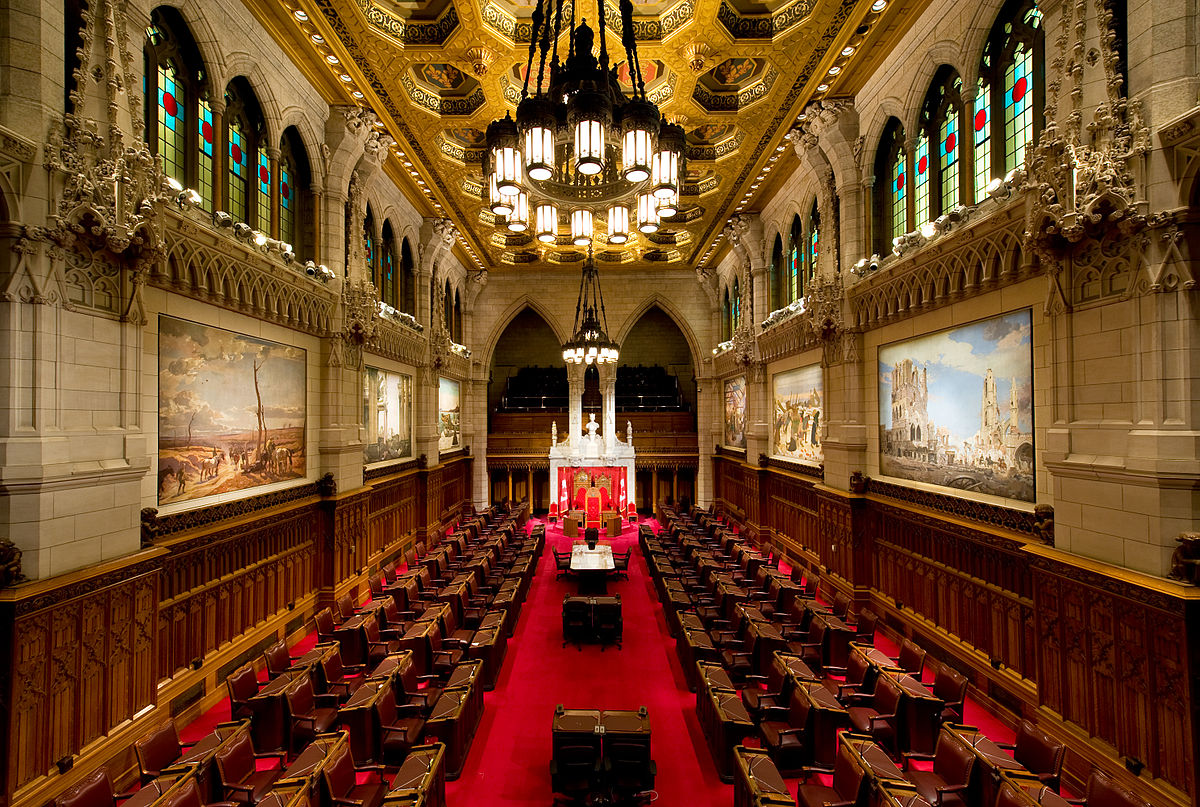
“In the east wing of the Centre Block is the Senate chamber, in which are the thrones for the Canadian monarch and her consort, or for the federal viceroy and his or her consort, and from which either the sovereign or the governor general gives the Speech from the Throne and grants Royal Assent to bills passed by parliament. The senators themselves sit in the chamber, arranged so that those belonging to the governing party are to the right of the Speaker of the Senate and the opposition to the speaker’s left. The overall colour in the Senate chamber is red, seen in the upholstery, carpeting, and draperies, and reflecting the colour scheme of the House of Lords in the United Kingdom.”
Photo and description by Saffron Blaze via Wikimedia Commons.

Even as it enables the government to take such far-reaching actions, the Emergencies Act provides safeguards against abuse. One such safety valve is that the government’s declaration of an emergency has to be approved, in short order, by both the House of Commons and the Senate in order to continue in force. In the Act’s words, “If a motion for confirmation of a declaration of emergency is negatived by either House of Parliament, the declaration, to the extent that it has not previously expired or been revoked, is revoked effective on the day of the negative vote.”

The House of Commons approved the motion to confirm the government’s declaration of emergency on Monday. It is up to the Senate to consider it now. And so, it may be useful to review the principles that govern the role of this much misunderstood and often maligned institution.

The Senate is not a deus ex machina that can rescue us from bad government. The suggestion, put forward by some of the “freedom convoy” leaders, that a constitutional chimera made up of the Senate and the governor general could oust the federal government and redress whatever grievances they came to air was arrant nonsense. For the most part, the Senate’s role in the government of Canada is very limited, and rightly so.

Senators are not elected and, as a result, lack the legitimacy to oppose the will of the House of Commons, whose members (the MPs) are, and the cabinet, led by the prime minister, which is responsible to the House of Commons. When the cabinet proposes that a law should be enacted, and the House of Commons agrees, constitutional propriety (a “constitutional convention”, in the jargon) dictates that the Senate’s role is limited to, at most, making suggestions for improving this law while respecting its general principle.

[…]

Will the Senate act independently? I do not know; I am just a boring law professor, and this question is above my pay grade. But I would like to conclude with an observation about how either answer to this question should make us reflect on the attitude the current prime minister and his predecessor have taken to the Senate.

If the Senate defeats Mr. Trudeau’s government, it will be in part because he cut his ties with what used to be the Liberal caucus there, releasing existing Liberal senators and new appointees to act with greater independence (though, in fairness, senators were always somewhat more independent-minded than MPs; not having to get re-elected does that to one). What may have seen a cost-free symbolic gesture might yet turn out to have been quite consequential.

Conversely, if the Senate ends up siding with the government, this will in part be because there are fewer Conservative senators than one might have expected. The reason for that is that Stephen Harper simply stopped appointing senators, in a fit of pique over the failure of Senate reform plans. That was a dereliction of constitutional duty ― the prime minister must fill Senate vacancies as they arise. And now, if not Mr. Harper himself, then at least many of his erstwhile supporters may come to regret that he did not.

February 23, 2022

If the protest is over, why does the government believe it still needs the Emergencies Act powers?

Depressingly, the House of Commons approved Justin Trudeau’s use of the Emergencies Act, and various officials at federal and municipal level have continued rhetorical scorched-earth statements to the media and directly on social media about the protest. If the stated need for those emergency powers has abated, why are the feds still pushing to hang on to them?

In the Toronto Sun, former Liberal Party president Stephen LeDrew is scathing in his criticisms of Trudeau:

Just walk or drive through cities and villages and the countryside, and see the Canadian flags — paired with signs expressing vehement disapproval of our federal government. Loyal Canadians are fed up with their federal government.

And one person is responsible for this — Prime Minister Justin Trudeau.

He has drastically altered Canadian institutions and norms so considerably that usually calm people are raising their voices in protest.

The core of the protestors in Ottawa and other Canadian centres were angry not only about government heavy-handedness in its pandemic policies, but also the changes being brought about by Trudeau.

He has cheapened public discourse and public life.

He talks so high-minded, yet has a lifelong history of deplorable acts.

He has arbitrarily ruined the lives of many other people who have been supposedly guilty of far less egregious acts than have been proven by photographs against him — perhaps to deflect his own guilt?

Does “do as I say, not as I do” strike home? How about “one standard for the masses, and another for the elites like me?”

His intolerance, and high-handed and ill-founded rectitude has led many to regard the government with disdain, and doubt its ability to get things right.

And now his decision to not only invoke the Emergencies Act (which most minds — those not cowardly beholden to Trudeau — agree was not necessary to get the job done in Ottawa), but to keep it in force for an undetermined period (to “hunt down” some Canadians to charge them with mischief?), has shown precisely how inappropriate Trudeau really is for this high office.

David Warren is, in his own words, modestly optimistic despite the current political situation here in the Trudeaupian Maple Dictatorship:

Our provincial and Dominion governments went formally off the rails of settled law in response to the Batflu epidemic, two years ago. They arrogated to themselves powers never previously claimed by our politicians, except in wartime — to regulate the smallest details of everyday life. It began with “two weeks to disable the Constitution and Human Rights”, both here, and under Trump across the border. The “vaccine passports” were merely the latest crass obscenity of this political and bureaucratic class.

I am modestly optimistic about the course of events, however. True, I must expect direct persecution by the Party of the Dictatorship, which is out to settle scores. But the Freedom Convoy sent to the national capital has shown, for the first time in many years, that a substantial number of Canadians will resist.

That a majority cannot cope with freedom, and are likely to squall when exposed to it, I take for granted. Humans have always been “conservative”, in this worst possible sense. But the splendid Canadian reaction to tyranny went beyond what I had hoped for. In particular, many articulate voices have been raised to speak truth — in the dark fever-swamp of lies in which our culture, and by extension our economy, is choking. This will make a huge difference. The sun is distantly shining; and the spring can once again be imagined. Sunlight is the best disinfectant, to filth accumulating in public life.

In 1993, the then-governing “Progressive Conservatives” were reduced from a majority, to two seats in Parliament, and then to extinction at the “federal” level. Men of good will shall be working towards a similar result, at the next general election, in which the Liberals and NDP should be annihilated.

While my dislike of Trudeau runs extremely high, I didn’t have much of an opinion about Chrystia Freeland, the deputy PM, until very recently. Apparently, I’m way behind the curve on disliking “the Nurse Ratched of the New World Order”:

Sorkin’s Visa piece is suddenly relevant again, after fellow former finance reporter Chrystia Freeland — someone I’ve known since we were both expat journalists in Russia in the nineties — announced last week that her native Canada would be making Sorkin’s vision a reality. Freeland arouses strong feelings among old Russia hands. Before the Yeltsin era collapsed, she had consistent, remarkable access to gangster-oligarchs like Boris Berezovsky, who appeared in her Financial Times articles described as aw-shucks humans just doing their best to make sure “big capital” maintained its “necessary role” in Russia’s political life. “Berezovsky was one of several financiers who came together in a last-ditch attempt to keep the Communists out of the Kremlin” was typical Freeland fare in, say, 1998.

Then the Yeltsin era collapsed in corrupt ignominy and Freeland immediately wrote a book called Sale of the Century that identified Yeltsin’s embrace of her former top sources as the “original sin” of Russian capitalism, a “Faustian bargain” that crippled Russia’s chance at true progress. […]

Years later, she is somehow Canada’s Finance Minister, and what another friend from our Russia days laughingly describes as “the Nurse Ratched of the New World Order”. At the end of last week, Minister Freeland explained that in expanding its Financial Transactions and Reports Analysis Centre of Canada (FINTRAC) program, her government was “directing Canadian financial institutions to review their relationships with anyone involved in the illegal blockades.”

The Emergencies Act contains language beyond the inventive powers of the best sci-fi writers. It defines a “designated person” — a person eligible for cutoff of financial services — as someone “directly or indirectly” participating in a “public assembly that may reasonably be expected to lead to a breach of the peace.” Directly or indirectly?

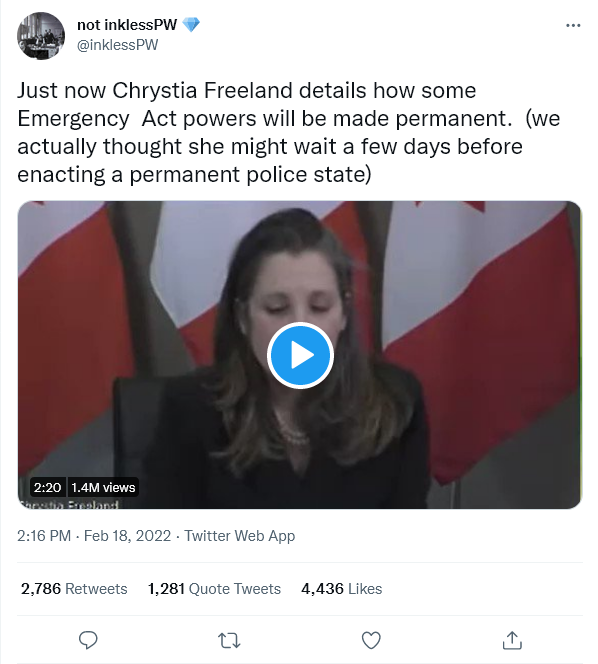
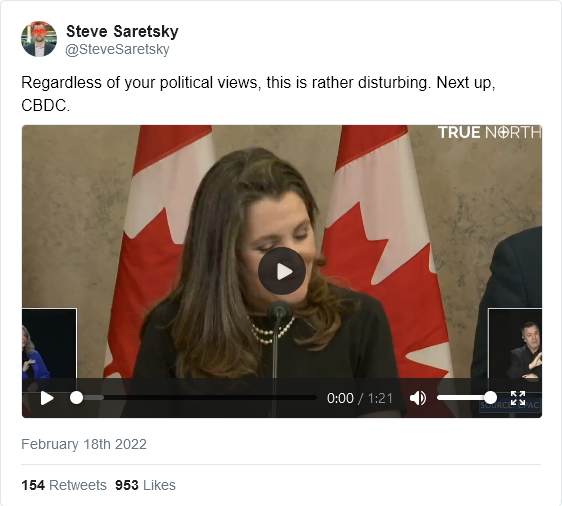
She went on to describe the invocation of Canada’s Emergencies Act in the dripping-fake tones of someone trying to put a smile on an insurance claim rejection, with even phrases packed with bad news steered upward in the form of cheery hypotheticals. As in, The names of both individuals and entities as well as crypto wallets? Have been shared? By the RCMP with financial institutions? And accounts have been frozen? As she confirmed this monstrous news about freezing bank accounts, Freeland burst into nervous laughter, looking like Tony Perkins sharing a cheery memory with “mother”:
One of the oddest moments during the weeks-long protest in Ottawa was when “counter-protesters” showed up, but as one observer noted, they seemed to be at the wrong protest:

At first glance, it looked like one of the strangest, most incongruous moments of the great trucker uprising of 2022. There were the truckers and their working-class allies, in Ottawa, loudly agitating against Justin Trudeau’s vaccine mandates, when a bunch of hyper-woke, definitely not working-class counter-protesters rocked up to rail against this horn-honking throng. And what did they chant, these painfully PC counter-protesters? “Trans rights are human rights”, that’s what. As clear as anything, these supposed leftists, seemingly horrified by the sight of working-class men and women fighting for their rights, engaged in arguably the most striking non-sequitur of the 2020s so far – they brought transgenderism into an issue that has nothing whatsoever to do with transgenderism.

The truckers have said nothing about trans people. We have no idea what these pissed-off working-class drivers think about genderfluidity and all the rest. My hunch is that they think it’s nonsense. But we don’t know. This vast gathering of truckers and their supporters, which has so rattled the Trudeau administration and inspired copycat revolts around the world, is completely unrelated to sex changes and pronouns and the right of born men to beat women in sports and all the other things that fall under the banner of “trans rights” these days. So, understandably, many people were perplexed by the counter-protesters’ chant. “I don’t think they are at the right protest”, said one observer. Memes emerged, saying: “Truckers: Freedom for all! Counter-protest: Trans rights are human rights. Truckers: What??” What indeed.

[…]

In other words, that strange “trans rights” counter-protest captured a larger truth about the truckers’ uprising. Which is that wokeness has enabled the Canadian state’s exceptionally intolerant and violent assault on this working-class uprising. Many of us have marvelled at the allegedly radical left’s studious ignoring of the Canadian working-class revolt against the bourgeois state. But as more and more time passes, it has become clear that the left has not in fact ignored this globally important protest – rather, it has played a key role in legitimising state tyranny against the protesters, in providing the political justification for the Ottawa police’s violent wielding of truncheons and their crushing of working people. The woke are not mere bystanders, not mere wide-eyed shoulder-shruggers to this working-class uprising. On the contrary, they have been the moral facilitators of the state’s classist violence against the truckers and their allies.


February 21, 2022

Trudeau government intends to keep (some of) the powers seized through illegitimate use of the Emergencies Act

The Canadian government under Justin Trudeau took advantage of a peaceful protest in the streets of Ottawa to invoke the Emergencies Act, the modern-day successor to the War Measures Act (which itself had only ever been used three times). Nothing the police have done in Ottawa since the emergency was declared required the powers enabled under the legislation, but apparently the protest was just a pretext to let the government do what it really wanted to do anyway:

The regular weekly round-up from The Line was delayed until Saturday as the events in Ottawa were far too fast-moving to summarize at that point. Here’s part of the later newsletter:

As the protest in Ottawa winds down, your Line editors are beginning to ask themselves, perhaps too optimistically: what happens after the emergency is over?

The Liberal government has arrogated to itself enormous powers through the Emergencies Act: the most notable among them, the ability to freeze assets of protest participants without any kind of prior judicial approval or warrant. It’s not entirely clear to us what would constitute an offence that the government would consider serious enough to justify using this power.

If someone gave $500 to the protest movement three weeks ago, would that merit freezing a bank account? Is the number $5,000? Or $50,000? Would this act apply to independent media livestreaming the protests?

Complicating matters, on Wednesday, Justice Minister David Lametti gave an interview with CTV’s host Evan Soloman. Solomon asked whether ordinary people who donated to the trucker convoy should be worried about the provisions in the Emergencies Act. Lametti responded:

“If you are a member of a pro-Trump movement who is donating hundreds of thousands of dollars, and millions of dollars to this kind of thing, then you ought to be worried,” said Lametti.

Excuse us, but … wtf?

Threatening people who are donating cash to anything that can be construed as a “pro-Trump” movement suggests that attempts to freeze assets aren’t directed toward criminal behaviour, but are rather politically motivated.

We asked Lametti’s office for response to his “pro-Trump” comments and this was his response:

    “We always ask our police forces as well as our prosecutors to act reasonably, where they’re going to work with the banks to ensure that they act reasonably. Obviously there are going to be judgment calls that will be made and serious contributors will be treated more seriously. But, as always, we’re going to leave it to law enforcement to work with the banks, as they already do in other areas that already exist. Such as in anti-terrorism financing and in other areas through FINTRAC.”

This is, frankly, not much of an answer. It amounts to “we will be reasonable. Trust us!”

Well, we don’t. We don’t trust NDP leader Jagmeet Singh to hold this government to account in Parliament. We don’t trust the left to clue into the fact that the tactics used against the convoy will be used against their causes in turn. We don’t trust conservatives to show more principle or restraint when in power.

David Sacks, posting at Bari Weiss’s Common Sense blog, says that the federal government’s moves to seize bank accounts is a clear sign that we’re having a Chinese-style “social credit” system imposed on us:

Last summer, I warned readers of Common Sense that financial deplatforming would be the next wave of online censorship. Big Tech companies like PayPal were already working with left-wing groups like the ADL and SPLC to define lists of individuals and groups who should be denied service. As more and more similarly minded tech companies followed suit (as happened with social media censorship), these deplorables would be deplatformed, debanked, and eventually denied access to the modern economy altogether, as punishment for their unacceptable views.

That prediction has become reality.

What I could not have anticipated is that it would occur first in our mild-mannered neighbor to the north, with the Canadian government itself directing the reprisals. It remains to be seen whether Canada will be a bellwether for the U.S. But anyone who cares about the future of America as a place where citizens are free to protest their government needs to understand what has just occurred and work to stop it from taking root here.

[…]

Trudeau escalated things further on Tuesday night, when he issued a new directive called the Emergency Economic Measures Order. Invoking a War on Terror law called the Proceeds of Crime and Terrorist Financing Act, the order requires financial institutions — including banks, credit unions, co-ops, loan companies, trusts, and even cryptocurrency wallets — to stop “providing any financial or related services” to anyone associated with the protests (a “designated person”). This has resulted, according to the CBC, in “frozen accounts, stranded money and canceled credit cards”.

Banks, according to this new order, have a “duty to determine” if one of their customers is a “designated person”. A “designated person” can refer to anyone who “directly or indirectly” participates in the protest, including donors who “provide property to facilitate” the protests through crowdfunding sites. In other words, a designated person can just as easily be a grandmother who donated $25 to support the truckers as one of the organizers of the convoy.

Because the donor data to the crowdfunding site GiveSendGo was hacked — and the leaked data shows that Canadians donated most of the $8 million raised — many thousands of law-abiding Canadians now face the prospect of financial retaliation and ruin merely for supporting an anti-government protest.

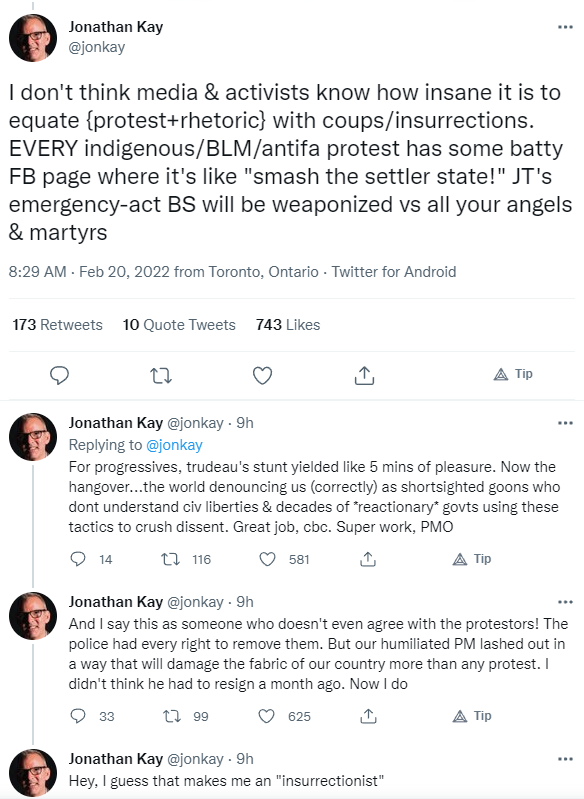
Hard to disagree with Jon Kay here:

Jordan Peterson discusses the catastrophe of Canada with Rex Murphy:

February 20, 2022

That “small fringe minority … holding unacceptable views” and their banner of racism and white supremacy (checks notes) — the Canadian flag

Filed under: Cancon, Government, Media, Politics — Tags: , , , , , — Nicholas @ 03:00

David Warren notes that if nothing else, the Freedom Convoy has managed to get some central Canadians to turn against the national flag:

There is one interesting, nearly universal feature of the demonstrations in Canada for political freedom. The members — called a “small fringe minority” by our prime minister — would seem to be almost entirely Christian. They are also patriotic, as is evident even to legacy media, who feel compelled to use photographs and footage, and thus to admit a fragment of the truth. Canadian flags are exhibited on the grilles of the honking trucks, and generally.

Indeed, a Globe reporter has tweeted that she is now traumatized by this experience, of being confronted by Canadian flags. She gags at what I used to call the “Pearson pennant”. (It is only in the last few weeks, that I have ceased to be “traumatized” by it, myself; though truth to tell, I’m not the “traumatized” type.)

But the Christian attachments, among the protestors, is not waved about as a flag. It is expressed mostly in prayers, and the articulation of blessings, and in subtle decorations worn close to head and heart, that may be illegal in Quebec.

Batya Ungar-Sargon reports on the situation in Ottawa for Spiked:

It’s been quite a few weeks for our neighbours to the north. Three weeks ago, a ragtag, grassroots campaign of disgruntled truckers made their way to the Canadian capital to protest a government vaccine mandate. As of last night, two of the organisers of what has been, by all accounts, a peaceful protest have been arrested, giving Canada – a country that bills itself a democracy – its first political prisoners in recent memory.

On Thursday, Chris Barber was arrested, while Tamara Lich had her personal bank account frozen and was detained on a charge of “aiding and abetting mischief” – a trumped-up charge resulting directly from a naked power grab by Canadian prime minister Justin Trudeau.

Instead of meeting with his citizens to hear their demands, Trudeau has spent the past three weeks smearing them as hateful and violent. On Monday he became the first Canadian leader to invoke the Emergencies Act – giving his government a series of draconian powers. Without one iota of evidence that the “violence” of the truckers’ protests has ever exceeded honking, Trudeau broadened the scope of Canada’s anti-money-laundering and terrorist-financing rules, putting the striking truckers on a par with terrorists, suspending their civil liberties and allowing banks to freeze the personal accounts of anyone linked to them. Now Trudeau is having them arrested. And on Friday morning, he cancelled a parliamentary session in which his edict was due to be voted on, and could have potentially been revoked, by the House of Commons or the Senate.

The truckers’ protest began with Trudeau smearing the truckers as Nazis and fascists – a line gladly repeated, day in day out, by reporters and pundits in the elite liberal media. It is now ending with those same elites cheering on Trudeau’s authoritarianism.

Although the media have promoted Trudeau’s falsehoods and cheered his overreach, many Canadians see the protests for what they are. The Canadian Civil Liberties Association is taking the federal government to court for invoking the Emergencies Act. “It’s possible for protests to be both disruptive and peaceful”, Noa Mendelsohn Aviv, its executive director, rightly argued. Others have pointed out Trudeau’s hypocrisy. In 2020 the Canadian PM threw his support behind both Black Lives Matter’s disruptive protests and protesting farmers in India who were blocking major highways. “Canada will always be there to defend the right of peaceful protest”, Trudeau said back then.

H/T to Samizdata for the link.

Of course, it’s totally reasonable (in the government’s view anyway) to set the mounted unit and riot-helmeted, baton-wielding police against the dangerous bouncy castle terrorists in Ottawa, but on the other side of the country actual terrorist actions are being downplayed:

There has been an outbreak of political violence in Canada. A member of the Royal Canadian Mounted Police was hurt and people going about their daily business were threatened by masked men with axes. Roads were blocked with barricades, Millions of dollars of damage was caused. At one point some of the workers were trapped in a building while the demonstrator tried to set light to it with them still inside.

This happened on Thursday night. It didn’t happen in Ottawa where hundreds of truck drivers maintained their protest despite emergency powers being granted to the authorities. Powers to steal their trucks, close their bank accounts – including those who have donated to their cause, and now they are talking about forcibly removing their children, and euthanising pet dogs, all because they have engaged in peaceful protest. People who have been vilified in the Canadian media as terrorists or as insurrectionists intent on overthrowing the democratically elected government of Canada as the January 6th protesters did at the White House, but this time in plaid shirts.

No this attack took place, not in Ottawa, but in British Columbia, at an industrial site. This is what the RCMP (Royal Canadian Mounted Police) had to say: “Shortly after midnight, Houston RCMP was called to the Marten Forest Service Road (FSR) after Coastal Gas Link (CGL) security reported acts of violence at their work site … approximately 20 people, some armed with axes, were attacking security guards and smashing their vehicle windows …

“Upon police attendance at the 41 km mark, the roadway had been blocked with downed trees, tar covered stumps, wire, boards with spikes in them, and fires had been lit throughout the debris. As police worked their way through the debris and traps, several people threw smoke bombs and fire lit sticks at the police, injuring one officer.

“At the 43 km mark, an old school bus blocked the road … When police arrived … they found significant damage had been done to heavy machinery, fencing, and portable buildings …

“This is a very troubling escalation in violent criminal activity that could have resulted in serious injury or death. This was a calculated and organized violent attack that left its victims shaken and a multimillion dollar path of destruction,” says Chief Superintendent Warren Brown, North District Commander, “While we respect everyone’s right to peacefully protest in Canada, we cannot tolerate this type of extreme violence and intimidation. Our investigators will work tirelessly to identify the culprits and hold them accountable for their actions.”

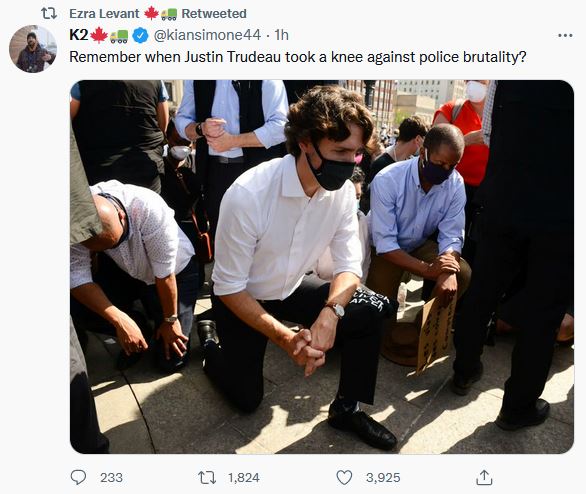
And from the “That was then, this is now” file, here’s Justin Trudeau taking a knee over police brutality in the far, distant days of the past:

H/T to JoNova for the screencap.

February 19, 2022

Freedom Convoy organizers arrested, Ottawa police “operations” pre-empt Parliamentary session to debate the invocation of the Emergencies Act. Just another day in Trudeaupia

Parliament was scheduled to debate the Prime Minstrel’s use of the Emergencies Act, but the session was cancelled because the Ottawa police were conducting an “operation” on Parliament Hill. The police also warned journalists to avoid the area for their own safety. Nothing disturbing or authoritarian about attempting to ensure that there won’t be any independent reports on the “operation”, right? This isn’t the kind of “free and democratic society” most of us imagined it was just a few days ago.

Jordan Peterson points out the amazing tone-deafness of the federal government on yet another topic:

ReasonTV looked at the “Revolt of the Canadian Truckers” and compared it to other populist protest movements of recent years:

PPC leader Maxime Bernier sent out this email to supporters:

There is violence in the streets of Ottawa.

The police, armed with riot gear, are brutalizing and arresting peaceful demonstrators from the truckers’ convoy.

Meanwhile, Parliament is not sitting today because of this police operation. All parties agreed to stay away while the regime cracks down on dissidents.

Just like in a banana republic.

They should have been debating Trudeau’s decision to invoke the Emergencies Act.

The Emergencies Act replaced the War Measures Act in 1988. The only other times in Canadian history that it was invoked were during the First and Second World Wars, and during the October Crisis in 1970.

There is no emergency in Canada. No war, no insurrection, no terrorist attack, no sanitary or environmental catastrophe that justifies invoking this law.

It’s outright illegal, undemocratic, and unconstitutional for this government to give itself exceptional powers to deal with peaceful demonstrators.

It’s a power grab on Trudeau’s part to crush dissidence, that’s all it is.

Trudeau and his Finance minister Chrystia Freeland have given themselves the power to freeze the bank accounts not only of the organizers of the Freedom Convoy, but of anyone who is suspected of helping and funding them.

And we’re supposed to believe that a government that has violated our Constitution and our rights and freedoms for two year will not abuse these new powers?

Nicholas, it’s a dark day for Canada.

But it’s not over. We will continue to fight this authoritarian government, and bring back freedom, respect and justice to this country.

Don’t despair. Stay strong and free.
-Max

The good folks at Spiked explain why the truckers must win:

GiveSendGo sent an email in response to queries about whether the truckers had received the money that had been donated:

Where’s the money?

The questions keep on coming, so we want to answer!

The number one question people are asking right now is, “Have the truckers received the funds?” Our answer is this: “Yes, the truckers have received some of the funds paid out to the ‘Adopt a Trucker’ campaign.”

As this plays out with the Canadian government, there have been steps taken to prevent the funds from being “frozen”. Currently, the bulk of the funds are in an undisclosed U.S. bank.

Right now, the teams involved are actively discussing the legal options for getting the funds where they need to go. (Thank you to those who’ve sent in suggestions, you’ve definitely had some creative ones!)

What we need from you:

We ask that you do not request a refund at this time as these funds will be needed for the truckers and their legal teams. Additionally, please be patient and pray for wisdom for all involved. We will keep you updated as we move forward.

Thank you for all your prayers and support over these past few weeks!

“But as for you, be strong and courageous, for your work will be rewarded.” ‭‭2 Chronicles‬ ‭15:7

‭‭Shine Brightly!

February 18, 2022

The “small fringe minority … holding unacceptable views” who can now have their bank accounts seized without recourse

Filed under: Cancon, Government, Politics — Tags: , , , , , , — Nicholas @ 03:00

Prime Minstrel Justin Trudeau invoked the Emergencies Act earlier this week, which gives the federal government the kind of powers previously reserved for wartime. Among other measures, it is claimed that the act gives the feds the power to have Canadian banks seize the accounts of Canadians holding unacceptable views. Even those of us who donated to the support of the trucker convoys in Ottawa and several border crossings are now “legally” able to be deprived of our property. This is far from the kind of free and democratic society most of us thought we inhabited before the public health crisis of the Wuhan Coronavirus somehow transmuted our country into a would-be dictatorship.

At Essays in Idleness, David Warren demands that we stop it now:

The idea that one has the right, under a “Charter”, to speak freely, demonstrate and protest, but not the right to occupy physical space and time, has long been apparent to persons of the cold-blooded, criminal disposition.

In this respect Justin Trudeau is hardly unique. Like, for instance, the New Zealish prime minister, Jacinda Ardern, he rose to his present eminence as the embodiment of an empathy, that was entirely fake. Indeed, he had no other skills or gifts, and like Miss Ardern, has only offered administrative incompetence. He is what we call “a nasty piece of work”.

He has now declared a national State of Emergency: because there are trucks parked illegally on Wellington Street in Ottawa. Had he been quicker with his proclamation, he could have mentioned a bridge in Windsor and border crossings in Manitoba and Alberta. But this would not have made his claim more plausible, as all the demonstrations were provocatively peaceful. The only chance of violence is to use force against them.

An economy is a controversial thing, for economic activity will often involve the use of space and time. For instance, truckers, and most others who are inclined to resist government “mandates”, are known to have bank accounts. They buy food to put in themselves, and fuel to put in their vehicles. By “freezing” these financial instruments, Trudeau vainly hopes to starve his opponents into panicked submission.

As Jen Gerson notes on Twitter, Canada is suffering a psychotic break. The technical term is “Bug Fuck Crazy”:

She continues:

I mean, perhaps this was inevitable. No country can be this uptight and stoic for so long without losing its collective bugfuck crazy mind eventually.

    @MacLeodKirk: Yeah, to be honest I’m rather tired of us measuring our level of excellence based on the batshit crazy happenings in the US.
    Perhaps we could aim just a tad bit higher?

The difference is that America can tolerate a certain baseline level of crazy. It’s like having an alcohol tolerance.

Canada, by comparison, is an 18-year-old Ontario girl crossing into Quebec and taking her first shot of Sourpuss right now. We can’t handle our shit.

“ALL OF YOU ARE ACTING LIKE CRAZY PEOPLE” she screamed into the Internet abyss before throwing her wine glass at the wall and disappearing for three days.

Earlier this week, the government’s spokesgoons in the media made not-so-veiled threats against the children of truckers and other supporters. On Thursday, Ottawa officially threatened to dognap any pets at the protest … for their own good, of course. Interestingly, Thursday was also the day that workers began to install a fence around the Parliament buildings, in imitation of the fortifications at the American Congress.

Malcom Kyeyune calls it “Justin Trudeau’s phoney dictatorship”:

When Justin Trudeau invoked emergency powers to quell protests against mandatory Covid-19 vaccinations this week, it was another sign that for Western liberal democracy, business as usual is over. This is the first time Canada’s Emergencies Act has ever been called upon by a Prime Minister. Its predecessor, the War Measures Act, was used three times: once for World War One, once for World War Two, and once to deal with a violent campaign of bombing, kidnapping, and murder by Quebecois separatists in 1970.

Yet Trudeau’s invocation of the Emergency Act is also a bizarre moment. Consider that the law stipulates that the government can fine people violating the act between 500 and 5,000 dollars. On the face of it, these are not numbers that seem commensurate to punish violators of the most powerful emergency law in the Canadian state’s armoury. But the reason these numbers seem so strange is simple: the law hasn’t been updated to keep up with the times, or inflation.

The oddness doesn’t end there. A law that in a real sense was forgotten — and designed to handle the most extreme situations a nation state can find itself in — is now dredged up to deal with a fairly routine political protest. Trudeau, and his finance minister Chrystia Freeland, have also called on financial institutions to freeze or suspend any bank accounts without a court order if they are being used to fund the protests. They believe, as David Frum writes in The Atlantic, that the truckers represent a “form of performative intimidation”.

Compared to the mass burning and vandalism of Catholic Churches in Canada last summer — which Trudeau both denounced and sympathised with, calling the arsons “understandable” at one point — the truckers hardly represent a nadir of public order. Across the border in the United States, the rioting that occurred there in the summer of 2020 involved loss of life, and massive damage to property. Back then Kamala Harris’s response was markedly similar to that of Trudeau — hand-wringing, sure, but also sympathy with the motivations of those who rioted.

Perhaps buildings being burned down, sometimes with their occupants still inside them, is just part and parcel of living in a vibrant democracy. Meanwhile, a protest that has led to zero loss of life and no torched buildings is cast as a grave threat to democracy. Put up bouncy castles for kids to play in and have public barbecues, as the truckers have done? Then, in the words of the New York Times‘ editorial board, you are “far-Right”, and represent a “test of democracy” itself.

Or you will be accused of “sedition” by the usually phlegmatic Mark Carney. The former Bank of England governor may support Trudeau’s use of emergency powers, but by all indications it is a spectacularly ill-conceived move. Many provincial leaders are already openly rejecting the necessity of such extreme measures.

Kim du Toit responds to a rant by one of Sarah Hoyt’s contributors:

As I see it, most ordinary Americans — if faced with the choice — would rather go to war against our own government than against Canada, present company included.

And as Mr. Free Market put it to me during a semi-drunken phone call last night: how bad does the Canadian government have to be, to have pissed off the nicest, politest people on the planet?

They’re so nice that SoyBoy Trudeau is highly unlikely to have a Ceaușescu Moment, even though it could be argued that he deserves one

As always, Canadians love it when foreigners (especially Brits and Americans) call us “nice” and “polite” … it shows they don’t follow hockey or know many actual Canadians. Canadians are polite, generally, but it’s a kind of passive-aggressive niceness that can snap unexpectedly under sufficient provocation, then the gloves come off and there’s blood on the ice. That last bit is only sometimes metaphoric.

February 15, 2022

“Freedom”. You proles keep using that word. The CBC doesn’t think it means what you think it means

Filed under: Cancon, Liberty, Media, Politics — Tags: , , , , , — Nicholas @ 05:00

In Monday’s NP Platformed newsletter, Colby Cosh considers what this mysterious and esoteric word “freedom” seems to mean to the CBC:

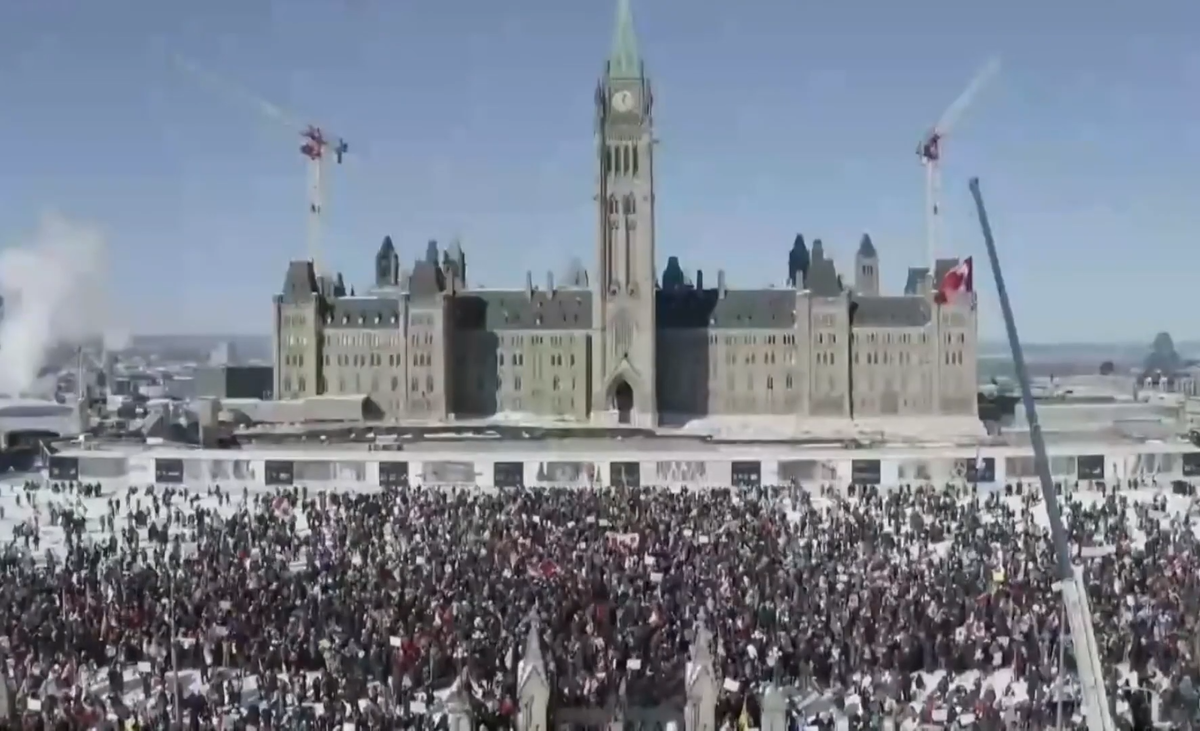
A screenshot from a YouTube video showing the protest in front of Parliament in Ottawa on 30 January, 2022.
Photo via Wikimedia Commons.

You may have heard that truck-driving protesters have taken over downtown Ottawa and several important border crossings here in Canada. These festive but obstructive people often claim, it is said, to be seeking some esoteric substance known as “freedom”. NP Platformed, unable to locate this “freedom” in the conventional periodic table, consulted a range of chemists in search of expert advice.

One suggested that the word was plainly a misspelling of “friedium”, implying the existence of an element or other matter known only to the Germans. Several hypothesized a molecular relationship with the abolished industrial refrigerant “freon”, raising questions about whether the Montreal Protocol has been subverted. Firm conclusions eluded our quest, but we are sure that a royal commission of inquiry will eventually be convened to get to the bottom of it all.

CBC News, confronted with the same information, did not appeal to the good old exact sciences for help. Instead, its reporters rang up every “hate” expert in their Rolodex of left-wing academics. This yielded tidbits of wisdom, such as this one: freedom “is a term that has resonated … You can define it and understand it and sort of manipulate it in a way that makes sense to you and is useful to you, depending on your perspective.” We’re pretty sure our chemical theories are less stupid than whatever this is supposed to be, but it does bear the imprimatur of Ontario Tech University, the renowned (checks notes) Oshawa-based home of the (checks notes again) Ridgebacks.

The CBC’s obtuse explanation of how the word “freedom” has been used in the past by fascist nasties, and absolutely nobody else in the annals of history, is rightly coming in for plenty of heckling. NP Platformed couldn’t resist joining in, but we would observe that this news copy bears signs of an actual journalistic crisis. If you are paying attention, you have heard about, or even seen video of, the torrents of abuse received by CTV and Global news reporters visiting the “Freedom Convoy” in Ottawa. One can only imagine the fear and frustration of CBC News employees, who know that they are much more attractive targets for misbehaviour — being a recognized part of the Ottawa blob that hinterland protesters are in town specifically to torment and terrorize.

Most of them are no doubt staying well clear of the protests, and for the public broadcaster to develop good sources within an amorphous CBC-hating right-wing movement is a plain impossibility. What’s left is Rolodex journalism. We did a lot of it back in the day, at the late, legendary Alberta Report — which, in our time, was vigorously hated by somewhere between half and two-thirds of the population of Alberta.

February 13, 2022

Update on that “small fringe minority … holding unacceptable views”

First up, David Warren has a few “little truths” to share:

A screenshot from a YouTube video showing the protest in front of Parliament in Ottawa on 30 January, 2022.
Photo via Wikimedia Commons.

My mind is in Ottawa, and all other places in Canada and abroad where people are struggling to get their lives back — now, before they die. These people are overwhelmingly the self-employed, and workers in small businesses: such as truck drivers, who bought their own rigs. They have consistently been made to pay in many ways for government lockdown measures, and are generally despised by the “laptop class”, who cannot lose their jobs, and work from home.

Few people in the Big City (which includes Toronto and Ottawa) have ever met a trucker, or would think of chatting with him. They may patronize small “boutique” operations, for conspicuous consumption. But Amazon drivers deliver their regular goods, and their services, too, are mostly dialled up.

True, the Batflu has sometimes interfered with their holiday bookings, so I must add, boo hoo.

A Rasmussen report on public opinion recently showed that in America, three-quarters of Democrats supported vaccine mandates, more than half thought those who refuse should be fined, and almost half would give them gaol sentences. Nearly a third thought the “vaccine hesitant” should have their children taken away. As Californicators, and the inhabitants of most urban constituencies, seldom have children, this can be received with rolling eyeballs. For luckily, there are Republicans in the more rural places, whose votes are sometimes counted.

Ottawa (outside “the Valley”) offers a caricature of this point of view. I recall my days as a columnist, published in the Ottawa Citizen. (Eventually, I was deleted.) To walk downtown was to invite verbal assaults by those who recognized my mug in the paper. Some were actually friendly, and said hiya. But I was often called a fascist, or something else obscene, by people who didn’t notice I was human. “Are you David Warren?” the grim inquiry would come. I tried to counter it with some jest. (“It depends: do you like David Warren?”) This might cause my assailant great pain. (Humour is violence, as every Leftist knows.) But it was tiresome for both of us.

One may check election results from the middle of that town, to learn that a large majority of its inhabitants vote Liberal, in the manner of zombies. One thinks of The Invasion of the Body Snatchers.

Rex Murphy (paywalled, unfortunately, so no link) suggests that things are desperate within the imperial capital thanks to the ravaging barbarians beseiging Caesar Justin:

How deep is the terror in our once cozy capital? I am told there are certain fine bakeries in Ottawa where it is no longer possible to get a fresh croissant. There are advisories warning about heading out alone to go to yoga classes. And there are rumours that DoorDash delivery from the better Italian restaurants can take over an hour. It is a horror, a scene too grim for the human mind to grasp, or the human heart to bear. In occupied Ottawa, you may, unasked, be offered soup. Where is the United Nations? Is the Security Council asleep?

Not to despair completely, however, as Canadians know that when the politicians fail, the police stand idle and the military are still, they have the Ottawa press gallery.

It is they who alerted us to the Confederate flag guy. The tribunes of the CBC have been all over him. There’s hardly been a report without the mention of a Confederate flag at the protest. Mention of the wildly more numerous Canadian flags have been wisely subdued.

The national press have been unmatched in getting the word out on what the brigands and racists and misogynists and white supremacists and yobs and Islamophobes and louts have inflicted on our national capital. With strong earplugs and stouter hearts, they have braved the chaos, enduring “taunts”. They shuffled past parked transport trucks, some of them with Alberta drivers in the cabs!

But the real glory belongs further up. The fact that Canada is, for the moment at least, still functioning as a country is a miracle due to the steel will and captivating oratory of our resolute prime minister. Much like England in those tenebrous days of 1939, our country has found its Churchillian voice.

In the free exerpt from his Weekly Dish newsletter, Andrew Sullivan admits that despite acquiring deep knowledge and understanding of Canadian culture from the invaluable South Park, he did not see the truckers’ protest coming:

To be honest, I didn’t quite see the Canadian truckers coming. I’ve watched a lot of Canada coverage over the years (mainly via South Park, I concede) and the whole anti-vaxxer, campfire-burning, horn-tooting, macho revolt among our gentle neighbors to the north nonetheless took me by surprise.

Rob Ford was a harbinger, I guess. It’s as if the ancient, manly, lumberjacky Canadian id was finally roused from its cultural slumber by a soy-boy prime minister, forcing truckers to take a jab or forfeit their livelihood. And some reports suggest that the vaccine issue seems just the proximate trigger for the rage, and not the real source — a rage which has been steadily building for some time, especially in the pandemic, in the most progressive-left country on the planet.

And there’s something very blue-collar male about this populist anger. Trump, of course, identified the testosterone tribe he helped define and rally:

    I can tell you I have the support of the police, the support of the military, the support of the Bikers for Trump — I have the tough people, but they don’t play it tough — until they go to a certain point, and then it would be very bad, very bad.

You can see similar “tough people” fault-lines in the other recent Covid contretemps involving Joe Rogan. The millions of men (71 percent male, and evenly split between high school and college grads) who listen to Rogan’s legendary podcast have rallied to him, even as the media establishment has been waging a fully-flexed campaign against him and some of his Covid coverage. There’s something about masking — chin-diapers — and mandating vaccines, and vaccines themselves, that some men seem to find feminizing.

February 11, 2022

Ottawa in the year of the honk

Filed under: Cancon, Media, Politics — Tags: , , , , — Nicholas @ 03:00

At SDA, Kate shares part of an email she sent to a friend who works in the national media:

We watched pipelines get cancelled, LNG plants yanked, Caledonia thrown to the wolves — and Spendy McBlackface take a knee over some dead guy in Minneapolis.

Did the national media and professional left really think the business of bringing government and industry to a standstill would always remain the exclusive jurisdiction of Liberal rent-a-mobs?

And that’s the real problem, yes? There’s no one to call them off. Think about that. The professional protests of the left have structure, a chain of command and big money funders to direct them.

These protests don’t. They’re completely organic, which means they can spread and grow without the help of a Soros backed foundation. And it’s fucking glorious.

In The Line, Matt Gurney‘s latest update from Ottawa:

At the start of this week, I spent two days among the protesters in downtown Ottawa, wandering the lines of trucks on Wellington, on Kent, and the other roads all around Parliament Hill. I’ve tried to convey for readers what it’s like to be there — at least, what it’s been like for me to be there. This is a complicated protest and a complicated event. It has layers.

Are there good, frustrated people just trying to be heard in the crowd? Yes. Are there bad people in the crowd, including some who’ve waved hate symbols and harassed or attacked others? Yes. Are there people taking careful care of the roads, sweeping up trash and shovelling ice and snow off the sidewalk? Yes. Are there hard men milling about, keeping a wary eye on anyone who seems out of place? Yes. Is it a place where some people are having good-natured fun? Yes. Is it a place some other people would rightly be afraid to go? Yes. And so on.

But it’s even more complicated than it looks. And Ottawa Police Services chief Peter Sloly wants you to know that.

Sloly is in a tough spot. I don’t honestly know the backstory of the how and why the Ottawa protest was allowed to settle into the downtown core the way it did. It was obviously a massive intelligence and planning failure, but what kind of failure? And whose? Did they not have enough information? Bad information? Did they have good information that, for whatever reason, they didn’t accept or trust? That’s not the sort of thing you can discover wandering the site. But I can tell you that some of the protesters themselves are surprised by how easy it was for them to set up shop.

I have the terrible feeling, and I’ve spoken with five separate sources in government roles or in adjacent security positions who all confirmed this, that Sloly is one of the damn few people in Ottawa who understands the situation he’s in, and he’s trying to get everyone else to notice, or at least to catch up to his understanding. My sources, alas, seem to think that most others involved in decision-making are only just now starting to realize the enormity of the challenge in the capital. Sloly figured it out last week.

The chief is very political. I say that with no disrespect. Becoming the chief of a major police force isn’t something that happens because you catch the most bad guys. It happens because you’re good at working your way up through the power structures of a very particular institution. Sloly talks like a politician. But if you listen closely, and if you follow along across his briefings, you start to see a theme. From the moment he first mentioned that there might not be a policing solution to this protest, and hinted that we need the armed forces, he’s been signalling to the public that Ottawa, as a city, has lost control of itself. That’s a blunt description, but as I noted in a Twitter thread after a pretty remarkably stark Ottawa Police Services Board meeting on the weekend, Sloly was clear: the city needs to be rescued. It has lost control, it is outnumbered, and it cannot fix this problem with the resources on hand.

« Newer PostsOlder Posts »

Powered by WordPress