Quotulatiousness

April 27, 2025

“[T]he practical reality of electoral politics throughout the west: the choice is between a Leftward Ho! party and a Ratchet party”

Filed under: Australia, Britain, Cancon, Media, Politics — Tags: , , — Nicholas @ 03:00

Mark Steyn on the steady leftward march of pretty much every western nation that never, ever stops and only rarely slows down:

A ratchet allows rotation in one direction, but prevents rotation in the other direction. That’s been a common explanation of most western governments for decades … leftward motion occurs, but can only be stopped, never reversed.

In a shrewd assessment of the current campaign Down Under, Paul Collits cites a certain “niche Canadian”:

    Mark Steyn says that we cannot vote our way out of the Western mess. The 2025 Australian election is living proof of the truth of his claim. Whoever wins here will inherit an unholy mess, and will not have the will to address it.

Of course, he could be talking about next week’s Canadian election or last month’s German election. As we have noted, Fred Merz, the incoming chancellor in Berlin, has yet to take office but what Americans call the honeymoon is over before the coalition has been officially pronounced man and wife. Hermann Binkert, head honcho of Germany’s INSA polling agency, says the country has never seen loss of approval on this scale between the election and the formation of the government. The so-called “far-right” AfD is now leading in multiple polls. Which would be super-exciting if voting hadn’t already taken place.

In America, the new administration certainly has the “will to address” the “unholy mess” but the Trumpian Gulliver is beset on all sides by District Court Lilliputians whose position is that what a Democrat president has done cannot “lawfully” be undone. This is a pseudo-“constitutional” recognition of the practical reality of electoral politics throughout the west: the choice is between a Leftward Ho! party and a Ratchet party. If the Left wins, they dissolve the border and trannify your kids. If the “Right” wins (Stephen Harper, Scott Morrison), they may pause some of the more obviously crazy stuff but they never actually reverse the direction of travel. Unless they’re the UK Tories (Cameron, May, Johnson, Sunak), in which case they stay in the leftie lane without even shifting down to third gear.

So “politics”, as increasingly narrowly defined, is less and less likely to save you. Because the gap between “politics” and reality grows ever wider. Consider the instructive example of one Hashem Abedi. Mr Abedi and his brother plotted the Ariana Grande concert bombing in Manchester. It was, from the Abedi viewpoint, a huge success: twenty-two dead, half of them kids, plus a thousand injured. It was a big deal at the time: lots of flowers, teddy bears, and heart-rending renditions of “Don’t Look Back in Anger”.

So you’d have thought even the British state would have at least pretended to take it seriously. Hashem Abedi was detained at His Majesty’s Pleasure, and under one of the three supposedly toughest prison regimes in England and Wales. Nevertheless, on April 12th he put three of his guards in hospital with what were described as “life-threatening injuries“. A fortnight later, two are still there. How did a maximum-security prisoner manage to do that? Well, he used boiling cooking oil and weaponised kitchen utensils.

So how did he get hold of boiling cooking oil? Was he a finalist for Maximum Security Masterchef? Ah, well. The details remain vague, and as usual the worthless UK media has shown not the slightest curiosity in how the Ariana Grande perp came close to bulking up his death toll by fifteen per cent.

April 26, 2025

QotD: “Woke”

… over the past few years the term has been appropriated and sloganised by the cult of social justice. “Woke” is no longer simply a matter of standing up to racism, but is irrevocably connected to the authoritarian mindset of the identitarian left. Rather than confront bad ideas through discussion, debate, ridicule and protest, those who self-identify as “woke” would sooner intimidate their detractors into silence through what has become known as “cancel culture”. More insidiously, they have sought to empower the state and strengthen hate-speech laws, which curb individual freedom. They do all this in the belief that theirs is a righteous cause, but their illiberal actions ultimately bolster the very ideas they purport to despise.

Moreover, this monomaniacal need to expose an ever-expanding set of “phobias” in society means that they end up detecting prejudice even where it does not exist. In the absence of evidence of racism the woke have a habit of simply concocting it; hence the continual emphasis on “unconscious bias”, “white privilege” and “institutional power structures”. Such ideas have germinated over many years in academia – particularly in the postmodern branches of critical theory – and have since seeped into the mainstream.

This is why the public is routinely confronted with absurd articles in the media grounded in an extreme form of intersectionality. One, for instance, claims that white women are “evil”, another that white DNA is an “abomination”. Barely a day goes by without some frenzied denunciation of a movie or a television series for its lack of diversity and positive representation, as though the function of the arts is to send a message that accords with identitarian values.

Few members of the public are entirely familiar with the jargon (“cisgender”, “mansplaining”, “toxic masculinity”), but are assured nonetheless that the premises are indisputable. There’s a very good reason why the Catholic Church resisted translating the Bible into the vernacular for so long. Those in power are always threatened when the plebeians start thinking for themselves and asking difficult questions.

Some commentators have recently raised concerns that “woke” has been weaponised by the far right as a slur against anti-racist campaigners. Afua Hirsch, for instance, has claimed in the Guardian that anyone using the word is “likely to be a right-wing culture warrior angry at a phenomenon that lives mainly in their imagination”. This strikes me as particularly odd, given the Guardian‘s own frequent use of the word, including in headlines such as “Can a woke makeover win Barbie and Monopoly new fans?” and “My search for Mr Woke: a dating diary”. Perhaps Hirsch’s colleagues are further to the right than is generally supposed.

Andrew Doyle, “Why I’m anti-woke”, Spiked, 2020-02-04.

April 17, 2025

QotD: Explaining mid-century American support of Chiang Kai-Shek and the Republic of China

[A question I posed on Founding Questions kindly answered by Pickle Rick:] Can anyone explain, in simple easy words, just exactly why the US State Department and/or other US government functionaries had such a mad pash for Chiang? Was it the Sun-Yat-Sen connection? Did he have inside info on the white slave trade in [Washington, DC]? Was it the opium smuggled in through diplomatic pouches? What in the Fu Manchu made Chiang of all the options the Juggalo pick of the litter? Every time I try to figure this out for myself, I end up in the same place … either [the Imperial Japanese Army] or the little red book fanatics couldn’t possibly have made a worse job of effing up what was left of Imperial China, so why Chiang of all the warlords?

PR: Because the missionaries in China had decided that it was going to become their great project, channeling that global do gooder impulse that had lain dormant since the end of the Civil War as their Great Cause — the missionaries were the grandchildren of the abolitionists and they took their fanaticism straight from that movement. China was to be “saved” from paganism, Catholicism and colonialism and they formed some kind of proto-NGO, ensuring that their views were made the policy of the government. It is not a coincidence that both Chaing and his wife were Protestant Christian converts (at least nominally) That impulse to “nation build” China into a facsimile of Progresssive Christian America (excluding, of course, the Old Confederacy) is the source of the drive to make their fantasy real, like that Utopian impulse we described the other day that is a bedrock of the Juggalo mindset. To find the roots of the China obsession you have to understand the power of the missionary movement. Nothing to me sums it up better than Kenneth Wherry, who became a big player in the China Lobby, with his mix of naivety, pathological altruism, and religious fervor-

    With God’s help, we will lift Shanghai up and up, ever up, until it is just like Kansas City …

[…]

That’s an important point — the Protestants never had the same fervor to make Vietnam or Cuba or even the Philippines (even though it was OUR colony) into Kansas City, because they were either already Catholic or had a minority Catholic elite. China, however, gave them that sweet Protestant fix in making a new China with the “right” kind of Christianity. It’s also why they hated Japan so — Japan had slammed the door on Protestant missionaries pretty hard and their Christian minority (in Nagasaki, ironically) was Catholic.

From the comment thread on “WNF: A Twofer”, Founding Questions, 2025-01-15.

April 16, 2025

The “medicalization” or “syndromization” of aspects of the normal human condition

Filed under: Health, Media, USA — Tags: , , , — Nicholas @ 05:00

On his Substack, Freddie deBoer wonders why we can’t be honest about the rise of bespoke “mental disorders” that look remarkably like typical human reaction to stimuli:

I just found a cost-free way to farm sympathy and attention 😊

I will never not be fascinated by those issues or arguments or perspectives that are studiously ignored by the media generally and the New York Times in particular. I’ve whinged about this many times when it comes to education, as the NYT is simply not going to consider the notion that different individual people have fundamentally different levels of academic potential in its pages, not even in an attempt to rebut the idea. I suppose that notion is just too challenging to the elite meritocratic liberalism that the Times epitomizes; the idea that we are all ultimately capable of achieving academic and professional greatness flatters the high-achievers who read and write the paper, and the “anyone can be anything” ethos is pleasant and unchallenging. It’s also destructive, which is the point. Bad ideas grow like weeds in the shade, or whatever the saying is. Disability issues are another place where the Grey Lady is very picky about what ideas to consider, and as usual they set the rhythm for many other publications.

This weekend the Times released a long piece looking at the ever-escalating rates of ADHD diagnoses and what exactly they tell us. What’s in the piece is fine — of course, the ADHD activist class doesn’t like it — but what’s remarkable is what isn’t in it. Once again, there’s just about zero consideration of ADHD as a social contagion, any recognition that there is now a vast and deeply annoying ADHD culture online that acts as a kind of evangelical movement for a neurodevelopment disorder. There are millions of people on ADHD TikTok and ADHD Tumblr and ADHD Twitter. There’s a vast universe of facile memes, dubious statistics, and self-flattering nostrums about ADHD floating around out there, and increasingly they’re penetrating into broader internet culture. (I am genuinely unaware of a subculture that is more directly and shamelessly self-celebrating than the online ADHD community, and I’ve read the comments at LessWrong.) Unsurprisingly, a big subsidiary industry has sprung up, with all kinds of products and services for sale, books and apparel and tchotchkes and conferences and boutique forms of therapy and exclusive members-only Discords … Whether neurodevelopmental disorders should have merch is an open question. What’s not subject to questioning is that this is happening. Five minutes of cursory searching would reveal the remarkable scope of online ADHD culture.

And yet the piece’s author, Paul Tough, is just about totally silent on this glaring reality. I find it genuinely bizarre. In a long and rambling (in a good way) piece where he kicks the various rocks of ADHD and asks good-faith questions about how diagnostic rules and social perception of the disorder influence medical practice, he still somehow fails to ever refer to the large, influential, and growing online movement that has raised the profile of the disorder even beyond its prior notoriety and in doing so injected a ton of money into the equation. You can dismiss that community as an online sideshow if you choose, but of course the online world has become profoundly influential on real life, and in other contexts neither the New York Times specifically nor the elite media generally has any problem acknowledging that fact. Why not here?

This tendency extends beyond ADHD. Recently Holden Thorp, editor in chief of the prestigious journal Science, wrote an essay for the NYT that explores the rise of autism diagnoses, which have expanded at truly ludicrous rates. To the extent that it’s referenced at all, the idea of social contagion is dismissed without argument. A couple years ago the Times published a piece by Azeen Ghorayshi about the absurd case of Tourette’s spreading (or “spreading”) among too-online adolescent girls via TikTok; though Ghorayshi is admirably clear that those young women did not in fact have Tourette’s, her piece is also slavishly, almost comically sympathetic to them, never bothering to suggest that maybe these were just bored teenagers who engaged in a frivolous and offensive bit of minstrelsy. (Imagine, judging teenagers for doing something stupid!) The idea that anyone could ever have unserious and wrongheaded motivations for adopting a disability seems to be one of those stories that the New York Times absolutely refuses to tell.

But why? People make up fake illnesses all the time, both consciously and unconsciously. Factitious disorders are real; we have references to what we might now call psychosomatic illnesses that stretch back to antiquity. Munchausen by internet is real. Hypochondria, factitious illness, Munchausen’s, the worried well … these have represented a major challenge for psychiatry for as long as the field has been formalized and integrated into the larger medical project. Why does no one ever talk about this stuff in our stuffy elite publications? Why do so many people in our media dance and shuffle rather than ask direct questions like “How many of these diagnoses are fundamentally faulty?” Why can’t anyone point out that saying you have a medical disorder is a shortcut to getting sympathy and attention, and that human beings crave sympathy and attention the way they crave water and air? We’ve lived through something like a “vibe shift,” and previously-unchallengeable social justice pieties are increasingly challenged, in good ways and bad. Yet under the broad umbrella of disability rhetoric, it’s always 2018, with both traditional and social media operating under a cloud of fear of giving offense. As I’ve said many times, the number of people who privately agree with me about all this is legion. The number who are willing to say so publicly are very few indeed. Nobody wants to paint that target on their back, I suppose. But why do these issues make people feel like targets at all?

April 15, 2025

What is it with the progressives’ love for (some) brutal murderers?

Filed under: Media, Politics, USA — Tags: , , , — Nicholas @ 05:00

I’ve managed to avoid watching any of the interview, but Taylor Lorenz was on CNN, where utter inhumanity is apparently the flavour of the month for all right-thinking progressives:

Former New York Times and Washington Post reporter Taylor Lorenz, speaking about accused killer Luigi Mangione on CNN MisinfoNation with Donnie O’Sullivan:

    To see these millionaire media pundits on TV clutching their pearls about someone stanning a murderer when this is the United States of America. As if we don’t lionize criminals … There’s a huge disconnect between the narratives and the angles that mainstream media pushes and what the American public feels … You’re going to see women especially that feel like, “Oh my God”, right? Like, “Here’s this man who’s revolutionary, who’s famous, who’s handsome, who is young, who’s smart”. He’s a person that seems like this morally good man, which is hard to find.

I know Lorenz is a human bug-zapper whose purpose is luring people to doom by drawing them to the glow of the impossibly stupid online utterance, but even by her standards this is nuts. For one thing, Lorenz is a leading advocate for dumbed-all-the-way-down media like her “beloved” Vine, which featured six-second-max videos. If someone handed her a hardcover book, she’d be a serious threat to bite it. Her invoking Flannery O’Connor and A Good Man is Hard to Find in the context of Luigi Mangione is high comedy. Regarding America “stanning” murderers because “we give them Netflix shows,” which does she mean? Americans may be fascinated by O.J. and Bundy and Phil Spector, but we don’t gush cartoon hearts at them over cable, we watch them in lurid docudramas.

As Jim Treacher puts it:

The thing I like most about journalism is the moral authority.

Journos are better human beings than the rest of us — morally, ethically, and intellectually — and they’re not shy about saying so. Their views are the correct views, after all. Their political opinions are the North Star. And if you disagree with anything they know to be true about the world, you’re the enemy and they don’t care what happens to you.

Hell, if you’re on their literal hit list, they’ll openly laugh and swoon over anyone who hurts you. If you don’t believe it, just watch the following clip from a cable news network.

Dramatis Personae:

  • Donie O’Sullivan is a “senior correspondent” for CNN.
  • Taylor Lorenz is a reporter who has worked for the New York Times and the Washington Post.
  • Luigi Mangione, the heir to a wealthy Baltimore family, shot a health insurance executive named Brian Thompson in the back as he was walking to work in Manhattan.

And now, here are O’Sullivan and Lorenz celebrating the murder on national television.

April 13, 2025

QotD: The 15-minute city

Take, for example, the 15-minute city, which is a radical proposal that people should be able to get pretty much anywhere they need to go within fifteen minutes and ideally without needing a car. It’s a lovely idea, and the parts of residential America that are like that — most of them former suburbs — are insanely desirable and therefore insanely expensive. If it were easy to make more of them, you’d think the market would have figured out how! And if I had any confidence whatsoever that anyone involved in municipal planning could produce more neighborhoods like that — leafy green places full of parks, libraries, schools, and shops — or even that they wanted to have safe, clean, and reliable transit options, I’d be all for it. But these are the same people who are gutting public safety in the cities while failing to maintain or enforce order on existing transit. These are the same people who imposed draconian Covid mitigation policies like Zoom kindergarten, padlocked churches, and old people dying alone with nothing but a glove full of warm water to mimic human touch, all of which were meant to buy time for … something (human challenge trials? nationalized N95 production?) that never happened. It’s easy to ban things; it’s hard to do things. So you’ll excuse my doubts about their ability to build a 15-minute city that looks like Jane Jacobs’s ideal mixed-use development, with safe, orderly streets and a neighborhood feel. One rather suspects they would find it far more within their wheelhouse to simply abolish single-family zoning or imposing restrictions on who can go where, when.

Jane Psmith, “REVIEW: The Wizard and the Prophet, by Charles C. Mann”, Mr. and Mrs. Psmith’s Bookshelf, 2024-01-22.

April 11, 2025

Critical Trade Theory

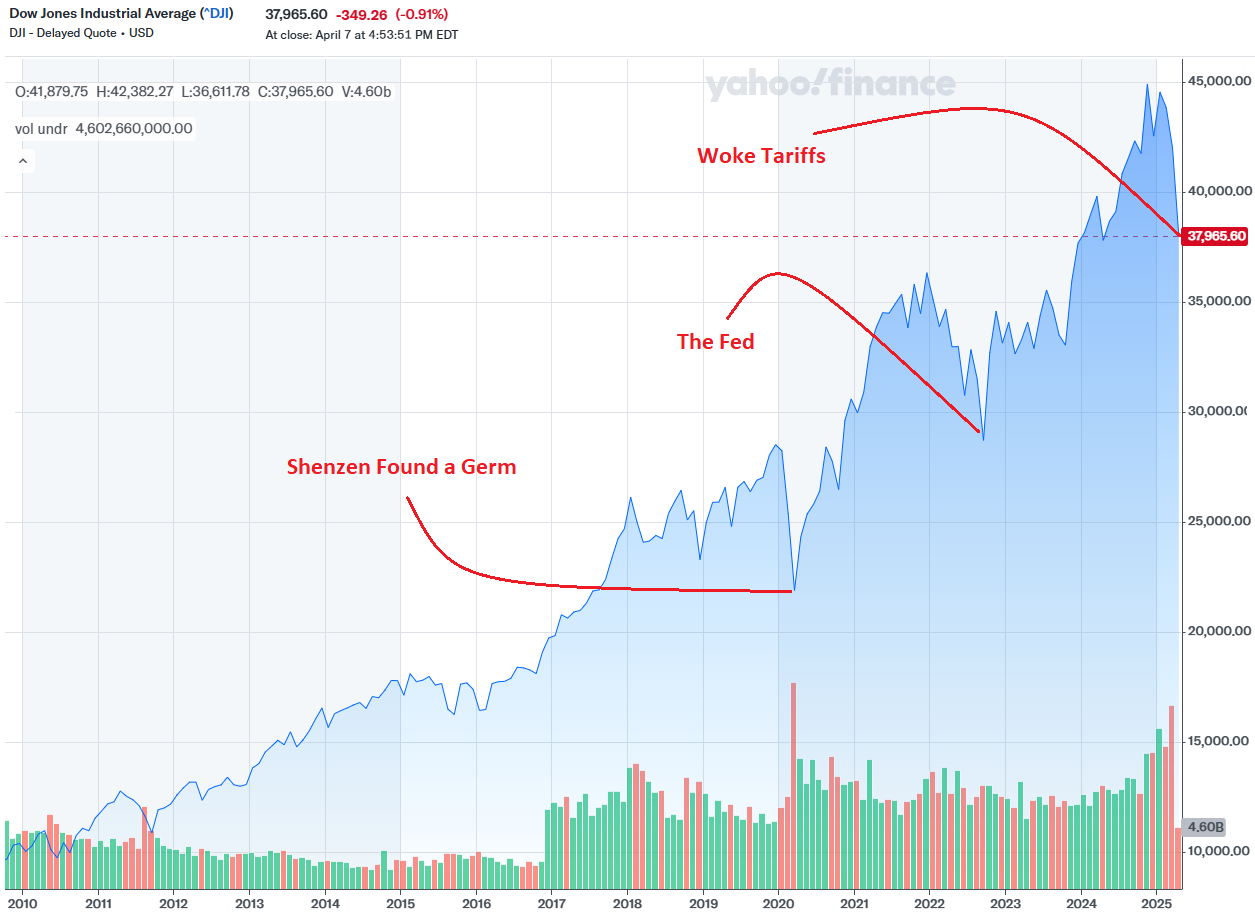
A discussion at the amusingly named Handwaving Freakoutery on the ongoing wave of tariff activity under the Trump II administration, characterizing them as “woke” tariffs:

The great argument playing out in the media right now about the relative value and ethical implications of reciprocal tariffs is not relevant. It is not relevant because these tariffs are not reciprocal tariffs in any measurable way. They aren’t reciprocal, they aren’t sensible, and the justification for them is Woke in every sense of the word. Let’s take a close look at what we might call Critical Trade Theory, back our way into an understanding of what a woke tariff is and how this is definitely that, and close with a quick word about how political realignments portend doom for the left even though the right is really screwing this up. Then we’ll all buy mop handle futures.

Awokening

The Great Awokening of the prior decade was founded in part on the False Cause Fallacy. Our major institutions for the better part of the last ten years were operated by wokerists, who used an Intersectional Matrix of Culturally Encouraged Race and Gender Prejudice to counteract what they viewed as hidden unmeasurable forces such as “systemic racism”. They couldn’t point to the systemic racism, but they knew it must be there because of the imbalance in socioeconomic metrics, and they denied any other possible explanation for the imbalance. Once the False Cause was in place, the devout wokerist was forced to fight the hidden prejudice with overt reverse prejudice, because they couldn’t conceive any other cause.

For example, if black folks have a hard time getting into Harvard or UNC, it must be because society is systemically racist against black people, and no other reason, therefore we should redirect admission slots from Asians who earned them to blacks who didn’t, for race balancing.

Harvard did exactly that, for exactly that reason, and admitted it, and it was sent to the Supreme Court, and the Supreme Court banned it, and then Harvard kept doing it and is still doing it using different words.

Some of our other institutions are still running this wokery program, although the Trump Administration purged much of it from the halls of federal power this year under their DEI ban, and many other institutions used Trump as cover to independently purge it from theirs. But this same smooth-brained thinking wiggled its way right into Trump’s tariff plan last week, through an equation that looks fancy but is something my middle school son could figure out.

[…]

The media thinks these woke tariffs are going to bomb the economy back to the stone age, but when I make the abhorrent choice to read the graphs myself it looks more like January 2024. A 20% tariff on Chinese goods is rough. Adding 34% more to it is rougher. But a 54% tariff on Chinese goods is nothing compared to Shenzhen closing its entire manufacturing sector down because they found a germ, and probably not significantly worse than the Fed turning off the free money spigot in 2022.

These tariffs are going to do goofy shit to the economy. I don’t like the goofy shit they’re likely to do. I think that trade balancing through tariffs is an idea so stupid that only Rust Belt union workers could come up with it, which is why they probably did come up with it, and also probably why Trump won the election by flipping the Rust Belt.

April 10, 2025

Late onset Trump Derangement Syndrome

Filed under: Media, Politics, USA — Tags: , , , , — Nicholas @ 05:00

Ed West diagnoses himself with a raging case of late onset TDS:

What has caused this late-onset TDS, however, is not Trump’s behaviour, but the relative silence of his critics. During Trump’s first term, everyone in the American establishment seemed to be calling him the next Hitler, and this included not just the usual academics and journalists but many major corporations; companies like Nike, Heineken and Airbnb were at the forefront of the “resistance” against the president, a trend labelled “CEO Activism”. It was quite obviously self-interested and performative, because if everyone in your country is calling its leader a fascist dictator, then you probably don’t live in a fascist dictatorship.

I have no idea where I saw this meme, but it makes me laugh

That is not the case this time around, and that is more troubling. I recall from my time volunteering for first aid training that, when you arrive at the scene of an accident, you don’t go to the person screaming in pain, but the individual lying on the ground in stony silence. Similarly, the fact that people working for large corporations now keep quiet about Trump, even as he embarks on the most reckless economic policy in recent years, should probably concern us. The reason they keep quiet — and this is something I have heard from the horse’s mouth — is because they feel that there is a real risk of punitive action if they speak out.

One of the things more moderate folks used to warn the far left activists about using any and all tools to “get” their enemies is that it can — and in this case has — unleashed exactly the same kind of retribution when their former target now has the power to do so. “Muh norms!” indeed.

The constant evocation of fascism is not just mistaken in my view, but neurotic. Western civilisation is emotionally scarred by the violent racial supremacism of the Nazi regime and in particular the Holocaust, the worst crime in history, yet people have a tendency to fight the last war and this isn’t the danger that Trump represents. He is not a white supremacist and not especially motivated by ethnic nationalism. He is, however, authoritarian in nature, prone to be vengeful to those who cross him while also surrounding himself with yes-men, and he does seem to have territorial ambitions, even if they concern a frozen wasteland. Those things are all bad enough in themselves.

Rather than being a new Hitler, a more realistic concern is that Trump represents the 19th century spectre of Caesarism, a man who uses democracy in order to establish himself as an imperial figure. The fear of a Caesar always haunted the founders of the Republic, obsessed with Roman history as they were and sceptical of democracy and mobs.

Trump as a modern Louis Napoleon? A case could certainly be made for it.

Caesars do not come out of nowhere, and the progressivism of the last few years has been deeply illiberal, hostile to freedom of speech and even more so to freedom of association. Jonathan Haidt talked of “decentralized totalitarianism” and it was the chaotic nature of woke progressivism that made it so disconcerting and caused many people, including those same corporate leaders, to stay silent.

Many of the things Trump is now doing are not entirely dissimilar to what radical progressives did when the opportunity arose, in particular the determination that institutions are cleared of their opponents. It is bitterly ironic, for instance, to have the Left accuse Trump of “rewriting history” for ideological reasons (gosh, imagine!). Yet there is something quite different about people scared of online mobs and being scared of the government. Activists, though loud and hysterical, could be ignored if people only had the courage to face them (which they usually didn’t); the state can make your life very difficult indeed. Already the Trump regime has punished law firms which oppose their leader; foreign nationals who’ve expressed criticism of the regime have been detained. These are not good signs.

I’ve sneered at the American critics who worked themselves up into hysterical rages about Trump, not just because of their puritanical piety but because of the lack of awareness about their own behaviour, in particular the conspiracies about Russia and the dishonest, partisan nature of American journalism (Trump is probably the most dishonest president in US history, but it may also be true that he is the most lied about). In the modern liberal imagination, in part because so many people read far more fiction than history, Trumpian figures tend to be opposed by a courageous “resistance”, whereas in reality most dictatorial leaders arise because there are no moderate alternatives, and the opposition is similarly extreme and unpalatable. There were no real goodies in the Spanish Civil War, nor in Syria, nor even in much of central-eastern Europe in the mid-20th century, where fascists fought communists for control of the streets.

April 9, 2025

“South Africa is what happens when a country becomes ungovernable”

Niccolo Soldo’s weekend roundup includes some quotes from Lawrence Thomas on what he terms a “racketeer party state“, what the “Rainbow Nation” of South Africa has degenerated into since the end of Apartheid:

South Africa is what happens when a country becomes ungovernable. From endemic sexual crime to farm murders, rolling blackouts, and expropriation, the rest is just the details. What has come to be termed “South Africanization” is not the failed development of a Third-World nation such as Afghanistan or Somalia, but the structural de-development of a once fully modern state that had its own nuclear weapons program. President Trump’s support of Afrikaner farmers has brought global attention to the decaying state of the country and is perhaps the most high-level recognition yet that the 1990s “Rainbow Nation” dream is dead. What’s strange about it all is how much of it happened on purpose.

What may be worse is that the very system of law and government itself has become an instrument to be captured and used to further the mass looting of the country. South Africans of all races inherit a Western political culture and economy. The average South African experiences a strong civic identity, highly active political parties, popular national media networks, a market economy, and a parliamentary constitutional order. The last thirty years saw a coalition of political actors, patronage networks, and organized criminal gangs seize control of and use all the infrastructure of modern government for their own ends.

[…]

While songs like “Kill the Boer” at rallies tend to grab headlines, the most consequential development of late is the passing of expropriation without compensation into law by the supposedly moderate President Cyril Ramaphosa. In addition to further eroding property rights, it emboldens a widespread movement that sees land redistribution as the sole resolution to the country’s racial conflict and views the presence of any white population as fundamentally illegitimate. The radicalization of race politics is the means through which political fights are won, since it plays on the country’s major divides and wins over those who feel left out of the spoils.

On the ground, reports tell of ANC officials tacitly allowing invasions of private and public land by squatters. Occupations of this sort have sometimes preceded the farm murders which have gained media attention internationally, and squatters have now begun to invoke the Expropriation Act. Such groups become the shock troops of political pressure: they can harass and pressure the occupants of the lands they occupy, or worse, while becoming a media story about the “landless oppressed” used to justify broader government action. The broad facilitation of ground-level conflict and crime by those with political power is the defining feature of South Africanization.

[…]

In other words, decay is a burden without benefit. There is no “rock bottom”. Business, political organization, social fabric, and all other forms of Western cultural life just face increasing costs. Some are direct, while others are opportunity costs: how much doesn’t happen because almost no one can guarantee electricity? In a relatively developed country, there’s still much more to break down and expropriate.

The combination of social progressivism with an economic model of managed decline has become orthodoxy in many establishment parties across the developed world. South Africa is a study of the political phenomenon in its advanced stage and a demonstration of what is at stake in defeating it in the rest of the Western world. Flip Buys, leader of the Afrikaner trade union Solidariteit, was likely prophetic when he foresaw that South Africa would become home to the “first large grouping of Westerners living in a post-Western country”.

Emphasis from Niccolo’s excerpts.

April 8, 2025

QotD: The sad plight of the modern day “radical”

Filed under: Humour, Politics, Quotations — Tags: , , — Nicholas @ 01:00

Many are opposed to faith, family, industrious habits, common decency and public order. The “radical” will not be able to articulate reasons for his bitter opposition, but one look at his face should make everything clear. Here in Parkdale, we have a lot of Leftists. Perhaps they had unhappy childhoods. I hope gentle reader will not think me a bigot, but I have noticed that they are almost all white people.

Whatever the cause, they cannot “smoak a jest”, recognize other forms of humour, or distinguish the parts of speech. This makes them appear batty (in the old sense, when it would have attracted institutional attention). They are frequently convulsed with anger, then sullen when they have exhausted themselves. Alas, they cannot be left in normal company, for they will immediately and raucously demand a “safe space”, and then not go away. They will accuse the normal person of “racism”, “fascism”, “sexism”, and “microaggressions”. Their spittle represents a health hazard.

It is hard to know what to do with these people, in the absence of the traditional arrangements. When world markets open again, we could sell them into slavery. But in the meantime, I suppose, we must keep them in group homes, ideally under armed guard. Maybe feed them okra; surely there is a surplus, and I’m told it has calming properties.

But that’s just me, always looking for solutions.

David Warren, “Keeping one’s peace”, Essays in Idleness, 2020-04-18.

April 7, 2025

Those brave, rare contrarians willing to risk everything by … criticizing Trump?

Filed under: Books, Government, Media, Politics, USA — Tags: , , , , , — Nicholas @ 05:00

Chris Bray is deeply concerned that a free society seems unable to produce even a mild array of differing political opinions these days:

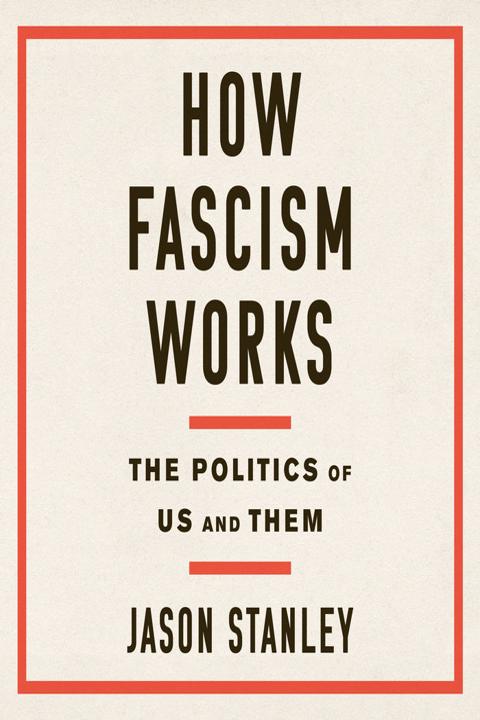
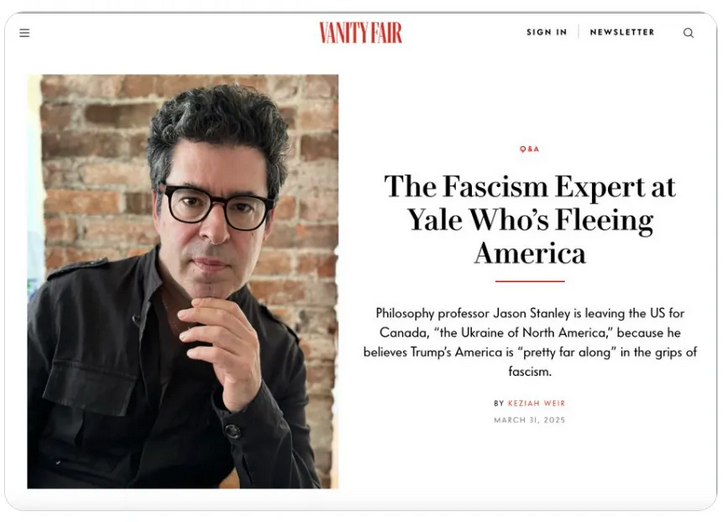
I was at a small independent bookstore today, the exact kind of place that’s supposed to curate a culture of argument and criticism. The prominently displayed books about politics and current events were Timothy Snyder’s book about the terrifying rise of American fascism under that monster Trump, Jason Stanley’s book about the terrifying rise of American fascism under that monster Trump, Anne Applebaum’s book about the terrifying rise of American fascism under that monster Trump, and a bunch of other books by prominent journalists and professors about … okay, try to guess.

On the other side of that exchange, the books by public intellectuals offering a favorable or even neutral view of Trump and the Trump era were … not there? Maybe I just missed them. So every prominent figure moving to the cultural foreground from academia and “mainstream” journalism — every brave contrarian, every freethinking intellectual warrior rising against the prevailing fascist sentiment of the age to speak in his own voice as a free person — thinks and says the same things, the same ways, with the same evidence and the same framing and the same tone and in the same state of mind. They’re so free and brave and iconoclastic that they’re essentially identical, chanting in intellectual unison.

Forget Trump for a moment and answer this question in general: If you’re living through an era in which every prominent journalist and academic and artist says exactly the same fucking thing all the time, what kind of moment are you living in? Would you call people who all chant in unison the resistance?

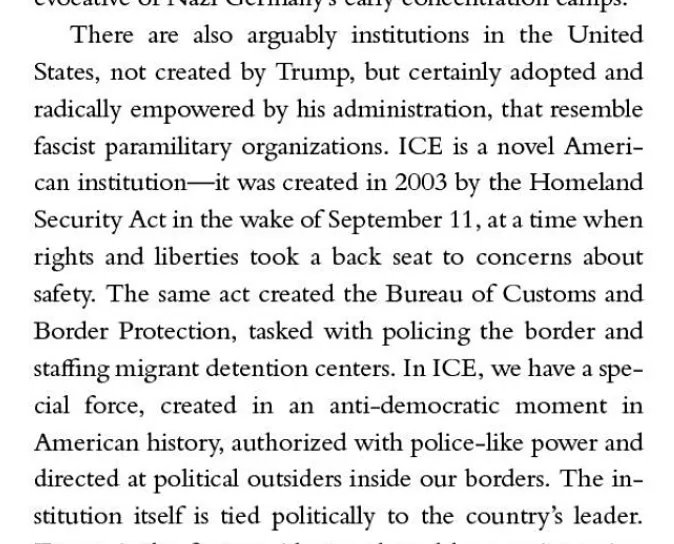
Any engagement with these books reveals their emptiness. Snyder, Stanley, Applebaum, whatever: pick a book, then pick a page. See if it makes sense. Here, I spent a few nauseating minutes today with brave Jason Stanley’s book How Fascism Works: The Politics of Us and Them. Here’s a paragraph from the introduction to the paperback edition:

ICE is novel: It was created after 9/11, by the same law that created a bureau tasked with border protection: a “special force, created in an anti-democratic moment”.

I can’t calibrate the degree to which this person is a fool or a liar, but let’s go with both. The Border Patrol was created in 1924, and was itself the successor agency to a different organization that was created in 1904. You can read that history here. The post-9/11 organization that supposedly created this novel American institution merely reorganized a century-old American institution, making it not the least bit novel. Before ICE, we had INS. Yes, we had a border before 2003, and we policed it. This isn’t a novel concept at all, as it has operated in any form of practice.

You can go through that single amazing paragraph sentence by sentence and tear every last bit of it apart, at the lowest, simplest factual level. The argument isn’t wrong: all of it is wrong, every layer of fact and interpretation. This man is an absolutely enormous jackass. And he’s … important. An important public intellectual, you see.

April 3, 2025

QotD: When the History Department at Flyover State committed slow motion suicide

Filed under: Education, History, Politics, Quotations, USA — Tags: , , , , — Nicholas @ 01:00

It started when they hired a radical feminist lesbian. Radical by ivory tower standards, I mean, which as you can imagine is a bar so high, Mt. Everest could limbo under it without breaking a sweat. This was the kind of “scholar” whose work was like that dude we mentioned a while back, who claimed that the US Civil War was really about “gay rights” — something that’s not merely wrong, but impossible, as the mid-19th century lacked the conceptual vocabulary to even suggest such a thing. In other words, they hired this persyn to be professionally obnoxious, and xzhey were happy to oblige.

Now, you have to understand something about the academy at this point: Though these people are profoundly ideologically enstupidated, they’re still pretty cunning where their wallets are concerned. Indeed, that’s the whole reason they allow “scholarship” on left-handed LatinX truck drivers in the Ming Dynasty or whatever that persyn’s book was, to pull that kind of stunt — only “original” “research” gets published, and since all the true facts have been ascertained long ago, you have to make shit up if you want tenure. Publish or perish, baby!

A clever plan, but with one teensy tiny flaw: “Tenure” requires a university, and universities require students, which means that, while pretty much all professors hate teaching, they have to do it … and not only that, they have to actually appeal to those icky little deplorables, the students, in sufficient numbers to keep the faculty employed. If, back in your own college days, you wondered if maybe the only reason Western Civ I or whatever was required was that it gave Professor Jones something to do, congrats, you were right. But you can’t require History majors, and there’s only enough Western Civ to go around, which means you have to have 200- through 400-level classes that students actually want to take …

You can see where this is going, and to their credit, some of the faculty at Flyover State saw it, too. At the time, there were still enough upperclassman History majors (and grad students) that the class on LatinX truck drivers in the Ming Dynasty would fill … barely … but that situation obviously would not continue. Nor could you simply stick the new hire in Western Civ classes, because in addition to the other obvious problems, of course xzhey would immediately turn “Western Civ I” into “LatinX truck drivers in the Ming Dynasty … and maybe, if there’s time, the Roman Empire or some shit.”

You know what the Department ended up doing (hint: nothing), and so the first semester after the new hire went exactly like you knew it would. And so did the next, and the next, because as we all know, chicks of both sexes and however-many-we’re-up-to-now genders are herd animals. Hiring the radical lesbian gave all the slightly-less-radical lesbians, again of both sexes and however-many genders, permission to let their freak flag fly. Which, of course, they did. Pretty soon you couldn’t find a History class that wasn’t some bizarre, micro-specialized SJW mad lib. Sure, they’d still call it “The US in the Civil War Era” or “Modern Germany” or whatever, but the course description made it perfectly clear that the class was really about transsexual cabaret acts on the New York Bowery … and maybe, if there’s time, secession or some shit.

And soon enough there were no more History majors, and thus no more History Department. At one of the small schools that collectively make up “Flyover State”, the former History, Psychology, and Classics departments have been folded into something called the “Humanities Department” … to which, last I heard, the former English Department will soon be added.

Severian, “The Dunbar Problem”, Founding Questions, 2021-10-06.

April 1, 2025

Marine Le Pen

Filed under: France, Law, Media, Politics — Tags: , , , , — Nicholas @ 03:00

Yet another right-of-centre European political leader has been taken out of the political arena. It’s starting to be a pattern, as the centre-left and the far left occupy a lot of the positions of power within the EU and are quite willing to use any tools at their disposal to remove actual or perceived threats to their stranglehold on the levers of power:

Marine Le Pen speaking in Lille during the 2017 French presidential election
Photo by Jérémy-Günther-Heinz Jähnick via Wikimedia Commons

Democracy is a sick joke, as the prosecution of Trump in America, Bolsonaro in Brazil, Imran Khan in Pakistan, Salvini in Italy, Georgescu in Romania, and now Le Pen in France, has displayed, unambiguously, to the whole world, if the world were capable of noticing, or thought. Each of these candidates stands accused of being a “populist” — i.e. likely to win an election, unless they had already won. Marine Le Pen is being put in prison, where the Democrats tried to put Trump (for up to 300 years on twisted and absurd charges), using the United States’ corrupt progressive judicial system. The specific charge brought against Le Pen was that she embezzled from the European bureaucracy. As all mainstream European politicians are constantly and obviously guilty of this, it was a convenient charge.

The parrot gallery is all singing that she is “far right”, this morning.

I am not your political reporter, and will not take the extravagant amount of space required to explain the detailed particulars of each case, when all are essentially simple. Democracy is a viciously corrupt system, in which the powers-that-be in each electoral district do what they think is necessary to maintain their dictatorship. Power is the only thing they care about, because with power, money can be appropriated. Truth is something they all despise. This has been my own experience, both here and abroad; and one must be a fool (though a “holy fool” perhaps) to stand up to a political establishment, for it will own even the opposition parties. (Find out what commands all-party agreement.)

I haven’t been following this story at all, and I have no idea whether the French court’s decision is fair or just, but it certainly is very convenient for those opposed to Le Pen and her party:

The French judicial system delivered a gut punch to the democratic process that ought to make any observer of history wince. Marine Le Pen, the firebrand leader of the National Rally (RN), has been convicted of embezzling European Parliament funds and barred from running for public office for five years — effective immediately. This ruling ensures she cannot contest the 2027 presidential election, a race she was poised to dominate with poll numbers hovering between 34-37%. The sentence — four years in prison (two suspended, two with an electronic bracelet) and a €100,000 fine — reads less like justice and more like a calculated assassination of a political movement. The French government and its courts have crossed a Rubicon, and the echoes of history suggest this won’t end quietly.

Let’s be clear: this isn’t about whether Le Pen is a saint. The charges stem from a scheme between 2004 and 2016, where she and 24 RN associates allegedly misused EU funds meant for parliamentary assistants to pay party staffers in France. The court claims €4 million was siphoned off, a serious accusation if proven beyond doubt. Le Pen denies it, calling it a “witch hunt” — language that resonates with anyone who’s watched populist leaders tangle with entrenched elites. But the real scandal isn’t the money; it’s the timing and the punishment. An immediate five-year ban, enforced even as she appeals, reeks of a system desperate to kneecap its most formidable opponent. This isn’t justice — it’s a power play, and the French state has a long, ugly history of bending the law to protect its own.

Rewind to 1793, when the French Revolution’s Committee of Public Safety turned the guillotine into a political tool. Robespierre and his ilk didn’t just execute aristocrats; they silenced dissenters under the guise of protecting the republic. Fast forward to the Third Republic in 1894, and you’ve got the Dreyfus Affair — Captain Alfred Dreyfus, a Jewish officer, falsely convicted of treason on flimsy evidence because the establishment wanted a scapegoat. The courts bowed to political pressure then, just as they seem to now. Le Pen’s conviction fits this pattern: a popular figure, reviled by the elite, taken out not by the ballot box but by judicial fiat. The presiding judge, Bénédicte de Perthuis, justified the immediate ban by citing “democratic public unrest” if a convicted embezzler were elected. But isn’t the greater unrest sparked by denying voters their choice?

eugyppius provides more information on the case against Le Pen:

Le Pen was convicted alongside eight other members of the Rassemblement national/Front national, and twelve parliamentary aides. She did not personally embezzle funds or enrich herself from EU coffers. Rather, prosecutors accuse her of directing aides to undertake work for her party while they were receiving salaries from the European Parliament. They claim this happened between 2004 and 2016, and that Le Pen and her associates misappropriated over four million Euros in this way. While nobody doubts the substance of the accusations, what Le Pen did was far from unusual and the sentence just seems ridiculous to me. Many European parliamentary representatives have used staff paid from parliamentary budgets for party projects – including Franziska Brantner, the present co-chair of German Green Party. Until recently this was a common practice, and even now the distinction between party and parliamentary work is not always easy to maintain, and both routinely and deliberately blurred.

Le Pen is a complex political figure, and she has not always been an unvarnished force for good. Her campaign to normalise the Rassemblement National (known as “dédiabolisation“, or “de-demonisation) came at devastating cost to Alternative für Deutschland during last year’s European elections. In service of casting the Rassemblement National as something less than “far right”, Le Pen and her party attacked the AfD for their rhetoric surrounding “remigration” and even seized upon Maximilian Krah’s inept remarks about the Waffen-SS to kick the entire AfD delegation out of the Identity and Democracy faction of the European Parliament.

In the wake of these fireworks, some German commentators have suggested that the AfD undertake a de-demonisation campaign of their own, for example by distancing themselves from nationalist AfD politicians like Björn Höcke. Le Pen’s fate shows that programmes of optical moderation and attempts to claim the political centre provide no salvation. The European political establishment only claims to be worried about “the extreme right”; their true anxieties attach to their hold on power, and nothing else.

Le Pen’s sentence confirms an ominous anti-democratic tactic emerging across Europe, namely attacks on the passive suffrage of opposition politicians. At the start of this month, the Central Election Bureau of Romania withdrew Călin Georgescu’s right to run for office there, months after Georgescu emerged as the frontrunner in the first round of the presidential elections and the Romanian Constitutional Court annulled the vote. In Germany, schemes to attack passive suffrage have also been gaining ground, with the CDU and SPD openly planning to use this measure against anyone convicted more than once of the broad and ill-defined speech offence of “incitement”.

This is very bad, and I fear it is a symptom of something much worse.

March 28, 2025

Mistaking popular fiction for real life

Filed under: Britain, Media, Politics, USA — Tags: , , , , , , — Nicholas @ 05:00

At Postcards from Barsoom, John Carter recounts an odd but revealing experience with a young progressive entity:

Image by Paul Jackson

Some years ago I was provided a fascinating psychological experience in the form of a young graduate student in the English literature program, whom I encountered because they (you heard me) was (God that’s grammatically awkward) married to a colleague. She (I’m not doing this anymore) specialized in the study of propaganda, by which of course she meant everything her backwards conservative parents in Nowhere, Nebrahoma believed, and not anything she believed. One evening, after enthusiastically explaining the symbolism of the inverted pentagram tattooed on her shoulder, she informed me with invincible confidence that not only was gender an arbitrary social construction, but that even the idea of biological sex was nothing more than convention. Her reasoning, which I presume she’d gleaned from a seminar on radically liberatory queer theory, was that testosterone levels fluctuated during the day, so “males” changed their degree of “maleness” all the time, and how can something that’s constantly changing be used as the basis for a hard binary distinction?

“But that’s not how biological sex is defined,” I replied. “Testosterone is just a hormone. It’s only present in vertebrates. Insects don’t have it, and neither do plants, but they still have biological sex. Sex is defined according to whether an organism produces mobile gametes or sessile gametes, which is basically universal across multicellular life forms.”

“I don’t understand what that means,” she chirped, still thinking we were playing language games. “Like I don’t know what a ‘sessile gamete’ is.”

“Oh,” I responded helpfully, “A gamete is just a reproductive cell. Sessile means it doesn’t move. So –”

The horrible reality of what I was saying dawned upon her. “I just realized that this isn’t a conversation I should be having,” she cut me off, and walked away.

It was remarkable. The mindworm parasitizing her consciousness had detected a threat to its structural integrity, and ordered its host to remove herself from the interaction before she consumed a malinformative infohazard. She didn’t even pretend that this wasn’t what she was doing. I’d never before seen something quite like it.

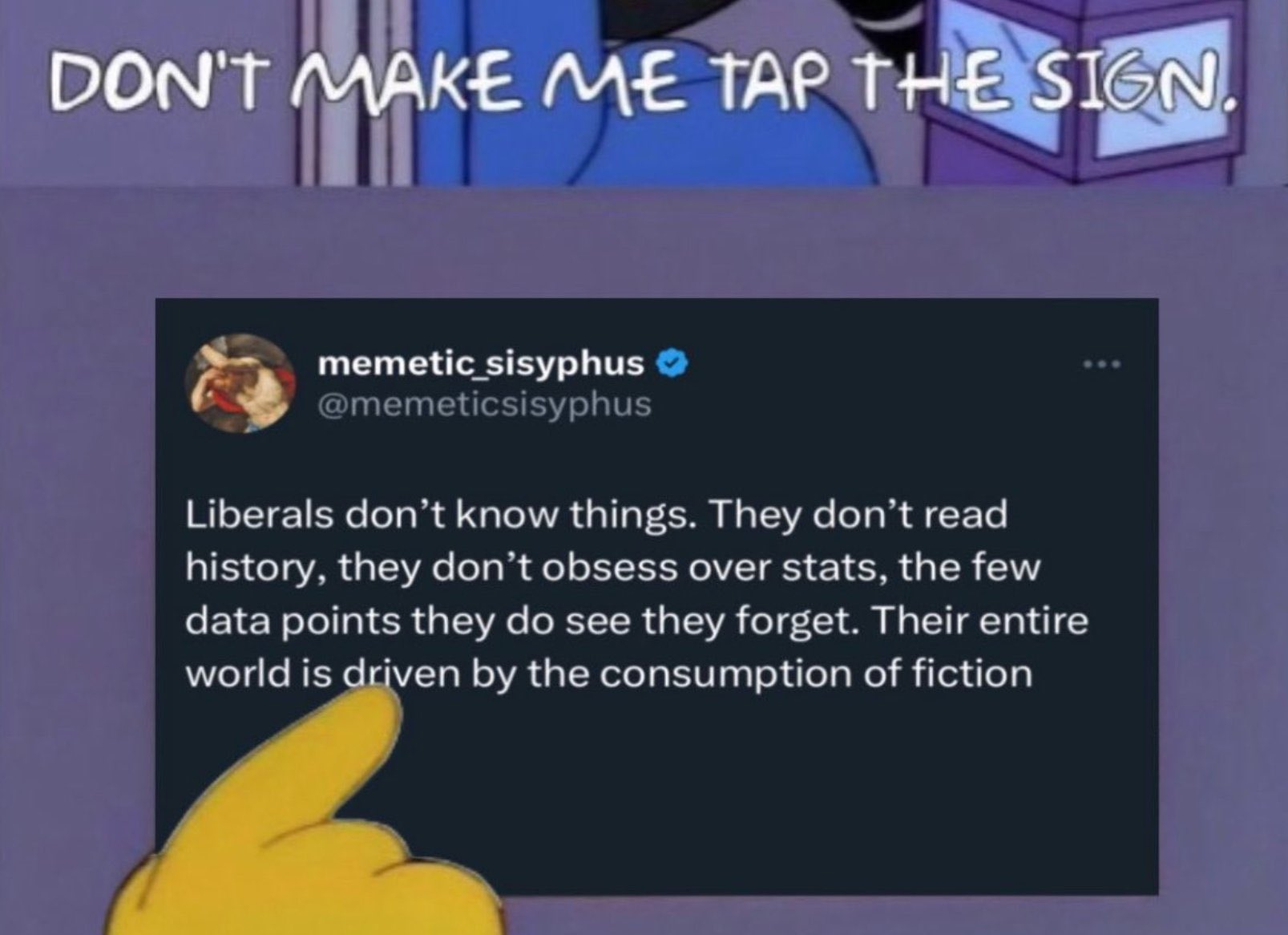
There’s a long-standing joke that liberals don’t know things, that their entire worldview seems to be formed by the ersatz experiences of visual entertainment. When they discuss the war in Ukraine, they express it in terms of Marvel comic book movies or Star Wars; when thinking of President Trump, in terms of Harry Potter. Black people are all wise and benevolent and great dancers because this is what Fresh Prince and Morgan Freeman told them; white men are all inbred stupid Klansmen because of Mississippi Burning and Roots; girls are just as strong as boys (stronger, actually) because Black Widow kicks butt; and so on. Even their favourite point of historical reference – World War Two, the Nazis, Hitler – seems to be almost entirely a palimpsest of Steven Spielberg movies like Saving Private Ryan and Schindler’s List.

It isn’t just that they use fictional references as metaphors or allusions. That’s a very human thing to do, and the right is certainly no stranger to Tolkien analogies. But liberals seem to do this a lot, with only the most tenuous connection back to reality. Their inner world is a series of self-referential fantasies. The right uses fictional references as metaphors to explain facts; the left substitutes fictional metaphors for facts, and then forgets that it does this.

The recent Netflix drama Adolescence is a striking case in point. It portrays the fictional story of a 13-year-old white boy who stabs a female classmate to death because his brain was twisted into a pretzel by exposure to the incel subculture over social media. Following its premier, the British government has been using it to gin up a moral panic, with calls to censor social media to tackle the urgent problem of toxic masculinity.

March 25, 2025

Analyzing the structure of Tim Walz’s “joke”

Filed under: Humour, Media, Politics, USA — Tags: , , — Nicholas @ 03:00

On his Substack, Jim Treacher shares his deep knowledge of the cultural and linguistic complexities of the humour of Minnesota Governor Tim Walz:

Tim Walz as a standup comedian
Fake image generated with Grok

A joke is a delicate thing.

Let’s say you write a joke and then tell it to some people. The joke might “kill” (get a big laugh) with one audience, but then it might “die” (be met with stony silence or outright anger) with another audience.

Maybe you don’t get the wording quite right: “Why did the chicken cross the street? Wait, no …” Maybe the crowd doesn’t understand a reference you’re making. Maybe it’s just not your day. It can take a lot of work to perfect a joke, and any number of things can still go wrong. You’ll fail at least as often as you succeed, and past performance does not guarantee future results.

I’ve never done stand-up comedy because it would require me to leave the house, but I do have a bit of experience writing jokes for television. And sometimes, a joke I thought was funny when I wrote it in the morning just doesn’t land with that evening’s audience. It’s a crummy feeling, but that’s showbiz.

So, I know just how Tim Walz feels these days!

Last week he made a really funny joke, but a lot of people weren’t smart enough to get it because they’re not Democrats […]

    I was saying, on my phone, some of you know this, on the iPhone they’ve got that little stock app? I added Tesla to it to give me a little boost during the day. 225 and dropping!

    And if you own one, we’re not blaming you. You can take dental floss and pull the Tesla thing off, you know.

Ha ha ha ha ha! [SLAP KNEE, BUST GUT, ETC.]

I will now analyze this brilliant joke, using my hard-won comedy experience, and explain why you’re misguided for not laughing.

You’re welcome.

Now, to the uninitiated, it might sound like Tim Walz is celebrating the misfortune of an opponent. “Ha-ha, your stock is dropping. It’s funny because I don’t like you!” The humor of the bully. Trying to out-Trump Trump.

You might think the audience laughed because they hate Elon Musk so much that they’re happy when he fails, even when it hurts a lot of other people. Maybe even themselves.

But here’s the big twist: That’s not it at all!

See, Governor Walz was being self-deprecating.

When he made that really, really good joke, he already knew that his own state holds 1.6 million shares of Tesla stock in its retirement fund. He was well aware that he was celebrating the misfortune of his own constituents.

But his stage persona didn’t know that.

« Newer PostsOlder Posts »

Powered by WordPress