Reading this Samizdata quote of the day got me thinking about why devolution in the UK has been a general disappointment and source of endless annoyance.
I remember when arguments were originally made for devolution, commentators would claim that devolution would work in the same way that the federal structure of the US works, or, for that matter, how the cantonal system works in Switzerland. By which they meant that if a state such as Zug in Switzerland or Wisconsin in the US tried a specific policy (encouraging cryptos, or enacting Workfare, to take two actual examples), that the perceived success or failure of these policies would be studied by other cantons and states. Hence the idea that devolution allows a sort of “laboratory experiment” of policy to take place. It creates a virtuous kind of competition. That’s the theory.
What seems to have happened is that since devolution in the UK, Scotland, Wales and to some extent, Northern Ireland, have competed with England in who can be the most statist, authoritarian and in general, be the biggest set of fools. Whether it is 20 mph speed limits spreading to many places and harsh lockdowns (Wales) or minimum pricing on booze and “snitching” on your own family for views about gender (Scotland), the Celtic fringe appears to be more interested in being more oppressive, rather than less. I cannot think of a single issue in which the devolved governments of the UK have been more liberal, and more respectful, of liberty under the rule of law. (Feel free to suggest where I am mistaken.)
One possible problem is that because the UK’s overall government holds considerable budgetary power, the devolved bits of the UK don’t face the consequences of feckless policy to the extent necessary to improve behaviour.
Even so, I don’t entirely know why the Scots and Welsh have taken this turn and I resist the temptation to engage in armchair culture guessing about why they tend to be more collectivist at present. It was not always thus. Wales has been a bastion of a kind of liberalism, fused to a certain degree with non-conformity in religion, and Scotland had both the non-conformist thing, and the whole “enlightment” (Smith, Hume, Ferguson, etc) element. At some point, however, that appears to have stopped. Wales became a hotbed of socialism in the 20th century, in part due to the rise of organised labour in heavy industry, and then the whole folklore – much of it sentimental bullshit – about the great achievements in healthcare of Nye Bevan. Scotland had its version of this, plus the resentments about Mrs Thatcher and the decline of Scotland as a manufacturing power.
[…]
Maybe the “test lab” force of devolution will play a part in demonstrating that, as and when we get a Labour government for the whole of the UK, it will be a shitshow on a scale to put what has happened in the Celtic parts of the UK in the shade.
Johnathan Pearce, “Why has devolution not worked in a liberal direction?”, Samizdata, 2024-04-23.
July 25, 2024
QotD: Why devolution has not worked in the United Kingdom
July 22, 2024
“Lovable loser” is not a good look for a political leader, even a British one
In The Critic, Andy Mayer points out that former British PM Rishi Sunak does not deserve the post facto praise he’s been getting from the media and should not be “rehabilitated” by them:

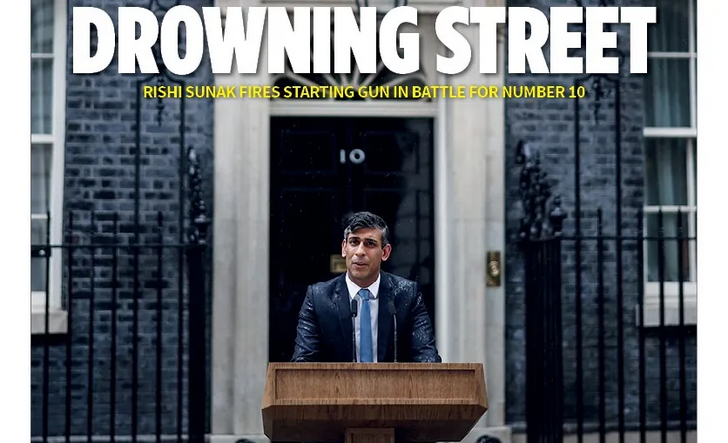
Rishi Sunak was a “wet” even before his farcical aquatic ceremony to kick off the 2024 general election.
We love a loser in Britain. From Eddie the Eagle to Gareth Southgate, our default reaction to a lack of success is warm appreciation. Parliament in that regard could not have been kinder to Rishi Sunak on his return as Leader of the Opposition. Never mind that the Conservative Party now looks more like the garrison of Rourke’s Drift than a campaign army. Never mind that the majority lies speared in the dust from their July 4th Isandlwana. Never mind that on the horizon General Farage is stirring the nativists for a future Bore War. The Lord Chelmsford of Prime Ministers marches on.
Less allegorically, Sunak, having made a couple of good speeches, is as one commentator put it “precisely the leader the Conservative Party needs right now”. On a personal level he is clearly a lovely guy, smart, capable, talented and has a very bright Clegg-like future ahead of him, whether in the valley or teaming up with Tony Blair to hawk AI to dictators. He is being feted by all the usual suspects who regard Parliament as a jolly club for centrist dads. Little thought however has been put into how this comes across to the poor bloody Tory infantry still pulling the bodies out of the metaphorical Buffalo River, wondering whether the inexperienced lieutenants rowing in the redoubts have what it takes to hold the line.
So let us be blunt, as a leader Sunak was hopeless. He had no coherent ideology or vision. He treated consensus building as an end in itself rather than as a means to an end. Even then he was better at building coalitions against rather than for him and was advised by people who used polls to tell them what to think, rather than as tools to move the public their way. He was neither a campaigner nor a political strategist.
As a result, he demonstrated cataclysmic judgement on the timing of the election. Whether this was through arrogance, naivety, or ignorance, he amplified the losses. He did so in the teeth of ample public commentary praising an assumed wise decision to delay until winter. Catching his own side by surprise, benefitting only morally vacuous apparatchiks boosting their betting accounts, and a far better prepared Opposition.
In office he was addicted to fad policies like generational bans, the Rwanda scheme, and the triple lock. He ducked hard choices on growth like building homes and cutting red tape, both things his deeply buried Thatcherite instincts should have told him were fights worth having. He was useless at implementation. Note, for example, the failure of his own borders policy or thinking through how to reform Ed Miliband’s ideological Net Zero architecture into something pragmatic.
He was right about one big thing — the importance of fiscal prudence and sound money. But he was also the Chancellor who undermined that prudence with wasteful lockdown splurges that destroyed growth and pushed the national debt over 100 per cent. He loved the sugar rush of popularity that came with being a spender in a crisis, but afterwards reformed nothing, preferring instead to raise taxes, generally by copying Labour’s madder talking points. For example, putting up corporation (company profits) tax to 25 per cent, freezing personal allowances, and hitting the North Sea with a 75 per cent “temporary” windfall tax, that has already outlasted the short period of high prices that inspired it. The latter has mortally wounded domestic investment, ripe for the Labour administration to finish it off. An error made despite his predecessor Osborne making exactly the same mistake with the same disastrous consequences only a few years earlier.
July 6, 2024
Labour’s “landslide”
I put the scare quotes around the word “landslide” because Labour’s eye-popping total of seats in Parliament was won on a remarkably narrow share of the actual votes cast in the British general election on Thursday (less than Jeremy Corbyn’s Labour party won in 2019). Fratricide on the right allowed a lot of Labour candidates to squeak in the win as the combined Tory/Reform votes would have been more than enough to top Labour.
Labour has won a landslide and the largest swing in British history without even increasing its vote share in England, and winning perhaps only 35% nationally. Its only significant gains in proportional terms were in Scotland, largely at the expense of the SNP, who have suffered catastrophic losses, meaning they are only 1 seat ahead of Sinn Fein, now the largest party in Northern Ireland — who are in turn 3 seats ahead of Reform, the third largest party in Britain by vote.
But these Reform MPs are — as I write — outnumbered by the five pro-Gaza independents, who won seats in Yorkshire, Lancashire, the Midlands and London in reaction to Keir Starmer’s position on Israel. Labour are down an average of 18 points in seats where the Muslim population is 20%, and in seats where that figure is above 25%, they are down 23 percentage points. While Labour lost a huge share of the Muslim vote, what is more worrying is the atmosphere in which this has taken place.
In Birmingham Yardley Jess Phillips held on by 700 votes, and in a remarkably unpleasant – I might even say upsetting, although I’ve only had three hours’ sleep — count she lamented that “This election has been the worst election I have ever stood in”, as she was booed.
“I understand that a strong woman standing up to you is met with such reticence”, she told her antagonists, and described how opponents had filmed a Labour activist in the streets and slashed her tyres, while another was screamed at by a man. She told how Jo Cox’s family had wanted to come and campaign but she couldn’t let them endure it. “Can you throw them out?” she asked the authorities of her hecklers.
There were similar scenes in Birmingham Ladywood as Shabana Mahmood was heckled as she gave her speech, the returning officer pleading with the supporters of independent Ahkmed Yakoob to stop.
Yakoob was described by the Sunday Times‘s Will Lloyd as “the one man in Britain who embodies the way our politics have changed”. He described “a 36-year-old defence solicitor who wears black Prada trainers, a glittering diamond watch, tinted gold-framed sunglasses and Gareth Southgate-like waistcoats. He has 195,000 followers on TikTok, a platform he understands more intuitively than 99 per cent of the politicians in this country. He speaks in clipped, brutal epigrams that sound like they are only ever a few” and “The word ‘genocide’ is never far from his mouth with ‘For Gaza’ printed on his leaflets.”
Labour hung on in Ladywood, a historic constituency in England’s second city where in 1924 Neville Chamberlain very narrowly beat a rising star of the Labour Party called Oswald Mosley.
Gaza independents also narrowly lost Birmingham Hodge Hill by just 1000 votes, and Ilford North, the constituency of Wes Streeting by just 528 votes.
While the media focus was largely engaged in catching out the musing of some of Reform’s less intellectually capable candidates, this other populist revolt has been carried out in an atmosphere of anger and intimidation perhaps not seen in English elections since the days of Rotten Boroughs.
There was police intervention in Oldham last month, Naz Shah MP was abused as a “dirty, dirty Zionist … paid by Friends of Israel”.
Fellow Canadian observer Damian Penny refuses to apologize for his headline “The Sunak Sets over the British Empire” (and I don’t blame him in the slightest):
Canadian readers, stop me if you’ve heard this before: an historically unpopular center-right Tory government heads into an election under a hapless leader running a catastrophically poor campaign and finds that even its traditional support is being badly eroded by an upstart right-wing populist party called Reform.
What happened in Britain on July 4 (weirdly symbolic, that) is not exactly what we experienced in Canada in 1993 – the Tories suffered the worst election result in their history, but they’re left with 119 more seats than the venerable Progressive Conservative party under Twitter-troll-in-waiting Kim Campbell, and at least the outgoing PM managed to hold on to his own seat — but it’s kind of nice to see the Mother Country adopting our traditions for once.
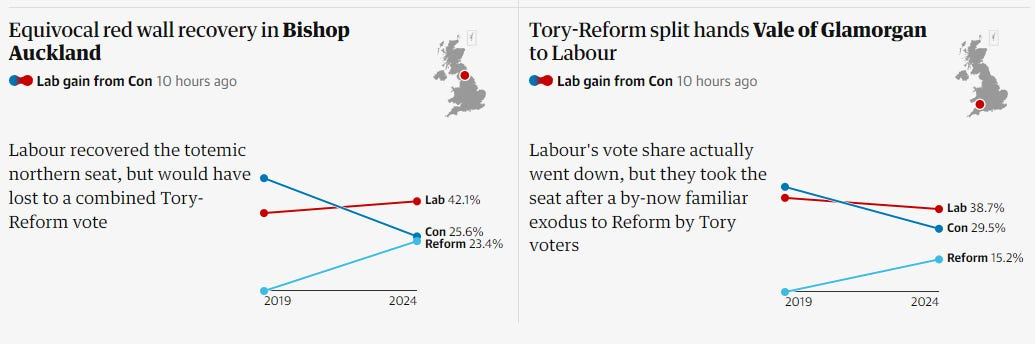
Honestly, 121 seats for Rishi Sunak’s Conservative Party is much better than I’d expected at the start of this campaign. And had it not been for Nigel Farage’s Reform Party, they might have managed a much less embarrassing defeat, because this kind of thing happened many times over last night:
Not everyone who voted Reform defected from the Conservatives – had Farage’s protest party not been on the ballot, many of its supporters would have stayed home or cast their votes for fringe parties and independent candidates — but it might have made the difference between a bad night for the Tories and the worst election in the Tories’ history.
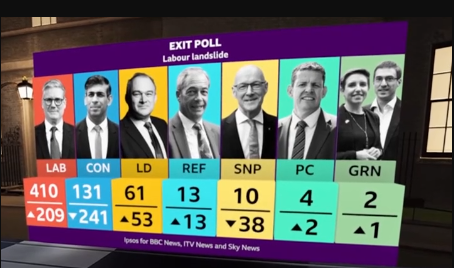
Reform won four seats outright – less than a hyperbolic exit poll predicted, but four more than most observers expected at the start of the campaign. They can’t really affect much at the national level, especially with Keir Starmer’s Labour Party holding an absolutely massive majority of seats in Parliament, but they will make things very difficult for the Conservatives.
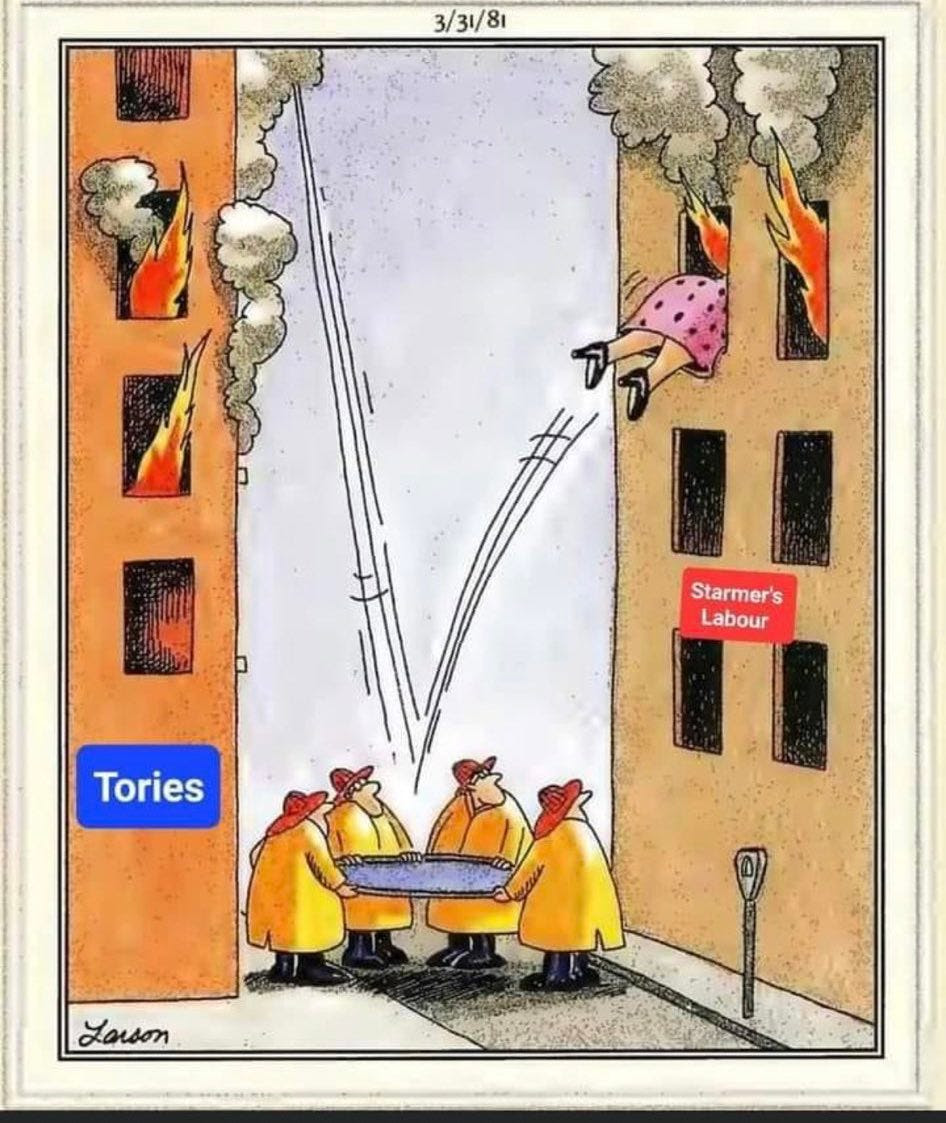
Helen Dale summarized the British general election result in a modified Gary Larson image:
Andrew Doyle points at the disproportional share of the vote won by Nigel Farage’s new Reform UK party compared to the tiny number of seats as a condemnation of the first-past-the-post system (also used here in Canada):
Keir Starmer surely cannot believe his luck. He has achieved a landslide victory by doing very little. He received fewer votes than Jeremy Corbyn in 2019, and yet has ended up with a whopping 412 seats in parliament. The rise of Nigel Farage’s Reform Party has split the right-wing vote and ushered the Conservatives along to their worst ever election result, plunging them to even greater depths than the disastrous election of 1906 under Arthur Balfour.
This was very much a Conservative loss rather than a Labour victory. There is no great enthusiasm for Starmer, and his majority is an indictment of the “First Past The Post” system which, as I have argued previously, should be abandoned in favour of Proportional Representation. It is unsurprising that upon his victory in Clacton-on-Sea, one of Farage’s first public statements has been a commitment to campaign for electoral reform. His party received over 4 million votes and has returned only 5 seats. So that’s 1% of the seats for 14% of the votes. Compare that with the Liberal Democrats, who have 11% of the seats for only 12% of the votes. Most of us will see that there is a problem here, irrespective of our political affiliations.
Worse still, Labour’s victory will empower the culture warriors, those identity-obsessed activists who have accrued so much power already in our major institutions. While the Tory party claimed to be fighting a “war on woke”, all the while enabling the ideology of Critical Social Justice to flourish, leading Labour politicians have cheered on the culture warriors while pretending that they were nothing more than a right-wing fantasy. We have seen some pushback over the past two years in regards to the worst excesses of this movement, but all of this may soon be undone. Now that the identitarians have their political wing in power, we should expect a few years of regression.
In Spiked, Brendan O’Neill thinks the real lesson to be learned from this election is that populism is here to stay:
To see the true quake, you need to look beyond Labour’s mirage-like landslide. As is now becoming clear, Labour has not been swept to power on anything like a wave of public enthusiasm. On the contrary, it won its 412 seats on the second lowest electoral turnout since 1885, and more as a result of people’s exhaustion with the Tories than their love for Sir Keir. No, it is those who refused to vote Labour who have brilliantly unsettled British politics. It is those who took a punt on Nigel Farage’s Reform party who have planted a bomb in the political landscape that will not be easily defused.
For me, the most fascinating stat of the election is the share of the vote received by Labour and the Tories. Labour won around 34 per cent of vote, the Tories around 24 per cent. Let’s leave to one side what a lame landslide it is if only 34 per cent of the people who could be bothered to vote put an X in your box. More striking is the fact that the combined vote share of Labour and the Tories, the parties that have dominated British politics for a century, was 58 per cent. That is staggeringly – and, if you will allow me, hilariously – low.
To put it in historical context: at the last General Election, in 2019, their combined vote share was 75.8 per cent. In 2017 it was even higher: 82.4 per cent. In the elections of the 2000s it hovered around 70 per cent. Why has it now dropped to less than 60 per cent, giving rise to the possibility that in the next few years the two parties that have run this country for decades might see their combined vote drop to less than half of all votes cast? Largely, because of Reform. And a few independents, too. Reform’s vote share is around 14 per cent, enough to shatter the Labour / Tory duopoly and to unravel the two big parties’ arrogant belief that they and they alone have a right to rule.
The speedy turnaround of the Reform revolt was extraordinary. It was only a few weeks ago that Farage ditched his plans to go to America to assist the Trump campaign and instead decided to become leader of Reform. He has now been elected MP for Clacton. Reform has won four seats in total. What’s shocking is that the Liberal Democrats won 71 seats despite getting fewer votes than Reform. The Lib Dems got around 12 per cent of the vote, to Reform’s 14 per cent. That the democratically less popular party of the two will wield far greater power in the Commons is a testament to how busted our first-past-the-post electoral system is. This is unsustainable. It is outright undemocratic.
And yet, even without the parliamentary representation their vote share deserves, Reform has struck a blow for democracy. Their voters, in thinking for themselves and rejecting both the Labour and Tory variety of technocracy, have forcefully created a new opening in political life. They have burst a few of the buckles on the political straitjacket that is our two-party system. The last time this happened was with Farage’s UK Independence Party, in the 2015 General Election, when it won 12.6 per cent of the vote, reducing the Tory / Labour vote share to 67.3 per cent. But where UKIP was mostly a one-issue party, dedicated to getting Britain out of the EU, Reform has broader policy goals. The millions of working-class people who voted for it are saying something very clear indeed: “We want something different”.
July 1, 2024
Fifty ways to leave your leader
Okay, I exaggerate in the headline … Mitch Heimpel only offers a list of eight factors that matter when it’s time for a political party to take their leader out behind the barn, so to speak:
Caucus revolts have gotten more common in Canadian politics of late.
They’ve always been commonplace in Westminster politics. In recent years, they’ve dethroned three prime ministers in the U.K. They’re almost as common as general elections for removing prime ministers in Australia. They’re a sign of a healthy parliamentary system … sort of. Our system runs on confidence. Prime ministers are supposed to be responsive to pressure from the backbench.
Canada has been something of an exception to this, and not always to our national benefit. Though less so lately. We’ve seen sitting governments in revolt (Jason Kenney in Alberta, 2022) We’ve also seen opposition leaders taken out by frustrated caucus (Erin O’Toole federally in 2022, Patrick Brown as Ontario Progressive Conservative leader, 2018.) The Chrétien-Martin feud was more of a civil war than a revolt.
Still, despite the examples above, these events remain relatively rare in Canada, compared to many of our Westminster peers, because of how centralized power has become in leaders’ offices (especially in the PMO). Our normal, as described in Jeffrey Simpson’s The Friendly Dictatorship, is how our system evolved, not how it was meant to be.
Now, since there are signs (see here and here and here) that at least some Liberals are musing about taking a shot at Prime Minister Justin Trudeau, it’s perhaps a good time to set some ground rules for caucus revolts. This is what we’ve learned not just from recent Canadian experience, but also from what our British and Australian cousins have learned over the years.
[…]
If things are going so badly that the caucus wants to revolt, you probably do need to make changes. Showing you’re listening, demonstrating accountability at the senior levels and demonstrating change can take the wind out of a caucus revolt before it gets out of hand.
The above are general rules — exceptions can obviously apply. And as noted at the beginning, Canada doesn’t have much experience with these situations. That’s why Australia and the U.K. are so instructive. But things do seem to be changing in Canada, and certainly, things seem to be changing in the Liberal caucus. The above rules are offered free of charge to mutineers and loyalists alike. Good luck!
June 26, 2024
Lord Balfour
Arthur Lord Balfour, Conservative Prime Minister from 1902 to 1905, is perhaps best known for the Balfour Declaration issued during World War 1 that established the formal goal of an independent homeland for the Jews in the Holy Land. Who was he? Barbara Kay’s essay originally published in the Dorchester Review was recently reposted at Woke Watch Canada:

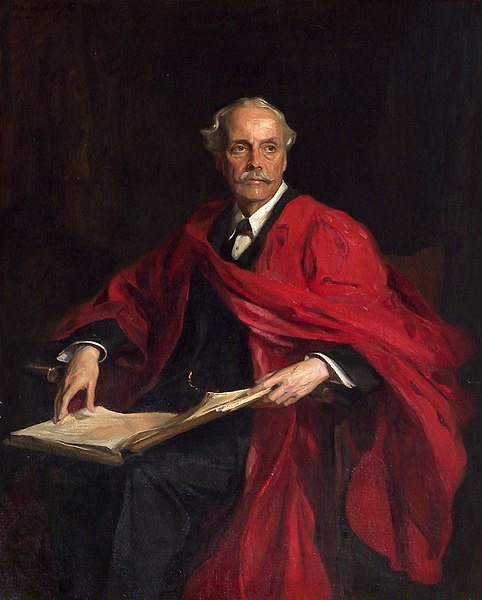
“Arthur James Balfour, 1st Earl of Balfour, KG, OM, PC, Prime Minister and Philosopher” portrait in oil by Philip de László, 1914.
From the Trinity College collection via Wikimedia Commons.
Why was the aristocrat Lord Balfour, the social antithesis of this humble Jew from the Pale of Russia, so taken with Weizmann’s vision that he was willing to expend political capital and exert so much effort to see it realized? Who was Balfour? What was he?
Arthur James Balfour was born at his family seat, Whittingehame, in East Lothian, the “granary of Scotland”. A forebear had made a fortune in India in military materials, so he was financially secure for life, and socially connected at the highest levels.
Having lost his father when he was 7, Balfour was lucky in his mother, a strong-willed and educated woman who, according to Mrs Dugdale, inculcated the idea of duty as “the uncompromising foundation of his character”. He attended Eton and Cambridge, where he was described by a friend as “a man of unusual philosophy and metaphysics”, who could hold his own with the Dons (professors), “some of them men of undoubted genius”. He was devoted to his extended family, and much beloved by his nieces and nephews.
In his essay “Arthur Balfour: a Fatal Charm”1 cultural critic Ferdinand Mount cites “nonchalance” as Balfour’s defining trait. Legendarily indolent, he rarely rose before 11 a.m., claimed never to read newspapers, and disdained the ritual schmoozing of fellow backbenchers expected by his peers in the Members’ Smoking Room. Mount says he was “indifferent to what his colleagues, the public or posterity thought of him or his policies”.
This loftiness — echoed in his unusual physical height — was perceived as admirable or maddening according to the observer and circumstances. Churchill said of him: “He was quite fearless. When they took him to the Front to see the war, he admired the bursting shells blandly through his pince-nez. There was in fact no way of getting to him.”
His self-sufficiency was no act. Sports-mad, he skipped lunch with the Kaiser to watch the Eton and Harrow cricket match, and when in Scotland might play two full rounds of golf a day (his handicap of 10 was better than P. G. Wodehouse and about the same as thriller writer Ian Fleming’s).
Balfour sounds from my description so far as if he was something of a playboy, but that is a very partial portrait. He was also known as “Bloody Balfour” for his readiness to endorse police action and his apparent indifference to their cost.
The Irish loathed him. In 1887 he became personal secretary for Ireland under his uncle, Lord Salisbury, just in time to enforce the Coercion Act against the volatile Irish Land League. Indeed, Balfour’s parliamentary critic William O’Brien saw him as a man who harboured a “lust for slaughter with a eunuchized imagination” who took “a strange pleasure in mere purposeless human suffering, which imparted a delicious excitement to his languid life”.
One hopes this accusation of actual sadism is an exaggeration of Balfour’s indubitable detachment. Yet indifference to human life is certainly not an uncommon charge laid against intellectuals for whom ideas loom larger in their claims to attention than the fate of those beyond their particular tribes.
For balance, we have Barbara Tuchman’s assessment:
Balfour had a capacious and philosophical mind. Words to describe him by contemporaries are often “charm” and “cynicism”. He had a profound and philosophic mind, he was lazy, imperturbable in any fracas, shunned detail, left facts to subordinates, played tennis whenever possible, but pursued his principles of statecraft with every art of politics under the command of a superb intelligence.
Fortunately for his temperament, Balfour’s life circumstances had landed him at the centre of a genuinely intellectual circle. His brothers in-law, for example, were Lord Rayleigh, who became head of the Cambridge Laboratory and won the Nobel Prize for Physics, and Henry Sidgwick, the Cambridge philosopher who with his wife Elaine Balfour founded Newnham College.
Politically, Balfour enjoyed both dramatic success and dramatic failure. He led the Unionist Party longer than anyone before him since Pitt the Younger. And he was a minister longer than anyone else in the 20th century, including Winston Churchill. Balfour was the only Unionist who was invited to join Asquith’s first war cabinet, and continued as foreign secretary after the coup that brought Lloyd George to power.
As Churchill put it: “He passed from one cabinet to the other, from the prime minister who was his champion to the prime minister who had been his most severe critic, like a powerful, graceful cat walking delicately and unsoiled across a rather muddy street”.
One of Balfour’s teachers at Eton described him as “fearless, resolved and negligently great”. On the other hand, Mount tells us, “indecisiveness” was his bane. He would stand paralyzed in the mezzanine of his London home agonizing over which of the matching staircases to descend by. He could love — the great love of his life died after an unreasonably long engagement — but, allegedly too staggered by the loss of his almost-fiancée, he never married.2 He could not be pinned down politically on many issues, a matter of great frustration to his colleagues, and this cost him dearly. As Mount notes, his charm was indisputable, “but more than charm he would not give” and “in the end, the charm is all that remains.”
Balfour fought three general elections as party leader and lost them all. His premiership lasted less than four years and ended in a Liberal landslide in 2006, a great electoral humiliation in making him the only prime minister in the 20th century to lose his own seat. He did not seem greatly to repine at the rejection, though, and it is thanks to the loss that he had time to further his education on the Zionist movement.
1. Mount, Ferdinand, English Voices (2016), pp 358 ff.
2. One suspects that even if May Lyttleton had lived, Balfour would have avoided marrying her on some pretext or other. There is no evidence that Balfour was a closeted homosexual, but he may have been asexual. He enjoyed an “amitié amoureuse” with (married) Mary Elcho for 30 years involving little or nothing in the way of sex, after which she wrote to him, “I’ll give you this much, tho, for although you have only loved me little, yet I must admit you have loved me long”.

June 17, 2024
For want of a security clearance, the (potential) traitors escaped scot-free
In the free-to-cheapskates section of this week’s Dispatch from The Line, we get a summary of the state of brain-freeze in Parliament over the NSICOP (National Security and Intelligence Committee of Parliamentarians) report, that in a functioning state would have triggered much more action than it has in the dysfunctional Dominion:

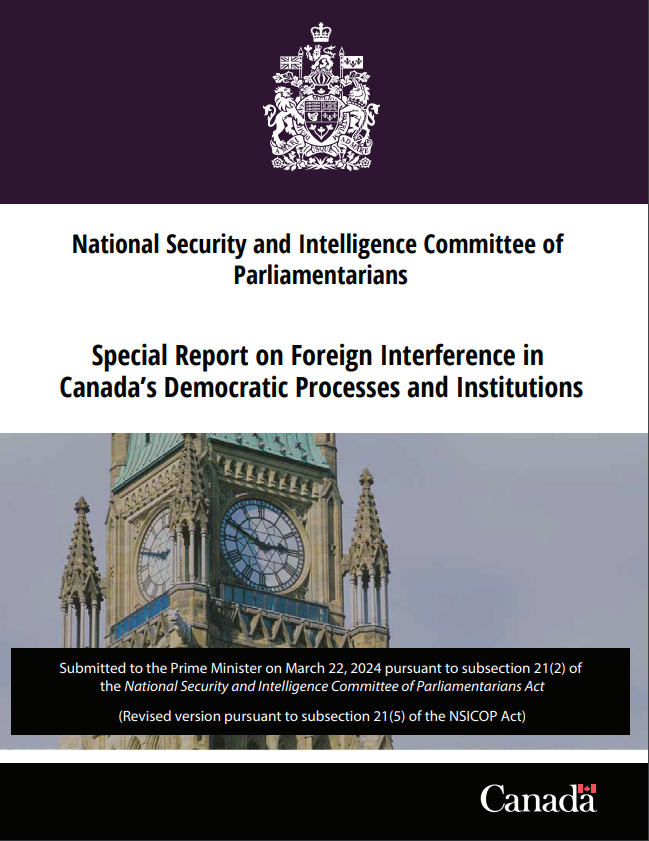
The cover of the NSICOP special report on foreign interference (PDF – https://nsicop-cpsnr.ca/reports/rp-2024-06-03/special-report-foreign-interference.pdf )
The lead story this week, clearly, was the continuing fallout from the NSICOP report last week. Because of this report, even though there is much that we do not know, there are absolutely some things that are clearly established. Let’s run through some of the key points that are uncontested and draw some very modest and safe conclusions from them.
Here are facts.
- There are multiple parliamentarians, meaning members of the House of Commons and the Senate, who have been deemed by eight of their colleagues to be engaged in activities with hostile foreign powers on either a witting or semi-witting basis.
- The prime minister and the PMO have been aware of who these individuals are for at least a month, if not longer. That is when NSICOP filed its unredacted report to them for review, as required.
The above facts are unchallenged. Now let’s draw a few conclusions.
The phrasing of the NSICOP report, as well as both Elizabeth May’s and Jagmeet Singh’s press conferences this week, led us to believe some of these individuals are still sitting in both the House of Commons and the Senate. We acknowledge that Elizabeth May and Jagmeet Singh differ considerably on the severity of what these individuals are alleged to have done, but both seem to agree that the relevant parties, in at least some cases, remain in Parliament.
The prime minister, as the person responsible for the administrative and legal apparatus of government, could call the Clerk of the Privy Council, the Director of CSIS, the minister of public safety and others as necessary into his office today, and inform them that he would be making the names public, and that it would be the responsibility of those individuals to figure out how that could be accomplished while protecting intelligence sources and methods. At this time, there is no indication that he has done so, or has any interest in doing so.
So we got the grotesque theatre that was the House of Commons this week. The government has spent the last week and change challenging various opposition leaders to obtain security clearances so that they could view information that the prime minister has had for at least a month, and perhaps longer, even though both the Security of Information Act and the National Security and Intelligence Committee of Parliamentarians Act (depending on the auspices under which their security clearances were issued) prevents them from disclosing what they read.
And, therefore, doing anything about it. Because to remove a caucus member would be to reveal it, and if a leader has no caucus members that are implicated, there is no urgency to their reading the report.
Protecting the national security of Canada, and the democratic institution of parliament itself, is the prime minister’s job before it is anyone else’s. And the prime minister has had this information for at least a month.
It’s worth repeating that because we want you to envision something. Imagine there are three U.S. Senators accused of aiding and abetting a foreign power, and Joe Biden knew about it for a month.
When do you think impeachment proceedings would start?
Boris Johnson was unceremoniously dumped by his party for lying about throwing a party during COVID lockdowns (and we have no problem with that). Our prime minister has known that there are people currently sitting in parliament that have turned themselves into intelligence assets for hostile foreign powers for a month, and …
… the government would like you to know that it thinks Pierre Poilievre should get a security clearance so that he can read the documents.
We think Poilievre should, too. Because here’s the thing. The Security of Information Act says right there in Section 24 “No prosecution shall be commenced for an offence against this Act without the consent of the Attorney General”.
That reads to us like so: Pierre Poilievre can read those documents, release the names, and then dare Justin Trudeau to prosecute him. Indeed, anyone with the names could.
Your Line editors have raised this before on the podcast, but it bears repeating. Canada’s international reputation has taken a lot of hits lately. So imagine if you would, gentle reader, a situation where Justin Trudeau’s Attorney General signs off on having his political opponent arrested for revealing that hostile foreign powers have coerced sitting MPs into becoming intelligence assets … especially if one or more of those MPs is revealed to be a Liberal.
That’s a front page international news story. We’d look like a banana republic. Our international reputation would take decades to recover.
Spoiler: we already do look like a banana republic and our international reputation is lower than it has ever been. Trudeau isn’t a dummy: he figures that our reputation literally can’t get much worse no matter what he does, so he’s choosing to protect … someone … and what’s Poilievre going to do? He proved during the lockdowns that he’s not willing to get arrested on a matter of principle (unlike Maxime Bernier), so he’s likely to just posture endlessly until something new pops up in the silly season news rotation.
June 13, 2024
June 12, 2024
“Treason never prospers” … except in Canadian politics, apparently
Justin Trudeau and his unindicted co-conspirators in Canada’s federal parliament don’t think the names of Members of Parliament who have been acting as enablers or actual agents of foreign powers — that is, possible traitors — should be made public. The National Security and Intelligence Committee of Parliamentarians (NSICOP) Even the least cynical may be forgiven for thinking that this isn’t what a mature country would do in similar circumstances:

The cover of the NSICOP special report on foreign interference (PDF here)
… MPs have an obligation to protect the institution that is the House of Commons. Every MP is required as a condition of taking their seats, to swear the following oath: “I, [name], do swear that I will be faithful and bear true allegiance to His Majesty King Charles the Third, King of Canada, his heirs and successors. So help me God.”
The violation of that oath, or the suspected violation of that oath, is absolutely arguably contempt against the House of Commons. We don’t have a ton of precedent for that, because MPs who have been alleged to have collaborated, even unwittingly, with a foreign power in the past usually have the good sense to resign. But MPs should absolutely be allowed to pass judgment on the actions of their colleagues, with the express intent of expelling from the House any members who have transgressed against their oath to King and Country. This isn’t just their duty, it is a duty that they are uniquely positioned and obligated to perform. Until we know exactly which parliamentarians we’re talking about, a spectre hangs over all 400-plus of them. That very much compromises the public’s opinion of Parliament and has a demonstrable impact on their ability to do their jobs as parliamentarians.
Once upon a time, children, ministers of the Crown would offer their resignations for mistakes made by members of the civil service in the ministry for which he or she held responsibility, never mind mistakes of their own. In modern times, of course, it’s rare to find a minister resigning voluntarily until the RCMP is literally knocking on the door, and sometimes not even then.
Second, we are a large and multicultural country. MPs are expected to represent members of any diaspora community which may exist in their constituency. If you’re a Tibetan or Uyghur activist, how can you be represented by an MP who’s demonstrated a willingness to collaborate with the government of the People’s Republic of China? If you’re an Iranian democracy and reform activist, how can you be represented by an MP who has close ties to Iran’s diplomatic and intelligence operation?
The answer, of course, is that you can’t be. The government has a greater responsibility to the democratic rights of those Canadians than it does to protecting the identity of any single unscrupulous or otherwise compromised parliamentarian. With every day that passes, Ottawa looks more like it has an interest in partisan butt-covering than it does in maintaining the long-term faith that democracy requires for our institutions to survive.
A good Member of Parliament recognizes the responsibility to the constituents — whether they voted for that particular MP or not — and would keep that responsibility as faithfully as possible. On that reckoning, we have fewer good MPs than we should have … and if the intelligence turns out to be fully supported upon full investigation, there should be a lot of open seats to run by-elections for (even if no formal charges of treason are ever laid).
Finally, I accept that intelligence is not evidence. I also accept, as noted in the Globe by Philippe Lagassé and Stephanie Carvin, that we must be cautious to not compromise intelligence sources and methods, or compromise ongoing investigations. Parliamentarians should not replace the criminal justice system or undercut our defence, but they what they are capable of doing, and indeed are required to do because no one else can do it for them, is broadly defining what the acceptable behaviour for parliamentarians should be. If an MP or a senator has engaged with a foreign power’s diplomatic or security services and they do not believe they have crossed the line for what we deem to be acceptable behaviour, they will be more than welcome to go on Power and Politics, or take to social media, or show up at what I’m sure will be many committee hearings, and make their case.
It is not a hardship to ask them do so. They are not being hard done by. The question here is not whether what they’ve done is criminal. It wasn’t criminal when Bev Oda billed the taxpayers for her juice. It wasn’t criminal when Bill Morneau forgot to leave a cabinet meeting where a decision was made that was a perceived conflict of interest. But both of those parliamentarians were forced to accept that their behaviour had failed the people they were sworn to represent. They resigned.
And the idea that orange juice crosses the line, but aiding a foreign intelligence service — even “semi-wittingly” — does not, will fail to pass the smell test with a very large number of Canadians. And that is entirely correct. The public is well ahead of the politicians on understanding this.
Public trust in politicians has been ebbing for quite some time and was fading even before the pandemic exposed so many of them as would-be dictators, poltroons, and idiots. There is no deep reservoir of respect for politicians that can be drawn on at this point. Swift action is the only thing that Parliament can do and by “swift”, I don’t mean setting up a Royal Commission with a multi-year remit to bury the issue until after the next federal election.
May 16, 2024
The Canadian Senate is an anti-democratic fossil … that might totally frustrate a future Conservative government
Tristin Hopper considers the constitutional weirdness of Canada’s upper house, an appointed body that has the power to block a popularly elected House of Commons:

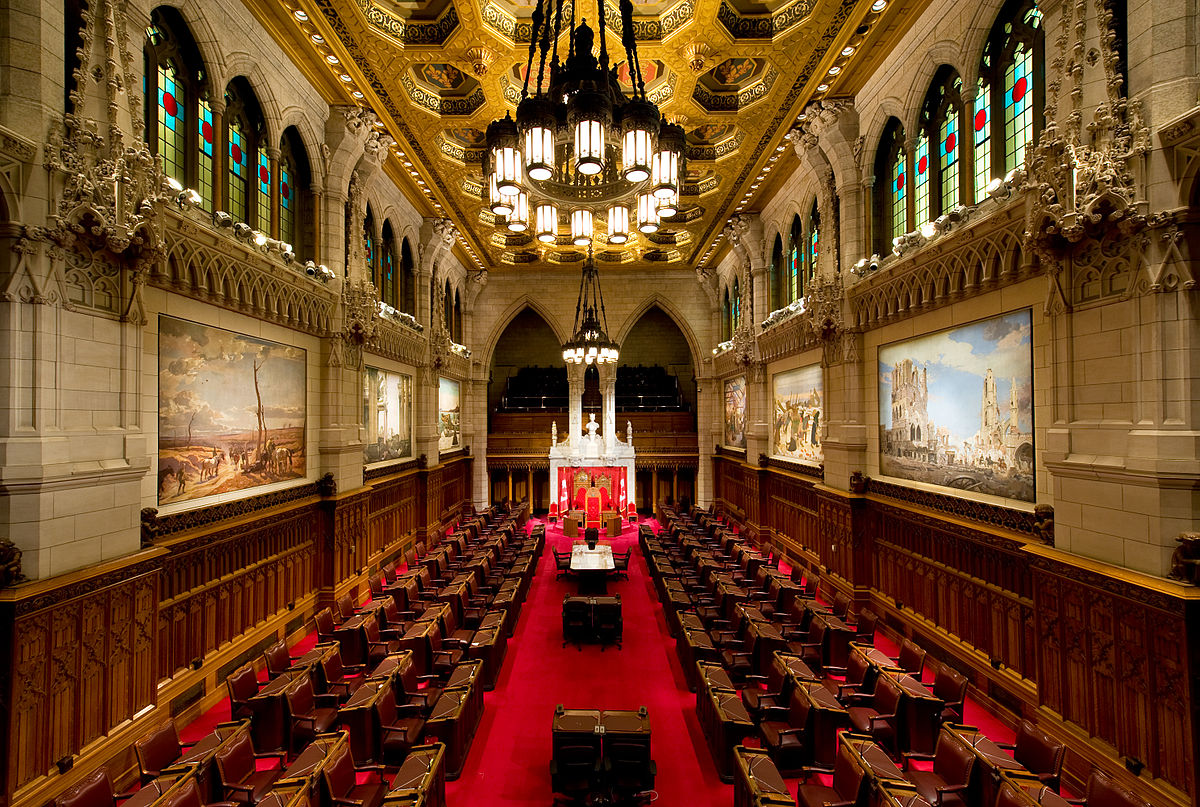
“In the east wing of the Centre Block is the Senate chamber, in which are the thrones for the [King and Queen], or for the federal viceroy and his or her consort, and from which either the sovereign or the governor general gives the Speech from the Throne and grants Royal Assent to bills passed by parliament. The senators themselves sit in the chamber, arranged so that those belonging to the governing party are to the right of the Speaker of the Senate and the opposition to the speaker’s left. The overall colour in the Senate chamber is red, seen in the upholstery, carpeting, and draperies, and reflecting the colour scheme of the House of Lords in the United Kingdom; red was a more royal colour, associated with the Crown and hereditary peers. Capping the room is a gilt ceiling with deep octagonal coffers, each filled with heraldic symbols, including maple leafs, fleur-de-lis, lions rampant, clàrsach, Welsh Dragons, and lions passant. On the east and west walls of the chamber are eight murals depicting scenes from the First World War; painted in between 1916 and 1920”
Photo and description by Saffron Blaze via Wikimedia Commons.
By the anticipated date of the 2025 federal election, only 10 to 15 members of the 105-seat Senate will be either Conservative or Conservative appointees. The rest will be Liberal appointees. As of this writing, 70 senators have been personally appointed by Trudeau, and he’ll likely have the opportunity to appoint another 12 before his term ends.
What this means is that no matter how strong the mandate of any future Conservative government, the Tory caucus will face a Liberal supermajority in the Senate with the power to gut or block any legislation sent their way.
“If a majority of the Senate chose to block or severely delay a Conservative government’s legislative agenda, it would plunge the country into a constitutional crisis the likes of which we have not seen in more than a century,” reads an analysis published Tuesday in The Hub.
Constitutional scholars Howard Anglin and Ray Pennings envisioned a potential nightmare scenario in which the Senate casts themselves as “resisting” a Conservative government. Given that senators are all permanently appointed until their mandatory retirement at age 75, it would take at least 10 years until a Conservative government could rack up enough Senate appointments to overcome the Liberal-appointed majority.
“Canadian politics would grind to the kind of impasse that is only broken by the kind of extraordinary force whose political and social repercussions are unpredictable,” they wrote.
The piece even makes a passing reference to 1849, when mobs burned down Canada’s pre-Confederation parliament.
The prospect of an all-powerful Senate able to block the mandate of an elected government is a legislative situation almost entirely unique to Canada.
New Zealand abolished its Senate and is now governed by a unicameral legislature. Australia and the United States both employ term-limited elected senates. The U.K. House of Lords – on which the Canadian Senate is closely modelled – is severely constrained in how far it can check the actions of the House of Commons.
But in Canada, the Senate essentially retains the power of a second House of Commons; it can do whatever it wants to legislation that has passed the House of Commons, including spike it entirely.
April 22, 2024
Canada’s Governor General is supposed to be above politics, not immersed in it
Colby Cosh says — quite correctly — that the issue with the Governor General indulging in partisan politics isn’t that people noticed and objected:

Mary Simon, Governor General of Canada on a visit to London in June, 2022.
Detail of a New Zealand Government official photo via Wikimedia Commons.
All week I’ve been thinking about the sheer number of people who must have known about this event and who apparently didn’t anticipate a potential constitutional problem. Hey, what could go wrong? Surely no Liberal cabinet minister would show up, press the flesh all day, head back to the office, and plunge moronically into auto-campaign mode, sharing snapshots of how “we discussed … our Online Harms Act“ at the palace over oolong and scones.
The GG’s own materials describing the event are careful to characterize it as a fundamentally sociable get-together with no relationship whatsoever to a government agenda. Attendees to the event insist that legislation now before the House of Commons wasn’t explicitly discussed by any of the speakers.
As Colleague Sarkonak pointed out in her hair-raising Tuesday column on the scandal, the symposium included a panel discussing “Emerging Solutions for a Safer Digital World”. In any other setting it would be weird and surprising to have such a discussion without involving any “solutions” that are legislative in nature. But maybe the attendees were careful to talk exclusively about technological and social solutions to online abuse: such a thing is certainly possible. Those of us whose invitations were lost in the mail are left to make maximally charitable assumptions.
It’s just that, logically, we can’t be charitable to both the Governor General and Justice Minister Arif Virani in this case. Their stories conflict, in a direct and consequential way.
Anyway, none of the excuses being made really cut much ice. It’s true that a governor general has some freedom to engage in philanthropy, oratory and social organizing that have no visible partisan aspect. It’s also true that if a GG’s social agenda coincides awkwardly with the House of Commons order paper, you’re playing Russian roulette with the Constitution. On Tuesday the government introduces a bill outlawing soda pop; by the end of the week the Gov-Gen is inviting diabetics and nutritionists to chat about their “lived experience” of Mr. Pibb addiction. And, most likely, when anyone at all objects, you get a familiar barrage of “conservatives pounce” stories.
April 19, 2024
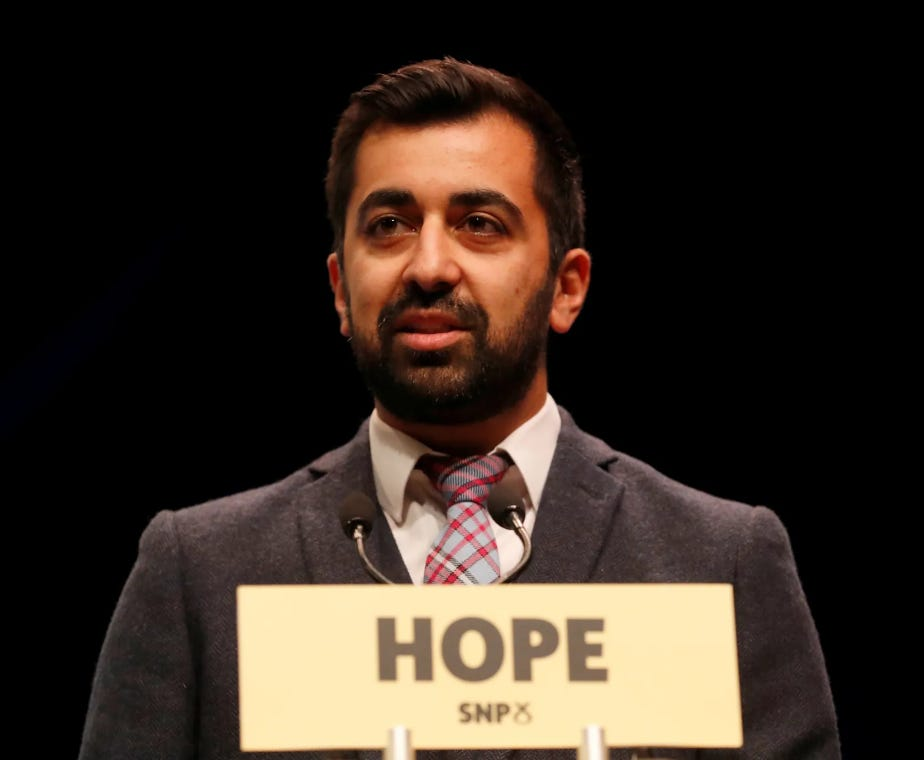
Humza Yousuf, the “Thug King of Scotland”
I don’t know what Scotland did to deserve Humza Yousuf as their first minister, but it must have been really bad:
Assuming he doesn’t get removed by a leadership coup before voters sink the leaking Tory battleship, Sunak will be gone by January of 2025 at the latest. That just leaves Humza Yousuf, characterized by Morgoth as The Thug King of Scotland: a post-ideological, apolitical opportunist interested purely in power for its own sake and quite happy to use the absurd public morality of the despised rubes that he rules over to keep the wretches in their place.
And boy, does he despise them.
Yousuf first came to the Internet’s attention in 2020, when he was filmed ranting in the Scottish parliament about how disgustingly racist it was that most of the high public offices in a country with an overwhelmingly White population were occupied by presumptively racist White cavebeasts:
The Lord President is white, the Lord Justice Clerk is white, every High Court judge is white, the Lord Advocate is white, the Solicitor General is white, the chief constable is white, every deputy chief constable is white, every assistant chief constable is white, the head of the Law Society is white, the head of the Faculty of Advocates is white and every prison governor is white.
That is not the case only in justice. The chief medical officer is white, the chief nursing officer is white, the chief veterinary officer is white, the chief social work adviser is whiteand almost every trade union in the country is headed by white people. In the Scottish Government, every director general is white. Every chair of every public body is white. That is not good enough.
If you haven’t watched the video, you should. You need to hear the contempt dripping off of his tongue, the way he spits out the awful word “White” like bitter venom.
In the immediate aftermath of this angry foreigner’s tirade, a sane country would have immediately marched their ill-mannered guest out of parliament, stripped him of office and citizenship, thrown him on a rusty fishing vessel, hauled him up north of the Orkneys, tossed him into the North Sea wearing nothing but a life preserver, and sent him on his way with a cheery wave and a reminder to mind the orcas.
Instead, they gave him the keys to the kingdom.
But while the infamous White Speech might not have prevented his elevation to the highest office in the land – indeed, given the derangement of our elites, if anything it smoothed his ascent – it has come back to haunt him. Thin-skinned and insecure as he is, Yousuf’s first priority on taking office was to ram through a new hate speech law with which to prevent the contemptible White worms from critiquing him or his noble tribe of vape-shop owners, cabbies, and grooming gang pimps. The law was ridiculously broad and invasive: one could be reported for the criminal offence of hate speech merely for making a remark in the privacy of one’s home, around the dinner table, with no one present but one’s kith and kin.
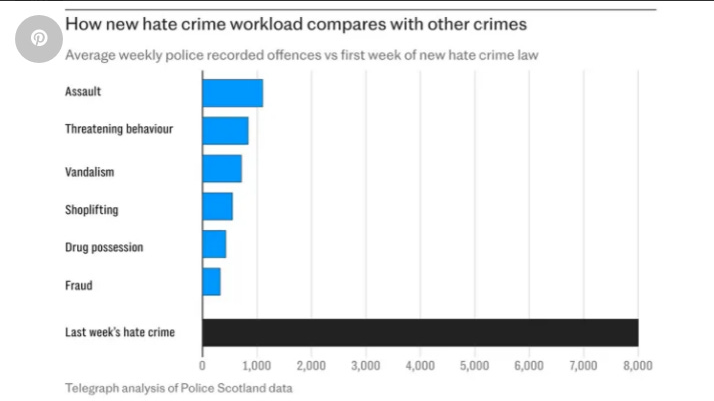
The day that the bill was finally forced through the Scottish parliament, and predictably enough for anyone who glanced at the law and had a passing understanding of the Scottish national character, the Scottish people responded by DDoSing the police with a deluge of hate crime reports, a very large number of which were reporting Yousuf’s rant as a hate crime … which, apparently, under the strict interpretation of the new law, it certainly was, with the only thing standing between Yousuf and indictment under his own half-baked law being that his ill-considered harangue took place prior to the law being passed. Which hasn’t stopped the Scots from taking the piss and continuing to report him.
It turns out that the Scots really do not like a ban on bantz, not one bit, and respond to demands that they cease the bantz by cranking up the bantz. Yousuf, being a humourless Pakistani who is confused and angered by this entirely foreseeable reaction, has risen to the occasion with all the grace, poise, and wit you would expect. In an attempt to stem the savage tide of mockery, Yousuf has tried claiming that reporting his hate speech is hate speech (lulz); has ordered Scottish police to read verbatim a prewritten transcript defending him each time his hate speech is thrown back at him (because that doesn’t look ridiculous); and faked a hate crime against himself by having his house sprayed with graffiti (did anyone fall for this?).
The next Scottish general election is two years away. Whether Humza survives the interim as First Minister, and if so whether he is able to guide the “Scottish” “National” Party to victory, remains to be seen. I don’t fancy his chances. He is a cunning and ruthless brute, to be sure. But he is also clumsy, clueless, and very stupid. Yousuf’s popularity has already plummeted. I’m sure he can find ways to plummet further. I believe in you, Yousuf. You can do it!
March 4, 2024
Japan’s Meiji Restoration, 1868-1912
Lawrence W. Reed outlines the end of Japan’s Shogunate Period and the start of the reign of Emperor Mutsuhito, known as the Meiji Period:

The Imperial Household Agency chose Uchida Kuichi, one of the most renowned photographers in Japan at the time, as the only artist permitted to photograph the Meiji Emperor in 1872 and again in 1873. Up to this point, no emperor had ever been photographed. Uchida established his reputation making portraits of samurai loyal to the ruling Tokugawa shogunate.
Wikimedia Commons.
In the 15 years that followed [American Commodore Matthew] Perry’s venture, the grip of the military dictatorship in Tokyo declined. Civil war erupted. When the smoke cleared in the first few days of January 1868, the shogunate was gone and a coup d’etat ushered in a new era of dramatic change. We call it the Reform Period, or the era of the Meiji Restoration.
That seminal event brought 14-year-old Mutsuhito to the throne, known as Emperor Meiji (a term meaning “enlightened rule”). He reigned for the next 44 years. His tenure proved to be perhaps the most consequential of Japan’s 122 emperors to that time. The country transformed itself from feudal isolation to a freer economy: engaged with the world and more tolerant at home.
In 1867, Japan was a closed country with both feet firmly planted in the past. A half-century later, it was a major world power. This remarkable transition begins with the Meiji Restoration. Let’s look at its reforms that remade the nation.
For centuries, Japan’s emperor possessed little power. His was a largely ceremonial post, with real authority resting in the hands of a shogun or, before that, multiple warlords. The immediate effect of the Meiji Restoration was to put the emperor back on the throne as the nation’s supreme governor.
In April 1868, the new regime issued the “Charter Oath,” outlining the ways Japan’s political and economic life would be reformed. It called for representative assemblies, an end to “evil” practices of the past such as class discrimination and restrictions on choice of employment, and an openness to foreign cultures and technologies.
After mopping up the rebellious remnants of the old shogunate, Emperor Meiji settled into his role as supreme spiritual leader of the Japanese, leaving his ministers to govern the country in his name. One of them, Mori Arinori, played a key role in liberalizing Japan. I regard Arinori as “the Tocqueville of Japan” for his extensive travels and keen observations about America.
The Meiji administration inherited the immediate challenge of a raging price inflation brought on by the previous government’s debasement of coinage. The oval-shaped koban, once almost pure gold, was so debauched that merchants preferred to use old counterfeits of it instead of the newer, debased issues. In 1871, the New Currency Act was passed which introduced the yen as the country’s medium of exchange and tied it firmly to gold. Silver served as subsidiary coinage.
A sounder currency brought stability to the monetary system and helped build the foundation for remarkable economic progress. Other important reforms also boosted growth and confidence in a new Japan. Bureaucratic barriers to commerce were streamlined, and an independent judiciary established. Citizens were granted freedom of movement within the country.
The new openness to the world resulted in Japanese studying abroad and foreigners investing in Japan. British capital, for instance, helped the Japanese build important railway lines between Tokyo and Kyoto and from those cities to major ports in the 1870s. The new environment encouraged the Japanese people themselves to save and invest as well.
For centuries, the warrior class (the samurai) were renowned for their skill, discipline, and courage in battle. They could also be brutal and loyal to powerful, local landowners. Numbering nearly two million by the late 1860s, the samurai represented competing power centers to the Meiji government. To ensure that the country wouldn’t disintegrate into chaos or military rule, the emperor took the extraordinary step of abolishing the samurai by edict. Some were incorporated into the new national army, while others found employment in business and various professions. Carrying a samurai sword was officially banned in 1876.
In 1889, the Meiji Constitution took effect. It created a legislature called the Imperial Diet, consisting of a House of Representatives and a House of Peers (similar to Britain’s House of Lords). Political parties emerged, though the ultimate supremacy of the emperor, at least on paper, was not seriously questioned. This nonetheless was Japan’s first experience with popularly elected representatives. The Constitution lasted until 1947, when American occupation led to a new one devised under the supervision of General Douglas MacArthur.
February 18, 2024
“Please, sir, can we have some more Roads?”
Every week, Tristin Hopper helps us understand an element of the week’s news by “imagining” the diary entries of the people or organizations involved. This week, it’s the turn of federal Environment Minister Steven Guilbeault, who had a hell of a week even by Trudeaupian standards:
Monday
There was a time when I was naïve enough to think that the climate crisis could be solved with mere emissions reductions or alternative energy. But it becomes more clear every day that Canada can never hope to meet its climate goals unless we’re prepared to remove redundancies from our economic system.Do we really need to produce any more music? I feel humanity has pretty well covered what a guitar or a trumpet can do; why waste scarce energy to continue heating concert halls or power tour buses? We have a food system that irresponsibly makes no distinction between the carbon footprint of certain foods: We cannot hope to be a climate leader if Canadians continue to eat prawns when a few strips of jicama could suffice.
And above all, this country is positively drowning in unnecessary roads. When the average Albertan starts up his masculinity-compensating coal-rolling monster truck and drives it for hours on a rural Canadian highway without seeing a soul, does it not cross his mind that some resources have been wasted? That man would be fitter, happier and richer if he’d instead been able to make the trip by the eminently more efficient method of bicycle, gondola or monorail.
Tuesday
“Steven Guilbeault wants to ban roads,” they say. But this is not a road ban. Provinces and municipalities can still build all the roads they want. If you and your buddies pool your money for some asphalt and graders — and I decide that it meets all necessary requirements for environmental mitigation, reconciliation and gender-based impacts — then pave away.We’ve merely correctly decided that roads are a wholly inappropriate concern for a Canadian federal government. The task of government is to focus on the fundamentals such as inclusion initiatives for federally regulated industries and means-tested dental subsidies. Things that could not exist if not done by the state.
Anybody can build a few hundred kilometres of glorified driveway.
Wednesday
I’m honestly appalled at the road-worship exhibited in recent days by my Conservative colleagues. I knew they had a regressive fixation on guns, trucks and plastic straws, but even I did not suspect a mass-genuflection for mere strips of asphalt, gravel and whatever else roads are made out of.But perhaps I shouldn’t be surprised. Where else but on a road can one pursue the right-wing fantasies of unfettered resource extraction or colonialist subjugation? Where is their law-and-order militarism without latticeworks of slick, black tarmac to survey and control the citizenry? When armed capitalistic thugs violently crushed the Winnipeg General Strike in 1919, how did they get there? That’s right; roads.
February 14, 2024
“… one of the most contemptible pieces of legislation since the introduction of the Indian Act in 1876″
In the National Post, Stephen Buffalo explains why many Canadian First Nations people are angry with NDP MP Charlie Angus for his recently introduced Private Member’s Bill in Parliament:

“Charlie Angus at convention 2023 2 (cropped)” by DrOwl19 is licensed under CC BY-SA 4.0 .
First Nations people used to consider NDP MP Charlie Angus an ally, as he has been outspoken on issues of Indigenous poverty and government mismanagement. Canadians do not want to know what many Indigenous people are calling him these days.
Last week, Angus tabled a private member’s bill, C-372, that is one of the most contemptible pieces of legislation since the introduction of the Indian Act in 1876. Angus’ proposed fossil fuel advertising act would outlaw oil and gas advertising and the “promotion” of fossil fuels, even by some private citizens. If passed, this would be the most egregious attack on civil liberties in recent Canadian history.
It is astonishing that an experienced parliamentarian like Angus could bring such nonsense forward. All Canadians, of all political stripes, should be outraged at this attempt to stifle public discussion.
Through actions like this, Angus and his environmental supporters — like the Sierra Club, Suzuki Foundation, Earthjustice, Greenpeace, 350.org and others — have shown themselves to be no fans of Indigenous peoples. These single-minded environmentalist organizations ignore the interests of First Nations, Metis and Inuit communities, except when they want to impose their will on them.
Angus has thrown his lot in with the wrong people. They are happy to tell us what to do on energy and environmental matters. But they are never around to fix our water issues, health-care problems, housing crises and rampant drug challenges. They clearly want Indigenous people to stay silent and follow their lead. No wonder many Indigenous folk describe environmentalists as the “new missionaries”.
While some of our members share the views of Angus and his ilk, most First Nations people support carefully managed resource and infrastructure development. We need our own resource revenue to break free from our dependence on government and to chart our own futures. Indigenous communities finally have prosperity and independence in sight.
People like Charlie Angus may agonize over our hardships, but they are content to maintain the Indian Act-style paternalism that created so much of the pain we endure. They must back off. First Nations, Metis and Inuit folk will not accept being shut up and will not tolerate people trying to tell us how to use our land and our resources.
February 11, 2024
Charlie Angus, Canada’s one-man campaign for struggle sessions, re-education, and prison for people who say things he doesn’t like
In the National Post, Tristin Hopper imagines the inside thoughts of NDP MP Charlie Angus, who introduced a Private Member’s Bill this week to criminalize speech that even hints at not being fully onboard with Team Climate Catastrophe, especially anything supporting the use of fossil fuels:

“Charlie Angus at convention 2023 2 (cropped)” by DrOwl19 is licensed under CC BY-SA 4.0 .
Monday
It’s an odd thing to work in the House of Commons; a place where the country’s most cynical, power-mad misanthropes are gathered together into one distilled mass of treachery.This is why I aligned myself with the only true bastion of moral rectitude in this wretched, faithless town. The NDP does not court power, and thus remains untainted by it. Only by insulating ourselves against the corrupting lure of ambition can we truly know we are on the right side of history.
And today, more than ever, I know the only true moral course is to introduce a federal program of jailing any Canadian who expresses positive opinions of a non-renewable fuel source. Not every Canadian, mind you, just those who can’t provide evidence that an oil company doesn’t indirectly benefit them in some way.
Tuesday
As predicted, the usual agents of disinformation have libelled my bill as “illiberal” or “fascistic”. We’ll prescribe appropriate criminal consequences for this kind of mendacity in due course, but for now I would only ask these deceit-merchants to consider what we’re up against.Oil companies are, quite literally, the knowing architects of the complete destruction of the human race. If the so-called “market” had been left to its own devices, the world would currently be a utopia of bottomless green energy. But instead, the oil and gas industry has tricked humanity into believing that fossil fuels are bringers of anything except slavery.
Against this kind of perfidy, I was forced to devise legislation that was broad enough to eliminate any conceivable loophole. If we banned pro-oil commercials, they would simply pour their advertising dollars into billboards. If we banned billboards, they would start embedding secret pro-gasoline messages in popular music. If we banned that, they would train armies of crows to attack e-cyclists while cawing the words “Suncor” and “pipelines”.
And you know what they would say when I tabled a bill to ban the attack crows? They would call it “illiberal”.