Quotulatiousness

December 17, 2021

Those Olympic rings are more than just tarnished

Filed under: China, Germany, History, Politics, Sports — Tags: , , , , — Nicholas @ 05:00

In First Things, George Weigel notes the, ah, Olympian disdain for mere morality and human decency is far from a new thing as the IOC prepares for the Beijing games in 2022:
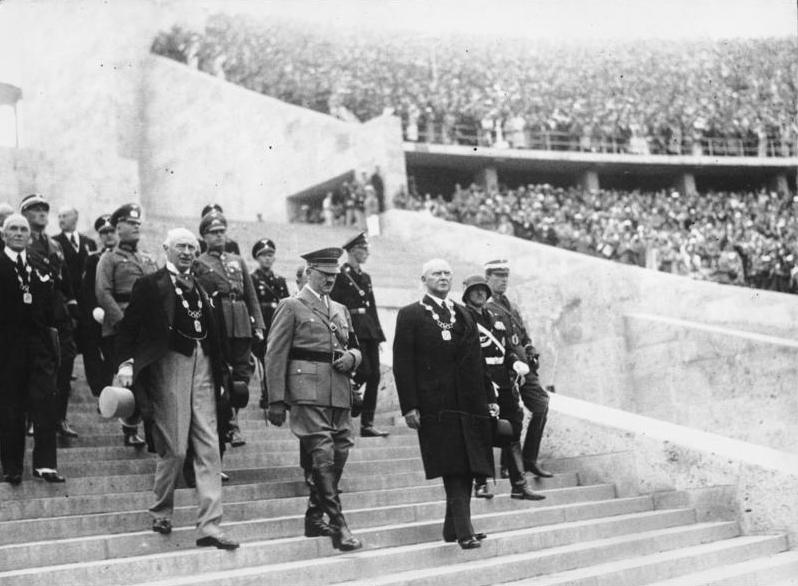
Google translation of the original German caption: “Before the ceremonial opening of the XI Olympic Games. Together with the members of the International and National Olympic Committee, the Führer and Reich Chancellor enters the stadium through the marathon gate. On the left of Adolf Hitler [Henry] Graf Baillet-Latour, on the right His Excellency [Theodor] Lewald.”
German Federal Archives (Accession number Bild 183-G00372) via Wikimedia Commons.

In July 2016, as we were sitting on the fantail of the Swiss sidewheeler Rhone while she chugged across Lake Geneva, my host pointed out the city of Lausanne, where a massive, glass-bedecked curvilinear building was shimmering in the summer sun. “Isn’t that the headquarters of the International Olympic Committee?” I asked. When my friend replied in the affirmative, I said, “I thought I smelled it.”

That rank odor — the stench of greed overpowering the solidarity the Olympics claim to represent — has intensified recently.

Even the casual student of modern Olympic history knows about the August 1936 Berlin Games, at which America’s Jesse Owens, a black man, took four gold medals and trashed Hitler’s Aryan supremacy myth. Fewer may be aware that, in February that year, the Olympic Winter Games were held in the Bavarian town of Garmisch-Partenkirchen. How, we ask today, could two Olympics be held in the Third Reich? How could people not know?

There was some controversy about holding the summer and winter Olympics under Nazi auspices. But in 1936, the German situation was not as comprehensively ghastly as it would become in later years. Yes, the Dachau concentration camp for political prisoners had opened in March 1933, and the Nuremberg Laws banning Jews from German citizenship and prohibiting marriage between Jews and “Aryans” had been enacted in 1935. The horrors of the Kristallnacht pogrom in November 1938 were two years in the future, however, and the satanic Wannsee Conference to plan the “Final Solution” to the “Jewish Question” would come six years later. Clear-minded people ought to have discerned some of the implications of the Nuremberg Laws. But the industrialized mass slaughter of millions, simply because they were children of Abraham, was beyond the imagination of virtually everyone.

So Hitler and his thugs temporarily behaved themselves (sort of) in the run-up to the Garmisch-Partenkirchen and Berlin Olympics. And the International Olympic Committee could salve whatever conscience it had in those days and proceed with the games.

The IOC has no excuses today, two months before the XXIV Olympic Winter Games open in Beijing. Because today, everyone knows.

August 13, 2021

Millennial maternalism

Filed under: Media, Politics, Technology — Tags: , , , , , — Nicholas @ 03:00

In The Critic, Kittie Helmick considers the Millennial generation and their pronounced maternalistic worldview:

“Millennials” by EpicTop10.com is licensed under CC BY 2.0

The popular conception of millennials paints the generation as immature, living an extended adolescence: late to marry, late to have children, late to buy houses. Even the retort — that society hasn’t delivered on its promises; that an unfavourable job market has prevented them from living the lives expected of adults — reads as a refusal to accept responsibility.

The response to Simone Biles’s withdrawal from the Olympics demonstrates that the opposite is true. Millennials are not behaving like teenagers — they are responding like mothers. The breakdown in family life combined with quantum leaps in telecommunication technology has sent the 90s generation to their computer screens for meaningful connections. Instead of growing out of video games and chat rooms, millennials have grown with them. Online communities have not stunted young people’s growth, but absorbed it.

Millennials — now aged in their late 20s and early 30s, some with families of their own — have directed all the maternal instincts of adulthood towards online media. Rather than collect family albums, they amass Instagram and Tumblr accounts with thousands of images of their favourite characters and celebrities. Notifications act as little appeals for attention akin to the tug of a child’s hand. This otherwise unrealised yearning to nurture underpins much of the affective response to news stories about the latest victim of injustice.

There are many strands entangled in the knot of American leftism, but the maternalism of millennials manifests in the self-righteous defensiveness of Biles’s supporters and the emotional outrage they direct at anyone who criticizes the gymnast. Stripped of patriotic sentiments and religious traditions, millennials have nowhere to direct their human instincts of loyalty and affection but at the figures (fictional or fabled) who occupy so many of their hours.

The language of critical theory cloaks these sentiments in intellectual rigor, lending some dignity not only to the mouthpieces of these ideas, but also to the intended objects of their affections. Millennials don’t have to worry about infantilising Biles if they call her an “exceptional Black woman”, even while they simultaneously invoke the moral standards of a kindergarten classroom in asking, “How do we make it our responsibility to love and protect each other?”

Witness these impulses play out in the more thinly veiled account of a father who wonders if he has turned “soft” because his parental cares now eclipse his admiration of Kerri Strug’s feat during the 1996 Olympics: performing a “one-legged vault” on an injured ankle. The father implies that only a monster could cheer when a teenage girl sacrifices her health for victory. He makes no secret of the reason behind his change of heart: “Now that I have two young daughters in gymnastics, I expect their safety to be the coach’s number one priority.”

There is nothing amiss in his love for his daughters, or the extension of that concern to other children, but this father has lost sight of other principles that might compete for priority in the spotlit, split second decisions of athletes and trainers in Olympic competitions. Loyalty to something greater than oneself — to Strug’s teammates, to the country she represented — has fallen out of the picture, leaving behind only the petty incentive of winning. This perspective permits no higher motive to the coach responsible for urging Strug on, than greed for a gold medal.

Millennial parents run to the opposite extreme of the Spartan mother: instead of inculcating self-sacrifice for the good of the community, they insist, “Not my child.” They see their role as shielding children from the dangers of the outside world, rather than preparing them to face it.

April 12, 2021

Tom Longboat: The “Bronze Streak to a Wildfire”

Filed under: Cancon, History, Military, Sports, WW1 — Tags: , , , — Nicholas @ 02:00

The History Guy: History Deserves to Be Remembered
Published 6 May 2019

Tom Longboat has been called Canada’s first professional athlete. But amid his setting records and gaining accolades, he served his country in the Great War and fought discrimination. His life is history that deserves to be remembered.

This is original content based on research by The History Guy. Images in the Public Domain are carefully selected and provide illustration. As images of actual events are sometimes not available, images of similar objects and events are used for illustration.

All events are portrayed in historical context and for educational purposes. No images or content are primarily intended to shock and disgust. Those who do not learn from history are doomed to repeat it. Non censuram.

Patreon: https://www.patreon.com/TheHistoryGuy

The History Guy: History Deserves to Be Remembered is the place to find short snippets of forgotten history from five to fifteen minutes long. If you like history too, this is the channel for you.

Awesome The History Guy merchandise is available at:
teespring.com/stores/the-history-guy

Script by HCW

#wwi #thehistoryguy #canada

October 9, 2020

Olympic-style fencing: a YouTuber versus a professional – you won’t be shocked by what happened next

Filed under: Americas, Sports — Tags: , , , , — Nicholas @ 02:00

Lindybeige
Published 2 Jul 2020

You see me here take on the top fencer in Guatemala in his gym. We are using epees, and one of us is using skill while the other shows what can be achieved with controlled panic.

Some may note it odd that at no point do I used my far-famed long and supple legs for a lunge. As I explain near the end, I had food poisoning, and had spent a large part of that day on the loo. A lunge executed with gusto would have been unwise.

Support me on Patreon: https://www.patreon.com/Lindybeige

Many thanks to Inguat (the Guatemalan tourist board) for inviting me over.

Some links to Guatemalan websites:
https://visitguatemala.com
https://www.nomadawaycorp.com/adventure
http://mayatrek.visitguatemala.com/ab…

Cameraman: Jeremy Lawrence (https://www.futtfuttfutt.com)

Buy the music – the music played at the end of my videos is now available here: https://lindybeige.bandcamp.com/track…

Buy tat (merch):
https://outloudmerch.com/collections/lindybeige

Lindybeige: a channel of archaeology, ancient and medieval warfare, rants, swing dance, travelogues, evolution, and whatever else occurs to me to make.

▼ Follow me…

Twitter: https://twitter.com/Lindybeige I may have some drivel to contribute to the Twittersphere, plus you get notice of uploads.

My website:
http://www.LloydianAspects.co.uk

January 31, 2020

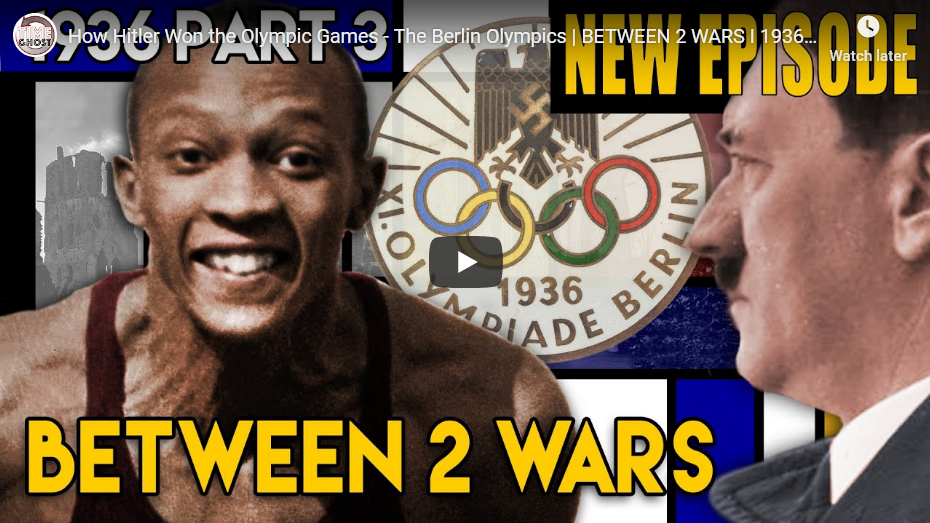
How Hitler Won the Olympic Games – The Berlin Olympics | BETWEEN 2 WARS I 1936 Part 3 of 3

Filed under: Germany, History, Sports — Tags: , , , , — Nicholas @ 06:00

TimeGhost History
Published 30 Jan 2020

The Berlin Olympics in 1936 were a masterfully played piece of Nazi propaganda, where they framed their race as physically superior and their ideology as modern, organised and cultured while also ostensibly downplaying their anti-internationalism racism and anti-semitism. But the Germans didn’t embrace sports for friendly competition. They did so for something very different.

Join us on Patreon: https://www.patreon.com/TimeGhostHistory

Hosted by: Indy Neidell
Written by: Joram Appel
Directed by: Spartacus Olsson and Astrid Deinhard
Executive Producers: Bodo Rittenauer, Astrid Deinhard, Indy Neidell, Spartacus Olsson
Creative Producer: Joram Appel
Post-Production Director: Wieke Kapteijns
Research by: Joram Appel
Edited by: Daniel Weiss
Sound design: Marek Kaminski

Sources:
Bundesarchiv_Bild:
183-G00372, 102-08105, 145_Bild-P017100, 183-R96374, 146-
1998-020-00A, 146-1976-033, 183-G00978, 183-1992-0421-500,
146-2005-0017, 183-G00352, 146-1976-116-08A, 146-1988-106-
29, 146II-728, 8076_Bild-0008
Modern Olympic Photos:
Photo from illang https://www.flickr.com/photos/ilan_sr…,
Photo by Agência Brasil http://agenciabrasil.ebc.com.br/rio-2…

Colorizations by:
Daniel Weiss
Norman Stewart
Joram Appel

Soundtracks from Epidemic Sound:
– “First Responders” – Skrya
– “The Inspector 4” – Johannes Bornlöf
– “Heroes On Horses” – Gunnar Johnsén
– “Split Decision” – Rannar Sillard
– “Not Safe Yet” – Gunnar Johnsen
– “Thunder Storm 01” – Fredrik Ekstrom
– “Dawn Of Civilization” – Jo Wandrini (1)
– “March Of The Brave 4” – Rannar Sillard
– “Magnificent March 3” – Johannes Bornlöf
– “Imperious” – Bonnie Grace
– “The Charleston 3” – Håkan Eriksson

A TimeGhost chronological documentary produced by OnLion Entertainment GmbH.

From the comments:

TimeGhost History
2 days ago (edited)
The 1936 Berlin Summer Olympics and Garmisch-Partenkirchen Winter Olympics were the first true modern Olympic games. Many of the now staples of the Olympic games were introduced for the first time by the Nazis. But magnificent as they might have been, the intent of the Germans was not really to advance the vision of the internationalist and pacifist goals of the Olympic games. And while we do realise that many of the characteristics of the 1936 Olympics – how it was used to push a certain national image or to strengthen nationalism, could be said of more recent editions of the Olympics as well. And while sports and international institutions are still today being used to push alternate agendas, we’d rather not discuss them in the comment section here as this is a history channel – not a current affairs channel.
Cheers, Joram

November 26, 2019

“Women’s sports are dying, and very quickly”

Filed under: Australia, History, Sports — Tags: , , , — Nicholas @ 03:00

Mark Steyn outlines the rise and sudden fall of women’s sports:

Rachel McKinnon on the podium after winning the Union Cycliste Internationale Masters Track Cycling World Championship, October 2018.

When the Olympic Games was revived in 1896, it was assumed by all that, as in the ancient games of Greece, the competitors would be men. The inclusion of women, said Baron de Coubertin, founder of the modern Olympiad, would be “impractical, uninteresting, unaesthetic and incorrect”.

By “uninteresting”, he meant that the innate differences between the male and female bodies ensured that women’s participation would require one to feign interest in races that were slower and jumps that were shorter. In a competitive celebration of excellence, what’s the point? So the first female Olympians were women who could hold their own with men and compete in the chaps’ events — such as Hélène de Pourtalès, who won a gold medal at the 1900 Paris Olympics as part of the Swiss sailing crew. A week later Mesdames Guerra and Moulin competed, unsuccessfully, in the hacks and hunter rounds of the equestrian events. In the croquet competition, seven men and three women participated, with the men taking all the medals.

And then came the tennis, for which they introduced a ladies’ singles event, at which Miss Charlotte Cooper (a five-times Wimbledon champ) prevailed.

These were the two models for female sportsmen, if you’ll forgive the expression: Compete in mixed events and spend most of your life losing to blokes, or compete only against other women where the lesser achievements are, as M le Baron saw it, “uninteresting”. In the case of certain activities, male sports felt obliged to spin off more genteel and (in Coubertin terms) even less interesting female variants — softball and netball, rather than baseball and basketball.

In the second half of the twentieth century, the latter model — female-only sports — prevailed, as part of what was understood by the general trend of “women’s rights”, loosely defined, and indeed more explicitly so by things like America’s Title Nine legislation.

In the second decade of the twenty-first century, the Charlotte Cooper model is collapsing, very fast. Women are back to losing to rivals who, whatever their lipstick, skirts or breast implants, are biologically male with all the inherent advantages. Miss Hannah Mouncey, for example, is six-foot-two and 220 pounds, which is rather heavier than me and an inch taller. The average Australian woman is five-foot-four-and-a-quarter and just under 157 pounds. If you have to catch a ball, standing six inches above anybody else on court comes in helpful:

Did Miss Mouncey procure her advantages over her sisters through a rigorous workout regime? No. She gained them by being born male. She played for Oz’s national men’s handball team until 2016, when she revealed she was transitioning and thus would henceforth play for the women’s team. She also announced she was taking up Aussie football, again for the ladies.

August 27, 2017

Stop Subsidizing Sports!

Filed under: Economics, Education, Government, Sports, USA — Tags: , , , — Nicholas @ 04:00

Published on 25 Aug 2017

Let’s talk about “sports”—that thing where we gather around to watch a muscular stranger put a regulation-size ball in a specific location.

Why are taxpayers forced to pony up cash for athletic ventures that don’t benefit them? Franchise owners routinely extort massive stadium subsidies through threats of relocation and fake promises of economic revitalization. Universities jack up student rates to subsidize athletic programs that should be self-sustaining. And the Olympics is economically devastating to every municipality foolish enough to get suckered by one of the oldest scams around.

Mostly Weekly host Andrew Heaton explores the sports phenomenon and why we should quit throwing other people’s money at it.

Links, past episodes, and more at https://reason.com/reasontv/2017/08/25/stop-subsidizing-sports

Script by Sarah Siskind with writing assistant from Andrew Heaton and David Fried.
Edited by Austin Bragg and Siskind.
Produced by Meredith and Austin Bragg.
Theme Song: Frozen by Surfer Blood.

August 7, 2017

Dutee Chand and the international sporting dilemma

Filed under: India, Sports — Tags: , , , — Nicholas @ 05:00

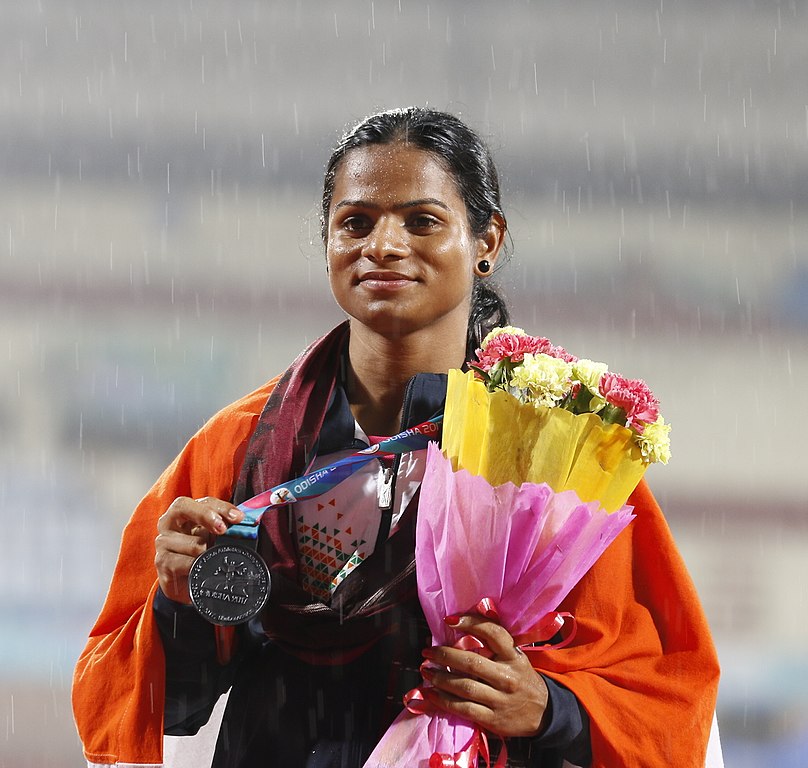
Dutee Chand is a woman who competes for India in track and field events. Dutee Chand has elevated levels of testosterone in her body … this creates a problem for those who determine who is allowed to compete as a woman in international sporting events:

Dutee Chand won the bronze medal in 22nd Asian Athletics Championships in Bhubaneswar, 8 July 2017. (via Wikimedia)

For the past two years, Dutee Chand could be herself.

She could run and train and even compete in the Rio Olympics. She didn’t have to constantly remind people that, yes, of course, she is a woman and that, yes, of course, she qualifies to compete with other women despite her naturally high level of testosterone.

She didn’t have to feel pressure to change her body so it conformed to rules or contemplate quitting her sport — pressure placed on her after doctors subjected her to gender testing in 2013, humiliating her by doing so, when she was only 17.

For two years, she could just be Dutee Chand. That’s because, two years ago last month, the Court of Arbitration for Sport, which is the supreme court for global sports, temporarily suspended an international track and field rule that had barred her from competing as a woman.

Chand, a sprinter from India, and women like her were excluded because their bodies produced a high amount of testosterone. It was often so high it was classified as being within the male range, a situation the authorities considered an unfair advantage. The only way these women could compete, track and field officials ruled, was if they took hormone-suppressing drugs or had surgery to limit the amount of testosterone their bodies produced.

The problem for international sporting bodies is that they’re still stuck in the binary — only two genders — model of competition, which leaves them unable to cope with situations like this. They can either prevent athletes like Dutee Chand from competing against other women or accept that the old standards no longer apply. Pushed to the limit, this means there can no longer be any kind of binary division of sporting activities into the old “male” and “female” categories … which will, in all likelihood, be devastating to women hoping to compete internationally, nationally, or even regionally. There’s no easy answer, and any Solomonic decision is going to make the situation worse, not better.

At its core, the sports world — rigidly separating men and women — will perpetually struggle to adapt to increasingly nuanced gender distinctions. In June, the District of Columbia became the first jurisdiction in the United States to offer an “X” gender, signifying a neutral gender, on its driver’s licenses. In March, a transgender New Zealand woman crushed her competition in her first international weight-lifting meet, and a transgender boy won a Texas state championship in girls’ wrestling.

Not every governing body is equipped to rule on these kind of eligibility questions. Not every athlete fits into this box, or that one.

To Chand, though, the issue of hyperandrogenism in sports is clear cut. She grew up as a girl. At 21, she is a proud young woman. She wants to race as one.

On Saturday, she did. But in the coming months, the Court of Arbitration for Sport will decide whether letting her continue to do so is fair.

What if it gets it wrong?

November 13, 2016

Olympic Games 1916 – Reaction To Tanks – Barbed Wire I OUT OF THE TRENCHES

Filed under: Europe, History, Military, WW1 — Tags: , , , — Nicholas @ 03:00

Published on 12 Nov 2016

It’s time for another exciting episode of Out Of The Trenches. This week we talk about the Olympic Games 1916, how the Germans reacted to the first tanks and about barbed wire.

August 30, 2016

QotD: The proper reaction to an Olympic bid for your city

Filed under: Humour, Quotations, Sports — Tags: — Nicholas @ 01:00

Local boosters frequently argue that the Olympics will produce a wave — a veritable tsunami — of economic benefits. The reality, as the Economist says, is that “prudent city governments should avoid the contests at all costs.” This does not really capture it. Prudent city governments should run screaming from any proposals to host the Olympics, and napalm the spot where the proposals were found, just to be safe.

Megan McArdle, “The Olympics Don’t Have to Be a Disaster”, Bloomberg News, 2016-08-10.

August 23, 2016

Hey, EU! Two can play this silly medal total game!

Filed under: Europe, Media, Sports — Tags: , , , , — Nicholas @ 03:00

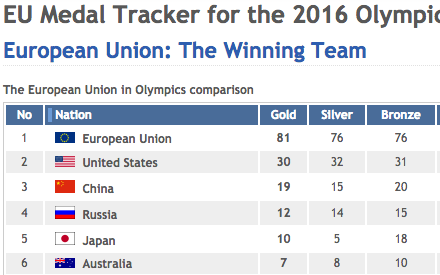
If you’re on Twitter or Facebook, I’m sure you’ve seen at least one variant of this bit of EU self-puffery going around:

EU fake 2016 Olympic medal ranking

As Guido Fawkes points out, under those rules the British Empire completely eclipses the medal total of all the EU states:

The former countries of the British Empire won 396 medals – 138 more medals than a post-Brexit EU. While the European Parliament invents an EU state to “win” the Olympics, the medal tally of a one-time actual supra-state leaves Brussels for dust. Former member countries of the British Empire accrued 76 more medals than the rest of the world (24%). In all, the Empire’s score of 137 gold medals trounces the EU’s, which after removing Great Britain sits at just 79.

Looking at other alliances NATO countries took a stunning 443 out of the 974 medals on offer (45%), while Anglosphere countries grabbed a whopping 288 – 30% of the world total. This is compared to Francophone states’ measly 87 (9%), even with Canada’s 22 (2%) generously included. Hoisting the colours appears to have been good luck; countries with Union Jacks in their flags took a massive 115 medals, of which 40 were gold!

July 26, 2016

The “international sporting event” in “a major city in Brazil”

Filed under: Americas, Law, Media, Sports — Tags: , , , , — Nicholas @ 03:00

Every four years, the world’s media turn en masse to a new location for the summer Olympic Games. This time around the games event is in Rio de Janeiro a major city in Brazil. I’d give more details, but the IOC is determined to reserve as much of that information to themselves and their official sponsoring media partners:

As the Olympic Games approach, the tension between athletes and non-sponsors with the United States Olympic Committee and the International Olympic Committee has ratcheted up once again.

In recent weeks, the United States Olympic Committee sent letters to those who sponsor athletes but don’t have any sponsorship designation with the USOC or International Olympic Committee, warning them about stealing intellectual property.

“Commercial entities may not post about the Trials or Games on their corporate social media accounts,” reads the letter written by USOC chief marketing officer Lisa Baird. “This restriction includes the use of USOC’s trademarks in hashtags such as #Rio2016 or #TeamUSA.”

The USOC owns the trademarks to “Olympic,” “Olympian” and “Go For The Gold,” among many other words and phrases.

The letter further stipulates that a company whose primary mission is not media-related cannot reference any Olympic results, cannot share or repost anything from the official Olympic account and cannot use any pictures taken at the Olympics.

This isn’t really a new or surprising thing, as we had warnings about any discussion of the “‘international sporting event’ in ‘the capital of the United Kingdom'” back in 2012. More recently, Toronto’s Pan Am Games organizers did the same sort of trademarks-out-the-wazoo-and-lawyers-on-speed-dial stuff over their 2015 international sporting event in ‘a large city in Ontario’.

If nothing else, it gives me an excuse to not blog anything about those every-four-years international corruption championships…

November 19, 2014

Corruption in the sport of … Badminton?

Filed under: Asia, Sports — Tags: , , , — Nicholas @ 00:02

Vice‘s Brian Blickenstaff smashes Badminton as “the world’s most corrupt sport”:

Late last week, it emerged that Lee Chong Wei, the world’s top badminton player, failed a drug test. A niche sport in the United States, badminton has been part of the Olympics since 1992 and enjoys huge popularity in Asia. Lee is the sport’s Novak Djokovic, a truly dominant force over the past several years. He’s the best player Malaysia, one of the world’s most badminton-mad countries, has ever produced. A two-time Olympic silver-medal winner, Lee is, or was, a favorite for gold in Rio de Janeiro; he faces a two year ban and could miss the Olympics entirely.

But Lee’s drug test isn’t notable simply because sports fans can’t look away when a giant teeters and falls; it’s notable because the incident is one of many scandals to hit badminton over the past year. On current form, badminton might be the world’s most corrupt sport.

In June, during the Japan Open, two Danish players were approached and offered north of 2,500 Euros to fix matches. The alleged fixer was Malaysian. The two players, Kim Astrup Sorenson and Hans Kristian Vittinghus, both reported the incident to authorities. 2,500 Euros might not be a lot of money, but the implications are huge. Vittinghus is the world’s 10th ranked singles player. If people are trying to flip a top-ten athlete, what’s happening lower down the pyramid?

I can attest that I’ve never been offered a bribe to throw a badminton game. Perhaps that’s because I’m not good enough to convincingly throw a game … unlike the Chinese Olympic players in 2012. Oh, wait … they weren’t convincing either.

February 17, 2014

The dirty not-so-secret about Olympic venues

Filed under: Sports — Tags: , , , , — Nicholas @ 10:44

Every time somebody suggests that Toronto be seriously involved in an Olympic bid, I become a big supporter of the other competing cities. Toronto is dysfunctional enough without adding the cost, disruption, and anti-democratic central planning aspects of hosting the Olympic games. In Samizdata, Michael Jennings looks at the shenanigans going on both in Sochi with the current Winter Games and in future venues:

The 2018 Winter Olympics are in Pyeongchang county in South Korea. Assuming that North Korea does not collapse or try to start a war between now and then, this will be straightforward, as these things go. A vast amount of money has been spent building new world class ski resorts at Alpensia and Yongpyong. These have largely been built already. They were built in anticipation of Pyeongchang winning the Winter Olympics. Pyeongchang also made unsuccessful bids for the games of 2006 and 2010, and has therefore been building for some time. There are already large financial black holes from the construction of these venues, but one cost overruns will be anywhere near as bad as have come from the highly corrupt race to get things built on time that took place prior to Sochi. Plus there have been and will be time for lots of test events to get the venues right. Of course, there are still highly expensive new highways and railways to be built, and a lot of indoor venues to be built for the ice events in the coastal city of Gangneung. As national pride is at stake, South Korean taxpayers will undoubtedly suffer painfully, but South Korea is a rich industrial democracy with competent people in charge. These games will likely go smoothly, but they will cost a lot — just not as much as Sochi.

The venue for the 2022 Winter Olympics has not yet been decided, but the IOC announced last year there were six final bidders: Stockholm (Åre), Sweden; Oslo, Norway; Krakow, Poland (Zakopane, Poland and Jasná, Slovakia); Almaty, Kazakhstan; Lviv, Ukraine; and Beijing (Zhangjiakou), China. [It has always been the case that the indoor ice events would be held in a city and the outdoor snow events in a mountain resort. In recent times the need for the city to be close to the resort has been relaxed somewhat, and I have listed the mountain resort(s) in brackets if it is a long way away from the official host city].

Sweden has already withdrawn their bid, and Norway appears to be close to doing so. The reason: they are seeing the immense expense and horrible shenanigans going on in Sochi. A little secret of the Olympics is that many of the the same people run it every time — the host city largely just picks up the bill. Once the event has ridiculous expenses and large amounts of outright corruption attached to it, this all comes with it to the next venue. Receiving kickbacks on construction projects becomes what it is all about.

Relatively uncorrupt places like Norway and Sweden look at this, and find that they want nothing to do with it. As great centres of winter sport, they have many of the right facilities already, meaning less scope for construction industry kickbacks. This means that for some of the IOC the fact that a country is already prepared for the Games is actually a negative rather than a positive.

Anyway, though, the point is that the two countries best able to host the games end up not being serious candidates.

As for the others: Poland and Slovakia would run the games just fine, but a fair bit of infrastructure and facilities would need to be built. Krakow is a lovely city. Zakopane is a lovely resort, and the Tata mountains are a suitable place for the games, even if the best downhill resorts are on the Slovakian side rather than the Polish side. (Some of the infrastructure construction would not be too counterproductive: Poland built lots of new roads, railways stations and airport terminals before the Euro 2012 soccer tournament, most of which were needed anyway and were part of Poland’s long term post-communist infrastructure modernisation). The Olympic games are not what money should be spent on in the present economic circumstances, though, and one also hopes that the richer countries of the EU are past paying for the Olympics to be held in the poorer countries of the EU (see Athens 2004). But with the EU, who knows?

February 13, 2014

Time to change the name of the Winter Olympics back to the “Nordic Games” they started as

Filed under: Russia, Sports — Tags: — Nicholas @ 14:13

Mick Hume isn’t a big fan of the Winter Olympics, and suggests that they revert back to their original name:

The six nations to have won medals at every winter games are, unsurprisingly, Austria, Canada, Finland, Norway, Sweden and the US. (Of the other snowy powers, Germany might be on the list but was banned from competing immediately after the Second World War; the Soviet Union did not enter until the 1956 winter games, where it won more medals than any other state.)

This snow-job badly skews the assessment of sporting prowess. Thus Jamaica, the undisputed king of world sprinting, remains a Cool Runnings joke at Sochi. Africa, the new powerhouse of global athletics, is barely there; an American-based student has just become the first Winter Olympics entrant from Zimbabwe, where it has not snowed since before he was born.

Before the International Olympic Committee decided to claim winter sports for itself, the major festival of sporting events on snow and ice, also held every four years, was called the Nordic Games. That might still seem a more fitting name for it today.

There’s also the quite fair comment that unlike the original Olympic events, too many of the Winter events are, for lack of a better word, effete sports for rich folks:

The Winter Olympics have little such universal appeal. Most events are arcane, technical affairs of which we know little and understand less, the commentators talking a foreign language – hog line, backside rodeo, bossing that melon – even when apparently speaking English. The competitors often seem a self-defined cliquish elite not only in the best sporting sense, but also in not-so-admirable cultural terms. Whatever they might think, however, to be the quickest of a closed shop of posh blokes swanning about the slopes in garish Euro-trash garb is hardly on a par with Usain Bolt’s Olympic title of the Fastest Man on Earth.

No doubt the accusation of dull, sectional, technical cliquishness could also be levelled at a good few fringe events in the summer games, from sailing to dressage – but then they shouldn’t be Olympic sports, either.

Many of these events look more like ‘games’ in the childish sense than world-class sport. For instance, speeding down an icy slope on a tea tray, either head-first (‘skeleton’) or feet-first (‘luge’), would be many a reckless youth’s idea of fun. Several of the new events introduced at Sochi have made matters worse, giving out Olympic gold medals for messing around doing smartarse tricks in the snow. The reaction to Jenny Jones winning the UK’s first-ever medal on snow in one such event, the ‘slopestyle’, rather captured the puerile atmosphere, with all three BBC commentators squealing like Blue Peter presenters on speed (‘This feels like I’ve got slugs in my knickers!’) before all bursting into tears when Jones got bronze. As Britain’s top TV columnist Ally Ross observed in the Sun, ‘Snowboarding is, and always will be, just young people twatting about’.

However, this suggestion would eliminate one of the all-time evergreen sporting jokes “… and 4.2 from the Russian judge”:

As for the events decided by judges’ marks, there is a good case for arguing that no such subjective carry-on should ever be considered as a serious sporting contest. Even one of the greatest sports, boxing, can be demeaned by the idiosyncrasies and idiocies of judges. Sporting tragedy becomes farce when judges award Olympic medals for dancing on ice or doing tricks in the snow, almost reducing the ‘greatest show on earth’ to the level of reality TV (‘Strictly Come Sochi?’). Britain may still go on about Torvill and Dean’s gold as ‘our’ finest Winter Olympic hour, but if ice dancing is a real Olympic sport it is hard to argue with those who want the ballroom version included in the summer games.

Personally, I haven’t watched any of the Olympic coverage this time around. Elizabeth’s god-daughter played hockey for Canada in three previous Olympic games, but she retired from competition last year … so there’s not the same level of personal interest now.

« Newer PostsOlder Posts »

Powered by WordPress