
Little moments like that kept adding up, incrementally nudging me away from leftism but not yet to full conversion. In 1988, watching a John Pilger documentary with lefty friends, another such moment occurred.
Pilger, as usual, was complaining about colonialism and racism and Aboriginal injustice, so naturally we — uniformly white, urban and privileged — were lapping it up. The documentary then shifted to the former nuclear testing site at Maralinga in South Australia, where seven British bombs were detonated in the 1950s and 1960s. Pointing to a sign warning of radiation danger, Pilger observed mournfully that it was written in several languages — “but not in the Aboriginal language”.
Startled by this claim, I looked around the room. Everyone was silent, including a few who had studied Aboriginal history in considerable depth, and so must have known that Pilger’s line was completely wrong. So I just said it: “There is no single Aboriginal language. And no Aboriginal language has a written form.”
I didn’t last long with that bunch of friends, either. Small note to self: my comrades will deny even their own knowledge if it runs counter to a preferred leftist version of events.
Tim Blair, “The Setting of Their Leftist Suns”, Quadrant, 2017-06-17.
July 23, 2017
QotD: Australian aboriginal languages
June 15, 2017
QotD: The Budapest Effect
A group of Manhattan Project physicists created a tongue-in-cheek mythology where superintelligent Martian scouts landed in Budapest in the late 19th century and stayed for about a generation, after which they decided the planet was unsuitable for their needs and disappeared. The only clue to their existence were the children they had with local women.
The joke was that this explained why the Manhattan Project was led by a group of Hungarian supergeniuses, all born in Budapest between 1890 and 1920. These included Manhattan Project founder Leo Szilard, H-bomb creator Edward Teller, Nobel-Prize-winning quantum physicist Eugene Wigner, and legendary polymath John von Neumann, namesake of the List Of Things Named After John Von Neumann.
The coincidences actually pile up beyond this. Von Neumann, Wigner, and possibly Teller all went to the same central Budapest high school at about the same time, leading a friend to joke about the atomic bomb being basically a Hungarian high school science fair project.
But maybe we shouldn’t be joking about this so much. Suppose we learned that Beethoven, Mozart, and Bach all had the same childhood piano tutor. It sounds less like “ha ha, what a funny coincidence” and more like “wait, who was this guy, and how quickly can we make everyone else start doing what he did?”
In this case, the guy was Laszlo Ratz, legendary Budapest high school math teacher. I didn’t even know people told legends about high school math teachers, but apparently they do, and this guy features in a lot of them. There is apparently a Laszlo Ratz Memorial Congress for high school math teachers each year, and a Laszlo Ratz medal for services to the profession. There are plaques and statues to this guy. It’s pretty impressive.
A while ago I looked into the literature on teachers and concluded that they didn’t have much effect overall. Similarly, Freddie deBoer writes that most claims that certain schools or programs have transformative effects on their students are the result of selection bias.
On the other hand, we have a Hungarian academy producing like half the brainpower behind 20th century physics, and Nobel laureates who literally keep a picture of their high school math teacher on the wall of their office to inspire them. Perhaps even if teachers don’t explain much of the existing variability, there are heights of teacherdom so rare that they don’t show up in the statistics, but still exist to be aspired to?
Scott Alexander, “The Atomic Bomb Considered as Hungarian High School Science Fair Project”, Slate Star Codex, 2016-05-26.
June 9, 2017
QotD: The post-war world and (relative) peace
Between 1945 and about 1965, atom bombs and then hydrogen bombs were devised and demonstrated by the two biggest Great Powers, and then manufactured and attached to rockets in sufficient numbers to cause any all-out war between these two superpowers very probably to be a catastrophic defeat for both, to say nothing of being a similar catastrophe for all other humans, within a few hours. This new kind of destructive power also spread to a small club of lesser Great Powers.
This did not happen overnight. It didn’t all come about in 1945. But it happened pretty quickly, historically in the blink of an eye. It changed the world from a place in which Great Wars between Great Powers had to be prepared for, at all costs, to a place in which Great Wars between Great Powers had to be avoided, again, at all costs. That is a very big change.
I do not assert that all wars have ended. Clearly they have not, as one glance through a newspaper or news website will tell you. Small powers still have small wars, and Great Powers regularly join in, in small ways. Sometimes, Great Powers start small wars, like the one in the Ukraine now. But even these small wars have been getting less numerous and smaller in recent decades. Small wars can get big, so even small wars are now discouraged by Great Powers.
Nor do I assert that all preparations for war by Great Powers have ceased, or that they should. But more than ever, the purpose of such preparations is to enable mere confrontations to be emerged from victoriously or failing that satisfactorily, rather than for such preparations — such weapons — constantly to be “used”, in the sense of being fired, fought with, and so on. The purpose of weapons is to scare, as well as to win fights, and they are being “used” whenever anyone is scared by them. Great Powers will still spend lots of money on weaponry.
But what has not happened, for many decades now, and what still shows no sign of happening despite all kinds of diplomatic, ideological and financial turbulence, is an all-out fire-every-weapon-we-have war involving two or more Great — by which I of course mean nuclear — Powers. In this sense, countries like mine, and almost certainly yours too given that you are reading this, have become peaceful in a way that they have never experienced before in all of human history before 1945.
Brian Micklethwait, “From the Great Peace … to the ordeal of Adam Lyth at the Oval cricket ground”, Samizdata, 2015-08-20.
March 2, 2017
Possible end-game for the British nuclear deterrent
Charles Stross speculates on a few ways that Il Donalduce could trigger the end of Britain’s nuclear-armed ballistic missile submarines:
Working hypothesis #1: Donald Trump is an agent of influence of Moscow. Less alarmingly: Putin’s people have got blackmail material on the current President and this explains his willingness to pursue policies favourable to the Kremlin. Russian foreign policy is no longer ideologically dominated by communism, but focusses on narrow Russian interests as a regional hegemonic power and primary oil and gas exporter.
Clearly, it is not in Russia’s geopolitical interest to allow a small, belligerent neighbor to point strategic nuclear missiles at Moscow. But this neighbor’s nuclear capability has a single point of failure in the shape of the resupply arrangements under the 1958 UK-USA Agreement. Donald Trump has made no bones about his willingness to renegotiate existing treaties in the USA’s favor, and has indicated that he wants to modernise and expand the US strategic nuclear capability. Existing nuclear weapons modernization programs make the first goal pointless (thanks, Obama!) but he might plausibly try to withdraw British access to Trident D-5 in order to justify commissioning four new US Navy SSBNs to carry the same missiles and warheads.
(Yes, this would break the “special relationship” between the USA and the UK for good — but remember, this is Donald Trump we’re talking about: the original diplomatic bull in a china shop who decapitated the state department in his first month in office.)
Trump could present this as delivering on his promise to expand the US nuclear capability, while handing his buddy a gift-wrapped geopolitical easter egg.
Working hypothesis #2: Let us suppose that Donald Trump isn’t a Russian agent of influence. He might still withdraw, or threaten, British access to Trident as a negotiation lever in search of a better trade deal with the UK, when Theresa May or her successor comes cap-in-hand to Washington DC in the wake of Brexit. It’s a clear negative sum game for the British negotiating side — you can have a nuclear deterrent, or a slightly less unpalatable trade deal, but not both.
In this scenario, Trump wouldn’t be following any geopolitical agenda; he’d just be using the British Trident renewal program as a handy stick to beat an opponent with, because Trump doesn’t understand allies: he only understands supporters and enemies.
As for how fast the British Trident force might go away …
Missiles don’t have an indefinite shelf-life: they need regular servicing and maintenance. By abrogating the 1958 agreement, or banning Royal Navy warships from retrieving or delivering UGM-133s from the common stockpile at King’s Bay, POTUS could rely on the currently-loaded missiles becoming unreliable or unsafe to launch within a relatively short period of time — enough for trade negotiations, perhaps, but too short to design and procure even a temporary replacement. It’s unlikely that French M51 missiles could be carried aboard Dreadnought-class SSBNs without major design changes to the submarines, even if they were a politically viable replacement (which, in the wake of Brexit, they might well not be).
March 1, 2017
Yes Prime Minister – Bernard Woolley on defence capabilities
Uploaded on 20 Jul 2010
September 10, 2015
July 19, 2015
Catch the last flying Vulcan before September
As I’ve reported before, the very last of the Vulcan bombers able to take to the air will be retiring this year. Stuart Burns and Lewis Page have the details:
Visit a British air show before September and it’s possible you’ll get the opportunity to witness the last Vulcan bomber in flight — and this is definitely the last year you’ll get the chance, this time.
Alongside the staple leather-clad wing-walking ladies, the Battle of Britain Memorial Flight, simulated Apache attack-chopper scenarios and Red Arrows displays, you may find XH558 — now owned and flown by charity Vulcan to the Sky Trust, funded by charitable donations and Lottery cash.
The Vulcan holds a very special place in the hearts of many, not just for that unmistakable shape but because it functioned as a basic but wholly British nuclear deterrent early on in the Cold War.
Such was its frontline status and iconic image, the Vulcan was used by James Bond scriptwriters and given generous screen time in Thunderball (1965) — in which the V-bomber is hijacked by SPECTRE resulting in the loss of two nukes, which Commander Bond must then retrieve.
In the real world the Vulcan’s only combat action came in 1982, as part of the Falklands War. The “Black Buck” raids in which Vulcans — supported by a large fleet of aerial tankers — travelled all the way from Ascension Island to attack the Falklands held the longest-distance combat bombing record for nine years until the USAF took the top spot with B-52 raids in the 1991 Gulf War.
Standing as I did at the Cosford Airshow — one of those last displays — just few hundred yards from XH558, with its engines running at full tilt, you knew it was something special. The ground shook and your stomach throbbed as this mighty aircraft passed overhead.
To understand the reasoning behind the creation of the Vulcan you need to know the backstory about the freezing of the nuclear relationship between the UK and the US after World War II. When the bombs dropped on Nagasaki and Hiroshima, the war entered its final phase. Unfortunately, so did the nuclear relationship between the UK and the US.
The US, wanting to keep all the nuclear toys for itself, passed the McMahon Act — officially the Atomic Energy Act of 1946 — forbidding the transfer of nuclear knowledge or technology to any country, even those former allies (Britain and Canada) that helped develop the bombs which had been dropped on Japan.
June 20, 2015
If World War III had broken out in 1955
Mark Stout looks at what a global nuclear war might have looked like merely ten years after the first nuclear weapons were used to end the Second World War:
Those of us who came of age in the late Cold War imagined that if a nuclear war came it would be The End of Everything. By contrast, those who came of age after the Cold War never thought there’d be a nuclear war at all. With Putin’s military forces on the loose in Ukraine and all around Europe, the chance of war by miscalculation, even a nuclear war is rising. What would such a war look like? With the world situation vastly different from the late Cold War and with nuclear arsenals much smaller, it would probably not be a brief nuclear exchange but something more limited, albeit still horrific.
Perhaps such a war would be like one that the U.S. government imagined in 1955. In June of that year, the government conducted a massive relocation exercise called Operation Alert in cities across the country. A British Pathé newsreel tells the story in breathless shorthand. As part of the exercise, the State Department moved key personnel to an above-ground location at the foot of the Shenandoah Mountains in Front Royal, Virginia that now belongs to the Smithsonian Institution. There, according to records held at the National Archives, they practiced how they would continue to conduct the business of the department in case of World War III.
Among other documents, the Archives holds “Situation Report #1,” issued by the State Department’s intelligence arm on D+1 of the war game. It is an interesting artifact of the time. In 1955 nuclear arsenals on both sides of the Iron Curtain were much smaller than they became later and intercontinental ballistic missiles did not exist. Thus, the Soviet ability to strike the U.S. homeland was also much more limited and the “war” unfolded much more slowly than it would have even ten years later. As a result, the imaginary war of June 1955 combined attributes of World War II as well as the World War III that haunted us in the 1980s.
May 21, 2015
This year will be the last in the air for XH558, the last of the Avro Vulcan bombers
At The Register, Lester Haines explains why the trust that operates XH558 is having to ground the aircraft permanently:
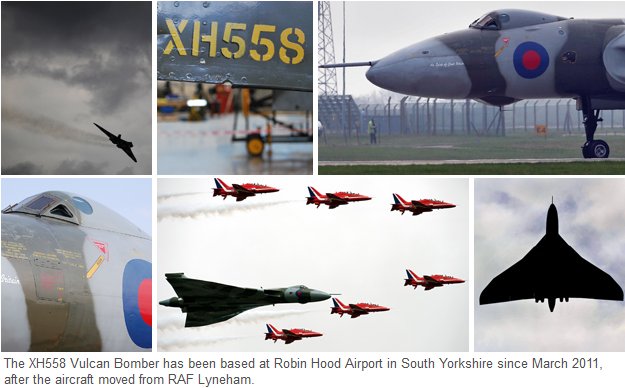
The Vulcan To The Sky Trust has announced “with considerable sadness” that this summer will be the public’s last chance to catch Avro Vulcan XH558 thundering through British skies, as the legendary V-bomber will be permanently grounded at the end of this flying season.
The trust explains that the axe will fall because “three expert companies on whom we depend – known as the ‘technical authorities’ – have together decided to cease their support at the end of this flying season”.
It elaborates:
At the heart of their decision are two factors. First, although we are all confident that XH558 is currently as safe as any aircraft flying today, her structure and systems are already more than ten percent beyond the flying hours of any other Vulcan, so knowing where to look for any possible failure is becoming more difficult. These can be thought of as the ‘unknown unknown’ issues, which can be impossible to predict with any accuracy. Second, maintaining her superb safety record requires expertise that is increasingly difficult to find.
Keeping XH558 in the air has been an epic undertaking, and not without wing-and-a-prayer moments involving last-minute injections of cash.
May 20, 2015
Scuttled Soviet submarines in the Arctic
The Soviet Union had a remarkably casual approach to disposing of nuclear-powered submarines that were no longer useful in active service:
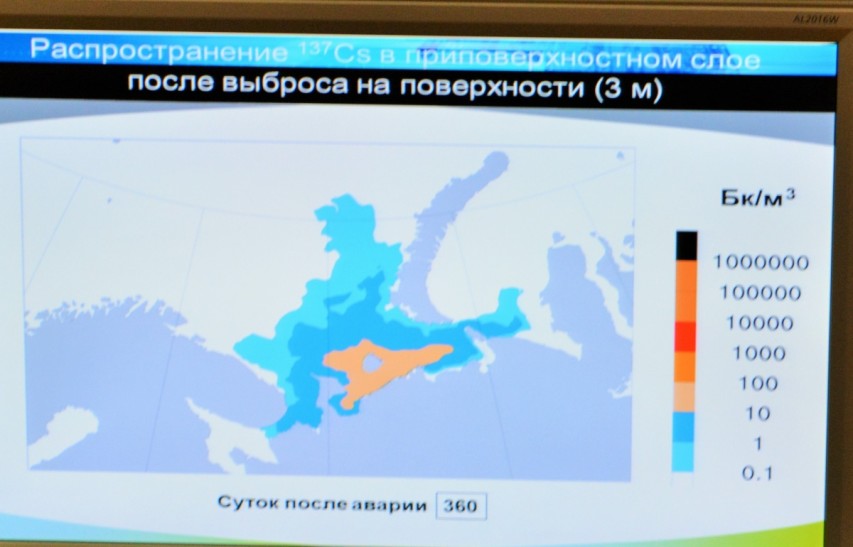
Russian scientists have made a worst-case scenario map for possible spreading of radionuclides from the wreck of the K-159 nuclear-powered submarine that sank twelve years ago in one of the best fishing areas of the Barents Sea.
Mikhail Kobrinsky with the Nuclear Safety Institute of the Russian Academy of Science says the sunken November-class submarine can’t stay at the seabed. The two reactors contain 800 kilos of spent uranium fuel.
At a recent seminar in Murmansk organized jointly by Russia’s nuclear agency Rosatom and the Norwegian environmental group Bellona, Kobrinsky presented the scenario map most fishermen in the Barents Sea would get nightmares by seeing.The map shows expected spreading of radioactive Cs-137 from potential releases from the K-159 that still lays on the seabed northeast of Murmansk in the Barents Sea.
Some areas could be sealed off for commercial fisheries for up to two years, Mikhail Kobrinsky explained.
Ocean currents would bring the radioactivity eastwards in the Barents Sea towards the inlet to the White Sea in the south and towards the Pechora Sea and Novaya Zemlya in the northeast.
April 20, 2015
Twice-nuked aircraft carrier sunk 80 km from San Francisco
If you’d ever wondered what happened to the ships that were used in the Bikini Atoll nuclear tests, here’s one that might surprise you:
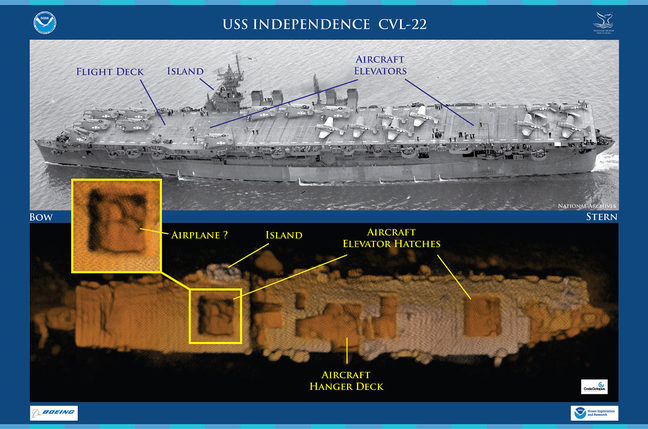
The sonar image with oranges color tones (lower) shows an outline of a possible airplane in the forward aircraft elevator hatch opening. Credit: NOAA, Boeing, and Coda Octopus
The Independence (CVL-22) was commissioned as cruiser, but adapted to become a light carrier as the demands of the Pacific war made mobile air power desirable. The ship served in the Pacific from November 1943 to August 1945, but by 1946 was deemed fit for duty as a test vessel at an atomic bomb test near Bikini Atoll. Independence was stationed less than half a mile from ground zero on a July 1st test, survived that ordeal without sinking so was nuked again on the 25th.
The US Navy then brought the vessel back to San Francisco to assess the damage, and to try nuclear decontamination techniques. By 1951 Independence was felt to be at risk of sinking, so with a colossal radioactive carcass not the sort of thing one wants near a major city it was sunk.
And so the Independence passed into history, its fate largely forgotten … until the NOAA decided to embark on a mission to “to locate, map and study historic shipwrecks in Gulf of the Farallones National Marine Sanctuary and nearby waters.” As part of that effort, Independence was found “in 2,600 feet of water off California’s Farallon Islands”, which one can find here, at what looks to be a distance of about 80kms from San Francisco.
February 18, 2015
A tour of the French ballistic missile submarine Le Redoutable
Gerard Vanderleun posted a link to this set of photos of the retired French submarine Le Redoutable:
Fascinating and worthwhile for the blend of megadeath and French lifestyles: A tour of the ballistic missile submarine Redoutable (photos) the largest submarine you can tour without security clearance, and one of the only ballistic missile subs fully accessible to the general public. The French nuclear submarine Redoutable spent the ’70s and ’80s at sea and was home to 135 sailors for months at a time. The missile boat-turned-museum resides in the French seaside town of Cherbourg after extensive refurbishment.
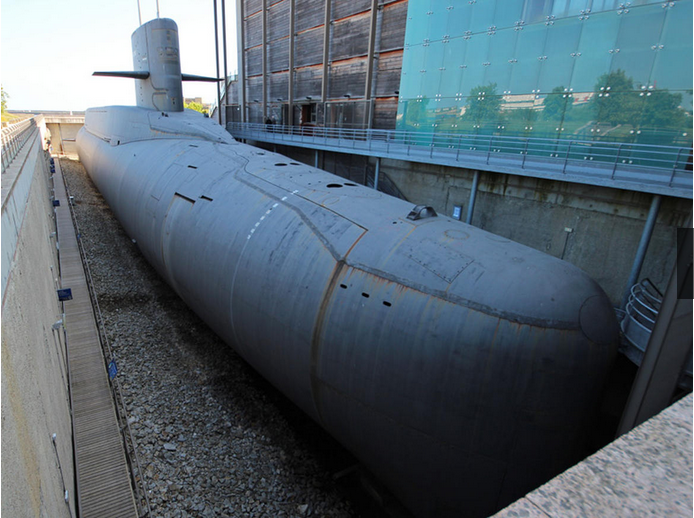
It’s pretty much impossible to get a full shot of the sub, given where it rests. Let’s just say, it’s big.
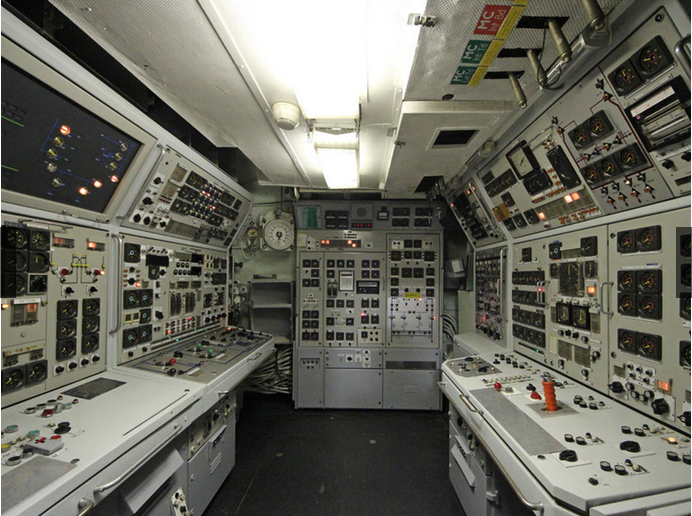
Man, this looks like a nuclear power station control room.
Oh, wait, it is. Along with all the other moving and dangerous parts of the “drivetrain.”
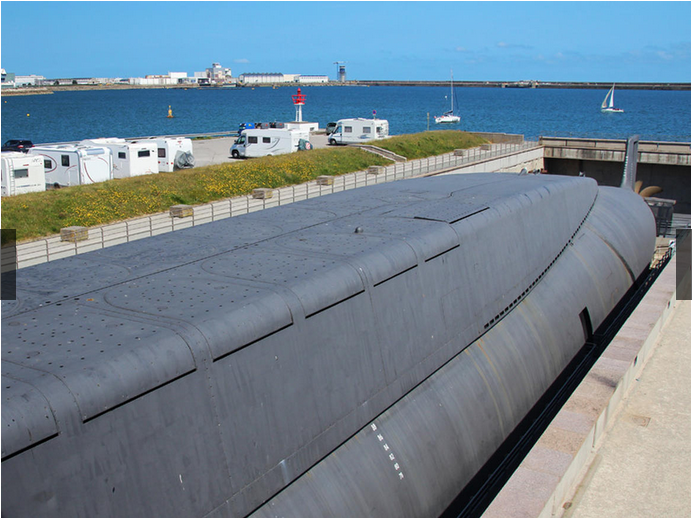
The 16 missile hatches, with the lovely Cherbourg harbor in the background.
February 6, 2015
“Green men” finally triumph over the “Cyborgs”
Unfortunately, the “green men” are almost certainly Russian special forces troops, while the “cyborgs” were a rag-tag bunch of Ukrainian defenders of what remained of Donetsk’s modern airport terminal:
Late last week pro-Kremlin separatist militias — aided and very likely led by “green men” — defeated the last band of Ukrainian “Cyborgs” defending Donetsk’s airport. Two years ago the airport was touted as one of Eastern Europe’s most modern air hubs. Today it is, like many neighborhoods in the Donetsk region and villages along the Russia-Ukraine border, a miserable ruin.
For Ukrainians, Donetsk’s airport had become a national symbol. Media compared its stubborn Ukrainian defense to the legendary World War II Battle of Stalingrad, which pitted Red Army defenders against invading Nazis. In Ukraine’s narrative, the Ukrainians were defending Soviet forces, the Kremlin’s “green men” and their proxy militias the invaders.
Russian President Vladimir Putin, however, is an adept propagandist. In Putin’s insistent rendition, the Kremlin’s militias are Stalingrad’s glorious Russian soldiers reborn. Ukrainian defenders he scorns as “fascists.”
[…]
“The green men”: They wear green uniforms, without insignia, and masks. They pack sophisticated weaponry and gear. I associate their media nickname with, obviously, alien invaders, and invaders they are. They led the Russian invasion of Crimea; they appear, furtively, in Eastern Ukraine. They are Russian Army special operations troops. They advise the separatists. They seize key terrain. Credible sources have them participating in tactical combat.
The 1994 Budapest Accord leaves no doubt they are invaders. Putin wants the 1994 Budapest Accord to disappear down the global memory hole. Ukraine signed the Accord and gave up its nuclear arsenal in exchange for territorial security assurances by Russia. The U.S. (Clinton Administration) and Great Britain guaranteed the deal. If the U.S. had not guaranteed the Accord, I doubt Kiev would have signed it. In late February 2014 Putin shredded the Accord and invaded Crimea. Denuclearized, Ukraine’s resistance was futile.
But here’s the mistake Washington and London would like you to ignore: The U.S. (Obama administration) and Great Britain failed to support Ukraine.
December 5, 2014
Ross Perot (of all people) and one of the earliest real computers
At Wired, Brendan I. Koerner talks about the odd circumstances which led to H. Ross Perot being instrumental in saving an iconic piece of computer history:
Eccentric billionaires are tough to impress, so their minions must always think big when handed vague assignments. Ross Perot’s staffers did just that in 2006, when their boss declared that he wanted to decorate his Plano, Texas, headquarters with relics from computing history. Aware that a few measly Apple I’s and Altair 880’s wouldn’t be enough to satisfy a former presidential candidate, Perot’s people decided to acquire a more singular prize: a big chunk of ENIAC, the “Electronic Numerical Integrator And Computer.” The ENIAC was a 27-ton, 1,800-square-foot bundle of vacuum tubes and diodes that was arguably the world’s first true computer. The hardware that Perot’s team diligently unearthed and lovingly refurbished is now accessible to the general public for the first time, back at the same Army base where it almost rotted into oblivion.
ENIAC was conceived in the thick of World War II, as a tool to help artillerymen calculate the trajectories of shells. Though construction began a year before D-Day, the computer wasn’t activated until November 1945, by which time the U.S. Army’s guns had fallen silent. But the military still found plenty of use for ENIAC as the Cold War began — the machine’s 17,468 vacuum tubes were put to work by the developers of the first hydrogen bomb, who needed a way to test the feasibility of their early designs. The scientists at Los Alamos later declared that they could never have achieved success without ENIAC’s awesome computing might: the machine could execute 5,000 instructions per second, a capability that made it a thousand times faster than the electromechanical calculators of the day. (An iPhone 6, by contrast, can zip through 25 billion instructions per second.)
When the Army declared ENIAC obsolete in 1955, however, the historic invention was treated with scant respect: its 40 panels, each of which weighed an average of 858 pounds, were divvied up and strewn about with little care. Some of the hardware landed in the hands of folks who appreciated its significance — the engineer Arthur Burks, for example, donated his panel to the University of Michigan, and the Smithsonian managed to snag a couple of panels for its collection, too. But as Libby Craft, Perot’s director of special projects, found out to her chagrin, much of ENIAC vanished into disorganized warehouses, a bit like the Ark of the Covenant at the end of Raiders of the Lost Ark.
Lost in the bureaucracy

An ENIAC technician changes a tube. (Photo: US Army)
November 16, 2014
In Civilization games, Gandhi is the most likely leader to use nukes
In Kotaku, Luke Plunkett explains why of all the AI leaders in the game, none are more likely to espouse the philosophy “nuke ’em ’till they glow, then shoot ’em in the dark” than India’s Gandhi:

In the original Civilization, it was because of a bug. Each leader in the game had an “aggression” rating, and Gandhi – to best reflect his real-world persona – was given the lowest score possible, a 1, so low that he’d rarely if ever go out of his way to declare war on someone.
Only, there was a problem. When a player adopted democracy in Civilization, their aggression would be automatically reduced by 2. Code being code, if Gandhi went democratic his aggression wouldn’t go to -1, it looped back around to the ludicrously high figure of 255, making him as aggressive as a civilization could possibly be.
In later games this bug was obviously not an issue, but as a tribute/easter egg of sorts, parts of his white-hot rage have been kept around. In Civilization V, for example, while Gandhi’s regular diplomatic approach is more peaceful than other leaders, he’s also the most likely to go dropping a-bombs when pushed, with a nuke “rating” of 12 putting him well ahead of the competition (the next three most likely to go nuclear have a rating of 8, with most leaders around the 4-6 region).
Update, 16 November: Fixed the broken link.


