seangabb
Published 1 Jan 2022Between 330 AD and 1453, Constantinople (modern Istanbul) was the capital of the Roman Empire, otherwise known as the Later Roman Empire, the Eastern Roman Empire, the Mediaeval Roman Empire, or The Byzantine Empire. For most of this time, it was the largest and richest city in Christendom. The territories of which it was the central capital enjoyed better protections of life, liberty and property, and a higher standard of living, than any other Christian territory, and usually compared favourably with the neighbouring and rival Islamic empires.
The purpose of this course is to give an overview of Byzantine history, from the refoundation of the City by Constantine the Great to its final capture by the Turks.
Here is a series of lectures given by Sean Gabb in late 2021, in which he discusses and tries to explain the history of Byzantium. For reasons of politeness and data protection, all student contributions have been removed.
(more…)
September 20, 2022
The Byzantine Empire: Part 4 – Justinian, The Hand of God
July 27, 2022
When the founder of the SAS was captured by Italian troops in 1943
In The Critic, Saul David describes what happened when Lieutenant Colonel David Stirling was captured during his “most hare-brained scheme” to link up the troops of Britain’s First and Eighth armies in Tunisia:
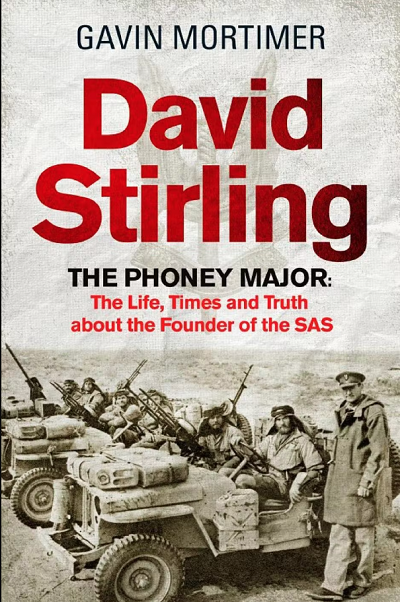
In January 1943 Lieutenant Colonel David Stirling, founder of the SAS, was flown to Rome for interrogation. He had been captured by the Italians on his “most hare-brained scheme yet” — leading a small raiding party deep into enemy territory in Tunisia to attack lines of communication, reconnoitre the terrain and become the first Eighth Army unit to link up with the First Army advancing from the west.
Cautious when speaking to the Italians, he was “vain and voluble” in conversation with a fellow “captive”, Captain John Richards. Unbeknown to Stirling, Richards was an Anglo-Swiss stool pigeon, Theodore Schurch, who had deserted from the British army and was working for fascist intelligence.
Prior to Schurch’s court-martial for treachery in late 1945, Stirling denied he had revealed any sensitive information. If he had, it was inaccurate and “designed to deceive”. This was a lie, told to protect Stirling’s reputation. In fact, as the British authorities knew all too well from intercepted signals, Stirling had told Richards vital details about current SAS operations, including the location of patrols and their orders. He had even given them the name of his probable replacement as SAS commander: Paddy Mayne.
The story of Stirling’s unfortunate encounter with Schurch has been told before, notably by Ben Macintyre in his bestselling SAS: Rogue Heroes. But Macintyre underplays Stirling’s indiscretion and fails to link it to the many other examples of the SAS commander’s recklessness and poor judgement of character. For Gavin Mortimer, on the other hand, both the capture and loose talk were typical of a man who was “imaginative, immature, immoderate and ill-disciplined”. Small wonder that even his own brother Bill thought he would be better off in a prisoner-of-war camp.
The subtitle of Mortimer’s book — a carefully researched and impeccably sourced take-down of the legendary special forces pioneer — is a corrective to the flattering but inaccurate nickname that was first coined for Stirling by British tabloids during the Second World War. “When word reached Cairo of the Phantom Major moniker,” writes Mortimer, “it must have sparked a mix of hilarity and indignation. All the falsehoods and fabrications would have been harmless enough had Stirling not stolen the valour of his comrades.”
Thread by thread, Mortimer unpicks the myth of Stirling’s life and war service that the subject and his fawning admirers had so carefully constructed, both during and after the war. Stirling was not training in North America for an attempt on Mount Everest’s summit when war broke out in 1939, as he later claimed, but rather working as a ranch hand because his exasperated family hoped it might give the feckless youth some focus and direction.
Italy’s Worst Machine Gun: The Breda Modello 30
Forgotten Weapons
Published 28 Jul 2017http://www.patreon.com/ForgottenWeapons
Cool Forgotten Weapons merchandise! http://shop.bbtv.com/collections/forg…
The Breda Model 30 was the standard Italian light machine gun of World War II, and is a serious contender for “worst machine gun ever”. Yes, given the choice we would prefer to have a Chauchat (which really wasn’t as bad as people today generally think).
The Breda 30 suffered from all manner of problems. To begin with, it was far more complicated than necessary. The amount of machining needed to build one is mind boggling compared to contemporary guns like the ZB26/Bren or BAR. And for all that work, it just didn’t work well in combat conditions.
Mechanically, the Breda used a short recoil action with a rotating bolt. The recoil action meant that the barrel moved with each shot, so the sights were mounted on the receiver to keep them fixed. This seems like a good idea, but it meant that the sights would need to be re-zeroed each time the barrel was changed. To compound this, the gun fired from a closed bolt which made it more susceptible to overheating and it was recommended to change barrels every 200 rounds or so. An oiling mechanism was built in to lightly oil each cartridge on feeding. This allowed the gun to extract without ripping rims off the cases, but was a disaster waiting to happen on the battlefield. In places like North Africa, the oil acted as a magnet for sand and dust, leading to quick jamming if the gun were not kept scrupulously clean.
The next huge judgment error on Breda’s part was the magazine. The thought behind it was that magazine feed lips are easily damaged in the field, and they can be protected by building them into the gun receiver rather than in each cheap disposable box magazine (the Johnson LMG and Madsen LMG recognized this issue as well). However, Breda’s solution was to make the 20-round magazine a permanent part of the gun. The magazine was attached to the receiver by a hinge pin, and was reloaded by special 20-round stripper clips. This meant that reloading took significantly longer than changing magazines, and any damage to the one attached magazine would render the gun inoperable. As if anything else were needed, the magazine was made with a big opening on top to allow the gunner to see how many rounds remained – and to let more of that North African sand into the action.
Most of the Breda Model 30s were made in 6.5 Carcano, but a small number were made in 7.35 Carcano when that cartridge was adopted. The rate of fire was about 500 rounds per minute, which was a bit slower than most other machineguns of the day.
(more…)
May 15, 2022
Tank Chat #147 M14/41 | The Tank Museum
The Tank Museum
Published 4 Feb 2022► JOIN OUR PATREON: Our Patreons have already enjoyed Early Access and AD free viewing of our weekly YouTube video! Consider becoming a Patreon Supporter today: https://www.patreon.com/tankmuseum
► TIMESTAMP:
00:00 – INTRO
00:22 – FEATURES
(more…)
March 27, 2022
American Army Finally Does Something Right – WW2 – 187 – March 26, 1943
World War Two
Published 26 Mar 2021The British are attacking the Mareth Line in North Africa while the Americans hit the Axis flank, but the Allies are withdrawing in Burma. It’s the Germans who are pulling back in the USSR, though, and there is another attempt from within German Command to assassinate Adolf Hitler.
(more…)
March 21, 2022
Republic to Empire: Sulla A Failed Reaction
seangabb
Published 10 Feb 2021In 120 BC, Rome was a republic with touches of democracy. A century later, it was a divine right military dictatorship. Between January and March 2021, Sean Gabb explored this transformation with his students. Here is one of his lectures. All student contributions have been removed.
(more…)
February 4, 2022
The Origins of the SAS – WW2 Special Episode
World War Two
Published 3 Feb 2022“Who dares, wins”. Nowadays the British SAS — Special Air Service — is considered one of the best special forces in the world. Yet its wartime origins are shrouded in mysteries and legends. From the first ideas of top-secret “special raiding squadrons”, to the first raids in North Africa accompanying the Long Range Desert Group, the SAS’s beginnings resemble one big experiment. An experiment from which a truly legendary special service would emerge.
(more…)
January 30, 2022
Time to Fire Rommel? – WW2 – 179 – January 29, 1943
World War Two
Published 29 Jan 2022The Allies are unable to win in Tunisia, though further east Bernard Montgomery has achieved his goal of driving the enemy out of Libya. To the west, the Casablanca Conference comes to its end and the Allies write a list of their war priorities. The Soviets, however, are on the move everywhere, closing in on Stalingrad, and launching new operations up and down the eastern front, to the dismay and detriment of the Axis forces.
(more…)
QotD: Montgomery on the advance after El Alamein
A curious incident occurred as our light forces were moving forward south of Benghazi. I was right up behind the leading armoured cars, reconnoitering the area; I had a small escort with me. We had outstripped the fighter cover and from time to time enemy aircraft strafed the road; it was not a healthy place and I suppose that I ought not to have been there.
Suddenly I saw a lorry coming up from behind, and on it a large boat; a naval Petty Officer sat with the driver and some sailors were inside.
I stopped the lorry and said to the Petty Officer: “What are you doing here? Do you realise that you are right up with the most forward elements of the Eighth Army, and you and your boat are leading the advance? This is a very dangerous area just at present, and you are unarmed. You must turn round and go back at once.”
He was dreadfully upset. He had been ordered to open up a “petrol point” at a small cove well to the north of Mersa Brega; small naval craft were to land petrol at this point in order that the leading armoured car regiments could refill their tanks; this was the easiest way of getting petrol and oil to them. He explained this to me, looking at me with pleading eyes rather like a spaniel asking to be taken for a walk to hunt rabbits.
He then said: “Don’t send me back, sir. If the armoured cars don’t get their petrol, they will have to halt and you will lose touch with the Germans. Couldn’t I go on with you? I would then be quite safe.”
That Petty Officer was clearly a student of psychology! In point of fact I did not know about these small petrol points for the armoured cars; it was a staff plan and a very good one. I took the naval party forward with me and saw them safely to their cove, where I was their first customer for petrol. I have often thought of that Petty Officer; he was from the Merchant Navy and in the R.N.V.R.; his sense of duty was of the highest order, and Britain will never lose her wars so long as the Royal Navy can count on men like him.
Bernard L. Montgomery, The Memoirs of Field-Marshal Montgomery, 1958.
January 27, 2022
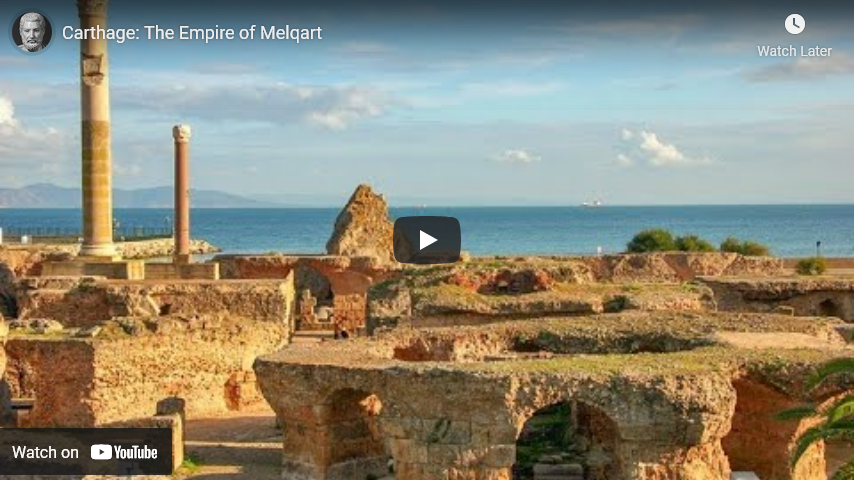
Carthage: The Empire of Melqart
Thersites the Historian
Published 11 Nov 2021In this lecture, we look at why it is so hard to find Punic material remains and where one can search for what little there is left to find.
Patreon link: https://www.patreon.com/thersites
PayPal link: paypal.me/thersites
Discord: https://discord.gg/QCaXXFr
Brave Browser: https://brave.com/noa557
Twitter link: https://twitter.com/ThersitesAthens
Minds.com link: https://www.minds.com/ThersitestheHis…
Steemit/dtube link: https://steemit.com/@thersites/feed
BitChute: https://www.bitchute.com/channel/jbyg…
January 16, 2022
Food for Leningrad, Breaking the Siege! – WW2 – 177- January 15th, 1943
World War Two
Published 15 Jan 2022Soviet attacks are launched this week to destroy the Hungarians, all while the German desperation at Stalingrad and Velikie Luki continues, but in the far north the Soviets have broken through the siege of Leningrad after 16 months. And the Casablanca Conference begins, a meeting to guide the war’s future progress.
(more…)
January 7, 2022
Desert War – Dysentery, Disease, and Dehydration – WW2 Special
World War Two
Published 6 Jan 2022North Africa. The Axis and Allies are fighting each other but even more, they’re fighting the desert itself. The men of the desert burn during the day and freeze at night. They do most of their fighting on a litre of water and a packet of army biscuits. What is life in such a hostile environment?
(more…)
December 19, 2021
Guadalcanal Life Expectancy: 30 Days- WW2 – 173 – December 18, 1942
World War Two
Published 18 Dec 2021Just a few weeks ago massive offensives were launched in North Africa and the Soviet Union, against the Axis. These operations and offensives have now morphed into fully fledged campaigns, and the nature of these theatres of the war has been transformed.
(more…)
December 17, 2021
Death Squads Arrive in North Africa – WAH 048 – December 1942, Pt. 1
World War Two
Published 16 Dec 2021Despite Allied occupation, the situation of the Jews in North Africa hardly improves, in newly German-occupied Tunisia it deteriorates. Meanwhile, the world learns more of the details of the Holocaust — they cannot believe their ears.
(more…)
November 22, 2021
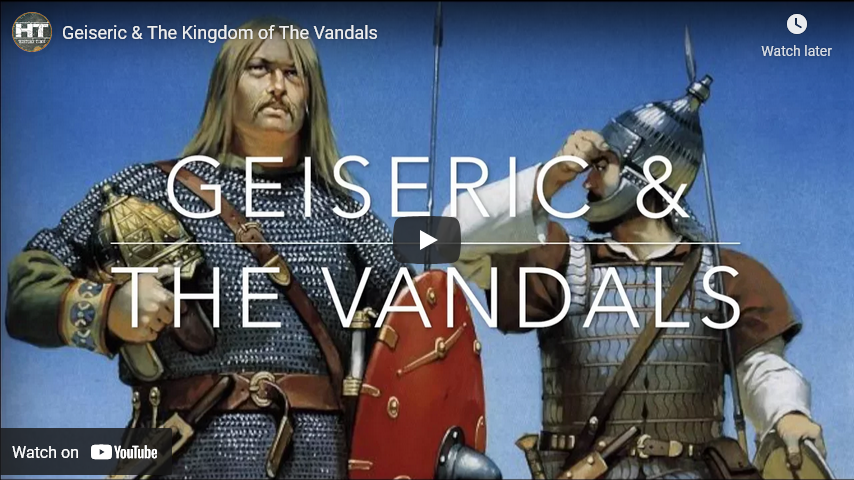
Geiseric & The Kingdom of The Vandals
History Time
Published 5 Sep 2017A brief look at Geiseric and the Vandals
Further reading:-
Edward Gibbon, The Decline and Fall of the Roman Empire
Walter Goffart, Barbarian & Romans
Peter Heather, The Fall of the Roman Empire
Andrew Merrills, The VandalsMusic:-
Morning Light – “Deep Thoughts” https://www.youtube.com/watch?v=1tXOL…
Peter Gundry – “Víðbláinn” https://www.youtube.com/watch?v=ZnCML…
Kevin MacLeod – “Ossuary 2: Turn” https://www.youtube.com/watch?v=e6jZS…If you liked this video and have as little as a dollar to spare then please consider supporting me on Patreon for more and better content in the future:-
http://www.patreon.com/historytimeUKAre you a budding artist, illustrator, cartographer, or music producer? Send me a message! No matter how professional you are or even if you’re just starting out, I can always use new music and images in my videos. Get in touch! I’d love to hear from you.
I’ve also compiled a reading list of my favourite history books via the Amazon influencer program. If you do choose to purchase any of these incredible sources of information, many of which form the basis of my videos, then Amazon will send me a tiny fraction of the earnings (as long as you do it through the link) (this means more and better content in the future) I’ll keep adding to and updating the list as time goes on — https://www.amazon.com/shop/historytime
I try to use copyright-free images at all times. However if I have used any of your artwork or maps then please don’t hesitate to contact me and I’ll be more than happy to give the appropriate credit.
—Join the History Time community on social media:-
Patreon — https://www.patreon.com/historytimeUK
Instagram — https://www.instagram.com/historytime…
Twitter — https://twitter.com/HistoryTimePete