Quotulatiousness

May 2, 2022

Free speech is different from those days when people wore tricorn hats and buckles on their shoes

Filed under: History, Liberty, Media, Politics, USA — Tags: , , , , — Nicholas @ 05:00

At least, those who have a strong aversion to Elon Musk allowing free speech on Twitter believe things were very different back in the olden days and we can’t allow just anyone to say whatever they want in the current year, else chaos descend:
Recently, Max Boot said that social media has to be handled differently than media did in the past, because in the 1980s we only had three TV networks and we mostly communicated ideas by chiseling pictures into rocks and firing them at neighboring towns with a trebuchet. Or, I don’t know, something like that, which I talked about here.

Now a Time magazine correspondent named Charlotte Alter — more about her in a moment — says the same thing, but with different periodization:

    But “free speech” in the 21st century means something very different than it did in the 18th, when the Founders enshrined it in the Constitution. The right to say what you want without being imprisoned is not the same as the right to broadcast disinformation to millions of people on a corporate platform. This nuance seems to be lost on some techno-wizards who see any restriction as the enemy of innovation.

That’s all she says about speech in the 18th century, so it beats the shit out of me what this comparison is supposed to mean, and I kind of suspect that it beats the shit out of her, too. But again, Alter’s it was different back then is no better than the last one that got on my nerves. The idea that the conflict over information now is wholly different than the conflict over information then is just the usual nonsense.

First, the Founders had just fought a revolutionary war that was born from print culture, from an explosion of written sources that were widely shared and widely contested. Someone like the Massachusetts colonial official Thomas Hutchinson absolutely thought, and said very clearly, that he was engaged in a contest with idiots who were spreading disinformation in print. I’ve already written about this, too.

Again, here’s how the historian Bernard Bailyn sums up Hutchinson’s view of the idiots and demagogues (like John Adams) that he was arguing with in the decade before the Revolution, and tell me if it sounds the slightest bit different than the current “misinformation” discourse from our own Thomas Hutchinsons: “The common run of the people, lacking the necessary education, leisure, and economic independence to make an impartial assessment of public problems, were mercurial playthings of leaders who could profit by exciting their fears.” I’m not sure if Hutchinson was Max Boot living in a past life or David French living in a past life, but I take this as clear evidence that at least one of them did, in fact, have past lives, and that they’ve been the same elitist whiner every time the wheel of existence has turned.

Second, all of the things the Founders enshrined in the Constitution were the products of a fierce and sustained rhetorical contest in print, as Federalists and Anti-Federalists — writing pseudonymously, like some asshole on Twitter — fought over the likely practical effects of their ideological differences. Brutus and Cato thought Publius was spreading disinformation, and Publius returned the favor. Newspapers all over the country reprinted their exchanges; 18th century political discourse was wide open, it was broadly disseminated, and it ran hot. If you want to argue that “free speech” in the 21st century means something different than it meant in the 18th, you have to say how. People argued then. In print. And then the arguments went out all over the place. I Swear.
April 25, 2022

“We live in such a degraded information environment that we can’t get to discussions of principle”

Filed under: Media, Politics, USA — Tags: , , , , , — Nicholas @ 05:00

Chris Bray on the increasing inability or deliberate choice of most legacy media outlets to avoid presenting basic facts in favour of pitching a scenario with the preferred outcome prepackaged and largely predigested for the consumer to accept uncritically:

Over and over again, journalism doesn’t begin to accurately describe; consuming it, we don’t get to the starting line of a functioning political discourse, which is just knowing what’s happening, more or less. We’re buried in fakery, in representations of reality that have no connection to reality. […]

I wrote last week about the disappearance of basic information on the criminal justice system in Los Angeles County, where I live. We have an ongoing debate over our Woke DA’s policy choices — but the more I look at the debate, the more I’m sure it’s a debate about nothing, because the slogans used to represent the DA’s policy choices really don’t seem to begin to reflect the reality of the DA’s actual policy choices. The slogans look from here like cover words, chaff fired as a rhetorical countermeasure to cloud the air. I’ve been trying to get clear information from people in Los Angeles County government, which has been … interesting, so stay tuned on that question. But what are we debating if we’re exchanging our thoughts on the empty fakery the DA is deploying to prevent us from noticing what he’s doing?

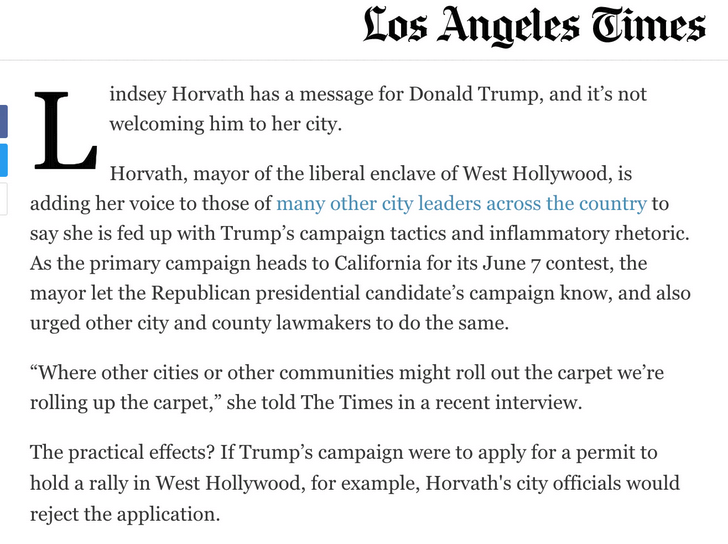
Back in 2016, the vapid mayor of a tiny city in Los Angeles County boldly announced that she had banned Donald Trump from her community, ordering city staff to burn the witch. Journalists reported it straight: TRUMP BANNED FROM LOCAL CITY.

It was left to lawyers with a media presence to seriously examine all of the problems with the remarkable claim that a part-time small-town mayor owns a personal fiefdom and can ban people from it. A not-especially-gifted politician with ambitions for higher office made up some nonsense to get herself in the news, and it worked. But the news was about nothing, because she had no authority to do the thing she announced in the press release.

This is more than half of the news: Noise with nothing it, a press release from an idiot typed up by idiots. What debate over questions of principle can proceed on the foundation of an informational void? (“I’m for empty hole!” “Oh yeah, well I’m against empty hole!”)

We’re beginning to solve some big pieces of that problem with alternative media, which is why you’re hearing so much complaining about misinformation. “Our democracy,” that hilarious phrase that doesn’t mean what it says, relies on the screen of fakery. Nothing happens until we punch enough holes in that screen.

April 10, 2022

“Canadian media, ‘independent’ or otherwise, is about as sparkly as dry toast”

Filed under: Bureaucracy, Business, Cancon, Government, Media — Tags: , , , — Nicholas @ 05:00

It’s impossible to disagree with the editors at The Line about the negative impact of government involvement, oversight and subsidization of the media, and the ensuing neutralization (or even Pablumization) of the news presented to Canadians:

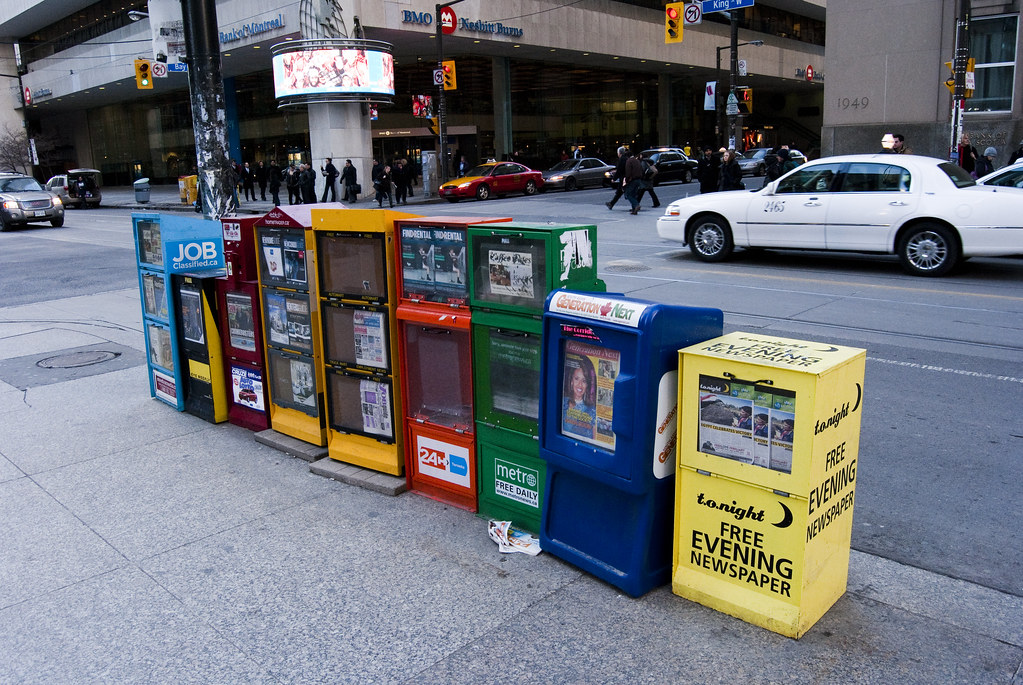
“Newspaper Boxes” by Randy Landicho is licensed under CC BY 2.0

There is no way to create such a system without an inherently political process to answer philosophically fraught questions like “what is news?” and “what is a journalist?” And that takes us ever closer to the perilous path of state credentialization of a profession that only operates properly when it is free of both undue government interference and of government assistance. State meddling is bad for journalism whether the intent be good, bad or indifferent.

Every outlet is beholden to the people who cut the cheque, and if your business model relies on impressing government grant gifters or corporate social responsibility committees, then your content is going to reflect the milquetoast sensibilities of your true audience.

Which, bluntly, is why so much Canadian media, “independent” or otherwise, is about as sparkly as dry toast. Whole grain. To rely on government money is not only philosophically untenable, it is almost inherently corrupting. There are public journalism enterprises in Canada, including, for instance, the CBC and TVO, and your Line editors contribute to both. You can trust us when we tell you that the people in charge of those organizations work very, very hard to avoid the impossible conflicts public funding of journalism cannot help but produce. The readers can judge the results, but no one in either outlets pretends it’s easy. It’s not.

And in case it needs to be noted here again, The Line accepts no public cash. Not a dime. We rely entirely on paid subscriptions from our reader base, and we like it that way. Our relationship with you, the reader, is what allows us to be risky, innovative, and occasionally belligerent. You’re here because you like us — you really like us! — and as a result, we serve only you. That doesn’t mean that you’re always going to agree with us, of course, but rather that you can trust us to tell you what we really think.

We looked into the QCJO program and although we believe we would qualify for the program, we are simply too horrified by its mere existence to consider applying. This puts us at a severe competitive disadvantage, and one that can only be overcome by outperforming everyone else.

April 4, 2022

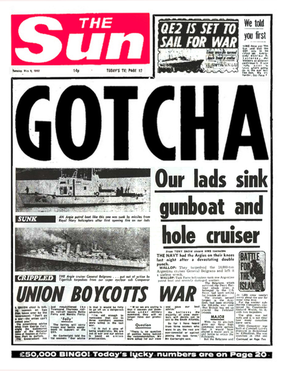
The Falklands War — the first postmodern war or the last colonial war?

Filed under: Americas, Britain, History, Media, Military — Tags: , , , , , — Nicholas @ 05:00

Dominic Sandbrook in UnHerd says Britain “needed the Falklands War”:

On the morning of Monday, 5 April 1982, the aircraft carrier Invincible slipped its moorings and eased into Portsmouth Harbour, bound for the South Atlantic. It was barely ten o’clock, yet the shoreline was packed with tens of thousands of flag-waving onlookers, singing and cheering for all they were worth, many of them in tears. From every building in sight flew the Union Jack, while well-wishers brandished dozens of homemade banners: “God Bless, Britannia Rules”, “Don’t Cry for Us, Argentina”. In the harbour, a flotilla of little boats, crammed with spectators, bobbed with patriotic enthusiasm. And as the band played and the ship’s horn sounded, red flares burst into the sky.

It is 40 years now since the outbreak of the Falklands War, one of the strangest, most colourful and most popular conflicts in British military history. Today this ten-week campaign to free the South Atlantic islands from Argentine occupation seems like a moment from a vanished age. But that was how it felt at the time, too: a scene from history, a colossal costume drama, a self-conscious re-enactment of triumphs past.

On the day the Invincible sailed, Margaret Thatcher quoted Queen Victoria: “Failure? The possibilities do not exist.” In the Sun, executives put up Winston Churchill’s portrait. And as the travel writer Jonathan Raban watched the departure of the Task Force on television, he thought it was like a historical pageant, complete with “pipe bands, bunting, flags, kisses, tears, waved handkerchiefs”. He regarded the whole exercise with deep derision, until the picture blurred and he realised that, despite himself, he was crying.

For many people the Falklands War was only too real. There were serious issues and genuine lives at stake, not just for the 1,813 islanders who had woken to find military vehicles roaring down their little streets, but for the tens of thousands of Argentine conscripts and British servicemen who were soon to be plunged into the nightmare of combat. And although polls suggest that about eight out of ten Britons strongly supported it, there were always those who considered it a mistake, a tragedy, even a crime. A certain Jeremy Corbyn thought it a “Tory plot to keep their money-making friends in business”. The novelist Margaret Drabble considered it a “frenzied outburst of dying power”. A far better writer, Argentina’s Jorge Luis Borges, famously called it “two bald men arguing over a comb”. That seems an odd analogy, though, for almost 2,000 blameless sheep farmers, who had no desire to be ruled by a junta that threw dissenters out of helicopters.

One common view of the Falklands campaign is that it was Britain’s last colonial war. But this strikes me as very unpersuasive. When we think of colonial wars, we think of wars of conquest by white men in pith helmets against brown-skinned underdogs. We think of embattled imperialists struggling to stave off a nationalist uprising, or fighting in defence of white settlers against a native majority. But the Falklands War was none of those things. There was no oppressed indigenous majority — except perhaps for the islanders themselves, some of whom had been there since the 1830s. As for the Argentines, their Spanish and Italian surnames were a dead giveaway. Indeed, few countries in the Americas had done a more thorough job of eliminating their original inhabitants.

April 1, 2022

Underbusing Hunter Biden?

Filed under: Government, Media, Politics, USA — Tags: , , , , , , , — Nicholas @ 05:00

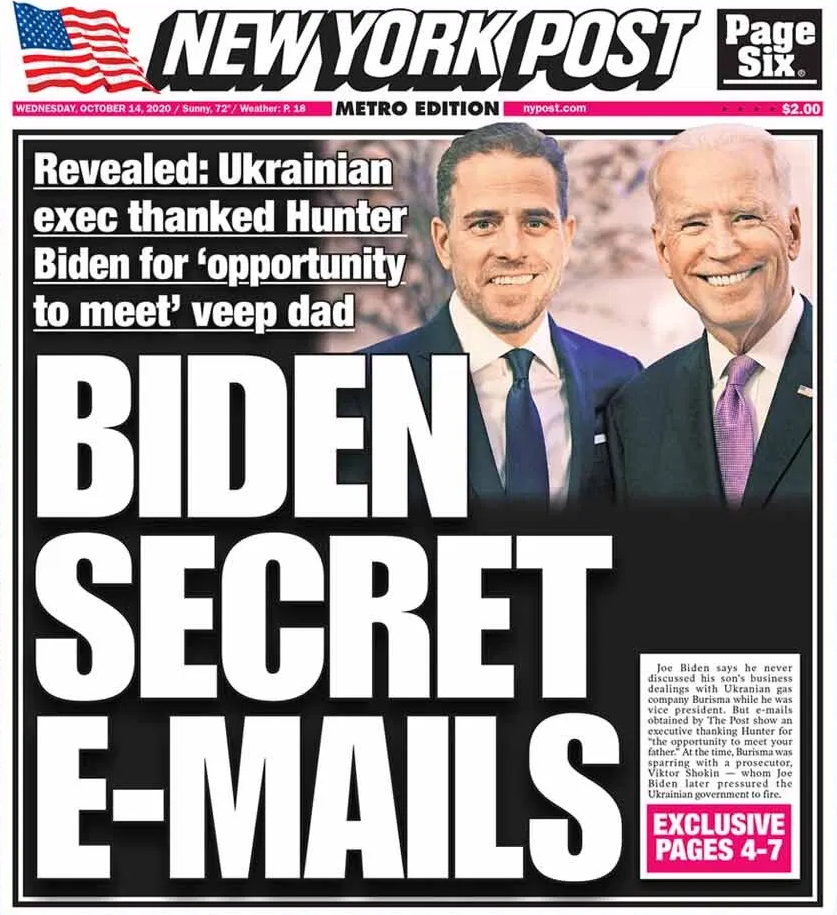
Long after the story was initially reported, and the New York Post was hammered for publicizing it at the time, the rest of the legacy media is showing interest in Hunter Biden’s laptop contents:

… If someone disappears for a while, it could mean nothing more than he is having a blood transfusion at one of Google’s secret rejuvenation centers. On the other hand, disparaging information about an oligarch in regime media could simply mean that one mob family is unhappy with another mob family and this is how they are communicating it. Using the media promotes the interests of the gangster class and delivers the message.

That is probably how to interpret the sudden interest by regime media in the famous Hunter Biden laptop from two years ago. For those not interested, this was the laptop that President Biden’s drug-addled son abandoned at a Delaware computer shop, which contained a trove of embarrassing information about the family. In addition to thousands of naked selfies and pics of Hunter smoking crack and meth with prostitutes, it had details of the Biden family criminal dealings.

Regime media dutifully covered this up by declaring it Russian propaganda and going as far as to imply it was a Trump campaign dirty trick. The New York Post, which was the first to report the laptop story, came under withering assault from the Silicon Valley crime families until they dropped the story. Facebook started banning people from their site for mentioning the story. Like the people air brushed from official photos in the Soviet Union, this story was erased from public view.

This is nothing new. The power of regime media is in what they can make the public ignore and this was a typical example. They do this by framing the issue as good guys versus bad guys, which is catnip for the American moralizer. Then they declare the thing to be ignored as the black hat and let the moralizers do the rest. Anyone mentioning the laptop on-line or even in private conversation was declared a crazy QAnon conspiracy theorist by others in their circle.

For no reason at all, the laptop story is back. First the intel community told the New York Times to admit they lied two years ago about it being fake. They did not mention that it was the intel community that lied, of course. Then the Washington Post was told to write about the Biden family’s criminal dealings that were on the laptop. The Post is the official organ of the intelligence community. You will recall that the Post was instrumental in the Russian collusion hoax in 2016.

March 23, 2022

The New York Times and the “world’s dullest editorial”

Filed under: Liberty, Media, USA — Tags: , , , — Nicholas @ 03:00

Matt Taibbi explains why a milquetoast New York Times editorial got such immense blowback from other legacy media outlets:

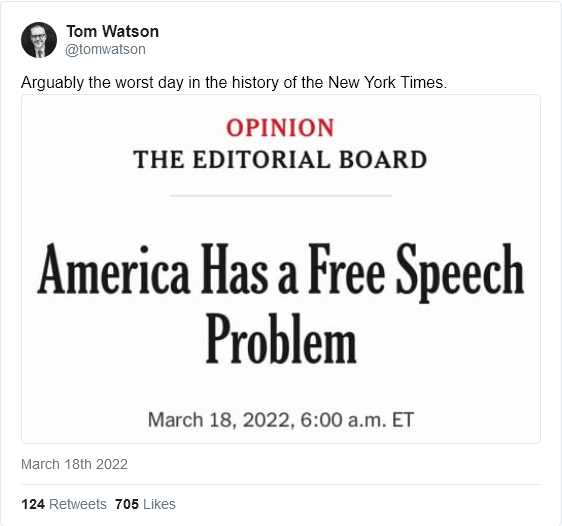
The New York Times ran a tepid house editorial in favor of free speech last week. A sober reaction:

One might think running botched WMD reports that got us into the Iraq war or getting a Pulitzer for lauding Stalin’s liquidation of five million kulaks might have constituted worse days — who knew? Pundits, academics, and politicians across the cultural mainstream seemed to agree with Watson, plunging into a days-long freakout over a meh editorial that shows little sign of abating.

“Appalling,” barked J-school professor Jeff Jarvis. “By the time the Times finally realizes what side it’s on, it may be too late,” screeched Philadelphia Inquirer columnist Will Bunch. “The board should retract and resign,” said journalist and former Planet Money of NPR fame founder Adam Davidson. “Toxic, brain-deadening bothsidesism,” railed Dan Froomkin of Press Watch, who went on to demand a retraction and a “mass resignation”. The aforementioned Watson agreed, saying “the NYT should retract this insanity, and replace the entire editorial board.” Not terribly relevant, but amusing still, was the reaction of actor George Takei, who said, “It’s like Bill Maher is now on the New York Times Editorial board.”

The main objection of most of the pilers-on involved the lede of the Times piece, which really was a maladroit piece of writing:

    For all the tolerance and enlightenment that modern society claims, Americans are losing hold of a fundamental right as citizens of a free country: the right to speak their minds and voice their opinions in public without fear of being shamed or shunned.

There’s obviously no legal right in America to voice an opinion without being criticized, so this line is indeed an error and an embarrassing one, for a labored-over first line of a major New York Times editorial. On the other hand, a lot of great liberal thinkers decried shaming tactics as utterly opposite to the spirit of free speech, with John Stuart Mill’s warning of a “social tyranny more formidable than many kinds of political oppression” being just one example. So, while the Times technically screwed up, cheering shaming and shunning as normal and healthy elements of life in free societies is a pretty weird gotcha. In any case, this bollocksed lede introduced a piece that had been in the works for a while, and came complete with a poll the paper commissioned in conjunction with Siena College.

[…]

This Times editorial is watered down almost the level of a public service announcement written for the Cartoon Network, or maybe a fortune cookie (“Free speech is a process, not a destination. Winning numbers 4, 9, 11, 32, 46 …”). It made the Harper’s letter read like a bin Laden fatwa, but it’s somehow arousing a bigger panic. Its critics view the mention of Republican legislative bans in conjunction with canceling as a monstrous affront, a felony case of both-sidesism. Obviously any implication that there’s any moral comparison between Republicans banning speech by law and Democrats doing it by way of informal backroom deals with unaccountable tech monopolies is unacceptable. Beyond that now, much of the commentariat seems to believe the op-ed page has outlived its usefulness unless it’s engaged in fulsome denunciations of correct targets

January 16, 2022

Is the narrative about the Trans Movement about to change?

Filed under: Health, Media, Politics — Tags: , , , , — Nicholas @ 03:00

In the latest Weekly Dish, Andrew Sullivan marks a perhaps significant change in how mainstream media outlets are discussing the Trans Movement:

An unusual thing happened in the conversation about transgender identity in America this week. The New York Times conceded that there is, indeed, a debate among medical professionals, transgender people, gays and lesbians and others about medical intervention for pre-pubescent minors who have gender dysphoria. The story pulled some factual punches, but any mildly-fair airing of this debate in the US MSM is a breakthrough of a kind.

Here’s the truth that the NYT was finally forced to acknowledge: “Clinicians are divided” over the role of mental health counseling before making irreversible changes to a child’s body. Among those who are urging more counseling and caution for kids are ground-breaking transgender surgeons. This very public divide was first aired by Abigail Shrier a few months ago on Bari’s Substack, of course, where a trans pioneer in sex-change surgery opined: “It is my considered opinion that due to some of the … I’ll call it just ‘sloppy’, sloppy healthcare work, that we’re going to have more young adults who will regret having gone through this process.” Oof.

The NYT piece also concedes another key fact: that puberty blockers are neither harmless nor totally reversible. Money quote:

    Some of the drug regimens bring long-term risks, such as irreversible fertility loss. And in some cases, thought to be quite rare, transgender people later “detransition” to the gender they were assigned at birth. Given these risks, as well as the increasing number of adolescents seeking these treatments, some clinicians say that teens need more psychological assessment than adults do.

I would think that, just as a general rule, minors making permanent, life-changing decisions should receive more psychological treatment than adults. How on earth is this not the default? In what other field of medicine do patients diagnose themselves, and that alone is justification for dramatic, irreversible medication?

The NYT doesn’t give you the data for the “increasing number” of transitions because it’s hard to find in the US. In the UK, however, the data show a 3,200 percent rise in adolescents seeking transition over a decade — 70 percent of whom are girls seeking to become boys, a break from historical norms where boys/men were much more likely to seek transition. Nor does the NYT give any data for “detransitioners”. But any brief look online suggests they are not exactly “quite rare”. They are, in fact, becoming a small but recognizable and tenacious part of the trans landscape. And among the risks of puberty blockers that the NYT does not mention are neurological damage, bone-density loss, and a permanent inability to experience sexual pleasure. And in almost every case (98 percent in one report), puberty blockers are never reversed.

January 2, 2022

Eat the bugs, peasants! Leave the meat for your betters!

Andrew Orlowski on the self-imagined elite attitudes to the environment and — as a direct result — the growing chorus of journalists pushing the idea of substituting plant-based synthetics and/or insects in place of meat for us proles:

In recent years, media messaging has been emphatically bossy about what we should eat. State micromanagement of taste has increased, too. After government intervention, British staples ranging from sticky-toffee pudding to Sugar Puffs have been reformulated beyond recognition. But the anti-meat crusade demands that something far more radical should happen – it seeks to stigmatise something central to many of our lives, and demands a shift in how we regard nature. As part of this, our media now seek to normalise lab-grown Frankenmeats, and strangest of all, adopt entomophagy – the practice of eating insects.

So what’s behind the war on meat? The apparent justification is the political elite’s great preoccupation of our time – climate change. We’re told that rearing livestock for meat is bad for the environment, and that cows are the worst offenders of all. That’s the assumption behind hit YouTube videos like Mark Rober’s “Feeding Bill Gates a fake burger (to save the world)”, a promotional video for Gates’ synthetic-meat investments, which has racked up nearly 46million views.

But the environmental argument doesn’t look so robust on closer examination. Agricultural CO2 emissions are small – so small that if the United States turned entirely vegan this decade, it would lower US emissions by just 2.6 per cent. In reality, a cow is a highly efficient protein-conversion system, turning protein that we can’t eat into protein that we love to eat. Three quarters of livestock, on balance, improve the environment, enhancing the yield of the land through fertiliser, which would otherwise need to be made synthetically. For example, one of the crimes regularly levelled against beef is water consumption. But the cow loses most of this water the same day – it’s returned to nature. So with environmental claims so weak, there must be some other rationale for the war on meat.

Much of today’s war on meat appears to be driven by venture capitalists, and their client journalists in the media. Ever eager for the next dot-com boom, Silicon Valley has made a bet on lab-grown, synthetic meat. This requires an industrial bioreactor – an expensive chemical process. But lab-grown meat doesn’t seem to be going anywhere. Business Insider recently reported that scepticism about the sector is growing, as costs remain higher than those for real meat – and this is before one single laboratory-meat formula has received regulatory approval, let alone passed the consumer test.

Another factor driving the war on meat is the academic blob. For example, Professor Peter Smith, an environmental scientist at Aberdeen University and a leading contributor to the UN’s Intergovernmental Panel on Climate Change (IPCC), likes to insist that “we’re not telling people to stop eating meat”, before adding that “it’s obvious that in the West we’re eating far too much”. Have a guess who defines what is “too much”. It’s Smith and his colleagues, not you or me making informed consumer choices.

But the oddest spectacle of all is the relentless promotion of entomophagy at the posh end of the media. The posher the paper, the keener they are on normalising bug-eating.

This is a campaign that has a high hurdle to overcome in most markets, where insects are associated with disease. “Deeply embedded in the Western psyche is a view of insects as dirty, disgusting and dangerous”, a group of academics found in 2014. Many bugs, such as cockroaches, carry disease. Flies like shit, as the saying goes. “Individuals vary in their sensitivity to disgust”, another academic paper acknowledges. “This sensitivity extends to three dimensions of disgust: core, animal reminder and contamination.” Only seven per cent of the US population would countenance the idea of eating insects, even in powdered form, according to one academic study in 2018. Processing insects also raises practical problems, with e-coli and salmonella. “Spore-forming bacteria and enterobacteriaceae have been reported in mealworms and crickets, with higher levels found in insects that had been crushed – likely due to the release of bacteria from the gut”, another study found. It’s easier to clean a cow’s stomach than a cockroach’s.

It should be no surprise, then, that the edible-insect movement has hit a few snags. Blythman recalls the startup, Eat Grub (geddit?), providing the snacks for an insect pop-up in London’s hipster East End. On the menu were “Thai-inspired” creations such as spicy cricket rice cakes and buffalo worms wrapped in betel leaf. “It tasted disgusting, and so I swallowed it whole. Then the legs stuck in my throat”, she recalls. The pop-up hasn’t returned. The following year, Sainsbury’s tapped Eat Grub for its first range of insect products – barbeque-flavoured crickets. Today, the only crickets you can buy at Sainsbury’s are cigarette lighters.

December 21, 2021

QotD: The Royal Victimhood Olympics

Filed under: Britain, Humour, Media, Quotations — Tags: , , , — Nicholas @ 01:00

It’s funny to think that, when I was a child, the Queen’s Christmas speech was the cue for the nation to fall into a collective postprandial slumber. For the past few years, her nearest and dearest have seen to it that her life has outdone any Bond film when it comes to anticipation of what fresh hell awaits our battle-sore yet unbowed hero(ine) around the next corner. Is she going to ignore her favourite son’s alleged association with a dead paedophile? Her grandson’s allegation that her family contains a racist?

It’s certainly been a bumpy old ride of a year, making Her Majesty’s annus horribilis look like a teddy bears’ picnic. But though I’m not a royalist, I’m counting on this most stiff-upper-lipped of ladies not to mention those two little words which were inescapable this year: “mental health”, or the Mental Elf, as I’ve come to think of him.

Remember our old friends Elf and Safety? They’ve been replaced by Mental Elf, and he’s even more annoying, a nasty little imp intent on making every single member of this once-stoic island race confess to hidden sorrows.

The Royal Victimhood Olympics are now an open-season event, like tennis. The Prince of Wails had a head start, moaning about being sent to boarding school by his “distant” mother who – shame on her! – was a young woman doing her very best in a role she had neither wanted nor expected. Meghan Markle famously fled Frogmore Cottage with the Mental Elf in hot pursuit. Prince William, who appeared to be the sensible one, revealed this week he felt as if “the whole world was dying” after he helped save the life of a child while working as a helicopter pilot for the air-ambulance service.

And of course Sarah Ferguson has referred to herself as “the most persecuted woman in the history of the royal family”. All we need now is for Duchess Kate to weigh in with a detailed account of, say, her PMS problems and we’ve collected the full set of Unhappy Royal Families!

Yes, I know Princess Diana started it. But neurosis was just a part of her emotional repertoire. She realised that one of the best guarantees of good mental health is helping others rather than contemplating one’s navel. Or in the case of the wretched Fergie, one’s novel. The writing of Her Heart for a Compass was reportedly “therapeutic” and boosted her “self-esteem”. Is the world big enough for a more self-loving Fergie?

Julie Burchill, “The Queen is the last sane royal standing”, Spiked, 2021-12-09.

December 14, 2021

The Omicron variant of the Wuhan Coronavirus

Filed under: Government, Health, Media — Tags: , , , , , — Nicholas @ 03:00

Jim Treacher gets to the essential question about the dreaded and fast-spreading Omicron variant that the media somehow always forgets to ask:

We’ve seen a lot of headlines about the Omicron variant, which is the latest thing we’re all supposed to panic about. That’s how it works: You must be driven into a perpetual state of hysteria. You must never be allowed a moment to stop and catch your breath and think about what’s happening, because you might fall into badthink. The latest name for that is Omicron.

Omicron! OMG!! Run around like a headless chicken!!!

But here’s a question that none of our moral, ethical, and intellectual betters in the press are asking, because they have no incentive to ask: How many people have died of Omicron?

Like, in the entire world. It doesn’t need to be a precise number. A rough estimate is fine. You can round up to the nearest 10.

Anybody? Hello?

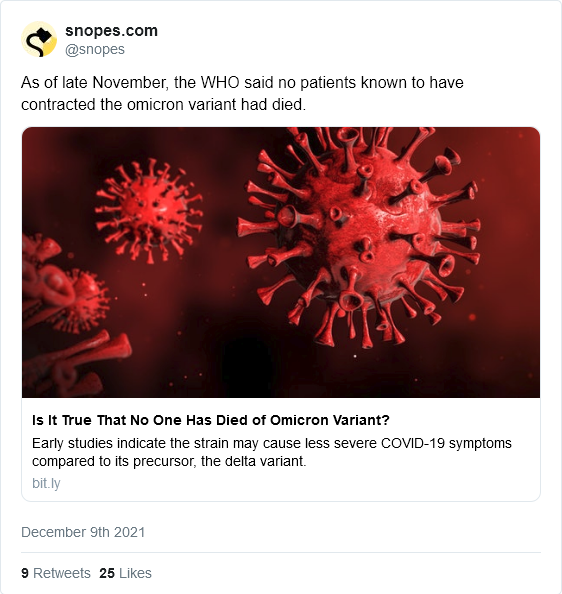
I’m not sure how trustworthy Snopes is, but they say the number so far is … zero.

Zip.

Zilch.

Goose egg.

1 – 1.

None.

So please excuse me if I don’t freak the hell out every time somebody gets Omicron. Every story about it lists the number of cases but glosses over minor little details. Like what happens to the people who get it.

Do they get sick?

If so, how sick do they get?

If not, what’s the problem?

The media is just selling fear, as usual. Yes, COVID-19 is real, and a lot of people have died. No, nobody is dying from this Omicron variant. That’s good news, which is why the “news” isn’t interested.

Of course, on the weekend British PM Boris Johnson announced the death of someone in Britain who had contracted the Omicron variant … but it’s not clear if the person’s death was a direct result of that infection. So, we know at least one person has died with the Omicron variant, but we don’t know if it was from it.

December 10, 2021

QotD: The media and the replication crisis

Filed under: Health, Media, Quotations, Science — Tags: , , , , — Nicholas @ 01:00

Here is the iron law of medical — in fact all scientific — studies in the modern world: most do not replicate. This has always been true of studies that supposedly find some link between doing [thing we enjoy] and cancer. This of course does not stop the media from running with initial study results based on 37 study participants as “fact”. The same is true for studies of new drugs and treatments. Most don’t pan out or are not nearly as efficacious as early studies might indicate. We have seen that over and over during COVID.

Warren Meyer, “A Couple of Thoughts on Medical Studies Given Recent Experience”, Coyote Blog, 2021-08-31.

November 19, 2021

Viewing-with-alarm … from afar

Filed under: Britain, Media, Politics, USA — Tags: , , , , , — Nicholas @ 05:00

In Spiked, Simon Evans explains why he finds British commentary on US hot-button issues like guns and race to be frequently uninformed but remarkably certain of itself:

What many Brits believe every American carries in their pickup trucks or on their persons, probably.

As a Brit, there are few things less edifying, nor more unintentionally hilarious, than an American newspaper reporting on any very English scandal. A breach of some obscure royal protocol, perhaps, or an aspect of parliamentary procedure, often involving Black Rod, which despite the capital B, the Washington Post will have to explain, is not a racial epithet, or an ill-advised tribute act.

A personal favourite is when a provincial dietary preference has caught the New York Times‘ eye, having unexpectedly “caught on” nationwide. It is an innocent enough pleasure, watching Americans trying to distinguish black pudding from haggis, or indeed gravy from “chippy sauce”. Like watching the Dutch discuss the morality of bullfighting, or Korea debate a proposed rule change in top flight Buzkashi.

Yet put the sneaker on the other foot and watch British commentators angrily contend the moral and legal thrust of a case in which an American is on trial for using lethal force with a firearm, and we suffer something very like Gell-Mann Amnesia by proxy. We forget how important a little local knowledge might be, and our seasoned, tolerant, bemused respect for tradition and culture and specialist knowledge are gone within moments. Watching the Kyle Rittenhouse case approach a verdict, British commentators are a-froth with indignation at the palpable miscarriages of justice seemingly running unchecked only five short hours away across the globe. My God, he had a gun ! What more is there to say? And – do I have this right? – he crossed state lines ! The man’s a monster.

Not since the proroguing of parliament two years ago have so many people become acquainted so quickly with something so arcane as the crossing of state lines with intent to do mischief. Putting aside the fact that the weapon itself did not cross this fabled demarcation, what is striking is the evident lack of enthusiasm for certain other state lines, such as the one somewhat further to America’s south, or indeed the one etched around the British Isles, that currently seem to get crossed on a pretty frequent basis, with who knows what intent? Drawing attention to those lines is clearly racist.

It was GB Shaw who first made the observation that GB’s shores were separated from the US’s by an ocean of incomprehension, concealed by our sharing a common language.

Rather like urban Canadians, most British readers and viewers tend to agree with the opinions expressed in US mainstream media based largely in urban coastal areas:

So, we don’t get the full spectrum argument. Instead, we gratefully share the apparent horror and shame of the coastal elite, with their tertiary education and their teeth that meet in the middle, when confronted with their inland, inbred in-laws. We deplore the multi-decade epidemic of what seems, if you read the Washington Post and the NYT, to be the largely white, Wild West assassination culture that 2A concedes. Bullets sprayed around schools. Shopping malls, synagogues and mosques running with blood. A death toll out of all control. Murder, cold-blooded and cruel – and largely in the service of a bigotry, as often as not a racial bigotry, as old as the Appalachians hills.

This is, to put it as mildly as one can without choking, not quite the whole story. Do your own due diligence, it isn’t hard. The editors of the NYT can’t stop you acquainting yourself with the FBI crime statistics, and they put some of the more notorious outbreaks of flying lead into useful perspective.

But generally, we instead swallow like sugary cough syrup (believing it good for us, no matter how delicious it also is) the narrative that guns are largely in the hands and lovingly tended racks of homicidal white supremacists, paranoid death-spiral redneck survivalists, and a police force that is barely superior in discipline, racial enlightenment or legitimacy to a rounded-up posse of ad hoc lynch-happy vigilantes.

November 15, 2021

QotD: Britain at war

England is the most class-ridden country under the sun. It is a land of snobbery and privilege, ruled largely by the old and silly. But in any calculation about it one has got to take into account its emotional unity, the tendency of nearly all its inhabitants to feel alike and act together in moments of supreme crisis. It is the only great country in Europe that is not obliged to drive hundreds of thousands of its nationals into exile or the concentration camp. At this moment, after a year of war, newspapers and pamphlets abusing the Government, praising the enemy and clamouring for surrender are being sold on the streets, almost without interference. And this is less from a respect for freedom of speech than from a simple perception that these things don’t matter. It is safe to let a paper like Peace News be sold, because it is certain that ninety-five per cent of the population will never want to read it. The nation is bound together by an invisible chain. At any normal time the ruling class will rob, mismanage, sabotage, lead us into the muck; but let popular opinion really make itself heard, let them get a tug from below that they cannot avoid feeling, and it is difficult for them not to respond. The left-wing writers who denounce the whole of the ruling class as “pro-Fascist” are grossly over-simplifying. Even among the inner clique of politicians who brought us to our present pass, it is doubtful whether there were any conscious traitors. The corruption that happens in England is seldom of that kind. Nearly always it is more in the nature of self-deception, of the right hand not knowing what the left hand doeth. And being unconscious, it is limited. One sees this at its most obvious in the English Press. Is the English press honest or dishonest? At normal times it is deeply dishonest. All the papers that matter live off their advertisements, and the advertisers exercise an indirect censorship over news. Yet I do not suppose there is one paper in England that can be straightforwardly bribed with hard cash. In the France of the Third Republic all but a very few of the newspapers could notoriously be bought over the counter like so many pounds of cheese. Public life in England has never been openly scandalous. It has not reached the pitch of disintegration at which humbug can be dropped.

George Orwell, “The Lion And The Unicorn: Socialism and the English Genius”, 1941-02-19.

November 14, 2021

The Media — declining to report the news and instead depleting the strategic reserve of Narrativium

Filed under: Business, Government, Media, Politics, USA — Tags: , , , , , — Nicholas @ 05:00

This week’s excerpt from Andrew Sullivan’s Weekly Dish explores the many, many ways that the mainstream media have been actively abandoning any semblance of informing their audience and instead now concentrate almost exclusively on propagandizing them:

The news is a perilous business. It’s perilous because the first draft of history is almost always somewhat wrong, and needs a second draft, and a third, and so on, over time, until the historian can investigate with more perspective and calm. The job of journalists is to do as best they can, day by day, and respond swiftly when they screw up, correct the record, and move forward. I’ve learned this the hard way, not least in the combination of credulousness and trauma I harbored in the wake of 9/11.

But when the sources of news keep getting things wrong, and all the errors lie in the exact same direction, and they are reluctant to acknowledge error, we have a problem. If you look back at the last few years, the record of errors, small and large, about major stories, is hard to deny. It’s as if the more Donald Trump accused the MSM of being “fake news” the more assiduously they tried to prove him right.

You know the situation is bad when Andrew Sullivan references Donald Trump without a sneer!

We found out this week, for example, that a key figure in the emergence of the Steele Dossier, Igor Danchenko, has been indicted for lying to the FBI. He is also charged with asking a Clinton crony, Charles Dolan Jr: “Any thought, rumor, allegation. I am working on a related project against Trump.”

The evidence from another key source for the dossier, Sergei Millian — touted across all media, including the Washington Post — has also been exposed as potentially fake. What has the Post done? As their own indispensable Erik Wemple notes, instead of a clear retraction, the Post has just added editors’ notes to previous stories, removed sections and a video, and altered headlines retroactively. This is a bizarre way of correcting the record: “No such case comes immediately or specifically to mind, at least no historical case that stirred lasting controversy,” said W. Joseph Campbell, a professor and journalism historian at American University.

This doesn’t mean that Trump wasn’t eager for Russian help. But Trump was right, in the end, about the dodgy dossier; he was right about the duped FBI’s original overreach; and the mass media — Rachel Maddow chief among them — were wrong. And yet the dossier dominated the headlines for three years, and the “corrections” have a fraction of the audience of the errors. Maddow gets promoted. And the man who first published it, Ben Smith, was made the media columnist for the NYT.

Think of the other narratives the MSM pushed in recent years that have collapsed. They viciously defamed the Covington boys. They authoritatively told us that bounties had been placed on US soldiers in Afghanistan by Putin — and Trump’s denials only made them more certain. They told us that the lab-leak theory of Covid was a conspiracy theory with no evidence behind it at all. (The NYT actually had the story of the leak theory, by Donald McNeil, killed it, and then fired McNeil, their best Covid reporter, after some schoolgirls complained he wasn’t woke.) Wrong. Wrong. Wrong.

The MSM took the ludicrous story of Jussie Smollett seriously because it fit their nutty “white supremacy” narrative. They told us that a woman was brutally gang-raped at UVA (invented), that the Pulse mass shooting was driven by homophobia (untrue) and that the Atlanta spa shooter was motivated by anti-Asian bias (no known evidence for that at all). For good measure, they followed up with story after story about white supremacists targeting Asian-Americans, in a new wave of “hate”, even as the assaults were disproportionately by African Americans and the mentally ill.

As Greenwald noted, the NYT “published an emotionally gut-wrenching but complete fiction that never had any evidence — that Officer Sicknick’s skull was savagely bashed in with a fire extinguisher by a pro-Trump mob until he died.” The media told us that an alleged transgender exposure in the Wi Spa in Los Angeles was an anti-trans hoax (also untrue). They told us that the emails recovered on Hunter Biden’s laptop were Russian disinformation. They did this just before an election and used that claim to stymie the story on social media. But they were not Russian disinformation. They were a valid if minor news story the media consciously kept from its audience for partisan purposes.

November 12, 2021

One Pretendian’s “cultural Munchausen syndrome”

In Thursday’s NP Platformed newsletter, Colby Cosh updates us on the story of Carrie Bourassa, who had effortlessly surfed to high profile, well-remunerated positions at the University of Saskatchewan and with the federal government largely on the basis of her claimed First Nations background:

Carrie Bourassa with media.
Lead photo in Geoff Leo’s article for the CBC – https://www.cbc.ca/newsinteractives/features/carrie-bourassa-indigenous

Newspapers have a slightly nasty characteristic: it’s easy for them to get pre-emptively mad when institutions are a little slow to do the right thing, and it’s also easy for them to forget to give credit when those institutions get around to it.

So let’s acknowledge that the federal government and the University of Saskatchewan are dealing — as best they can, almost certainly — with their shared Carrie Bourassa problem.

Two weeks ago, CBC News investigative reporter Geoff Leo published an astonishing tour de force. His feature article established, beyond almost any doubt, that Bourassa, a high-profile Indigenous scholar who told and published countless stories of racist treatment and childhood adversity, is actually a fabulist from a wealthy white family. The Institute of Indigenous Peoples’ Health soon put Bourassa, its scientific director, on unpaid leave. The U of S suspended her with pay, probably having no better immediate alternative.

[…]

Since Prof. Bourassa was put on ice in her lucrative Aboriginal-health jobs, Indigenous folk have been labouring to explain in the press what was wrong with her concoction and aggressive peddling of a fake Métis upbringing on the mean streets of Regina. Drew Hayden Taylor’s Globe and Mail op-ed about Bourassa’s “cultural Munchausen syndrome” is instructive and funny, but we hope it is all right to tell Aboriginal-Canadians that no white settler with a lick of sense would consider Bourassa’s tapestry of falsehoods to be harmless “fibs”. This may be a self-serving observation, but her confabulations about her personal history wouldn’t be consistent with the standards of a newspaper, let alone those of a university.

About a year ago, the Saskatchewan Health Research Foundation gave Bourassa an award (not her first) and published a capsule summary of her career. If you read it, you will notice how she was, from time to time, offered career advancement out of the blue by Indigenous supporters who had been taken in by her stories. Even a white grad student living on ramen in a basement apartment might be a little ticked about this. The University of Saskatchewan’s original claim that Prof. Bourassa hadn’t benefited from claiming Aboriginal ancestry is pathetic hokum: Bourassa tellingly accused her own sister of “looking for … a way to make some money” by accepting Indigenous scholarship funds during her PhD studies.

And it probably occurred to the USask brass sometime between the two press releases that an investigative reporter like Leo, in taking on a topic, always looks a couple articles ahead. Bourassa, for example, claims to have suffered from tuberculosis in her late 20s — a useful credential, unfortunately, for someone studying the field of Indigenous health. It’s useful because the disease has been nearly eliminated among non-Indigenous Canadians: the incidence rate for First Nations is 40 times higher, and the cases tend to be concentrated in remote northern Indigenous communities. Even if we overlook Bourassa’s propensity for creative autobiography … well, if she contracted TB, she was certainly very unlucky.

« Newer PostsOlder Posts »

Powered by WordPress