Quotulatiousness

July 12, 2024

New Canadian submarines and icebreakers promised at NATO Summit

Filed under: Cancon, Military — Tags: , , , , , , , — Nicholas @ 05:00

Under reportedly intense pressure from NATO allies, Canadian Prime Minister Justin Trudeau grudgingly promises to begin the (usually decades-long) process of purchasing new submarines for the Royal Canadian Navy:
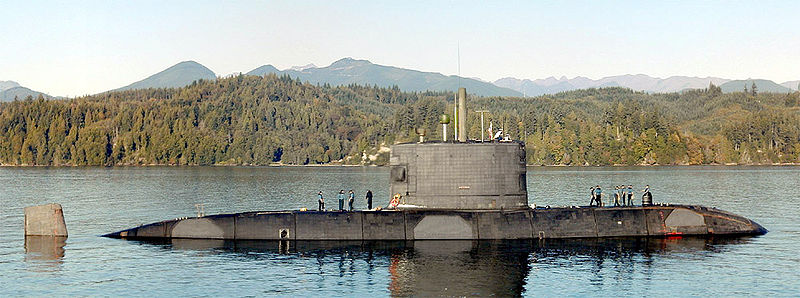
HMCS Victoria
Image via Wikimedia Commons.

The Canadian government announced today it is “taking the first steps” towards buying 12 conventionally-powered, under-ice capable submarines — a massive acquisition with numerous shipbuilders from the around world already eyeing the program reported to be worth at least $60 billion Canadian dollars.

“As the country with the longest coastline in the world, Canada needs a new fleet of submarines — and today, we’ve announced that we will move forward with this acquisition,” Bill Blair, minister of national defence, said in a statement published during the NATO Summit being held this week in Washington, DC. “This new fleet will enable Canada to protect its sovereignty in a changing world, and make valuable, high-end contributions to the security of our partners and NATO allies.”

Canada has been eyeing the acquisition of a new class of submarines to replace its four aging Victoria-class boats since at least April 2023, and Blair himself was the target of criticism earlier this year after he included language about the acquisition in a major defense policy document that critics labeled as “wishy washy”.

In an op-ed for Breaking Defense published ahead of the NATO summit, Blair said that Canada was still pursing the submarine plan, and emphasized that the investment would help his nation cross the 2 percent GDP target.

The government’s press release does not include a price estimate for the program, but the Ottawa Citizen has previously reported that the Royal Canadian Navy tagged the acquisition at $60 billion Canadian dollars ($44 billion USD).

Another item from Breaking Defence details a new trilateral agreement with Finland and the United States to develop a joint design for a “fleet” of icebreakers:
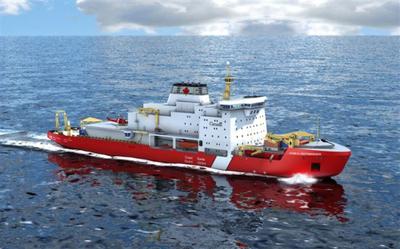
Originally ordered in 2008 for delivery in 2017, the CCGS John G. Diefenbaker is now expected to enter service in 2030.
Canadian Coast Guard conceptual rendering, 2012.

The US, Canada and Finland announced today a new trilateral effort, dubbed the Icebreaker Collaboration Effort or “ICE Pact”, to work together on the production of a “fleet” of new polar icebreakers, in what a US official said was a “strategic imperative” in the race of dominance of the high north.

The initiative, to be formalized in a memorandum of understanding by the end of the year, calls for better information sharing on ship production, collaboration on work force development — including better allowing workers and experts to train at each other’s yards — and an “invitation” to other allies and partners to buy icebreakers from ICE Pact members.

“Due to the capital intensity of shipbuilding, long-term, multi-ship orderbooks are essential to the success of a shipyard,” the White House said in its announcement. “The governments of the United States, Canada, and Finland intend to leverage shipyards in the United States, Canada, and Finland to build polar icebreakers for their own use, as well as to work closely with likeminded allies and partners to build and export polar icebreakers for their needs at speed and affordable cost.”

Ahead of the announcement, White House Deputy National Security Advisor for International Economics Daleep Singh framed the partnership as a commercial and industrial boon, but also one with national security implications: It is, in part, a message to Russia and China that the US and its partners “intend … to project power into the polar regions to enforce international norms and treaties that promote peace and prosperity in the arctic and Antarctic.”


June 5, 2024

HMCS Charlottetown: A formidable submarine-hunting force in Nato’s fleet

Filed under: Britain, Cancon, Military — Tags: , , , , — Nicholas @ 02:00

Forces News
Published Mar 1, 2024

Conceived in the middle of the Cold War era, the Canadian Royal Navy frigate HMCS Charlottetown has evolved over three decades of service, becoming one of the most capable and adaptable ships in Canada’s navy.

After setting sail for Nato’s Exercise Steadfast Defender in the North Sea, she made a stop in Edinburgh en route to participating in the alliance’s largest training mission since the Cold War.
(more…)

May 29, 2024

Why Germany Lost the Battle of the Atlantic

Filed under: Britain, Cancon, Germany, History, Military, USA, WW2 — Tags: , , , , , — Nicholas @ 02:00

Real Time History
Published Feb 2, 2024

In March 1943, German U-boats are on the attack – they sink 108 Allied vessels that month alone. Some Allied officials fear a German victory in the Atlantic is imminent. If the Allies lose the Atlantic, Britain loses its lifeline – and maybe even the war. But by May 1943, it will be the U-boats limping home in defeat. So how, in just two months, did the U-boats go from hunters to hunted?
(more…)

May 19, 2024

Kamikazes versus Admirals! – WW2 – Week 299 – May 18, 1945

World War Two
Published 18 May 2024

The kamikaze menace continues unabated, with suicide flyers hitting not one but two admirals’ flagships. There’s plenty of fighting on land, though, as the Americans advance on Okinawa and take a dam on Luzon to try and solve the Manila water crisis, but even after last week’s German surrender there is also still scattered fighting in Europe.

Chapters
01:34 The Battle of Poljana
06:32 American Advances on Okinawa
10:37 Kamikazes Versus the Admirals
13:58 The Battle for Ipo Dam
19:39 Soldiers Must Go From Europe to the Pacific
23:16 Summary
23:38 Conclusion
25:50 Call to Action
(more…)

May 18, 2024

Glory Days of the Kamikaze! – Operation Kikusui

Filed under: Britain, History, Japan, Military, Pacific, USA, WW2 — Tags: , , , , , — Nicholas @ 04:00

World War Two
Published 17 May 2024

During the Battle of Okinawa, the Japanese see the opportunity to cripple the core of the Allied navies. With their conventional air and naval forces unable to challenge the Allies, the Japanese unleash a wave of mass Kamikaze attacks. Hundreds of suicide pilots smash their aircraft into the Allied fleet. This is Operation Kikusui.
(more…)

HMS Victory: Returning Nelson’s flagship to her former glory

Filed under: Britain, History, Military, Woodworking — Tags: , — Nicholas @ 02:00

Forces News
Published Feb 10, 2024

HMS Victory is undergoing a massive restoration and conservation programme costing around £45m.

Lord Nelson’s flagship at the Battle of Trafalgar is being stripped right back and having all the rotten wood removed.

Forces News was given exclusive access to the ship, preserved for all to enjoy at the National Museum of the Royal Navy in Portsmouth, to see the progress that’s being made.
(more…)

May 15, 2024

Fiji in World War Two: the Momi Bay Gun Battery

Filed under: Britain, History, Military, Pacific, Weapons, WW2 — Tags: , , , , , — Nicholas @ 02:00

Forgotten Weapons
Published Feb 3, 2024

When the clouds of World War Two began to loom in the 1930s, Britain decided to begin securing some of its more distant colonial outposts — places that might be of strategic importance in a future conflict. Fiji was once of these outposts — a vital point on the seagoing supply line from Europe and the Americas to Australia and Asia. Construction of coastal defense batteries began in the late 1930s, mostly using 6 inch MkVII naval guns. These batteries were constructed around the capital of Suva and the airfield at Nadi on the west side of the island.

Today we are at the Momi Bay Battery, just south of Nadi. This emplacement has been restored and is maintained as a public museum site by the Fijian government today. It houses two 6 inch guns (the King’s Gun and the Queen’s Gun, colloquially), and originally also included an optical rangefinder and various command and control buildings. It had a range of about 8 miles, and controlled one of the few natural approaches to western Fiji.

The guns here were only fired in anger once, and that was actually at an unidentified sonar contact in the Bay. No evidence of an enemy vessel was ever found, and it ended up just being a brief reconnaissance by fire, so to speak. By later in the war, the threat of Japanese invasion had passed, but Fiji remained an active part of the war effort, as a transportation hub and a site for soldiers to get some R&R outside of combat duties. This led to the creation of the successful tourist economy which remains vibrant today on the island.
(more…)

May 13, 2024

Roman Legions – Sometimes found all at sea!

Drachinifel
Published Feb 2, 2024

Today we take a quick look at some of the maritime highlights of the new special exhibition at the British Museum about the Roman Legions:
https://www.britishmuseum.org/exhibit…
(more…)

May 12, 2024

The fascinating story of HMS Challenger (K07)

Filed under: Britain, History, Military — Tags: , , , , , , — Nicholas @ 05:00

Sir Humphrey pens a long blog post about a late Cold War Royal Navy ship — officially just a “diving support vessel”, but apparently much more capable — most naval fans may never have heard about:

HMS Challenger (K07) at Kiel, West Germany in 1985.
Photo by John Cook via Wikimedia Commons.

The story of HMS Challenger remains one of the most unusual of all post war Royal Navy vessels. Born in the late Cold War, she was in the eyes of the public a “white elephant” commissioned and never operationally used and sold after just a few years’ service at the end of the Cold War. She was to the few public that had heard of her, “the Warship that never was”. But revealing files in the National Archives tell a story of a ship that was designed to fill a range of highly secretive intelligence support functions and clandestine espionage activity that, had she been successful, would have made her perhaps one of the most vital intelligence collection assets in the UK. This article is about the untold story of HMS Challenger and why she deserves far more recognition than enjoyed to date.

The background of the Challenger story can be traced to the mid 1970s when the Royal Navy used the, by then positively venerable, warship HMS Reclaim to conduct diving support work. The Reclaim, commissioned in 1949 was the last warship in the RN to be designed and fitted with sails, that were occasionally used. Employed in diving support and salvage ops for 30 years, she was a vital asset for the recovery of crashed aircraft, support to diving and other assorted duties. But by 1975 she was also very old and out of date and requiring replacement (she paid off as the oldest operational vessel in the Royal Navy in 1979).

To replace her the Royal Navy developed Naval Staff Requirement 7003 and 7741, which were approved in 1976. These requirements set out the need for a replacement and the capabilities that were required. By this stage of the Cold War the world was a very different place both operationally and technologically from when HMS Reclaim entered service. There were significantly more undersea cables laid across the Atlantic, while the SOSUS network (a deep-water network of sonar systems intended to detect Russian submarines) had been delivered and expanded into UK waters in the early 1970s under project BACK SCRATCH. Additionally the Royal Navy had introduced a few years previously the Resolution class SSBN, which by 1976 had four submarines providing a Continuous At Sea Deterrent (CASD) with their Polaris missiles, as well as wider nuclear submarine operations. At the same time new technology was emerging including better diving capability, the rise of miniature submarines capable of both operating at immense depths and also the rise of rescue submarines for stranded nuclear submarines. Additionally technology had improved increasing the ability to recover items from the seabed.

When brought together this provided the RN with the opportunity to think afresh about how to replace Reclaim. The result was a set of requirements that were defined as follows:

    The objective of NSR 7003 was to provide the Royal Navy with a Vessel and equipment capable of carrying out seabed operations. The requirement … is to find, inspect, work on and recover items on the seabed at all depths down to 300m with some capability to greater depths.

The specific missions for which the requirement was looking to cater for broke down into three main areas:

  1. Inspection, neutralisation or recovery of military equipment, including weapons;
  2. Operations in support of national offshore interests including research;
  3. Assistance with submarine escape and rescue and with underwater salvage

This represented a significant leap forward compared to Reclaim, which was limited to diving at up to 90m in very limited conditions, and would have provided the Royal Navy with an entirely new level of capabilities.

The decision was taken to proceed with the requirement and Challenger was ordered in 1979 and commissioned in 1983. What then follows is a sorry story of a ship being brought into service and having practically everything that could go wrong, going wrong. This article will not go into any depth on the story of what failed, as to do so would be a lengthy story. Suffice to say that a combination of faulty equipment, manufacturing challenges, fires and other damages and the reality that technical aspirations were not matched by practical delivery in reality meant that Challenger never really became operational.

Used for a series of trials until the late 1980s to prove her systems and see if they would work, she struggled to achieve what was expected of her. She had some success recovering toxic chemicals from the seabed from a sunken merchant ship in the 1980s and then conducting other demonstrations, such as deep diving and supporting submarine rescue trials. But she never lived up to the expectations placed on her, and at a time when the costs required to get her to the level of capability were far too high, and the defence budget was under pressure at a point when the Warsaw Pact threat was rapidly collapsing, the decision was taken to pay her off as a failed experiment even before the wider Options for Change plan was announced. This much is widely known to the public, but what is nowhere near as well known is the missions that Challenger was intended to carry out. Had she been successful, it would have made a very real difference to RN capabilities.

Why did the Royal Navy seem so determined to make a success of Challenger for so many years, to the extent of throwing ever more money at her, given these problems? In short because the missions she was designed to do made it worthwhile. Files in the archives clearly show that beyond the public line of “research” she was designed to carry out exceptionally sensitive missions. Although the original Naval Staff Requirement focused on three areas, by the time she entered service, this had expanded to at least 9 (possibly more). These were:

  1. Strategic Deterrent Force Security
  2. Seabed surveillance device support
  3. Nuclear weapon recovery
  4. Recovery of security and military sensitive material
  5. Crashed military aircraft recovery
  6. Submarine escape and rescue operations
  7. Salvage operations
  8. MOD research and data collection for other than intelligence agencies
  9. Miscellaneous operations in support of other government agencies

It can be seen that far from being just a diving support platform, Challenger was in fact an absolutely central part in providing assurance to the protection of CASD and ensuring the security of the nuclear deterrent and SOSUS. How would she have done this?

The files show that in the 1980s the UK had a different attitude to the US about protection of these routes due to geographic differences.

May 8, 2024

QotD: Imperial Spain’s “House of Trade”

Filed under: Europe, History, Quotations — Tags: , , , , — Nicholas @ 01:00

Since 1503, the Spanish port of Seville had been home to the Casa de Contratación, or House of Trade. In one sense, the Casa was an administrative centre. It was where all taxes and duties on trade with the New World were collected. In another sense, however, it was the sixteenth century’s most important research and development hub. It was where the maps were made. Anyone who crossed the Atlantic was to check in with the Casa and share their information. There, the expert pilots, astronomers, mathematicians, and cartographers, were to sort out the sailors’ tall tales from the careful observations of coastlines. The Casa institutionalised the practice of gathering information – everything from the locations of safe havens or treacherous rocks, to the willingness of local populations to talk to strangers, to the raw materials glimpsed in newfound lands – all to be collated, evaluated, and then re-disseminated into manuals, lectures, and maps. It was where new pilots were instructed, and where navigational instruments were constructed and regulated. The Casa was a living encyclopaedia of navigation, for every would-be Spanish merchant, coloniser, or explorer to consult.

And it was something that the English tried, for decades, to emulate. Before they embarked on their first explorations of the icy seas around Russia in the 1550s, they first poached the Casa‘s principal navigator, the Pilot Major, Sebastian Cabot. And later, during the few years that England and Spain were united in matrimony, under Mary I, one English navigator, Stephen Borough, had the chance to visit and glean some of its secrets. He was instrumental in having Spain’s key navigational manual translated in English, and he petitioned Elizabeth I to create an English version of the Casa. That dream never materialised, but the quest to emulate the Casa informed many of the smaller-scale projects — lectures, manuals, globes, and maps — which meant that the English did not sail completely into the unknown.

Anton Howes, “The House of Trade”, Age of Invention, 2019-11-13.

May 1, 2024

Lobscouse, Hardtack & Navy Sea Cooks

Filed under: Britain, Food, History, Military — Tags: , , , , , — Nicholas @ 02:00

Tasting History with Max Miller
Published Jan 23, 2024

Hearty meat and potato stew thickened with crushed hardtack (clack clack)

Recipe at https://www.tastinghistory.com/recipes
(more…)

April 25, 2024

Were the Waffen-SS Really Germany’s Elite Fighters? – WW2 – OOTF 35

World War Two
Published 24 Apr 2024

It’s time for another thrilling installment of Out of the Foxholes, but what sort of questions does Indy answer today? Well, it’s good stuff — about Allied security and logistics at the major conferences, about what the British navy was doing once the Atlantic and Mediterranean were secure, and about the skills (or lack thereof) of the soldiers of the Waffen SS. How can you live without knowing about such things? I suppose it’s possible, but it would be a sad life indeed, so check it out!
(more…)

April 22, 2024

QotD: Before England could rely on the “wooden walls” of the Royal Navy

Filed under: Britain, History, Military, Quotations — Tags: , , , , , , — Nicholas @ 01:00

… given this general lack of geographical knowledge, try to imagine embarking on a voyage of discovery. To an extent, you might rely on the skill and experience of your mariners. For England in the mid-sixteenth century, however, these would not have been all that useful. It’s strange to think of England as not having been a nation of seafarers, but this was very much the case. Its merchants in 1550 might hop across the channel to Calais or Antwerp, or else hug the coastline down to Bordeaux or Spain. A handful had ventured further, to the eastern Mediterranean, but that was about it. Few, if any, had experience of sailing the open ocean. Even trade across the North Sea or to the Baltic was largely unknown – it was dominated by the German merchants of the Hanseatic League. Nor would England have had much to draw upon in the way of more military, naval experience. The seas for England were a traditional highway for invaders, not a defensive moat. After all, it had a land border with Scotland to the north, as well as a land border with France to the south, around the major trading port of Calais. Rather than relying on the “wooden walls” of its ships, as it would in the decades to come, the two bulwarks in 1550 were the major land forts at Calais and Berwick-upon-Tweed.

Anton Howes, “The House of Trade”, Age of Invention, 2019-11-13.

April 20, 2024

Cape Esperance and the Japanese Evacuation of Guadalcanal

Filed under: History, Japan, Military, Pacific, USA, WW2 — Tags: , , , , — Nicholas @ 02:00

Forgotten Weapons
Published Jan 12, 2024

Today we return to Guadalcanal, to the site of the last actions of the campaign. For the Japanese, the defeat at Edson’s Ridge (aka Bloody Ridge) forced a disastrous and uncoordinated retreat into the jungle. With their supply lines destroyed, Japanese troops largely moved west on the island, away from American positions and in search of food. This would eventually bring them to Cape Esperance, where a rearguard force was landed, and some 10,652 Japanese soldiers were successfully evacuated on fast-moving destroyers over the course of several nights in early February, 1943.

On the American side, Army troops landed to relieve the Marines. In January and into early February they ran what was considered a mopping-up campaign west, including landings on the far west end of the island beyond Esperance. The intention was to encircle the remaining Japanese forces, under the assumption that the destroyer activity was landing fresh troops. Instead, when the American forces joined up at Cape Esperance it was an anticlimactic end to the fighting, as all they found were remnants of equipment that had been left on the beaches.
(more…)

April 10, 2024

Saving Our Democracy watch – “[Trump] has to do at least ten years, or everybody will hate the navy”

Filed under: Government, Law, Military, Politics, USA — Tags: , , , , — Nicholas @ 04:00

Chris Bray suggests that reading the full linked document may be hazardous to your mental health, so he’s helpfully highlighted a few of the key points that may have you scratching your head and saying something like “The Fuh? What??”

I have a mixed view of Donald Trump’s argument about presidential immunity, which you can read here. But an amicus brief filed with the Supreme Court today by retired flag officers and service secretaries is so bizarre that reading it may permanently alter the structure of my face.

You can read the whole amicus brief here, but treat it like a solar eclipse and don’t stare at it directly. As a first sign of how much good faith the thing contains, one of the amici is Michael Hayden.

The first argument is that Trump has to go to prison or else civilians won’t control the military anymore. You think I’m kidding.

Amici are deeply interested in this case because presidential immunity from criminal prosecution would threaten the military’s role in American society, our nation’s constitutional order, and our national security.” See the connection? If Donald Trump doesn’t go to prison, “the military’s role in American society” will be damaged. He has to do at least ten years, or everybody will hate the navy.

The prevailing feature of the entire brief is an essence of flattening. Every issue is very simple. There are no competing examples. None of this has ever come up before: The brief deals with questions of presidential immunity around Obama drone-killing a 16 year-old US citizen, or Lincoln unilaterally suspending habeas corpus and using the military to arrest critics of the war, by not mentioning any of it, or any other historical example. Everything is a surface. I’ve graded undergraduate essays, so the tone and depth of the effort feels familiar.

Third argument: Donald Trump has to be prosecuted, because America promotes democracy all over the world, and Trump not being prosecuted is against democracy, so it will be harder for us to promote democracy if we don’t prosecute him. Authoritarian regimes say that American democracy doesn’t work, so: “Presidential immunity from criminal prosecution feeds those false and harmful narratives. Unless Petitioner’s theory is rejected, we risk jeopardizing America’s standing as a guardian of democracy in the world and further feeding the spread of authoritarianism, thereby threatening the national security of the United States and democracies around the world.”

We have to imprison the leader of the political opposition, or people won’t think we’re a democracy, and then there will be more authoritarianism, like when regimes imprison the political opposition.

« Newer PostsOlder Posts »

Powered by WordPress