Thersites the Historian
Published 28 Oct 2021In this lecture, I cover Greek history from 478-404 BCE with an emphasis on the Peloponnesian War. This is intended as a primer on the topic and I devote more time to establishing the context and causes of the war than I do going through the details of conflict itself.
Patreon link: https://www.patreon.com/thersites
PayPal link: paypal.me/thersites
Discord: https://discord.gg/QCaXXFr
Brave Browser: https://brave.com/noa557
Twitter link: https://twitter.com/ThersitesAthens
Minds.com link: https://www.minds.com/ThersitestheHis…
Steemit/dtube link: https://steemit.com/@thersites/feed
BitChute: https://www.bitchute.com/channel/jbyg…
February 11, 2022
The Peloponnesian War: Athens vs. Sparta (Context and Overview)
February 10, 2022
HMCS Quebec – Guide 145
Drachinifel
Published 28 Sep 2019HMCS Quebec, formerly HMS/HMCS Uganda, is today’s other entry.
Want to support the channel? – https://www.patreon.com/Drachinifel
Want a shirt/mug/hoodie – https://shop.spreadshirt.com/drachini…
Want a medal? – https://www.etsy.com/uk/shop/Drachinifel
Want to talk about ships? https://discord.gg/TYu88mt
Want to get some books? www.amazon.co.uk/shop/drachinifel
Drydock Episodes in podcast format – https://soundcloud.com/user-21912004
February 8, 2022
Roman Republic to Empire: 01 Mistress of the Mediterranean
seangabb
Published 21 Jan 2021[Update 2023-03-02 – Dr. Gabb took down the original posts and re-uploaded them.]
In 120 BC, Rome was a republic with touches of democracy. A century later, it was a divine right military dictatorship. Between January and March 2021, Sean Gabb explored this transformation with his students. Here is one of his lectures. All student contributions have been removed.
(more…)
January 30, 2022
QotD: Montgomery on the advance after El Alamein
A curious incident occurred as our light forces were moving forward south of Benghazi. I was right up behind the leading armoured cars, reconnoitering the area; I had a small escort with me. We had outstripped the fighter cover and from time to time enemy aircraft strafed the road; it was not a healthy place and I suppose that I ought not to have been there.
Suddenly I saw a lorry coming up from behind, and on it a large boat; a naval Petty Officer sat with the driver and some sailors were inside.
I stopped the lorry and said to the Petty Officer: “What are you doing here? Do you realise that you are right up with the most forward elements of the Eighth Army, and you and your boat are leading the advance? This is a very dangerous area just at present, and you are unarmed. You must turn round and go back at once.”
He was dreadfully upset. He had been ordered to open up a “petrol point” at a small cove well to the north of Mersa Brega; small naval craft were to land petrol at this point in order that the leading armoured car regiments could refill their tanks; this was the easiest way of getting petrol and oil to them. He explained this to me, looking at me with pleading eyes rather like a spaniel asking to be taken for a walk to hunt rabbits.
He then said: “Don’t send me back, sir. If the armoured cars don’t get their petrol, they will have to halt and you will lose touch with the Germans. Couldn’t I go on with you? I would then be quite safe.”
That Petty Officer was clearly a student of psychology! In point of fact I did not know about these small petrol points for the armoured cars; it was a staff plan and a very good one. I took the naval party forward with me and saw them safely to their cove, where I was their first customer for petrol. I have often thought of that Petty Officer; he was from the Merchant Navy and in the R.N.V.R.; his sense of duty was of the highest order, and Britain will never lose her wars so long as the Royal Navy can count on men like him.
Bernard L. Montgomery, The Memoirs of Field-Marshal Montgomery, 1958.
January 22, 2022
World War Zero – The Russo Japanese War
The Great War
Published 21 Jan 2022Get the Smartest Bundle in Streaming: https://smartbundle.com/thegreatwarsb
The Russo-Japanese War is nicknamed World War Zero – it was a clash between two world powers that foreshadowed war on an industrial scale as seen just 10 years later again. Gigantic land battles like the Battle of Mukden showed the true cost in manpower and materiel when modern armies clashed and the naval side of the war showed the strategic importance of modern navies.
» SUPPORT THE CHANNEL
Patreon: https://www.patreon.com/thegreatwar» THANKS TO OUR CO-PRODUCERS
John Ozment, James Darcangelo, Jacob Carter Landt, Thomas Brendan, Kurt Gillies, Scott Deederly, John Belland, Adam Smith, Taylor Allen, Rustem Sharipov, Christoph Wolf, Simen Røste, Marcus Bondura, Ramon Rijkhoek, Theodore Patrick Shannon, Philip Schoffman, Avi Woolf,» BIBLIOGRAPHY
Akiyama Saneyuki, Gundan (Tokyo: Jitsugyō no Nihonsha, 1917)Atsuo Yokoyama; Toshikatsu Nishikawa & Ichō Konsōshiamu, Heishitachi ga mita Nichi-Ro sensō, (Tokyo: Yūzankaku, 2012)
Corbett, Julian S., Maritime Operations in the Russo-Japanese War, 1904-1905, Volume I, (Annapolis, MD: Naval Institute Press, 2015)
Corbett, Julian S., Maritime Operations in the Russo-Japanese War, 1904-1905, Volume II, (Annapolis, MD: Naval Institute Press, 2015)
Деникин А. И. Путь русского офицера. (Нью-Йорк: Изд. им. А. Чехова, 1953)
Forczyk, Robert, Russian Battleship vs Japanese Battleship: Yellow Sea 1904-05, (Oxford: Osprey Publishing Ltd, 2009)
Hamby, Joel E, “Striking the Balance: Strategy and Force in the Russo-Japanese War” Armed Forces & Society, Vol. 30, No. 3 (2004)
Hosokawa Gentarō, Byōinsen Kōsai Maru kenbunroku (Tokyo: Hakubunkan Shinsha, 1993)
Ivanov, A & Jowett P, The Russo-Japanese War 1904-05, (Oxford: Osprey Publishing Ltd, 2004)
Jacob, Frank, The Russo-Japanese War and its Shaping of the Twentieth Century, (London: Routledge, 2017)
Jukes, Geoffrey, The Russo-Japanese War 1904-1905, (Oxford: Osprey Publishing Ltd, 2014)
Kowner, Rotem (ed), Rethinking the Russo-Japanese War, 1904-5, Volume 1: Centennial Perspectives, (Folkestone: Global Oriental, 2007)
Lynch, George & Palmer, Frederick, In Many Wars By Many War Correspondnets, (Tokyo: Tokyo Printing Co. 1904)
Mozawa Yusaku, Aru hohei no Nichi-Ro Sensō jūgun nikki (Tokyo: Sōshisha, 2005)
Murakami Hyōe, Konoe Rentai ki (Tokyo: Akita Shoten, 1967)
Paine, S. C. M., The Japanese Empire: Grand Strategy from the Meiji Restoration to the Pacific War, (Cambridge: Cambridge University Press, 2017)
Steinberg, John W; Meaning, Bruce W; Schimmelpennick van der Oye, David; Wolff, David & Yokote, Shinji (eds.), The Russo-Japanese War in Global Perspective: World War Zero, (Leiden: Brill, 2005)
Stille, Mark, The Imperial Japanese Navy of the Russo-Japanese War, (Oxford: Osprey Publishing Ltd, 2016)
Takagi Suiu, Jinsei hachimenkan (Tokyo: Teikoku Kyōiku Kenkyūkai, 1927)
van Dijk, Kees, Pacific Strife: The Great Powers and Their Political and Economic Rivalries in Asia and the Western Pacific, 1870-1914, (Amsterdam: Amsterdam University Press, 2015)
Warner, Denis & Warner, Peggy, The Tide at Sunrise: A History of the Russo-Japanese War 1904-1905, (London: Angus & Robertson, 1974)
»CREDITS
Presented by: Jesse Alexander
Written by: Jesse Alexander
Director: Toni Steller & Florian Wittig
Director of Photography: Toni Steller
Sound: Toni Steller
Editing: Jose Gamez
Motion Design: Philipp Appelt
Mixing, Mastering & Sound Design: http://above-zero.com
Research by: Jesse Alexander
Fact checking: Florian Wittig
Channel Design: Yves ThimianContains licensed material by getty images
All rights reserved – Real Time History GmbH 2022

January 21, 2022
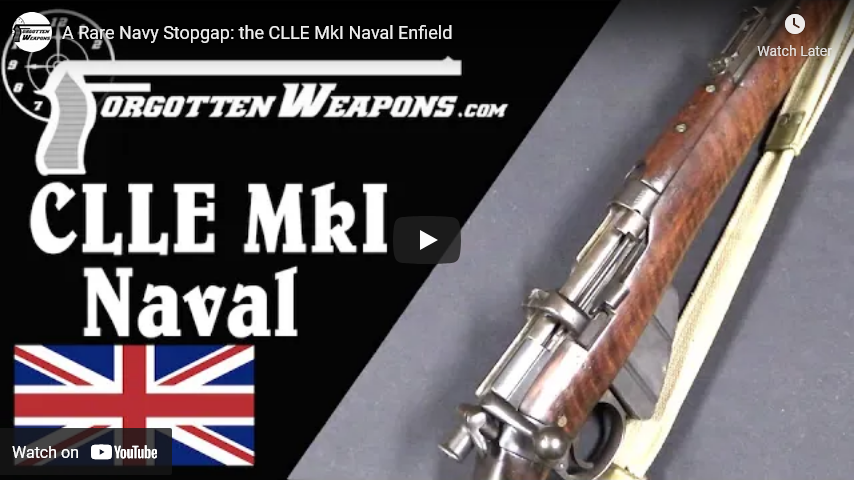
A Rare Navy Stopgap: the CLLE MkI Naval Enfield
Forgotten Weapons
Published 6 Sep 2021http://www.patreon.com/ForgottenWeapons
https://www.floatplane.com/channel/Fo…
Cool Forgotten Weapons merch! http://shop.forgottenweapons.com
The British Royal Navy tended to accumulate some of the obsolescent patterns of Enfield rifles around the turn of the 19th century, as the Army had higher priority for the new types of rifle. This resulted in a rather odd and poorly-documented pattern, the Charger-Loading Lee Enfield (CLLE) MkI Naval.
Produced around 1910-1912, these guns began as original production Long Lee (or Metford) rifles. In 1910, the new MkVII high velocity Spitzer ammunition was adopted, and it was largely issued on charger clips for use in the new SMLE rifles. The Royal Navy decided that it wanted to be able to use this ammunition, and so it converted some (exact numbers are unclear) of the old Long Lees with a mishmash of updates.
The rear sights were recalibrated for MkVII ammunition, but not changed in style. So, no windage adjustment was possible on either the front or rear.
A charger bridge was added, including a channel cut to allow a sight picture on the old-style sights. This also involved removing the early pattern dust covers on the bolts.
The resulting guns were marked “HV” for “high velocity” in front of their rear sights. The right side of the receiver socket retained the original production markings, and “CLLE MkI” was added to the left side of the sockets.
Contact:
Forgotten Weapons
6281 N. Oracle 36270
Tucson, AZ 85740
January 19, 2022
Triumph by Sea, Tragedy by Land – Supplying Guadalcanal – WW2 Special
World War Two
Published 18 Jan 2021Tens of thousands of Japanese soldiers were fighting over the jungles and beaches of Guadalcanal. To supply them with food, ammunition and medicine, the Japanese Navy had to resort to a series of daring supply runs — nicknamed the “Tokyo Express”. In the face of overwhelming American air superiority, the Tokyo Express had to find a tactic to overcome their enemy’s advantage, or it would doom its soldiers stranded on the island.
(more…)
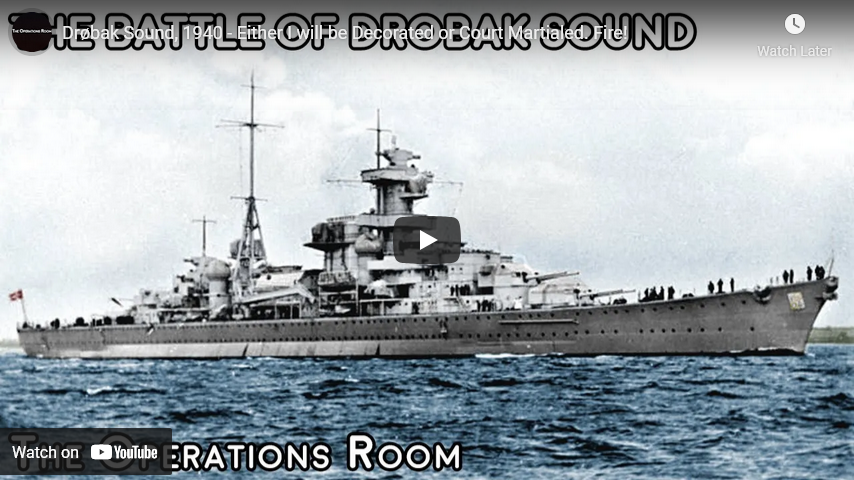
Drøbak Sound, 1940 – “Either I will be Decorated or Court Martialed. Fire!”
The Operations Room
Published 22 May 2021Peering through the darkness, Colonel Birger Eriksen spots a dark and menacing shape on the water. He can’t tell if its a friendly or enemy warship, but there’s no time to find out for sure. The dark and silent ship threatens his beloved Oslo. He must make his decision whether or not to fire. The German invasion of Norway has begun.
My “Group Captain” tier Patreons vote on my next video subject. If you’d like to have your say on my next video, please check out my Patreon at the link below:
https://www.patreon.com/TheOperations…https://twitter.com/The_Ops_Room
Special thanks to my Patreons: Abusemtex, Alexander K Leach, András Csányi, Bill Luster, Bryant Miano, Chris Faehl, Cody, dan, Dave Lombard, Dullis, e 141, Eric M, Flavio Ribeiro, Harmen, imfromthe808, Jeff Phillips, John Smaha, JONATHAN Vallett, Kole Pulley, libor riska, Luke Graham, Michael Choi, Miyama1018, omega21, PS, Richard Bejtlich, Shay Kneupper, Stephen James, wilbs43, Yurnero, Zachery Plaice, Aaron, Aaron Weisenburger, Alex Bell, Alex Pickworth, Andrew Ringquist, Axel Essbaum, Ben Harazim, Bodo Nuber, Brett VanBuren, Caleb DeArmas, Casual Observer, Christopher Cardona, Connor Kunihiro, Damien Dec, Darius Cosby, Dayan, Douglas, Ekstasis, Erick Velez, Escipio Sumski, Fredrick Wilson Nordby. Gaute, Geir Morten Soerensen, Graeme McEvoy, Gunship Sequel, Hanne Kortegaard Støchkel, Harrison A Tamke, Hunter Thornsberry, Innominate, Jack Baylor, Jack Mermod, Jack Parkin, Jackie Carson, Jason Wemyss, Jeffery Barnes, Jerry Xiao, Jessica Tiger, Jingold, Joe Robinson, John Harrison Herndon, John Walters, John Hesketh, Jordan Hedges, Joseph Sullivan, Justin Smith, Kurt Fox, Leo Maltoni, Luffylink, Luke Graham, LVE, Manfred Breuner, Michael J Jacobsen, Mike Thompson, Nick, Olufemi Adediwura, piranha45, Reese Spector, Richard Woodard, Rick Y-Bobby, Riley Matthews, Robby Gottesman, Robert Evans, Roderick Russell, Rory Weden, Ryan March, Siddharth Ahuwalia, Squerdle, The Man They Call Asher, Thomas Burton, Timothy Bucklin, UnicornStampede, Walter Kim, Warren Rudkin, Weston Hullander, Will Merrill, William Lydon, zintho9, Aaron Roberts, Alex Mackinnon, bascommander, Chris Roybal, Dave, Dylan Gilstein, e, Henry Buckley, Jack Lazarus, James Rosengrove, Johan West, john boland, Keven Guimaraes, Kristian Klibo, Marcelo Avila, Mark L., Mason, Matt, Matt Gonzales, Matthew Pulitano, Miguel, No Gods No Masters, Nicole Johnson, Peter S., The Rainmaker, Tommy Gates, Shikhir, Wolfgang Seitz, Wyatt Flynn Wilgus, Kelson Ball
January 17, 2022
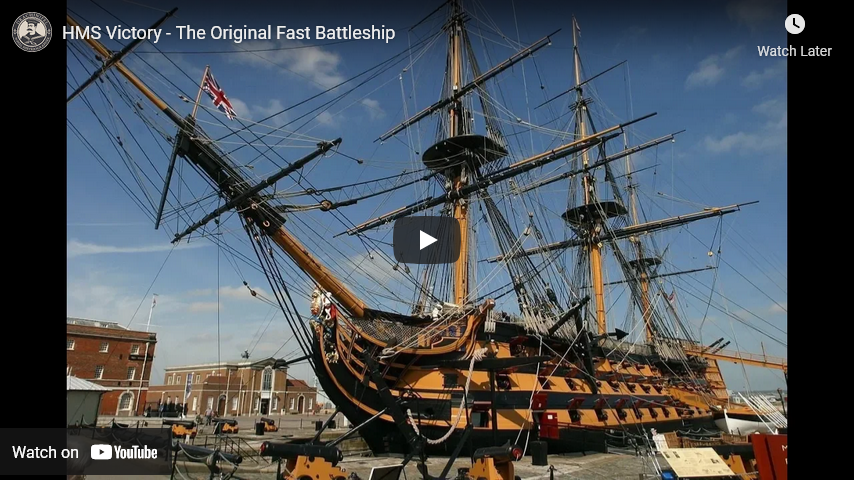
HMS Victory – The Original Fast Battleship
Drachinifel
Published 3 Jul 2019Today we look at the world’s oldest commissioned warship, the first rate ship of the line HMS Victory.
Want to support the channel? – https://www.patreon.com/Drachinifel
Want to talk about ships? https://discord.gg/TYu88mt
Music – https://www.youtube.com/c/NCMEpicMusic
January 15, 2022
Vietnam Mk18 Mod0 Hand-Crank Grenade Launcher
Forgotten Weapons
Published 20 Dec 2017http://www.patreon.com/ForgottenWeapons
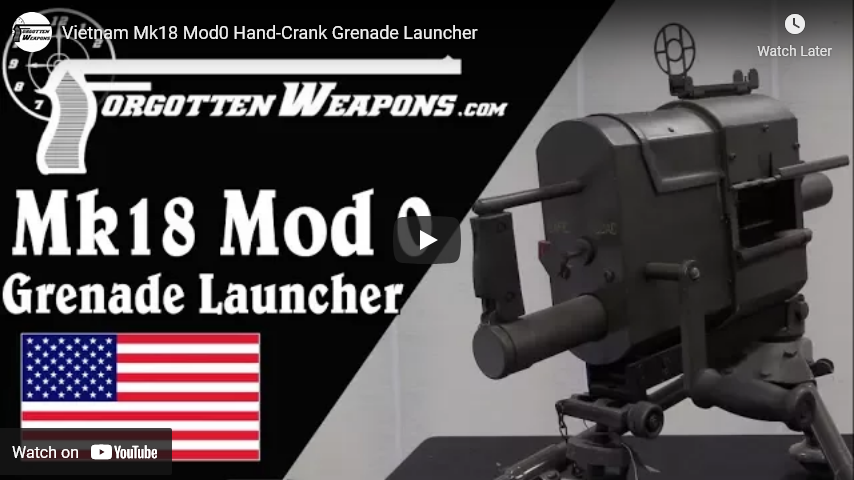
The Mk18 Mod0 grenade launchers was developed by the Honeywell corporation in 1962, and was the first weapon in what would became a category of high volume grenade launchers used by the US military. The modern iterations are all self-loading, but this first example was fired by a manual crank handle, like a Gatling gun. The Mk18 used the same 40x46mm grenade cartridge as the single shot M79 launcher, and this round’s low pressure allowed the Mk18 to use a rather unusual breech mechanism.
Unlike most belt-fed weapons, the cartridges in the Mk18 never left the belt. Instead, the breech consisted of two rotating spindles which would form the top and bottom halves of the chamber, closing around each shell as the handle was cranked. As a result, a loaded belt of grenades fed into the weapon, and a belt of empty cases came out the other side. Another effect of the low pressure cartridge was a rather short effective range, which limited adoption of the weapon to the US Navy, which bought 1200 and used them primarily on riverine patrol boats. In this application, the short effective range was not much of a hindrance, and the volume of high explosive firepower was a significant asset.
Armament Research Services (ARES) is a specialist technical intelligence consultancy, offering expertise and analysis to a range of government and non-government entities in the arms and munitions field. For detailed photos of this very cool early grenade launcher, don’t miss the ARES companion blog post:
Cool Forgotten Weapons merch! http://shop.bbtv.com/collections/forg…
January 8, 2022
Battle of the River Plate 1939: Minute-by-Minute
Historigraph
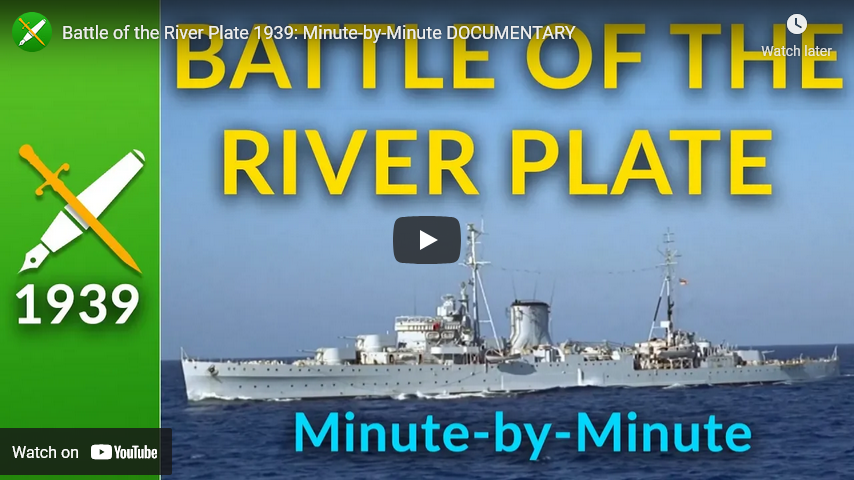
Published 24 Jul 2018The Battle of the River Plate took place in December 1939, and featured the Royal Navy cruisers Exeter, Achilles and Ajax, against the German Panzerschiffe, Graf Spee.
–
If you’d like to support the creation of more videos like this, please consider supporting us at: https://www.patreon.com/historigraph
If you’d like to join the historigraph community, consider joining my discord server, which is shared with my strategy gaming channel: https://discord.gg/f8JZw93
Follow the channel on Twitter: https://twitter.com/historigraph
And on facebook: https://www.facebook.com/historigraph/
Sources:
Richard Petrow, The Bitter Years: The invasion and Occupation of Denmark and Norway April 1940-May 1945 (London: Hodder and Stoughton, 1974). — The first chapter of the book includes a brief description of the hunt for the Graf SpeeCorelli Barnett, Engage The Enemy More Closely: The Royal Navy in the Second World War (London: Penguin, 1991)
Commodore Harwood’s own account of the battle, made available here: http://naval-history.net/WW2LGGrafSpe…
Graf Spee‘s voyage described here: https://www.deutschland-class.dk/admi…
Video clips from World of Warships gameplay and the Battle of the River Plate film, 1958
Music:
“Crypto” Kevin MacLeod (incompetech.com)
Licensed under Creative Commons: By Attribution 3.0 License
https://creativecommons.org/licenses/by/3.0/“Division” Kevin MacLeod (incompetech.com)
Licensed under Creative Commons: By Attribution 3.0 License
https://creativecommons.org/licenses/by/3.0/“Crossing the Chasm” Kevin MacLeod (incompetech.com)
Licensed under Creative Commons: By Attribution 3.0 License
https://creativecommons.org/licenses/by/3.0/Sound Effects:
Gunshots and so on are recordings from World of Warships, where the gameplay footage of the ships hails from.
January 2, 2022
And Now It’s 1943 … – WW2 – 175 – January 1st, 1943
World War Two
Published 1 Jan 2023The attrition cannot continue so the Japanese decide they will evacuate Guadalcanal, conceding the Solomon Islands to the Allies. The Allies are also conceding the Caucasus, and a naval battle in the far north convinces Hitler that he should scrap the entire German surface fleet. 1943 begins ominously for the Axis.
(more…)
December 9, 2021
The sequel to the British disaster at the Battle of Coronel, the German disaster at the Battle of the Falkland Islands
On December 8th, the people of the Falkland Islands observe “Battle Day” to commemorate the British naval victory off the islands in 1914. This is the bookend to the Battle of Coronel the previous month (described here and here), where a Royal Navy squadron was almost annihilated by Imperial Germany’s East Asia Squadron under Vice-Admiral Graf Maximilian von Spee. At the Battle of the Falkland Islands, an equally lop-sided victory eliminated von Spee’s ships with minimal damage to Rear Admiral Sir Frederick Doveton Sturdee’s squadron. In The Critic, A.S.H. Smyth outlines the events as shown in a British film released in 1927:

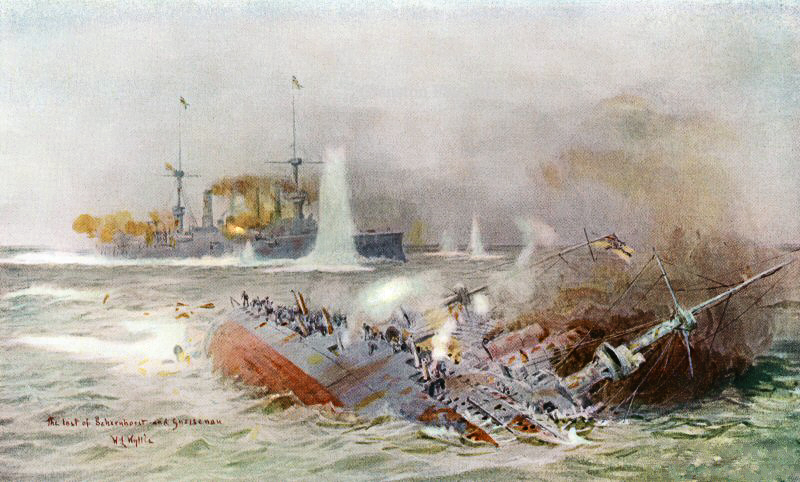
Battle of the Falkland Islands, 1914 by William Lionel Wyllie. SMS Scharnhorst rolls over and sinks while SMS Gneisenau continues to fight.
Originally published in 1918 by Cassel & Company. Retouched image via Wikimedia Commons
Rear Admiral Sir Frederick Doveton Sturdee (unimprovably British, isn’t it?), Chief of War Staff at the Admiralty, and at distinct risk of being scapegoated for the Coronel catastrophe, was summarily appointed Commander-in-Chief South Atlantic and Pacific(!) and despatched posthaste by [First Sea Lord John “Jackie”] Fisher (with whom he did not get on), on something of a do-or-die mission as the commander of new, eight-cruiser squadron.
The Admiral Superintendent of Devonport warns that Sturdee’s two battle cruisers, Invincible and Inflexible, cannot be ready before Friday the 13th November. First Lord of the Admiralty Winston Churchill balks at that ill-omened date, and orders that they sail on the 11th, ready or not. (Students of the 1982 conflict may see more than a couple of parallels here.) Cue: dockyard refitting montage.
Cut to the German colony at Valparaiso, where his countrymen fête von Spee’s glorious German victory in their first naval battle. “Damnation to the British Navy!” they want to toast. No, says, von Spee: “to a gallant enemy.” Handed a bouquet of flowers, he says he’ll keep them for his funeral “when my time comes.” For “when were the British ever content to leave an enemy to his triumph?”
Von Spee was well aware, it seems, that running the gauntlet up through the Atlantic was going to be a torrid prospect, even without a veangeful enemy on the look-out for him personally. But homeless (Tsingtau had fallen to the Japanese), in need of fuel, and down to half their ammunition, von Spee’s captains urged him now to head for Germany, and he agreed.
Von Spee’s ships were in need of dockyard maintenance and not steaming efficiently, but thanks to a captured British collier they were not in need of coal to be able to get home. Before setting off from where they’d been refuelling, Spee decided to strike another blow against the British and raid the Royal Navy’s supply base at Port Stanley in the Falkland Islands where only local militia were expected to be defending.
It was, among other things, sheer bad luck that von Spee came up to Stanley just a few hours after Sturdee had arrived with his group of cruisers — all newer, faster, and better-gunned than their fatigued German counterparts — and was busily refuelling. Likewise, that the sea was calm, there was little wind, and visibility was excellent. Too late, Gneisenau observes that there are British warships in the harbour! (The acting here is particularly terrible.)
It has been suggested that von Spee had not known that the British ships were “waiting” there (they hardly were); but it has also been alleged that he was misled by poor German intelligence, or even false British cryptography. [The Wikipedia article on the battle credits misinformation by British intelligence for leading von Spee into the trap.]
In Britain, meanwhile, the Admiralty is under the impression that Sturdee is the one who has been caught unawares in the Falkland Islands. Von Spee is a mere 12 miles away, and none of the British ships have their steam up. The FIVF [the Falklands Islands Volunteer Force] are called out, as the ships are ordered to go from zero to hero. One poor lad has to run up the Union Jack in local weather conditions (I’ve been that lad: he has my sympathies); another forgets his rifle, as emphasised by a heavily-asterisked title card.
As so often happens, Fate now played its hand, and Canopus, parked, with her fully-functioning 12-inch guns (so missed at Coronel) in Stanley Harbour, as the Islands’ main defensive battery, came into her own. As the Germans turn and run, Canopus opens fire, and soon enough the “grimly purposeful” cruiser group — “fittingly bearing names from the four corners of Britain … Kent, Cornwall, Glasgow and Carnarvon” — set off in pursuit.
The maths was simply not on the Germans’ side. Sturdee even sent his men below to eat. At midday, he called them back to Action Stations. Von Spee responded by ordering his light cruisers to scatter and make for neutral ports, while Scharnhorst and Gneisenau remained to “accept action to cover their escape”. Flashback to the presentation of those flowers.
November 30, 2021
The Surprising and Forgotten History of Helium
The History Guy: History Deserves to Be Remembered
Published 28 Jun 2019Humanity didn’t recognize the second most abundant element in the known universe until the nineteenth century. A significant source on earth wasn’t discovered until 1903. The discovery and understanding of the element helium played a central role in some of the most important scientific discoveries of the modern era, and helium continues to change the world today.
This is original content based on research by The History Guy. Images in the Public Domain are carefully selected and provide illustration. As images of actual events are sometimes not available, images of similar objects and events are used for illustration.
All events are portrayed in historical context and for educational purposes. No images or content are primarily intended to shock and disgust. Those who do not learn from history are doomed to repeat it. Non censuram.
Find The History Guy at:
Patreon: https://www.patreon.com/TheHistoryGuy
The History Guy: History Deserves to Be Remembered is the place to find short snippets of forgotten history from five to fifteen minutes long. If you like history too, this is the channel for you.
Awesome The History Guy merchandise is available at:
teespring.com/stores/the-history-guyScript by THG
#thehistoryguy #helium #science
November 28, 2021
A bit of perspective on the loss of the British F-35 from HMS Queen Elizabeth
At the Thin Pinstriped Line, Sir Humphrey offers a bit of historical perspective on peacetime aircraft losses:

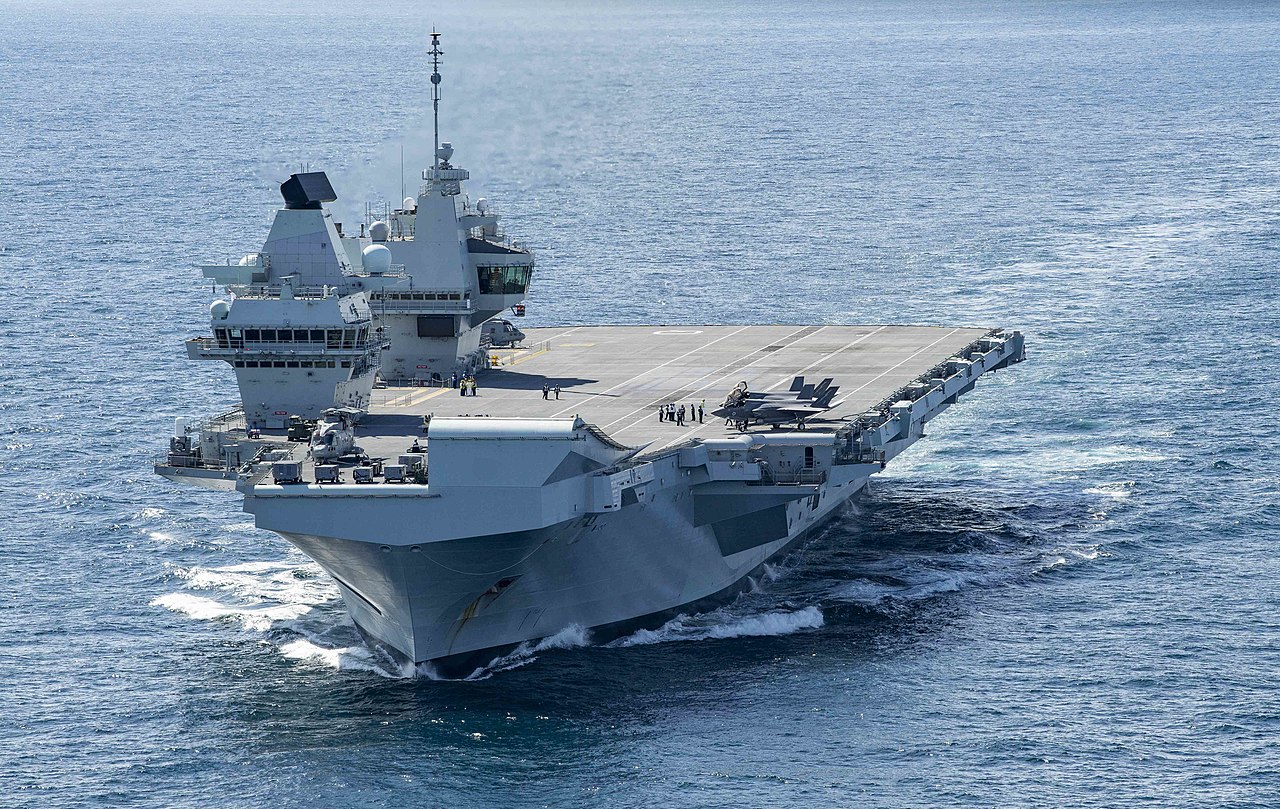
Royal Navy aircraft carrier HMS Queen Elizabeth (R08) underway in the Atlantic on 17 October 2019, participating in exercise “WESTLANT 19”.
Photo by Mass Communication Specialist 3rd Class Nathan T. Beard, US Navy, via Wikimedia Commons.
If you look at historical data, then it shows that for decades, flying fast jets was an exceptionally dangerous occupation. In 1956 the RAF lost six Hawker Hunter aircraft in the space of just 45 minutes. These were just six of no less than 380 British military aircraft and helicopters lost in 1956, which averages out at more than one aircraft lost every day of the year – and this was not an unusual year.
Fast jet flying is and always has been an extremely dangerous business, which requires the highest levels of safety, standards and training to carry out. Over the intervening decades there has been a general decline in losses due to changes in equipment, reliability of machinery and different ways of operating, particularly with new technology, but there is still an element of risk. In particular the Martin Baker ejection seat is worth mentioning – this incident reminds us of the many lives this British company is responsible for saving over many decades.
Carrier aviation in particular remains an extremely dangerous occupation, even if crash rates have dropped. It is important to understand that the combination of fast jets, large warships and complex operating conditions can, and do, sometimes go wrong. We must not assume that aircraft will not crash anymore.
The Wikipedia page covering military aviation accidents for the period 2010-2019 is a good read to understand how risky military aviation is, and how many aircraft have been lost globally during this period.
That said, the current crop of modern British fast jets like the F35 and Typhoon have a phenomenal safety record, being operated in hugely demanding conditions around the globe for many years, and with only a handful lost. It is very telling that the loss of an aircraft is something that has gone from the utterly routine and barely newsworthy, to something that can dominate the media cycle for several days and generate huge national media coverage.
The theme on social media has been peculiar — there have been many posters talking about how embarrassing it is for the UK, or that its somehow a national disgrace that the aircraft crashed, particularly with the US embarked as well. This is utter nonsense – there is no embarrassment in a pilot taking a decision to eject in order to save his life. That is absolutely the right thing to do, and anyone who thinks otherwise has clearly never been faced with the decision on whether to eject or not.
There has been some coverage suggesting that the F35 programme is troubled in some way and that this is a setback for it. Again, this is nonsense – the aircraft first flew 15 years ago, and well over 700 have now been produced flying over 400,000 flying hours. In this time, a total of 5 aircraft (3 American, 1 Japanese and 1 British) have been lost – this is an under 1% loss rate, or one aircraft lost for every 80,000 hours in the sky.
By way of contrast, the Sea Vixen, a British jet used for carrier operations was in service from 1959-1971. Of the 145 aircraft built and operated, no less than 55 were lost in accidents in this period – a loss rate of around 38% of the whole force in just 12 years.