
The Great War
Published 9 Dec 2022The Spanish-American War (fought in Cuba and the Philippines) kickstarted US global ambitions and expanded their influence far beyond the borders of the United States. At the same time the war marked the endpoint of the decline of Spain as a global power.
(more…)
December 10, 2022
United States Empire – The Spanish-American War
Comments Off on United States Empire – The Spanish-American War
December 9, 2022
Canada’s “historic” shift toward the Indo-Pacific is … more marketing than strategy
In The Line, retired Canadian Lieutenant General Mike Day distills down all the airy phrases to see just what the Canadian government is actually going to do in the Indo-Pacific as opposed to merely talking about it:
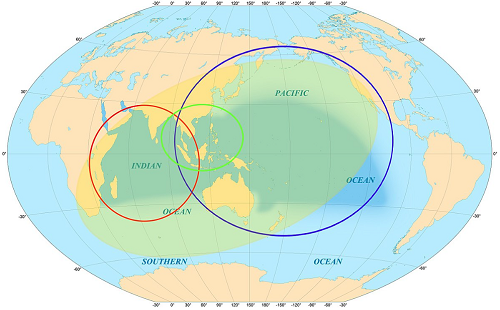
“Red circle/oval roughly depicts the Indian Ocean region. Blue circle/oval covers the Pacific region. Green oval covers ASEAN. Yellow overlay covers the Indo Pacific.”
Map annotation by Eric Gaba via Wikimedia Commons.
A formal public-policy statement from the Government of Canada is a rare thing. It is even rarer when it is not just a speech but a published written document. The rarest of these is undoubtedly when such a document focuses on foreign policy. When Foreign Affairs Minister Mélanie Joly recently pitched her “once-in-a-generation shift” toward the Indo-Pacific, much was made of why Canada was doing it and what it would achieve. No fewer than four cabinet ministers took part in the announcement. Canada will, they announced, step up naval patrols of the region, continue to expand trade with China while also tightening our protections of intellectual property and ownership rules for strategic industries, and use “Team Canada” trade missions to boost commercial links with other growing regional economic powers, including India. We seek also to expand our intelligence and cybersecurity links with allies and partners in the region.
Now that the dust on the rhetoric has settled, closer examination reveals that this might simply be an exercise of branding separate activities into a marketing-friendly bundle, as opposed to a coherent plan focused on achieving specific outcomes.
In examining the document two approaches are equally useful in assessing value: whether the content has some substance and whether the policy framework is sufficiently robust to hang various activities and plans on its body.
Three hints are provided as to why the new plan might not be the cornerstone of Canada’s foreign policy that it portends to be. Firstly, operating in the “National Interest”, a phrase used six separate times over the 26 pages, is given neither form nor function and lacks any definition. It is reminiscent of the Cheshire Cat talking to Alice asking her “where do you want to get to”. When Alice replies that “I don’t much care …” the Cheshire Cat wisely suggests that “Then it doesn’t matter which way you go.” With no definition of national interests pretty much anything can be hand waved as to being necessary and required, or not, for its achievement.
This leads in turn to the second hint that the plan might be more posturing than substance. Lacking the single aimpoint of operating in the national interest, the “objectives” supposedly fill that gap by providing a set of specific achievements which in combination would be a sufficiently clear aimpoint. But normally objectives can, and should, be thought of as something specific and measurable, allowing plans to be developed to achieve them. “Save 100 dollars this month” or perhaps, in more relevant terms, “Increase our trade in the Indo-Pacific region by 100 per cent over the five years of this policy enactment.” Plans can then be developed to achieve those objectives. But reviewing those objectives reveals that they are themselves actions, not end-states. It appears that the policy is based on “doing, not achieving”. I am reminded of my sons many years ago. When asked if their rooms were clean, they would reply, “I’m cleaning it.” The process was enduring but we most certainly disagreed on the value of the activity as opposed to achieving a measurable result. Under this construct the government can claim that as long as Canada is doing stuff the policy should be considered a success.
Comments Off on Canada’s “historic” shift toward the Indo-Pacific is … more marketing than strategy
December 7, 2022
Pearl Harbor: Before and After December 7th
Geographics
Published 20 Sep 2022
(more…)
Comments Off on Pearl Harbor: Before and After December 7th
December 3, 2022
This Is What A British Sailor Ate In Nelson’s Royal Navy!
History Hit
Published 23 Oct 2021‘This Is What A British Sailor Ate In Nelson’s Royal Navy!’
200 years ago, Britain’s Royal Navy was the most technologically advanced and supremely efficient force in the history of naval warfare.
But what was it like to live and work on board these ships? What did the men eat? How did the ships sail? What were the weapons they used?
In our latest documentary on History Hit TV, to commemorate the Battle of Trafalgar, Dan Snow explores what life would have been like for those whose served in the Nelson’s Navy.
(more…)
Comments Off on This Is What A British Sailor Ate In Nelson’s Royal Navy!
November 28, 2022
Near Peer: China (Understanding the Chinese Military)
Army University Press
Published 29 Jul 2022This film examines the Chinese military. Subject matter experts discuss Chinese history, current affairs, and military doctrine. Topics range from Mao, to the PLA, to current advances in military technologies. “Near Peer: China” is the first film in a four-part series exploring America’s global competitors.
(more…)
Comments Off on Near Peer: China (Understanding the Chinese Military)
November 26, 2022
Why so Deadly? – Battle of Okinawa 1945
Real Time History
Published 25 Nov 2022The American invasion of Okinawa was the last big island operation on the Pacific Front. It took the US Marines and Army troops several months to defeat the last Japanese resistance on the island in one of the costliest American victories of the 2nd World War — but in the end not even Japanese Kamikaze attacks and using the civilian population could avert the outcome.
(more…)
Comments Off on Why so Deadly? – Battle of Okinawa 1945
November 25, 2022
Canada’s all-purpose VTOL transport that could have changed everything; the Canadair CL-84 Dynavert
Polyus Studios
Published 14 Jul 2018The program that developed the CL-84 lasted for almost 20 years and produced one of the most successful VTOL aircraft ever, as far as performance. Canadair produced four Dynavert’s over those 20 years and two of them crashed. In fact one crashed twice. The story of the great CL-84 is one of perseverance and missed potential.
(more…)
Comments Off on Canada’s all-purpose VTOL transport that could have changed everything; the Canadair CL-84 Dynavert
November 20, 2022
A Conspiracy to kill America’s President? – WW2 – 221 – November 19, 1943
World War Two
Published 19 Nov 2022A torpedo attack against the President; a Marine invasion in the central Pacific that turns very bloody in a hurry; German counterattacks in the Soviet Union; a bombing raid in Italy against a secret weapons site — all of that this week.
(more…)
Comments Off on A Conspiracy to kill America’s President? – WW2 – 221 – November 19, 1943
November 11, 2022
In memoriam
A simple recognition of some of our family members who served in the First and Second World Wars:
The Great War
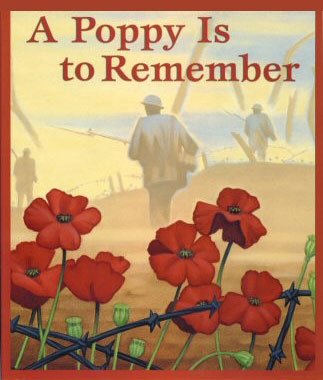 Private William Penman, Scots Guards, died 16 May, 1915 at Le Touret, age 25
(Elizabeth’s great uncle)- Private Archibald Turner Mulholland, Argyll & Sutherland Highlanders, mortally wounded 25 September, 1915 at Loos, age 27
(Elizabeth’s great uncle) - Private David Buller, Highland Light Infantry, died 21 October, 1915 at Loos, age 35
(Elizabeth’s great grandfather) - Private Harold Edgar Brand, East Yorkshire Regiment. died 4 June, 1917 at Tournai.
(My first cousin, three times removed) - Private Walter Porteous, Durham Light Infantry, died 4 October, 1917 at Passchendaele, age 18
(my great uncle) - Corporal John Mulholland, Argyll & Sutherland Highlanders, wounded 2 September, 1914 (shortly before the First Battle of the Aisne), wounded again 29 June, 1918, lived through the war.
(Elizabeth’s great uncle)
The Second World War
- Flying Officer Richard Porteous, Royal Air Force, survived the defeat in Malaya, was evacuated to India and lived through the war
(my great uncle) - Able Seaman John Penman, Royal Navy, served in the Defensively Equipped Merchant fleet on the Atlantic convoys, the Murmansk Run (he may have been on a ship in convoy PQ-17, as we know he spent a winter in Russia) and other convoy routes, was involved in firefighting and rescue efforts during the Bombay Docks explosion in 1944, lived through the war
(Elizabeth’s father) - Private Archie Black (commissioned after the war and retired as a Major), Gordon Highlanders, captured during the fall of Singapore (aged 15) and survived a Japanese POW camp (he had begun to write an autobiography shortly before he died)
(Elizabeth’s uncle) - Elizabeth Buller, “Lumberjill” in the Women’s Timber Corps, an offshoot of the Women’s Land Army in Scotland through the war.
(Elizabeth’s mother) - Trooper Leslie Taplan Russon, 3rd Royal Tank Regiment, died at Tobruk, 19 December, 1942 (aged 23).
Leslie was my father’s first cousin, once removed (and therefore my first cousin, twice removed).
My maternal grandfather, Matthew Kendrew Thornton, was in a reserved occupation during the war as a plater working at Smith’s Docks in Middlesbrough. The original design for the famous Flower-class corvettes came from Smith’s Docks and 16 (including four intended for the French Marine National) of the 196 built in the UK during the war (more were built in Canada).
For the curious, the Commonwealth War Graves Commission the Royal British Legion, and the Library and Archives Canada WW1 and WW2 records site provide search engines you can use to look up your family name. The RBL’s Every One Remembered site shows you everyone who died in the Great War in British or Empire service (Canadians, Australians, New Zealanders, South Africans and other Imperial countries). The CWGC site also includes those who died in the Second World War. Library and Archives Canada allows searches of the Canadian Expeditionary Force and the Royal Newfoundland Regiment for all who served during WW1, and including those who volunteered for the CEF but were not accepted.
In Flanders fields the poppies blow
Between the crosses row on row,
That mark our place; and in the sky
The larks, still bravely singing, fly
Scarce heard amid the guns below.We are the Dead. Short days ago
We lived, felt dawn, saw sunset glow,
Loved and were loved, and now we lie
In Flanders fields.Take up our quarrel with the foe:
To you from failing hands we throw
The torch; be yours to hold it high.
If ye break faith with us who die
We shall not sleep, though poppies grow
In Flanders fields.Lieutenant Colonel John McCrae, MD Canadian Army Medical Corps (1872-1918)
Comments Off on In memoriam
November 8, 2022
Look at Life — Underwater Menace (1969)
PauliosVids
Published 20 Nov 2018Dealing with the hazardous legacy of World War II.
Comments Off on Look at Life — Underwater Menace (1969)
November 4, 2022
“Dreadnought” – The King of the High Seas! – Sabaton History 114 [Official]
Sabaton History
Published 2 Nov 2022When the Dreadnought made its appearance in the early 20th century, it was the mightiest ship the world had ever seen, making all other gunships obsolete, including the rest of its own navy. It also sparked a naval arms race around the world, as many nations built such behemoths. But what were they actually like?
(more…)
Comments Off on “Dreadnought” – The King of the High Seas! – Sabaton History 114 [Official]
November 1, 2022
Ukraine unleashes the modern descendent of the “fireship” against Sevastopol
CDR Salamander on the Ukrainian attack on Russian shipping in Sevastopol harbour over the weekend:
The big navalist news over the weekend was unquestionably what appears to be a successful attack on the Russian Navy at Sevastopol by remotely piloted surface craft by the Ukrainians.
Some reports call them “drones” or other such descriptors, but really they appear to be an upscaled militarized remotely piloted surface vessel on a one way trip. There is a lot of expected hyperbole about the attack, and that is what I wanted to address today. I am concerned that the overhype by the ignorant, click hunting, or agenda driven people in the public space will cause us to miss the most important lesson here.
This attack was not historically significant in a larger sense, no more than the attack on the Moskva was. This is not a glimpse into the future of naval warfare. This was simply a continuation of sound naval tactics with a pedigree directly tracible thousands of years in to the past. Not to understand this is to dangerously not understand what happened.
First of all, let’s take a moment to state the obvious: the Russians should have been ready. They had about as clear of a warning as possible in September.
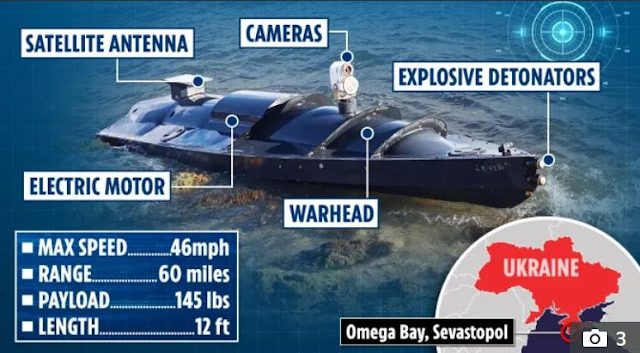
A MYSTERIOUS vessel widely believed to be a Ukrainian suicide drone has washed up near to a Russian naval base.
The vessel was found in Omega Bay, by the port of Sevastopol, which is home to Vladimir Putin’s Black Sea fleet.
We can safely assume — as the videos below seem to demonstrate — that the ones used in the attack are of the same design.
We will loop back to this point later, but just behold the simplicity of it via the article from The Sun linked above;
This is all COTS technology riding on either a canoe or ocean going kayak. If you have someone with an understanding of explosives and communications (the only part requiring military expertise +/-) and then any garden variety electrician, small engine pro, and fiberglass guy … you can run a production line of these on a shoestring budget at scale.
[…]
This is another demonstration that the military culture of Russia is broken. The human element in the Sevastopol was manifested in the complete lack of preparation for the attack in spite of the warnings so clearly provided in September.
As old as “fire ships” are to naval warfare are the defenses against them. They are as simple as the weapons you need to defend against them. Barriers at the water level and crew served weapons — preferable optically sighted — as a backup.
Part of the video above you can see both surface ship and helo gunfire taking out the threat from one boat, but other boats were able to approach surface ships underway and penetrate deep in to port.
Why?
What is one of the things we have repeatedly discussed here for the last 18-years? When war comes you never have enough of what? That’s right, anti-aircraft defenses and medium caliber guns including crew served weapons.
We build our ships around the most high-technology threats and equally exquisite defenses against them, but completely overlook the low-tech weapons that are just as deadly. We ignore mine warfare, and we also ignore threats as simple as a converted kayak. It isn’t sexy and the contracts awarded are small … but the threats are real.
Comments Off on Ukraine unleashes the modern descendent of the “fireship” against Sevastopol
September 25, 2022
200 Medals Won in an Hour – The Raid on Zeebrugge, 1918
Historigraph
Published 11 May 2022
(more…)
Comments Off on 200 Medals Won in an Hour – The Raid on Zeebrugge, 1918
September 23, 2022
A Short History of Ships Cats – Floating Felines, Maritime Moggies and Kleptomaniac Kittens
Drachinifel
Published 26 Feb 2020A quick look at the origins of a vital part of the ship’s maintenance crew, and some notable examples.
(more…)
Comments Off on A Short History of Ships Cats – Floating Felines, Maritime Moggies and Kleptomaniac Kittens
September 22, 2022
RAF Coastal Command vs U-Boats
The History Guy: History Deserves to Be Remembered
Published 5 Oct 2020The contest between aircraft and U-Boats during the Second World War was one of competing technological innovations, culminating with a decisive struggle in the summer of 1943. The History Guy tells the forgotten story of the development of anti-submarine warfare and the contest between the aircraft of RAF Coastal Command and U-Boats of the Kriegsmarine in the Bay of Biscay.
(more…)
Comments Off on RAF Coastal Command vs U-Boats


